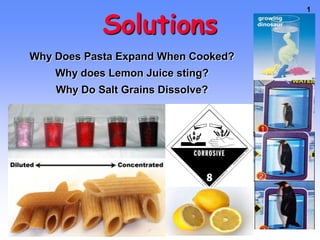
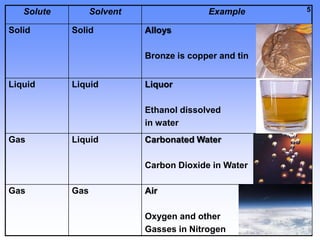
SolutionsWhy Does Pasta Expand When Cooked?Why does Lemon Juice sting?Why Do Salt Grains Dissolve?
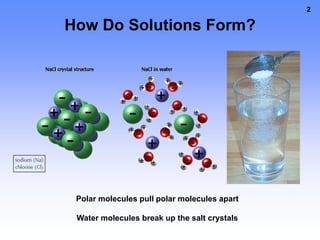
How Do Solutions Form?Polar molecules pull polar molecules apartWater molecules break up the salt crystals
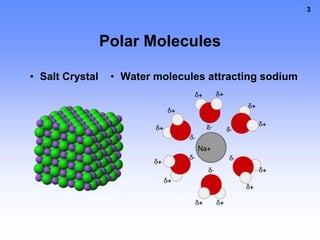
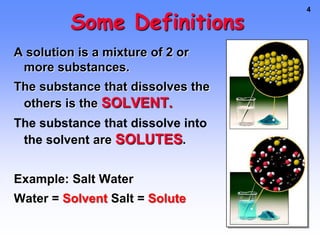
Polar MoleculesSalt CrystalWater molecules attracting sodiumSome DefinitionsA solution is a mixture of 2 or more substances. The substance that dissolves the others is the SOLVENT.The substance that dissolve into the solvent are SOLUTES.Example: Salt WaterWater = Solvent Salt = Solute
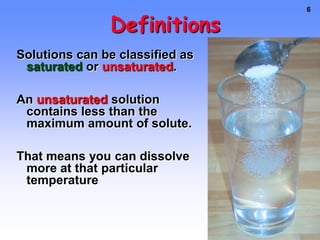
DefinitionsSolutions can be classified as saturated or unsaturated.An unsaturated solution contains less than the maximum amount of solute.That means you can dissolve more at that particular temperature
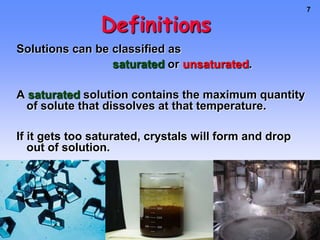
DefinitionsSolutions can be classified as saturatedor unsaturated.A saturated solution contains the maximum quantity of solute that dissolves at that temperature.If it gets too saturated, crystals will form and drop out of solution.
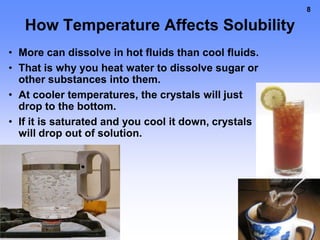
How Temperature Affects SolubilityMore can dissolve in hot fluids than cool fluids.That is why you heat water to dissolve sugar or other substances into them.At cooler temperatures, the crystals will just drop to the bottom.If it is saturated and you cool it down, crystals will drop out of solution.
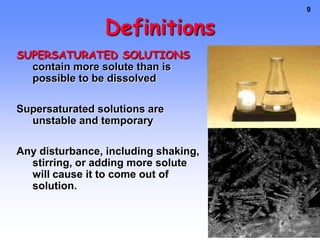
DefinitionsSUPERSATURATED SOLUTIONS contain more solute than is possible to be dissolvedSupersaturated solutions are unstableand temporaryAny disturbance, including shaking, stirring, or adding more solute will cause it to come out of solution.
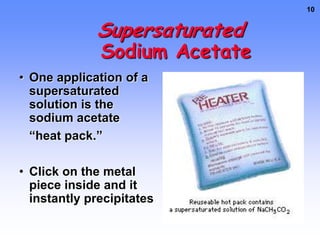
Supersaturated		Sodium AcetateOne application of a supersaturated solution is the sodium acetate 	“heat pack.”Click on the metal piece inside and it instantly precipitates
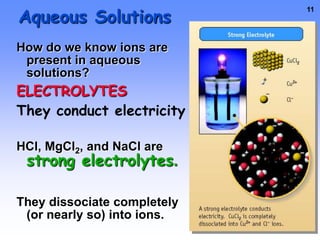
Aqueous SolutionsHow do we know ions are present in aqueous solutions?ELECTROLYTESThey conduct electricityHCl, MgCl2, and NaCl are strong electrolytes. They dissociate completely (or nearly so) into ions.
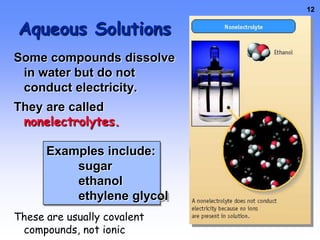
Aqueous SolutionsSome compounds dissolve in water but do not conduct electricity.  They are called nonelectrolytes.These are usually covalent compounds, not ionicExamples include:	sugar	ethanol	ethylene glycol
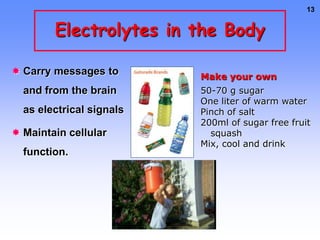
Electrolytes in the BodyCarry messages to and from the brain as electrical signals
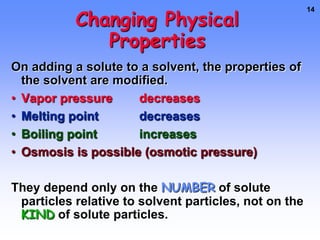
Maintain cellular function.Changing Physical PropertiesOn adding a solute to a solvent, the properties of the solvent are modified.Vapor pressure 	decreasesMelting point 		decreasesBoiling point 		increasesOsmosis is possible (osmotic pressure)They depend only on the NUMBER of solute particles relative to solvent particles, not on the KIND of solute particles.
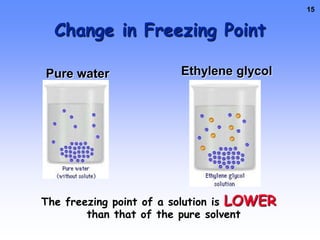
Change in Freezing Point Ethylene glycolPure waterThe freezing point of a solution is LOWERthan that of the pure solvent
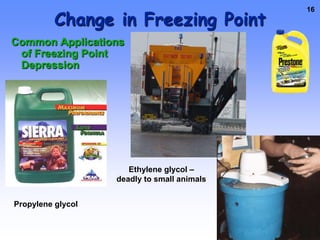
Change in Freezing Point Common Applications of Freezing Point DepressionEthylene glycol – deadly to small animalsPropylene glycol
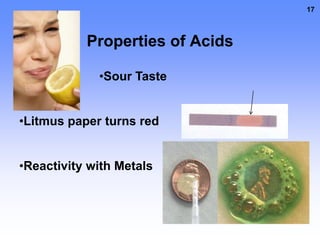
Properties of AcidsSour Taste
Litmus paper turns red
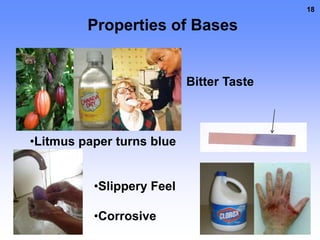
Reactivity with MetalsProperties of Bases       Bitter Taste
Litmus paper turns blue
Slippery Feel
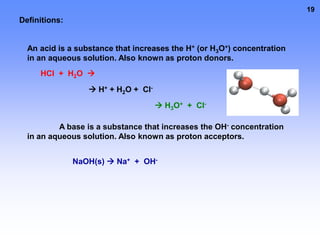
CorrosiveDefinitions:An acid is a substance that increases the H+ (or H3O+) concentration in an aqueous solution. Also known as proton donors.HCl  +  H2O   H++ H2O+  Cl-H3O+  +  Cl-	A base is a substance that increases the OH- concentrationin an aqueous solution. Also known as proton acceptors.NaOH(s)  Na+  +  OH-
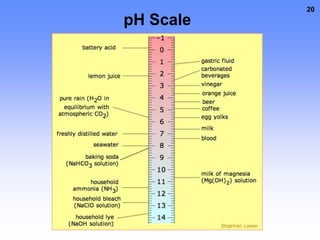
pH Scale
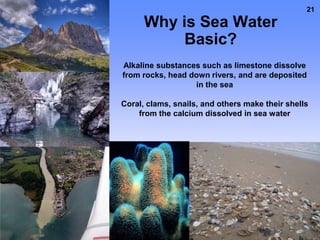
Why is Sea Water Basic?Alkaline substances such as limestone dissolve from rocks, head down rivers, and are deposited in the seaCoral, clams, snails, and others make their shells from the calcium dissolved in sea water

Unit 15 Solutions, Acids, and Bases

  • 1.
    SolutionsWhy Does PastaExpand When Cooked?Why does Lemon Juice sting?Why Do Salt Grains Dissolve?
  • 2.
    How Do SolutionsForm?Polar molecules pull polar molecules apartWater molecules break up the salt crystals
  • 3.
    Polar MoleculesSalt CrystalWatermolecules attracting sodiumSome DefinitionsA solution is a mixture of 2 or more substances. The substance that dissolves the others is the SOLVENT.The substance that dissolve into the solvent are SOLUTES.Example: Salt WaterWater = Solvent Salt = Solute
  • 5.
    DefinitionsSolutions can beclassified as saturated or unsaturated.An unsaturated solution contains less than the maximum amount of solute.That means you can dissolve more at that particular temperature
  • 6.
    DefinitionsSolutions can beclassified as saturatedor unsaturated.A saturated solution contains the maximum quantity of solute that dissolves at that temperature.If it gets too saturated, crystals will form and drop out of solution.
  • 7.
    How Temperature AffectsSolubilityMore can dissolve in hot fluids than cool fluids.That is why you heat water to dissolve sugar or other substances into them.At cooler temperatures, the crystals will just drop to the bottom.If it is saturated and you cool it down, crystals will drop out of solution.
  • 8.
    DefinitionsSUPERSATURATED SOLUTIONS containmore solute than is possible to be dissolvedSupersaturated solutions are unstableand temporaryAny disturbance, including shaking, stirring, or adding more solute will cause it to come out of solution.
  • 9.
    Supersaturated Sodium AcetateOne applicationof a supersaturated solution is the sodium acetate “heat pack.”Click on the metal piece inside and it instantly precipitates
  • 10.
    Aqueous SolutionsHow dowe know ions are present in aqueous solutions?ELECTROLYTESThey conduct electricityHCl, MgCl2, and NaCl are strong electrolytes. They dissociate completely (or nearly so) into ions.
  • 11.
    Aqueous SolutionsSome compoundsdissolve in water but do not conduct electricity. They are called nonelectrolytes.These are usually covalent compounds, not ionicExamples include: sugar ethanol ethylene glycol
  • 12.
    Electrolytes in theBodyCarry messages to and from the brain as electrical signals
  • 13.
    Maintain cellular function.ChangingPhysical PropertiesOn adding a solute to a solvent, the properties of the solvent are modified.Vapor pressure decreasesMelting point decreasesBoiling point increasesOsmosis is possible (osmotic pressure)They depend only on the NUMBER of solute particles relative to solvent particles, not on the KIND of solute particles.
  • 14.
    Change in FreezingPoint Ethylene glycolPure waterThe freezing point of a solution is LOWERthan that of the pure solvent
  • 15.
    Change in FreezingPoint Common Applications of Freezing Point DepressionEthylene glycol – deadly to small animalsPropylene glycol
  • 16.
  • 17.
  • 18.
  • 19.
  • 20.
  • 21.
    CorrosiveDefinitions:An acid isa substance that increases the H+ (or H3O+) concentration in an aqueous solution. Also known as proton donors.HCl + H2O  H++ H2O+ Cl-H3O+ + Cl- A base is a substance that increases the OH- concentrationin an aqueous solution. Also known as proton acceptors.NaOH(s)  Na+ + OH-
  • 22.
  • 23.
    Why is SeaWater Basic?Alkaline substances such as limestone dissolve from rocks, head down rivers, and are deposited in the seaCoral, clams, snails, and others make their shells from the calcium dissolved in sea water