SALTS
HISTORY
The word salt comes
from the Latin word
‘salarium’ meaning
salary.
SALT
In chemistry, salts are
ionic compounds that result
from the neutralization reaction
of an acid and a base.
PROPERTIES OF SALT
Color
–Transparent
–Opaque
–Metallic
–Lustrous
PROPERTIES OF SALT
Salts exist in many different colors:
Yellow (Sodium chromate)
PROPERTIES OF SALT
Orange (Potassium dichromate)
PROPERTIES OF SALT
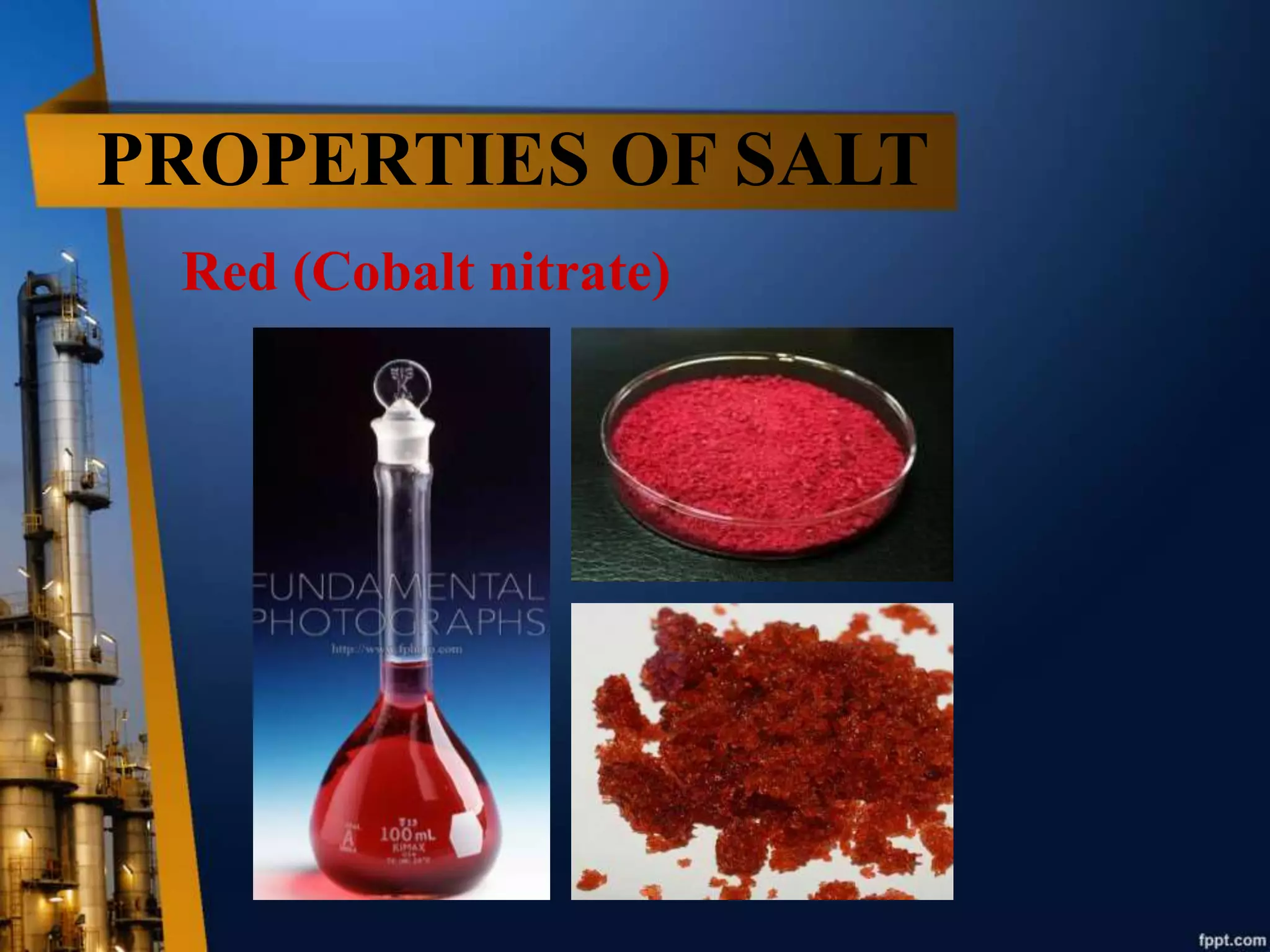
Red (Cobalt nitrate)
PROPERTIES OF SALT
Blue (Copper sulfate pentahydrate)
PROPERTIES OF SALT
Purple (Potassium permanganate)
PROPERTIES OF SALT
Green (Nickel chloride hexahydrate)
PROPERTIES OF SALT
Colorless
PROPERTIES OF SALT
Taste
Five Basic Tastes
1. Salty (sodium chloride)
2. Sweet (lead diacetate)
3. Sour (potassium bitartrate)
4. Bitter (magnesium sulfate)
5. Umami (monosodium glutamate)
PROPERTIES OF SALT
Conductivity
Liquid salts (solution of salts)
conduct electricity
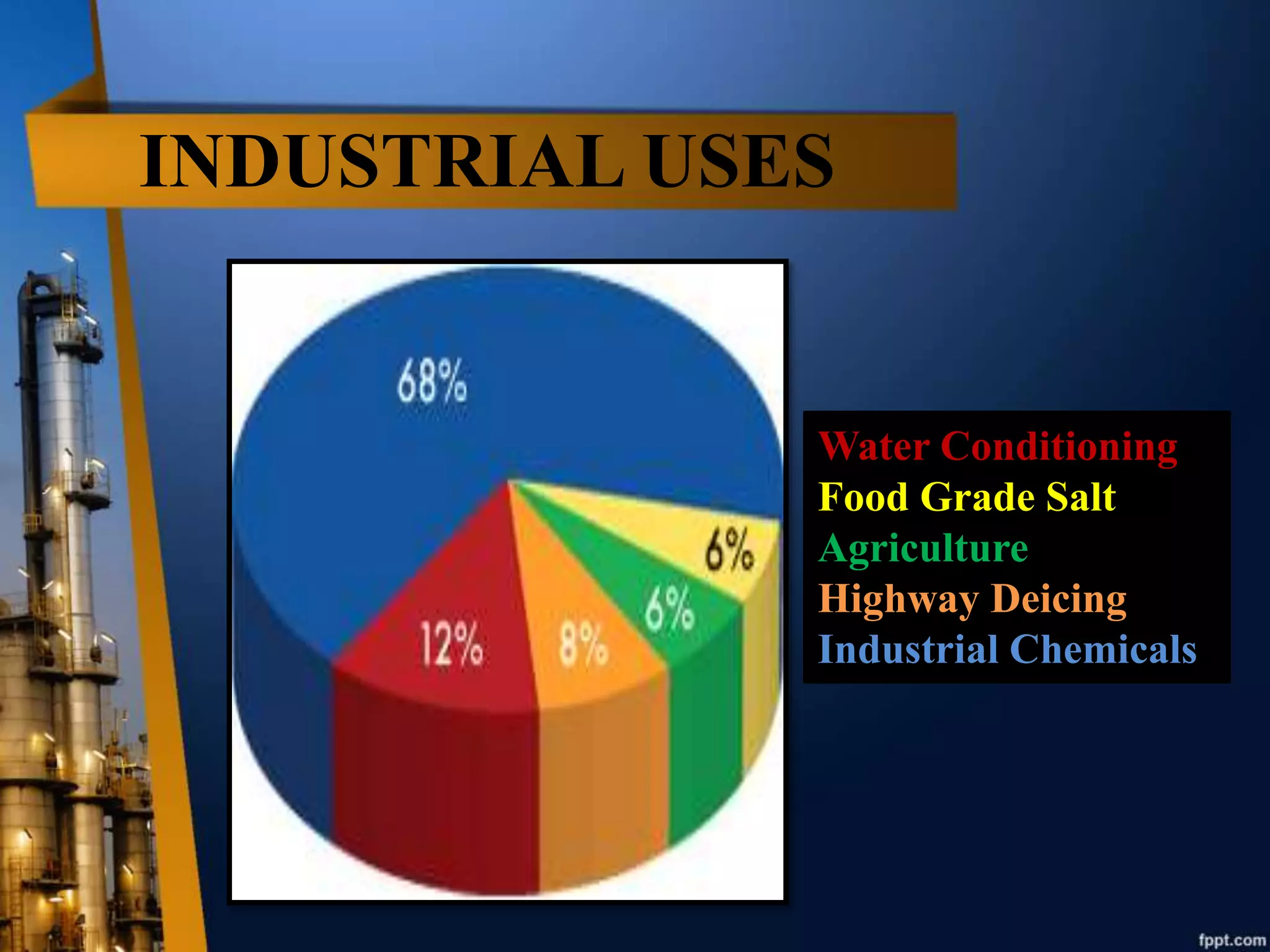
INDUSTRIAL USES
Water Conditioning
Food Grade Salt
Agriculture
Highway Deicing
Industrial Chemicals
INDUSTRIAL USES
A. Water Conditioning
Softens the water avoiding scale build-up
on water appliances.
INDUSTRIAL USES
A. Water Conditioning
Sodium chloride
Potassium chloride
INDUSTRIAL USES
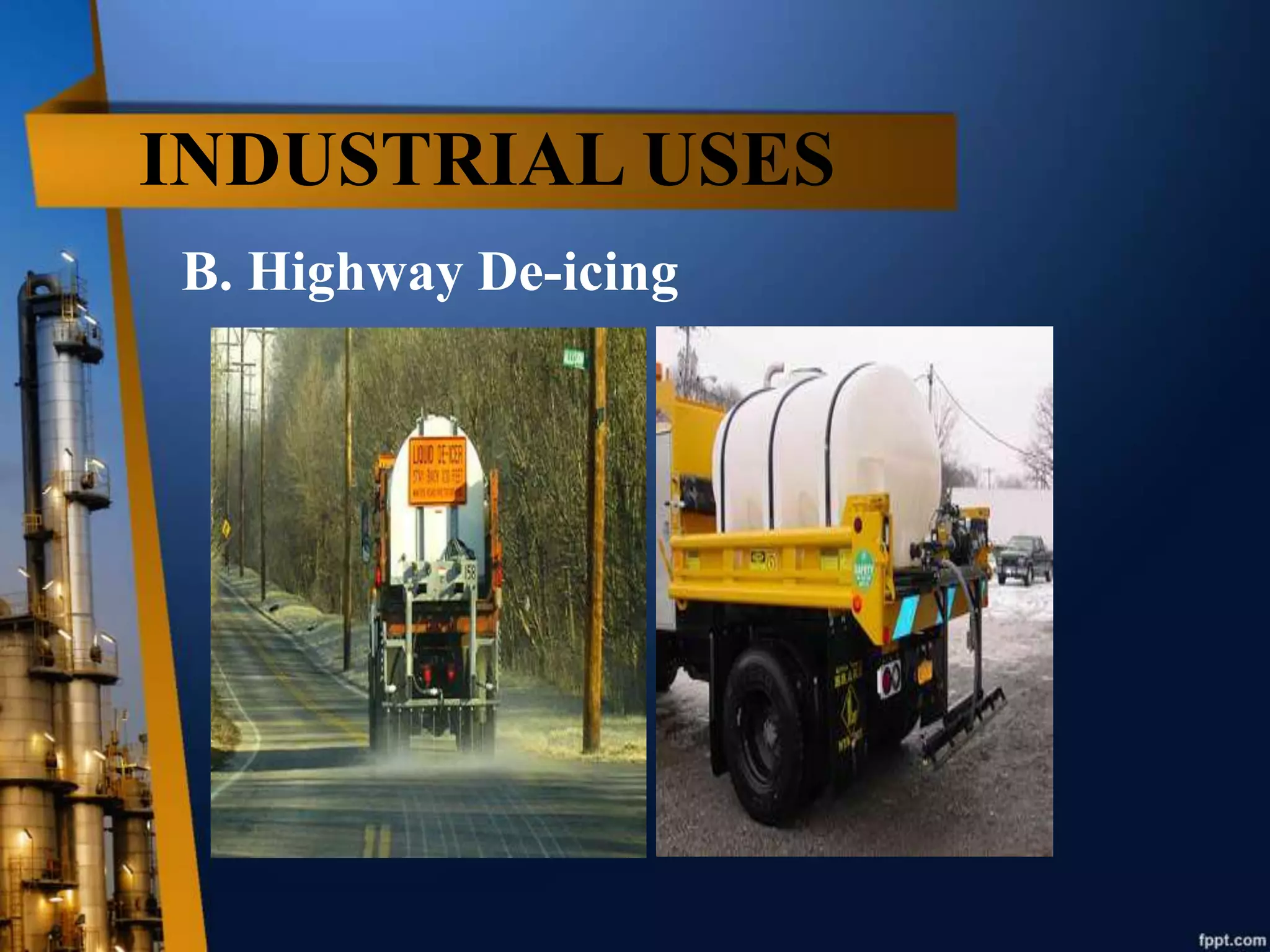
B. Highway De-icing
INDUSTRIAL USES
B. Highway De-icing
Sodium chloride
the most widely
used de-icing agent
INDUSTRIAL USES
C. Industrial Chemicals
Example:
The chlor-alkali industry uses
salt, primarily as salt in brine
from captive brine wells, to
produce chlorine and caustic
soda.
INDUSTRIAL USES
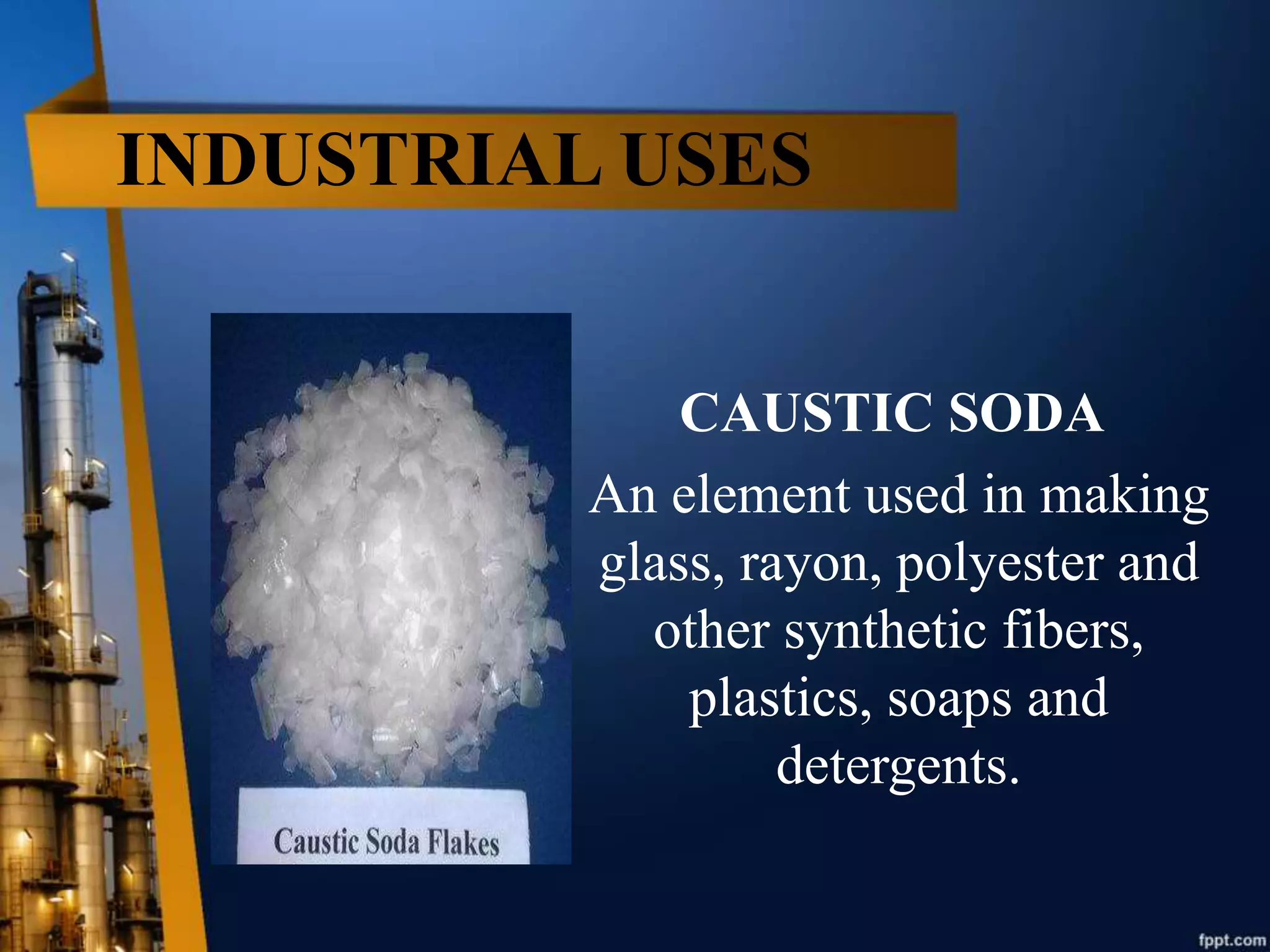
CAUSTIC SODA
An element used in making
glass, rayon, polyester and
other synthetic fibers,
plastics, soaps and
detergents.
INDUSTRIAL USES
CHLORINE
Used primarily in
producing polymers that are
used in manufacture of
plastics, synthetic fibers and
synthetic rubber; also used in
crude oil refining, for making
pesticides; in household
bleach, water treatment and
sewage treatment.
INDUSTRIAL USES
A. Metal processing
B. Remove impurities
C. Separate rubber from latex
D. Vitrifying the surface of heated clays
SALT PRODUCTION
THREE POSSIBLE WAYS
1. Deep-shaft mining
2. Solution mining
3. Solar evaporation
SALT PRODUCTION
DEEP-SHAFT
MINING
At the base of the
rock, using a machine
called an Under
Cutter, an opening is
made at the bottom of
the rock face.
SALT PRODUCTION
DEEP-SHAFT
MINING
Then using and electro-
hydraulic rotary drill,
holes are carefully made
on the rock face.
SALT PRODUCTION
DEEP-SHAFT
MINING
The face is then blasted,
by charging the holes
with explosives.
SALT PRODUCTION
DEEP-SHAFT
MINING
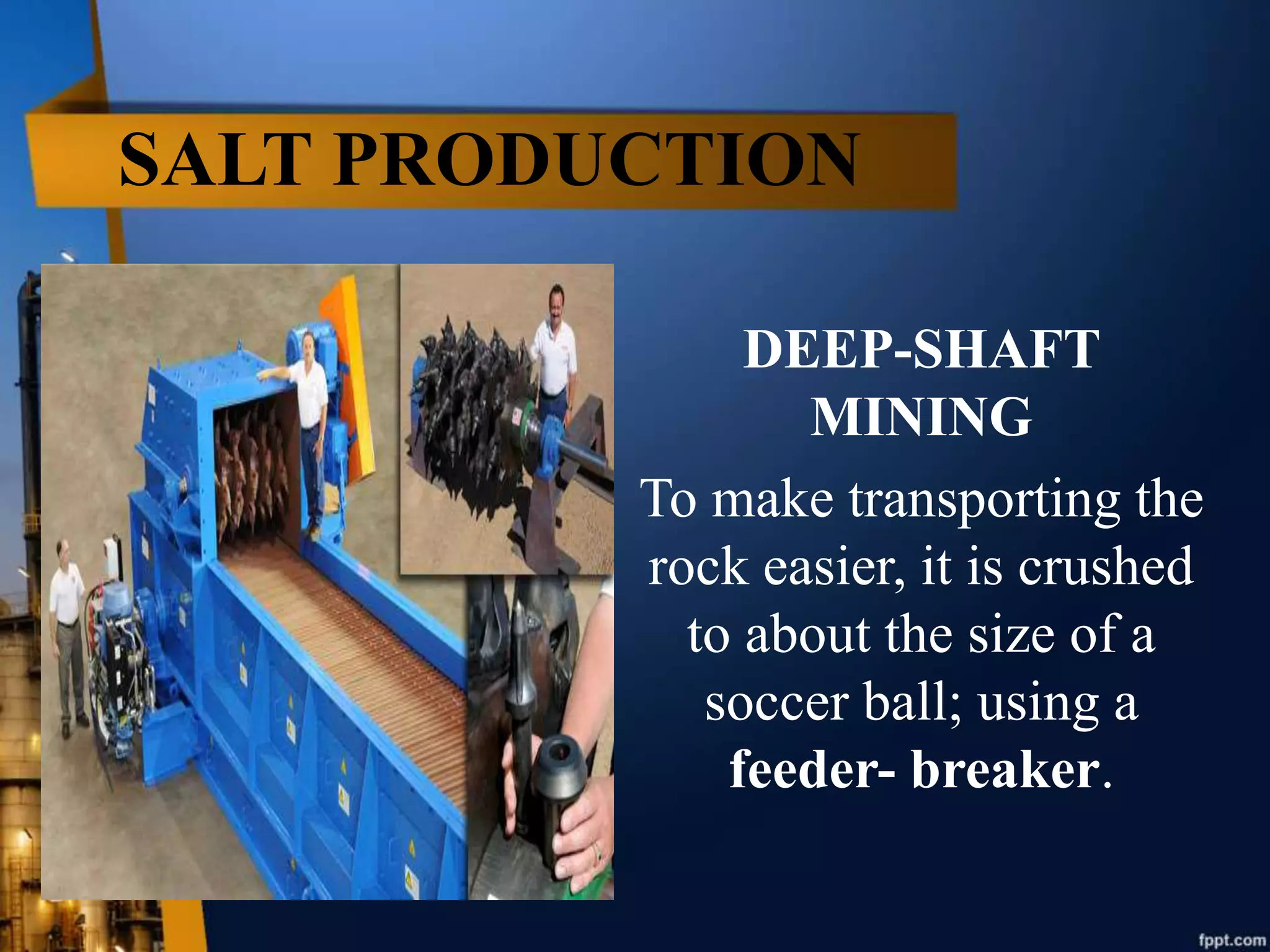
To make transporting the
rock easier, it is crushed
to about the size of a
soccer ball; using a
feeder- breaker.
SALT PRODUCTION
DEEP-SHAFT
MINING
It is then transported to
the “main crusher” by
means of a conveyor belt,
and is broken down into
smaller pieces.
SALT PRODUCTION
DEEP-SHAFT
MINING
It is also has to go
through a screen or sieve
to make sure that is an ok
size for use.
SALT PRODUCTION
DEEP-SHAFT
MINING
The salt is then lifted to
the surface.
SALT PRODUCTION
Solution Mining
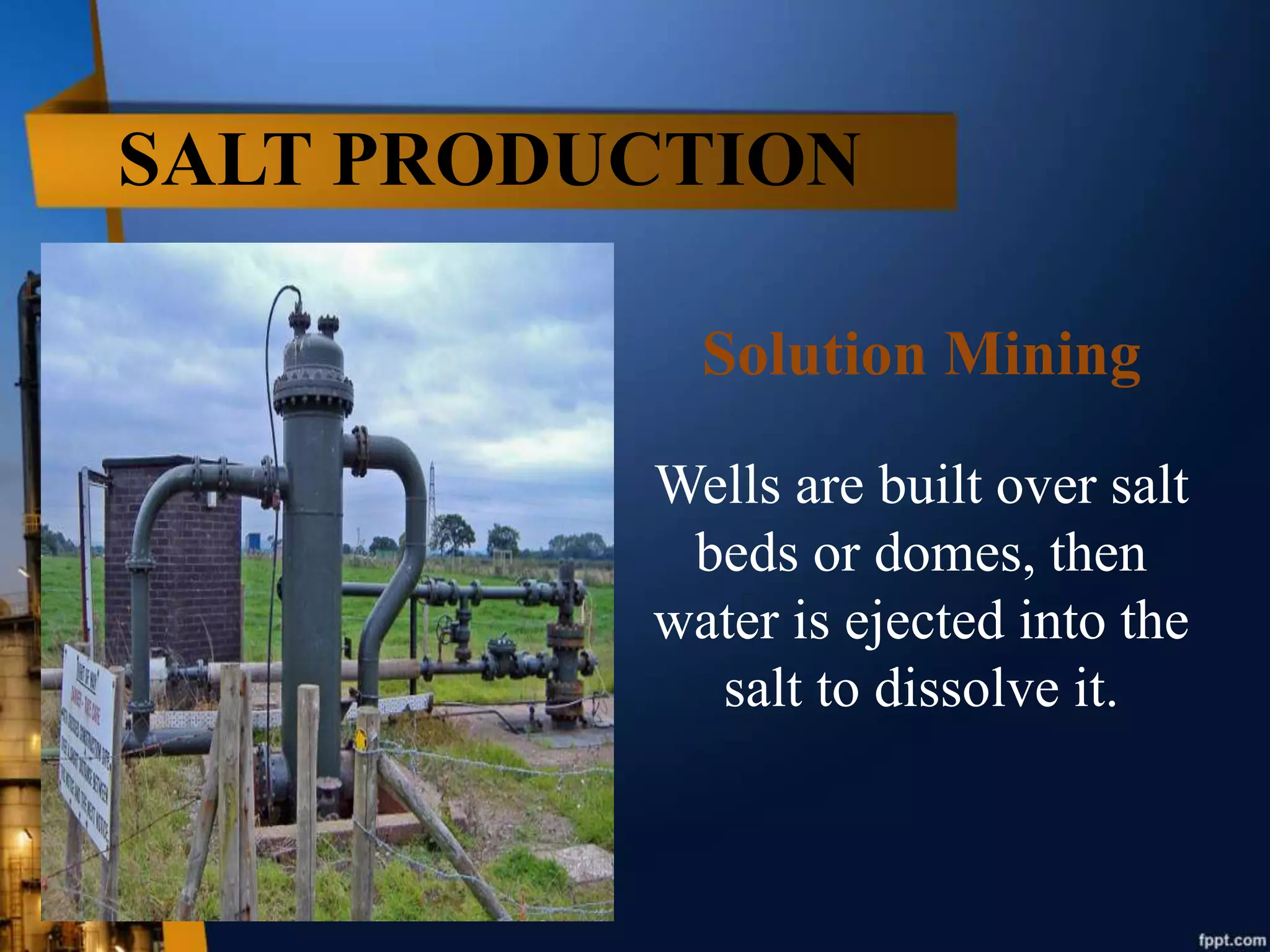
Wells are built over salt
beds or domes, then
water is ejected into the
salt to dissolve it.
SALT PRODUCTION
Solution Mining
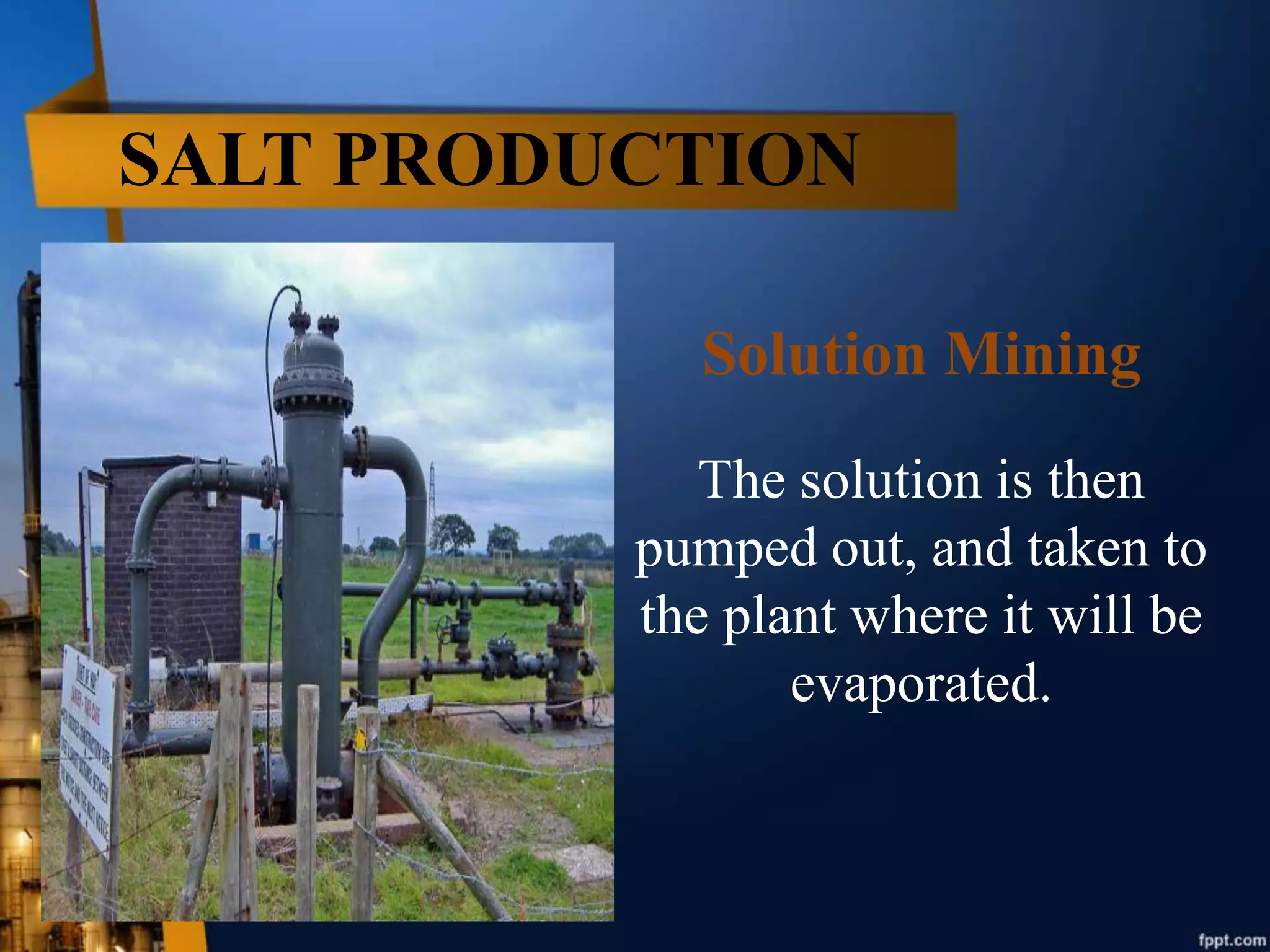
The solution is then
pumped out, and taken to
the plant where it will be
evaporated.
SALT PRODUCTION
Solution Mining
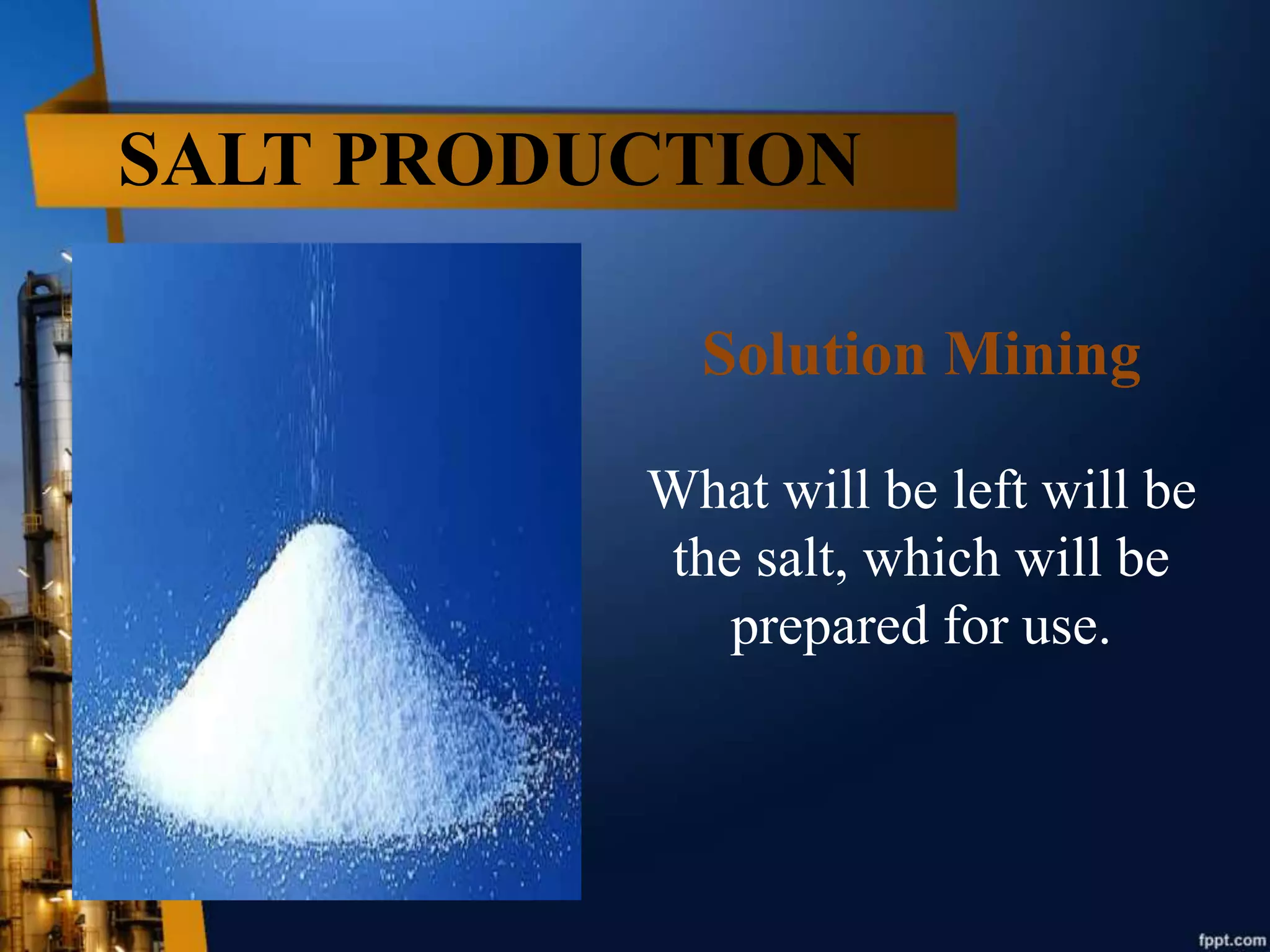
What will be left will be
the salt, which will be
prepared for use.
SALT PRODUCTION
Solar Evaporation

SALTS