This document discusses teratogens and their effects on fetal development. It defines teratogens as any substance that can alter fetal morphology or function when the fetus is exposed. The main causes of congenital anomalies are discussed, with drugs and chemicals accounting for 5%. Several factors determine the effect of teratogens on the fetus, including developmental stage at exposure and genetic susceptibility. The effects of teratogens can be immediate, at birth, or delayed. Various teratogenic agents are outlined, including maternal medical disorders, infections, ionizing radiation, chemicals, and drugs categorized by the FDA. Specific examples of each category and their risks are provided.
Presentation introduction by Prof. Aboubakr Elnashar from Benha University Hospital, Egypt.
Definition of teratogen: any factor that alters fetal development. Causes include multifactorial (70%), genetic (20%), and environmental (10%) factors.
Effects of teratogens vary by fetal development stage: malformation, functional defects, delayed effects. Factors include genetic susceptibility and timing.
Various maternal disorders (e.g., diabetes, epilepsy) that increase risks of congenital malformations in infants.
List of infectious agents (syphilis, rubella, CMV) causing fetal complications like miscarriage and diverse congenital defects.
Impact of ionizing radiation on fetal health: risks associated with dose levels, especially during early pregnancy, and specific recommendations.
Effects of chemicals (lead, mercury) and doctors' classifications of drug safety during pregnancy (Categories A to X) regarding teratogenic risk.
Negative impacts of alcohol and smoking on fetal development, leading to conditions like Fetal Alcohol Syndrome, increased abortion rates.
Vaccination considerations during pregnancy: avoid live vaccines; killed vaccines permitted in specific cases.
Acknowledgment of audience by Prof. Aboubakr Elnashar.
Definition of teratogen
Anychemical ( drug ), infection, physical
condition or deficiency that , on fetal
exposure,can alter fetal morphology or
subsequent function.
Causes of congenital anomalies
Multifactorial or unknown ( 70 % )
Genetic ( 20 % )
Environmental(10%)
Intrauterine infection ( 2% )
Maternal metabolic disorders ( 2% )
Drugs & chemicals ( 5% )
Ionizing radiation ( 1 % )Aboubakr Elnashar
4.
Factors determining theeffect of the teratogen
Fetal factors :
I Developmental stage :
1. Predifferentiation stage (0-7 days of gestation) :
Death or no effect.
Differentiation stage ( 7-57 days of gestation) :
Malformation
Post differentiation stage ( after 57 days of gestation ):
Functional defects
Growth retardation
II Genetic susceptibility :
Species differences.
Individual differences.
The route & length of administration of a teratogen.
Aboubakr Elnashar
5.
Effects of teratogens
Immediate: death & abortion
At birth : malformation
functional defects.
Delayed : carcinogenesis
mutagenesis.
Aboubakr Elnashar
6.
Teratogenic agents
Maternal medicaldisorders
1. Diabetes mellitus :
Infants of insulin-dependent diabetic mothers have up to
22 % incidence of cardiac , renal, gastrointestinal,
CNS & skeletal malformation. Most of the
malformations occur between the third & sixth week
postconception & are increased if there is
hyperglycemia during that stage of gestation.
2.Epilepsy :
3.Phenyl ketonuria.:
Infants have an increased incidence of mental
retardation, microcephaly,& low birth weight.
4.Virilizing tumors :
produce pseudohermaphroditic changes in female fetus.Aboubakr Elnashar
7.
B.Infections
Syphilis :
The incidenceof congenital infection is inversely
proportional to the duration of maternal infection &
degree of spirochetemia.
In utero infection may result in :
PTL or miscarriage
S.B.
Neonatal death in up to 50 % of affected infants
Congenital infection can manifest as :
hepatosplenomegaly,joint swelling, skin rash, anemia,
jaundice, snuffles, metaphyseal dystrophy &
periostitis.
Aboubakr Elnashar
8.
Toxoplasmosis :
Active primaryinfection during pre‰ـinfection.
Rubella virus (German measles)
The congenital rubella syndrome includes: CNS, CV,
ocular, ear defects & IUGR.
Cytomegalovirus:
The risk of severe complications is much higher for
infants of mothers who had a primary infection in
pregnancy compared to those who had recurrent
infection.
Aboubakr Elnashar
9.
5. Herpes simplexvirus type 2.:
Fetal infection during the first trimester results in
miscarriage . In few cases ,fetal anomalies occur.
6.Hyper thermia
Sustained maternal temperature > 38 C between 4 & 14
weeks gestation , rather than spiking fevers , is
teratogenic.
Aboubakr Elnashar
C. Ionizing radiation
Doseeffect :
< 5 rads & probably < 10 rads : Adverse fetal effects are
unlikely
10 - 25 rads : Some adverse fetal effects may occur.
> 25 rads : Classic fetal effects ( IUGR, structural
malformation, fetal resorption ) .Elective abortion
should be offered as an option.
The dose of diagnostic radiation to the conceptus
should be calculated according to certain tables.
Aboubakr Elnashar
13.
Risks of teratogenicity:
The mutagenic effects are very small
Risk of leukemia for children exposed to X - ray
pelvimetry increases from 1 in 3000 to 1 in 2000.
## Radioactive iodine : After the 10 th w of gestation ,
the fetal thyroid can be retarded in addition to any
adverse effects of radiation . Iodine-containing cough
preparation , antiseptic solutions or X ray adjuncts
should be avoided throughout pregnancy.
Aboubakr Elnashar
14.
Radiation Exposure inPregnancy
Cumulative dose of 5 rad considered safe
No increase in risk of pregnancy loss
CNS abnormalities
Risk during 10-17 wks gestation
10 rad – increased risk for mental retardation,
microcephaly
Should delay non-urgent radiographs > 17wks
Aboubakr Elnashar
15.
Malignancies
Very small increasein malignancies, mostly
leukemia
2 rad, malignancy risk increases from 3.6/10,000
(baseline population) to 5/10,000
Gene mutations
Very small increase in incidence of gene mutations
50-100 rad needed to double baseline mutation rate
Aboubakr Elnashar
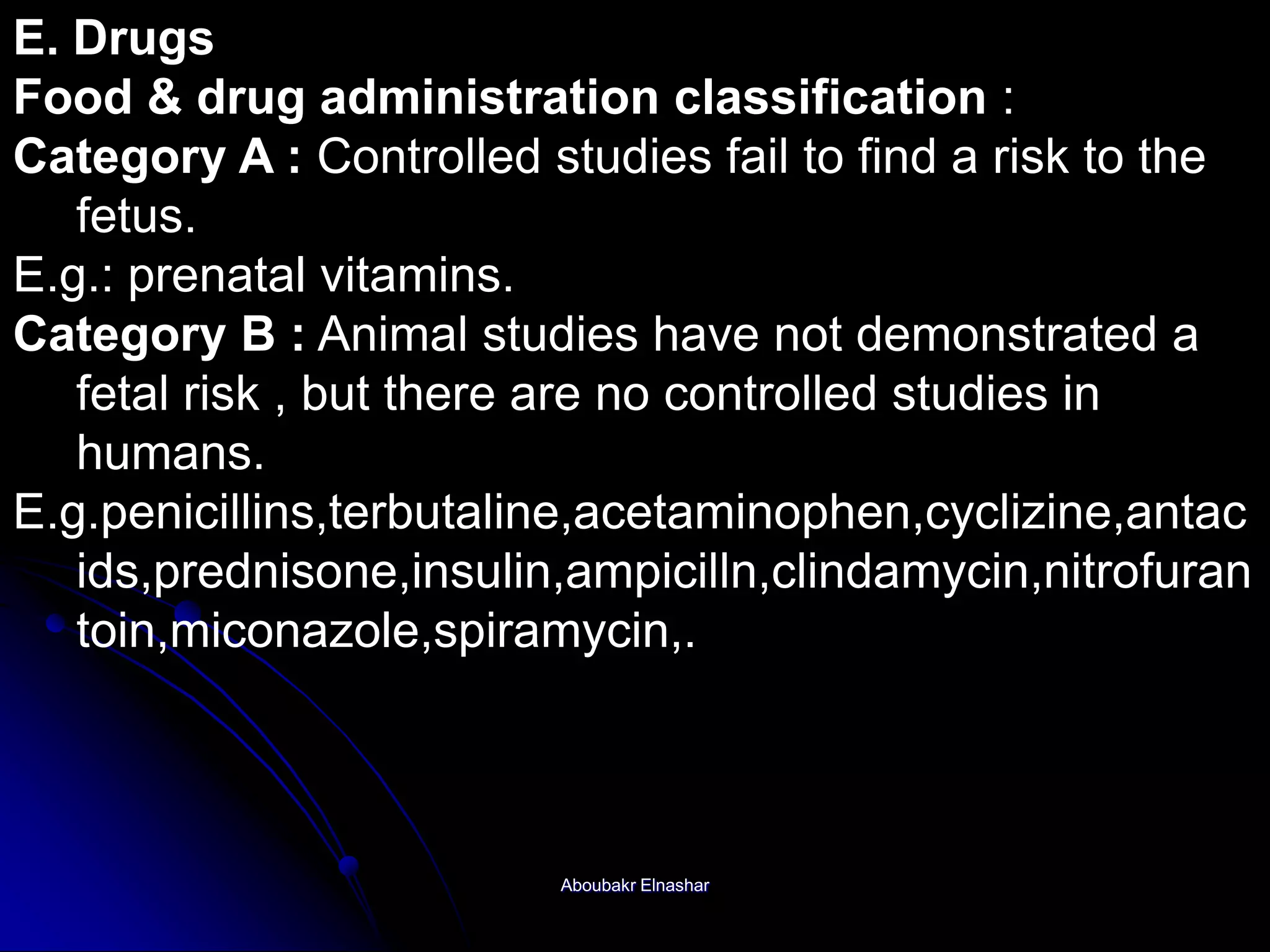
E. Drugs
Food &drug administration classification :
Category A : Controlled studies fail to find a risk to the
fetus.
E.g.: prenatal vitamins.
Category B : Animal studies have not demonstrated a
fetal risk , but there are no controlled studies in
humans.
E.g.penicillins,terbutaline,acetaminophen,cyclizine,antac
ids,prednisone,insulin,ampicilln,clindamycin,nitrofuran
toin,miconazole,spiramycin,.
Aboubakr Elnashar
18.
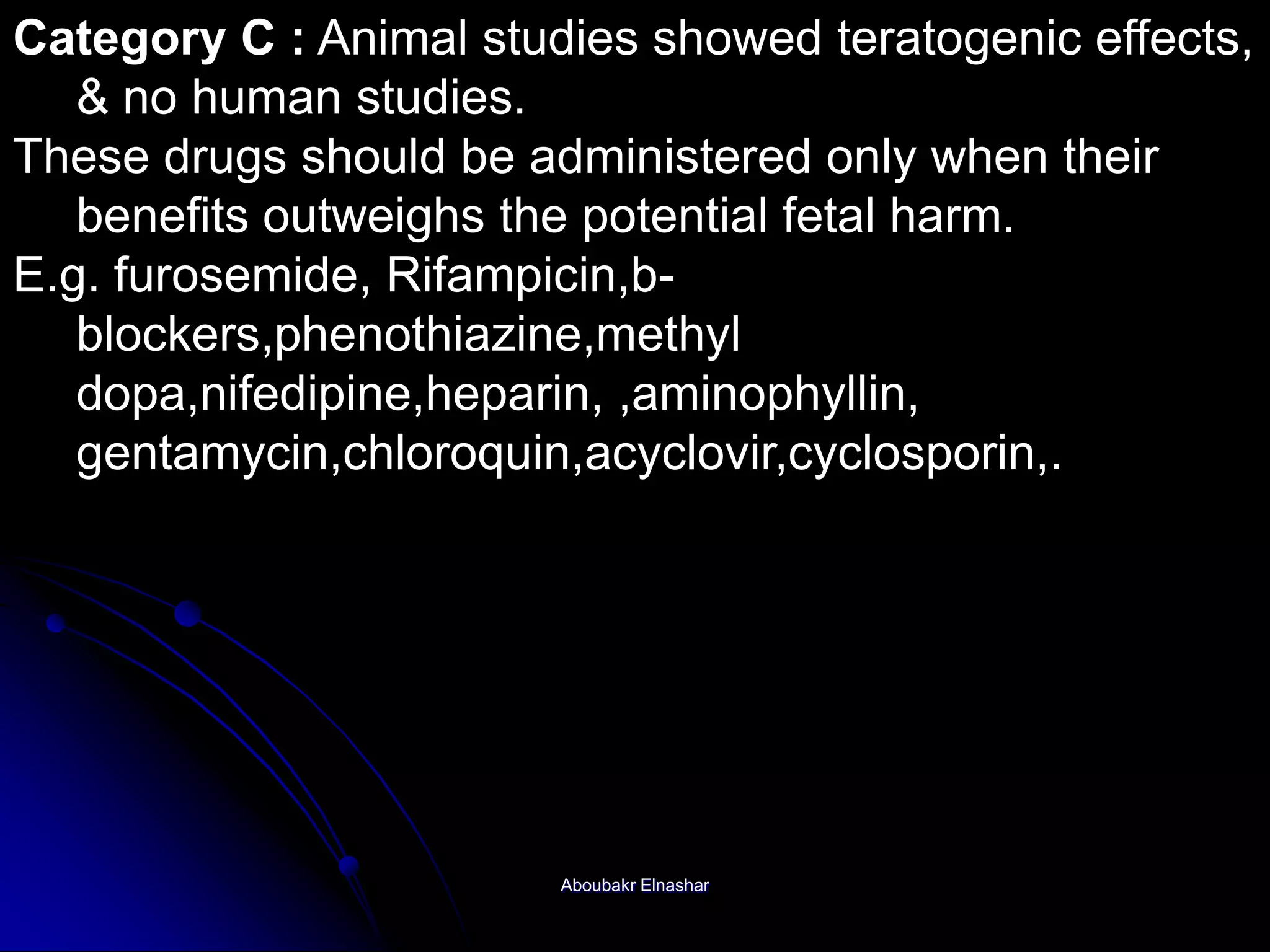
Category C :Animal studies showed teratogenic effects,
& no human studies.
These drugs should be administered only when their
benefits outweighs the potential fetal harm.
E.g. furosemide, Rifampicin,b-
blockers,phenothiazine,methyl
dopa,nifedipine,heparin, ,aminophyllin,
gentamycin,chloroquin,acyclovir,cyclosporin,.
Aboubakr Elnashar
19.
Category D :There is evidence of fetal risk in humans
but the benefits may outweigh the risk
These drugs are given only in serious disease because
no alternative.
E.g.phenytoin,valporic
acid,diazepam,imipramine,captopril,thiazides,spironol
actone,
coumarine,chlorpropamide,progestins,tetracyclin,strepto
mycin,quinine,methotrexate,
vinblastin,azathioprine,
Aboubakr Elnashar
20.
5. Category X: There is clear human risk that outweigh
the benefits.
These drugs are contraindicated.
E.g. Estrogen,androgens,aminopterin, isotretinoin,
thalidomide
Aboubakr Elnashar
21.
Effects of alcoholconsumption:
Increase rate of abortion & still birth.
Fetal alcohol syndrome : mental retardation
,IUGR,abnormal faces, occular,joint&cardiac
anomalies
Effects of cigarette smoking:
Late abortion, accidental hemmohrage, preterm labour,
PROM.
IUGR, neural tube defect.
long term effects : physical & mental retardation.
Aboubakr Elnashar
22.
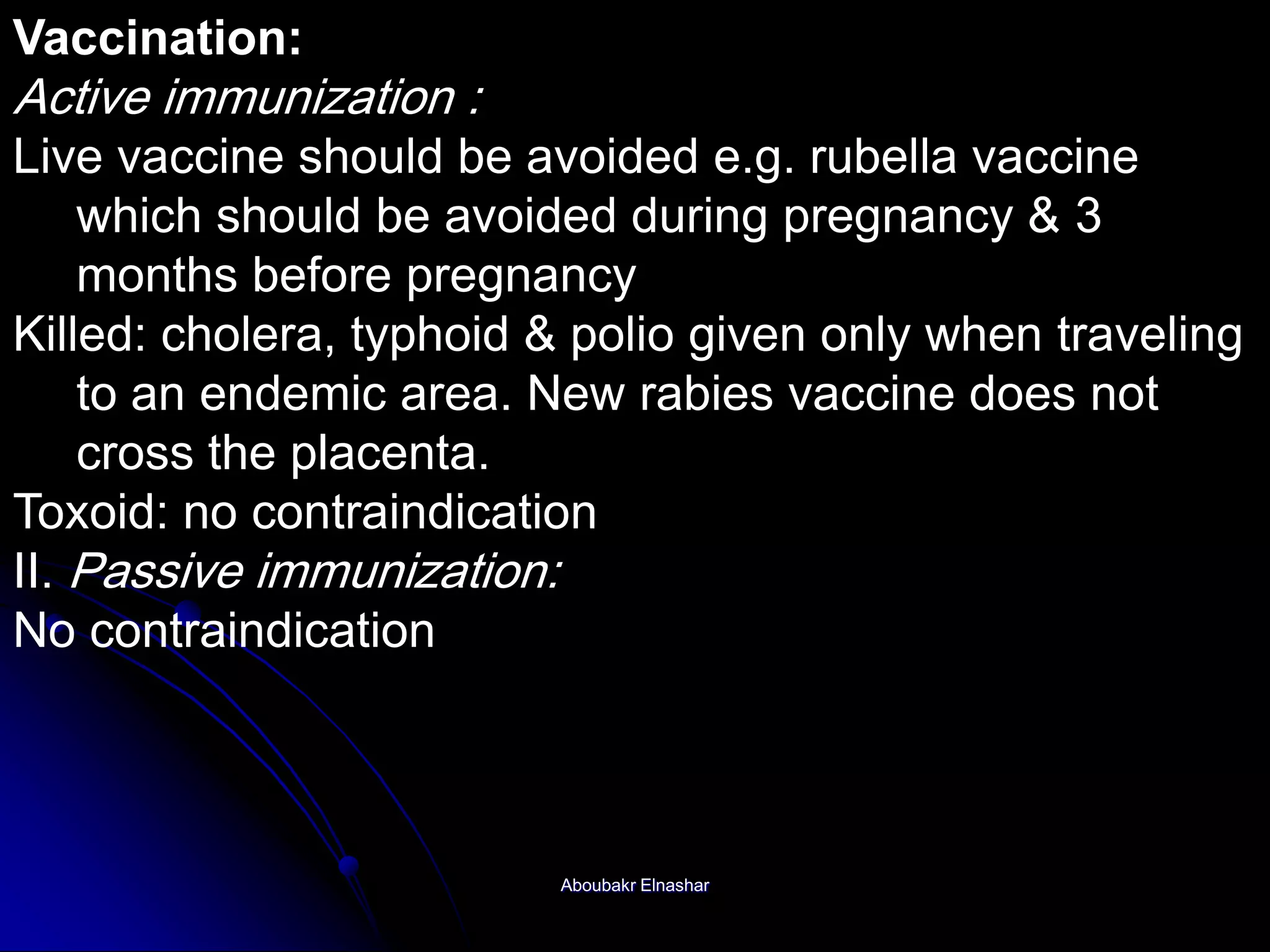
Vaccination:
Active immunization :
Livevaccine should be avoided e.g. rubella vaccine
which should be avoided during pregnancy & 3
months before pregnancy
Killed: cholera, typhoid & polio given only when traveling
to an endemic area. New rabies vaccine does not
cross the placenta.
Toxoid: no contraindication
II. Passive immunization:
No contraindication
Aboubakr Elnashar