Manufacturing of
Sodium Hydroxide
Sodium Hydroxide
-Chemical name : sodium hydroxide
-Chemical formula : NaOH
- With Mwt. 39.99 g/mol
-Commercial name : caustic soda , Lye
“It is a white solid substance which dissolves
readily in water, its solution has soapy feeling
and corrosive to skin.”
-Commonly used as a Base
- Raw Material used in manufacturing:
Rock salt “NaCl” sodium chloride & water “H2O”
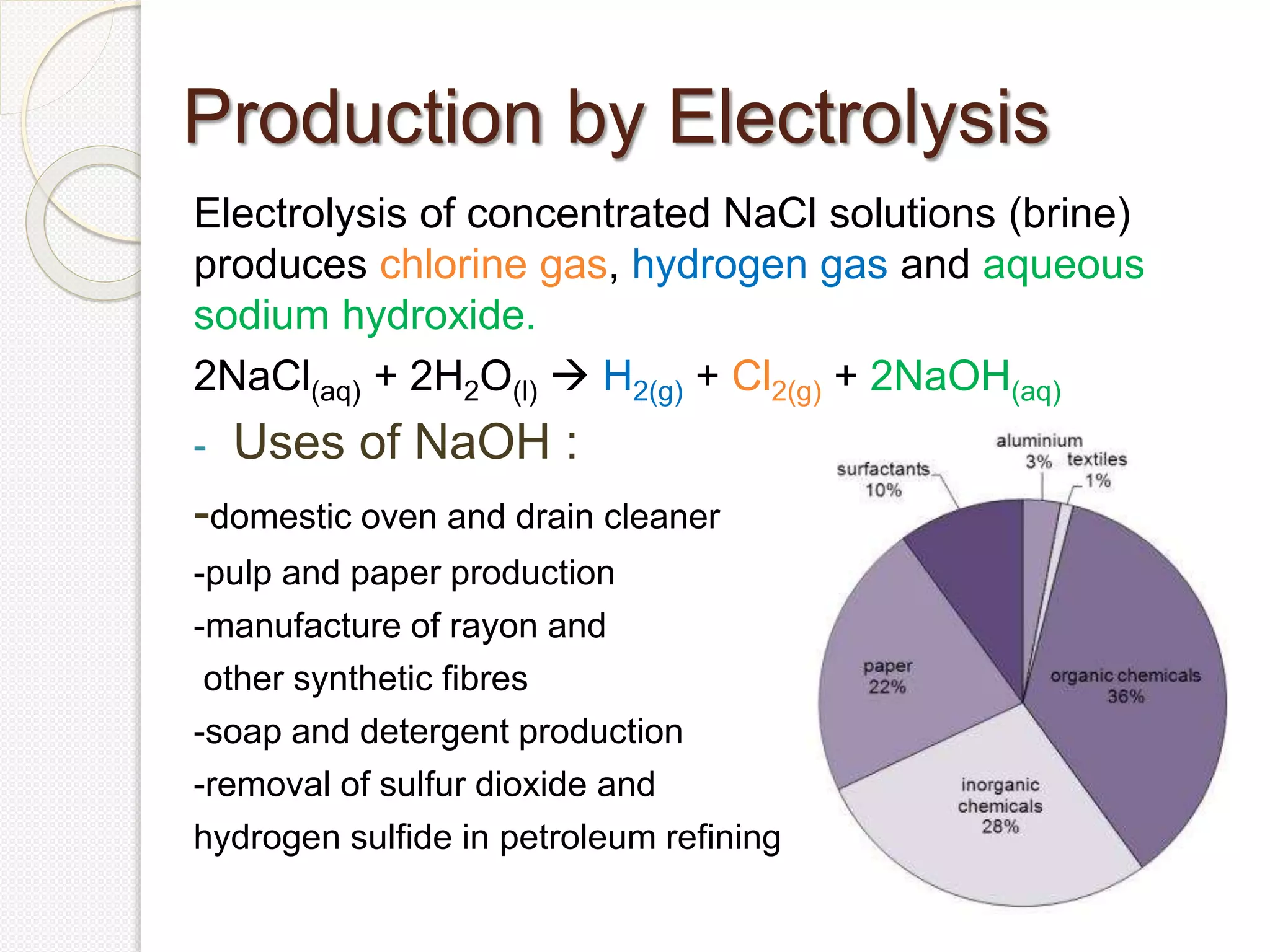
Production by Electrolysis
Electrolysis of concentrated NaCl solutions (brine)
produces chlorine gas, hydrogen gas and aqueous
sodium hydroxide.
2NaCl(aq) + 2H2O(l)  H2(g) + Cl2(g) + 2NaOH(aq)
- Uses of NaOH :
-domestic oven and drain cleaner
-pulp and paper production
-manufacture of rayon and
other synthetic fibres
-soap and detergent production
-removal of sulfur dioxide and
hydrogen sulfide in petroleum refining
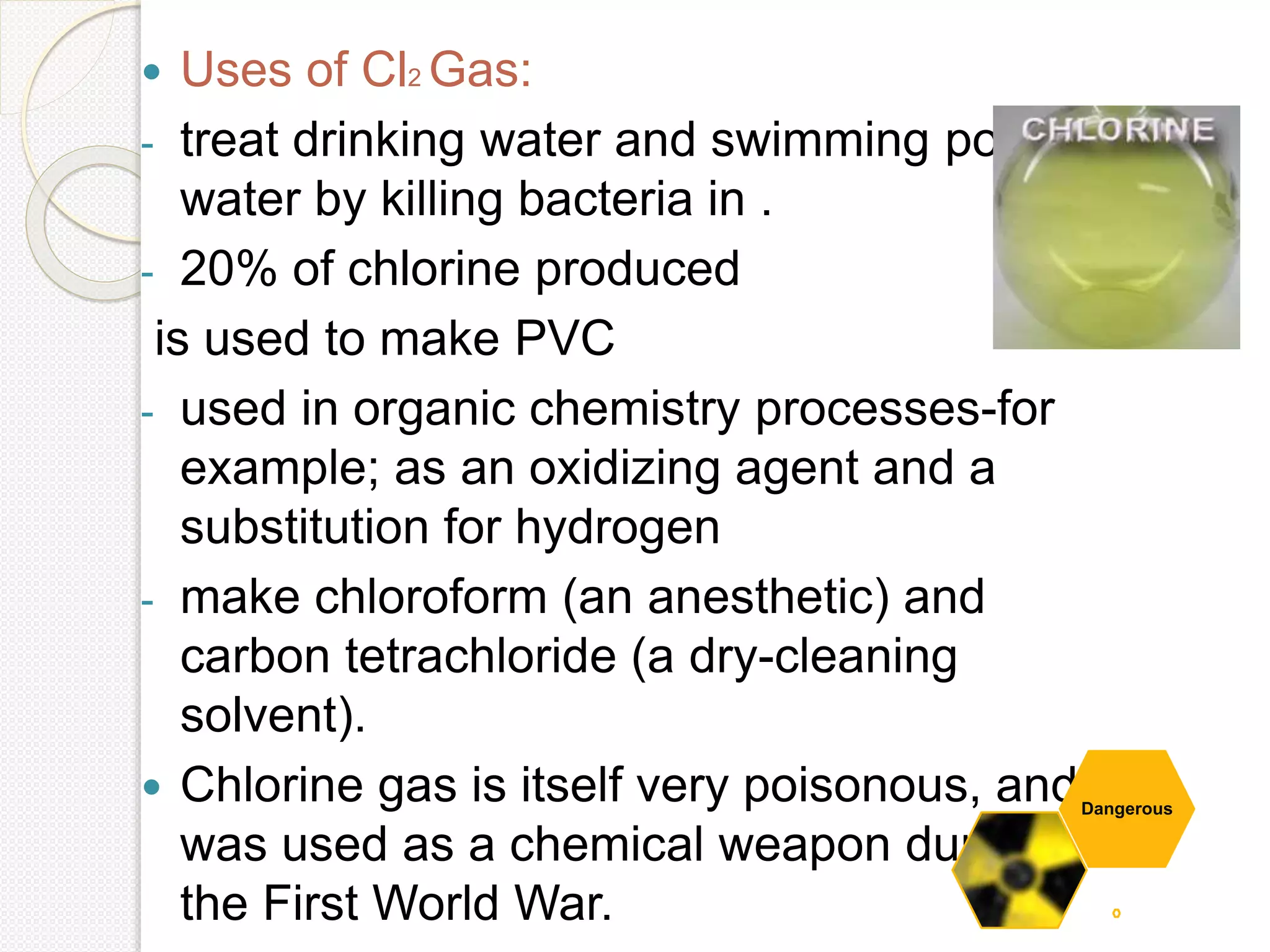
 Uses of Cl2 Gas:
- treat drinking water and swimming pool
water by killing bacteria in .
- 20% of chlorine produced
is used to make PVC
- used in organic chemistry processes-for
example; as an oxidizing agent and a
substitution for hydrogen
- make chloroform (an anesthetic) and
carbon tetrachloride (a dry-cleaning
solvent).
 Chlorine gas is itself very poisonous, and
was used as a chemical weapon during
the First World War.
Dangerous
Types of electrolytic cell
There are three types of electrolytic cell
are used to produce sodium hydroxide
from brine:
Castner-Kellner Cell (Mercury
Process)
Nelson Diaphragm Cell
Membrane Cell
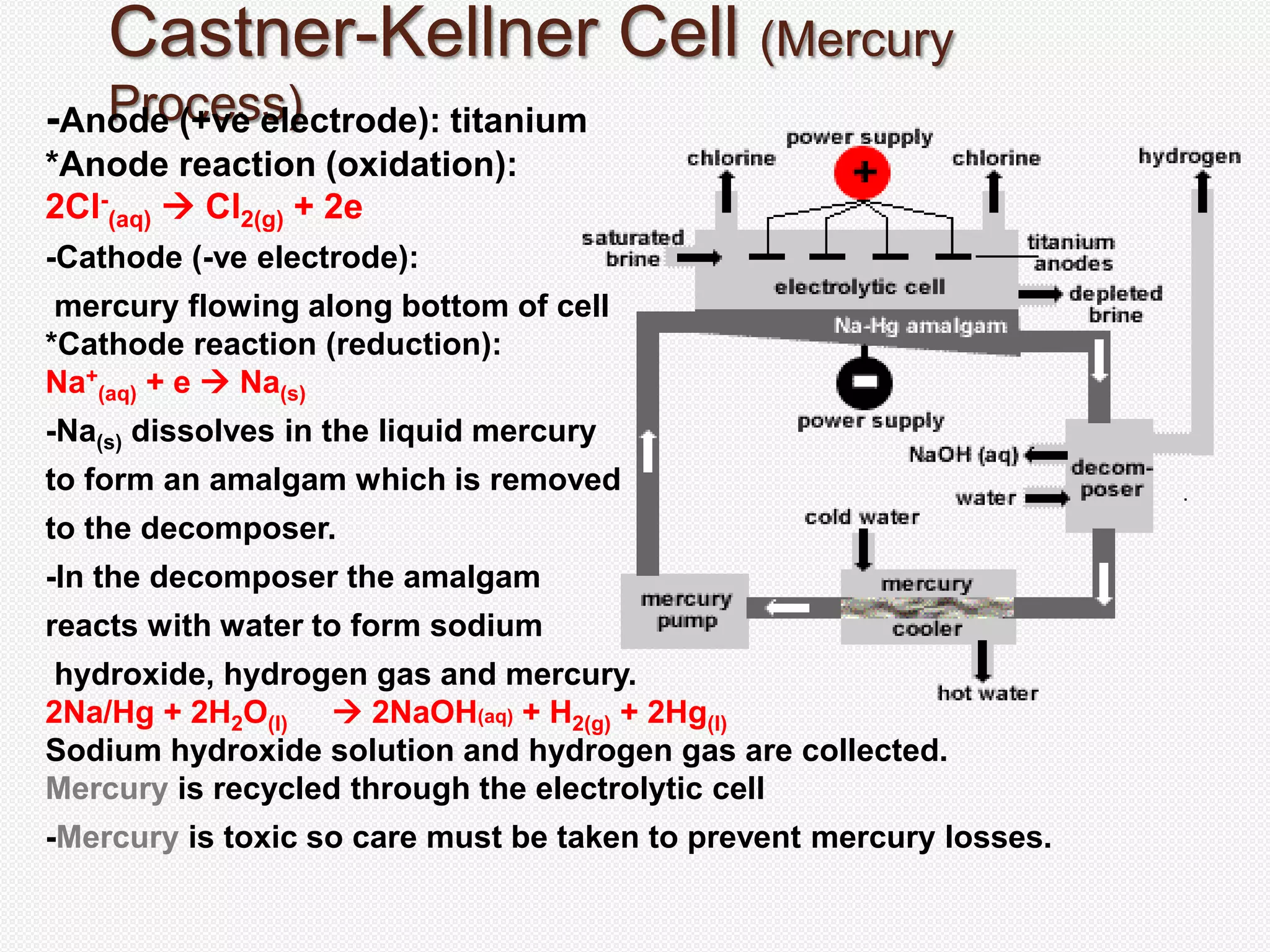
Castner-Kellner Cell (Mercury
Process)-Anode (+ve electrode): titanium
*Anode reaction (oxidation):
2Cl-
(aq)  Cl2(g) + 2e
-Cathode (-ve electrode):
mercury flowing along bottom of cell
*Cathode reaction (reduction):
Na+
(aq) + e  Na(s)
-Na(s) dissolves in the liquid mercury
to form an amalgam which is removed
to the decomposer.
-In the decomposer the amalgam
reacts with water to form sodium
hydroxide, hydrogen gas and mercury.
2Na/Hg + 2H2O(l)  2NaOH(aq) + H2(g) + 2Hg(l)
Sodium hydroxide solution and hydrogen gas are collected.
Mercury is recycled through the electrolytic cell
-Mercury is toxic so care must be taken to prevent mercury losses.
Nelson Diaphragm Cell
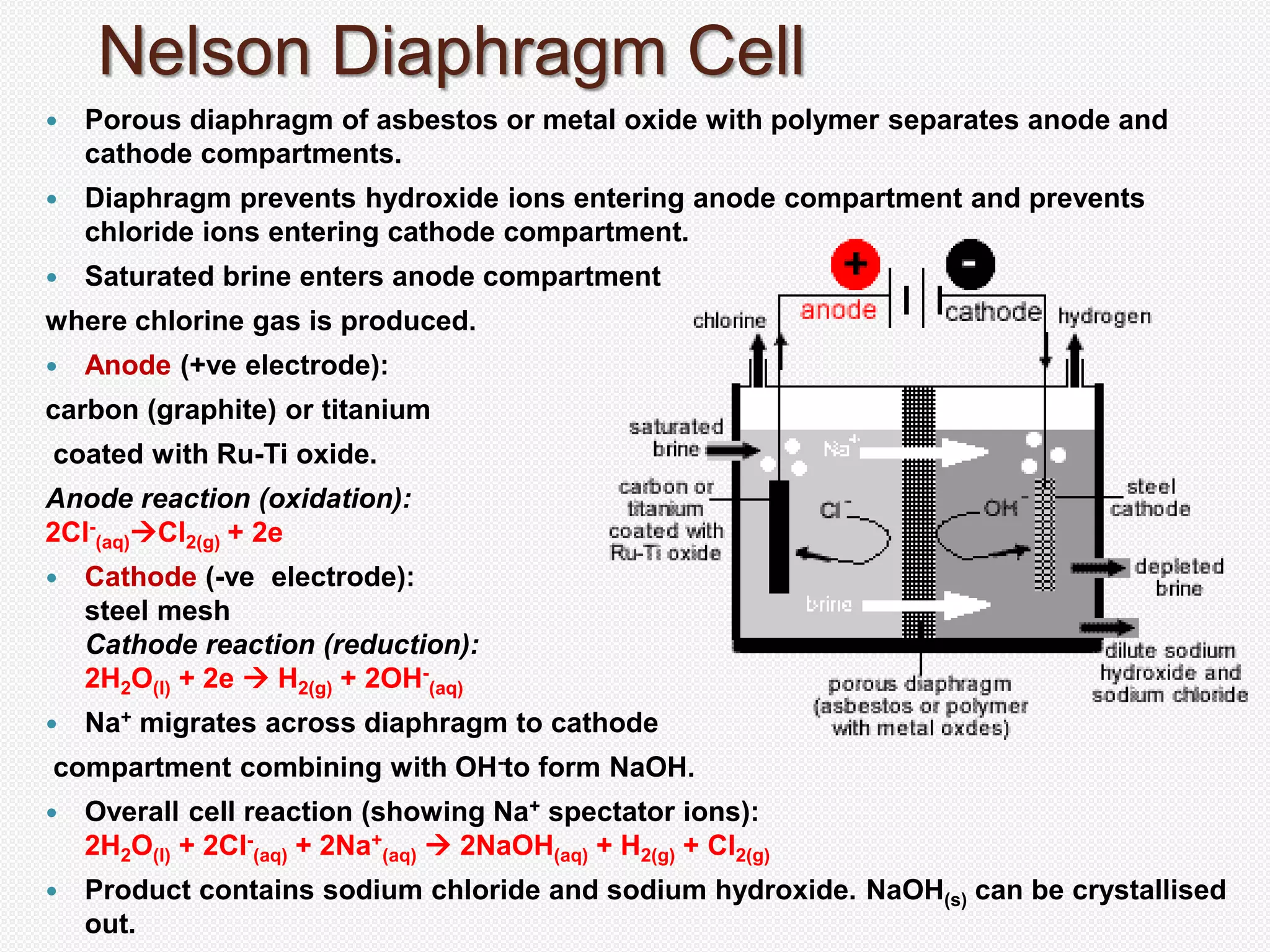
 Porous diaphragm of asbestos or metal oxide with polymer separates anode and
cathode compartments.
 Diaphragm prevents hydroxide ions entering anode compartment and prevents
chloride ions entering cathode compartment.
 Saturated brine enters anode compartment
where chlorine gas is produced.
 Anode (+ve electrode):
carbon (graphite) or titanium
coated with Ru-Ti oxide.
Anode reaction (oxidation):
2Cl-
(aq)Cl2(g) + 2e
 Cathode (-ve electrode):
steel mesh
Cathode reaction (reduction):
2H2O(l) + 2e  H2(g) + 2OH-
(aq)
 Na+ migrates across diaphragm to cathode
compartment combining with OH-to form NaOH.
 Overall cell reaction (showing Na+ spectator ions):
2H2O(l) + 2Cl-
(aq) + 2Na+
(aq)  2NaOH(aq) + H2(g) + Cl2(g)
 Product contains sodium chloride and sodium hydroxide. NaOH(s) can be crystallised
out.
Membrane Cell
 Favored method for producing very pure NaOH with no hazardous
waste, and with lowest energy requirements.
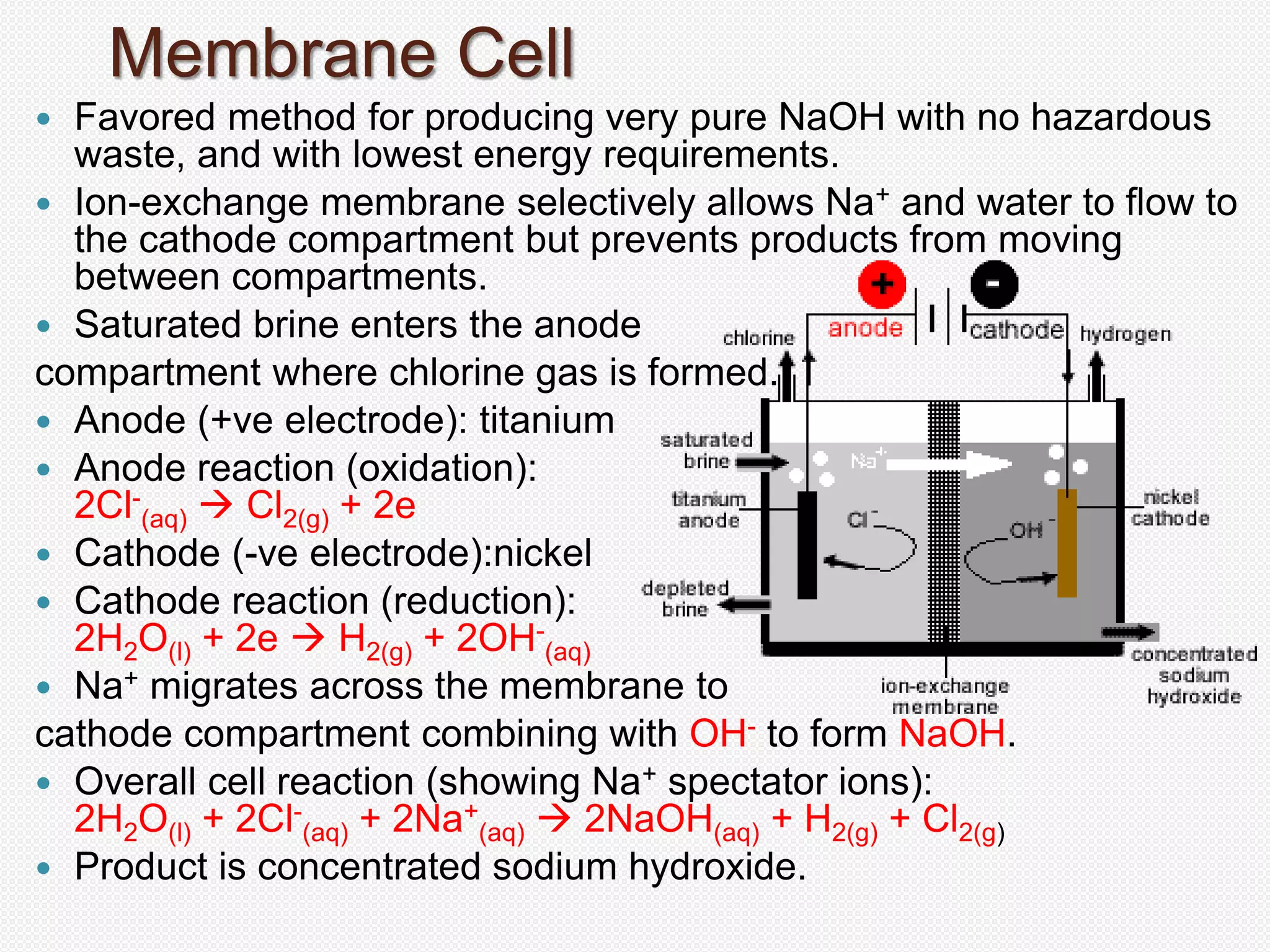
 Ion-exchange membrane selectively allows Na+ and water to flow to
the cathode compartment but prevents products from moving
between compartments.
 Saturated brine enters the anode
compartment where chlorine gas is formed.
 Anode (+ve electrode): titanium
 Anode reaction (oxidation):
2Cl-
(aq)  Cl2(g) + 2e
 Cathode (-ve electrode):nickel
 Cathode reaction (reduction):
2H2O(l) + 2e  H2(g) + 2OH-
(aq)
 Na+ migrates across the membrane to
cathode compartment combining with OH- to form NaOH.
 Overall cell reaction (showing Na+ spectator ions):
2H2O(l) + 2Cl-
(aq) + 2Na+
(aq)  2NaOH(aq) + H2(g) + Cl2(g)
 Product is concentrated sodium hydroxide.
 Process Advantages:
- Very Pure NaOH.
- No hazardous waste.
- Need lowest energy.
MEMBRANE CELL
CASTNER-KELLNER CELL
 Amalgam is mercury alloy “Hg& metal”
All most all metals can form amalgam with Hg,
exception : Iron, Platinum, Tungsten and
Tantalum.
 Process Advantages :
- Process very efficient.
- Produce very pure NaOH.
 Process Disadvantages :
- High electricity consumption .
- Environmental pollution due to escape of
mercury vapors .
References :
 AUS-e-TUTE is a science education
website
http://www.ausetute.com.au/
 Business Science Articles website
http://www.business-science-articles.com/
 Periodic Table website
http://www.rsc.org/periodic-table
 Look Chem “Look for chemicals”
website
http://www.lookchem.com/
Manufacturing of Sodium Hydroxide

Manufacturing of Sodium Hydroxide

  • 1.
  • 2.
    Sodium Hydroxide -Chemical name: sodium hydroxide -Chemical formula : NaOH - With Mwt. 39.99 g/mol -Commercial name : caustic soda , Lye “It is a white solid substance which dissolves readily in water, its solution has soapy feeling and corrosive to skin.” -Commonly used as a Base - Raw Material used in manufacturing: Rock salt “NaCl” sodium chloride & water “H2O”
  • 3.
    Production by Electrolysis Electrolysisof concentrated NaCl solutions (brine) produces chlorine gas, hydrogen gas and aqueous sodium hydroxide. 2NaCl(aq) + 2H2O(l)  H2(g) + Cl2(g) + 2NaOH(aq) - Uses of NaOH : -domestic oven and drain cleaner -pulp and paper production -manufacture of rayon and other synthetic fibres -soap and detergent production -removal of sulfur dioxide and hydrogen sulfide in petroleum refining
  • 4.
     Uses ofCl2 Gas: - treat drinking water and swimming pool water by killing bacteria in . - 20% of chlorine produced is used to make PVC - used in organic chemistry processes-for example; as an oxidizing agent and a substitution for hydrogen - make chloroform (an anesthetic) and carbon tetrachloride (a dry-cleaning solvent).  Chlorine gas is itself very poisonous, and was used as a chemical weapon during the First World War. Dangerous
  • 5.
    Types of electrolyticcell There are three types of electrolytic cell are used to produce sodium hydroxide from brine: Castner-Kellner Cell (Mercury Process) Nelson Diaphragm Cell Membrane Cell
  • 6.
    Castner-Kellner Cell (Mercury Process)-Anode(+ve electrode): titanium *Anode reaction (oxidation): 2Cl- (aq)  Cl2(g) + 2e -Cathode (-ve electrode): mercury flowing along bottom of cell *Cathode reaction (reduction): Na+ (aq) + e  Na(s) -Na(s) dissolves in the liquid mercury to form an amalgam which is removed to the decomposer. -In the decomposer the amalgam reacts with water to form sodium hydroxide, hydrogen gas and mercury. 2Na/Hg + 2H2O(l)  2NaOH(aq) + H2(g) + 2Hg(l) Sodium hydroxide solution and hydrogen gas are collected. Mercury is recycled through the electrolytic cell -Mercury is toxic so care must be taken to prevent mercury losses.
  • 7.
    Nelson Diaphragm Cell Porous diaphragm of asbestos or metal oxide with polymer separates anode and cathode compartments.  Diaphragm prevents hydroxide ions entering anode compartment and prevents chloride ions entering cathode compartment.  Saturated brine enters anode compartment where chlorine gas is produced.  Anode (+ve electrode): carbon (graphite) or titanium coated with Ru-Ti oxide. Anode reaction (oxidation): 2Cl- (aq)Cl2(g) + 2e  Cathode (-ve electrode): steel mesh Cathode reaction (reduction): 2H2O(l) + 2e  H2(g) + 2OH- (aq)  Na+ migrates across diaphragm to cathode compartment combining with OH-to form NaOH.  Overall cell reaction (showing Na+ spectator ions): 2H2O(l) + 2Cl- (aq) + 2Na+ (aq)  2NaOH(aq) + H2(g) + Cl2(g)  Product contains sodium chloride and sodium hydroxide. NaOH(s) can be crystallised out.
  • 8.
    Membrane Cell  Favoredmethod for producing very pure NaOH with no hazardous waste, and with lowest energy requirements.  Ion-exchange membrane selectively allows Na+ and water to flow to the cathode compartment but prevents products from moving between compartments.  Saturated brine enters the anode compartment where chlorine gas is formed.  Anode (+ve electrode): titanium  Anode reaction (oxidation): 2Cl- (aq)  Cl2(g) + 2e  Cathode (-ve electrode):nickel  Cathode reaction (reduction): 2H2O(l) + 2e  H2(g) + 2OH- (aq)  Na+ migrates across the membrane to cathode compartment combining with OH- to form NaOH.  Overall cell reaction (showing Na+ spectator ions): 2H2O(l) + 2Cl- (aq) + 2Na+ (aq)  2NaOH(aq) + H2(g) + Cl2(g)  Product is concentrated sodium hydroxide.
  • 9.
     Process Advantages: -Very Pure NaOH. - No hazardous waste. - Need lowest energy. MEMBRANE CELL CASTNER-KELLNER CELL  Amalgam is mercury alloy “Hg& metal” All most all metals can form amalgam with Hg, exception : Iron, Platinum, Tungsten and Tantalum.  Process Advantages : - Process very efficient. - Produce very pure NaOH.  Process Disadvantages : - High electricity consumption . - Environmental pollution due to escape of mercury vapors .
  • 10.
    References :  AUS-e-TUTEis a science education website http://www.ausetute.com.au/  Business Science Articles website http://www.business-science-articles.com/  Periodic Table website http://www.rsc.org/periodic-table  Look Chem “Look for chemicals” website http://www.lookchem.com/