Chemical & Physical
Properties of Matter
Chemical Properties
• Characteristics that are
observed ONLY when a
substance changes into a
different substance
Chemical Properties
• Types of Chemical Properties:
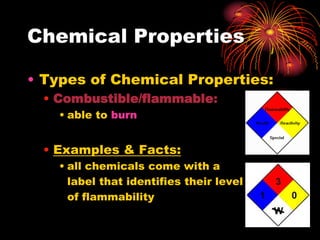
• Combustible/flammable:
• able to burn

• Examples & Facts:
• all chemicals come with a
label that identifies their level
of flammability
Chemical Properties
• Types of Chemical Properties:
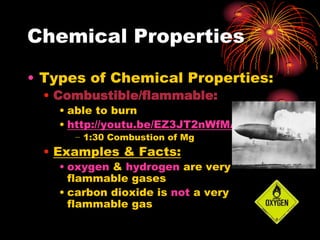
• Combustible/flammable:
• able to burn
• http://youtu.be/EZ3JT2nWfMA
− 1:30 Combustion of Mg

• Examples & Facts:

• oxygen & hydrogen are very
flammable gases
• carbon dioxide is not a very
flammable gas
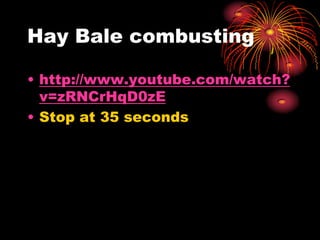
Hay Bale combusting
• http://www.youtube.com/watch?
v=zRNCrHqD0zE
• Stop at 35 seconds
Chemical Properties
• Types of Chemical Properties:
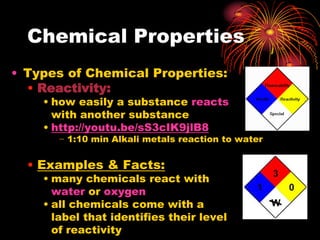
• Reactivity:

• how easily a substance reacts
with another substance
• http://youtu.be/sS3cIK9jlB8

− 1:10 min Alkali metals reaction to water

• Examples & Facts:

• many chemicals react with
water or oxygen
• all chemicals come with a
label that identifies their level
of reactivity
Chemical Properties
• Types of Chemical Properties:
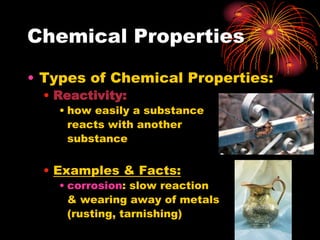
• Reactivity:
• how easily a substance
reacts with another
substance

• Examples & Facts:
• corrosion: slow reaction
& wearing away of metals
(rusting, tarnishing)
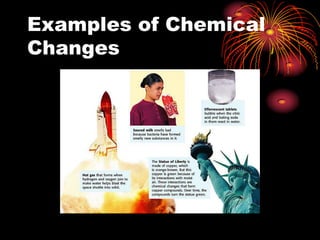
Examples of Chemical
Changes
Physical Properties
• Characteristics that can be
observed without changing the
substance into something else
Physical Properties
• Types of Physical Properties:
•
•
•
•
•
•
•

color
texture
odor
taste
hardness
magnetic
boiling, melting, & freezing points
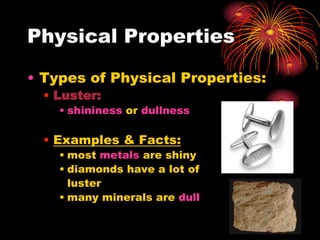
Physical Properties
• Types of Physical Properties:
• Luster:
• shininess or dullness

• Examples & Facts:
• most metals are shiny
• diamonds have a lot of
luster
• many minerals are dull
Physical Properties
• Types of Physical Properties:
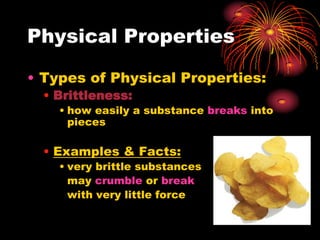
• Brittleness:
• how easily a substance breaks into
pieces

• Examples & Facts:
• very brittle substances
may crumble or break
with very little force
Physical Properties
• Types of Physical Properties:
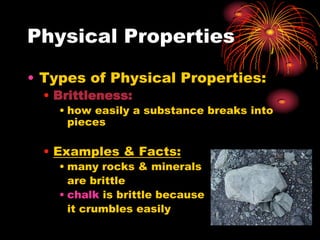
• Brittleness:
• how easily a substance breaks into
pieces

• Examples & Facts:
• many rocks & minerals
are brittle
• chalk is brittle because
it crumbles easily
Physical Properties
• Types of Physical Properties:
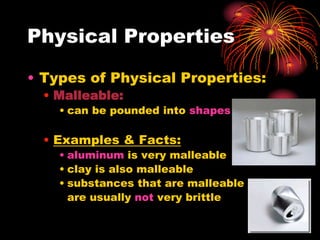
• Malleable:
• can be pounded into shapes

• Examples & Facts:
• aluminum is very malleable
• clay is also malleable
• substances that are malleable
are usually not very brittle
Properties Song
• http://www.youtube.com/watch?
v=uJOGy0dgmUU
Physical Properties
• Types of Physical Properties:
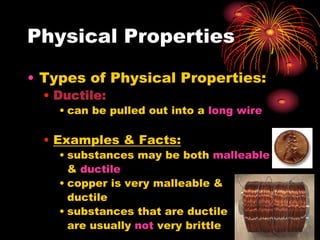
• Ductile:
• can be pulled out into a long wire

• Examples & Facts:
• substances may be both malleable
& ductile
• copper is very malleable &
ductile
• substances that are ductile
are usually not very brittle
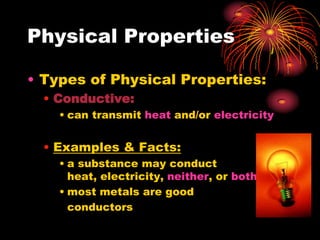
Physical Properties
• Types of Physical Properties:
• Conductive:
• can transmit heat and/or electricity

• Examples & Facts:
• a substance may conduct
heat, electricity, neither, or both
• most metals are good
conductors
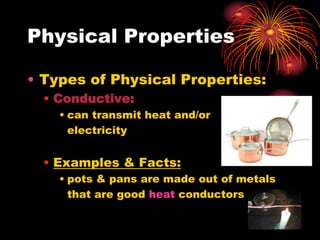
Physical Properties
• Types of Physical Properties:
• Conductive:
• can transmit heat and/or
electricity

• Examples & Facts:
• pots & pans are made out of metals
that are good heat conductors
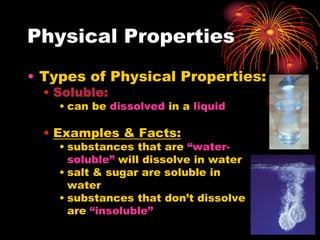
Physical Properties
• Types of Physical Properties:
• Soluble:

• can be dissolved in a liquid

• Examples & Facts:

• substances that are “watersoluble” will dissolve in water
• salt & sugar are soluble in
water
• substances that don’t dissolve
are “insoluble”
Overview of Physical &
Chemical properties
• http://youtu.be/oF0lN0jZYx0
• Physical and Chemical Properties
visual 2:30 min

• http://www.youtube.com/watch?
v=C4pQQQNwy30
• Chemistry - The Physical Properties
and Chemical Properties of Matter
− 6 min
Models are
representations of
objects or systems.
Models can be used for:
• Understanding something
• Predicting
• Picturing things in your mind
• Explain scientific theories
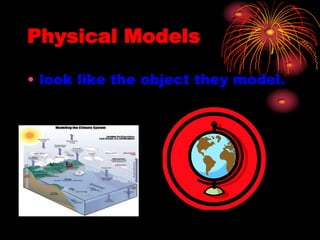
Physical Models
• look like the object they model.
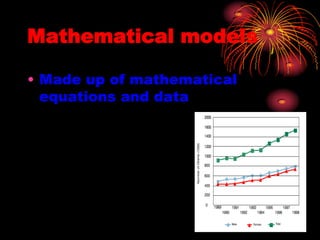
Mathematical models
• Made up of mathematical
equations and data
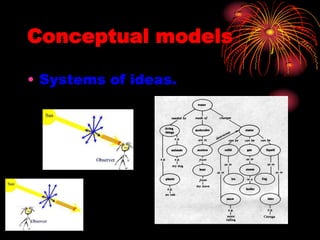
Conceptual models
• Systems of ideas.
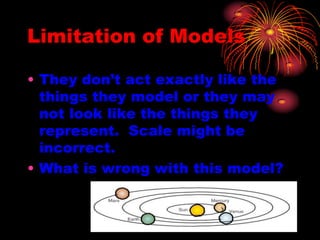
Limitation of Models
• They don’t act exactly like the
things they model or they may
not look like the things they
represent. Scale might be
incorrect.
• What is wrong with this model?
Extra information on
Chemical & Physical
•

http://education-portal.com/academy/lesson/matter-physical-and-chemicalproperties.html#transcript Just watch from 1:50 to 4:20 on video

•

http://www.youtube.com/watch?v=ritaljhhk7s Pharaoh Snake Reaction (Mercury(II)
thiocyanate decomposition) 3:11 min

•

http://www.youtube.com/watch?v=PQ6IsCbNZAQ Sulfuric Acid vs Sponge - Chemical
Reaction 1 min

Chemical & physical properties ppt

  • 1.
  • 2.
    Chemical Properties • Characteristicsthat are observed ONLY when a substance changes into a different substance
  • 3.
    Chemical Properties • Typesof Chemical Properties: • Combustible/flammable: • able to burn • Examples & Facts: • all chemicals come with a label that identifies their level of flammability
  • 4.
    Chemical Properties • Typesof Chemical Properties: • Combustible/flammable: • able to burn • http://youtu.be/EZ3JT2nWfMA − 1:30 Combustion of Mg • Examples & Facts: • oxygen & hydrogen are very flammable gases • carbon dioxide is not a very flammable gas
  • 5.
    Hay Bale combusting •http://www.youtube.com/watch? v=zRNCrHqD0zE • Stop at 35 seconds
  • 6.
    Chemical Properties • Typesof Chemical Properties: • Reactivity: • how easily a substance reacts with another substance • http://youtu.be/sS3cIK9jlB8 − 1:10 min Alkali metals reaction to water • Examples & Facts: • many chemicals react with water or oxygen • all chemicals come with a label that identifies their level of reactivity
  • 7.
    Chemical Properties • Typesof Chemical Properties: • Reactivity: • how easily a substance reacts with another substance • Examples & Facts: • corrosion: slow reaction & wearing away of metals (rusting, tarnishing)
  • 8.
  • 9.
    Physical Properties • Characteristicsthat can be observed without changing the substance into something else
  • 10.
    Physical Properties • Typesof Physical Properties: • • • • • • • color texture odor taste hardness magnetic boiling, melting, & freezing points
  • 11.
    Physical Properties • Typesof Physical Properties: • Luster: • shininess or dullness • Examples & Facts: • most metals are shiny • diamonds have a lot of luster • many minerals are dull
  • 12.
    Physical Properties • Typesof Physical Properties: • Brittleness: • how easily a substance breaks into pieces • Examples & Facts: • very brittle substances may crumble or break with very little force
  • 13.
    Physical Properties • Typesof Physical Properties: • Brittleness: • how easily a substance breaks into pieces • Examples & Facts: • many rocks & minerals are brittle • chalk is brittle because it crumbles easily
  • 14.
    Physical Properties • Typesof Physical Properties: • Malleable: • can be pounded into shapes • Examples & Facts: • aluminum is very malleable • clay is also malleable • substances that are malleable are usually not very brittle
  • 15.
  • 16.
    Physical Properties • Typesof Physical Properties: • Ductile: • can be pulled out into a long wire • Examples & Facts: • substances may be both malleable & ductile • copper is very malleable & ductile • substances that are ductile are usually not very brittle
  • 17.
    Physical Properties • Typesof Physical Properties: • Conductive: • can transmit heat and/or electricity • Examples & Facts: • a substance may conduct heat, electricity, neither, or both • most metals are good conductors
  • 18.
    Physical Properties • Typesof Physical Properties: • Conductive: • can transmit heat and/or electricity • Examples & Facts: • pots & pans are made out of metals that are good heat conductors
  • 19.
    Physical Properties • Typesof Physical Properties: • Soluble: • can be dissolved in a liquid • Examples & Facts: • substances that are “watersoluble” will dissolve in water • salt & sugar are soluble in water • substances that don’t dissolve are “insoluble”
  • 20.
    Overview of Physical& Chemical properties • http://youtu.be/oF0lN0jZYx0 • Physical and Chemical Properties visual 2:30 min • http://www.youtube.com/watch? v=C4pQQQNwy30 • Chemistry - The Physical Properties and Chemical Properties of Matter − 6 min
  • 21.
    Models are representations of objectsor systems. Models can be used for: • Understanding something • Predicting • Picturing things in your mind • Explain scientific theories
  • 22.
    Physical Models • looklike the object they model.
  • 23.
    Mathematical models • Madeup of mathematical equations and data
  • 24.
  • 25.
    Limitation of Models •They don’t act exactly like the things they model or they may not look like the things they represent. Scale might be incorrect. • What is wrong with this model?
  • 26.
    Extra information on Chemical& Physical • http://education-portal.com/academy/lesson/matter-physical-and-chemicalproperties.html#transcript Just watch from 1:50 to 4:20 on video • http://www.youtube.com/watch?v=ritaljhhk7s Pharaoh Snake Reaction (Mercury(II) thiocyanate decomposition) 3:11 min • http://www.youtube.com/watch?v=PQ6IsCbNZAQ Sulfuric Acid vs Sponge - Chemical Reaction 1 min