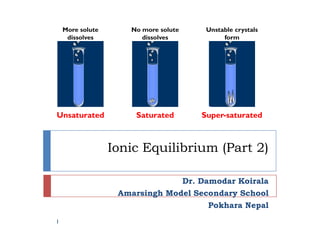
More solute
dissolves
No more solute
dissolves
Unstable crystals
form
Unsaturated Saturated Super-saturated
Ionic Equilibrium (Part 2)
Dr. Damodar Koirala
Amarsingh Model Secondary School
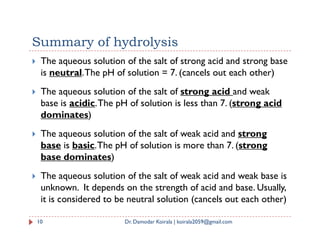
Pokhara Nepal
1
Content
 Part I (Previous Part)
 Degree of ionization
 Dissociation constant
 Arrhenius concept
 Ostwald dilution law
 Acid-base concept
2 Dr. Damodar Koirala | koirala2059@gmail.com
 Part II (This Part)
 Hydrolysis of salt
 Solubility product
 Common ion effect
 Buffer solution
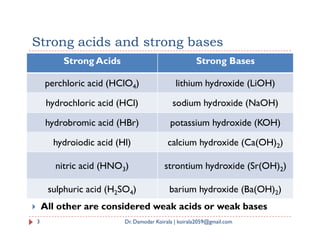
Strong acids and strong bases
Strong Acids Strong Bases
perchloric acid (HClO4) lithium hydroxide (LiOH)
hydrochloric acid (HCl) sodium hydroxide (NaOH)
hydrobromic acid (HBr) potassium hydroxide (KOH)
3 Dr. Damodar Koirala | koirala2059@gmail.com
hydrobromic acid (HBr) potassium hydroxide (KOH)
hydroiodic acid (Hl) calcium hydroxide (Ca(OH)2)
nitric acid (HNO3) strontium hydroxide (Sr(OH)2)
sulphuric acid (H2SO4) barium hydroxide (Ba(OH)2)
 All other are considered weak acids or weak bases
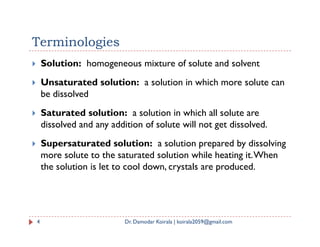
Terminologies
 Solution: homogeneous mixture of solute and solvent
 Unsaturated solution: a solution in which more solute can
be dissolved
 Saturated solution: a solution in which all solute are
dissolved and any addition of solute will not get dissolved.
 Supersaturated solution: a solution prepared by dissolving
more solute to the saturated solution while heating it.When
the solution is let to cool down, crystals are produced.
4 Dr. Damodar Koirala | koirala2059@gmail.com
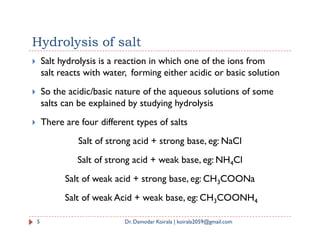
Hydrolysis of salt
 Salt hydrolysis is a reaction in which one of the ions from
salt reacts with water, forming either acidic or basic solution
 So the acidic/basic nature of the aqueous solutions of some
salts can be explained by studying hydrolysis
 There are four different types of salts
Salt of strong acid + strong base, eg: NaCl
Salt of strong acid + weak base, eg: NH4Cl
Salt of weak acid + strong base, eg: CH3COONa
Salt of weak Acid + weak base, eg: CH3COONH4
5 Dr. Damodar Koirala | koirala2059@gmail.com
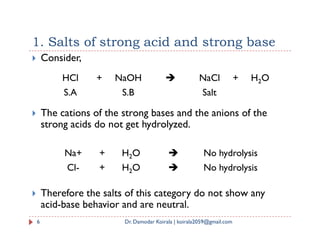
1. Salts of strong acid and strong base
 Consider,
 The cations of the strong bases and the anions of the
strong acids do not get hydrolyzed.
HCl + NaOH  NaCl + H2O
S.A S.B Salt
strong acids do not get hydrolyzed.
 Therefore the salts of this category do not show any
acid-base behavior and are neutral.
6 Dr. Damodar Koirala | koirala2059@gmail.com
Na+ + H2O  No hydrolysis
Cl- + H2O  No hydrolysis
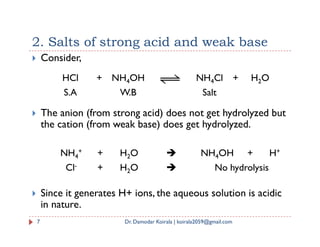
2. Salts of strong acid and weak base
 Consider,
 The anion (from strong acid) does not get hydrolyzed but
the cation (from weak base) does get hydrolyzed.
HCl + NH4OH NH4Cl + H2O
S.A W.B Salt
the cation (from weak base) does get hydrolyzed.
 Since it generates H+ ions, the aqueous solution is acidic
in nature.
7 Dr. Damodar Koirala | koirala2059@gmail.com
NH4
+ + H2O  NH4OH + H+
Cl- + H2O  No hydrolysis
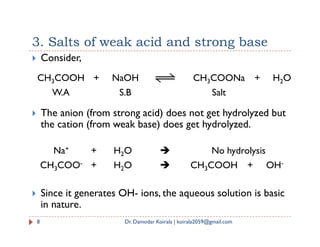
3. Salts of weak acid and strong base
 Consider,
 The anion (from strong acid) does not get hydrolyzed but
the cation (from weak base) does get hydrolyzed.
CH3COOH + NaOH CH3COONa + H2O
W.A S.B Salt
8 Dr. Damodar Koirala | koirala2059@gmail.com
the cation (from weak base) does get hydrolyzed.
 Since it generates OH- ions, the aqueous solution is basic
in nature.
Na+ + H2O  No hydrolysis
CH3COO- + H2O  CH3COOH + OH-
4. Salts of weak acid and weak base
 Consider,
 Both, the anion (from weak acid) and the cation (from weak
base) get hydrolyzed.
CH3COOH + NH4OH CH3COONH4 + H2O
W.A S.B Salt
9 Dr. Damodar Koirala | koirala2059@gmail.com
base) get hydrolyzed.
 Both H+ and OH- ions are produced. Solution could be acidic,
basic or neutral depending on the relative strength of the
weak acid and the weak base. Usually considered as neutral.
NH4
+ + H2O  NH4OH + H+
CH3COO- + H2O  CH3COOH + OH-
Summary of hydrolysis
 The aqueous solution of the salt of strong acid and strong base
is neutral.The pH of solution = 7. (cancels out each other)
 The aqueous solution of the salt of strong acid and weak
base is acidic.The pH of solution is less than 7. (strong acid
dominates)
 The aqueous solution of the salt of weak acid and strong
base is basic.The pH of solution is more than 7. (strong
base dominates)
 The aqueous solution of the salt of weak acid and weak base is
unknown. It depends on the strength of acid and base. Usually,
it is considered to be neutral solution (cancels out each other)
10 Dr. Damodar Koirala | koirala2059@gmail.com
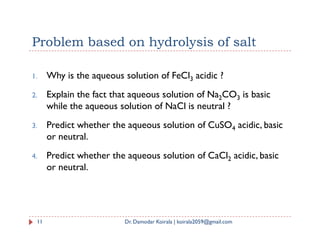
Problem based on hydrolysis of salt
1. Why is the aqueous solution of FeCl3 acidic ?
2. Explain the fact that aqueous solution of Na2CO3 is basic
while the aqueous solution of NaCl is neutral ?
3. Predict whether the aqueous solution of CuSO acidic, basic
11 Dr. Damodar Koirala | koirala2059@gmail.com
3. Predict whether the aqueous solution of CuSO4 acidic, basic
or neutral.
4. Predict whether the aqueous solution of CaCl2 acidic, basic
or neutral.
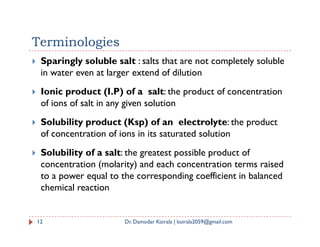
Terminologies
 Sparingly soluble salt : salts that are not completely soluble
in water even at larger extend of dilution
 Ionic product (I.P) of a salt: the product of concentration
of ions of salt in any given solution
 Solubility product (Ksp) of an electrolyte: the product
of concentration of ions in its saturated solution
 Solubility of a salt: the greatest possible product of
concentration (molarity) and each concentration terms raised
to a power equal to the corresponding coefficient in balanced
chemical reaction
12 Dr. Damodar Koirala | koirala2059@gmail.com
Solubility product: expression
 Let BA be binary salt that is sparingly soluble in water.Then,
BA(s) BA (solution) B+ + A-
 Applying the law of mass action,
K = [B+] [A-]
K* [BA(s)] = [B+] [A-]
 The concentration of solid salt [BA(s)] is constant. By
convention it is unity. So, [BA(s)] = 1
13 Dr. Damodar Koirala | koirala2059@gmail.com
K = [B+] [A-]
[AB(s)]
Solubility product: expression
 Hence, [B+] [A-] = constant = Ksp
 The constant Ksp is called the solubility product of salt BA.
 The above equation signifies that the product of concentration
of B+ and A- of a salt is constant independent of the individual
concentration of B+ and A- ions when temperature is constant
 If S is the solubility of BA, then [B+] = S and [A-] = S
 Ksp = [B+] [A-] = S * S = S2
 Here, unit of Ksp is (mol/L)2
14 Dr. Damodar Koirala | koirala2059@gmail.com
 Salt of BA type: ( For example AgCl, CaSO4)
 The solubility equilibrium can be represented as
BA(s) A-(aq) + B+(aq) and Ksp = [A-] [B+]
 Let S mol/L be the solubility then
Solubility product: expression
 Let S mol/L be the solubility then
[A-] = [B+] = S
 Substituting the values in the expression of Ksp
 Ksp = S * S = S2
 Here, unit of Ksp is (Mol/L)2
15 Dr. Damodar Koirala | koirala2059@gmail.com
 Salt of BA2 type: ( For example CaF2).
 The solubility equilibrium can be represented as
BA2(s) 2A-(aq) + B2+ (aq) and Ksp = [B2+] [A–]2
 Let S mol/L be the solubility then
Solubility product: expression
16 Dr. Damodar Koirala | koirala2059@gmail.com
 Let S mol/L be the solubility then
[B2+] = S and [A–] = 2S
 Substituting the values in the expression of Ksp
 Ksp = S * (2S)2 = 4 S3
 Here, unit of Ksp is (Mol/L)3
 Salt of B2A type: ( For example Ag2CrO4).
 The solubility equilibrium can be represented as
B2A (s) A2-(aq) + 2B+(aq) and Ksp = [B+]2 [A2-]
 Let S mol/L be the solubility then
Solubility product: expression
17 Dr. Damodar Koirala | koirala2059@gmail.com
 Let S mol/L be the solubility then
[B+] = 2S and [A2-] = S
 Substituting the values in the expression of Ksp
 Ksp = (2S)2 * S = 4 S3
 Here, unit of Ksp is (Mol/L)3
 Salt of B3A2 type: ( For example Ca3(PO4)2).
 The solubility equilibrium can be represented as
B3A2 (s) 2A3-(aq) + 3B2+(aq) and Ksp = [B2+]3 [A3–]2
 Let S mol/L be the solubility then
Solubility product: expression
18 Dr. Damodar Koirala | koirala2059@gmail.com
 Let S mol/L be the solubility then
[B2+] = 3S and [A3–] = 2S
 Substituting the values in the expression of Ksp
 Ksp = (3S)3 * (2S)2 = 108 S5
 Here, unit of Ksp is (Mol/L)5
Solubility product: expression
Salt [A-] [B+] Ksp Ksp Ksp unit
AB S S [A-] [B+] S . S M2
A2B 2S S [A-]2 [B2+] 22. S2. S M3
19 Dr. Damodar Koirala | koirala2059@gmail.com
AB2 S 2S [A2-] [B+]2 22. S. S2 M3
A2B3 2S 3S [A3-]2 [B2+]3 22. 33. S2. S3 M5
A3B2 3S 2S [A2-]3 [B3+]2 33.22.S3.S2 M5
AxBy xS yS [Ay-]x [Bx+]y xx. yy. Sx. Sy M(x+y)
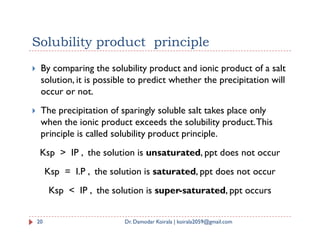
Solubility product principle
 By comparing the solubility product and ionic product of a salt
solution, it is possible to predict whether the precipitation will
occur or not.
 The precipitation of sparingly soluble salt takes place only
when the ionic product exceeds the solubility product.This
principle is called solubility product principle.
Ksp > IP , the solution is unsaturated, ppt does not occur
Ksp = I.P , the solution is saturated, ppt does not occur
Ksp < IP , the solution is super-saturated, ppt occurs
20 Dr. Damodar Koirala | koirala2059@gmail.com
Numerical: Solubility and solubility product
 The solubility of CaF2 in water at 18C is 2.05X10⁻⁴ mol/litre.
Calculate its solubility product .
 The solubility of CaCO3 is 0.0305 g/L. Calculate its solubility
product.
 0.00143 gram of AgCl dissolve in one liter of water at 25C to
form a saturated solution.What is the solubility product of the
salt ? (Ag = 108, Cl = 35.5)
 The solubility product constant of BaSO4 in water at 25C is
1*10-10 mol2 L-2. Calculate the solubility in g/l
21 Dr. Damodar Koirala | koirala2059@gmail.com
Common ion effect
 The degree of ionization of a weak electrolyte is suppressed
(decreased) by the addition of strong electrolyte having a
common ion is know as common ion effect.
 Eg: when NH4Cl (strong electrolyte) is added to NH4OH the
common ion NH4+ provided by NH4Cl suppress the
ionization of NH OH.
4 4
ionization of NH4OH.
 As a result, the concentration of OH- ion will decrease
otherwise the constant Ksp will change
 Therefore, NH4+ and OH- will combine to give the solid
NH4OH(s) and the solubility of NH4OH will decrease.
22 Dr. Damodar Koirala | koirala2059@gmail.com
Application: Common ion effect
 It is used for the precipitation of group II metals (Cu2+, Hg2+,
Pb2+,Ar3+, Sb3+, Bi3+, Cd3+) in qualitative salt analysis
 Used for the precipitation of group IIA metal ions (Fe2+, Fe3+,
Al3+, Cr3+) in qualitative salt analysis
 Why should we use HCl in the precipitation of group II
 What is the use of NH4Cl for the precipitate of Group IIIA
metal ion
23 Dr. Damodar Koirala | koirala2059@gmail.com
 A sample of AgCl was treated with 5 ml of 2M Na2CO3
solution to produce Ag2CO3.The remaining solution contained
0.003 gm of Cl- per litre. Calculate the solubility product of
AgCl (Ksp of Ag2CO3 = 8.2 X 10⁻¹²)
 At 25 C the solubility of BaSO4 is 0.00233 g/l. Calculate the
solubility product of the salt. Calculate the solubility of BaSO
Numerical: Common ion effect
solubility product of the salt. Calculate the solubility of BaSO4
in a solution of (NH4)2SO4 containing 13.2 g/L at 25C.
 The solubility of AgCl in water at 298K is 1.43X10⁻³ g/L.
Calculate its solubility in 0.5M KCl solution
24 Dr. Damodar Koirala | koirala2059@gmail.com
Buffer solution
 A solution which retain its pH value when stored for ong
time is known as buffer solution
 Even addition of small amount of strong acid or strong
base, its pH does not alter or change
 There are two type:
 Acidic buffer: it is the mixture of weak acid and a salt of the
same acid with a strong base .The pH of such buffer is less
than 7. Example: the solution of acetic acid with sodium acetate
 Basic buffer: it is the mixture of weak base and a salt of the
same base with a strong acid.The pH of such buffer is greater
than 7. Example: the solution of ammonium hydroxide with
ammonium chloride
25 Dr. Damodar Koirala | koirala2059@gmail.com
Mechanism of acidic buffer
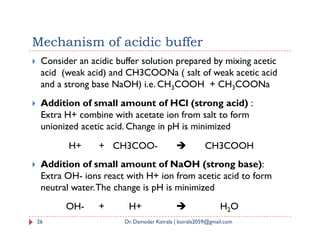
 Consider an acidic buffer solution prepared by mixing acetic
acid (weak acid) and CH3COONa ( salt of weak acetic acid
and a strong base NaOH) i.e. CH3COOH + CH3COONa
 Addition of small amount of HCl (strong acid) :
Extra H+ combine with acetate ion from salt to form
unionized acetic acid. Change in pH is minimized
 Addition of small amount of NaOH (strong base):
Extra OH- ions react with H+ ion from acetic acid to form
neutral water.The change is pH is minimized
26 Dr. Damodar Koirala | koirala2059@gmail.com
H+ + CH3COO-  CH3COOH
OH- + H+  H2O
Mechanism of basic buffer
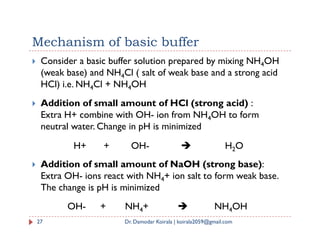
 Consider a basic buffer solution prepared by mixing NH4OH
(weak base) and NH4Cl ( salt of weak base and a strong acid
HCl) i.e. NH4Cl + NH4OH
 Addition of small amount of HCl (strong acid) :
Extra H+ combine with OH- ion from NH4OH to form
neutral water. Change in pH is minimized
 Addition of small amount of NaOH (strong base):
Extra OH- ions react with NH4+ ion salt to form weak base.
The change is pH is minimized
27 Dr. Damodar Koirala | koirala2059@gmail.com
OH- + NH4+  NH4OH
H+ + OH-  H2O

Ionic equilibrium part 2

  • 1.
    More solute dissolves No moresolute dissolves Unstable crystals form Unsaturated Saturated Super-saturated Ionic Equilibrium (Part 2) Dr. Damodar Koirala Amarsingh Model Secondary School Pokhara Nepal 1
  • 2.
    Content  Part I(Previous Part)  Degree of ionization  Dissociation constant  Arrhenius concept  Ostwald dilution law  Acid-base concept 2 Dr. Damodar Koirala | koirala2059@gmail.com  Part II (This Part)  Hydrolysis of salt  Solubility product  Common ion effect  Buffer solution
  • 3.
    Strong acids andstrong bases Strong Acids Strong Bases perchloric acid (HClO4) lithium hydroxide (LiOH) hydrochloric acid (HCl) sodium hydroxide (NaOH) hydrobromic acid (HBr) potassium hydroxide (KOH) 3 Dr. Damodar Koirala | koirala2059@gmail.com hydrobromic acid (HBr) potassium hydroxide (KOH) hydroiodic acid (Hl) calcium hydroxide (Ca(OH)2) nitric acid (HNO3) strontium hydroxide (Sr(OH)2) sulphuric acid (H2SO4) barium hydroxide (Ba(OH)2)  All other are considered weak acids or weak bases
  • 4.
    Terminologies  Solution: homogeneousmixture of solute and solvent  Unsaturated solution: a solution in which more solute can be dissolved  Saturated solution: a solution in which all solute are dissolved and any addition of solute will not get dissolved. dissolved and any addition of solute will not get dissolved.  Supersaturated solution: a solution prepared by dissolving more solute to the saturated solution while heating it.When the solution is let to cool down, crystals are produced. 4 Dr. Damodar Koirala | koirala2059@gmail.com
  • 5.
    Hydrolysis of salt Salt hydrolysis is a reaction in which one of the ions from salt reacts with water, forming either acidic or basic solution  So the acidic/basic nature of the aqueous solutions of some salts can be explained by studying hydrolysis  There are four different types of salts  There are four different types of salts Salt of strong acid + strong base, eg: NaCl Salt of strong acid + weak base, eg: NH4Cl Salt of weak acid + strong base, eg: CH3COONa Salt of weak Acid + weak base, eg: CH3COONH4 5 Dr. Damodar Koirala | koirala2059@gmail.com
  • 6.
    1. Salts ofstrong acid and strong base  Consider,  The cations of the strong bases and the anions of the strong acids do not get hydrolyzed. HCl + NaOH  NaCl + H2O S.A S.B Salt strong acids do not get hydrolyzed.  Therefore the salts of this category do not show any acid-base behavior and are neutral. 6 Dr. Damodar Koirala | koirala2059@gmail.com Na+ + H2O  No hydrolysis Cl- + H2O  No hydrolysis
  • 7.
    2. Salts ofstrong acid and weak base  Consider,  The anion (from strong acid) does not get hydrolyzed but the cation (from weak base) does get hydrolyzed. HCl + NH4OH NH4Cl + H2O S.A W.B Salt the cation (from weak base) does get hydrolyzed.  Since it generates H+ ions, the aqueous solution is acidic in nature. 7 Dr. Damodar Koirala | koirala2059@gmail.com NH4 + + H2O  NH4OH + H+ Cl- + H2O  No hydrolysis
  • 8.
    3. Salts ofweak acid and strong base  Consider,  The anion (from strong acid) does not get hydrolyzed but the cation (from weak base) does get hydrolyzed. CH3COOH + NaOH CH3COONa + H2O W.A S.B Salt 8 Dr. Damodar Koirala | koirala2059@gmail.com the cation (from weak base) does get hydrolyzed.  Since it generates OH- ions, the aqueous solution is basic in nature. Na+ + H2O  No hydrolysis CH3COO- + H2O  CH3COOH + OH-
  • 9.
    4. Salts ofweak acid and weak base  Consider,  Both, the anion (from weak acid) and the cation (from weak base) get hydrolyzed. CH3COOH + NH4OH CH3COONH4 + H2O W.A S.B Salt 9 Dr. Damodar Koirala | koirala2059@gmail.com base) get hydrolyzed.  Both H+ and OH- ions are produced. Solution could be acidic, basic or neutral depending on the relative strength of the weak acid and the weak base. Usually considered as neutral. NH4 + + H2O  NH4OH + H+ CH3COO- + H2O  CH3COOH + OH-
  • 10.
    Summary of hydrolysis The aqueous solution of the salt of strong acid and strong base is neutral.The pH of solution = 7. (cancels out each other)  The aqueous solution of the salt of strong acid and weak base is acidic.The pH of solution is less than 7. (strong acid dominates)  The aqueous solution of the salt of weak acid and strong base is basic.The pH of solution is more than 7. (strong base dominates)  The aqueous solution of the salt of weak acid and weak base is unknown. It depends on the strength of acid and base. Usually, it is considered to be neutral solution (cancels out each other) 10 Dr. Damodar Koirala | koirala2059@gmail.com
  • 11.
    Problem based onhydrolysis of salt 1. Why is the aqueous solution of FeCl3 acidic ? 2. Explain the fact that aqueous solution of Na2CO3 is basic while the aqueous solution of NaCl is neutral ? 3. Predict whether the aqueous solution of CuSO acidic, basic 11 Dr. Damodar Koirala | koirala2059@gmail.com 3. Predict whether the aqueous solution of CuSO4 acidic, basic or neutral. 4. Predict whether the aqueous solution of CaCl2 acidic, basic or neutral.
  • 12.
    Terminologies  Sparingly solublesalt : salts that are not completely soluble in water even at larger extend of dilution  Ionic product (I.P) of a salt: the product of concentration of ions of salt in any given solution  Solubility product (Ksp) of an electrolyte: the product  Solubility product (Ksp) of an electrolyte: the product of concentration of ions in its saturated solution  Solubility of a salt: the greatest possible product of concentration (molarity) and each concentration terms raised to a power equal to the corresponding coefficient in balanced chemical reaction 12 Dr. Damodar Koirala | koirala2059@gmail.com
  • 13.
    Solubility product: expression Let BA be binary salt that is sparingly soluble in water.Then, BA(s) BA (solution) B+ + A-  Applying the law of mass action, K = [B+] [A-] K* [BA(s)] = [B+] [A-]  The concentration of solid salt [BA(s)] is constant. By convention it is unity. So, [BA(s)] = 1 13 Dr. Damodar Koirala | koirala2059@gmail.com K = [B+] [A-] [AB(s)]
  • 14.
    Solubility product: expression Hence, [B+] [A-] = constant = Ksp  The constant Ksp is called the solubility product of salt BA.  The above equation signifies that the product of concentration of B+ and A- of a salt is constant independent of the individual of B+ and A- of a salt is constant independent of the individual concentration of B+ and A- ions when temperature is constant  If S is the solubility of BA, then [B+] = S and [A-] = S  Ksp = [B+] [A-] = S * S = S2  Here, unit of Ksp is (mol/L)2 14 Dr. Damodar Koirala | koirala2059@gmail.com
  • 15.
     Salt ofBA type: ( For example AgCl, CaSO4)  The solubility equilibrium can be represented as BA(s) A-(aq) + B+(aq) and Ksp = [A-] [B+]  Let S mol/L be the solubility then Solubility product: expression  Let S mol/L be the solubility then [A-] = [B+] = S  Substituting the values in the expression of Ksp  Ksp = S * S = S2  Here, unit of Ksp is (Mol/L)2 15 Dr. Damodar Koirala | koirala2059@gmail.com
  • 16.
     Salt ofBA2 type: ( For example CaF2).  The solubility equilibrium can be represented as BA2(s) 2A-(aq) + B2+ (aq) and Ksp = [B2+] [A–]2  Let S mol/L be the solubility then Solubility product: expression 16 Dr. Damodar Koirala | koirala2059@gmail.com  Let S mol/L be the solubility then [B2+] = S and [A–] = 2S  Substituting the values in the expression of Ksp  Ksp = S * (2S)2 = 4 S3  Here, unit of Ksp is (Mol/L)3
  • 17.
     Salt ofB2A type: ( For example Ag2CrO4).  The solubility equilibrium can be represented as B2A (s) A2-(aq) + 2B+(aq) and Ksp = [B+]2 [A2-]  Let S mol/L be the solubility then Solubility product: expression 17 Dr. Damodar Koirala | koirala2059@gmail.com  Let S mol/L be the solubility then [B+] = 2S and [A2-] = S  Substituting the values in the expression of Ksp  Ksp = (2S)2 * S = 4 S3  Here, unit of Ksp is (Mol/L)3
  • 18.
     Salt ofB3A2 type: ( For example Ca3(PO4)2).  The solubility equilibrium can be represented as B3A2 (s) 2A3-(aq) + 3B2+(aq) and Ksp = [B2+]3 [A3–]2  Let S mol/L be the solubility then Solubility product: expression 18 Dr. Damodar Koirala | koirala2059@gmail.com  Let S mol/L be the solubility then [B2+] = 3S and [A3–] = 2S  Substituting the values in the expression of Ksp  Ksp = (3S)3 * (2S)2 = 108 S5  Here, unit of Ksp is (Mol/L)5
  • 19.
    Solubility product: expression Salt[A-] [B+] Ksp Ksp Ksp unit AB S S [A-] [B+] S . S M2 A2B 2S S [A-]2 [B2+] 22. S2. S M3 19 Dr. Damodar Koirala | koirala2059@gmail.com AB2 S 2S [A2-] [B+]2 22. S. S2 M3 A2B3 2S 3S [A3-]2 [B2+]3 22. 33. S2. S3 M5 A3B2 3S 2S [A2-]3 [B3+]2 33.22.S3.S2 M5 AxBy xS yS [Ay-]x [Bx+]y xx. yy. Sx. Sy M(x+y)
  • 20.
    Solubility product principle By comparing the solubility product and ionic product of a salt solution, it is possible to predict whether the precipitation will occur or not.  The precipitation of sparingly soluble salt takes place only when the ionic product exceeds the solubility product.This when the ionic product exceeds the solubility product.This principle is called solubility product principle. Ksp > IP , the solution is unsaturated, ppt does not occur Ksp = I.P , the solution is saturated, ppt does not occur Ksp < IP , the solution is super-saturated, ppt occurs 20 Dr. Damodar Koirala | koirala2059@gmail.com
  • 21.
    Numerical: Solubility andsolubility product  The solubility of CaF2 in water at 18C is 2.05X10⁻⁴ mol/litre. Calculate its solubility product .  The solubility of CaCO3 is 0.0305 g/L. Calculate its solubility product.  0.00143 gram of AgCl dissolve in one liter of water at 25C to  0.00143 gram of AgCl dissolve in one liter of water at 25C to form a saturated solution.What is the solubility product of the salt ? (Ag = 108, Cl = 35.5)  The solubility product constant of BaSO4 in water at 25C is 1*10-10 mol2 L-2. Calculate the solubility in g/l 21 Dr. Damodar Koirala | koirala2059@gmail.com
  • 22.
    Common ion effect The degree of ionization of a weak electrolyte is suppressed (decreased) by the addition of strong electrolyte having a common ion is know as common ion effect.  Eg: when NH4Cl (strong electrolyte) is added to NH4OH the common ion NH4+ provided by NH4Cl suppress the ionization of NH OH. 4 4 ionization of NH4OH.  As a result, the concentration of OH- ion will decrease otherwise the constant Ksp will change  Therefore, NH4+ and OH- will combine to give the solid NH4OH(s) and the solubility of NH4OH will decrease. 22 Dr. Damodar Koirala | koirala2059@gmail.com
  • 23.
    Application: Common ioneffect  It is used for the precipitation of group II metals (Cu2+, Hg2+, Pb2+,Ar3+, Sb3+, Bi3+, Cd3+) in qualitative salt analysis  Used for the precipitation of group IIA metal ions (Fe2+, Fe3+, Al3+, Cr3+) in qualitative salt analysis  Why should we use HCl in the precipitation of group II  Why should we use HCl in the precipitation of group II  What is the use of NH4Cl for the precipitate of Group IIIA metal ion 23 Dr. Damodar Koirala | koirala2059@gmail.com
  • 24.
     A sampleof AgCl was treated with 5 ml of 2M Na2CO3 solution to produce Ag2CO3.The remaining solution contained 0.003 gm of Cl- per litre. Calculate the solubility product of AgCl (Ksp of Ag2CO3 = 8.2 X 10⁻¹²)  At 25 C the solubility of BaSO4 is 0.00233 g/l. Calculate the solubility product of the salt. Calculate the solubility of BaSO Numerical: Common ion effect solubility product of the salt. Calculate the solubility of BaSO4 in a solution of (NH4)2SO4 containing 13.2 g/L at 25C.  The solubility of AgCl in water at 298K is 1.43X10⁻³ g/L. Calculate its solubility in 0.5M KCl solution 24 Dr. Damodar Koirala | koirala2059@gmail.com
  • 25.
    Buffer solution  Asolution which retain its pH value when stored for ong time is known as buffer solution  Even addition of small amount of strong acid or strong base, its pH does not alter or change  There are two type:  Acidic buffer: it is the mixture of weak acid and a salt of the same acid with a strong base .The pH of such buffer is less than 7. Example: the solution of acetic acid with sodium acetate  Basic buffer: it is the mixture of weak base and a salt of the same base with a strong acid.The pH of such buffer is greater than 7. Example: the solution of ammonium hydroxide with ammonium chloride 25 Dr. Damodar Koirala | koirala2059@gmail.com
  • 26.
    Mechanism of acidicbuffer  Consider an acidic buffer solution prepared by mixing acetic acid (weak acid) and CH3COONa ( salt of weak acetic acid and a strong base NaOH) i.e. CH3COOH + CH3COONa  Addition of small amount of HCl (strong acid) : Extra H+ combine with acetate ion from salt to form unionized acetic acid. Change in pH is minimized unionized acetic acid. Change in pH is minimized  Addition of small amount of NaOH (strong base): Extra OH- ions react with H+ ion from acetic acid to form neutral water.The change is pH is minimized 26 Dr. Damodar Koirala | koirala2059@gmail.com H+ + CH3COO-  CH3COOH OH- + H+  H2O
  • 27.
    Mechanism of basicbuffer  Consider a basic buffer solution prepared by mixing NH4OH (weak base) and NH4Cl ( salt of weak base and a strong acid HCl) i.e. NH4Cl + NH4OH  Addition of small amount of HCl (strong acid) : Extra H+ combine with OH- ion from NH4OH to form neutral water. Change in pH is minimized neutral water. Change in pH is minimized  Addition of small amount of NaOH (strong base): Extra OH- ions react with NH4+ ion salt to form weak base. The change is pH is minimized 27 Dr. Damodar Koirala | koirala2059@gmail.com OH- + NH4+  NH4OH H+ + OH-  H2O