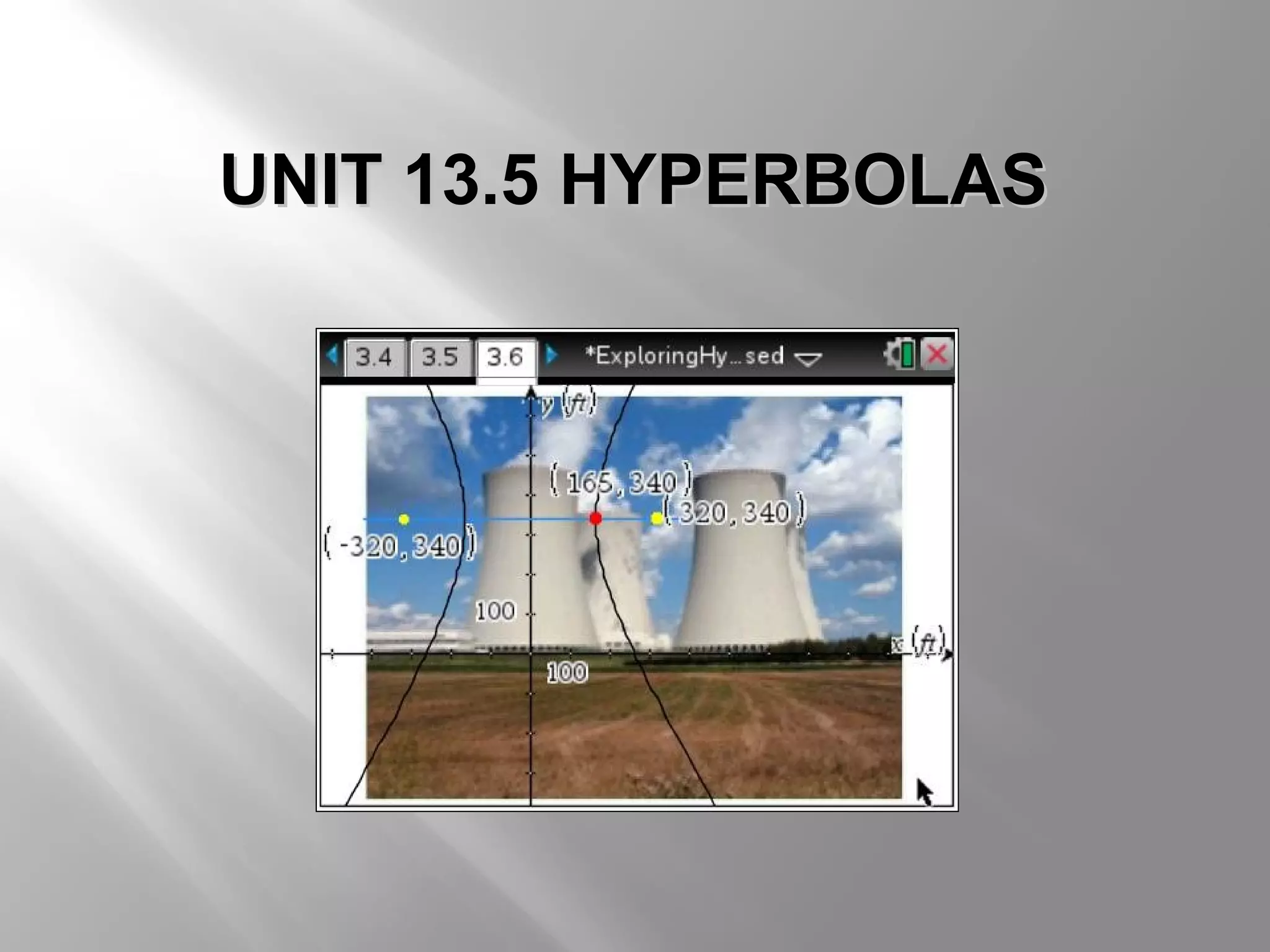

UNIT 13.5 HYPERBOLASUNIT 13.5 HYPERBOLAS
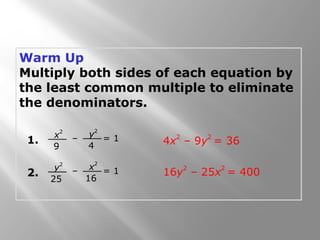
Warm Up
Multiply both sides of each equation by
the least common multiple to eliminate
the denominators.
4x
2
– 9y
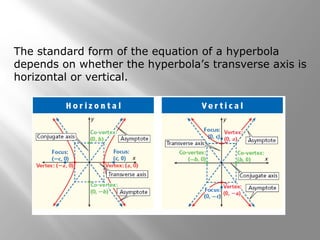
2
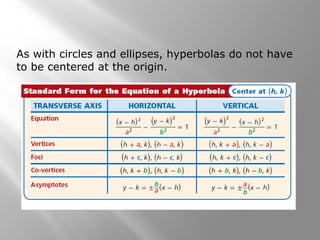
= 361.
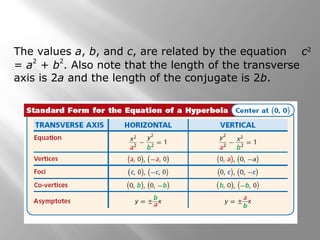
x
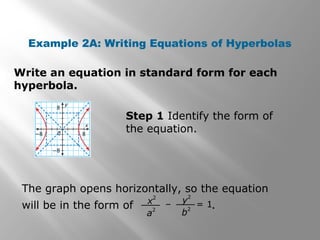
2
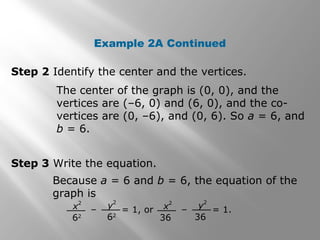
9
– = 1y
2
4
2.
y
2
25
– = 1x
2
16
16y
2
– 25x
2
= 400
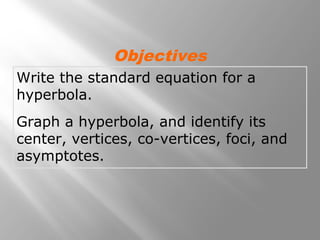
Write the standard equation for a
hyperbola.
Graph a hyperbola, and identify its
center, vertices, co-vertices, foci, and
asymptotes.
Objectives
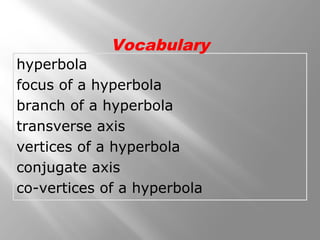
hyperbola
focus of a hyperbola
branch of a hyperbola
transverse axis
vertices of a hyperbola
conjugate axis
co-vertices of a hyperbola
Vocabulary
What would happen if you pulled the two foci of an
ellipse so far apart that they moved outside the
ellipse? The result would be a hyperbola, another
conic section.
A hyperbola is a set of points P(x, y) in a plane such
that the difference of the distances from P to fixed
points F1 and F2, the foci, is constant. For a hyperbola,
d = |PF1 – PF2 |, where d is the constant difference. You
can use the distance formula to find the equation of a
hyperbola.
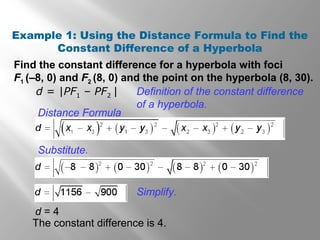
Find the constant difference for a hyperbola with foci
F1 (–8, 0) and F2 (8, 0) and the point on the hyperbola (8, 30).
Example 1: Using the Distance Formula to Find the
Constant Difference of a Hyperbola
Definition of the constant difference
of a hyperbola.
d = |PF1 – PF2 |
Distance Formula
Substitute.
Simplify.
d = 4
The constant difference is 4.
Find the constant difference for a hyperbola with foci
F1 (0, –10) and F2 (0, 10) and the point on the hyperbola (6, 7.5).
Check It Out! Example 1
As the graphs in the following table show, a hyperbola
contains two symmetrical parts called branches.
A hyperbola also has two axes of symmetry. The
transverse axis of symmetry contains the vertices
and, if it were extended, the foci of the hyperbola. The
vertices of a hyperbola are the endpoints of the
transverse axis.
The conjugate axis of symmetry separates the two
branches of the hyperbola. The co-vertices of a
hyperbola are the endpoints of the conjugate axis.
The transverse axis is not always longer than the
conjugate axis.
The standard form of the equation of a hyperbola
depends on whether the hyperbola’s transverse axis is
horizontal or vertical.
The values a, b, and c, are related by the equation c2
= a
2
+ b
2
. Also note that the length of the transverse
axis is 2a and the length of the conjugate is 2b.
Write an equation in standard form for each
hyperbola.
Example 2A: Writing Equations of Hyperbolas
Step 1 Identify the form of
the equation.
The graph opens horizontally, so the equation
will be in the form of .x
2
a
2
– = 1y
2
b
2
Example 2A Continued
Step 2 Identify the center and the vertices.
The center of the graph is (0, 0), and the
vertices are (–6, 0) and (6, 0), and the co-
vertices are (0, –6), and (0, 6). So a = 6, and
b = 6.
Step 3 Write the equation.
x
2
36
– = 1.y
2
36
Because a = 6 and b = 6, the equation of the
graph is
x
2
62
– = 1, ory
2
62
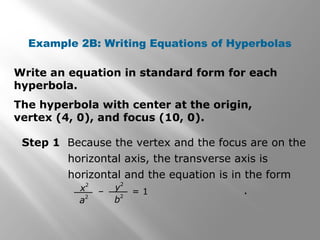
Example 2B: Writing Equations of Hyperbolas
The hyperbola with center at the origin,
vertex (4, 0), and focus (10, 0).
Step 1 Because the vertex and the focus are on the
horizontal axis, the transverse axis is
horizontal and the equation is in the form
.x
2
a
2
– = 1y
2
b
2
Write an equation in standard form for each
hyperbola.
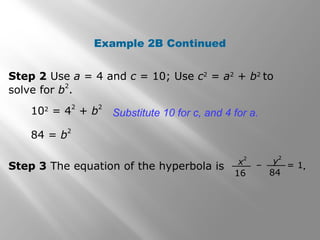
Example 2B Continued
Step 2 Use a = 4 and c = 10; Use c2
= a2
+ b2
to
solve for b
2
.
102
= 4
2
+ b
2
84 = b
2
Substitute 10 for c, and 4 for a.
Step 3 The equation of the hyperbola is .x
2
16
– = 1y
2
84
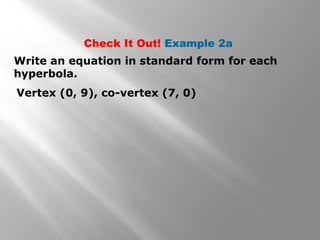
Write an equation in standard form for each
hyperbola.
Vertex (0, 9), co-vertex (7, 0)
Check It Out! Example 2a
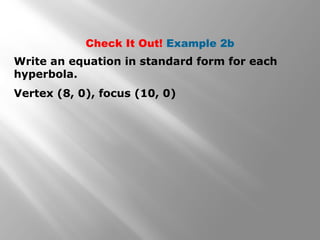
Vertex (8, 0), focus (10, 0)
Check It Out! Example 2b
Write an equation in standard form for each
hyperbola.
As with circles and ellipses, hyperbolas do not have
to be centered at the origin.
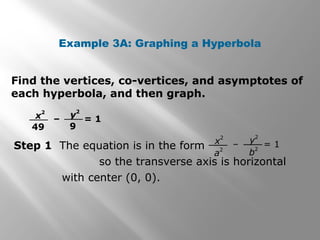
Example 3A: Graphing a Hyperbola
Find the vertices, co-vertices, and asymptotes of
each hyperbola, and then graph.
Step 1 The equation is in the form
so the transverse axis is horizontal
with center (0, 0).
x
2
a
2
– = 1y
2
b
2
x
2
49
– = 1y
2
9
Example 3A Continued
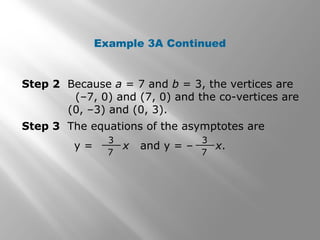
Step 2 Because a = 7 and b = 3, the vertices are
(–7, 0) and (7, 0) and the co-vertices are
(0, –3) and (0, 3).
3
7
Step 3 The equations of the asymptotes are
y = x and y = – x.
3
7
Example 3A Continued
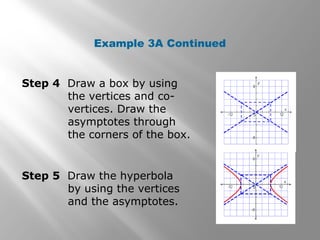
Step 4 Draw a box by using
the vertices and co-
vertices. Draw the
asymptotes through
the corners of the box.
Step 5 Draw the hyperbola
by using the vertices
and the asymptotes.
Find the vertices, co-vertices, and asymptotes of
each hyperbola, and then graph.
(x – 3)
2
9
– = 1(y + 5)
2
49
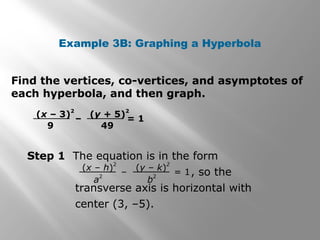
Step 1 The equation is in the form
, so the
transverse axis is horizontal with
center (3, –5).
(x – h)
2
a
2
– = 1(y – k)
2
b
2
Example 3B: Graphing a Hyperbola
Example 3B Continued
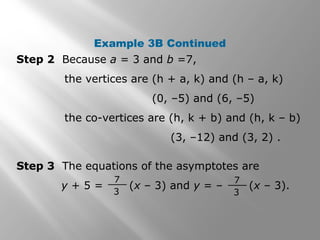
Step 2 Because a = 3 and b =7,
the vertices are (h + a, k) and (h – a, k)
(0, –5) and (6, –5)
the co-vertices are (h, k + b) and (h, k – b)
(3, –12) and (3, 2) .
Step 3 The equations of the asymptotes are
y + 5 = (x – 3) and y = – (x – 3).
7
3
7
3
Example 3B Continued
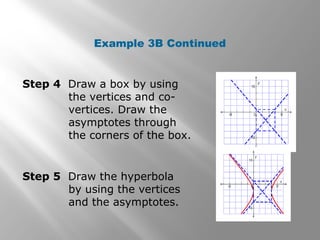
Step 4 Draw a box by using
the vertices and co-
vertices. Draw the
asymptotes through
the corners of the box.
Step 5 Draw the hyperbola
by using the vertices
and the asymptotes.
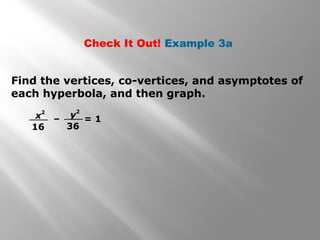
Find the vertices, co-vertices, and asymptotes of
each hyperbola, and then graph.
x
2
16
– = 1y
2
36
Check It Out! Example 3a
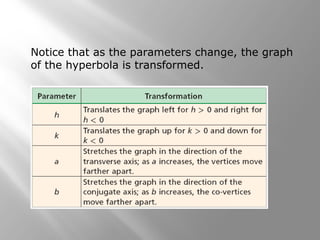
Notice that as the parameters change, the graph
of the hyperbola is transformed.
All rights belong to their respective owners.
Copyright Disclaimer Under Section 107 of
the Copyright Act 1976, allowance is made
for "fair use" for purposes such as criticism,
comment, news reporting, TEACHING,
scholarship, and research.
Fair use is a use permitted by copyright
statute that might otherwise be infringing.
Non-profit, EDUCATIONAL or personal use
tips the balance in favor of fair use.

Unit 13.5

  • 1.
    UNIT 13.5 HYPERBOLASUNIT13.5 HYPERBOLAS
  • 2.
    Warm Up Multiply bothsides of each equation by the least common multiple to eliminate the denominators. 4x 2 – 9y 2 = 361. x 2 9 – = 1y 2 4 2. y 2 25 – = 1x 2 16 16y 2 – 25x 2 = 400
  • 3.
    Write the standardequation for a hyperbola. Graph a hyperbola, and identify its center, vertices, co-vertices, foci, and asymptotes. Objectives
  • 4.
    hyperbola focus of ahyperbola branch of a hyperbola transverse axis vertices of a hyperbola conjugate axis co-vertices of a hyperbola Vocabulary
  • 5.
    What would happenif you pulled the two foci of an ellipse so far apart that they moved outside the ellipse? The result would be a hyperbola, another conic section. A hyperbola is a set of points P(x, y) in a plane such that the difference of the distances from P to fixed points F1 and F2, the foci, is constant. For a hyperbola, d = |PF1 – PF2 |, where d is the constant difference. You can use the distance formula to find the equation of a hyperbola.
  • 6.
    Find the constantdifference for a hyperbola with foci F1 (–8, 0) and F2 (8, 0) and the point on the hyperbola (8, 30). Example 1: Using the Distance Formula to Find the Constant Difference of a Hyperbola Definition of the constant difference of a hyperbola. d = |PF1 – PF2 | Distance Formula Substitute. Simplify. d = 4 The constant difference is 4.
  • 7.
    Find the constantdifference for a hyperbola with foci F1 (0, –10) and F2 (0, 10) and the point on the hyperbola (6, 7.5). Check It Out! Example 1
  • 8.
    As the graphsin the following table show, a hyperbola contains two symmetrical parts called branches. A hyperbola also has two axes of symmetry. The transverse axis of symmetry contains the vertices and, if it were extended, the foci of the hyperbola. The vertices of a hyperbola are the endpoints of the transverse axis. The conjugate axis of symmetry separates the two branches of the hyperbola. The co-vertices of a hyperbola are the endpoints of the conjugate axis. The transverse axis is not always longer than the conjugate axis.
  • 9.
    The standard formof the equation of a hyperbola depends on whether the hyperbola’s transverse axis is horizontal or vertical.
  • 10.
    The values a,b, and c, are related by the equation c2 = a 2 + b 2 . Also note that the length of the transverse axis is 2a and the length of the conjugate is 2b.
  • 11.
    Write an equationin standard form for each hyperbola. Example 2A: Writing Equations of Hyperbolas Step 1 Identify the form of the equation. The graph opens horizontally, so the equation will be in the form of .x 2 a 2 – = 1y 2 b 2
  • 12.
    Example 2A Continued Step2 Identify the center and the vertices. The center of the graph is (0, 0), and the vertices are (–6, 0) and (6, 0), and the co- vertices are (0, –6), and (0, 6). So a = 6, and b = 6. Step 3 Write the equation. x 2 36 – = 1.y 2 36 Because a = 6 and b = 6, the equation of the graph is x 2 62 – = 1, ory 2 62
  • 13.
    Example 2B: WritingEquations of Hyperbolas The hyperbola with center at the origin, vertex (4, 0), and focus (10, 0). Step 1 Because the vertex and the focus are on the horizontal axis, the transverse axis is horizontal and the equation is in the form .x 2 a 2 – = 1y 2 b 2 Write an equation in standard form for each hyperbola.
  • 14.
    Example 2B Continued Step2 Use a = 4 and c = 10; Use c2 = a2 + b2 to solve for b 2 . 102 = 4 2 + b 2 84 = b 2 Substitute 10 for c, and 4 for a. Step 3 The equation of the hyperbola is .x 2 16 – = 1y 2 84
  • 15.
    Write an equationin standard form for each hyperbola. Vertex (0, 9), co-vertex (7, 0) Check It Out! Example 2a
  • 16.
    Vertex (8, 0),focus (10, 0) Check It Out! Example 2b Write an equation in standard form for each hyperbola.
  • 17.
    As with circlesand ellipses, hyperbolas do not have to be centered at the origin.
  • 18.
    Example 3A: Graphinga Hyperbola Find the vertices, co-vertices, and asymptotes of each hyperbola, and then graph. Step 1 The equation is in the form so the transverse axis is horizontal with center (0, 0). x 2 a 2 – = 1y 2 b 2 x 2 49 – = 1y 2 9
  • 19.
    Example 3A Continued Step2 Because a = 7 and b = 3, the vertices are (–7, 0) and (7, 0) and the co-vertices are (0, –3) and (0, 3). 3 7 Step 3 The equations of the asymptotes are y = x and y = – x. 3 7
  • 20.
    Example 3A Continued Step4 Draw a box by using the vertices and co- vertices. Draw the asymptotes through the corners of the box. Step 5 Draw the hyperbola by using the vertices and the asymptotes.
  • 21.
    Find the vertices,co-vertices, and asymptotes of each hyperbola, and then graph. (x – 3) 2 9 – = 1(y + 5) 2 49 Step 1 The equation is in the form , so the transverse axis is horizontal with center (3, –5). (x – h) 2 a 2 – = 1(y – k) 2 b 2 Example 3B: Graphing a Hyperbola
  • 22.
    Example 3B Continued Step2 Because a = 3 and b =7, the vertices are (h + a, k) and (h – a, k) (0, –5) and (6, –5) the co-vertices are (h, k + b) and (h, k – b) (3, –12) and (3, 2) . Step 3 The equations of the asymptotes are y + 5 = (x – 3) and y = – (x – 3). 7 3 7 3
  • 23.
    Example 3B Continued Step4 Draw a box by using the vertices and co- vertices. Draw the asymptotes through the corners of the box. Step 5 Draw the hyperbola by using the vertices and the asymptotes.
  • 24.
    Find the vertices,co-vertices, and asymptotes of each hyperbola, and then graph. x 2 16 – = 1y 2 36 Check It Out! Example 3a
  • 25.
    Notice that asthe parameters change, the graph of the hyperbola is transformed.
  • 26.
    All rights belongto their respective owners. Copyright Disclaimer Under Section 107 of the Copyright Act 1976, allowance is made for "fair use" for purposes such as criticism, comment, news reporting, TEACHING, scholarship, and research. Fair use is a use permitted by copyright statute that might otherwise be infringing. Non-profit, EDUCATIONAL or personal use tips the balance in favor of fair use.