Hyperbola
In mathematics, a hyperbola is a type of conic section, which is a curve that is created
by the intersection of a plane with a cone. A hyperbola has two branches, which are
mirror images of each other. That are separated by a center line called
the “transverse axis”. The distance between the two branche is define to by its
“foci,”. The shape of a hyperbola is determined by the ratio of the distance between its
foci to its transverse axis.
that are often used to model real-world phenomena, such as the paths of objects
moving at high speeds and the shapes of orbits in celestial mechanics.
Table of Contents
 BRANCHES (Hyperbola)
 Origin (Hyperbola)
 Equation (Hyperbola)
 Parts
 Standard Equation
 Trignmetry Function
 Curve
BRANCHES (Hyperbola)
The branche are the two curve lines that make up the shape of the hyperbola. These
branches are symmetric with respect to the center line of the hyperbola, known as the
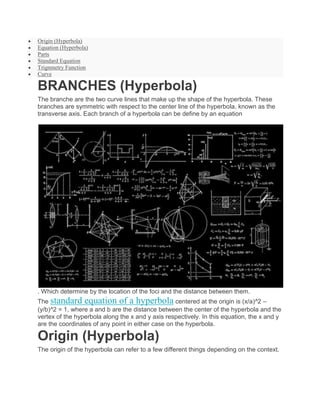
transverse axis. Each branch of a hyperbola can be define by an equation
. Which determine by the location of the foci and the distance between them.
The standard equation of a hyperbola centered at the origin is (x/a)^2 –
(y/b)^2 = 1, where a and b are the distance between the center of the hyperbola and the
vertex of the hyperbola along the x and y axis respectively. In this equation, the x and y
are the coordinates of any point in either case on the hyperbola.
Origin (Hyperbola)
The origin of the hyperbola can refer to a few different things depending on the context.
1. In the mathematical context, the origin of the hyperbola is the point where the two
branches of the hyperbola cross the transverse axis. It is also the center of the hyperbola.
2. In the geometric context, the origin is the point where the conic section is construct by
the intersection of a plane and a double-napped right cone.
3. In the physical context, That was first studied by Menaechmus and Apollonius of Perga
in the 3rd and 2nd centuries BC, respectively. Apollonius of Perga was the first to
introduce the term “hyperbola” and wrote a treatise on the subject.
It is worth noting that the concept is not in short to a certain time or place.
It is a mathematical concept
that has been studied by many cultures and civilizations throughout history. The origin
of the word now hyperbola may have different etymology depending on the culture and
language.
Equation (Hyperbola)
The equation can represent in two forms, standard form and general form.
1. Standard form: The standard form of the equation is (x/a)^2 – (y/b)^2 = 1, where a and b
are the distance between the center and the vertex along the x and y axis respectively.
2. General form: The general form of the equation is (x – h)^2/a^2 – (y – k)^2/b^2 = 1,
where (h,k) is the center, a and b are the distance between the center and the vertex and x
and y are the coordinates of any point on the hyperbola.
It is important to note that the equation. That’s always represente as the difference of
squares of x and y coordinates. This is what makes it different from an ellipse. Which
represent as the sum of the squares of x and y coordinates. Also, depending on the
position and orientation the equation could adjust by changing the sign of the difference.
Parts
That is a type of conic section, which is a curve that is create by the intersection of a
plane with a cone. These are the parts,
1. In summary, Foci (plural of focus): The two points that are locate on the transverse axis.
That use to define the shape. The distance between the two foci is called the “latus
rectum” and the ratio of the latus rectum to the transverse axis determines the shape.
2. Vertex: The point of intersection with the transverse axis.
3. Transverse axis: The line that runs through the vertex and is perpendicular to the line that
connects the two foci.
4. Asymptotes: The two straight lines that approaches but never touches. The asymptotes
are always perpendicular to the transverse axis and they divide into four branches.
5. Branches: The two curved lines that make up the shape of the hyperbola. These branches
are symmetric with respect to the center line, known as the transverse axis.
6. Directrix: A straight line that use to define. Every point on the hyperbola is equidistant
from the focus and the directrix.
7. Eccentricity : Once a value that describes how elongated or squashed a hyperbola is, it
represent by the letter “e”.
All these part are essential to define a hyperbola and to be able to graph it and use it in
various fields of study , such as physics, engineering, and mathematics.
Standard Equation
The standard form of the equation is:
(x/a)^2 – (y/b)^2 = 1
where a and b are positive constants, called the “semi-major” and “semi-minor” axis,
respectively, and x and y are the coordinates of any point on the hyperbola. The
standard form use when the center is at the origin (0,0). The transverse axis is parallel
to the x-axis.
It’s worth noting that the equation can also represent as:
-(y/b)^2 + (x/a)^2 = 1
This also consider as the standard form of the hyperbola. The difference is that the
branches are now pointing in the opposite direction.
In both cases, the semi-major axis ‘a’ is the distance between the center and the vertex
along the x-axis. The semi-minor axis ‘b’ is the distance between the center of the
hyperbola and the vertex along the y-axis. The foci are located at a distance of √(a^2 +
b^2) from the center on the transverse axis.
Trignmetry Function
Hyperbolas can represent in terms of trigonometric functions such as sine and cosine.
The standard form equation of a hyperbola is (x/a)^2 – (y/b)^2 = 1 where (a,b) is the
distance between the center and vertex along x and y axis. One way to express the
hyperbola in terms of trigonometric functions is by using the following equations: x =
acosh(t), y = bsinh(t) or x = asinh(t), y = bcosh(t)
where t is a parameter and cosh(t) and sinh(t) are hyperbolic functions. These
equations describe the general form in terms of the parameter t, which can use to plot
the hyperbola for different values of t.
Another way to express the hyperbola in terms of trigonometric functions is by using
polar coordinates. The standard form equation in polar coordinates is
(rcos(theta))^2 – (rsin(theta))^2 = 1
Where r is the distance from the origin to a point on the hyperbola and theta is the angle
between the positive x-axis and the line connecting the origin to the point.The above
equations allow us to express the hyperbola in different forms which can be useful in
different fields of study.
Curve
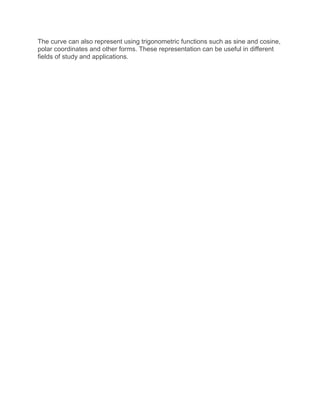
The curve define by the equation (x/a)^2 – (y/b)^2 = 1, where a and b are positive
constants. This equation represents the standard form when the center of the hyperbola
is located at the origin (0,0) and the transverse axis is parallel to the x-axis.
The curve is a smooth, continuous, and symmetric shape that is defined by the
values of x and y that satisfy the equation. It has two branches, each of which is
mirror images of the other and is separated by a center line called the transverse
axis.
The distance between the two branches of the hyperbola is defined by its foci. The
shape determine by the ratio of the distance between its foci to its transverse axis.
once the curve is open and extends to infinity in both directions along the
asymptotes, which are two straight lines that the hyperbola approaches but never
touches. The asymptotes divide the hyperbola into four branches, and it is an
important feature.
The curve can also represent using trigonometric functions such as sine and cosine,
polar coordinates and other forms. These representation can be useful in different
fields of study and applications.

Hyperbola.docx

  • 1.
    Hyperbola In mathematics, ahyperbola is a type of conic section, which is a curve that is created by the intersection of a plane with a cone. A hyperbola has two branches, which are mirror images of each other. That are separated by a center line called the “transverse axis”. The distance between the two branche is define to by its “foci,”. The shape of a hyperbola is determined by the ratio of the distance between its foci to its transverse axis. that are often used to model real-world phenomena, such as the paths of objects moving at high speeds and the shapes of orbits in celestial mechanics. Table of Contents  BRANCHES (Hyperbola)
  • 2.
     Origin (Hyperbola) Equation (Hyperbola)  Parts  Standard Equation  Trignmetry Function  Curve BRANCHES (Hyperbola) The branche are the two curve lines that make up the shape of the hyperbola. These branches are symmetric with respect to the center line of the hyperbola, known as the transverse axis. Each branch of a hyperbola can be define by an equation . Which determine by the location of the foci and the distance between them. The standard equation of a hyperbola centered at the origin is (x/a)^2 – (y/b)^2 = 1, where a and b are the distance between the center of the hyperbola and the vertex of the hyperbola along the x and y axis respectively. In this equation, the x and y are the coordinates of any point in either case on the hyperbola. Origin (Hyperbola) The origin of the hyperbola can refer to a few different things depending on the context.
  • 3.
    1. In themathematical context, the origin of the hyperbola is the point where the two branches of the hyperbola cross the transverse axis. It is also the center of the hyperbola. 2. In the geometric context, the origin is the point where the conic section is construct by the intersection of a plane and a double-napped right cone. 3. In the physical context, That was first studied by Menaechmus and Apollonius of Perga in the 3rd and 2nd centuries BC, respectively. Apollonius of Perga was the first to introduce the term “hyperbola” and wrote a treatise on the subject. It is worth noting that the concept is not in short to a certain time or place. It is a mathematical concept that has been studied by many cultures and civilizations throughout history. The origin of the word now hyperbola may have different etymology depending on the culture and language. Equation (Hyperbola) The equation can represent in two forms, standard form and general form. 1. Standard form: The standard form of the equation is (x/a)^2 – (y/b)^2 = 1, where a and b are the distance between the center and the vertex along the x and y axis respectively.
  • 4.
    2. General form:The general form of the equation is (x – h)^2/a^2 – (y – k)^2/b^2 = 1, where (h,k) is the center, a and b are the distance between the center and the vertex and x and y are the coordinates of any point on the hyperbola. It is important to note that the equation. That’s always represente as the difference of squares of x and y coordinates. This is what makes it different from an ellipse. Which represent as the sum of the squares of x and y coordinates. Also, depending on the position and orientation the equation could adjust by changing the sign of the difference. Parts That is a type of conic section, which is a curve that is create by the intersection of a plane with a cone. These are the parts, 1. In summary, Foci (plural of focus): The two points that are locate on the transverse axis. That use to define the shape. The distance between the two foci is called the “latus rectum” and the ratio of the latus rectum to the transverse axis determines the shape. 2. Vertex: The point of intersection with the transverse axis. 3. Transverse axis: The line that runs through the vertex and is perpendicular to the line that connects the two foci. 4. Asymptotes: The two straight lines that approaches but never touches. The asymptotes are always perpendicular to the transverse axis and they divide into four branches. 5. Branches: The two curved lines that make up the shape of the hyperbola. These branches are symmetric with respect to the center line, known as the transverse axis. 6. Directrix: A straight line that use to define. Every point on the hyperbola is equidistant from the focus and the directrix. 7. Eccentricity : Once a value that describes how elongated or squashed a hyperbola is, it represent by the letter “e”. All these part are essential to define a hyperbola and to be able to graph it and use it in various fields of study , such as physics, engineering, and mathematics.
  • 5.
    Standard Equation The standardform of the equation is: (x/a)^2 – (y/b)^2 = 1 where a and b are positive constants, called the “semi-major” and “semi-minor” axis, respectively, and x and y are the coordinates of any point on the hyperbola. The standard form use when the center is at the origin (0,0). The transverse axis is parallel to the x-axis. It’s worth noting that the equation can also represent as: -(y/b)^2 + (x/a)^2 = 1 This also consider as the standard form of the hyperbola. The difference is that the branches are now pointing in the opposite direction. In both cases, the semi-major axis ‘a’ is the distance between the center and the vertex along the x-axis. The semi-minor axis ‘b’ is the distance between the center of the hyperbola and the vertex along the y-axis. The foci are located at a distance of √(a^2 + b^2) from the center on the transverse axis. Trignmetry Function Hyperbolas can represent in terms of trigonometric functions such as sine and cosine. The standard form equation of a hyperbola is (x/a)^2 – (y/b)^2 = 1 where (a,b) is the distance between the center and vertex along x and y axis. One way to express the hyperbola in terms of trigonometric functions is by using the following equations: x = acosh(t), y = bsinh(t) or x = asinh(t), y = bcosh(t) where t is a parameter and cosh(t) and sinh(t) are hyperbolic functions. These equations describe the general form in terms of the parameter t, which can use to plot the hyperbola for different values of t. Another way to express the hyperbola in terms of trigonometric functions is by using polar coordinates. The standard form equation in polar coordinates is (rcos(theta))^2 – (rsin(theta))^2 = 1 Where r is the distance from the origin to a point on the hyperbola and theta is the angle between the positive x-axis and the line connecting the origin to the point.The above equations allow us to express the hyperbola in different forms which can be useful in different fields of study.
  • 6.
    Curve The curve defineby the equation (x/a)^2 – (y/b)^2 = 1, where a and b are positive constants. This equation represents the standard form when the center of the hyperbola is located at the origin (0,0) and the transverse axis is parallel to the x-axis. The curve is a smooth, continuous, and symmetric shape that is defined by the values of x and y that satisfy the equation. It has two branches, each of which is mirror images of the other and is separated by a center line called the transverse axis. The distance between the two branches of the hyperbola is defined by its foci. The shape determine by the ratio of the distance between its foci to its transverse axis. once the curve is open and extends to infinity in both directions along the asymptotes, which are two straight lines that the hyperbola approaches but never touches. The asymptotes divide the hyperbola into four branches, and it is an important feature.
  • 8.
    The curve canalso represent using trigonometric functions such as sine and cosine, polar coordinates and other forms. These representation can be useful in different fields of study and applications.