10.2 Ellipses
Chapter 10 Analytic Geometry
Concepts and Objectives
 Ellipses
 Identify the equation of an ellipse
 Find the center, x-radius, and y-radius of an ellipse
 Find the major and minor axes
 Find the foci and focal length of an ellipse
 Write the equation of an ellipse
 Solve problems involving ellipses
Ellipses
 An ellipse, geometrically speaking, is a set of points in a
plane such that for each point, the sum of its distances,
d1 + d2, from two fixed points F1 and F2, is constant.
 What does this mean?
Parts of an Ellipse
 Parts of an ellipse:
 Center
Parts of an Ellipse
 Parts of an ellipse:
 Center
 Vertices (ea. vertex)
 
Parts of an Ellipse
 Parts of an ellipse:
 Center
 Vertices (ea. vertex)
 Major axis
 
Parts of an Ellipse
 Parts of an ellipse:
 Center
 Vertices (ea. vertex)
 Major axis
 Minor axis
 
Parts of an Ellipse
 Parts of an ellipse:
 Center
 Vertices (ea. vertex)
 Major axis
 Minor axis
 Foci (ea. focus)
 
Parts of an Ellipse
 Other important parts:
 The semi-major and semi-minor axes are half the
length of the major and minor axes.
 The distance from the center to the ellipse in the
x-direction is called the x-radius. Likewise, the
distance in the y-direction is called the y-radius.
 The distance between the foci is called the focal
length. The distance between the center and a focus
is called the focal radius.
Standard Form
 The standard form of an ellipse centered at h, k is
where rx is the x-radius and ry is the y-radius.
 To graph an ellipse from the standard form, plot the
center, mark the x- and y-radii, and sketch in the curve.
 The ellipse will be wider in the direction that has the
larger radius.
 
 
 
 
 
   
   
2
2
1
x y
x h y k
r r
Standard Form
 Example: Sketch the graph of
 
   
 
   
   
2 2
4 1
1
3 5
x y
Standard Form
 Example: Sketch the graph of
The center is at 4, –1
 
   
 
   
   
2 2
4 1
1
3 5
x y
Standard Form
 Example: Sketch the graph of
The center is at 4, –1
The x-radius is 3
 
   
 
   
   
2 2
4 1
1
3 5
x y
Standard Form
 Example: Sketch the graph of
The center is at 4, –1
The x-radius is 3
The y-radius is 5
 
   
 
   
   
2 2
4 1
1
3 5
x y
Standard Form
 Example: Sketch the graph of
The center is at 4, –1
The x-radius is 3
The y-radius is 5
Sketch in the curves
 
   
 
   
   
2 2
4 1
1
3 5
x y
General Form of an Ellipse
 Example: Sketch the graph of
    
2 2
4 9 16 90 205 0
x y x y
General Form of an Ellipse
 Example: Sketch the graph of
To sketch the graph, we have to rewrite the equation:
    
2 2
4 9 16 90 205 0
x y x y
   
    
2 2
4 16 9 90 205
x x y y
General Form of an Ellipse
 Example: Sketch the graph of
To sketch the graph, we have to rewrite the equation:
    
2 2
4 9 16 90 205 0
x y x y
   
    
2 2
4 16 9 90 205
x x y y
       
    
 
 
2 2
2
2
2 2
4 4 10 205
2 4 2
9 5 9 5
x x y y
Remember, you have to
factor out the
coefficients of x2 and y2!
General Form of an Ellipse
 Example: Sketch the graph of
To sketch the graph, we have to rewrite the equation:
    
2 2
4 9 16 90 205 0
x y x y
   
    
2 2
4 16 9 90 205
x x y y
       
    
 
 
2 2
2
2
2 2
4 4 10 205
2 4 2
9 5 9 5
x x y y
   
   
2 2
4 2 9 5 36
x y
General Form of an Ellipse
 Example: Sketch the graph of
To sketch the graph, we have to rewrite the equation:
    
2 2
4 9 16 90 205 0
x y x y
   
    
2 2
4 16 9 90 205
x x y y
       
    
 
 
2 2
2
2
2 2
4 4 10 205
2 4 2
9 5 9 5
x x y y
   
 
 
2 2
4 2 9 5 36
36 36 36
x y
General Form of an Ellipse
 Example: Sketch the graph of
To sketch the graph, we have to rewrite the equation:
    
2 2
4 9 16 90 205 0
x y x y
   
    
2 2
4 16 9 90 205
x x y y
       
    
 
 
2 2
2
2
2 2
4 4 10 205
2 4 2
9 5 9 5
x x y y
   
 
 
2 2
4 2 9 5 36
36 36 36
x y
 
   
 
   
   
2 2
2 5
1
3 2
x y
   
 
 
2 2
2 5
1
9 4
x y

General Form of an Ellipse
 Example (cont.):
The center is at 2, –5
The x-radius is 3 (semi-major)
The y-radius is 2 (semi-minor)
 
   
 
   
   
2 2
2 5
1
3 2
x y
Ellipses
 With ellipses, we use the following notation:
 a is the length of the semi-major axis
 b is the length of the semi-minor axis
 c is the length of the focal radius.
 Therefore,
 The length of the major axis is 2a
 The length of the minor axis is 2b
 The sum of the distances from a point x, y on the
ellipse to the two foci is 2a (the major axis length)
Focal Radius
Not only does the dotted
line trace the outline of the
ellipse, but it is also the
length of the major axis. As
you can see from the
picture, half of that length
(a) is the hypotenuse of the
triangle formed by the semi-
minor axis and the focal
radius. This gives us the
formula:
 
2 2 2
c a b
b
a
c
(careful!)
Focal Length
 Example: Write the equation of the ellipse having center
at the origin, foci at –5, 0 and 5, 0, and major axis of
length 18 units.
Focal Length
 Example: Write the equation of the ellipse having center
at the origin, foci at –5, 0 and 5, 0, and major axis of
length 18 units.
Since the major axis is 18 units long, 2a = 18, so a = 9.
The distance between the center and a focus, c, is 5.
Therefore, we can find b using the formula:
 
2 2 2
c a b
 
2 2 2
5 9 b
  
2 2 2
9 5 56
b
 56
b
Focal Length
 Example (cont.):
The foci lie along the major axis, so we know that rx = a.
Putting it all together, we have:
or
 
 
 
   
   
2
2
1
9 56
x y
 
2 2
1
81 56
x y
Eccentricity
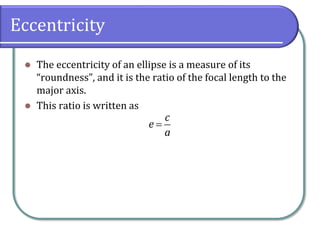
 The eccentricity of an ellipse is a measure of its
“roundness”, and it is the ratio of the focal length to the
major axis.
 This ratio is written as

c
e
a
Eccentricity
 Example: The orbit of Jupiter is an ellipse with the sun
at one focus (mostly). The eccentricity of the ellipse is
0.0489, and the maximum distance of Jupiter from the
sun is 507.4 million miles. Find the closest distance that
Jupiter comes to the sun.
Eccentricity
 Example: The orbit of Jupiter is an ellipse with the sun
at one focus (mostly). The eccentricity of the ellipse is
0.0489, and the maximum distance of Jupiter from the
sun is 507.4 million miles. Find the closest distance that
Jupiter comes to the sun.


Jupiter
Sun
a + c
a – c
0.0489
c
a
0.0489
c a
 507.4
a c
 
0.0489 507.4
a a
 
507.4
483.74
1.0489
a
Eccentricity
 Example (cont.):


Jupiter
Sun
a + c
a – c
 
0.0489 483.74
c
23.65
c
  
483.74 23.65
a c
460.1 million miles
Classwork
 College Algebra
 Page 968: 4-14 (even), page 957: 20-38 (even),
page 908: 78-82 (even)

10.2 Ellipses

  • 1.
    10.2 Ellipses Chapter 10Analytic Geometry
  • 2.
    Concepts and Objectives Ellipses  Identify the equation of an ellipse  Find the center, x-radius, and y-radius of an ellipse  Find the major and minor axes  Find the foci and focal length of an ellipse  Write the equation of an ellipse  Solve problems involving ellipses
  • 3.
    Ellipses  An ellipse,geometrically speaking, is a set of points in a plane such that for each point, the sum of its distances, d1 + d2, from two fixed points F1 and F2, is constant.  What does this mean?
  • 4.
    Parts of anEllipse  Parts of an ellipse:  Center
  • 5.
    Parts of anEllipse  Parts of an ellipse:  Center  Vertices (ea. vertex)  
  • 6.
    Parts of anEllipse  Parts of an ellipse:  Center  Vertices (ea. vertex)  Major axis  
  • 7.
    Parts of anEllipse  Parts of an ellipse:  Center  Vertices (ea. vertex)  Major axis  Minor axis  
  • 8.
    Parts of anEllipse  Parts of an ellipse:  Center  Vertices (ea. vertex)  Major axis  Minor axis  Foci (ea. focus)  
  • 9.
    Parts of anEllipse  Other important parts:  The semi-major and semi-minor axes are half the length of the major and minor axes.  The distance from the center to the ellipse in the x-direction is called the x-radius. Likewise, the distance in the y-direction is called the y-radius.  The distance between the foci is called the focal length. The distance between the center and a focus is called the focal radius.
  • 10.
    Standard Form  Thestandard form of an ellipse centered at h, k is where rx is the x-radius and ry is the y-radius.  To graph an ellipse from the standard form, plot the center, mark the x- and y-radii, and sketch in the curve.  The ellipse will be wider in the direction that has the larger radius.                   2 2 1 x y x h y k r r
  • 11.
    Standard Form  Example:Sketch the graph of                 2 2 4 1 1 3 5 x y
  • 12.
    Standard Form  Example:Sketch the graph of The center is at 4, –1                 2 2 4 1 1 3 5 x y
  • 13.
    Standard Form  Example:Sketch the graph of The center is at 4, –1 The x-radius is 3                 2 2 4 1 1 3 5 x y
  • 14.
    Standard Form  Example:Sketch the graph of The center is at 4, –1 The x-radius is 3 The y-radius is 5                 2 2 4 1 1 3 5 x y
  • 15.
    Standard Form  Example:Sketch the graph of The center is at 4, –1 The x-radius is 3 The y-radius is 5 Sketch in the curves                 2 2 4 1 1 3 5 x y
  • 16.
    General Form ofan Ellipse  Example: Sketch the graph of      2 2 4 9 16 90 205 0 x y x y
  • 17.
    General Form ofan Ellipse  Example: Sketch the graph of To sketch the graph, we have to rewrite the equation:      2 2 4 9 16 90 205 0 x y x y          2 2 4 16 9 90 205 x x y y
  • 18.
    General Form ofan Ellipse  Example: Sketch the graph of To sketch the graph, we have to rewrite the equation:      2 2 4 9 16 90 205 0 x y x y          2 2 4 16 9 90 205 x x y y                  2 2 2 2 2 2 4 4 10 205 2 4 2 9 5 9 5 x x y y Remember, you have to factor out the coefficients of x2 and y2!
  • 19.
    General Form ofan Ellipse  Example: Sketch the graph of To sketch the graph, we have to rewrite the equation:      2 2 4 9 16 90 205 0 x y x y          2 2 4 16 9 90 205 x x y y                  2 2 2 2 2 2 4 4 10 205 2 4 2 9 5 9 5 x x y y         2 2 4 2 9 5 36 x y
  • 20.
    General Form ofan Ellipse  Example: Sketch the graph of To sketch the graph, we have to rewrite the equation:      2 2 4 9 16 90 205 0 x y x y          2 2 4 16 9 90 205 x x y y                  2 2 2 2 2 2 4 4 10 205 2 4 2 9 5 9 5 x x y y         2 2 4 2 9 5 36 36 36 36 x y
  • 21.
    General Form ofan Ellipse  Example: Sketch the graph of To sketch the graph, we have to rewrite the equation:      2 2 4 9 16 90 205 0 x y x y          2 2 4 16 9 90 205 x x y y                  2 2 2 2 2 2 4 4 10 205 2 4 2 9 5 9 5 x x y y         2 2 4 2 9 5 36 36 36 36 x y                 2 2 2 5 1 3 2 x y         2 2 2 5 1 9 4 x y 
  • 22.
    General Form ofan Ellipse  Example (cont.): The center is at 2, –5 The x-radius is 3 (semi-major) The y-radius is 2 (semi-minor)                 2 2 2 5 1 3 2 x y
  • 23.
    Ellipses  With ellipses,we use the following notation:  a is the length of the semi-major axis  b is the length of the semi-minor axis  c is the length of the focal radius.  Therefore,  The length of the major axis is 2a  The length of the minor axis is 2b  The sum of the distances from a point x, y on the ellipse to the two foci is 2a (the major axis length)
  • 24.
    Focal Radius Not onlydoes the dotted line trace the outline of the ellipse, but it is also the length of the major axis. As you can see from the picture, half of that length (a) is the hypotenuse of the triangle formed by the semi- minor axis and the focal radius. This gives us the formula:   2 2 2 c a b b a c (careful!)
  • 25.
    Focal Length  Example:Write the equation of the ellipse having center at the origin, foci at –5, 0 and 5, 0, and major axis of length 18 units.
  • 26.
    Focal Length  Example:Write the equation of the ellipse having center at the origin, foci at –5, 0 and 5, 0, and major axis of length 18 units. Since the major axis is 18 units long, 2a = 18, so a = 9. The distance between the center and a focus, c, is 5. Therefore, we can find b using the formula:   2 2 2 c a b   2 2 2 5 9 b    2 2 2 9 5 56 b  56 b
  • 27.
    Focal Length  Example(cont.): The foci lie along the major axis, so we know that rx = a. Putting it all together, we have: or               2 2 1 9 56 x y   2 2 1 81 56 x y
  • 28.
    Eccentricity  The eccentricityof an ellipse is a measure of its “roundness”, and it is the ratio of the focal length to the major axis.  This ratio is written as  c e a
  • 29.
    Eccentricity  Example: Theorbit of Jupiter is an ellipse with the sun at one focus (mostly). The eccentricity of the ellipse is 0.0489, and the maximum distance of Jupiter from the sun is 507.4 million miles. Find the closest distance that Jupiter comes to the sun.
  • 30.
    Eccentricity  Example: Theorbit of Jupiter is an ellipse with the sun at one focus (mostly). The eccentricity of the ellipse is 0.0489, and the maximum distance of Jupiter from the sun is 507.4 million miles. Find the closest distance that Jupiter comes to the sun.   Jupiter Sun a + c a – c 0.0489 c a 0.0489 c a  507.4 a c   0.0489 507.4 a a   507.4 483.74 1.0489 a
  • 31.
    Eccentricity  Example (cont.):   Jupiter Sun a+ c a – c   0.0489 483.74 c 23.65 c    483.74 23.65 a c 460.1 million miles
  • 32.
    Classwork  College Algebra Page 968: 4-14 (even), page 957: 20-38 (even), page 908: 78-82 (even)