HYPERBO
LAS
Discussants:
Table 3
Concept of a
Hyperbola
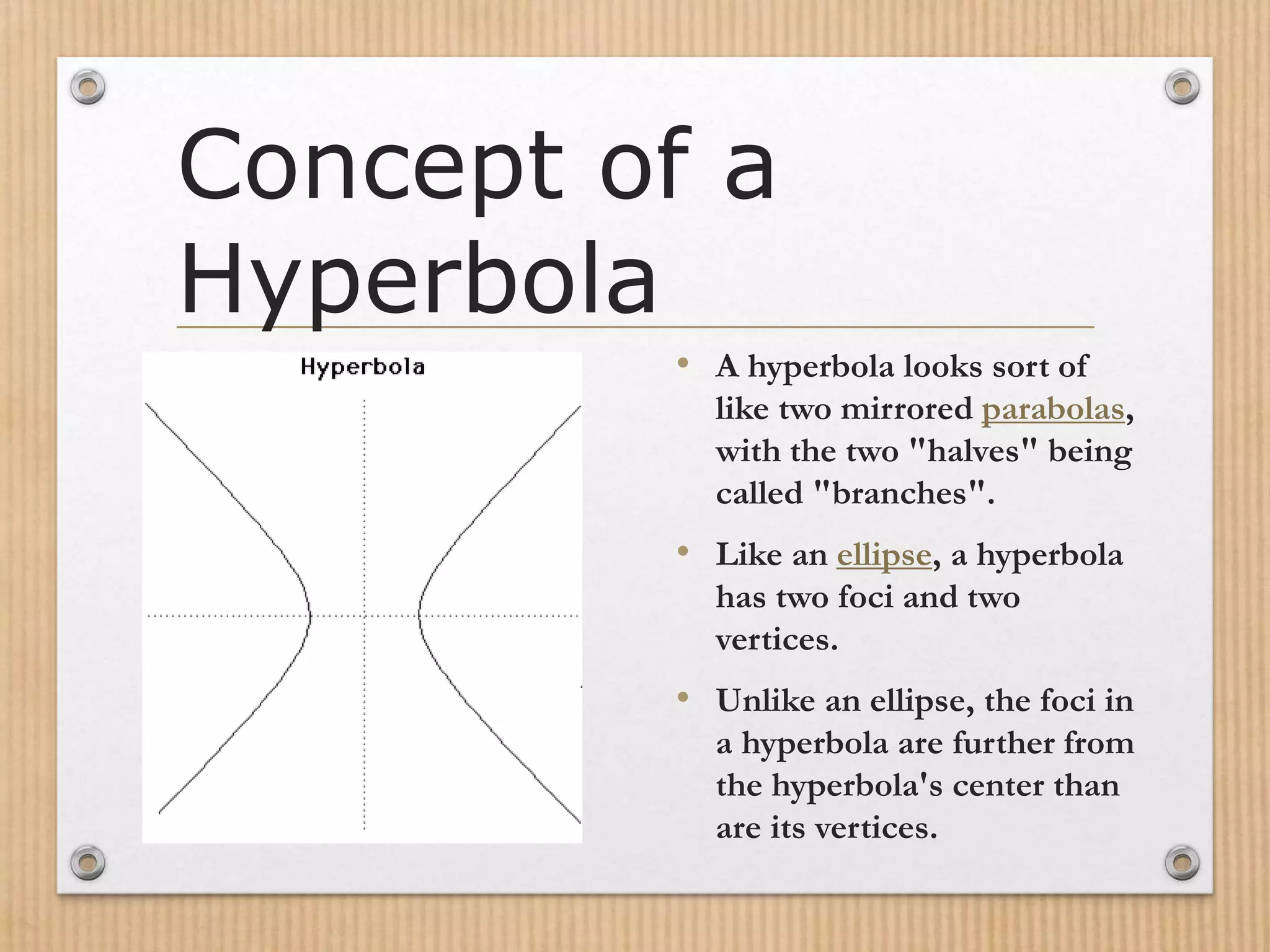
• A hyperbola looks sort of
like two mirrored parabolas,
with the two "halves" being
called "branches".
• Like an ellipse, a hyperbola
has two foci and two
vertices.
• Unlike an ellipse, the foci in
a hyperbola are further from
the hyperbola's center than
are its vertices.
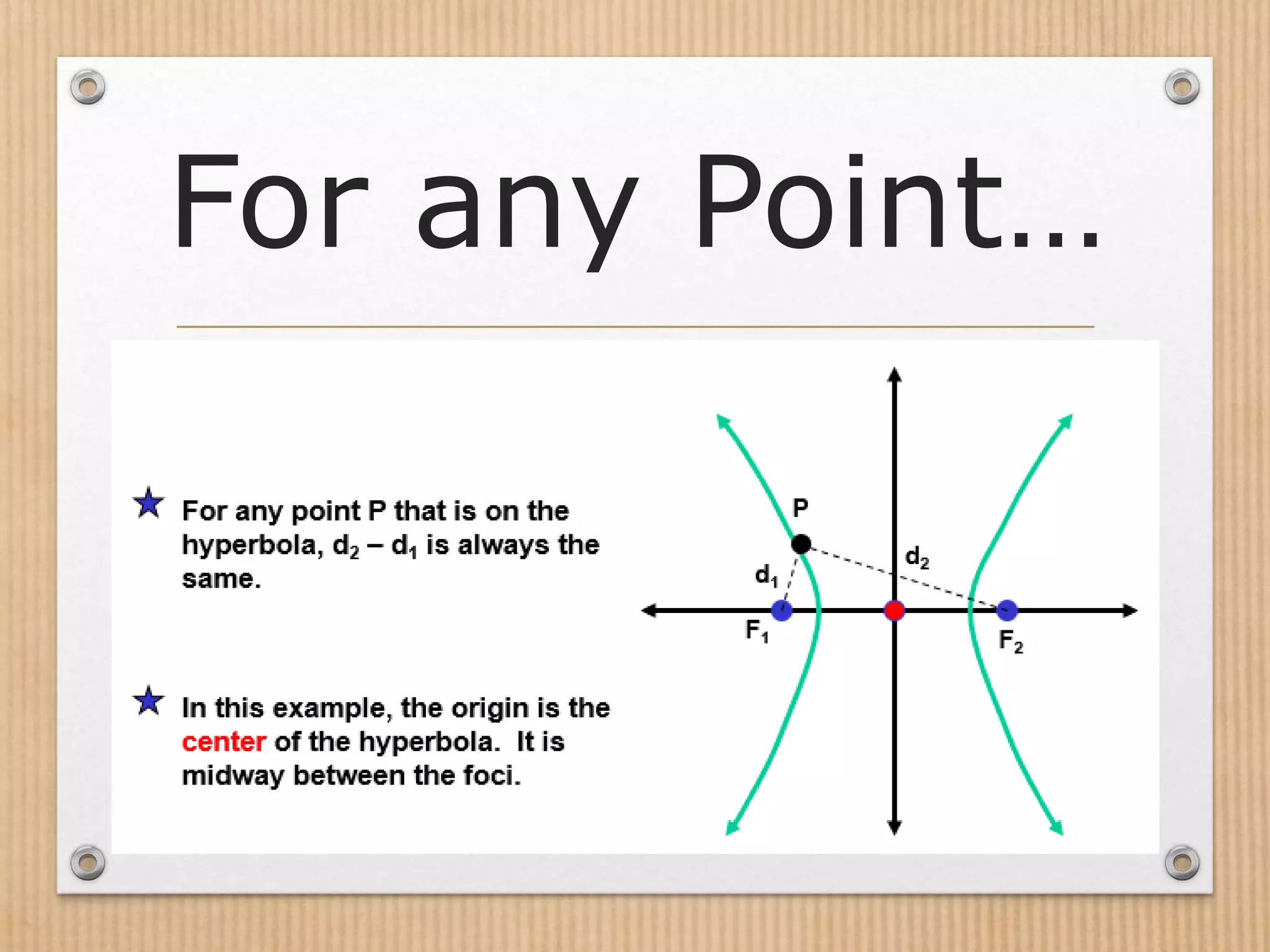
For any Point…
Therefore
…
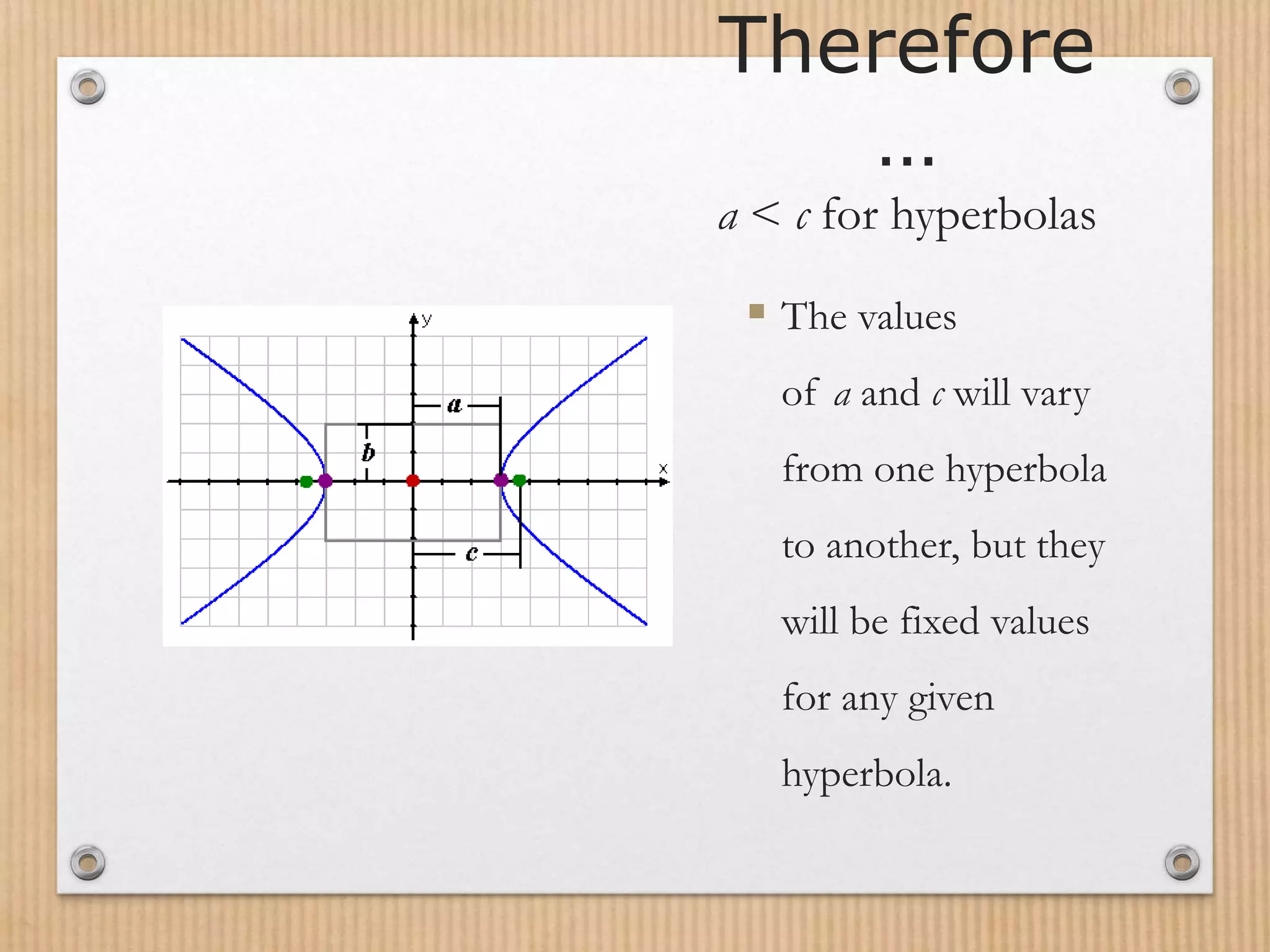
a < c for hyperbolas
 The values
of a and c will vary
from one hyperbola
to another, but they
will be fixed values
for any given
hyperbola.
Parts of a
Hyperbola
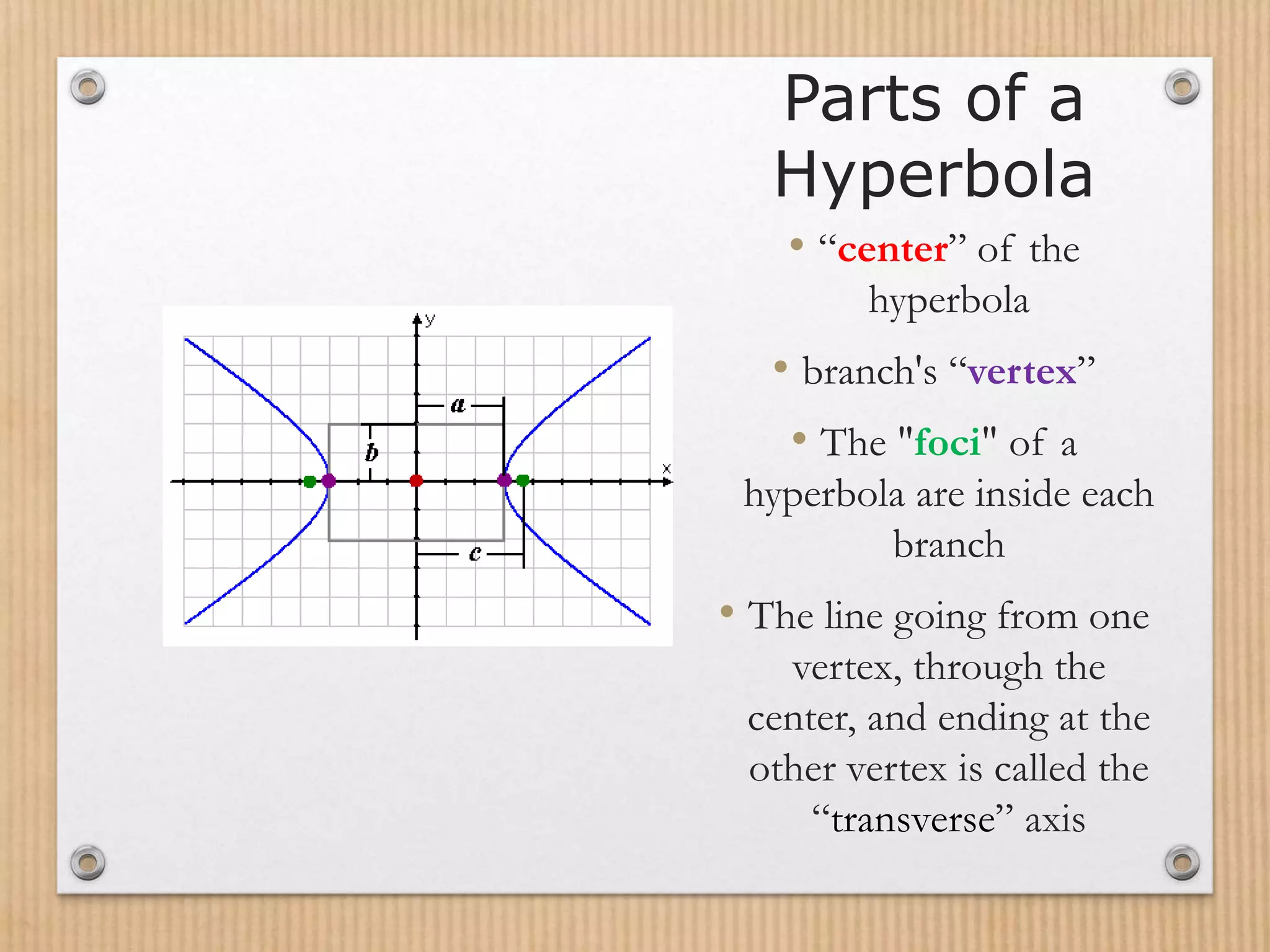
• “center” of the
hyperbola
• branch's “vertex”
• The "foci" of a
hyperbola are inside each
branch
• The line going from one
vertex, through the
center, and ending at the
other vertex is called the
“transverse” axis
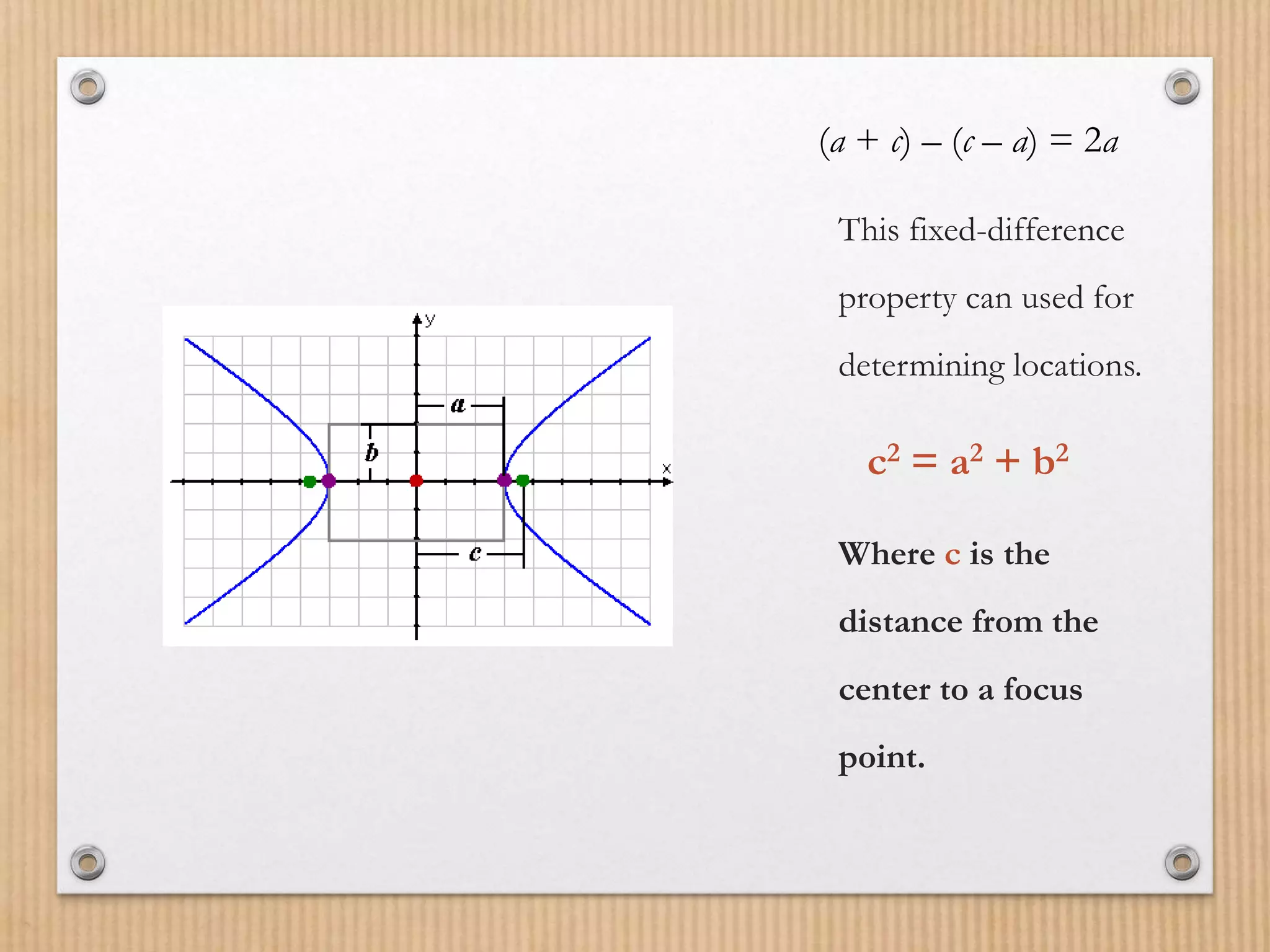
(a + c) – (c – a) = 2a
This fixed-difference
property can used for
determining locations.
c2 = a2 + b2
Where c is the
distance from the
center to a focus
point.
The fundamental
box…
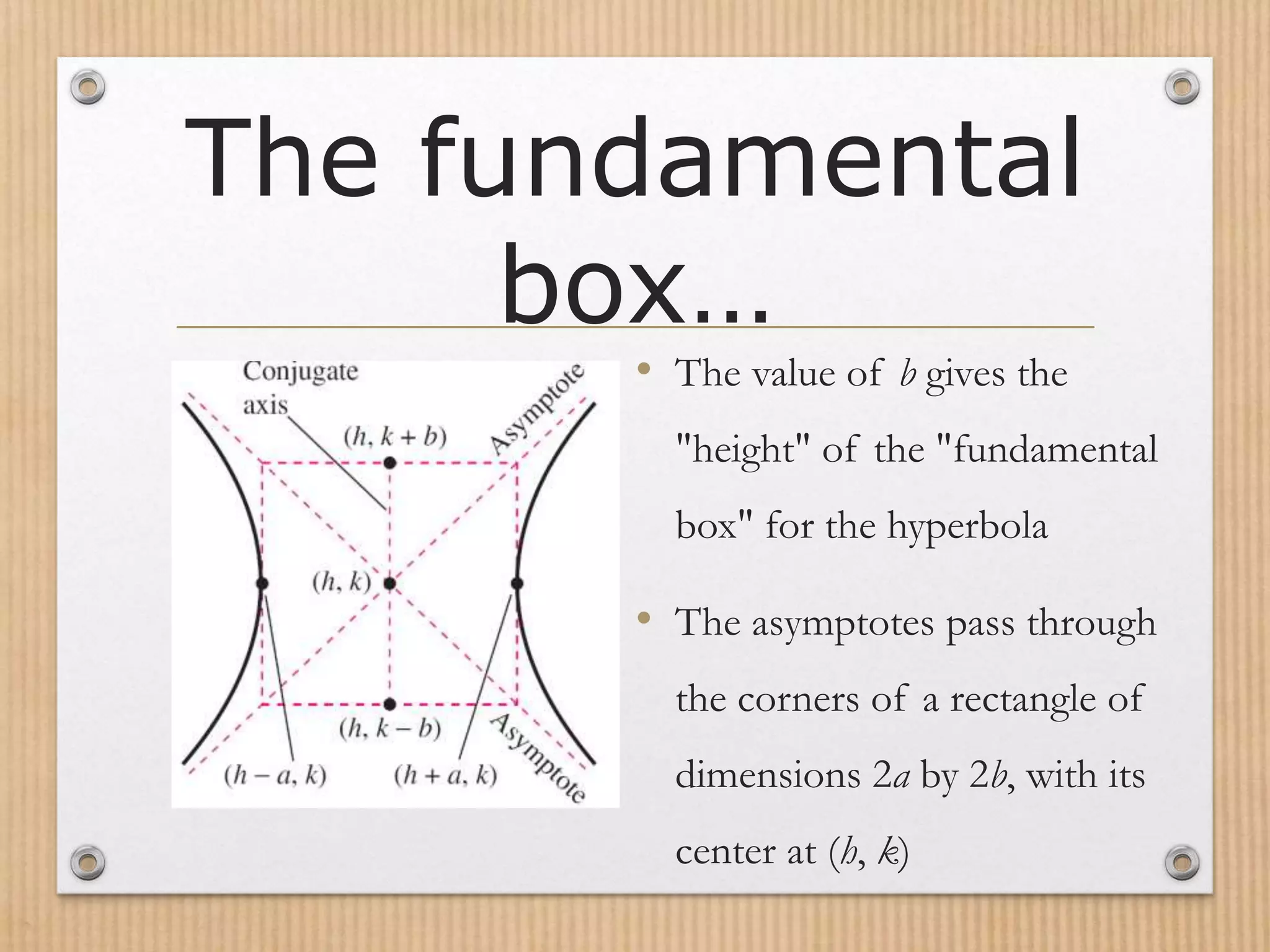
• The value of b gives the
"height" of the "fundamental
box" for the hyperbola
• The asymptotes pass through
the corners of a rectangle of
dimensions 2a by 2b, with its
center at (h, k)
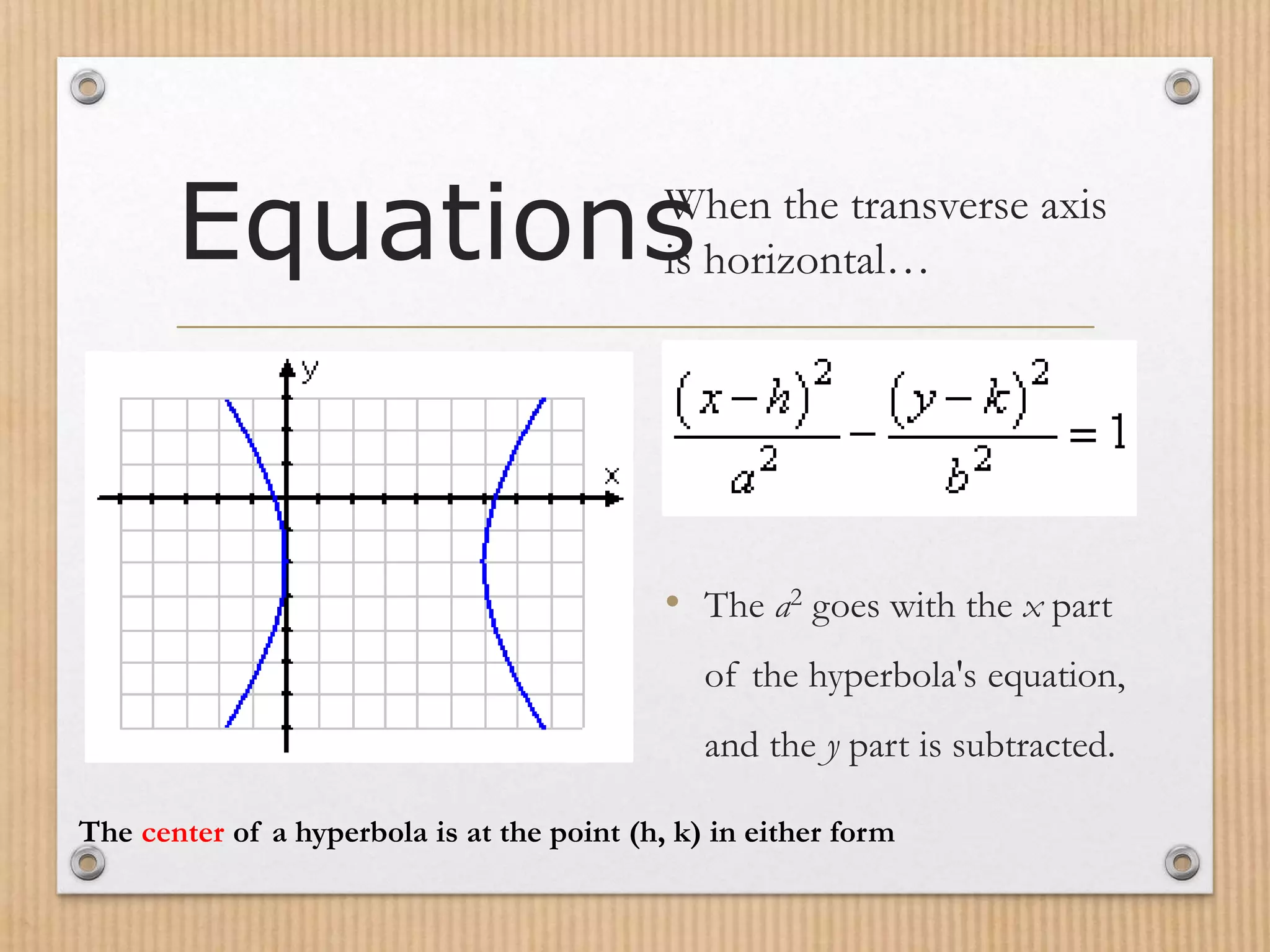
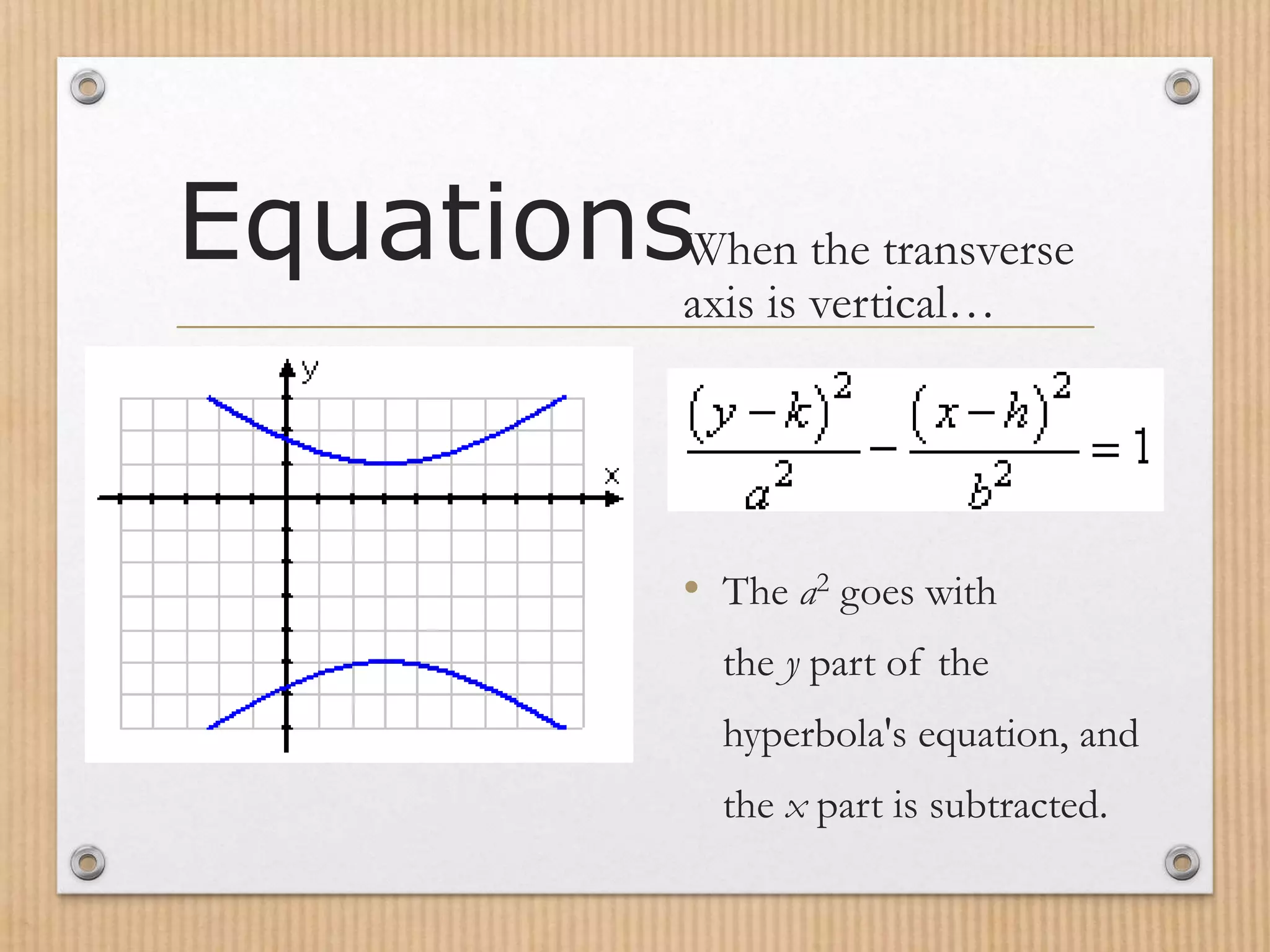
EquationsWhen the transverse axis
is horizontal…
• The a2 goes with the x part
of the hyperbola's equation,
and the y part is subtracted.
The center of a hyperbola is at the point (h, k) in either form
EquationsWhen the transverse
axis is vertical…
• The a2 goes with
the y part of the
hyperbola's equation, and
the x part is subtracted.
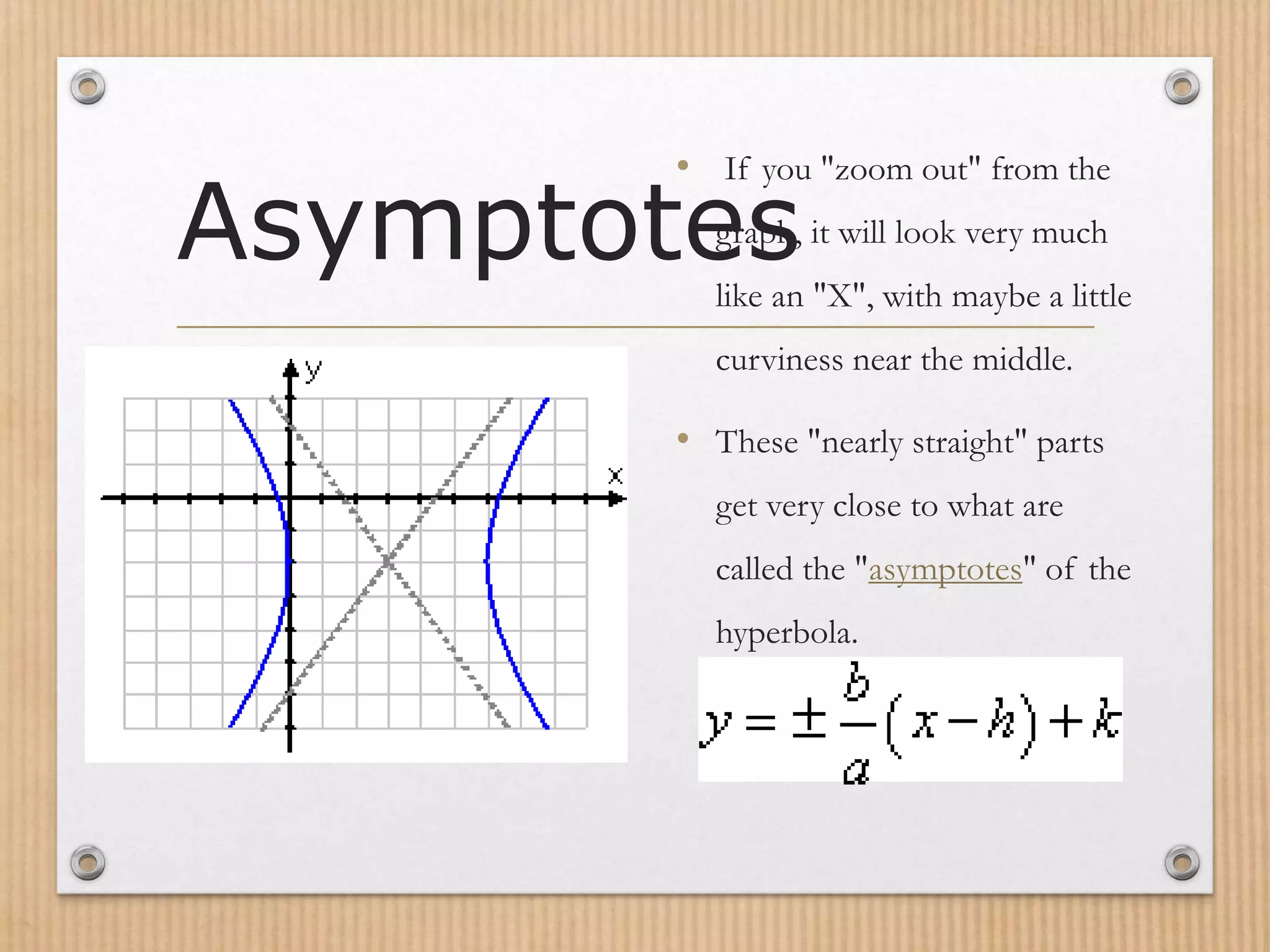
Asymptotes
• If you "zoom out" from the
graph, it will look very much
like an "X", with maybe a little
curviness near the middle.
• These "nearly straight" parts
get very close to what are
called the "asymptotes" of the
hyperbola.
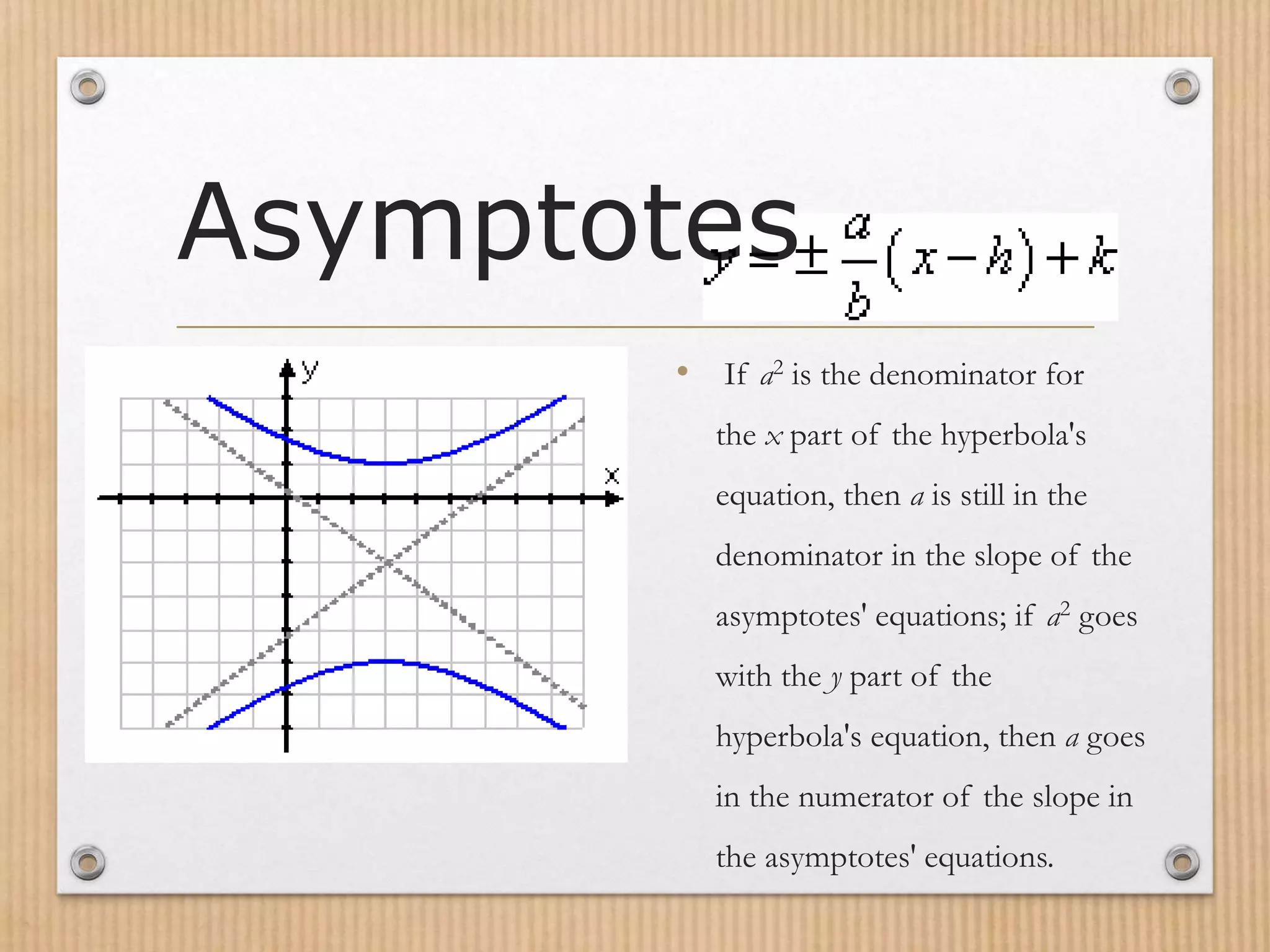
Asymptotes
• If a2 is the denominator for
the x part of the hyperbola's
equation, then a is still in the
denominator in the slope of the
asymptotes' equations; if a2 goes
with the y part of the
hyperbola's equation, then a goes
in the numerator of the slope in
the asymptotes' equations.
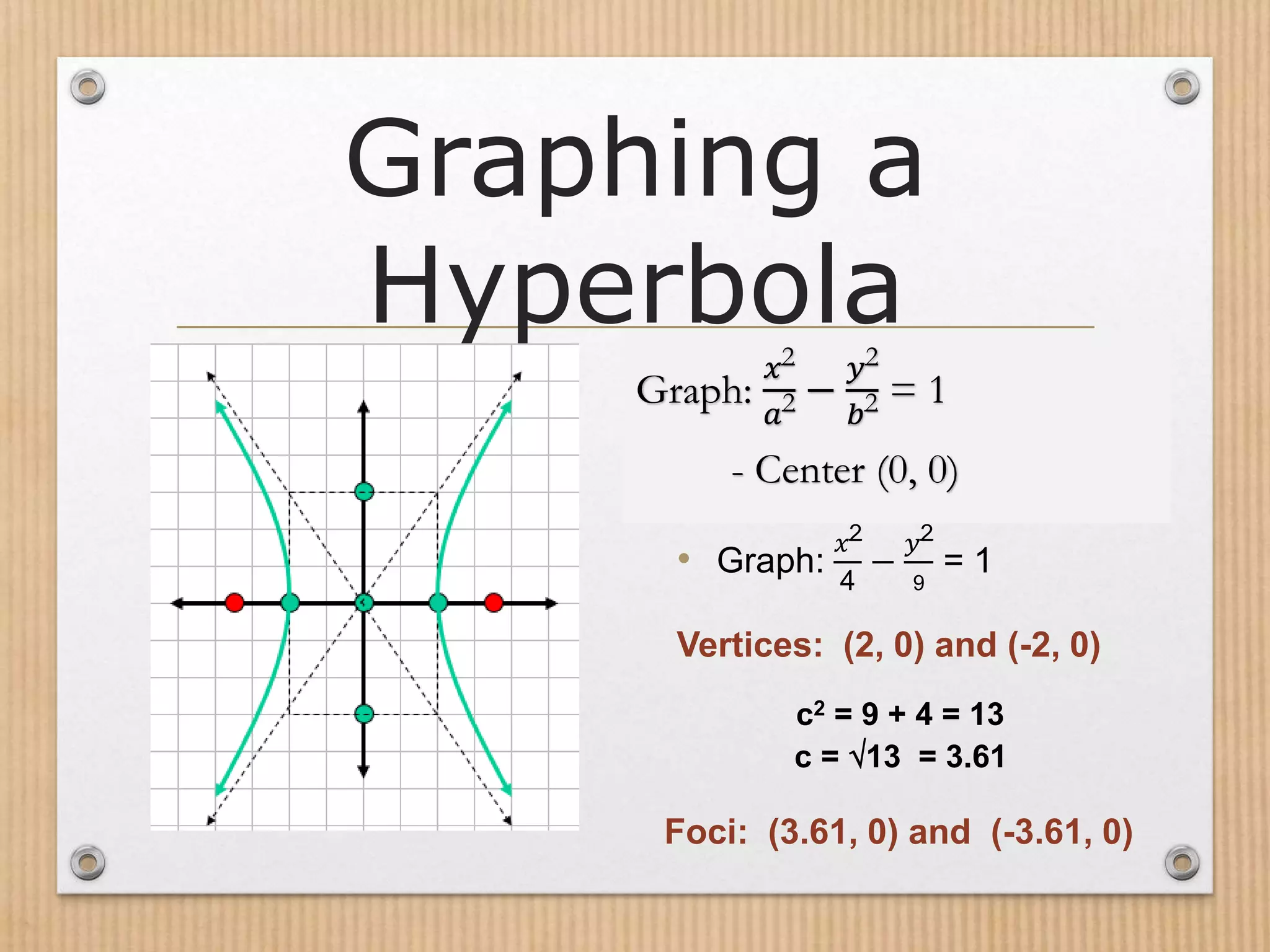
Graphing a
Hyperbola
• Graph:
𝑥2
4
−
𝑦2
9
= 1
Vertices: (2, 0) and (-2, 0)
c2 = 9 + 4 = 13
c = 13 = 3.61
Foci: (3.61, 0) and (-3.61, 0)
Graph:
𝑥2
𝑎2 −
𝑦2
𝑏2 = 1
- Center (0, 0)
Graphing a
Hyperbola
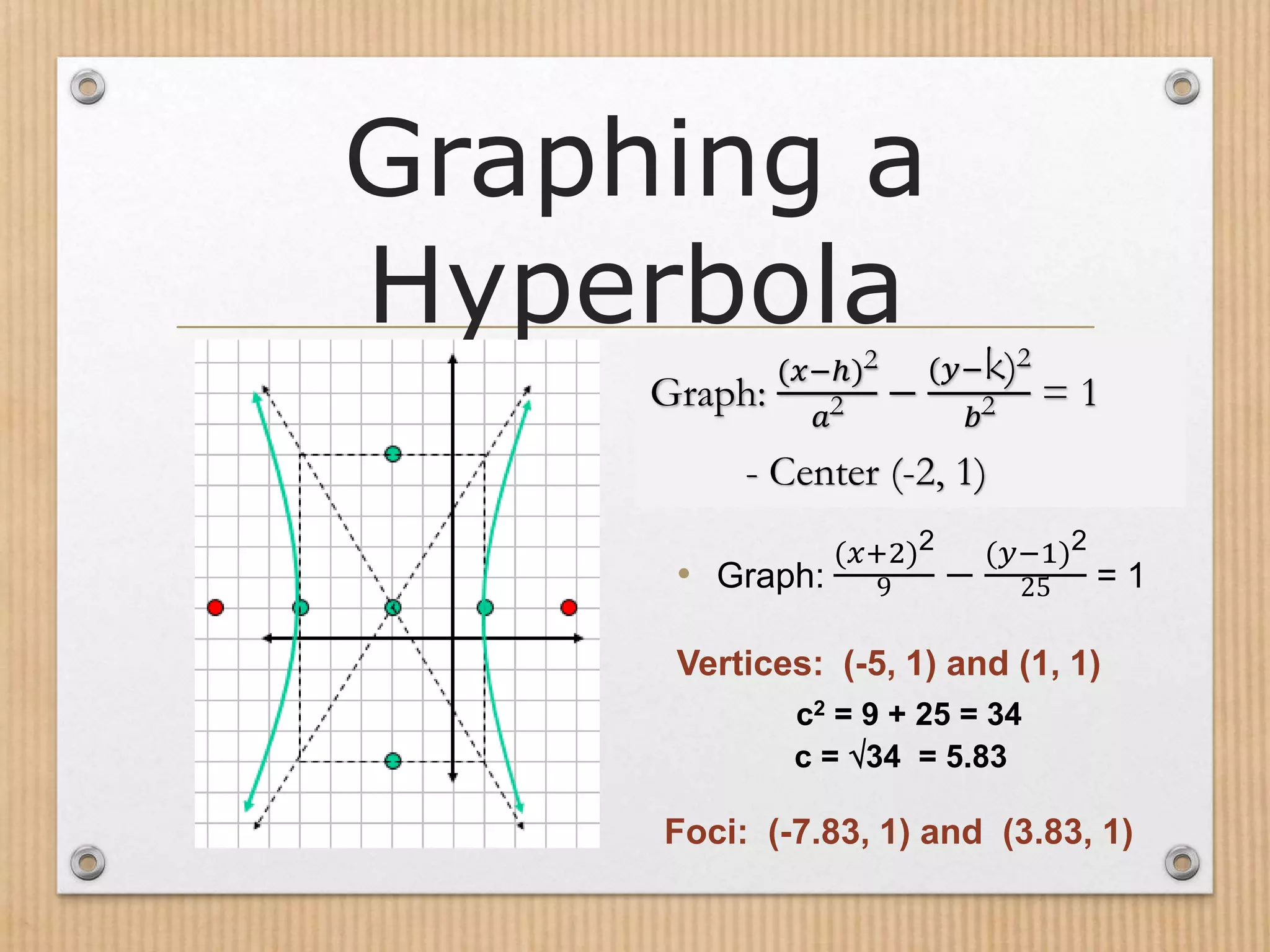
• Graph:
(𝑥+2)2
9 −
(𝑦−1)2
25 = 1
Vertices: (-5, 1) and (1, 1)
c2 = 9 + 25 = 34
c = 34 = 5.83
Foci: (-7.83, 1) and (3.83, 1)
Graph:
(𝑥−ℎ)2
𝑎2 −
(𝑦−k)2
𝑏2 = 1
- Center (-2, 1)
Finding
an
Equation
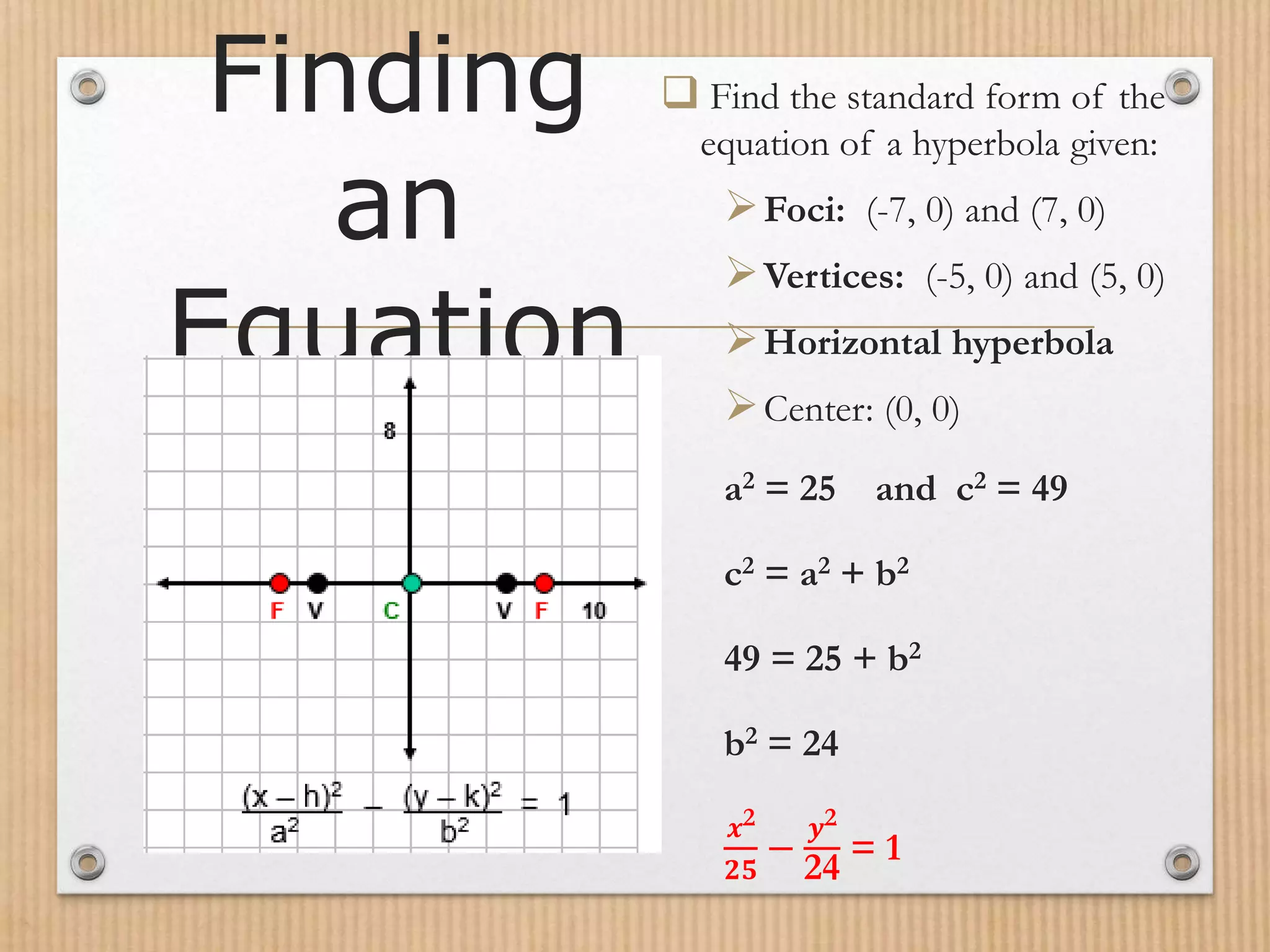
 Find the standard form of the
equation of a hyperbola given:
Foci: (-7, 0) and (7, 0)
Vertices: (-5, 0) and (5, 0)
Horizontal hyperbola
Center: (0, 0)
a2 = 25 and c2 = 49
c2 = a2 + b2
49 = 25 + b2
b2 = 24
𝒙2
𝟐𝟓
−
𝒚2
24
= 1
Sketching a
Hyperbola
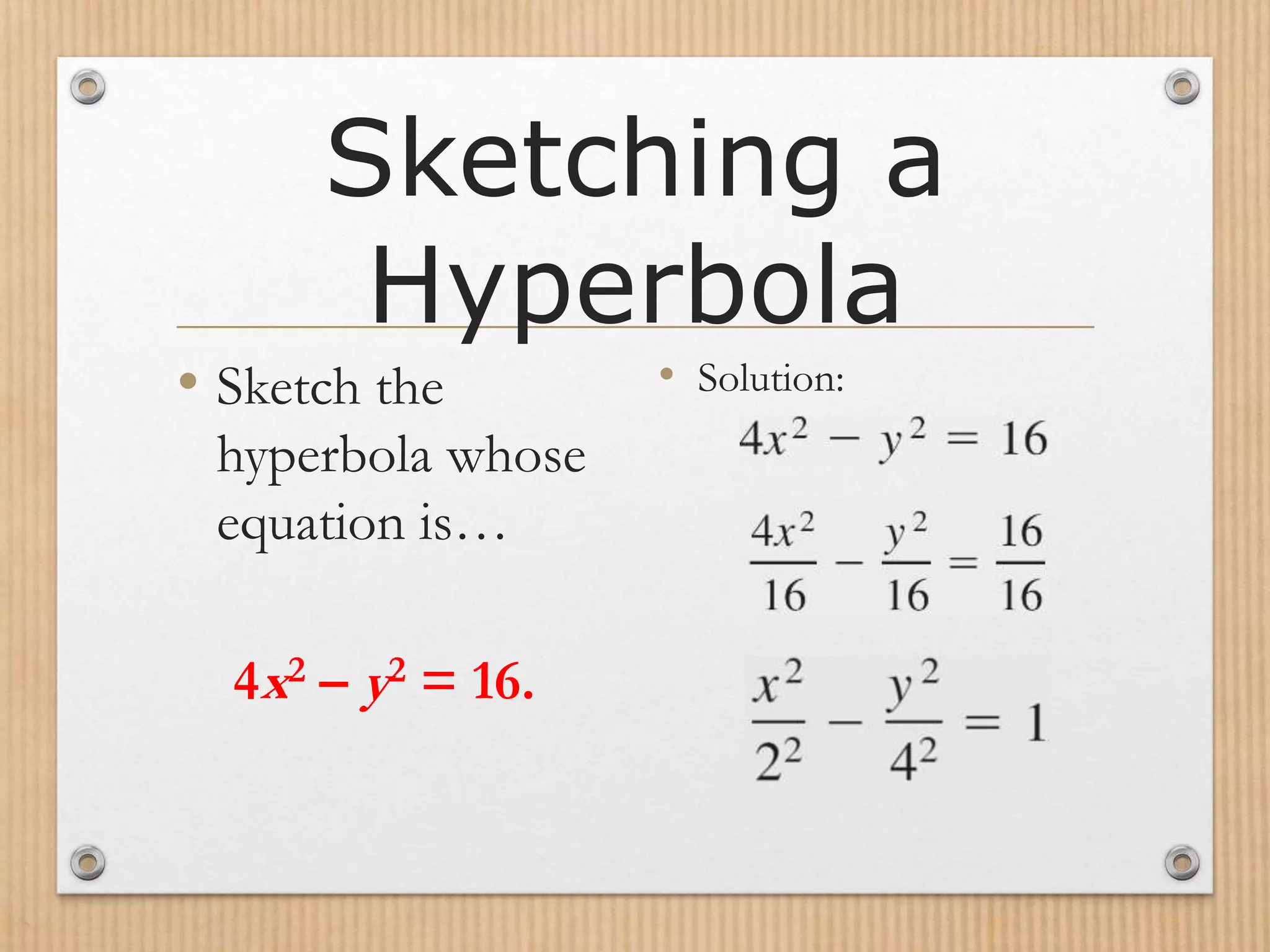
• Sketch the
hyperbola whose
equation is…
4x2 – y2 = 16.
• Solution:
Other info…
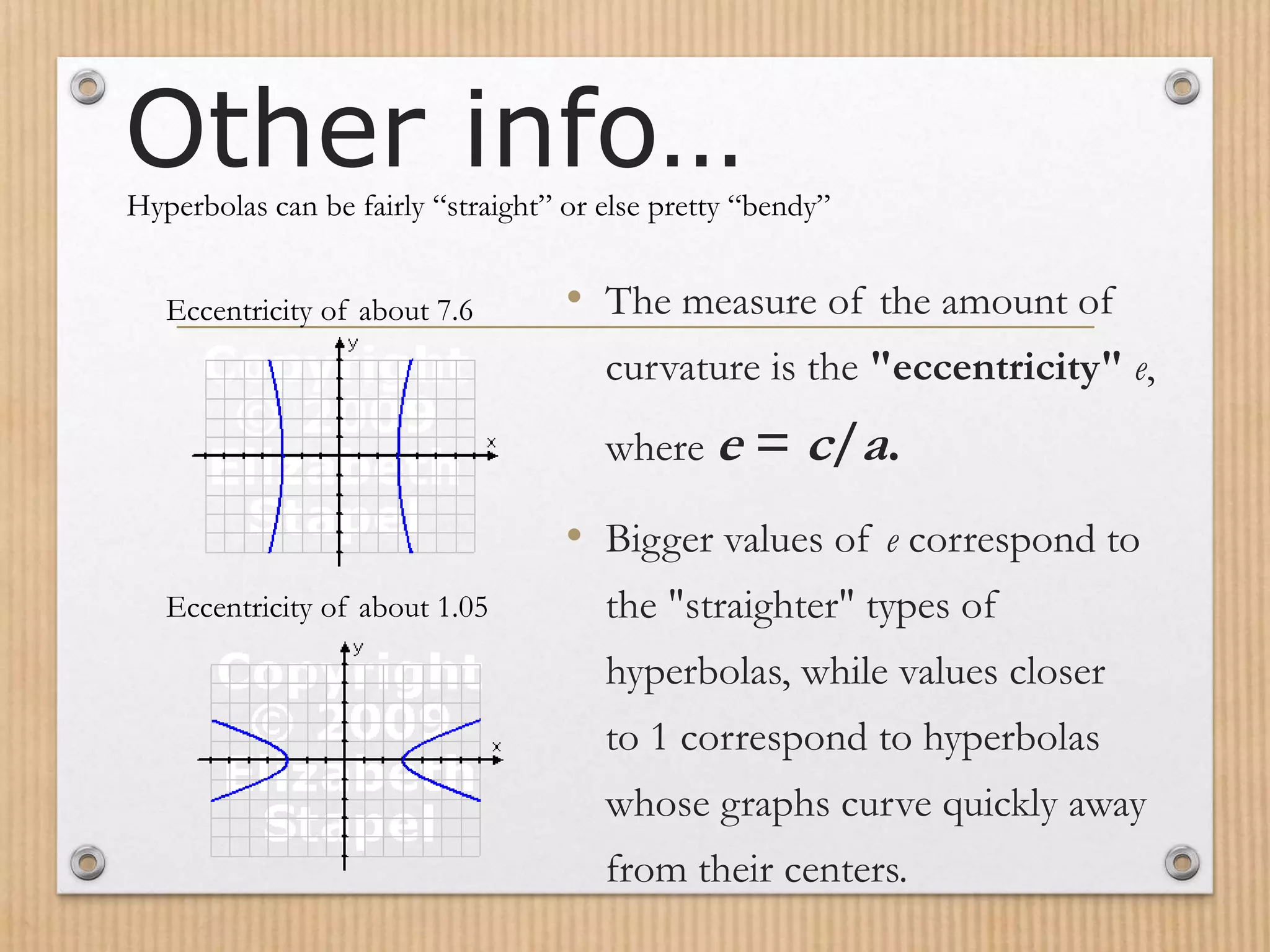
• The measure of the amount of
curvature is the "eccentricity" e,
where e = c/a.
• Bigger values of e correspond to
the "straighter" types of
hyperbolas, while values closer
to 1 correspond to hyperbolas
whose graphs curve quickly away
from their centers.
Hyperbolas can be fairly “straight” or else pretty “bendy”
Eccentricity of about 7.6
Eccentricity of about 1.05
“Hyperbola”
• Was given its present name by Apollonius
who was the first to study the two branches
of the hyperbola.
• Euclid and Aristaeus wrote about the general
hyperbola but only studied one branch of it
Thankiiie
ee!!!
Twitter: @zelgandako
Instagram: @zelgandugh

Hyperbolas

  • 1.
  • 2.
    Concept of a Hyperbola •A hyperbola looks sort of like two mirrored parabolas, with the two "halves" being called "branches". • Like an ellipse, a hyperbola has two foci and two vertices. • Unlike an ellipse, the foci in a hyperbola are further from the hyperbola's center than are its vertices.
  • 3.
  • 4.
    Therefore … a < cfor hyperbolas  The values of a and c will vary from one hyperbola to another, but they will be fixed values for any given hyperbola.
  • 5.
    Parts of a Hyperbola •“center” of the hyperbola • branch's “vertex” • The "foci" of a hyperbola are inside each branch • The line going from one vertex, through the center, and ending at the other vertex is called the “transverse” axis
  • 6.
    (a + c)– (c – a) = 2a This fixed-difference property can used for determining locations. c2 = a2 + b2 Where c is the distance from the center to a focus point.
  • 7.
    The fundamental box… • Thevalue of b gives the "height" of the "fundamental box" for the hyperbola • The asymptotes pass through the corners of a rectangle of dimensions 2a by 2b, with its center at (h, k)
  • 8.
    EquationsWhen the transverseaxis is horizontal… • The a2 goes with the x part of the hyperbola's equation, and the y part is subtracted. The center of a hyperbola is at the point (h, k) in either form
  • 9.
    EquationsWhen the transverse axisis vertical… • The a2 goes with the y part of the hyperbola's equation, and the x part is subtracted.
  • 10.
    Asymptotes • If you"zoom out" from the graph, it will look very much like an "X", with maybe a little curviness near the middle. • These "nearly straight" parts get very close to what are called the "asymptotes" of the hyperbola.
  • 11.
    Asymptotes • If a2is the denominator for the x part of the hyperbola's equation, then a is still in the denominator in the slope of the asymptotes' equations; if a2 goes with the y part of the hyperbola's equation, then a goes in the numerator of the slope in the asymptotes' equations.
  • 12.
    Graphing a Hyperbola • Graph: 𝑥2 4 − 𝑦2 9 =1 Vertices: (2, 0) and (-2, 0) c2 = 9 + 4 = 13 c = 13 = 3.61 Foci: (3.61, 0) and (-3.61, 0) Graph: 𝑥2 𝑎2 − 𝑦2 𝑏2 = 1 - Center (0, 0)
  • 13.
    Graphing a Hyperbola • Graph: (𝑥+2)2 9− (𝑦−1)2 25 = 1 Vertices: (-5, 1) and (1, 1) c2 = 9 + 25 = 34 c = 34 = 5.83 Foci: (-7.83, 1) and (3.83, 1) Graph: (𝑥−ℎ)2 𝑎2 − (𝑦−k)2 𝑏2 = 1 - Center (-2, 1)
  • 14.
    Finding an Equation  Find thestandard form of the equation of a hyperbola given: Foci: (-7, 0) and (7, 0) Vertices: (-5, 0) and (5, 0) Horizontal hyperbola Center: (0, 0) a2 = 25 and c2 = 49 c2 = a2 + b2 49 = 25 + b2 b2 = 24 𝒙2 𝟐𝟓 − 𝒚2 24 = 1
  • 15.
    Sketching a Hyperbola • Sketchthe hyperbola whose equation is… 4x2 – y2 = 16. • Solution:
  • 16.
    Other info… • Themeasure of the amount of curvature is the "eccentricity" e, where e = c/a. • Bigger values of e correspond to the "straighter" types of hyperbolas, while values closer to 1 correspond to hyperbolas whose graphs curve quickly away from their centers. Hyperbolas can be fairly “straight” or else pretty “bendy” Eccentricity of about 7.6 Eccentricity of about 1.05
  • 17.
    “Hyperbola” • Was givenits present name by Apollonius who was the first to study the two branches of the hyperbola. • Euclid and Aristaeus wrote about the general hyperbola but only studied one branch of it
  • 18.