Conics
Ellipses
An ellipse is the locus of a variable point on a
plane so that the sum of its distance from two
fixed points is a constant.
P’(x,y)
P’’(x,y)
Let PF1+PF2 = 2a where a > 0
aycxycx 2)()( 2222
=++++−
2222
)(2)( ycxaycx ++−=+−
222222
)()(44)( ycxycxaaycx +++++−=+−
222
44)(4 acxycxa +=++
42222222
2)2( acxaxcycxcxa ++=+++
42222222222
22 acxaxcyacaxcaxa ++=+++
22422222
)( caayaxca −=+−
)()( 22222222
caayaxca −=+−
222
cabLet −=
222222
bayaxb =+
12
2
2
2
=+
b
y
a
x standard equation of
an ellipse
vertex
major axis = 2a
minor axis = 2b
lactus rectum
length of semi-major axis = a
length of the semi-minor axis = b
length of lactus rectum =
a
b2
2
Other form of Ellipse
12
2
2
2
=+
a
y
b
x
Ellipse
• Review: The geometric definition relies on
a cone and a plane intersecting it
• Algebraic definition: a set of points in the
plane such that the sum of the distances
from two fixed points, called foci, remains
constant.
Hands-on Activity
At your table is paper, corkboard, string, and
tacks.
Follow the directions on your handout to
complete the activity.
Ellipse Definitions
Algebraic Definition of an Ellipse: a set of points in the
plane such that the sum of the distances from two fixed
points, called foci, remains constant.
 What remains constant in your sketch?
 The points where you placed the tacks are known as the
foci. Draw a line through f1 and f2 to the edges of the
ellipse. This is known as the major axis. Locate the
midpoint between f1 and f2. Is this the center of the
ellipse? Will that always be the case?
 What inference can you draw from the data?
 Does the data support the definition? Explain.
Facts: Ellipse Equation
Both variables are squared.
Equation:
What makes the ellipse different from the
circle?
What makes the ellipse different from the
parabola?
2 2
2 2
( - ) ( - )
1
x h y k
a b
+ =
where the center is at (h,k) and |2a | is the length of the
horizontal axis and |2b| is the of the length of the
vertical axis.
Procedure to graph:
1. Put in standard form (above): x squared term
+ y squared term = 1
2. Plot the center (h,k)
3. Plot the endpoints of the horizontal axis by
moving “a” units left and right from the
center.
2 2
2 2
( - ) ( - )
1
x h y k
a b
+ =
where the center is at (h,k) and |2a | is the length of the
horizontal axis and |2b| is the of the length of the
vertical axis.
To graph:
4. Plot the endpoints of the vertical axis by moving
“b” units up and down from the center.
Note: Steps 3 and 4 locate the endpoints of the
major and minor axes.
5. Connect endpoint of axes with smooth curve.
2 2
2 2
( - ) ( - )
1
x h y k
a b
+ =
where the center is at (h,k) and |2a | is the length of the
horizontal axis and |2b| is the of the length of the
vertical axis.
To graph:
6. Use the following formula to help locate the
foci: c2
= a2
- b2
if a>b or c2
= b2
– a2
if b>a
**Challenge question: Why are we using this
formula to locate the foci? Draw a diagram and
justify your answer.**
2 2
2 2
( - ) ( - )
1
x h y k
a b
+ =
where the center is at (h,k) and |2a | is the length of the
horizontal axis and |2b| is the of the length of the
vertical axis.
To graph:
6. (continued) Move “c” units left and right form
the center if the major axis is horizontal
OR Move “c” units up and down form the center if
the major axis is vertical
Label the points f1 and f2 for the two foci.
Note: It is not necessary to plot the foci to graph the ellipse, but it is common
practice to locate them.
2 2
2 2
( - ) ( - )
1
x h y k
a b
+ =
where the center is at (h,k) and |2a | is the length of the
horizontal axis and |2b| is the of the length of the
vertical axis.
To graph:
7. Identify the length of the major and minor
axes.
2 2
2 2
( - ) ( - )
1
x h y k
a b
+ =
Exp. 1: Graph
To graph:
1. Put in standard form (set = 1)
Done
2. Plot the center (h,k)
(-2,3)
3. Plot the endpoints of the horizontal axis by
moving “a” units left and right from the center.
Endpoints at (-7,3) and (3,3)
2 2
( 2) ( -3)
1
25 16
x y+
+ =
Exp. 1: Graph
4. Plot the endpoints of the vertical axis by
moving “b” units up and down from the
center.
Endpoints at (-2,7) and (-2,-1)
5. Connect endpoint of axes with smooth curve
2 2
( 2) ( -3)
1
25 16
x y+
+ =
Major axis
Center
Minor axis
2 2
( 2) ( -3)
1
25 16
x y+
+ =
Exp. 1: Graph
6. Which way is the major axis in this problem (horizontal or
vertical)?
Horizontal because 25>16 and 25 is under the “x”
Use the following formula to help locate the foci: c2
= a2
- b2
if
a>b or c2
= b2
– a2
if b>a
c2
= a2
- b2
c2
= 25– 16
c2
= 9
c= ±3
Move 3 units left and right from the center to locate the foci.
Where are the foci?
(-5,3) and (1,3)
2 2
( 2) ( -3)
1
25 16
x y+
+ =
Foci
f1 f2
Length of Major Axis is 10.
Length of Minor Axis is 8.
2 2
( 2) ( -3)
1
25 16
x y+
+ =
Exp. 2: Graph 16x2
+ 9y2
= 144
To graph:
1. Put in standard form.
2. Plot the center
(0,0)
3. Plot the endpoints of the horizontal axis.
Endpoints at (-3,0) and (3,0)
2 2
1
9 16
x y
+ =
Exp. 2: Graph 16x2
+ 9y2
= 144
4. Plot the endpoints of the vertical axis.
Endpoints at (0,4) and (0,-4)
5. Connect endpoint of axes with smooth curve
6. Which way is the major axis in this problem?
Vertical because 16>9 and 16 is under the “y”
Locate the foci:
c2
= b 2
- a2
c2
= 16 - 9
c2
= 7
c= ±√7
Where are the foci?
(0, √7) and (0,-√7)
2 2
1
9 16
x y
+ =
2 2
1
9 16
x y
+ =
Length of Major Axis is 8.
Length of Minor Axis is 6.
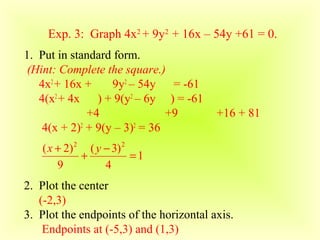
Exp. 3: Graph 4x2
+ 9y2
+ 16x – 54y +61 = 0.
1. Put in standard form.
(Hint: Complete the square.)
4x2
+ 16x + 9y2
– 54y = -61
4(x2
+ 4x ) + 9(y2
– 6y ) = -61
+4 +9 +16 + 81
4(x + 2)2
+ 9(y – 3)2
= 36
2. Plot the center
(-2,3)
3. Plot the endpoints of the horizontal axis.
Endpoints at (-5,3) and (1,3)
2 2
( 2) ( 3)
1
9 4
x y+ −
+ =
Exp. 3: Graph 4x2
+ 9y2
+ 16x – 54y +61 = 0.
4. Plot the endpoints of the vertical axis.
Endpoints at (-2,5) and (-2,1)
5. Connect endpoint of axes with smooth curve
6. Which way is the major axis in this problem?
Horizontal
Locate the foci:
c2
= a2
- b2
c2
= 9 - 4
c2
= 5
c= ±√5
Where are the foci?
(-2 ±√5, 3)
2 2
( 2) ( 3)
1
9 4
x y+ −
+ =
Length of Major Axis is 6.
Length of Minor Axis is 4.
2 2
( 2) ( 3)
1
9 4
x y+ −
+ =
Challenge Question
Given the following information, write the
equation of the ellipse. Sketch and find the
foci.
Center is (4,-3), the major axis is vertical
and has a length of 12, and the minor axis
has a length of 8.
Review
1) How can you tell if the graph of an
equation will be a line, parabola, circle, or
an ellipse?
2) What’s the standard form of an ellipse?
3) What are the steps for graphing an
ellipse?
4) What’s the standard form of a parabola?
5) What’s the standard form of a circle?
6) How are the various equations similar and
different?

Ellipse

  • 1.
  • 2.
    Ellipses An ellipse isthe locus of a variable point on a plane so that the sum of its distance from two fixed points is a constant. P’(x,y) P’’(x,y)
  • 3.
    Let PF1+PF2 =2a where a > 0 aycxycx 2)()( 2222 =++++− 2222 )(2)( ycxaycx ++−=+− 222222 )()(44)( ycxycxaaycx +++++−=+− 222 44)(4 acxycxa +=++ 42222222 2)2( acxaxcycxcxa ++=+++ 42222222222 22 acxaxcyacaxcaxa ++=+++
  • 4.
    22422222 )( caayaxca −=+− )()(22222222 caayaxca −=+− 222 cabLet −= 222222 bayaxb =+ 12 2 2 2 =+ b y a x standard equation of an ellipse
  • 5.
    vertex major axis =2a minor axis = 2b lactus rectum length of semi-major axis = a length of the semi-minor axis = b length of lactus rectum = a b2 2
  • 7.
    Other form ofEllipse 12 2 2 2 =+ a y b x
  • 8.
    Ellipse • Review: Thegeometric definition relies on a cone and a plane intersecting it • Algebraic definition: a set of points in the plane such that the sum of the distances from two fixed points, called foci, remains constant.
  • 9.
    Hands-on Activity At yourtable is paper, corkboard, string, and tacks. Follow the directions on your handout to complete the activity.
  • 10.
    Ellipse Definitions Algebraic Definitionof an Ellipse: a set of points in the plane such that the sum of the distances from two fixed points, called foci, remains constant.  What remains constant in your sketch?  The points where you placed the tacks are known as the foci. Draw a line through f1 and f2 to the edges of the ellipse. This is known as the major axis. Locate the midpoint between f1 and f2. Is this the center of the ellipse? Will that always be the case?  What inference can you draw from the data?  Does the data support the definition? Explain.
  • 11.
    Facts: Ellipse Equation Bothvariables are squared. Equation: What makes the ellipse different from the circle? What makes the ellipse different from the parabola? 2 2 2 2 ( - ) ( - ) 1 x h y k a b + =
  • 12.
    where the centeris at (h,k) and |2a | is the length of the horizontal axis and |2b| is the of the length of the vertical axis. Procedure to graph: 1. Put in standard form (above): x squared term + y squared term = 1 2. Plot the center (h,k) 3. Plot the endpoints of the horizontal axis by moving “a” units left and right from the center. 2 2 2 2 ( - ) ( - ) 1 x h y k a b + =
  • 13.
    where the centeris at (h,k) and |2a | is the length of the horizontal axis and |2b| is the of the length of the vertical axis. To graph: 4. Plot the endpoints of the vertical axis by moving “b” units up and down from the center. Note: Steps 3 and 4 locate the endpoints of the major and minor axes. 5. Connect endpoint of axes with smooth curve. 2 2 2 2 ( - ) ( - ) 1 x h y k a b + =
  • 14.
    where the centeris at (h,k) and |2a | is the length of the horizontal axis and |2b| is the of the length of the vertical axis. To graph: 6. Use the following formula to help locate the foci: c2 = a2 - b2 if a>b or c2 = b2 – a2 if b>a **Challenge question: Why are we using this formula to locate the foci? Draw a diagram and justify your answer.** 2 2 2 2 ( - ) ( - ) 1 x h y k a b + =
  • 15.
    where the centeris at (h,k) and |2a | is the length of the horizontal axis and |2b| is the of the length of the vertical axis. To graph: 6. (continued) Move “c” units left and right form the center if the major axis is horizontal OR Move “c” units up and down form the center if the major axis is vertical Label the points f1 and f2 for the two foci. Note: It is not necessary to plot the foci to graph the ellipse, but it is common practice to locate them. 2 2 2 2 ( - ) ( - ) 1 x h y k a b + =
  • 16.
    where the centeris at (h,k) and |2a | is the length of the horizontal axis and |2b| is the of the length of the vertical axis. To graph: 7. Identify the length of the major and minor axes. 2 2 2 2 ( - ) ( - ) 1 x h y k a b + =
  • 17.
    Exp. 1: Graph Tograph: 1. Put in standard form (set = 1) Done 2. Plot the center (h,k) (-2,3) 3. Plot the endpoints of the horizontal axis by moving “a” units left and right from the center. Endpoints at (-7,3) and (3,3) 2 2 ( 2) ( -3) 1 25 16 x y+ + =
  • 18.
    Exp. 1: Graph 4.Plot the endpoints of the vertical axis by moving “b” units up and down from the center. Endpoints at (-2,7) and (-2,-1) 5. Connect endpoint of axes with smooth curve 2 2 ( 2) ( -3) 1 25 16 x y+ + =
  • 19.
    Major axis Center Minor axis 22 ( 2) ( -3) 1 25 16 x y+ + =
  • 20.
    Exp. 1: Graph 6.Which way is the major axis in this problem (horizontal or vertical)? Horizontal because 25>16 and 25 is under the “x” Use the following formula to help locate the foci: c2 = a2 - b2 if a>b or c2 = b2 – a2 if b>a c2 = a2 - b2 c2 = 25– 16 c2 = 9 c= ±3 Move 3 units left and right from the center to locate the foci. Where are the foci? (-5,3) and (1,3) 2 2 ( 2) ( -3) 1 25 16 x y+ + =
  • 21.
    Foci f1 f2 Length ofMajor Axis is 10. Length of Minor Axis is 8. 2 2 ( 2) ( -3) 1 25 16 x y+ + =
  • 22.
    Exp. 2: Graph16x2 + 9y2 = 144 To graph: 1. Put in standard form. 2. Plot the center (0,0) 3. Plot the endpoints of the horizontal axis. Endpoints at (-3,0) and (3,0) 2 2 1 9 16 x y + =
  • 23.
    Exp. 2: Graph16x2 + 9y2 = 144 4. Plot the endpoints of the vertical axis. Endpoints at (0,4) and (0,-4) 5. Connect endpoint of axes with smooth curve 6. Which way is the major axis in this problem? Vertical because 16>9 and 16 is under the “y” Locate the foci: c2 = b 2 - a2 c2 = 16 - 9 c2 = 7 c= ±√7 Where are the foci? (0, √7) and (0,-√7) 2 2 1 9 16 x y + =
  • 24.
    2 2 1 9 16 xy + = Length of Major Axis is 8. Length of Minor Axis is 6.
  • 25.
    Exp. 3: Graph4x2 + 9y2 + 16x – 54y +61 = 0. 1. Put in standard form. (Hint: Complete the square.) 4x2 + 16x + 9y2 – 54y = -61 4(x2 + 4x ) + 9(y2 – 6y ) = -61 +4 +9 +16 + 81 4(x + 2)2 + 9(y – 3)2 = 36 2. Plot the center (-2,3) 3. Plot the endpoints of the horizontal axis. Endpoints at (-5,3) and (1,3) 2 2 ( 2) ( 3) 1 9 4 x y+ − + =
  • 26.
    Exp. 3: Graph4x2 + 9y2 + 16x – 54y +61 = 0. 4. Plot the endpoints of the vertical axis. Endpoints at (-2,5) and (-2,1) 5. Connect endpoint of axes with smooth curve 6. Which way is the major axis in this problem? Horizontal Locate the foci: c2 = a2 - b2 c2 = 9 - 4 c2 = 5 c= ±√5 Where are the foci? (-2 ±√5, 3) 2 2 ( 2) ( 3) 1 9 4 x y+ − + =
  • 27.
    Length of MajorAxis is 6. Length of Minor Axis is 4. 2 2 ( 2) ( 3) 1 9 4 x y+ − + =
  • 28.
    Challenge Question Given thefollowing information, write the equation of the ellipse. Sketch and find the foci. Center is (4,-3), the major axis is vertical and has a length of 12, and the minor axis has a length of 8.
  • 29.
    Review 1) How canyou tell if the graph of an equation will be a line, parabola, circle, or an ellipse? 2) What’s the standard form of an ellipse? 3) What are the steps for graphing an ellipse? 4) What’s the standard form of a parabola? 5) What’s the standard form of a circle? 6) How are the various equations similar and different?

Editor's Notes

  • #10 Teachers often demonstrate. If possible, have students do the activity. When students draw the conic themselves, they better understand the concept that the sum of the distances remains constant.
  • #11 If you are unable to do the activity, skip this slide.
  • #12 When put it standard form the denominators of an ellipse are different and the denominators of a circle are the same. Stress that in the parabola equation, only one variable is squared, while two are squared in the circle and ellipse equations.
  • #13 Explain how this should make sense to the students intuitively and not be something they memorize. Since “X” is the horizontal axis, it should make sense the we would have the horizontal axis under it. Since “Y” is the vertical axis, it should make sense that we would have the vertical axis under it.
  • #14 Explain how this should make sense to the students intuitively and not be something they memorize. Since “X” is the horizontal axis, it should make sense the we would have the horizontal axis under it. Since “Y” is the vertical axis, it should make sense that we would have the vertical axis under it.
  • #15 Tell students to do larger squared minus smaller squared. Summarize by saying that c squared = the larger squared minus the smaller squared
  • #23 Graph the ellipse on the board as you go through the steps.
  • #24 Graph the ellipse on the board as you go through the steps.
  • #25 Have students volunteer to plot foci.
  • #26 Graph the ellipse on the board as you go through the steps.
  • #27 Graph the ellipse on the board as you go through the steps.
  • #28 Have students volunteer to plot foci.
  • #29 (x – 4)2/16 + (y + 3) 2/36 = 1
  • #30 Stress that linear equations have exponents of 1 on both the x and the y. With parabolas, either the x or the y has an exponent of 2. With circles and ellipses, both x and y terms are squared. With circles, the coefficients (or denominators) are the same for x2 and y2 and with ellipses, they are different.