Precalculus
At the end of the lesson, the student is able to:
 (1) illustrate the different types of conic sections: parabola,
ellipse, circle, hyperbola, and degenerate cases;
 (2) define a circle;
 (3) determine the standard form of equation of a circle; (4)
graph a circle in a rectangular coordinate system; and (5) solve
situational problems involving conic sections (circles).
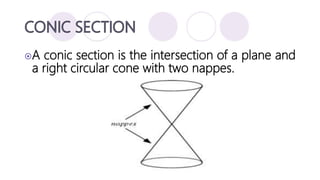
A conic section is the intersection of a plane and
a right circular cone with two nappes.
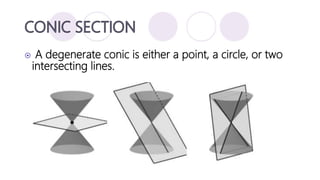
 A degenerate conic is either a point, a circle, or two
intersecting lines.
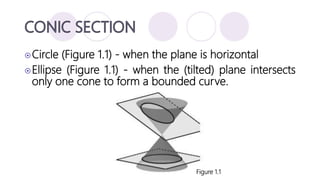
Circle (Figure 1.1) - when the plane is horizontal
Ellipse (Figure 1.1) - when the (tilted) plane intersects
only one cone to form a bounded curve.
Figure 1.1
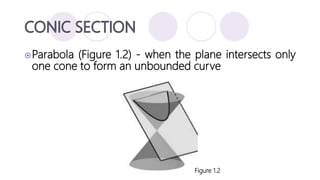
Parabola (Figure 1.2) - when the plane intersects only
one cone to form an unbounded curve
Figure 1.2
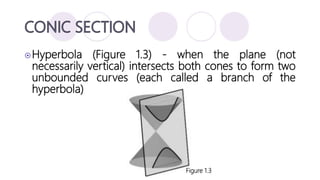
Hyperbola (Figure 1.3) - when the plane (not
necessarily vertical) intersects both cones to form two
unbounded curves (each called a branch of the
hyperbola)
Figure 1.3
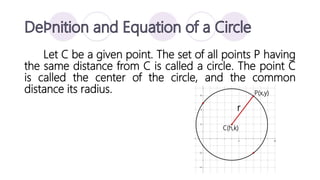
Let C be a given point. The set of all points P having
the same distance from C is called a circle. The point C
is called the center of the circle, and the common
distance its radius. P(x,y)
C(h,k)
r
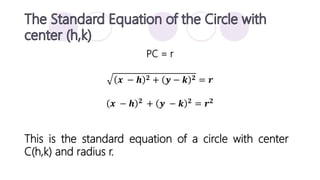
PC = r
𝒙 − 𝒉 𝟐 + 𝒚 − 𝒌 𝟐 = 𝒓
𝒙 − 𝒉 𝟐 + 𝒚 − 𝒌 𝟐 = 𝒓 𝟐
This is the standard equation of a circle with center
C(h,k) and radius r.
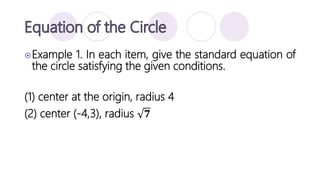
Example 1. In each item, give the standard equation of
the circle satisfying the given conditions.
(1) center at the origin, radius 4
(2) center (-4,3), radius 𝟕
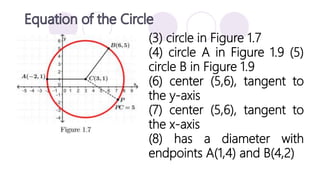
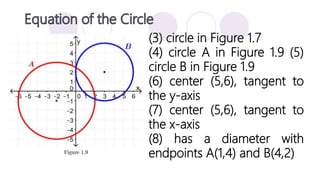
(3) circle in Figure 1.7
(4) circle A in Figure 1.9 (5)
circle B in Figure 1.9
(6) center (5,6), tangent to
the y-axis
(7) center (5,6), tangent to
the x-axis
(8) has a diameter with
endpoints A(1,4) and B(4,2)
(3) circle in Figure 1.7
(4) circle A in Figure 1.9 (5)
circle B in Figure 1.9
(6) center (5,6), tangent to
the y-axis
(7) center (5,6), tangent to
the x-axis
(8) has a diameter with
endpoints A(1,4) and B(4,2)
www.slideshare.net/reycastro1
@reylkastro2
reylkastro

Introduction to conic sections

  • 1.
  • 2.
    At the endof the lesson, the student is able to:  (1) illustrate the different types of conic sections: parabola, ellipse, circle, hyperbola, and degenerate cases;  (2) define a circle;  (3) determine the standard form of equation of a circle; (4) graph a circle in a rectangular coordinate system; and (5) solve situational problems involving conic sections (circles).
  • 3.
    A conic sectionis the intersection of a plane and a right circular cone with two nappes.
  • 4.
     A degenerateconic is either a point, a circle, or two intersecting lines.
  • 5.
    Circle (Figure 1.1)- when the plane is horizontal Ellipse (Figure 1.1) - when the (tilted) plane intersects only one cone to form a bounded curve. Figure 1.1
  • 6.
    Parabola (Figure 1.2)- when the plane intersects only one cone to form an unbounded curve Figure 1.2
  • 7.
    Hyperbola (Figure 1.3)- when the plane (not necessarily vertical) intersects both cones to form two unbounded curves (each called a branch of the hyperbola) Figure 1.3
  • 8.
    Let C bea given point. The set of all points P having the same distance from C is called a circle. The point C is called the center of the circle, and the common distance its radius. P(x,y) C(h,k) r
  • 9.
    PC = r 𝒙− 𝒉 𝟐 + 𝒚 − 𝒌 𝟐 = 𝒓 𝒙 − 𝒉 𝟐 + 𝒚 − 𝒌 𝟐 = 𝒓 𝟐 This is the standard equation of a circle with center C(h,k) and radius r.
  • 10.
    Example 1. Ineach item, give the standard equation of the circle satisfying the given conditions. (1) center at the origin, radius 4 (2) center (-4,3), radius 𝟕
  • 11.
    (3) circle inFigure 1.7 (4) circle A in Figure 1.9 (5) circle B in Figure 1.9 (6) center (5,6), tangent to the y-axis (7) center (5,6), tangent to the x-axis (8) has a diameter with endpoints A(1,4) and B(4,2)
  • 12.
    (3) circle inFigure 1.7 (4) circle A in Figure 1.9 (5) circle B in Figure 1.9 (6) center (5,6), tangent to the y-axis (7) center (5,6), tangent to the x-axis (8) has a diameter with endpoints A(1,4) and B(4,2)
  • 13.