Surface Acoustic Wave (SAW)  Wireless Passive RF Sensor Systems Donald C. Malocha School of Electrical Engineering & Computer Science University of Central Florida  Orlando, Fl. 32816-2450 [email_address]
Univ. of Central Florida SAW UCF Center for Acoustoelectronic Technology (CAAT) has been actively doing SAW and BAW research for over 25 years Research includes communication devices and systems, new piezoelectric materials, & sensors  Capabilities include SAW/BAW analysis, design, mask generation, device fabrication, RF testing, and RF system development Current group has 8 PhDs and 1 MS Graduated 14 PhDs and 38 MS students
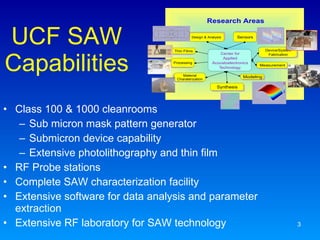
UCF SAW Capabilities Class 100 & 1000 cleanrooms Sub micron mask pattern generator Submicron device capability Extensive photolithography and thin film RF Probe stations Complete SAW characterization facility Extensive software for data analysis and parameter extraction Extensive RF laboratory for SAW technology
What is a typical SAW Device? A solid state device Converts electrical energy into a mechanical wave on a single crystal substrate Provides very complex signal processing in a very small volume It is estimated that approximately 4 billion SAW devices are produced each year University of Central Florida School of Electrical Engineering and Computer Science Applications: Cellular phones and TV (largest market) Military (Radar, filters, advanced systems Currently emerging – sensors, RFID
SAW Sensors This is a very new and exciting area Since SAW devices are sensitive to temperature, stress, pressure, liquids, viscosity and surface effects, a wide range of sensors are possible
Sensor Wish-list Passive, Wireless, Coded Small, rugged, cheap Operate over all temperatures and environments Measure physical, chemical and biological variables No cross sensitivity Low loss and variable frequency Radiation hard for space applications Large range to 100’s meters or more SAW sensors meet many of these criteria
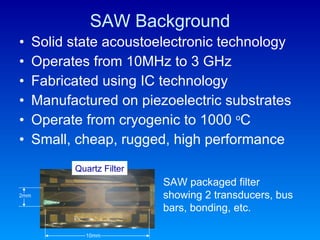
SAW Background Solid state acoustoelectronic technology Operates from 10MHz to 3 GHz Fabricated using IC technology Manufactured on piezoelectric substrates Operate from cryogenic to 1000  o C Small, cheap, rugged, high performance  SAW packaged filter showing 2 transducers, bus bars, bonding, etc. 2mm 10mm Quartz Filter
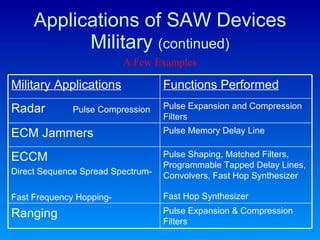
Applications of SAW Devices Military  (continued) A Few Examples Military Applications Functions Performed Radar  Pulse Compression Pulse Expansion and Compression Filters ECM Jammers Pulse Memory Delay Line ECCM  Direct Sequence Spread Spectrum- Fast Frequency Hopping- Pulse Shaping, Matched Filters, Programmable Tapped Delay Lines, Convolvers, Fast Hop Synthesizer Fast Hop Synthesizer Ranging Pulse Expansion & Compression Filters
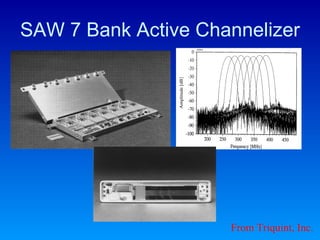
SAW 7 Bank Active Channelizer From Triquint, Inc.
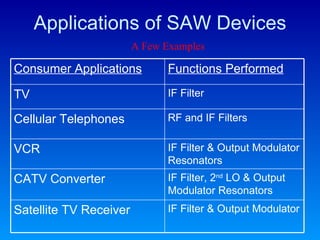
Applications of SAW Devices A Few Examples Consumer Applications Functions Performed TV IF Filter Cellular Telephones RF and IF Filters VCR IF Filter & Output Modulator Resonators CATV Converter IF Filter, 2 nd  LO & Output Modulator Resonators Satellite TV Receiver IF Filter & Output Modulator
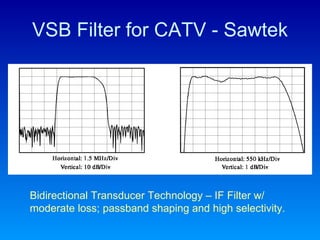
VSB Filter for CATV - Sawtek Bidirectional Transducer Technology – IF Filter w/ moderate loss; passband shaping and high selectivity.
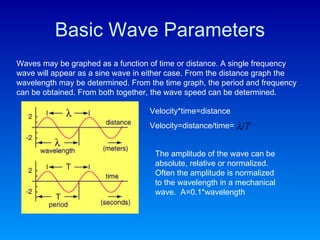
Basic Wave Parameters Waves may be graphed as a function of time or distance. A single frequency wave will appear as a sine wave in either case. From the distance graph the wavelength may be determined. From the time graph, the period and frequency can be obtained. From both together, the wave speed can be determined.  Velocity*time=distance Velocity=distance/time= The amplitude of the wave can be absolute, relative or normalized.  Often the amplitude is normalized to the wavelength in a mechanical wave.  A=0.1*wavelength
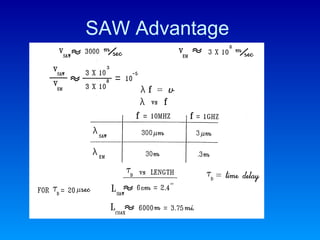
SAW Advantage
SAW Transducer & Reflector  Degrees of Freedom Parameter Degrees of Freedom Electrode amplitude and/or length Electrode phase (electrical) Electrode position (delay) Instantaneous electrode frequency Device Infrastructure Degrees of Freedom Material Choice Thin Films on the Substrate Spatial Diversity on the Substrate Electrical Networks and Interface
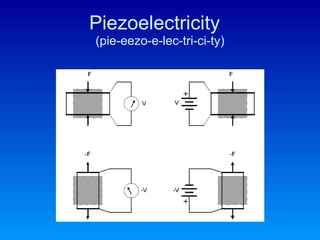
Piezoelectricity  (pie-eezo-e-lec-tri-ci-ty)
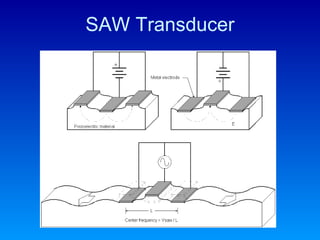
SAW Transducer
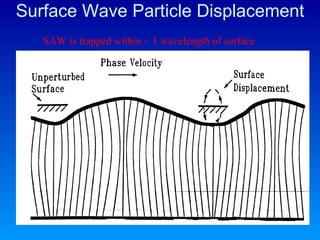
Surface Wave Particle Displacement SAW is trapped within ~ 1 wavelength of surface
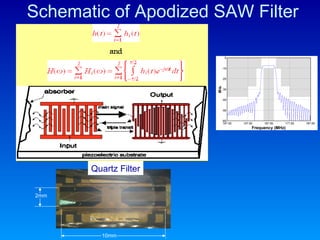
Schematic of Apodized SAW Filter 2mm 10mm Quartz Filter
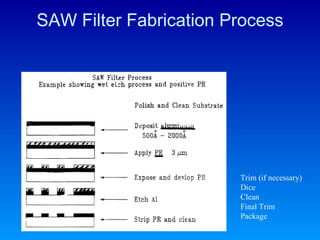
SAW Filter Fabrication Process Trim (if necessary) Dice Clean Final Trim Package
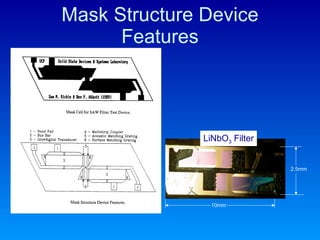
Mask Structure Device Features 2.5mm 10mm LiNbO 3  Filter
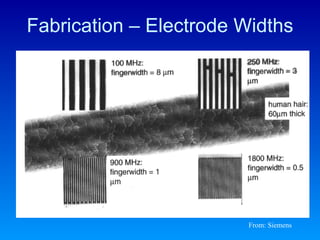
Fabrication – Electrode Widths From: Siemens
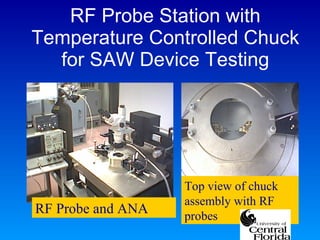
RF Probe Station with Temperature Controlled Chuck for SAW Device Testing RF Probe and ANA Top view of chuck assembly with RF probes
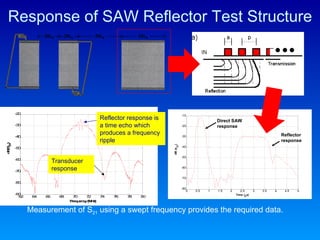
Response of SAW Reflector Test Structure Measurement of S 21  using a swept frequency provides the required data. Transducer response Reflector response is a time echo which produces a frequency ripple
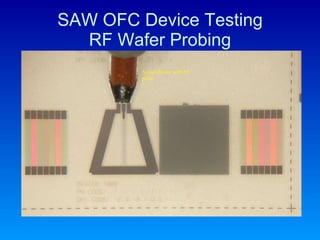
SAW OFC Device Testing RF Wafer Probing Actual device with RF probe
Why Use SAW Sensors and Tags? Frequency/time are measured with greatest accuracy compared to any other physical measurement (10 -10  - 10 -14) . External stimuli affects device parameters (frequency, phase, amplitude, delay) Operate from cryogenic to >1000 o C Ability to both measure a stimuli and to wirelessly, passively transmit information Frequency range  ~10 MHz – 3 GHz Monolithic structure fabricated with current IC photolithography techniques, small, rugged
Goals Applications:  SAW sensors for NASA ground, space-flight, and space-exploration SAW Wireless, Passive, Orthogonal Frequency Coded (OFC) Spread Spectrum Sensor System Multiple sensors (temperature, gas, liquid, pressure, other) in a single platform Operation up to 50 meters at ~ 1 GHz Ultra-wide band operation University of Central Florida School of Electrical Engineering and Computer Science
SAW OFC Properties Extremely robust Operating temperature range: cryogenic to ~1000  o C Radiation hard, solid state Wireless and passive (NO BATTERIES) Coding and spread spectrum embodiments Security in coding; reduced fading effects Multi-sensors or tags can be interrogated Wide range of sensors in a single platform Temperature, pressure, liquid, gas, etc. Integration of external sensor University of Central Florida School of Electrical Engineering and Computer Science
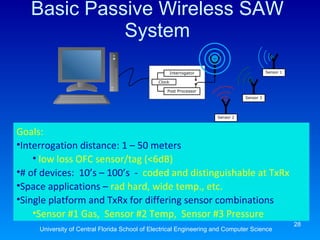
Basic Passive Wireless SAW System University of Central Florida School of Electrical Engineering and Computer Science Goals: Interrogation distance: 1 – 50 meters  low loss OFC sensor/tag (<6dB) # of devices:  10’s – 100’s  -  coded and distinguishable at TxRx Space applications –  rad hard, wide temp., etc. Single platform and TxRx for differing sensor combinations Sensor #1 Gas,  Sensor #2 Temp,  Sensor #3 Pressure
Multi-Sensor TAG Approaches Silicon RFID –  integrated or external sensors Requires battery, energy scavenging, or transmit power Radiation sensitive Limited operating temperature & environments SAW RFID Tags -  integrated or external sensors Passive – powered by interrogation signal  Radiation hard Operational temperatures ~ 0 - 500 +  K Single frequency (no coding, low loss, jamming) CDMA( coding, 40-50 dB loss, code collision) OFC( coding, 3-20 dB loss, code collision solutions, wideband)
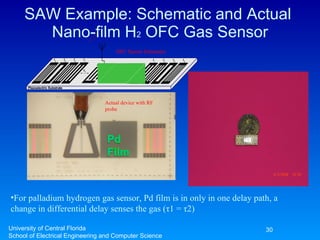
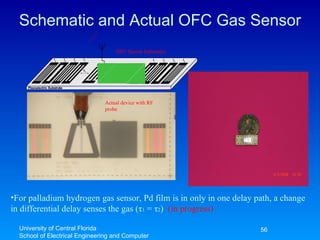
SAW Example: Schematic and Actual  Nano-film H 2  OFC Gas Sensor University of Central Florida  School of Electrical Engineering and Computer Science For palladium hydrogen gas sensor, Pd film is in only in one delay path, a change in differential delay senses the gas ( τ 1 =  τ 2)   OFC Sensor Schematic Actual device with RF probe
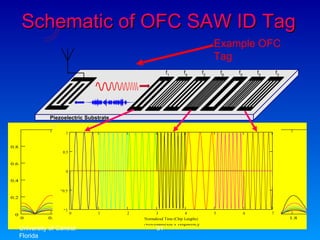
University of Central Florida School of Electrical Engineering and Computer Science Schematic of OFC SAW ID Tag  Example OFC Tag
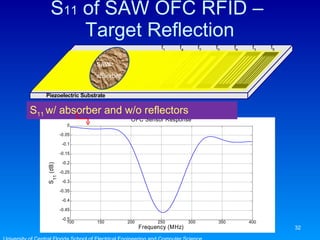
S 11  of SAW OFC RFID –  Target Reflection S 11  w/ absorber and w/o reflectors University of Central Florida School of Electrical Engineering and Computer Science SAW absorber
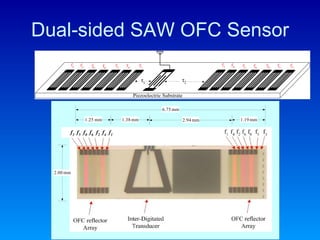
Dual-sided SAW OFC Sensor
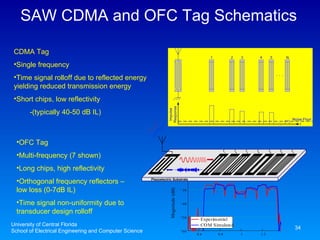
SAW CDMA and OFC Tag Schematics CDMA Tag Single frequency Time signal rolloff due to reflected energy yielding reduced transmission energy Short chips, low reflectivity  -(typically 40-50 dB IL) OFC Tag  Multi-frequency (7 shown) Long chips, high reflectivity Orthogonal frequency reflectors –low loss (0-7dB IL) Time signal non-uniformity due to transducer design rolloff University of Central Florida  School of Electrical Engineering and Computer Science
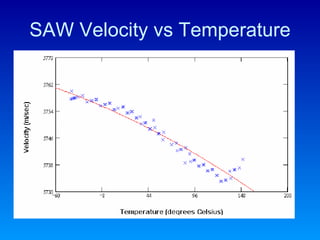
SAW Velocity vs Temperature
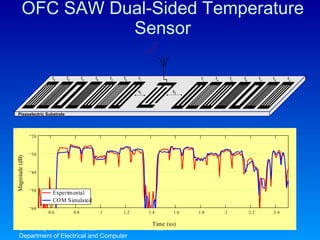
OFC SAW Dual-Sided Temperature Sensor University of Central Florida Department of Electrical and Computer Engineering
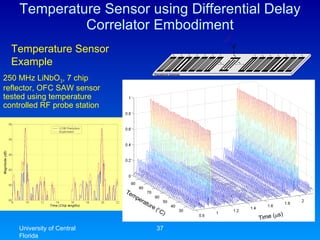
Temperature Sensor using Differential Delay Correlator Embodiment University of Central Florida School of Electrical Engineering and Computer Science Temperature Sensor Example 250 MHz LiNbO 3 , 7 chip reflector, OFC SAW sensor tested using temperature controlled RF probe station
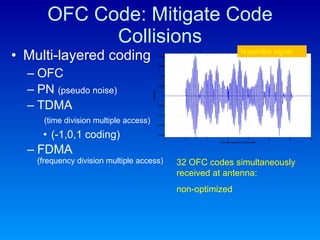
OFC Code: Mitigate Code Collisions Multi-layered coding OFC PN  (pseudo noise) TDMA  (time division multiple access) (-1,0,1 coding) FDMA  (frequency division multiple access) 32 OFC codes simultaneously received at antenna:  non-optimized Noise-like signal
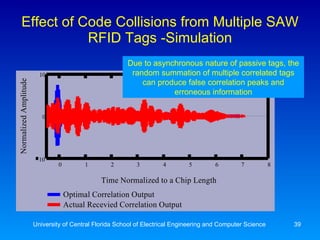
Effect of Code Collisions from Multiple SAW RFID Tags -Simulation Due to asynchronous nature of passive tags, the random summation of multiple correlated tags can produce false correlation peaks and erroneous information University of Central Florida School of Electrical Engineering and Computer Science
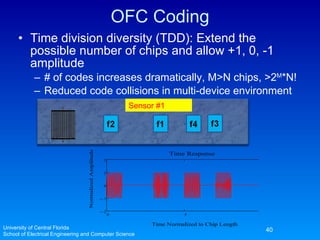
OFC Coding Time division diversity (TDD): Extend the possible number of chips and allow +1, 0, -1 amplitude # of codes increases dramatically, M>N chips, >2 M *N! Reduced code collisions in multi-device environment University of Central Florida School of Electrical Engineering and Computer Science Sensor #1
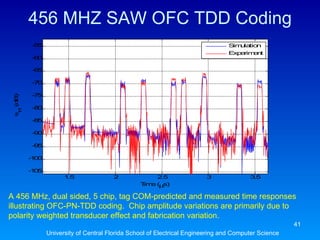
456 MHZ SAW OFC TDD Coding University of Central Florida School of Electrical Engineering and Computer Science A 456 MHz, dual sided, 5 chip, tag COM-predicted and measured time responses illustrating OFC-PN-TDD coding.  Chip amplitude variations are primarily due to polarity weighted transducer effect and fabrication variation.
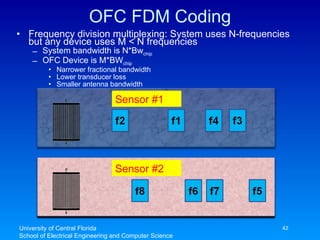
OFC FDM Coding Frequency division multiplexing: System uses N-frequencies but any device uses M < N frequencies System bandwidth is N*Bw chip OFC Device is M*BW chip Narrower fractional bandwidth Lower transducer loss Smaller antenna bandwidth University of Central Florida School of Electrical Engineering and Computer Science Sensor #1 Sensor #2
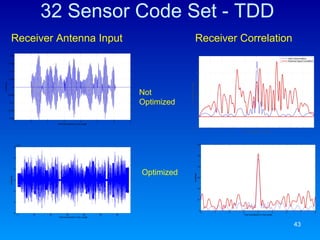
32 Sensor Code Set - TDD Optimized Not Optimized Receiver Correlation Receiver Antenna Input
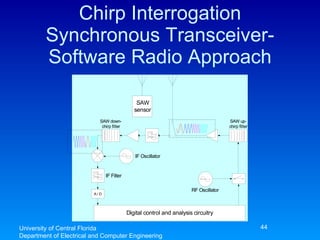
Chirp Interrogation Synchronous Transceiver- Software Radio Approach University of Central Florida Department of Electrical and Computer Engineering
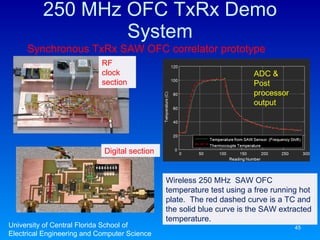
250 MHz OFC TxRx Demo System Synchronous TxRx SAW OFC correlator prototype system RF clock section Digital section University of Central Florida School of Electrical Engineering and Computer Science Wireless 250 MHz  SAW OFC temperature test using a free running hot plate.  The red dashed curve is a TC and the solid blue curve is the SAW extracted temperature. ADC & Post processor output
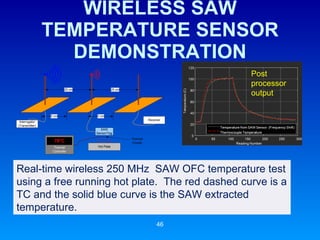
WIRELESS SAW TEMPERATURE SENSOR DEMONSTRATION Real-time wireless 250 MHz  SAW OFC temperature test using a free running hot plate.  The red dashed curve is a TC and the solid blue curve is the SAW extracted temperature. Post processor output
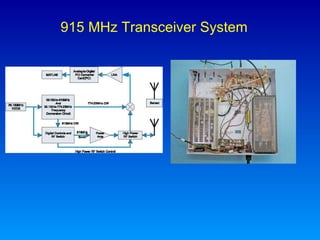
915 MHz Transceiver System
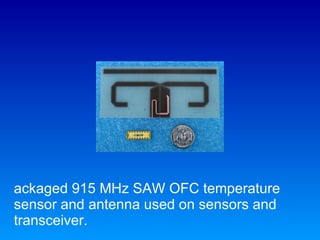
Packaged 915 MHz SAW OFC temperature sensor and antenna used on sensors and transceiver.
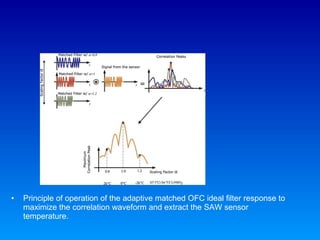
Principle of operation of the adaptive matched OFC ideal filter response to maximize the correlation waveform and extract the SAW sensor temperature.
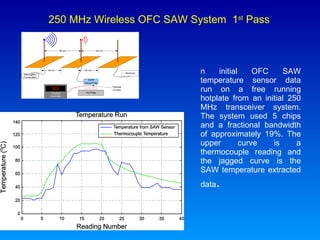
An initial OFC SAW temperature sensor data run on a free running hotplate from an initial 250 MHz transceiver system. The system used 5 chips and a fractional bandwidth of approximately 19%. The upper curve is a thermocouple reading and the jagged curve is the SAW temperature extracted data .  250 MHz Wireless OFC SAW System  1 st  Pass
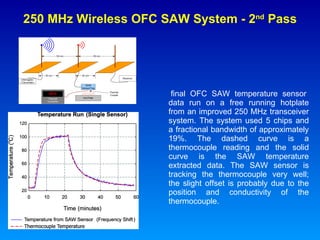
250 MHz Wireless OFC SAW System - 2 nd  Pass A final OFC SAW temperature sensor data run on a free running hotplate from an improved 250 MHz transceiver system. The system used 5 chips and a fractional bandwidth of approximately 19%. The dashed curve is a thermocouple reading and the solid curve is the SAW temperature extracted data. The SAW sensor is tracking the thermocouple very well; the slight offset is probably due to the position and conductivity of the thermocouple.
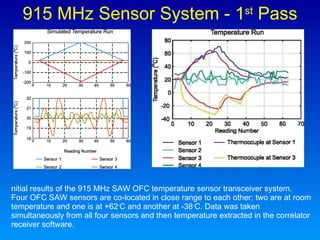
915 MHz Sensor System - 1 st  Pass Initial results of the 915 MHz SAW OFC temperature sensor transceiver system.  Four OFC SAW sensors are co-located in close range to each other; two are at room temperature and one is at +62 ◦ C and another at -38 ◦ C. Data was taken simultaneously from all four sensors and then temperature extracted in the correlator receiver software.
UCF OFC Sensor  Successful Demonstrations Temperature sensing Cryogenic: liquid nitrogen  Room temperature to 250 o C Currently working on sensor for operation to 750 o C Cryogenic liquid level sensor: liquid nitrogen Pressure/Strain sensor Hydrogen gas sensor
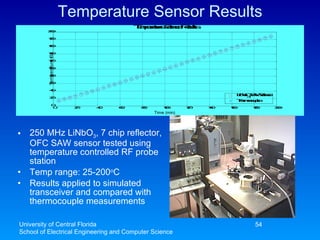
Temperature Sensor Results 250 MHz LiNbO 3 , 7 chip reflector, OFC SAW sensor tested using temperature controlled RF probe station  Temp range: 25-200 o C Results applied to simulated transceiver and compared with thermocouple measurements University of Central Florida School of Electrical Engineering and Computer Science
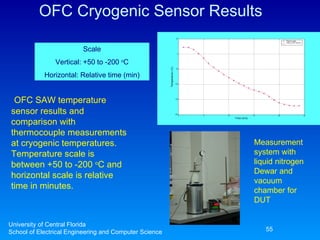
OFC Cryogenic Sensor Results University of Central Florida School of Electrical Engineering and Computer Science Scale Vertical: +50 to -200  o C Horizontal: Relative time (min) Measurement system with liquid nitrogen Dewar and vacuum chamber for DUT OFC SAW temperature sensor results and comparison with thermocouple measurements at cryogenic temperatures.  Temperature scale is between +50 to -200  o C and horizontal scale is relative time in minutes.
Schematic and Actual OFC Gas Sensor University of Central Florida School of Electrical Engineering and Computer Science For palladium hydrogen gas sensor, Pd film is in only in one delay path, a change in differential delay senses the gas ( τ 1  =  τ 2 )   (in progress) OFC Sensor Schematic Actual device with RF probe
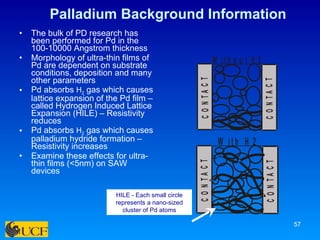
Palladium Background Information The bulk of PD research has been performed for Pd in the 100-10000 Angstrom thickness Morphology of ultra-thin films of Pd are dependent on substrate conditions, deposition and many other parameters Pd absorbs  H 2  gas which causes lattice expansion of the Pd film – called Hydrogen Induced Lattice Expansion (HILE) – Resistivity reduces Pd absorbs  H 2  gas which causes palladium hydride formation – Resistivity increases Examine these effects for ultra-thin films (<5nm) on SAW devices HILE - Each small circle represents a nano-sized cluster of Pd atoms
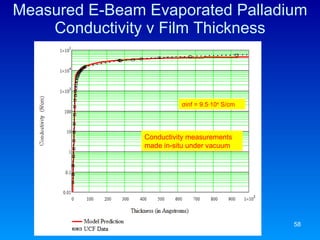
Measured E-Beam Evaporated Palladium Conductivity v Film Thickness Conductivity measurements made in-situ under vacuum σ inf = 9.5·10 4  S/cm
Ultra-thin Pd on SAW Devices for Hydrogen Gas Sensing Pd is known to be very sensitive to hydrogen gas Due to the SAW AE interaction with resistive films and the potentially large change in Pd resistivity, a sensitive SAW hydrogen sensor is possible Experimental investigation of the SAW-Pd-H 2  interaction
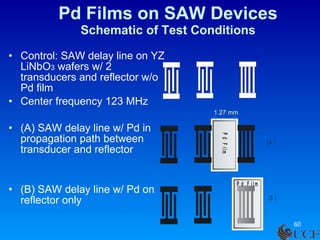
Pd Films on SAW Devices Schematic of Test Conditions Control: SAW delay line on YZ LiNbO 3  wafers w/ 2 transducers and reflector w/o Pd film Center frequency 123 MHz (A) SAW delay line w/ Pd in propagation path between transducer and reflector (B) SAW delay line w/ Pd on reflector only 1.27 mm
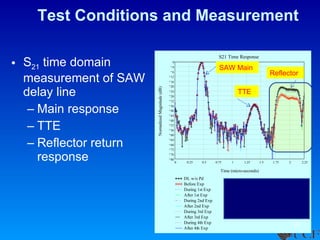
Test Conditions and Measurement S 21  time domain measurement of SAW delay line Main response TTE Reflector return response  TTE SAW Main Reflector
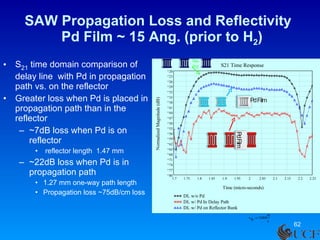
SAW Propagation Loss and Reflectivity   Pd Film ~ 15 Ang. (prior to H 2 ) S 21  time domain comparison of delay line  with Pd in propagation path vs. on the reflector Greater loss when Pd is placed in propagation path than in the reflector ~7dB loss when Pd is on reflector reflector length  1.47 mm ~22dB loss when Pd is in propagation path  1.27 mm one-way path length  Propagation loss ~75dB/cm loss No Pd P d F i l m P d F i l m
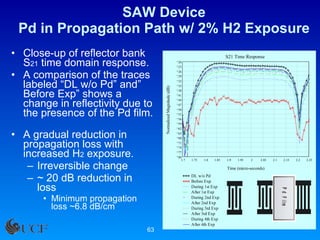
SAW Device Pd in Propagation Path w/ 2% H2 Exposure Close-up of reflector bank S 21  time domain response.  A comparison of the traces labeled “DL w/o Pd” and” Before Exp” shows a change in reflectivity due to the presence of the Pd film.  A gradual reduction in propagation loss with increased H 2  exposure. Irreversible change ~ 20 dB reduction in loss Minimum propagation loss ~6.8 dB/cm
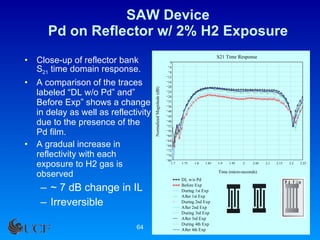
SAW Device Pd on Reflector w/ 2% H2 Exposure Close-up of reflector bank S 21  time domain response.  A comparison of the traces labeled “DL w/o Pd” and” Before Exp” shows a change in delay as well as reflectivity due to the presence of the Pd film.  A gradual increase in reflectivity with each exposure to H2 gas is observed ~ 7 dB change in IL Irreversible
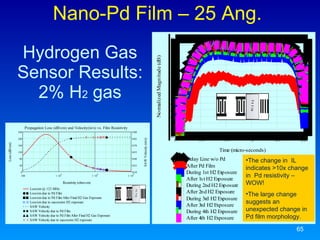
Hydrogen Gas Sensor Results: 2% H 2  gas Nano-Pd Film – 25 Ang. The change in  IL indicates >10x change in  Pd resistivity – WOW! The large change  suggests an unexpected change in Pd film morphology.
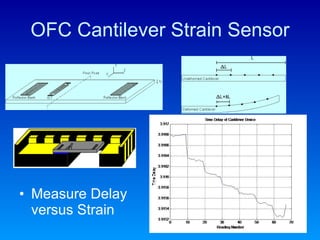
OFC Cantilever Strain Sensor Measure Delay versus Strain
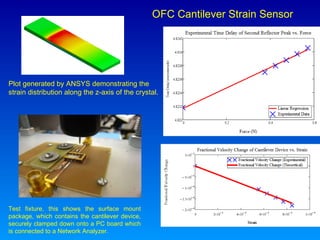
Plot generated by ANSYS demonstrating the strain distribution along the z-axis of the crystal. Test fixture, this shows the surface mount package, which contains the cantilever device, securely clamped down onto a PC board which is connected to a Network Analyzer.  OFC Cantilever Strain Sensor
Applications Current efforts include OFC SAW liquid level, hydrogen gas, pressure and temperature sensors Multi-sensor spread spectrum systems Cryogenic sensing High temperature sensing Space applications Turbine generators Harsh environments Ultra Wide band (UWB) Communication  UWB OFC transducers Potentially many others School of Electrical Engineering and Computer Science
Vision for Future Multiple access, SAW RFID sensors SAW RFID sensor loss approaching 0 dB Unidirectional transducers Low loss reflectors New and novel coding approaches using OFC-type transducers and reflectors Operation in the 1-3 GHz range for small size Single platform for various sensors (temperature, gas, pressure, etc.) SAW sensors in space flight and support operations in 2 to 5 years University of Central Florida  School of Electrical Engineering and Computer Science
NASA Support and Collaborations NASA support KSC 4 Phase I STTRs and 4 Phase II STTRs: 2005-2011 Latest STTR Phase II begins this summer JSC 900 MHz device development in 2008 Langley GRA OFC sensor funding: 2008-2010
Collaborations Micro System Sensors  2005-2006, STTR ASR&D , 2007-present, STTR Mnemonics,  2007-present, STTR United Space Alliance (USA): 2 nd  order collaboration MtronPTI – 1995-present, STTR Triquint Semiconductor  -2009 Vectron - 2009  (SenGenuity 2 nd  order collaboration) Univ. of South Florida 2005-present, SAW sensors Univ. of Puerto Rico Mayaguez – initiating SAW sensor activity
SAW Research at UCF Approximately 200 publications and 7 patents + (5 pending) on SAW technology  Approximately $5M in SAW contracts and grants Approximately 50 graduate students Many international collaborations Contracts with industry, DOD and NASA Current efforts on SAW sensors for space applications funded by NASA
Current Graduate Research Student Contributors Brian Fisher Daniel Gallagher Mark Gallagher Nick Kozlovski Matt Pavlina Luis Rodriguez Mike Roller Nancy Saldanha
Acknowledgment University of Central Florida School of Electrical Engineering and Computer Science Thank you for your attention! The authors wish to thank continuing support from NASA, and especially Dr. Robert Youngquist, NASA-KSC.  The foundation of this work was funded through NASA Graduate Student Research Program Fellowships, the University of Central Florida - Florida Solar Energy Center (FSEC), and NASA STTR contracts.  Continuing research is funded through NASA STTR contracts and industrial collaboration with Applied Sensor Research and Development Corporation, and Mnemonics Corp.

UCF Wireless SAW Sensor Systems

  • 1.
    Surface Acoustic Wave(SAW) Wireless Passive RF Sensor Systems Donald C. Malocha School of Electrical Engineering & Computer Science University of Central Florida Orlando, Fl. 32816-2450 [email_address]
  • 2.
    Univ. of CentralFlorida SAW UCF Center for Acoustoelectronic Technology (CAAT) has been actively doing SAW and BAW research for over 25 years Research includes communication devices and systems, new piezoelectric materials, & sensors Capabilities include SAW/BAW analysis, design, mask generation, device fabrication, RF testing, and RF system development Current group has 8 PhDs and 1 MS Graduated 14 PhDs and 38 MS students
  • 3.
    UCF SAW CapabilitiesClass 100 & 1000 cleanrooms Sub micron mask pattern generator Submicron device capability Extensive photolithography and thin film RF Probe stations Complete SAW characterization facility Extensive software for data analysis and parameter extraction Extensive RF laboratory for SAW technology
  • 4.
    What is atypical SAW Device? A solid state device Converts electrical energy into a mechanical wave on a single crystal substrate Provides very complex signal processing in a very small volume It is estimated that approximately 4 billion SAW devices are produced each year University of Central Florida School of Electrical Engineering and Computer Science Applications: Cellular phones and TV (largest market) Military (Radar, filters, advanced systems Currently emerging – sensors, RFID
  • 5.
    SAW Sensors Thisis a very new and exciting area Since SAW devices are sensitive to temperature, stress, pressure, liquids, viscosity and surface effects, a wide range of sensors are possible
  • 6.
    Sensor Wish-list Passive,Wireless, Coded Small, rugged, cheap Operate over all temperatures and environments Measure physical, chemical and biological variables No cross sensitivity Low loss and variable frequency Radiation hard for space applications Large range to 100’s meters or more SAW sensors meet many of these criteria
  • 7.
    SAW Background Solidstate acoustoelectronic technology Operates from 10MHz to 3 GHz Fabricated using IC technology Manufactured on piezoelectric substrates Operate from cryogenic to 1000 o C Small, cheap, rugged, high performance SAW packaged filter showing 2 transducers, bus bars, bonding, etc. 2mm 10mm Quartz Filter
  • 8.
    Applications of SAWDevices Military (continued) A Few Examples Military Applications Functions Performed Radar Pulse Compression Pulse Expansion and Compression Filters ECM Jammers Pulse Memory Delay Line ECCM Direct Sequence Spread Spectrum- Fast Frequency Hopping- Pulse Shaping, Matched Filters, Programmable Tapped Delay Lines, Convolvers, Fast Hop Synthesizer Fast Hop Synthesizer Ranging Pulse Expansion & Compression Filters
  • 9.
    SAW 7 BankActive Channelizer From Triquint, Inc.
  • 10.
    Applications of SAWDevices A Few Examples Consumer Applications Functions Performed TV IF Filter Cellular Telephones RF and IF Filters VCR IF Filter & Output Modulator Resonators CATV Converter IF Filter, 2 nd LO & Output Modulator Resonators Satellite TV Receiver IF Filter & Output Modulator
  • 11.
    VSB Filter forCATV - Sawtek Bidirectional Transducer Technology – IF Filter w/ moderate loss; passband shaping and high selectivity.
  • 12.
    Basic Wave ParametersWaves may be graphed as a function of time or distance. A single frequency wave will appear as a sine wave in either case. From the distance graph the wavelength may be determined. From the time graph, the period and frequency can be obtained. From both together, the wave speed can be determined. Velocity*time=distance Velocity=distance/time= The amplitude of the wave can be absolute, relative or normalized. Often the amplitude is normalized to the wavelength in a mechanical wave. A=0.1*wavelength
  • 13.
  • 14.
    SAW Transducer &Reflector Degrees of Freedom Parameter Degrees of Freedom Electrode amplitude and/or length Electrode phase (electrical) Electrode position (delay) Instantaneous electrode frequency Device Infrastructure Degrees of Freedom Material Choice Thin Films on the Substrate Spatial Diversity on the Substrate Electrical Networks and Interface
  • 15.
  • 16.
  • 17.
    Surface Wave ParticleDisplacement SAW is trapped within ~ 1 wavelength of surface
  • 18.
    Schematic of ApodizedSAW Filter 2mm 10mm Quartz Filter
  • 19.
    SAW Filter FabricationProcess Trim (if necessary) Dice Clean Final Trim Package
  • 20.
    Mask Structure DeviceFeatures 2.5mm 10mm LiNbO 3 Filter
  • 21.
    Fabrication – ElectrodeWidths From: Siemens
  • 22.
    RF Probe Stationwith Temperature Controlled Chuck for SAW Device Testing RF Probe and ANA Top view of chuck assembly with RF probes
  • 23.
    Response of SAWReflector Test Structure Measurement of S 21 using a swept frequency provides the required data. Transducer response Reflector response is a time echo which produces a frequency ripple
  • 24.
    SAW OFC DeviceTesting RF Wafer Probing Actual device with RF probe
  • 25.
    Why Use SAWSensors and Tags? Frequency/time are measured with greatest accuracy compared to any other physical measurement (10 -10 - 10 -14) . External stimuli affects device parameters (frequency, phase, amplitude, delay) Operate from cryogenic to >1000 o C Ability to both measure a stimuli and to wirelessly, passively transmit information Frequency range ~10 MHz – 3 GHz Monolithic structure fabricated with current IC photolithography techniques, small, rugged
  • 26.
    Goals Applications: SAW sensors for NASA ground, space-flight, and space-exploration SAW Wireless, Passive, Orthogonal Frequency Coded (OFC) Spread Spectrum Sensor System Multiple sensors (temperature, gas, liquid, pressure, other) in a single platform Operation up to 50 meters at ~ 1 GHz Ultra-wide band operation University of Central Florida School of Electrical Engineering and Computer Science
  • 27.
    SAW OFC PropertiesExtremely robust Operating temperature range: cryogenic to ~1000 o C Radiation hard, solid state Wireless and passive (NO BATTERIES) Coding and spread spectrum embodiments Security in coding; reduced fading effects Multi-sensors or tags can be interrogated Wide range of sensors in a single platform Temperature, pressure, liquid, gas, etc. Integration of external sensor University of Central Florida School of Electrical Engineering and Computer Science
  • 28.
    Basic Passive WirelessSAW System University of Central Florida School of Electrical Engineering and Computer Science Goals: Interrogation distance: 1 – 50 meters low loss OFC sensor/tag (<6dB) # of devices: 10’s – 100’s - coded and distinguishable at TxRx Space applications – rad hard, wide temp., etc. Single platform and TxRx for differing sensor combinations Sensor #1 Gas, Sensor #2 Temp, Sensor #3 Pressure
  • 29.
    Multi-Sensor TAG ApproachesSilicon RFID – integrated or external sensors Requires battery, energy scavenging, or transmit power Radiation sensitive Limited operating temperature & environments SAW RFID Tags - integrated or external sensors Passive – powered by interrogation signal Radiation hard Operational temperatures ~ 0 - 500 + K Single frequency (no coding, low loss, jamming) CDMA( coding, 40-50 dB loss, code collision) OFC( coding, 3-20 dB loss, code collision solutions, wideband)
  • 30.
    SAW Example: Schematicand Actual Nano-film H 2 OFC Gas Sensor University of Central Florida School of Electrical Engineering and Computer Science For palladium hydrogen gas sensor, Pd film is in only in one delay path, a change in differential delay senses the gas ( τ 1 = τ 2) OFC Sensor Schematic Actual device with RF probe
  • 31.
    University of CentralFlorida School of Electrical Engineering and Computer Science Schematic of OFC SAW ID Tag Example OFC Tag
  • 32.
    S 11 of SAW OFC RFID – Target Reflection S 11 w/ absorber and w/o reflectors University of Central Florida School of Electrical Engineering and Computer Science SAW absorber
  • 33.
  • 34.
    SAW CDMA andOFC Tag Schematics CDMA Tag Single frequency Time signal rolloff due to reflected energy yielding reduced transmission energy Short chips, low reflectivity -(typically 40-50 dB IL) OFC Tag Multi-frequency (7 shown) Long chips, high reflectivity Orthogonal frequency reflectors –low loss (0-7dB IL) Time signal non-uniformity due to transducer design rolloff University of Central Florida School of Electrical Engineering and Computer Science
  • 35.
    SAW Velocity vsTemperature
  • 36.
    OFC SAW Dual-SidedTemperature Sensor University of Central Florida Department of Electrical and Computer Engineering
  • 37.
    Temperature Sensor usingDifferential Delay Correlator Embodiment University of Central Florida School of Electrical Engineering and Computer Science Temperature Sensor Example 250 MHz LiNbO 3 , 7 chip reflector, OFC SAW sensor tested using temperature controlled RF probe station
  • 38.
    OFC Code: MitigateCode Collisions Multi-layered coding OFC PN (pseudo noise) TDMA (time division multiple access) (-1,0,1 coding) FDMA (frequency division multiple access) 32 OFC codes simultaneously received at antenna: non-optimized Noise-like signal
  • 39.
    Effect of CodeCollisions from Multiple SAW RFID Tags -Simulation Due to asynchronous nature of passive tags, the random summation of multiple correlated tags can produce false correlation peaks and erroneous information University of Central Florida School of Electrical Engineering and Computer Science
  • 40.
    OFC Coding Timedivision diversity (TDD): Extend the possible number of chips and allow +1, 0, -1 amplitude # of codes increases dramatically, M>N chips, >2 M *N! Reduced code collisions in multi-device environment University of Central Florida School of Electrical Engineering and Computer Science Sensor #1
  • 41.
    456 MHZ SAWOFC TDD Coding University of Central Florida School of Electrical Engineering and Computer Science A 456 MHz, dual sided, 5 chip, tag COM-predicted and measured time responses illustrating OFC-PN-TDD coding. Chip amplitude variations are primarily due to polarity weighted transducer effect and fabrication variation.
  • 42.
    OFC FDM CodingFrequency division multiplexing: System uses N-frequencies but any device uses M < N frequencies System bandwidth is N*Bw chip OFC Device is M*BW chip Narrower fractional bandwidth Lower transducer loss Smaller antenna bandwidth University of Central Florida School of Electrical Engineering and Computer Science Sensor #1 Sensor #2
  • 43.
    32 Sensor CodeSet - TDD Optimized Not Optimized Receiver Correlation Receiver Antenna Input
  • 44.
    Chirp Interrogation SynchronousTransceiver- Software Radio Approach University of Central Florida Department of Electrical and Computer Engineering
  • 45.
    250 MHz OFCTxRx Demo System Synchronous TxRx SAW OFC correlator prototype system RF clock section Digital section University of Central Florida School of Electrical Engineering and Computer Science Wireless 250 MHz SAW OFC temperature test using a free running hot plate. The red dashed curve is a TC and the solid blue curve is the SAW extracted temperature. ADC & Post processor output
  • 46.
    WIRELESS SAW TEMPERATURESENSOR DEMONSTRATION Real-time wireless 250 MHz SAW OFC temperature test using a free running hot plate. The red dashed curve is a TC and the solid blue curve is the SAW extracted temperature. Post processor output
  • 47.
  • 48.
    Packaged 915 MHzSAW OFC temperature sensor and antenna used on sensors and transceiver.
  • 49.
    Principle of operationof the adaptive matched OFC ideal filter response to maximize the correlation waveform and extract the SAW sensor temperature.
  • 50.
    An initial OFCSAW temperature sensor data run on a free running hotplate from an initial 250 MHz transceiver system. The system used 5 chips and a fractional bandwidth of approximately 19%. The upper curve is a thermocouple reading and the jagged curve is the SAW temperature extracted data . 250 MHz Wireless OFC SAW System 1 st Pass
  • 51.
    250 MHz WirelessOFC SAW System - 2 nd Pass A final OFC SAW temperature sensor data run on a free running hotplate from an improved 250 MHz transceiver system. The system used 5 chips and a fractional bandwidth of approximately 19%. The dashed curve is a thermocouple reading and the solid curve is the SAW temperature extracted data. The SAW sensor is tracking the thermocouple very well; the slight offset is probably due to the position and conductivity of the thermocouple.
  • 52.
    915 MHz SensorSystem - 1 st Pass Initial results of the 915 MHz SAW OFC temperature sensor transceiver system. Four OFC SAW sensors are co-located in close range to each other; two are at room temperature and one is at +62 ◦ C and another at -38 ◦ C. Data was taken simultaneously from all four sensors and then temperature extracted in the correlator receiver software.
  • 53.
    UCF OFC Sensor Successful Demonstrations Temperature sensing Cryogenic: liquid nitrogen Room temperature to 250 o C Currently working on sensor for operation to 750 o C Cryogenic liquid level sensor: liquid nitrogen Pressure/Strain sensor Hydrogen gas sensor
  • 54.
    Temperature Sensor Results250 MHz LiNbO 3 , 7 chip reflector, OFC SAW sensor tested using temperature controlled RF probe station Temp range: 25-200 o C Results applied to simulated transceiver and compared with thermocouple measurements University of Central Florida School of Electrical Engineering and Computer Science
  • 55.
    OFC Cryogenic SensorResults University of Central Florida School of Electrical Engineering and Computer Science Scale Vertical: +50 to -200 o C Horizontal: Relative time (min) Measurement system with liquid nitrogen Dewar and vacuum chamber for DUT OFC SAW temperature sensor results and comparison with thermocouple measurements at cryogenic temperatures. Temperature scale is between +50 to -200 o C and horizontal scale is relative time in minutes.
  • 56.
    Schematic and ActualOFC Gas Sensor University of Central Florida School of Electrical Engineering and Computer Science For palladium hydrogen gas sensor, Pd film is in only in one delay path, a change in differential delay senses the gas ( τ 1 = τ 2 ) (in progress) OFC Sensor Schematic Actual device with RF probe
  • 57.
    Palladium Background InformationThe bulk of PD research has been performed for Pd in the 100-10000 Angstrom thickness Morphology of ultra-thin films of Pd are dependent on substrate conditions, deposition and many other parameters Pd absorbs H 2 gas which causes lattice expansion of the Pd film – called Hydrogen Induced Lattice Expansion (HILE) – Resistivity reduces Pd absorbs H 2 gas which causes palladium hydride formation – Resistivity increases Examine these effects for ultra-thin films (<5nm) on SAW devices HILE - Each small circle represents a nano-sized cluster of Pd atoms
  • 58.
    Measured E-Beam EvaporatedPalladium Conductivity v Film Thickness Conductivity measurements made in-situ under vacuum σ inf = 9.5·10 4 S/cm
  • 59.
    Ultra-thin Pd onSAW Devices for Hydrogen Gas Sensing Pd is known to be very sensitive to hydrogen gas Due to the SAW AE interaction with resistive films and the potentially large change in Pd resistivity, a sensitive SAW hydrogen sensor is possible Experimental investigation of the SAW-Pd-H 2 interaction
  • 60.
    Pd Films onSAW Devices Schematic of Test Conditions Control: SAW delay line on YZ LiNbO 3 wafers w/ 2 transducers and reflector w/o Pd film Center frequency 123 MHz (A) SAW delay line w/ Pd in propagation path between transducer and reflector (B) SAW delay line w/ Pd on reflector only 1.27 mm
  • 61.
    Test Conditions andMeasurement S 21 time domain measurement of SAW delay line Main response TTE Reflector return response TTE SAW Main Reflector
  • 62.
    SAW Propagation Lossand Reflectivity Pd Film ~ 15 Ang. (prior to H 2 ) S 21 time domain comparison of delay line with Pd in propagation path vs. on the reflector Greater loss when Pd is placed in propagation path than in the reflector ~7dB loss when Pd is on reflector reflector length 1.47 mm ~22dB loss when Pd is in propagation path 1.27 mm one-way path length Propagation loss ~75dB/cm loss No Pd P d F i l m P d F i l m
  • 63.
    SAW Device Pdin Propagation Path w/ 2% H2 Exposure Close-up of reflector bank S 21 time domain response. A comparison of the traces labeled “DL w/o Pd” and” Before Exp” shows a change in reflectivity due to the presence of the Pd film. A gradual reduction in propagation loss with increased H 2 exposure. Irreversible change ~ 20 dB reduction in loss Minimum propagation loss ~6.8 dB/cm
  • 64.
    SAW Device Pdon Reflector w/ 2% H2 Exposure Close-up of reflector bank S 21 time domain response. A comparison of the traces labeled “DL w/o Pd” and” Before Exp” shows a change in delay as well as reflectivity due to the presence of the Pd film. A gradual increase in reflectivity with each exposure to H2 gas is observed ~ 7 dB change in IL Irreversible
  • 65.
    Hydrogen Gas SensorResults: 2% H 2 gas Nano-Pd Film – 25 Ang. The change in IL indicates >10x change in Pd resistivity – WOW! The large change suggests an unexpected change in Pd film morphology.
  • 66.
    OFC Cantilever StrainSensor Measure Delay versus Strain
  • 67.
    Plot generated byANSYS demonstrating the strain distribution along the z-axis of the crystal. Test fixture, this shows the surface mount package, which contains the cantilever device, securely clamped down onto a PC board which is connected to a Network Analyzer. OFC Cantilever Strain Sensor
  • 68.
    Applications Current effortsinclude OFC SAW liquid level, hydrogen gas, pressure and temperature sensors Multi-sensor spread spectrum systems Cryogenic sensing High temperature sensing Space applications Turbine generators Harsh environments Ultra Wide band (UWB) Communication UWB OFC transducers Potentially many others School of Electrical Engineering and Computer Science
  • 69.
    Vision for FutureMultiple access, SAW RFID sensors SAW RFID sensor loss approaching 0 dB Unidirectional transducers Low loss reflectors New and novel coding approaches using OFC-type transducers and reflectors Operation in the 1-3 GHz range for small size Single platform for various sensors (temperature, gas, pressure, etc.) SAW sensors in space flight and support operations in 2 to 5 years University of Central Florida School of Electrical Engineering and Computer Science
  • 70.
    NASA Support andCollaborations NASA support KSC 4 Phase I STTRs and 4 Phase II STTRs: 2005-2011 Latest STTR Phase II begins this summer JSC 900 MHz device development in 2008 Langley GRA OFC sensor funding: 2008-2010
  • 71.
    Collaborations Micro SystemSensors 2005-2006, STTR ASR&D , 2007-present, STTR Mnemonics, 2007-present, STTR United Space Alliance (USA): 2 nd order collaboration MtronPTI – 1995-present, STTR Triquint Semiconductor -2009 Vectron - 2009 (SenGenuity 2 nd order collaboration) Univ. of South Florida 2005-present, SAW sensors Univ. of Puerto Rico Mayaguez – initiating SAW sensor activity
  • 72.
    SAW Research atUCF Approximately 200 publications and 7 patents + (5 pending) on SAW technology Approximately $5M in SAW contracts and grants Approximately 50 graduate students Many international collaborations Contracts with industry, DOD and NASA Current efforts on SAW sensors for space applications funded by NASA
  • 73.
    Current Graduate ResearchStudent Contributors Brian Fisher Daniel Gallagher Mark Gallagher Nick Kozlovski Matt Pavlina Luis Rodriguez Mike Roller Nancy Saldanha
  • 74.
    Acknowledgment University ofCentral Florida School of Electrical Engineering and Computer Science Thank you for your attention! The authors wish to thank continuing support from NASA, and especially Dr. Robert Youngquist, NASA-KSC. The foundation of this work was funded through NASA Graduate Student Research Program Fellowships, the University of Central Florida - Florida Solar Energy Center (FSEC), and NASA STTR contracts. Continuing research is funded through NASA STTR contracts and industrial collaboration with Applied Sensor Research and Development Corporation, and Mnemonics Corp.

Editor's Notes

  • #24 Explain axes Delay line with pass band ripple