1
Cleanroom Fabrication and Applications of Surface Acoustic
Wave Devices
Nitasha Goyal Madelyn Hutton Kevin Mao
nitashagoyal27@gmail.com maddyrhutton@yahoo.com kevinmao7@gmail.com
Walter Roper Soumya Sudhakar
wroper9910@gmail.com soumya96@gmail.com
Abstract
Beyond traditional uses as filters in radios and
cell phones, surface acoustic wave (SAW)
devices have applications in the medical field
as biosensors. Five SAW devices were
fabricated in the Rutgers MERL cleanroom
through the processes of thin film deposition,
photolithography, and wet etching.
Measurements of the bandwidths using 3
decibel (dB) width calculations and
measurements of operating frequencies of the
SAW devices showed functionality as filters.
Measurements of the mass of biotin
demonstrate the potential use of SAW devices
as microbalances and biosensors.
1 Introduction
Nanotechnology and microfabrication
have gained importance in today’s world since
the fields enable machines to be more energy
and cost efficient. One type of device in this
field is the surface acoustic wave (SAW)
device. Most commonly, SAW devices act as
frequency filters in instruments such as cell
phones and radios, selecting only a certain
bandwidth of frequencies. Today, research is
being conducted using SAW devices as
biosensors. Biosensors can be microbalances
that measure the mass of objects on a
microscale such as a strand of DNA. In
addition to aiding in genetic research such as
DNA hybridization, SAW devices can help
diabetic patients in blood glucose testing by
substantially reducing the amount of blood
collected. Some recent research is focused on
SAW devices’ ability to improve the efficiency
of solar panels[1]. In this work, SAW devices
were demonstrated successfully as filters and
used in the biosensing application as
microbalances.
2 Background
The microfabrication procedure has
been successfully improved in both research
and industry in the past decades. Our SAW
devices were fabricated in the cleanroom at
Rutgers’ Microelectronics Research
Laboratory (MERL).
2.1 The Cleanroom
A cleanroom is a lab in which certain
environmental pollutants are highly
controlled. This type of lab is commonly used
in fields that are sensitive to ecological
contamination such as semiconductor
manufacturing, biotechnology, and
microfabrication processes[2]. Despite its
name, cleanrooms are not sterile; rather, they
have a controlled level of airborne
contamination. Airflow rates and direction,
pressurization, temperature, humidity and
filtration are regulated to keep pollutants at a
minimum[3].
A cleanroom is necessary for the
fabrication process in order to preserve the
integrity of the devices made. Dust particles
in the air can interfere with the fabrication of
SAW devices during the fabrication process.
Since the SAW devices are on the microscale,
these dust particles are large enough to cause
the devices to be defective[4]. In addition to
2
dust, other particulates in air, such as smoke,
bacteria, and cells, can also cause similar
problems in the devices. For these reasons,
microfabrication processes are carried out in
cleanrooms where the number of particulates
in the air can be controlled, decreasing the
probability of defective devices.
2.2 Surface Acoustic Wave Devices
SAW filters utilize interdigital
transducers (IDTs) and piezoelectricity to
produce surface acoustic waves.
IDTs consist of finger-like patterns
made of conductive material, such as
aluminum, as seen in Figure 2.1, and are used
to generate and receive the surface acoustic
waves. The number of fingers, the spacing
between the fingers, and the spacing between
the IDTs determines which frequencies are
able to travel through the circuit effectively.
Figure 2.1 Blue represents the IDTs of the SAW
device while yellow represents the quartz delay line.
Courtesy of Zheng Zhang, Rutgers University.
The SAW device utilizes the
piezoelectric effect by converting electrical
energy (AC voltage) to mechanical energy at
one end of the device and converting back to
electrical energy at the other end. The
piezoelectric effect refers to the electric
charge in response to pressure due to dipole
formation in the crystal lattice. The effect is
reversible; the inverse piezoelectric effect
results in the generation of mechanical strain
from an applied electric field. Voltage across
the input IDT generates a current which
energizes the quartz underneath the IDT
fingers. Quartz is a piezoelectric material. The
electrical energy is converted into mechanical
energy waves due to the contraction of the
quartz. The waves travel across the quartz to
the output IDT. The output IDT then
converts the mechanical waves back to
electrical energy, resulting in a voltage.
SAW-based processors are
lightweight and versatile and have low energy
consumption; therefore, they are
advantageous to use in portable wireless
communication devices[4].
2.3 Usage of SAW Devices as
Filters
One common use of SAW devices is
as filters found in appliances such as radios and
cell phones.
SAW devices filter frequencies
through the basic principles of wave
interference. When waves are in phase across
the device, they cause constructive
interference and are allowed through the
device. When waves are out of phase across
the device, they cause destructive interference
and are filtered[5]. The phase coherence
depends on the frequency of the waves (or the
wavelength), the distance between the IDTs
and the IDT periodicity.
2.4 Quartz Crystal Microbalance
A new area of research involves using
acoustic wave devices as biosensors to
determine the mass of objects. In this work,
this application was demonstrated using the
quartz crystal microbalance (QCM). QCM is
also a piezoelectric device, but uses acoustic
waves propagating longitudinally rather than
tranversely. The biosensors in Figure 2.2
work since QCM devices can detect changes
in frequency. Using Equation 1, it is possible
to determine the change in mass.
Equation 1
= 3.336x10³
m/s (acoustic velocity of quartz)
= 2.648x10³
(density of quartz)
= 0.2047 cm3
(area of quartz)
= change in frequency
= fundamental frequency
3
This microbalance can be used to
detect gas absorption as well as the
interactions between the biological molecules:
DNA-DNA, DNA-RNA, protein-protein, and
protein-small molecules.
Figure 2.2 Microbalance with the SAW device in
the center
Biotin is used in research to test the
microbalance since it is representative of
biomolecules that can be measured on a
microbalance[6].
Another device that can be used as a
biosensor is a quartz crystal microbalance
(QCM). QCMs have larger electrodes, thus
better suited for finding changes in
frequencies. Though not a SAW device,
QCMs also utilize piezoelectricity and are a
suitable replacement for measurement
purposes. The major difference between the
SAW device and the QCM is that the SAW
device operates on transverse waves whereas
the QCM operates on longitudinal waves.
2.5 Microfabrication Processes and
Measurement Principles
2.5.1 Mask
Masks are tools to imprint the design
of the device onto the photoresist on the
aluminum conductor. The mask has a chrome
pattern of the SAW device on a glass substrate
as seen in Figure 2.3. A mask with defects can
result in a low yield of chips[4].
Figure 2.3 Glass mask with chrome pattern
2.5.2 Photolithography and Wet
Etching
Photolithography includes the process
of spin coating photoresist on to the substrate.
This procedure has to be done in a yellow-lit
room since the photoresist reacts to UV light.
The layer of photoresist applied by spin
coating reacts with the concentrated UV light
during exposure[7].
The process used to expose the
photoresist to the light is contact printing.
Contact printing involves the wafer touching
the mask to allow for correct pattern transfer
during exposure. Contact printing may be
susceptible to dust particles on the wafer that
can potentially damage the mask; therefore,
proper care must be taken during the mask to
substrate contact[4].
The developing stage removes the
photoresist that has been exposed to UV light
during exposure, leaving the unexposed
photoresist to remain on the substrate. After
using this resist to pattern the aluminum by
wet etching, the photoresist is left on the
wafer to prevent corrosion; this process is
called passivation.
The etch rate of the aluminum is not
only dependent on the concentration of
solutes but also on the temperature of the
solution, the agitation of wafers, and the
impurities or alloys in the film[4].
4
2.5.3 Bandwidth and Operating
Frequency
The bandwidth is the optimal range of
frequencies that the device will allow. Any
frequency outside the bandwidth range will be
unlikely to resonate in the device. The
bandwidth is calculated by analyzing the
frequency values three decibels (dB) down
from the peak operating frequency – the
mode – and finding the width of the gap as
shown in Figure 2.4. The interval of 3 dB is
chosen since this marks the half power point -
the point at which the wave’s output power is
half that of its mid-band value.
The peak operating frequency is the
frequency associated with the wave that
experienced the most constructive
interference, as indicated by a high signal
strength. More than one operating frequency
can occur for each SAW filter. The resonance
of the waves results in a fundamental
frequency and additional harmonics, all of
which can be considered as multiple peak
operating frequencies.
Figure 2.4 The bandwidth of a wave between
frequency 1 and frequency 2
3 Microfabrication,
Measurements, and Biosensor
Application of SAW Devices
SAW devices and microbalances are
fabricated through a series of detailed steps
and tested.
3.1 Microfabrication of SAW
Devices in Cleanroom
Microfabrication includes electron
beam-physical vapor deposition,
photolithography, contact printing,
developing, and wet etching. This process was
done for five samples.
3.1.1 Cleaning and Electron Beam-
Physical Vapor Deposition
Cleaning of the quartz substrates was
done using acetone and methanol [8]. Next,
the wafer was rinsed with deionized water and
blown dry with nitrogen which quickly
evaporates any solvents or liquids on the
wafer. Nitrogen is used because it does not
cause the wafer to oxidize [9]. The wafer was
baked to dry and remove solvents. A film of
aluminum conductor was deposited on one
side of the quartz wafer by electron beam
physical vapor deposition [10], as shown in
Figure 3.1..
Figure 3.1 The samples of quartz substrate coated
with aluminum
3.1.2 Spin Coating
Spin coating began by placing the
sample in the middle of the spinner. A few
drops of photoresist (AZ 5124) were put onto
the center of the aluminum layer of the quartz
as seen in Figure 3.2 until the sample was
covered. To ensure the purity of the
photoresist, the tip of the dropper must not
touch the opening of the bottle nor the
sample. The substrate was then rotated at a
high speed in order to spread the coating
5
evenly by centrifugal force. Rotation was
done for 5 seconds at 500 rpm and then
subsequently for 40 seconds at 4,000 rpm.
After the spinning was done, the wafer was
soft baked to dry off any solvent from the spin
coating, improve the adhesion of the resist to
the wafer, and anneal the stresses put on the
wafer during spin coating[11].
Figure 3.2 Spinner with the aluminum-coated
substrate (Sample 1) and pink photoresist (AZ 5124)
For Sample 2, an extra layer of
photoresist was applied due to a spinner
error. After applying the photoresist to
Sample 2, the spinner started immediately at
4,000 rpm, a higher speed than intended. As a
result, the spinning was stopped and Sample 2
was reexamined; some of the photoresist was
no longer on the chip. Photoresist was
reapplied to Sample 2 and the correct
program was used to spin Sample 2.
3.1.3 Mask and Exposure
The samples were positioned on the
stage in order to maximize the number of
chips on the samples. Once the shadow
disappeared as the sample contacted the mask,
the UV light was turned on; exposure lasted
for 15 seconds.
For all samples, the shadow was
examined in order to ensure the wafer was
just touching the mask. As the wafer moved
closer to the mask, the shadow diminished.
3.1.4 Image Developing
The sample was then soaked in a
developer to remove the exposed photoresist
leaving behind the pattern as seen in Figure
3.3. The developer was AZ 1:1 and was
compatible with the AZ 5214 photoresist.
The amount of time in the developer varies
depending on the sample, but is usually
around one minute. The samples were
dipped in distilled water, then removed, and
then dipped once again. This method was used
to ensure that all the developer was off the
wafer. The wafer was then dried using high-
pressure nitrogen.
Figure 3.3 Samples after developing
As seen in Table 1, the samples were
in the developing solution twice before the
photoresist was removed. They had to be
developed for 30 sec, dried, and developed
for 30 sec again to observe the development
progress. Sample 2 needed more time during
the developing stage. Sample 2 was developed
for 1 minute and 6 seconds, with two rounds
of 30 seconds each and a third round of 6
seconds. This was likely because at the earlier
spinning step, the photoresist was re-applied.
Sample Developing Time/Sequence Etching
Time
1 30 sec + rinse + 30 sec + rinse =
60 sec total
11:50
2 30 sec + rinse + 30 sec + rinse +
6 sec + rinse= 66 sec total
20:07
3 30 sec + rinse + 30 sec + rinse =
60 sec total
25:01
4 30 sec + rinse + 30 sec + rinse =
60 sec total
9:00
5 30 sec + rinse + 30 sec + rinse=
60 sec total
10:42
Table 1 Developing and etching times
6
3.1.5 Aluminum Wet Etching
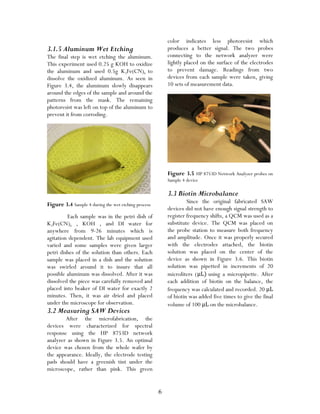
The final step is wet etching the aluminum.
This experiment used 0.25 g KOH to oxidize
the aluminum and used 0.5g K3Fe(CN)6 to
dissolve the oxidized aluminum. As seen in
Figure 3.4, the aluminum slowly disappears
around the edges of the sample and around the
patterns from the mask. The remaining
photoresist was left on top of the aluminum to
prevent it from corroding.
Figure 3.4 Sample 4 during the wet etching process
Each sample was in the petri dish of
K3Fe(CN)6 , KOH , and DI water for
anywhere from 9-26 minutes which is
agitation dependent. The lab equipment used
varied and some samples were given larger
petri dishes of the solution than others. Each
sample was placed in a dish and the solution
was swirled around it to insure that all
possible aluminum was dissolved. After it was
dissolved the piece was carefully removed and
placed into beaker of DI water for exactly 2
minutes. Then, it was air dried and placed
under the microscope for observation.
3.2 Measuring SAW Devices
After the microfabrication, the
devices were characterized for spectral
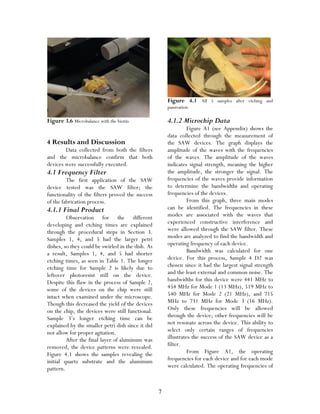
response using the HP 8753D network
analyzer as shown in Figure 3.5. An optimal
device was chosen from the whole wafer by
the appearance. Ideally, the electrode testing
pads should have a greenish tint under the
microscope, rather than pink. This green
color indicates less photoresist which
produces a better signal. The two probes
connecting to the network analyzer were
lightly placed on the surface of the electrodes
to prevent damage. Readings from two
devices from each sample were taken, giving
10 sets of measurement data.
Figure 3.5 HP 8753D Network Analyzer probes on
Sample 4 device
3.3 Biotin Microbalance
Since the original fabricated SAW
devices did not have enough signal strength to
register frequency shifts, a QCM was used as a
substitute device. The QCM was placed on
the probe station to measure both frequency
and amplitude. Once it was properly secured
with the electrodes attached, the biotin
solution was placed on the center of the
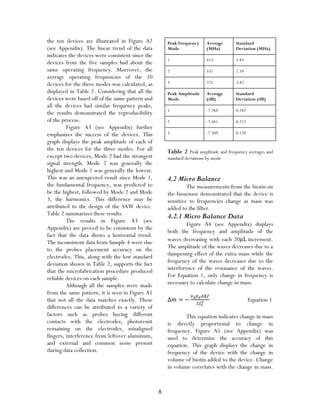
device as shown in Figure 3.6. This biotin
solution was pipetted in increments of 20
microliters ( using a micropipette. After
each addition of biotin on the balance, the
frequency was calculated and recorded. 20
of biotin was added five times to give the final
volume of 100 on the microbalance.
7
Figure 3.6 Microbalance with the biotin
4 Results and Discussion
Data collected from both the filters
and the microbalance confirm that both
devices were successfully executed.
4.1 Frequency Filter
The first application of the SAW
device tested was the SAW filter; the
functionality of the filters proved the success
of the fabrication process.
4.1.1 Final Product
Observation for the different
developing and etching times are explained
through the procedural steps in Section 3.
Samples 1, 4, and 5 had the larger petri
dishes, so they could be swirled in the dish. As
a result, Samples 1, 4, and 5 had shorter
etching times, as seen in Table 1. The longer
etching time for Sample 2 is likely due to
leftover photoresist still on the device.
Despite this flaw in the process of Sample 2,
some of the devices on the chip were still
intact when examined under the microscope.
Though this decreased the yield of the devices
on the chip, the devices were still functional.
Sample 3’s longer etching time can be
explained by the smaller petri dish since it did
not allow for proper agitation.
After the final layer of aluminum was
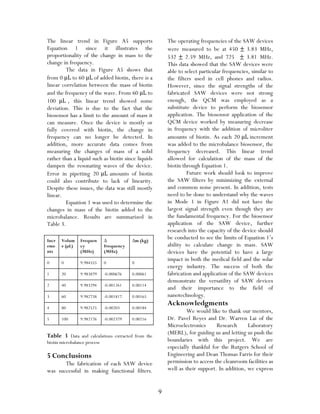
removed, the device patterns were revealed.
Figure 4.1 shows the samples revealing the
initial quartz substrate and the aluminum
pattern.
Figure 4.1 All 5 samples after etching and
passivation
4.1.2 Microchip Data
Figure A1 (see Appendix) shows the
data collected through the measurement of
the SAW devices. The graph displays the
amplitude of the waves with the frequencies
of the waves. The amplitude of the waves
indicates signal strength, meaning the higher
the amplitude, the stronger the signal. The
frequencies of the waves provide information
to determine the bandwidths and operating
frequencies of the devices.
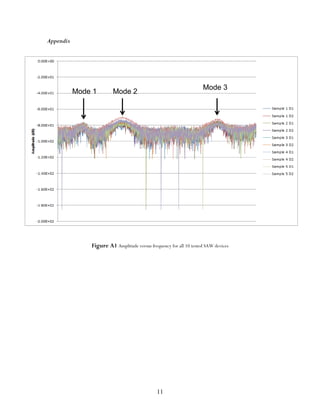
From this graph, three main modes
can be identified. The frequencies in these
modes are associated with the waves that
experienced constructive interference and
were allowed through the SAW filter. These
modes are analyzed to find the bandwidth and
operating frequency of each device.
Bandwidth was calculated for one
device. For this process, Sample 4 D2 was
chosen since it had the largest signal strength
and the least external and common noise. The
bandwidths for this device were 441 MHz to
454 MHz for Mode 1 (13 MHz), 519 MHz to
540 MHz for Mode 2 (21 MHz), and 715
MHz to 731 MHz for Mode 3 (16 MHz).
Only these frequencies will be allowed
through the device; other frequencies will be
not resonate across the device. This ability to
select only certain ranges of frequencies
illustrates the success of the SAW device as a
filter.
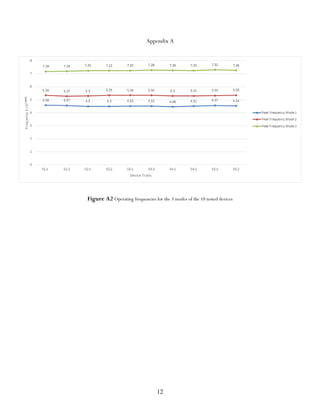
From Figure A1, the operating
frequencies for each device and for each mode
were calculated. The operating frequencies of
8
the ten devices are illustrated in Figure A2
(see Appendix). The linear trend of the data
indicates the devices were consistent since the
devices from the five samples had about the
same operating frequency. Moreover, the
average operating frequencies of the 10
devices for the three modes was calculated, as
displayed in Table 2. Considering that all the
devices were based off of the same pattern and
all the devices had similar frequency peaks,
the results demonstrated the reproducibility
of the process.
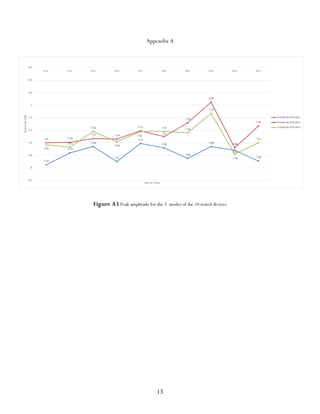
Figure A3 (see Appendix) further
emphasizes the success of the devices. This
graph displays the peak amplitude of each of
the ten devices for the three modes. For all
except two devices, Mode 2 had the strongest
signal strength. Mode 2 was generally the
highest and Mode 1 was generally the lowest.
This was an unexpected result since Mode 1,
the fundamental frequency, was predicted to
be the highest, followed by Mode 2 and Mode
3, the harmonics. This difference may be
attributed to the design of the SAW device.
Table 2 summarizes these results.
The results in Figure A3 (see
Appendix) are proved to be consistent by the
fact that the data shows a horizontal trend.
The inconsistent data from Sample 4 were due
to the probes placement accuracy on the
electrodes. This, along with the low standard
deviation shown in Table 2, supports the fact
that the microfabrication procedure produced
reliable devices on each sample.
Although all the samples were made
from the same pattern, it is seen in Figure A1
that not all the data matches exactly. These
differences can be attributed to a variety of
factors such as probes having different
contacts with the electrodes, photoresist
remaining on the electrodes, misaligned
fingers, interference from leftover aluminum,
and external and common noise present
during data collection.
Peak Frequency
Mode
Average
(MHz)
Standard
Deviation (MHz)
1 453 3.83
2 532 2.59
3 725 3.82
Peak Amplitude
Mode
Average
(dB)
Standard
Deviation (dB)
1 -7.768 0.182
2 -7.441 0.212
3 -7.509 0.120
Table 2 Peak amplitude and frequency averages and
standard deviations by mode
4.2 Micro Balance
The measurements from the biotin on
the biosensor demonstrated that the device is
sensitive to frequencies change as mass was
added to the filter.
4.2.1 Micro Balance Data
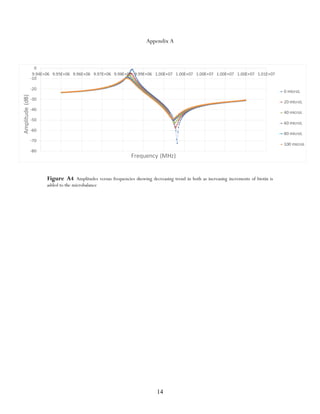
Figure A4 (see Appendix) displays
both the frequency and amplitude of the
waves decreasing with each 20 increment.
The amplitude of the waves decreases due to a
dampening effect of the extra mass while the
frequency of the waves decreases due to the
interference of the resonance of the waves.
For Equation 1, only change in frequency is
necessary to calculate change in mass.
Equation 1
This equation indicates change in mass
is directly proportional to change in
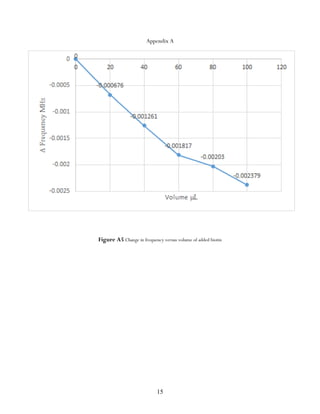
frequency. Figure A5 (see Appendix) was
used to determine the accuracy of this
equation. This graph displays the change in
frequency of the device with the change in
volume of biotin added to the device. Change
in volume correlates with the change in mass.
9
The linear trend in Figure A5 supports
Equation 1 since it illustrates the
proportionality of the change in mass to the
change in frequency.
The data in Figure A5 shows that
from 0 to 60 of added biotin, there is a
linear correlation between the mass of biotin
and the frequency of the wave. From 60 to
100 , this linear trend showed some
deviation. This is due to the fact that the
biosensor has a limit to the amount of mass it
can measure. Once the device is mostly or
fully covered with biotin, the change in
frequency can no longer be detected. In
addition, more accurate data comes from
measuring the changes of mass of a solid
rather than a liquid such as biotin since liquids
dampen the resonating waves of the device.
Error in pipetting 20 amounts of biotin
could also contribute to lack of linearity.
Despite these issues, the data was still mostly
linear.
Equation 1 was used to determine the
changes in mass of the biotin added to the
microbalance. Results are summarized in
Table 3.
Incr
eme
nts
Volum
e (µL)
Frequen
cy
(MHz)
∆
Frequency
(MHz)
∆m (kg)
0 0 9.984555 0 0
1 20 9.983879 -0.000676 0.00061
2 40 9.983294 -0.001261 0.00114
3 60 9.982738 -0.001817 0.00165
4 80 9.982525 -0.00203 0.00184
5 100 9.982176 -0.002379 0.00216
Table 3 Data and calculations extracted from the
biotin microbalance process
5 Conclusions
The fabrication of each SAW device
was successful in making functional filters.
The operating frequencies of the SAW devices
were measured to be at 450 3.83 MHz,
532 2.59 MHz, and 725 3.81 MHz.
This data showed that the SAW devices were
able to select particular frequencies, similar to
the filters used in cell phones and radios.
However, since the signal strengths of the
fabricated SAW devices were not strong
enough, the QCM was employed as a
substitute device to perform the biosensor
application. The biosensor application of the
QCM device worked by measuring decrease
in frequency with the addition of microliter
amounts of biotin. As each 20 increment
was added to the microbalance biosensor, the
frequency decreased. This linear trend
allowed for calculation of the mass of the
biotin through Equation 1.
Future work should look to improve
the SAW filters by minimizing the external
and common noise present. In addition, tests
need to be done to understand why the waves
in Mode 1 in Figure A1 did not have the
largest signal strength even though they are
the fundamental frequency. For the biosensor
application of the SAW device, further
research into the capacity of the device should
be conducted to see the limits of Equation 1’s
ability to calculate change in mass. SAW
devices have the potential to have a large
impact in both the medical field and the solar
energy industry. The success of both the
fabrication and application of the SAW devices
demonstrate the versatility of SAW devices
and their importance to the field of
nanotechnology.
Acknowledgments
We would like to thank our mentors,
Dr. Pavel Reyes and Dr. Warren Lai of the
Microelectronics Research Laboratory
(MERL), for guiding us and letting us push the
boundaries with this project. We are
especially thankful for the Rutgers School of
Engineering and Dean Thomas Farris for their
permission to access the cleanroom facilities as
well as their support. In addition, we express
10
our gratitude to Robert Lorber for the
cleanroom technical support. We would also
like to thank The Governor’s School of
Engineering and its sponsors: Rutgers, The
State University of New Jersey, Morgan
Stanley, NJ Resources, South Jersey
Industries, PSE&G, and the GSET alumni and
community. Furthermore, we would like to
thank Jean Patrick Antoine, and all of the
counselors for giving us this opportunity. A
special thank you to Jeff Kowalski, our
Residential Teaching Associate, for always
being there for us and taking us to where we
need to be.
References
[1] "Highly Efficient Photovoltaic Energy
Conversion Using Surface Acoustic Waves in
Piezoelectric Semiconductors | University of
Maryland Energy Research Center." Highly
Efficient Photovoltaic Energy Conversion Using
Surface Acoustic Waves in Piezoelectric
Semiconductors | University of Maryland Energy
Research Center. N.p., n.d. Web. 24 July 2013.
<http://www.umerc.umd.edu/projects/sol
ar05>.
[2] “In NASA’s Sterile Areas, Plenty of
Robust Bacteria.” New York Times, 9.
October 2007.
[3] McFadden, Roger. "A Basic Introduction
to Clean Room." Coastwide Laboratories. N.p.,
n.d. Web. 5 July 2013.
<http://www.coastwidelabs.com/Technical
%20Articles/Cleaning%20the%20Cleanroom
.htm>.
[4] Ng, Kwok K. “Lithography and Etching.”
Semiconductor Device Technology. By Simon
M. Sze. N.p.: Wiley, 2005. 404-18. Print.
[5] Coon, Allan. "SAW Filter PCB Layout."
RFM. N.p., n.d. Web. 19 July
2013.
<http://www.rfm.com/products/apnotes/a
n42.pdf>.
[6] "What Is Biotin?" WiseGEEK. N.p., n.d.
Web. 19 July 2013.
<http://www.wisegeek.org/what-is-
biotin.htm>.
[7] "Photolithography." Photolithography.
N.p., n.d. Web. 05 July 2013.
<http://www.ece.gatech.edu/research/labs
/vc/theory/photolith.html>.
[8] "Cleaning Procedures for Class
Substrates." UCIRvine, n.d. Web. 5 July
2013.
<http://www.inrf.uci.edu/wordpress/wp-
content/uploads/sop-wet-cleaning-pro-for-
glass-substrates.pdf>.
[9] Downie, N. A. Industrial Gases. London:
Blackie Academic & Professional,
1997.Google Books. Web. 5 July 2013.
[10] "Electron Beam Physical Vapour
Deposition (EB-PVD)." Phoenix Scientific
Industries Ltd. N.p., n.d. Web. 04 July 2013.
<http://www.psiltd.co.uk/Products/Deposi
tionSystems/ElectronBeam/tabid/238/langu
age/en-GB/Default.aspx>.
[11] "Coating Quality and Spin
Coating." Materials Science and Engineering.
N.p., n.d. Web. 25 July 2013.
11
Appendix
Figure A1 Amplitude versus frequency for all 10 tested SAW devices
Mode 1 Mode 2
Mode 3
12
Appendix A
Figure A2 Operating frequencies for the 3 modes of the 10 tested devices
13
Appendix A
Figure A3 Peak amplitude for the 3 modes of the 10 tested devices
14
Appendix A
Figure A4 Amplitudes versus frequencies showing decreasing trend in both as increasing increments of biotin is
added to the microbalance
15
Appendix A
Figure A5 Change in frequency versus volume of added biotin

Surface Acoustic Wave Devices

  • 1.
    1 Cleanroom Fabrication andApplications of Surface Acoustic Wave Devices Nitasha Goyal Madelyn Hutton Kevin Mao nitashagoyal27@gmail.com maddyrhutton@yahoo.com kevinmao7@gmail.com Walter Roper Soumya Sudhakar wroper9910@gmail.com soumya96@gmail.com Abstract Beyond traditional uses as filters in radios and cell phones, surface acoustic wave (SAW) devices have applications in the medical field as biosensors. Five SAW devices were fabricated in the Rutgers MERL cleanroom through the processes of thin film deposition, photolithography, and wet etching. Measurements of the bandwidths using 3 decibel (dB) width calculations and measurements of operating frequencies of the SAW devices showed functionality as filters. Measurements of the mass of biotin demonstrate the potential use of SAW devices as microbalances and biosensors. 1 Introduction Nanotechnology and microfabrication have gained importance in today’s world since the fields enable machines to be more energy and cost efficient. One type of device in this field is the surface acoustic wave (SAW) device. Most commonly, SAW devices act as frequency filters in instruments such as cell phones and radios, selecting only a certain bandwidth of frequencies. Today, research is being conducted using SAW devices as biosensors. Biosensors can be microbalances that measure the mass of objects on a microscale such as a strand of DNA. In addition to aiding in genetic research such as DNA hybridization, SAW devices can help diabetic patients in blood glucose testing by substantially reducing the amount of blood collected. Some recent research is focused on SAW devices’ ability to improve the efficiency of solar panels[1]. In this work, SAW devices were demonstrated successfully as filters and used in the biosensing application as microbalances. 2 Background The microfabrication procedure has been successfully improved in both research and industry in the past decades. Our SAW devices were fabricated in the cleanroom at Rutgers’ Microelectronics Research Laboratory (MERL). 2.1 The Cleanroom A cleanroom is a lab in which certain environmental pollutants are highly controlled. This type of lab is commonly used in fields that are sensitive to ecological contamination such as semiconductor manufacturing, biotechnology, and microfabrication processes[2]. Despite its name, cleanrooms are not sterile; rather, they have a controlled level of airborne contamination. Airflow rates and direction, pressurization, temperature, humidity and filtration are regulated to keep pollutants at a minimum[3]. A cleanroom is necessary for the fabrication process in order to preserve the integrity of the devices made. Dust particles in the air can interfere with the fabrication of SAW devices during the fabrication process. Since the SAW devices are on the microscale, these dust particles are large enough to cause the devices to be defective[4]. In addition to
  • 2.
    2 dust, other particulatesin air, such as smoke, bacteria, and cells, can also cause similar problems in the devices. For these reasons, microfabrication processes are carried out in cleanrooms where the number of particulates in the air can be controlled, decreasing the probability of defective devices. 2.2 Surface Acoustic Wave Devices SAW filters utilize interdigital transducers (IDTs) and piezoelectricity to produce surface acoustic waves. IDTs consist of finger-like patterns made of conductive material, such as aluminum, as seen in Figure 2.1, and are used to generate and receive the surface acoustic waves. The number of fingers, the spacing between the fingers, and the spacing between the IDTs determines which frequencies are able to travel through the circuit effectively. Figure 2.1 Blue represents the IDTs of the SAW device while yellow represents the quartz delay line. Courtesy of Zheng Zhang, Rutgers University. The SAW device utilizes the piezoelectric effect by converting electrical energy (AC voltage) to mechanical energy at one end of the device and converting back to electrical energy at the other end. The piezoelectric effect refers to the electric charge in response to pressure due to dipole formation in the crystal lattice. The effect is reversible; the inverse piezoelectric effect results in the generation of mechanical strain from an applied electric field. Voltage across the input IDT generates a current which energizes the quartz underneath the IDT fingers. Quartz is a piezoelectric material. The electrical energy is converted into mechanical energy waves due to the contraction of the quartz. The waves travel across the quartz to the output IDT. The output IDT then converts the mechanical waves back to electrical energy, resulting in a voltage. SAW-based processors are lightweight and versatile and have low energy consumption; therefore, they are advantageous to use in portable wireless communication devices[4]. 2.3 Usage of SAW Devices as Filters One common use of SAW devices is as filters found in appliances such as radios and cell phones. SAW devices filter frequencies through the basic principles of wave interference. When waves are in phase across the device, they cause constructive interference and are allowed through the device. When waves are out of phase across the device, they cause destructive interference and are filtered[5]. The phase coherence depends on the frequency of the waves (or the wavelength), the distance between the IDTs and the IDT periodicity. 2.4 Quartz Crystal Microbalance A new area of research involves using acoustic wave devices as biosensors to determine the mass of objects. In this work, this application was demonstrated using the quartz crystal microbalance (QCM). QCM is also a piezoelectric device, but uses acoustic waves propagating longitudinally rather than tranversely. The biosensors in Figure 2.2 work since QCM devices can detect changes in frequency. Using Equation 1, it is possible to determine the change in mass. Equation 1 = 3.336x10³ m/s (acoustic velocity of quartz) = 2.648x10³ (density of quartz) = 0.2047 cm3 (area of quartz) = change in frequency = fundamental frequency
  • 3.
    3 This microbalance canbe used to detect gas absorption as well as the interactions between the biological molecules: DNA-DNA, DNA-RNA, protein-protein, and protein-small molecules. Figure 2.2 Microbalance with the SAW device in the center Biotin is used in research to test the microbalance since it is representative of biomolecules that can be measured on a microbalance[6]. Another device that can be used as a biosensor is a quartz crystal microbalance (QCM). QCMs have larger electrodes, thus better suited for finding changes in frequencies. Though not a SAW device, QCMs also utilize piezoelectricity and are a suitable replacement for measurement purposes. The major difference between the SAW device and the QCM is that the SAW device operates on transverse waves whereas the QCM operates on longitudinal waves. 2.5 Microfabrication Processes and Measurement Principles 2.5.1 Mask Masks are tools to imprint the design of the device onto the photoresist on the aluminum conductor. The mask has a chrome pattern of the SAW device on a glass substrate as seen in Figure 2.3. A mask with defects can result in a low yield of chips[4]. Figure 2.3 Glass mask with chrome pattern 2.5.2 Photolithography and Wet Etching Photolithography includes the process of spin coating photoresist on to the substrate. This procedure has to be done in a yellow-lit room since the photoresist reacts to UV light. The layer of photoresist applied by spin coating reacts with the concentrated UV light during exposure[7]. The process used to expose the photoresist to the light is contact printing. Contact printing involves the wafer touching the mask to allow for correct pattern transfer during exposure. Contact printing may be susceptible to dust particles on the wafer that can potentially damage the mask; therefore, proper care must be taken during the mask to substrate contact[4]. The developing stage removes the photoresist that has been exposed to UV light during exposure, leaving the unexposed photoresist to remain on the substrate. After using this resist to pattern the aluminum by wet etching, the photoresist is left on the wafer to prevent corrosion; this process is called passivation. The etch rate of the aluminum is not only dependent on the concentration of solutes but also on the temperature of the solution, the agitation of wafers, and the impurities or alloys in the film[4].
  • 4.
    4 2.5.3 Bandwidth andOperating Frequency The bandwidth is the optimal range of frequencies that the device will allow. Any frequency outside the bandwidth range will be unlikely to resonate in the device. The bandwidth is calculated by analyzing the frequency values three decibels (dB) down from the peak operating frequency – the mode – and finding the width of the gap as shown in Figure 2.4. The interval of 3 dB is chosen since this marks the half power point - the point at which the wave’s output power is half that of its mid-band value. The peak operating frequency is the frequency associated with the wave that experienced the most constructive interference, as indicated by a high signal strength. More than one operating frequency can occur for each SAW filter. The resonance of the waves results in a fundamental frequency and additional harmonics, all of which can be considered as multiple peak operating frequencies. Figure 2.4 The bandwidth of a wave between frequency 1 and frequency 2 3 Microfabrication, Measurements, and Biosensor Application of SAW Devices SAW devices and microbalances are fabricated through a series of detailed steps and tested. 3.1 Microfabrication of SAW Devices in Cleanroom Microfabrication includes electron beam-physical vapor deposition, photolithography, contact printing, developing, and wet etching. This process was done for five samples. 3.1.1 Cleaning and Electron Beam- Physical Vapor Deposition Cleaning of the quartz substrates was done using acetone and methanol [8]. Next, the wafer was rinsed with deionized water and blown dry with nitrogen which quickly evaporates any solvents or liquids on the wafer. Nitrogen is used because it does not cause the wafer to oxidize [9]. The wafer was baked to dry and remove solvents. A film of aluminum conductor was deposited on one side of the quartz wafer by electron beam physical vapor deposition [10], as shown in Figure 3.1.. Figure 3.1 The samples of quartz substrate coated with aluminum 3.1.2 Spin Coating Spin coating began by placing the sample in the middle of the spinner. A few drops of photoresist (AZ 5124) were put onto the center of the aluminum layer of the quartz as seen in Figure 3.2 until the sample was covered. To ensure the purity of the photoresist, the tip of the dropper must not touch the opening of the bottle nor the sample. The substrate was then rotated at a high speed in order to spread the coating
  • 5.
    5 evenly by centrifugalforce. Rotation was done for 5 seconds at 500 rpm and then subsequently for 40 seconds at 4,000 rpm. After the spinning was done, the wafer was soft baked to dry off any solvent from the spin coating, improve the adhesion of the resist to the wafer, and anneal the stresses put on the wafer during spin coating[11]. Figure 3.2 Spinner with the aluminum-coated substrate (Sample 1) and pink photoresist (AZ 5124) For Sample 2, an extra layer of photoresist was applied due to a spinner error. After applying the photoresist to Sample 2, the spinner started immediately at 4,000 rpm, a higher speed than intended. As a result, the spinning was stopped and Sample 2 was reexamined; some of the photoresist was no longer on the chip. Photoresist was reapplied to Sample 2 and the correct program was used to spin Sample 2. 3.1.3 Mask and Exposure The samples were positioned on the stage in order to maximize the number of chips on the samples. Once the shadow disappeared as the sample contacted the mask, the UV light was turned on; exposure lasted for 15 seconds. For all samples, the shadow was examined in order to ensure the wafer was just touching the mask. As the wafer moved closer to the mask, the shadow diminished. 3.1.4 Image Developing The sample was then soaked in a developer to remove the exposed photoresist leaving behind the pattern as seen in Figure 3.3. The developer was AZ 1:1 and was compatible with the AZ 5214 photoresist. The amount of time in the developer varies depending on the sample, but is usually around one minute. The samples were dipped in distilled water, then removed, and then dipped once again. This method was used to ensure that all the developer was off the wafer. The wafer was then dried using high- pressure nitrogen. Figure 3.3 Samples after developing As seen in Table 1, the samples were in the developing solution twice before the photoresist was removed. They had to be developed for 30 sec, dried, and developed for 30 sec again to observe the development progress. Sample 2 needed more time during the developing stage. Sample 2 was developed for 1 minute and 6 seconds, with two rounds of 30 seconds each and a third round of 6 seconds. This was likely because at the earlier spinning step, the photoresist was re-applied. Sample Developing Time/Sequence Etching Time 1 30 sec + rinse + 30 sec + rinse = 60 sec total 11:50 2 30 sec + rinse + 30 sec + rinse + 6 sec + rinse= 66 sec total 20:07 3 30 sec + rinse + 30 sec + rinse = 60 sec total 25:01 4 30 sec + rinse + 30 sec + rinse = 60 sec total 9:00 5 30 sec + rinse + 30 sec + rinse= 60 sec total 10:42 Table 1 Developing and etching times
  • 6.
    6 3.1.5 Aluminum WetEtching The final step is wet etching the aluminum. This experiment used 0.25 g KOH to oxidize the aluminum and used 0.5g K3Fe(CN)6 to dissolve the oxidized aluminum. As seen in Figure 3.4, the aluminum slowly disappears around the edges of the sample and around the patterns from the mask. The remaining photoresist was left on top of the aluminum to prevent it from corroding. Figure 3.4 Sample 4 during the wet etching process Each sample was in the petri dish of K3Fe(CN)6 , KOH , and DI water for anywhere from 9-26 minutes which is agitation dependent. The lab equipment used varied and some samples were given larger petri dishes of the solution than others. Each sample was placed in a dish and the solution was swirled around it to insure that all possible aluminum was dissolved. After it was dissolved the piece was carefully removed and placed into beaker of DI water for exactly 2 minutes. Then, it was air dried and placed under the microscope for observation. 3.2 Measuring SAW Devices After the microfabrication, the devices were characterized for spectral response using the HP 8753D network analyzer as shown in Figure 3.5. An optimal device was chosen from the whole wafer by the appearance. Ideally, the electrode testing pads should have a greenish tint under the microscope, rather than pink. This green color indicates less photoresist which produces a better signal. The two probes connecting to the network analyzer were lightly placed on the surface of the electrodes to prevent damage. Readings from two devices from each sample were taken, giving 10 sets of measurement data. Figure 3.5 HP 8753D Network Analyzer probes on Sample 4 device 3.3 Biotin Microbalance Since the original fabricated SAW devices did not have enough signal strength to register frequency shifts, a QCM was used as a substitute device. The QCM was placed on the probe station to measure both frequency and amplitude. Once it was properly secured with the electrodes attached, the biotin solution was placed on the center of the device as shown in Figure 3.6. This biotin solution was pipetted in increments of 20 microliters ( using a micropipette. After each addition of biotin on the balance, the frequency was calculated and recorded. 20 of biotin was added five times to give the final volume of 100 on the microbalance.
  • 7.
    7 Figure 3.6 Microbalancewith the biotin 4 Results and Discussion Data collected from both the filters and the microbalance confirm that both devices were successfully executed. 4.1 Frequency Filter The first application of the SAW device tested was the SAW filter; the functionality of the filters proved the success of the fabrication process. 4.1.1 Final Product Observation for the different developing and etching times are explained through the procedural steps in Section 3. Samples 1, 4, and 5 had the larger petri dishes, so they could be swirled in the dish. As a result, Samples 1, 4, and 5 had shorter etching times, as seen in Table 1. The longer etching time for Sample 2 is likely due to leftover photoresist still on the device. Despite this flaw in the process of Sample 2, some of the devices on the chip were still intact when examined under the microscope. Though this decreased the yield of the devices on the chip, the devices were still functional. Sample 3’s longer etching time can be explained by the smaller petri dish since it did not allow for proper agitation. After the final layer of aluminum was removed, the device patterns were revealed. Figure 4.1 shows the samples revealing the initial quartz substrate and the aluminum pattern. Figure 4.1 All 5 samples after etching and passivation 4.1.2 Microchip Data Figure A1 (see Appendix) shows the data collected through the measurement of the SAW devices. The graph displays the amplitude of the waves with the frequencies of the waves. The amplitude of the waves indicates signal strength, meaning the higher the amplitude, the stronger the signal. The frequencies of the waves provide information to determine the bandwidths and operating frequencies of the devices. From this graph, three main modes can be identified. The frequencies in these modes are associated with the waves that experienced constructive interference and were allowed through the SAW filter. These modes are analyzed to find the bandwidth and operating frequency of each device. Bandwidth was calculated for one device. For this process, Sample 4 D2 was chosen since it had the largest signal strength and the least external and common noise. The bandwidths for this device were 441 MHz to 454 MHz for Mode 1 (13 MHz), 519 MHz to 540 MHz for Mode 2 (21 MHz), and 715 MHz to 731 MHz for Mode 3 (16 MHz). Only these frequencies will be allowed through the device; other frequencies will be not resonate across the device. This ability to select only certain ranges of frequencies illustrates the success of the SAW device as a filter. From Figure A1, the operating frequencies for each device and for each mode were calculated. The operating frequencies of
  • 8.
    8 the ten devicesare illustrated in Figure A2 (see Appendix). The linear trend of the data indicates the devices were consistent since the devices from the five samples had about the same operating frequency. Moreover, the average operating frequencies of the 10 devices for the three modes was calculated, as displayed in Table 2. Considering that all the devices were based off of the same pattern and all the devices had similar frequency peaks, the results demonstrated the reproducibility of the process. Figure A3 (see Appendix) further emphasizes the success of the devices. This graph displays the peak amplitude of each of the ten devices for the three modes. For all except two devices, Mode 2 had the strongest signal strength. Mode 2 was generally the highest and Mode 1 was generally the lowest. This was an unexpected result since Mode 1, the fundamental frequency, was predicted to be the highest, followed by Mode 2 and Mode 3, the harmonics. This difference may be attributed to the design of the SAW device. Table 2 summarizes these results. The results in Figure A3 (see Appendix) are proved to be consistent by the fact that the data shows a horizontal trend. The inconsistent data from Sample 4 were due to the probes placement accuracy on the electrodes. This, along with the low standard deviation shown in Table 2, supports the fact that the microfabrication procedure produced reliable devices on each sample. Although all the samples were made from the same pattern, it is seen in Figure A1 that not all the data matches exactly. These differences can be attributed to a variety of factors such as probes having different contacts with the electrodes, photoresist remaining on the electrodes, misaligned fingers, interference from leftover aluminum, and external and common noise present during data collection. Peak Frequency Mode Average (MHz) Standard Deviation (MHz) 1 453 3.83 2 532 2.59 3 725 3.82 Peak Amplitude Mode Average (dB) Standard Deviation (dB) 1 -7.768 0.182 2 -7.441 0.212 3 -7.509 0.120 Table 2 Peak amplitude and frequency averages and standard deviations by mode 4.2 Micro Balance The measurements from the biotin on the biosensor demonstrated that the device is sensitive to frequencies change as mass was added to the filter. 4.2.1 Micro Balance Data Figure A4 (see Appendix) displays both the frequency and amplitude of the waves decreasing with each 20 increment. The amplitude of the waves decreases due to a dampening effect of the extra mass while the frequency of the waves decreases due to the interference of the resonance of the waves. For Equation 1, only change in frequency is necessary to calculate change in mass. Equation 1 This equation indicates change in mass is directly proportional to change in frequency. Figure A5 (see Appendix) was used to determine the accuracy of this equation. This graph displays the change in frequency of the device with the change in volume of biotin added to the device. Change in volume correlates with the change in mass.
  • 9.
    9 The linear trendin Figure A5 supports Equation 1 since it illustrates the proportionality of the change in mass to the change in frequency. The data in Figure A5 shows that from 0 to 60 of added biotin, there is a linear correlation between the mass of biotin and the frequency of the wave. From 60 to 100 , this linear trend showed some deviation. This is due to the fact that the biosensor has a limit to the amount of mass it can measure. Once the device is mostly or fully covered with biotin, the change in frequency can no longer be detected. In addition, more accurate data comes from measuring the changes of mass of a solid rather than a liquid such as biotin since liquids dampen the resonating waves of the device. Error in pipetting 20 amounts of biotin could also contribute to lack of linearity. Despite these issues, the data was still mostly linear. Equation 1 was used to determine the changes in mass of the biotin added to the microbalance. Results are summarized in Table 3. Incr eme nts Volum e (µL) Frequen cy (MHz) ∆ Frequency (MHz) ∆m (kg) 0 0 9.984555 0 0 1 20 9.983879 -0.000676 0.00061 2 40 9.983294 -0.001261 0.00114 3 60 9.982738 -0.001817 0.00165 4 80 9.982525 -0.00203 0.00184 5 100 9.982176 -0.002379 0.00216 Table 3 Data and calculations extracted from the biotin microbalance process 5 Conclusions The fabrication of each SAW device was successful in making functional filters. The operating frequencies of the SAW devices were measured to be at 450 3.83 MHz, 532 2.59 MHz, and 725 3.81 MHz. This data showed that the SAW devices were able to select particular frequencies, similar to the filters used in cell phones and radios. However, since the signal strengths of the fabricated SAW devices were not strong enough, the QCM was employed as a substitute device to perform the biosensor application. The biosensor application of the QCM device worked by measuring decrease in frequency with the addition of microliter amounts of biotin. As each 20 increment was added to the microbalance biosensor, the frequency decreased. This linear trend allowed for calculation of the mass of the biotin through Equation 1. Future work should look to improve the SAW filters by minimizing the external and common noise present. In addition, tests need to be done to understand why the waves in Mode 1 in Figure A1 did not have the largest signal strength even though they are the fundamental frequency. For the biosensor application of the SAW device, further research into the capacity of the device should be conducted to see the limits of Equation 1’s ability to calculate change in mass. SAW devices have the potential to have a large impact in both the medical field and the solar energy industry. The success of both the fabrication and application of the SAW devices demonstrate the versatility of SAW devices and their importance to the field of nanotechnology. Acknowledgments We would like to thank our mentors, Dr. Pavel Reyes and Dr. Warren Lai of the Microelectronics Research Laboratory (MERL), for guiding us and letting us push the boundaries with this project. We are especially thankful for the Rutgers School of Engineering and Dean Thomas Farris for their permission to access the cleanroom facilities as well as their support. In addition, we express
  • 10.
    10 our gratitude toRobert Lorber for the cleanroom technical support. We would also like to thank The Governor’s School of Engineering and its sponsors: Rutgers, The State University of New Jersey, Morgan Stanley, NJ Resources, South Jersey Industries, PSE&G, and the GSET alumni and community. Furthermore, we would like to thank Jean Patrick Antoine, and all of the counselors for giving us this opportunity. A special thank you to Jeff Kowalski, our Residential Teaching Associate, for always being there for us and taking us to where we need to be. References [1] "Highly Efficient Photovoltaic Energy Conversion Using Surface Acoustic Waves in Piezoelectric Semiconductors | University of Maryland Energy Research Center." Highly Efficient Photovoltaic Energy Conversion Using Surface Acoustic Waves in Piezoelectric Semiconductors | University of Maryland Energy Research Center. N.p., n.d. Web. 24 July 2013. <http://www.umerc.umd.edu/projects/sol ar05>. [2] “In NASA’s Sterile Areas, Plenty of Robust Bacteria.” New York Times, 9. October 2007. [3] McFadden, Roger. "A Basic Introduction to Clean Room." Coastwide Laboratories. N.p., n.d. Web. 5 July 2013. <http://www.coastwidelabs.com/Technical %20Articles/Cleaning%20the%20Cleanroom .htm>. [4] Ng, Kwok K. “Lithography and Etching.” Semiconductor Device Technology. By Simon M. Sze. N.p.: Wiley, 2005. 404-18. Print. [5] Coon, Allan. "SAW Filter PCB Layout." RFM. N.p., n.d. Web. 19 July 2013. <http://www.rfm.com/products/apnotes/a n42.pdf>. [6] "What Is Biotin?" WiseGEEK. N.p., n.d. Web. 19 July 2013. <http://www.wisegeek.org/what-is- biotin.htm>. [7] "Photolithography." Photolithography. N.p., n.d. Web. 05 July 2013. <http://www.ece.gatech.edu/research/labs /vc/theory/photolith.html>. [8] "Cleaning Procedures for Class Substrates." UCIRvine, n.d. Web. 5 July 2013. <http://www.inrf.uci.edu/wordpress/wp- content/uploads/sop-wet-cleaning-pro-for- glass-substrates.pdf>. [9] Downie, N. A. Industrial Gases. London: Blackie Academic & Professional, 1997.Google Books. Web. 5 July 2013. [10] "Electron Beam Physical Vapour Deposition (EB-PVD)." Phoenix Scientific Industries Ltd. N.p., n.d. Web. 04 July 2013. <http://www.psiltd.co.uk/Products/Deposi tionSystems/ElectronBeam/tabid/238/langu age/en-GB/Default.aspx>. [11] "Coating Quality and Spin Coating." Materials Science and Engineering. N.p., n.d. Web. 25 July 2013.
  • 11.
    11 Appendix Figure A1 Amplitudeversus frequency for all 10 tested SAW devices Mode 1 Mode 2 Mode 3
  • 12.
    12 Appendix A Figure A2Operating frequencies for the 3 modes of the 10 tested devices
  • 13.
    13 Appendix A Figure A3Peak amplitude for the 3 modes of the 10 tested devices
  • 14.
    14 Appendix A Figure A4Amplitudes versus frequencies showing decreasing trend in both as increasing increments of biotin is added to the microbalance
  • 15.
    15 Appendix A Figure A5Change in frequency versus volume of added biotin