

1
THIN FILM GAS SENSORS
Dr. M. K. Deore
Material Research lab. Dept. of Physics,
K. T. H. M. College, Nashik, India -422 002
2
General introduction
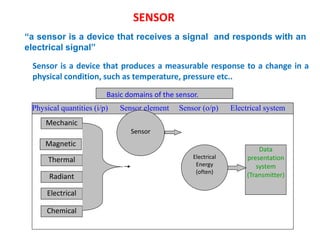
Basic domains of the sensor.
Mechanic
Magnetic
Thermal
Radiant
Electrical
Chemical
Electrical
Energy
(often)
Data
presentation
system
(Transmitter)
Physical quantities (i/p) Sensor element Sensor (o/p) Electrical system
Sensor is a device that produces a measurable response to a change in a
physical condition, such as temperature, pressure etc..
SENSOR
Sensor
“a sensor is a device that receives a signal and responds with an
electrical signal”
4
Sensors
Passive Sensors Active sensors
5
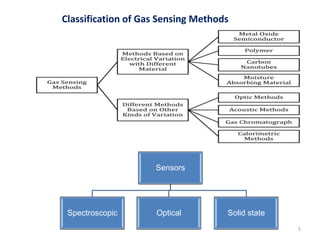
Classification of Gas Sensing Methods
Sensors
Spectroscopic Optical Solid state
6
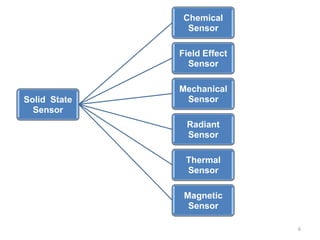
Solid State
Sensor
Chemical
Sensor
Field Effect
Sensor
Mechanical
Sensor
Radiant
Sensor
Thermal
Sensor
Magnetic
Sensor
7
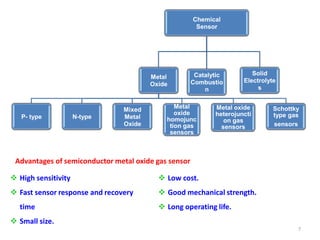
Chemical
Sensor
Metal
Oxide
P- type N-type
Mixed
Metal
Oxide
Metal
oxide
homojunc
tion gas
sensors
Metal oxide
heterojuncti
on gas
sensors
Schottky
type gas
sensors
Catalytic
Combustio
n
Solid
Electrolyte
s
 High sensitivity
 Fast sensor response and recovery
time
 Small size.
 Low cost.
 Good mechanical strength.
 Long operating life.
Advantages of semiconductor metal oxide gas sensor
8
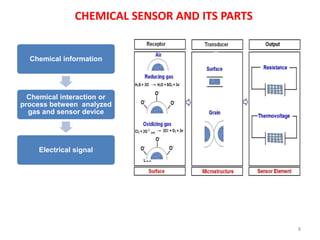
CHEMICAL SENSOR AND ITS PARTS
Chemical information
Chemical interaction or
process between analyzed
gas and sensor device
Electrical signal
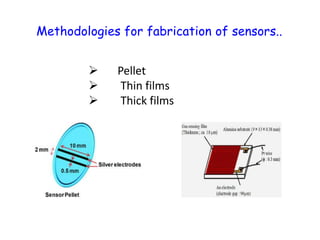
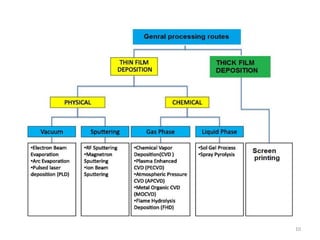
Methodologies for fabrication of sensors..
 Pellet
 Thin films
 Thick films
10
11
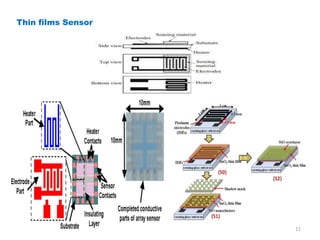
Thin films Sensor
12
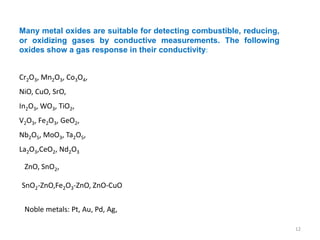
Many metal oxides are suitable for detecting combustible, reducing,
or oxidizing gases by conductive measurements. The following
oxides show a gas response in their conductivity:
Cr2O3, Mn2O3, Co3O4,
NiO, CuO, SrO,
In2O3, WO3, TiO2,
V2O3, Fe2O3, GeO2,
Nb2O5, MoO3, Ta2O5,
La2O3,CeO2, Nd2O3
SnO2-ZnO,Fe2O3-ZnO, ZnO-CuO
ZnO, SnO2,
Noble metals: Pt, Au, Pd, Ag,
13
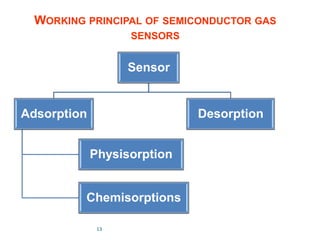
WORKING PRINCIPAL OF SEMICONDUCTOR GAS
SENSORS
Sensor
Adsorption
Physisorption
Chemisorptions
Desorption
14
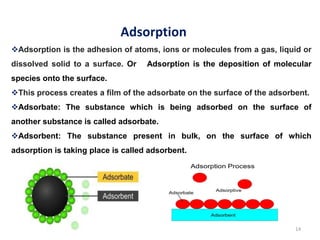
Adsorption is the adhesion of atoms, ions or molecules from a gas, liquid or
dissolved solid to a surface. Or Adsorption is the deposition of molecular
species onto the surface.
This process creates a film of the adsorbate on the surface of the adsorbent.
Adsorbate: The substance which is being adsorbed on the surface of
another substance is called adsorbate.
Adsorbent: The substance present in bulk, on the surface of which
adsorption is taking place is called adsorbent.
Adsorption
Types of adsorption
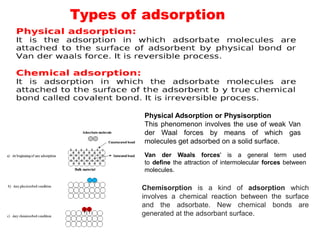
Chemisorption is a kind of adsorption which
involves a chemical reaction between the surface
and the adsorbate. New chemical bonds are
generated at the adsorbant surface.
Physical Adsorption or Physisorption
This phenomenon involves the use of weak Van
der Waal forces by means of which gas
molecules get adsorbed on a solid surface.
Van der Waals forces' is a general term used
to define the attraction of intermolecular forces between
molecules.
16
Adsorption Mechanism
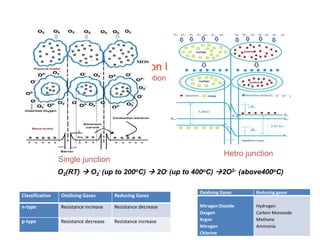
Adsorption of oxygen
O2(RT)  O2
- (up to 200oC)  2O- (up to 400oC) 2O2- (above400oC)
Single junction
Hetro junction
Classification Oxidising Gases Reducing Gases
n-type Resistance increase Resistance decrease
p-type Resistance decrease Resistance increase
Oxidising Gases Reducing gases
Nitrogen Dioxide
Oxygen
Argon
Nitrogen
Chlorine
Hydrogen
Carbon Monoxide
Methane
Ammonia
17
Desorption
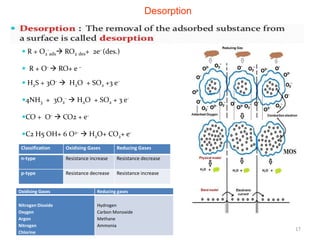
 R + O2
-
ads RO2 des+ 2e- (des.)
 R + O-  RO+ e –
 H2S + 3O-  H2O + SO2 +3 e-
4NH3 + 3O2
-  H2O + SO2 + 3 e-
CO + O-  CO2 + e-
C2 H5 OH+ 6 O2-  H2O+ CO2+ e-
Classification Oxidising Gases Reducing Gases
n-type Resistance increase Resistance decrease
p-type Resistance decrease Resistance increase
Oxidising Gases Reducing gases
Nitrogen Dioxide
Oxygen
Argon
Nitrogen
Chlorine
Hydrogen
Carbon Monoxide
Methane
Ammonia
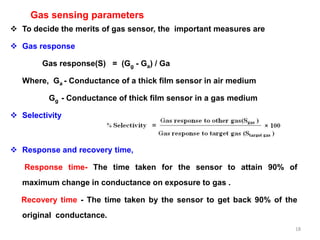
Gas sensing parameters
 To decide the merits of gas sensor, the important measures are
 Gas response
Gas response(S) = (Gg - Ga) / Ga
Where, Ga - Conductance of a thick film sensor in air medium
Gg - Conductance of thick film sensor in a gas medium
 Selectivity
 Response and recovery time,
Response time- The time taken for the sensor to attain 90% of
maximum change in conductance on exposure to gas .
Recovery time - The time taken by the sensor to get back 90% of the
original conductance.
18
Characterization techniques
 X-ray Diffractometry (XRD)
 Scanning Electron Microscopy (SEM)
 Energy Dispersive analysis of X-ray (EDAX)
 Thermogravimetric Analysis (TGA/DTA/DTG)
 Fourier Transform Infrared Spectroscopy (FTIR)
 Electrical Characteristics
(I-V Curve, Conductivity curve)
 Gas sensing response,
20
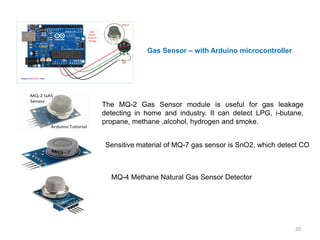
The MQ-2 Gas Sensor module is useful for gas leakage
detecting in home and industry. It can detect LPG, i-butane,
propane, methane ,alcohol, hydrogen and smoke.
Gas Sensor – with Arduino microcontroller
Sensitive material of MQ-7 gas sensor is SnO2, which detect CO
MQ-4 Methane Natural Gas Sensor Detector
21
THANK YOU

Thin film gas sensor

  • 1.
    1 THIN FILM GASSENSORS Dr. M. K. Deore Material Research lab. Dept. of Physics, K. T. H. M. College, Nashik, India -422 002
  • 2.
  • 3.
    Basic domains ofthe sensor. Mechanic Magnetic Thermal Radiant Electrical Chemical Electrical Energy (often) Data presentation system (Transmitter) Physical quantities (i/p) Sensor element Sensor (o/p) Electrical system Sensor is a device that produces a measurable response to a change in a physical condition, such as temperature, pressure etc.. SENSOR Sensor “a sensor is a device that receives a signal and responds with an electrical signal”
  • 4.
  • 5.
    5 Classification of GasSensing Methods Sensors Spectroscopic Optical Solid state
  • 6.
  • 7.
    7 Chemical Sensor Metal Oxide P- type N-type Mixed Metal Oxide Metal oxide homojunc tiongas sensors Metal oxide heterojuncti on gas sensors Schottky type gas sensors Catalytic Combustio n Solid Electrolyte s  High sensitivity  Fast sensor response and recovery time  Small size.  Low cost.  Good mechanical strength.  Long operating life. Advantages of semiconductor metal oxide gas sensor
  • 8.
    8 CHEMICAL SENSOR ANDITS PARTS Chemical information Chemical interaction or process between analyzed gas and sensor device Electrical signal
  • 9.
    Methodologies for fabricationof sensors..  Pellet  Thin films  Thick films
  • 10.
  • 11.
  • 12.
    12 Many metal oxidesare suitable for detecting combustible, reducing, or oxidizing gases by conductive measurements. The following oxides show a gas response in their conductivity: Cr2O3, Mn2O3, Co3O4, NiO, CuO, SrO, In2O3, WO3, TiO2, V2O3, Fe2O3, GeO2, Nb2O5, MoO3, Ta2O5, La2O3,CeO2, Nd2O3 SnO2-ZnO,Fe2O3-ZnO, ZnO-CuO ZnO, SnO2, Noble metals: Pt, Au, Pd, Ag,
  • 13.
    13 WORKING PRINCIPAL OFSEMICONDUCTOR GAS SENSORS Sensor Adsorption Physisorption Chemisorptions Desorption
  • 14.
    14 Adsorption is theadhesion of atoms, ions or molecules from a gas, liquid or dissolved solid to a surface. Or Adsorption is the deposition of molecular species onto the surface. This process creates a film of the adsorbate on the surface of the adsorbent. Adsorbate: The substance which is being adsorbed on the surface of another substance is called adsorbate. Adsorbent: The substance present in bulk, on the surface of which adsorption is taking place is called adsorbent. Adsorption
  • 15.
    Types of adsorption Chemisorptionis a kind of adsorption which involves a chemical reaction between the surface and the adsorbate. New chemical bonds are generated at the adsorbant surface. Physical Adsorption or Physisorption This phenomenon involves the use of weak Van der Waal forces by means of which gas molecules get adsorbed on a solid surface. Van der Waals forces' is a general term used to define the attraction of intermolecular forces between molecules.
  • 16.
    16 Adsorption Mechanism Adsorption ofoxygen O2(RT)  O2 - (up to 200oC)  2O- (up to 400oC) 2O2- (above400oC) Single junction Hetro junction Classification Oxidising Gases Reducing Gases n-type Resistance increase Resistance decrease p-type Resistance decrease Resistance increase Oxidising Gases Reducing gases Nitrogen Dioxide Oxygen Argon Nitrogen Chlorine Hydrogen Carbon Monoxide Methane Ammonia
  • 17.
    17 Desorption  R +O2 - ads RO2 des+ 2e- (des.)  R + O-  RO+ e –  H2S + 3O-  H2O + SO2 +3 e- 4NH3 + 3O2 -  H2O + SO2 + 3 e- CO + O-  CO2 + e- C2 H5 OH+ 6 O2-  H2O+ CO2+ e- Classification Oxidising Gases Reducing Gases n-type Resistance increase Resistance decrease p-type Resistance decrease Resistance increase Oxidising Gases Reducing gases Nitrogen Dioxide Oxygen Argon Nitrogen Chlorine Hydrogen Carbon Monoxide Methane Ammonia
  • 18.
    Gas sensing parameters To decide the merits of gas sensor, the important measures are  Gas response Gas response(S) = (Gg - Ga) / Ga Where, Ga - Conductance of a thick film sensor in air medium Gg - Conductance of thick film sensor in a gas medium  Selectivity  Response and recovery time, Response time- The time taken for the sensor to attain 90% of maximum change in conductance on exposure to gas . Recovery time - The time taken by the sensor to get back 90% of the original conductance. 18
  • 19.
    Characterization techniques  X-rayDiffractometry (XRD)  Scanning Electron Microscopy (SEM)  Energy Dispersive analysis of X-ray (EDAX)  Thermogravimetric Analysis (TGA/DTA/DTG)  Fourier Transform Infrared Spectroscopy (FTIR)  Electrical Characteristics (I-V Curve, Conductivity curve)  Gas sensing response,
  • 20.
    20 The MQ-2 GasSensor module is useful for gas leakage detecting in home and industry. It can detect LPG, i-butane, propane, methane ,alcohol, hydrogen and smoke. Gas Sensor – with Arduino microcontroller Sensitive material of MQ-7 gas sensor is SnO2, which detect CO MQ-4 Methane Natural Gas Sensor Detector
  • 21.