Under the guidance of
Dr. Priyanka Mondal
Major Project Presented by
Abhishek kumar(1304010)
Krishna kumar(1304035)
Prashant shekhar(1304038)
Efficiency Improvement of A High
Power Amplifier
Electronics and communication Engineering
NATIONAL INSTITUTE OF TECHNOLOGY PATNA
Contents
• Objective
• Introduction
• Performance Parameters
• Literature Survey
• Classification of Power Amplifier(PA)
• Stability of PA
• Load Pull Analysis
• Simulation Steps And Results
• Future Scope
• Conclusion
• References
Objective
• Simulation of class F power amplifier using
ADS.
• Operating frequency is 2.4 GHz.
• We are targeting power added efficiency more
than 50%.
• We are targeting output power more than 30
dBm.
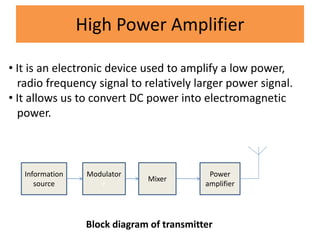
High Power Amplifier
• It is an electronic device used to amplify a low power,
radio frequency signal to relatively larger power signal.
• It allows us to convert DC power into electromagnetic
power.
Information
source
Modulator
r
Mixer
Power
amplifier
Block diagram of transmitter
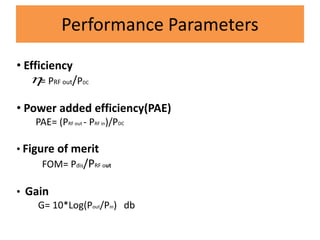
Performance Parameters
• Efficiency
= PRF out/PDC
• Power added efficiency(PAE)
PAE= (PRF out - PRF in)/PDC
• Figure of merit
FOM= Pdis/PRF out
• Gain
G= 10*Log(Pout/Pin) db

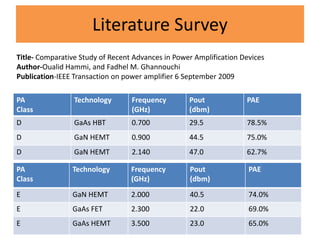
Literature Survey
PA
Class
Technology Frequency
(GHz)
Pout
(dbm)
PAE
D GaAs HBT 0.700 29.5 78.5%
D GaN HEMT 0.900 44.5 75.0%
D GaN HEMT 2.140 47.0 62.7%
PA
Class
Technology Frequency
(GHz)
Pout
(dbm)
PAE
E GaN HEMT 2.000 40.5 74.0%
E GaAs FET 2.300 22.0 69.0%
E GaAs HEMT 3.500 23.0 65.0%
Title- Comparative Study of Recent Advances in Power Amplification Devices
Author-Oualid Hammi, and Fadhel M. Ghannouchi
Publication-IEEE Transaction on power amplifier 6 September 2009
Continued
PA
Class
Technology Frequency
(GHz)
Pout
(dbm)
Power added
Efficiency
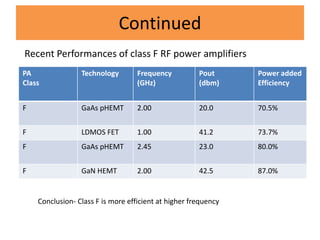
F GaAs pHEMT 2.00 20.0 70.5%
F LDMOS FET 1.00 41.2 73.7%
F GaAs pHEMT 2.45 23.0 80.0%
F GaN HEMT 2.00 42.5 87.0%
Recent Performances of class F RF power amplifiers
Conclusion- Class F is more efficient at higher frequency
Continued
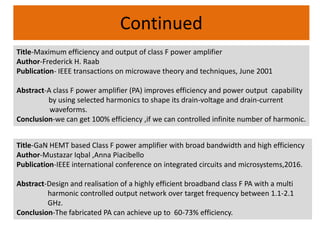
Title-Maximum efficiency and output of class F power amplifier
Author-Frederick H. Raab
Publication- IEEE transactions on microwave theory and techniques, June 2001
Abstract-A class F power amplifier (PA) improves efficiency and power output capability
by using selected harmonics to shape its drain-voltage and drain-current
waveforms.
Conclusion-we can get 100% efficiency ,if we can controlled infinite number of harmonic.
Title-GaN HEMT based Class F power amplifier with broad bandwidth and high efficiency
Author-Mustazar Iqbal ,Anna Piacibello
Publication-IEEE international conference on integrated circuits and microsystems,2016.
Abstract-Design and realisation of a highly efficient broadband class F PA with a multi
harmonic controlled output network over target frequency between 1.1-2.1
GHz.
Conclusion-The fabricated PA can achieve up to 60-73% efficiency.
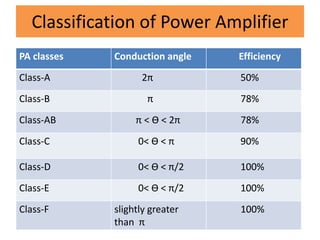
Classification of Power Amplifier
PA classes Conduction angle Efficiency
Class-A 2π 50%
Class-B π 78%
Class-AB π < Ɵ < 2π 78%
Class-C 0< Ɵ < π 90%
Class-D 0< Ɵ < π/2 100%
Class-E 0< Ɵ < π/2 100%
Class-F slightly greater
than π
100%
Class F
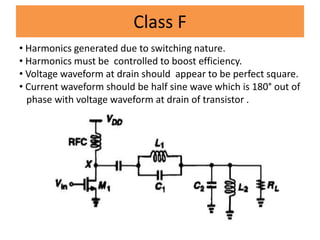
• Harmonics generated due to switching nature.
• Harmonics must be controlled to boost efficiency.
• Voltage waveform at drain should appear to be perfect square.
• Current waveform should be half sine wave which is 180° out of
phase with voltage waveform at drain of transistor .
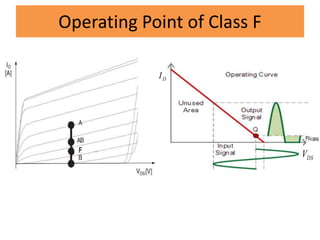
Operating Point of Class F
DI
DSV
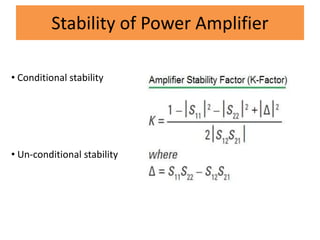
Stability of Power Amplifier
• Conditional stability
• Un-conditional stability
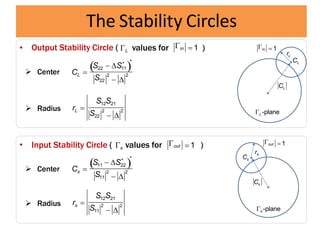
The Stability Circles
S12S21
2 2
S22
Lr 
 
 22

11
2 2
S22
CL 
S  S

 
• Output Stability Circle ( L values for  1 )in
 Center
 Radius
 1in
CL
rL
CL
L -plane
S12S21
2 2
S11
sr 
 
 11 22
2 2
S11
 Center Cs 
S  S

 
• Input Stability Circle ( s values for  1 )
 Radius
out  1out
Cs
rs
Cs
s -plane
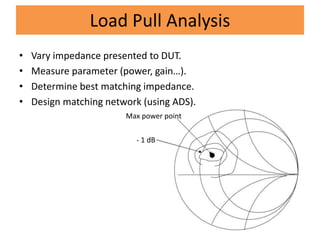
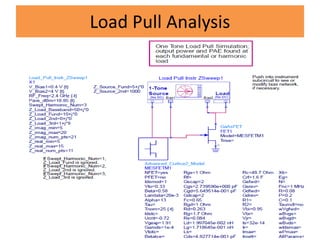
Load Pull Analysis
• Vary impedance presented to DUT.
• Measure parameter (power, gain…).
• Determine best matching impedance.
• Design matching network (using ADS).
Max power point
- 1 dB
Simulation Steps
• DC analysis
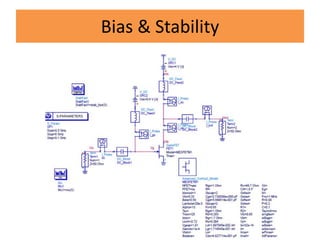
• Bias and stability
• Load pull analysis
• High PA design
• Impedance matching
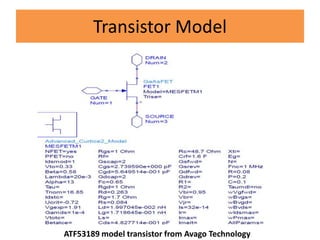
Transistor Model
ATF53189 model transistor from Avago Technology
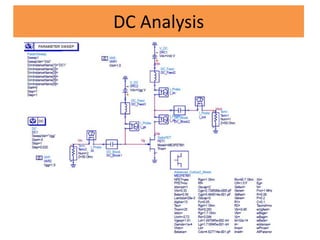
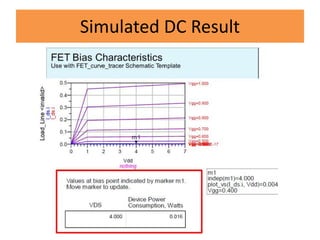
DC Analysis
Simulated DC Result
Bias & Stability
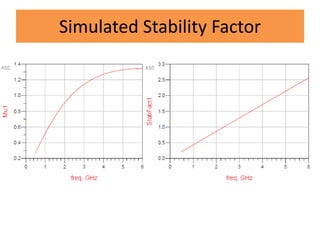
Simulated Stability Factor
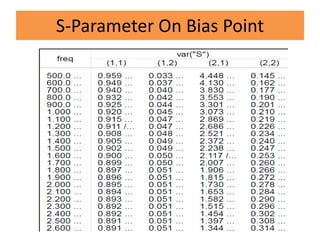
S-Parameter On Bias Point
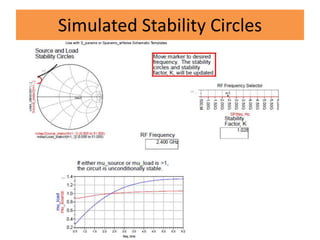
Simulated Stability Circles
Load Pull Analysis
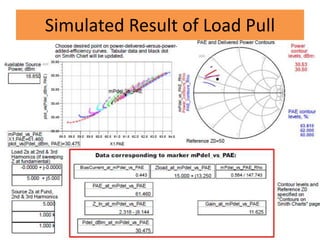
Simulated Result of Load Pull
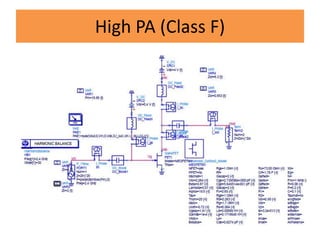
High PA (Class F)
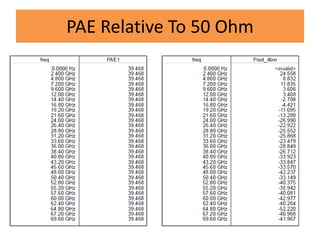
PAE Relative To 50 Ohm
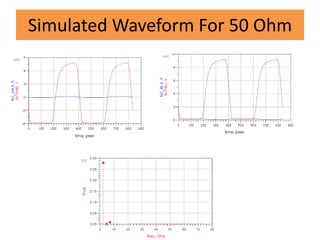
Simulated Waveform For 50 Ohm
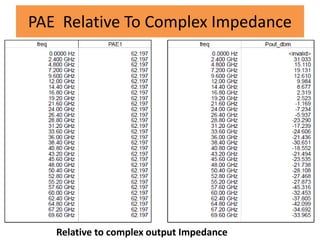
Relative to complex output Impedance
PAE Relative To Complex Impedance
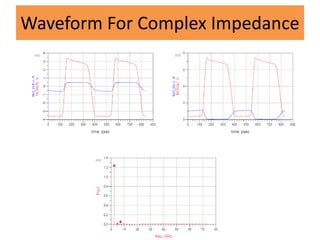
Waveform For Complex Impedance
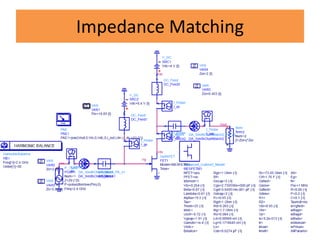
Impedance Matching
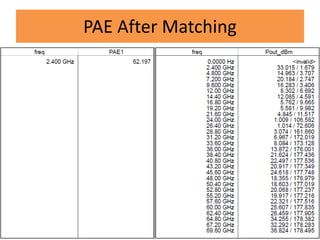
PAE After Matching
Future Scope
• We can increase power added efficiency (PAE)
by adding more harmonics at drain output of
transistor.
• By controlling more harmonics we can also
increase gain because output power will be
increase.
• We can also improve PAE by changing various
parameter of transistor.
Conclusion
• Class F power amplifiers offer a significant
improvement in transmitter efficiency over other
designs.
• We have improved power added efficiency from
39% to 62% by changing 50 ohm standard
impedance to complex impedance.
• We have achieved output power 33 dBm from
input power 18 dBm after designing and
matching.
References
[1] P. Colantonio, F. Giannini, E. Limiti, “High efficiency RF and microwave
solid state power amplifier”, John Wiley & Sons, Ltd, 2009
[2] Steve C. Cripps, RF power amplifier for wireless comm.(2nd edition) ,artech
house microwave library
[3] Class D Audio Amplifier with Ferroxcube Gapped Toroid Output Filter,
Ferroxcube - Ferrite Cores, Bobbins & Accessories. Web. 13 May 2010.
[4] M. Hayati, A. Lotfi, M. Kazimierczuk, and H. Sekiya, “Performance
study of class-e power amplifier with a shunt inductor at subnominal
condition,” IEEE Trans. Power Electron., vol. 28, no. 8, pp. 3834–3844,
[5] F. H. Raab, “Maximum efficiency and output of Class-F power amplifiers”,
IEEE Transactions on Microwave Theory and Techniques, Vol. 49, No. 6,
June 2001
Continued
[6] F. H. Raab, “An introduction to Class-F power amplifiers,” RF Design, Vol.
19, No. 5, pp. 79-84, May 1996.
[7] N. Tuffy, G. Lei, Z. Anding, and T. J. Brazil, "A simplified broadband
design methodology for linearized high-efficiency continuous Class-F
power amplifiers," IEEE Trans. Microw. Theory Tech., vol. 60, pp. 1952-
1963, 2012.
[8] W. Ying, D. Shiwei, Y. Lisheng, L. Zhengjun, D. Yazhou, and F. Wenli,
"Design of high efficiency GaN HEMT class-F power amplifier at Sband,"in
Antennas and Propagation (APCAP), 2014 3rd Asia-Pacific Conference on,
2014, pp. 1157-1158.
Power amplifier ppt

Power amplifier ppt

  • 1.
    Under the guidanceof Dr. Priyanka Mondal Major Project Presented by Abhishek kumar(1304010) Krishna kumar(1304035) Prashant shekhar(1304038) Efficiency Improvement of A High Power Amplifier Electronics and communication Engineering NATIONAL INSTITUTE OF TECHNOLOGY PATNA
  • 2.
    Contents • Objective • Introduction •Performance Parameters • Literature Survey • Classification of Power Amplifier(PA) • Stability of PA • Load Pull Analysis • Simulation Steps And Results • Future Scope • Conclusion • References
  • 3.
    Objective • Simulation ofclass F power amplifier using ADS. • Operating frequency is 2.4 GHz. • We are targeting power added efficiency more than 50%. • We are targeting output power more than 30 dBm.
  • 4.
    High Power Amplifier •It is an electronic device used to amplify a low power, radio frequency signal to relatively larger power signal. • It allows us to convert DC power into electromagnetic power. Information source Modulator r Mixer Power amplifier Block diagram of transmitter
  • 5.
    Performance Parameters • Efficiency =PRF out/PDC • Power added efficiency(PAE) PAE= (PRF out - PRF in)/PDC • Figure of merit FOM= Pdis/PRF out • Gain G= 10*Log(Pout/Pin) db 
  • 6.
    Literature Survey PA Class Technology Frequency (GHz) Pout (dbm) PAE DGaAs HBT 0.700 29.5 78.5% D GaN HEMT 0.900 44.5 75.0% D GaN HEMT 2.140 47.0 62.7% PA Class Technology Frequency (GHz) Pout (dbm) PAE E GaN HEMT 2.000 40.5 74.0% E GaAs FET 2.300 22.0 69.0% E GaAs HEMT 3.500 23.0 65.0% Title- Comparative Study of Recent Advances in Power Amplification Devices Author-Oualid Hammi, and Fadhel M. Ghannouchi Publication-IEEE Transaction on power amplifier 6 September 2009
  • 7.
    Continued PA Class Technology Frequency (GHz) Pout (dbm) Power added Efficiency FGaAs pHEMT 2.00 20.0 70.5% F LDMOS FET 1.00 41.2 73.7% F GaAs pHEMT 2.45 23.0 80.0% F GaN HEMT 2.00 42.5 87.0% Recent Performances of class F RF power amplifiers Conclusion- Class F is more efficient at higher frequency
  • 8.
    Continued Title-Maximum efficiency andoutput of class F power amplifier Author-Frederick H. Raab Publication- IEEE transactions on microwave theory and techniques, June 2001 Abstract-A class F power amplifier (PA) improves efficiency and power output capability by using selected harmonics to shape its drain-voltage and drain-current waveforms. Conclusion-we can get 100% efficiency ,if we can controlled infinite number of harmonic. Title-GaN HEMT based Class F power amplifier with broad bandwidth and high efficiency Author-Mustazar Iqbal ,Anna Piacibello Publication-IEEE international conference on integrated circuits and microsystems,2016. Abstract-Design and realisation of a highly efficient broadband class F PA with a multi harmonic controlled output network over target frequency between 1.1-2.1 GHz. Conclusion-The fabricated PA can achieve up to 60-73% efficiency.
  • 9.
    Classification of PowerAmplifier PA classes Conduction angle Efficiency Class-A 2π 50% Class-B π 78% Class-AB π < Ɵ < 2π 78% Class-C 0< Ɵ < π 90% Class-D 0< Ɵ < π/2 100% Class-E 0< Ɵ < π/2 100% Class-F slightly greater than π 100%
  • 10.
    Class F • Harmonicsgenerated due to switching nature. • Harmonics must be controlled to boost efficiency. • Voltage waveform at drain should appear to be perfect square. • Current waveform should be half sine wave which is 180° out of phase with voltage waveform at drain of transistor .
  • 11.
    Operating Point ofClass F DI DSV
  • 12.
    Stability of PowerAmplifier • Conditional stability • Un-conditional stability
  • 13.
    The Stability Circles S12S21 22 S22 Lr     22  11 2 2 S22 CL  S  S    • Output Stability Circle ( L values for  1 )in  Center  Radius  1in CL rL CL L -plane S12S21 2 2 S11 sr     11 22 2 2 S11  Center Cs  S  S    • Input Stability Circle ( s values for  1 )  Radius out  1out Cs rs Cs s -plane
  • 14.
    Load Pull Analysis •Vary impedance presented to DUT. • Measure parameter (power, gain…). • Determine best matching impedance. • Design matching network (using ADS). Max power point - 1 dB
  • 15.
    Simulation Steps • DCanalysis • Bias and stability • Load pull analysis • High PA design • Impedance matching
  • 16.
    Transistor Model ATF53189 modeltransistor from Avago Technology
  • 17.
  • 18.
  • 19.
  • 20.
  • 21.
  • 22.
  • 23.
  • 24.
  • 25.
  • 26.
  • 27.
  • 28.
    Relative to complexoutput Impedance PAE Relative To Complex Impedance
  • 29.
  • 30.
  • 31.
  • 32.
    Future Scope • Wecan increase power added efficiency (PAE) by adding more harmonics at drain output of transistor. • By controlling more harmonics we can also increase gain because output power will be increase. • We can also improve PAE by changing various parameter of transistor.
  • 33.
    Conclusion • Class Fpower amplifiers offer a significant improvement in transmitter efficiency over other designs. • We have improved power added efficiency from 39% to 62% by changing 50 ohm standard impedance to complex impedance. • We have achieved output power 33 dBm from input power 18 dBm after designing and matching.
  • 34.
    References [1] P. Colantonio,F. Giannini, E. Limiti, “High efficiency RF and microwave solid state power amplifier”, John Wiley & Sons, Ltd, 2009 [2] Steve C. Cripps, RF power amplifier for wireless comm.(2nd edition) ,artech house microwave library [3] Class D Audio Amplifier with Ferroxcube Gapped Toroid Output Filter, Ferroxcube - Ferrite Cores, Bobbins & Accessories. Web. 13 May 2010. [4] M. Hayati, A. Lotfi, M. Kazimierczuk, and H. Sekiya, “Performance study of class-e power amplifier with a shunt inductor at subnominal condition,” IEEE Trans. Power Electron., vol. 28, no. 8, pp. 3834–3844, [5] F. H. Raab, “Maximum efficiency and output of Class-F power amplifiers”, IEEE Transactions on Microwave Theory and Techniques, Vol. 49, No. 6, June 2001
  • 35.
    Continued [6] F. H.Raab, “An introduction to Class-F power amplifiers,” RF Design, Vol. 19, No. 5, pp. 79-84, May 1996. [7] N. Tuffy, G. Lei, Z. Anding, and T. J. Brazil, "A simplified broadband design methodology for linearized high-efficiency continuous Class-F power amplifiers," IEEE Trans. Microw. Theory Tech., vol. 60, pp. 1952- 1963, 2012. [8] W. Ying, D. Shiwei, Y. Lisheng, L. Zhengjun, D. Yazhou, and F. Wenli, "Design of high efficiency GaN HEMT class-F power amplifier at Sband,"in Antennas and Propagation (APCAP), 2014 3rd Asia-Pacific Conference on, 2014, pp. 1157-1158.