 Isolation amplifiers provide electrical
isolation and an electrical safety barrier.
 They protect the patients from leakage
currents.
 They break the ohmic continuity of electrical
signals between input and output.
 Isolated power supplies are provided for both
the input and output stages.
 Used to amplify low level signals.
GENERAL PIN
CONFIGURATION OF
ISOLATION AMPLIFIER
TYPES
Three types of methods are used to design
isolation amplifier
 Transformer isolation
 Optical isolation
 Capacitive isolation
TRANSFORMER COUPLED
ISOLATION AMPLIFIER
 It uses either frequency modulated or a
pulse width modulated carrier signal.
 Internally it has 20KHz oscillator,
transformer, rectifier and filter to provide
supplies for each isolated stages.
 Rectifier- input to primary OPAMP.
 Transformer- couples the supply.
 Oscillator – input to secondary OPAMP.
 A low pass filter is used to remove the
other frequency components.
Advantages
 High common mode rejection ratio
 High linearity
 High accuracy
applications
 MEDICAL
Patient Monitoring and Diagnostic
Instrumentation
 INDUSTRIAL
Ground Loop Elimination and
Off-ground Signal Measurement
 NUCLEAR
Input/output/Power Isolation
Optically isolated isolation
amplifier
 The biological signal is converted into a
light signal by LED for further process.
 It has patient circuit which is the input
circuit and a phototransistor which
forms the output circuit.
 Each circuit is battery driven.
 The input circuit converts the signal to
light and the output circuit converts the
light back to signal.
advantages
 Original frequency and amplitude is
obtained.
 High linearity.
 No modulator or demodulator is needed as
it couples optically.
 Improves patient safety
Application
 INDUSTRIAL PROCESS CONTROL
 DATAACQUISITION
 INTERFACE ELEMENT
 BIOMEDICAL MEASUREMENTS
 PATIENT MONITORING
 TEST EQUIPMENT
 CURRENT SHUNT MEASUREMENT
 GROUND-LOOP ELIMINATION
 SCR CONTROLS
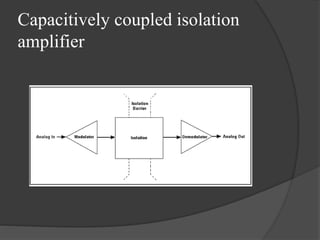
Capacitively coupled isolation
amplifier
 It uses digital encoding of the input
voltage and frequency modulation.
 The input voltage is converted to
proportional charge on the switched
capacitor.
 It has modulator and demodulator circuits.
 The signals are sent across a differential
capacitive barrier.
 Separate supplies are given for both sides.
advantages
 Ripple noises are removed.
 It avoids device noise, radiated noise and
conducted noise.
 High immunity to magnetic noises.
 Useful for analog systems.
 Has high gain stability and linearity.
applications
 DATAACQUISITION
 INTERFACE ELEMENT
 PATIENT MONITORING
 ECG
 EEG
Comparative study
 Commonly used
Transformer isolation amplifier
 Cost
Optical- low cost due to less
components
Transformer
Capacitor coupled- high cost
 Isolation voltage
Optical- low (800V)
Transformer- medium (1200V)
 Isolation resistance
Optical- 10^12
Transformer- 10^10
Capacitance- 10^12
 Gain stability and Linearity
Optical- 0.02%
Transformer- between 0.005% and
0.02%
Capacitance- 0.005% (best)
VECTOR CARDIOGRAPHY
(VCG)
ANGULAR VIEWS
VCG WAVEFORM

Digital techniques for optical isolation

  • 2.
     Isolation amplifiersprovide electrical isolation and an electrical safety barrier.  They protect the patients from leakage currents.  They break the ohmic continuity of electrical signals between input and output.  Isolated power supplies are provided for both the input and output stages.  Used to amplify low level signals.
  • 3.
  • 4.
    TYPES Three types ofmethods are used to design isolation amplifier  Transformer isolation  Optical isolation  Capacitive isolation
  • 5.
  • 6.
     It useseither frequency modulated or a pulse width modulated carrier signal.  Internally it has 20KHz oscillator, transformer, rectifier and filter to provide supplies for each isolated stages.  Rectifier- input to primary OPAMP.  Transformer- couples the supply.  Oscillator – input to secondary OPAMP.  A low pass filter is used to remove the other frequency components.
  • 7.
    Advantages  High commonmode rejection ratio  High linearity  High accuracy
  • 9.
    applications  MEDICAL Patient Monitoringand Diagnostic Instrumentation  INDUSTRIAL Ground Loop Elimination and Off-ground Signal Measurement  NUCLEAR Input/output/Power Isolation
  • 10.
  • 11.
     The biologicalsignal is converted into a light signal by LED for further process.  It has patient circuit which is the input circuit and a phototransistor which forms the output circuit.  Each circuit is battery driven.  The input circuit converts the signal to light and the output circuit converts the light back to signal.
  • 13.
    advantages  Original frequencyand amplitude is obtained.  High linearity.  No modulator or demodulator is needed as it couples optically.  Improves patient safety
  • 14.
    Application  INDUSTRIAL PROCESSCONTROL  DATAACQUISITION  INTERFACE ELEMENT  BIOMEDICAL MEASUREMENTS  PATIENT MONITORING  TEST EQUIPMENT  CURRENT SHUNT MEASUREMENT  GROUND-LOOP ELIMINATION  SCR CONTROLS
  • 15.
  • 16.
     It usesdigital encoding of the input voltage and frequency modulation.  The input voltage is converted to proportional charge on the switched capacitor.  It has modulator and demodulator circuits.  The signals are sent across a differential capacitive barrier.  Separate supplies are given for both sides.
  • 18.
    advantages  Ripple noisesare removed.  It avoids device noise, radiated noise and conducted noise.  High immunity to magnetic noises.  Useful for analog systems.  Has high gain stability and linearity.
  • 19.
    applications  DATAACQUISITION  INTERFACEELEMENT  PATIENT MONITORING  ECG  EEG
  • 20.
    Comparative study  Commonlyused Transformer isolation amplifier  Cost Optical- low cost due to less components Transformer Capacitor coupled- high cost  Isolation voltage Optical- low (800V) Transformer- medium (1200V)
  • 21.
     Isolation resistance Optical-10^12 Transformer- 10^10 Capacitance- 10^12  Gain stability and Linearity Optical- 0.02% Transformer- between 0.005% and 0.02% Capacitance- 0.005% (best)
  • 22.
  • 23.
  • 24.