Surface Acoustic Wave
Technology
Presented By:
AKHIL BARAIK
Outline
• Introduction
• Terminology
• Surface Acoustic Wave(SAW)
- Components
- Properties
• SAW Principle
• Applications
• Advantages & Disadvantages
• Conclusion
• References
Outline
Outline
Surface Acoustic Wave Technology
Brief History:
• Surface Acoustic Waves (SAW) were discovered in 1885 by
Lord Rayleigh
• SAW device was invented by White and Voltmer in 1965
• Around 1970, developed for Pulse Compression Radar,
oscillators, and bandpass filters for domestic TV
• Diverse applications in consumer and highly professional
electronic devices and systems
• Perform different functions in the frequency range from 10
MHz to several GHz.
Introduction
Outline
Continued...
Terminology
• Surface: Outside part or uppermost layer of something.
• Acoustic : Science deals with the study of all mechanical
waves in gases, liquids, and solids.
• Wave: Oscillation accompanied by transfer of energy that
travels through space or mass.
• Acoustic Wave : Type of longitudinal wave propagates by
means of adiabatic compression and decompression.
Introduction
Outline
Definition
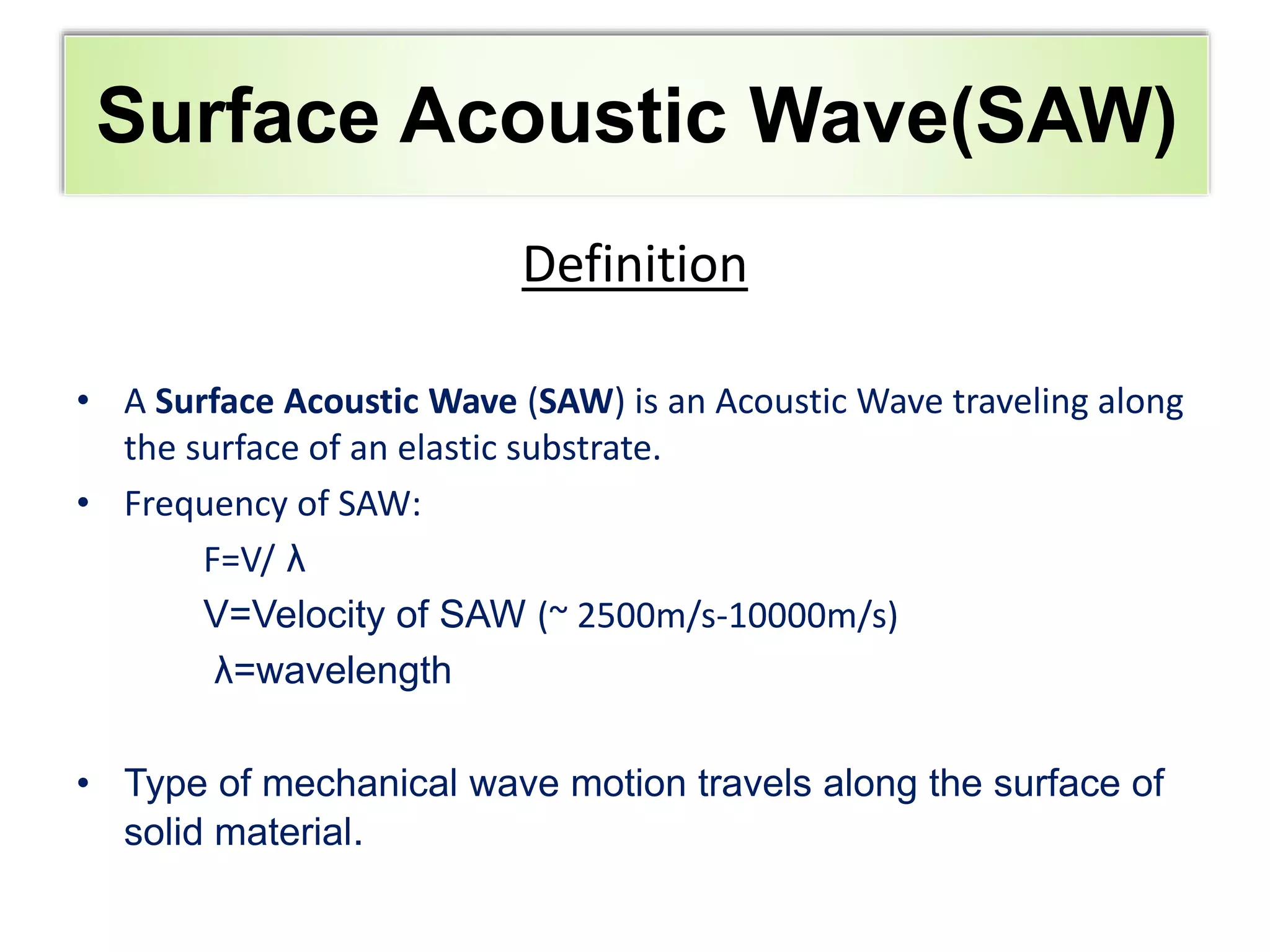
• A Surface Acoustic Wave (SAW) is an Acoustic Wave traveling along
the surface of an elastic substrate.
• Frequency of SAW:
F=V/ λ
V=Velocity of SAW (~ 2500m/s-10000m/s)
λ=wavelength
• Type of mechanical wave motion travels along the surface of
solid material.
Surface Acoustic Wave(SAW)
Outline
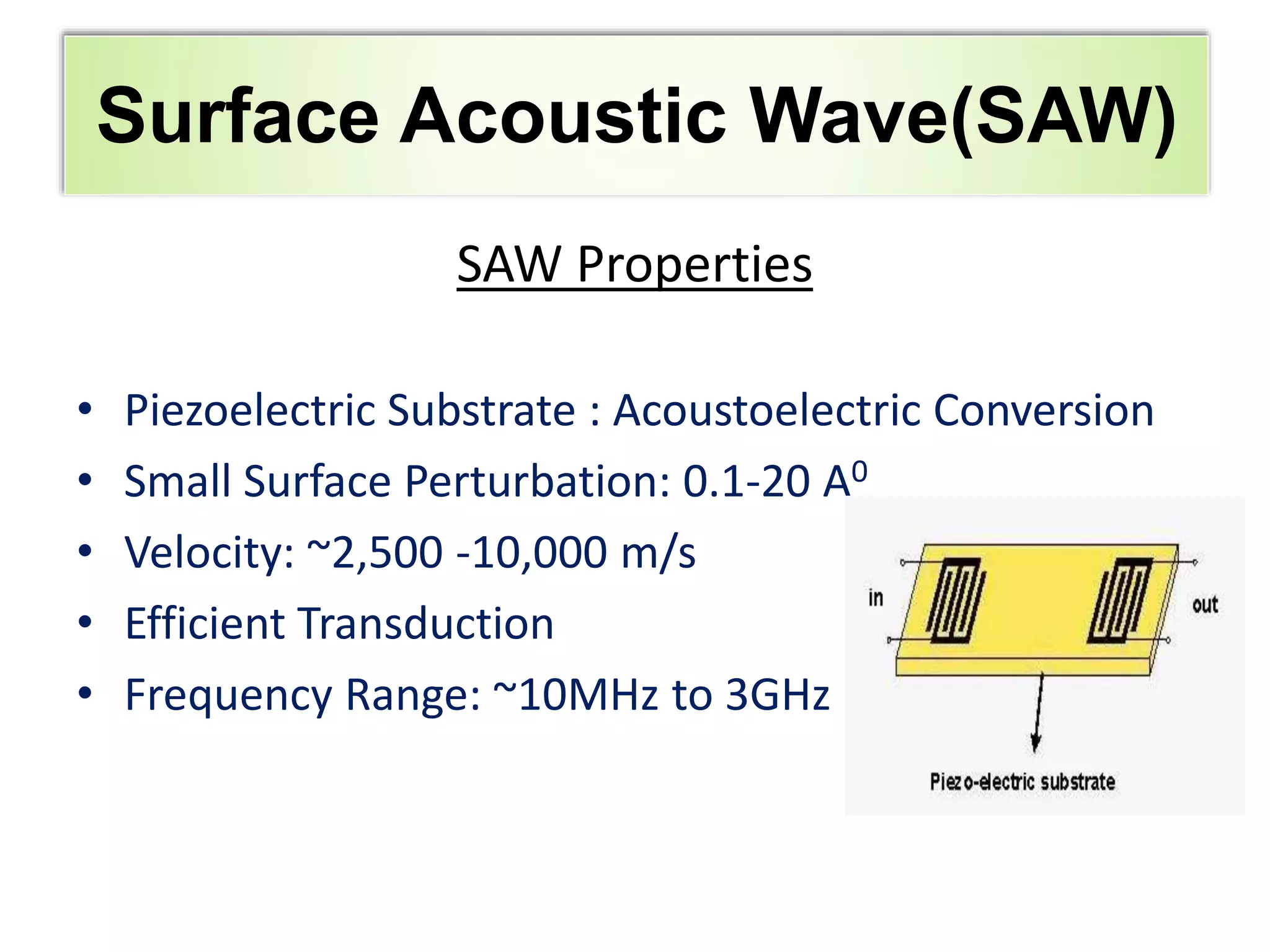
SAW Device
.
Fig : Basic Structure of SAW Device
Surface Acoustic Wave(SAW)
Outline
Continued...
SAW Device?
• A solid state device
– Converts electrical energy into a mechanical wave(Acoustic) on
a single crystal substrate
and vice versa
– Provides very complex signal processing in a very small volume
• Approximately 4-5 billion SAW
devices are produced each year
Surface Acoustic Wave(SAW)
Outline
SAW Device Components
• Transducers(IDT)
• Piezoelectric Substrate
– Crystal Quartz(SiO2)
– Lithium Niobates(LiNbO3)
– Lithium Tantalates(LiTaO3) etc.
• Reflectors
Surface Acoustic Wave(SAW)
Fig : Typical Piezoelectric Transducer
Fig : SAW Reflector Gratings
Outline
SAW Properties
• Piezoelectric Substrate : Acoustoelectric Conversion
• Small Surface Perturbation: 0.1-20 A0
• Velocity: ~2,500 -10,000 m/s
• Efficient Transduction
• Frequency Range: ~10MHz to 3GHz
Surface Acoustic Wave(SAW)
Outline
SAW Comparison with EM wave
Vsaw=~3000 m/s Vem=~3 x10⁸ m/s
F λ=V
Surface Acoustic Wave(SAW)
F=10MHz F=1GHz
λsaw 300 µm 3µm
λ EM 30m 3m
Outline
SAW Principle
• Based on Piezoelectric Effect:
Useful in applications:
– production and detection of sound
– generation of high voltages etc
• Based on Acoustic Wave :
Wave propagates by means of adiabatic
compression and decompression.
SAW Fundamentals
Outline
Continued... Piezoelectric Effect
• Also called as Piezoelectricity
• The ability of certain materials to generate
an voltage when subjected to mechanical stress
• Reverse is also true.
SAW Fundamentals
Fig : Piezoelectric Effect
Outline
• SAW Touch Screen
• SAW Filter
• Delay Line
• Resonator
• Sensors
• RFID
Applications
Outline
SAW Touch Screen
Application
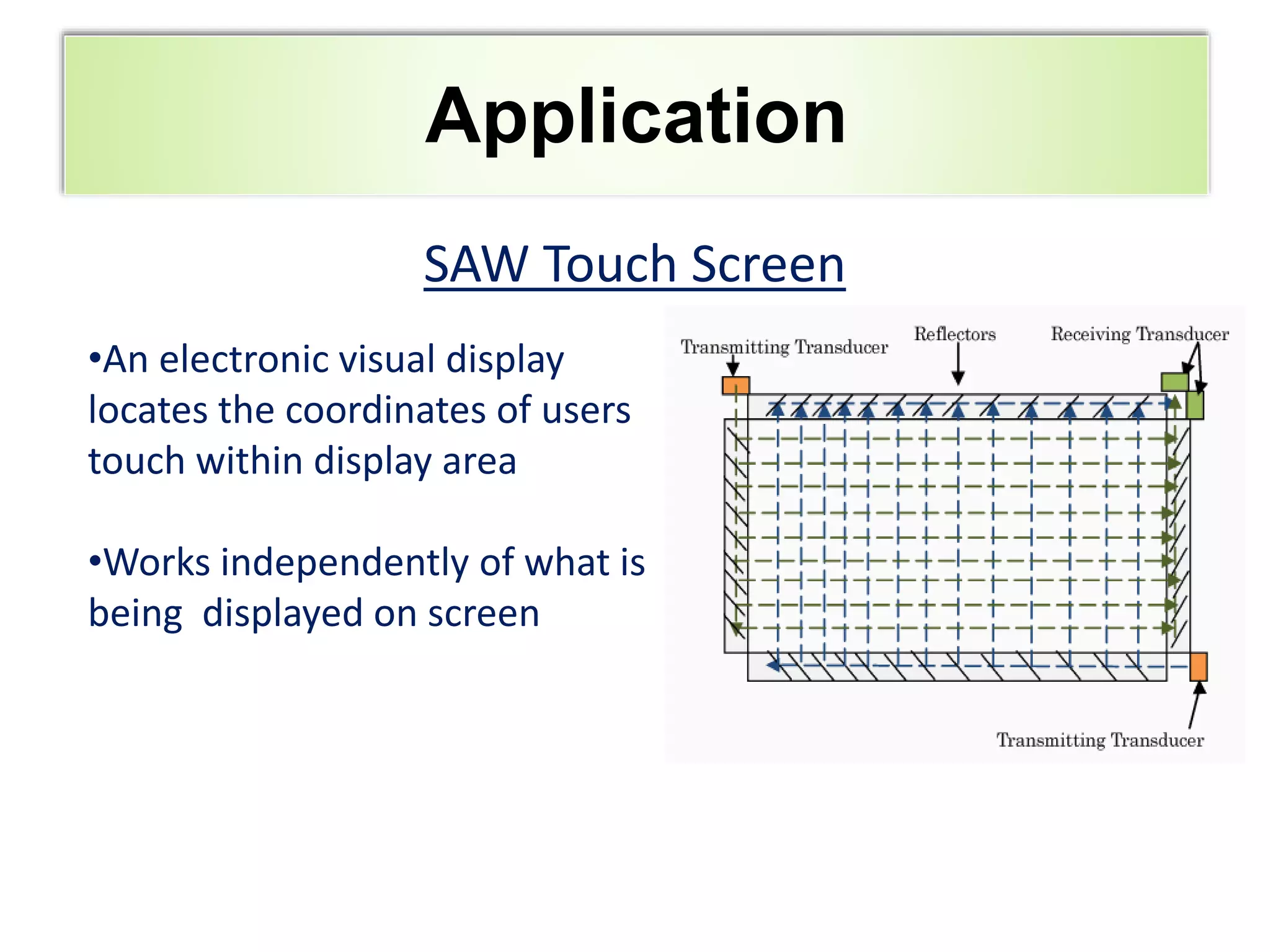
•An electronic visual display
locates the coordinates of users
touch within display area
•Works independently of what is
being displayed on screen
Outline
Continued...
SAW Based Touch Screen
Application
Outline
Continued...
SAW Touch Screen
• Surface consists of glass overlay with
transmitting and receiving transducers
• Electrical signals sent to the transmitting
transducers
• Waves are directed across screen by
reflectors then directed to receiving
transducers
Application
Outline
Continued...
SAW Touch Screen
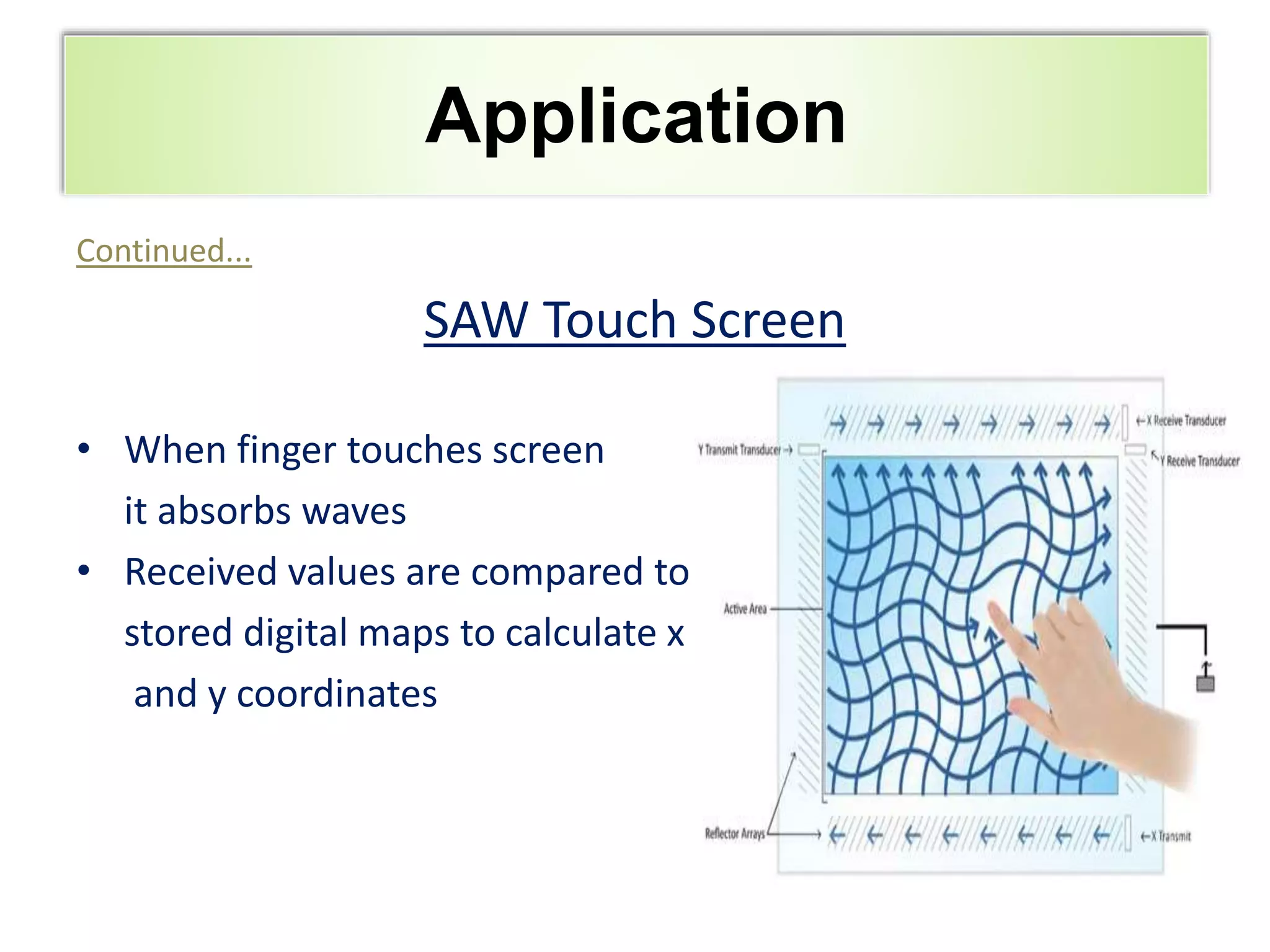
• When finger touches screen
it absorbs waves
• Received values are compared to
stored digital maps to calculate x
and y coordinates
Application
Outline
Continued...
Illustration
Application
Outline
Application of SAW Touch Screen
• ATMs
• Amusement Parks
• Gaming Environments
• kiosks
• Industrial Control Rooms
Application
Outline
Why SAW Touch Screen?
• Advantages:
– Best optical quality
– High surface durability
– Activated by multiple sources
– High “touch-life”
• Disadvantages:
– Expensive
– Contaminates on screen can cause false-touches
– Non conductive material can not activate screen
Application
Outline
Surface Acoustic Wave
ADVANTAGES:
• Low Velocity
• Low attenuation
• Low cost
• Simple design and fabrication
• Low power consumption
DISADVANTAGES:
• Can not be operated in liquids
• Piezoelectric substrates are temperature dependent
ADVANTAGES &
DISADVANTAGES
OutlineCONCLUSION
• Surface Acoustic Wave Technology is widely used
technology.
• Applied to design filters, different sensors, resonators,
delay lines and many commercial devices.
• Most emerging technology across the world.
• All the electronics equipments and devices use SAW
technology.
• The demand of SAW technology will never abate
because of its fruitful advantages than disadvantages.
Works Cited
 http://en.wikipedia.org/wiki/Surface_Acoustic_wave
 http://www.dmccoltd.com/english/museum/touchscreens/technologies/AcousticWave.asp
 http://www.elotouch.com/technologies/intellitouch/default.asp
 http://admetro.com/products/surface-acoustic-wave-saw
 http://www.baanto.com/surface-acoustic-wave-saw-touch-screen
 http://www.analog.com/library/analogDialogue/archives/44-02/touch_screen.html
 http://apcmag.com/inside-touch-how-touchscreen-technologies-work.html
 http://www.slideshare.net/mshirif/touch-screen-technologies#
 http://computer.howstuffworks.com/question716.htm
Surface acoustic wave technology

Surface acoustic wave technology

  • 1.
  • 2.
    Outline • Introduction • Terminology •Surface Acoustic Wave(SAW) - Components - Properties • SAW Principle • Applications • Advantages & Disadvantages • Conclusion • References Outline
  • 3.
    Outline Surface Acoustic WaveTechnology Brief History: • Surface Acoustic Waves (SAW) were discovered in 1885 by Lord Rayleigh • SAW device was invented by White and Voltmer in 1965 • Around 1970, developed for Pulse Compression Radar, oscillators, and bandpass filters for domestic TV • Diverse applications in consumer and highly professional electronic devices and systems • Perform different functions in the frequency range from 10 MHz to several GHz. Introduction
  • 4.
    Outline Continued... Terminology • Surface: Outsidepart or uppermost layer of something. • Acoustic : Science deals with the study of all mechanical waves in gases, liquids, and solids. • Wave: Oscillation accompanied by transfer of energy that travels through space or mass. • Acoustic Wave : Type of longitudinal wave propagates by means of adiabatic compression and decompression. Introduction
  • 5.
    Outline Definition • A SurfaceAcoustic Wave (SAW) is an Acoustic Wave traveling along the surface of an elastic substrate. • Frequency of SAW: F=V/ λ V=Velocity of SAW (~ 2500m/s-10000m/s) λ=wavelength • Type of mechanical wave motion travels along the surface of solid material. Surface Acoustic Wave(SAW)
  • 6.
    Outline SAW Device . Fig :Basic Structure of SAW Device Surface Acoustic Wave(SAW)
  • 7.
    Outline Continued... SAW Device? • Asolid state device – Converts electrical energy into a mechanical wave(Acoustic) on a single crystal substrate and vice versa – Provides very complex signal processing in a very small volume • Approximately 4-5 billion SAW devices are produced each year Surface Acoustic Wave(SAW)
  • 8.
    Outline SAW Device Components •Transducers(IDT) • Piezoelectric Substrate – Crystal Quartz(SiO2) – Lithium Niobates(LiNbO3) – Lithium Tantalates(LiTaO3) etc. • Reflectors Surface Acoustic Wave(SAW) Fig : Typical Piezoelectric Transducer Fig : SAW Reflector Gratings
  • 9.
    Outline SAW Properties • PiezoelectricSubstrate : Acoustoelectric Conversion • Small Surface Perturbation: 0.1-20 A0 • Velocity: ~2,500 -10,000 m/s • Efficient Transduction • Frequency Range: ~10MHz to 3GHz Surface Acoustic Wave(SAW)
  • 10.
    Outline SAW Comparison withEM wave Vsaw=~3000 m/s Vem=~3 x10⁸ m/s F λ=V Surface Acoustic Wave(SAW) F=10MHz F=1GHz λsaw 300 µm 3µm λ EM 30m 3m
  • 11.
    Outline SAW Principle • Basedon Piezoelectric Effect: Useful in applications: – production and detection of sound – generation of high voltages etc • Based on Acoustic Wave : Wave propagates by means of adiabatic compression and decompression. SAW Fundamentals
  • 12.
    Outline Continued... Piezoelectric Effect •Also called as Piezoelectricity • The ability of certain materials to generate an voltage when subjected to mechanical stress • Reverse is also true. SAW Fundamentals Fig : Piezoelectric Effect
  • 13.
    Outline • SAW TouchScreen • SAW Filter • Delay Line • Resonator • Sensors • RFID Applications
  • 14.
    Outline SAW Touch Screen Application •Anelectronic visual display locates the coordinates of users touch within display area •Works independently of what is being displayed on screen
  • 15.
  • 16.
    Outline Continued... SAW Touch Screen •Surface consists of glass overlay with transmitting and receiving transducers • Electrical signals sent to the transmitting transducers • Waves are directed across screen by reflectors then directed to receiving transducers Application
  • 17.
    Outline Continued... SAW Touch Screen •When finger touches screen it absorbs waves • Received values are compared to stored digital maps to calculate x and y coordinates Application
  • 18.
  • 19.
    Outline Application of SAWTouch Screen • ATMs • Amusement Parks • Gaming Environments • kiosks • Industrial Control Rooms Application
  • 20.
    Outline Why SAW TouchScreen? • Advantages: – Best optical quality – High surface durability – Activated by multiple sources – High “touch-life” • Disadvantages: – Expensive – Contaminates on screen can cause false-touches – Non conductive material can not activate screen Application
  • 21.
    Outline Surface Acoustic Wave ADVANTAGES: •Low Velocity • Low attenuation • Low cost • Simple design and fabrication • Low power consumption DISADVANTAGES: • Can not be operated in liquids • Piezoelectric substrates are temperature dependent ADVANTAGES & DISADVANTAGES
  • 22.
    OutlineCONCLUSION • Surface AcousticWave Technology is widely used technology. • Applied to design filters, different sensors, resonators, delay lines and many commercial devices. • Most emerging technology across the world. • All the electronics equipments and devices use SAW technology. • The demand of SAW technology will never abate because of its fruitful advantages than disadvantages.
  • 24.
    Works Cited  http://en.wikipedia.org/wiki/Surface_Acoustic_wave http://www.dmccoltd.com/english/museum/touchscreens/technologies/AcousticWave.asp  http://www.elotouch.com/technologies/intellitouch/default.asp  http://admetro.com/products/surface-acoustic-wave-saw  http://www.baanto.com/surface-acoustic-wave-saw-touch-screen  http://www.analog.com/library/analogDialogue/archives/44-02/touch_screen.html  http://apcmag.com/inside-touch-how-touchscreen-technologies-work.html  http://www.slideshare.net/mshirif/touch-screen-technologies#  http://computer.howstuffworks.com/question716.htm