Metal–Oxide–Semiconductor
Capacitor
Instructor
Abu Syed Md. Jannatul Islam
Lecturer, Dept. of EEE, KUET, BD
M
O
S
MOS Capacitor
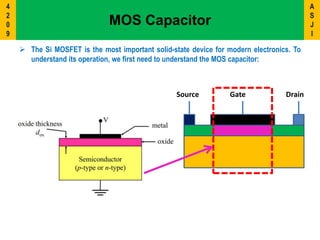
 The Si MOSFET is the most important solid-state device for modern electronics. To
understand its operation, we first need to understand the MOS capacitor:
Source Gate Drain
A
S
J
I
4
2
0
9
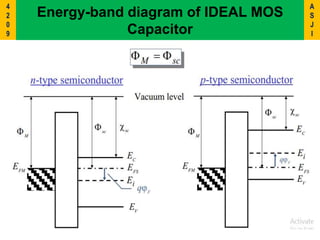
Energy-band diagram of IDEAL MOS
Capacitor
A
S
J
I
4
2
0
9
Accumulation in MOS for p-type
Substrate
 Ideal MOS capacitor under accumulation bias conditions: The valence-band edge is
closer to the Fermi level at the oxide–semiconductor interface than in the bulk
material, which implies that there is an accumulation of holes.
A
S
J
I
4
2
0
9
 The semiconductor surface appears to be more p-type than the bulk material. The
Fermi level is a constant in the semiconductor since the MOS system is in thermal
equilibrium and there is no current through the oxide.
Accumulation in MOS for p-type
Substrate
A
S
J
I
4
2
0
9
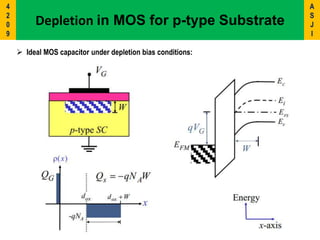
 Ideal MOS capacitor under depletion bias conditions:
Depletion in MOS for p-type Substrate
A
S
J
I
4
2
0
9
 Figure c : shows the energy-band diagram of the MOS system when a positive voltage
is applied to the gate.
 The conduction- and valence-band edges bend as shown in the figure, indicating a
space charge region similar to that in a pn junction.
 The conduction band and intrinsic Fermi levels move closer to the Fermi level.
 The induced space charge width is Xd or W. A larger negative charge in the MOS
capacitor implies a larger induced space charge region and more band bending.
Depletion in MOS for p-type Substrate
A
S
J
I
4
2
0
9
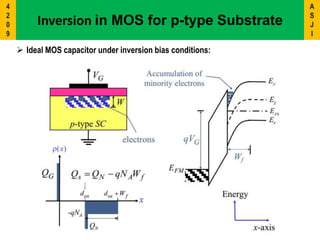
 Ideal MOS capacitor under inversion bias conditions:
Inversion in MOS for p-type Substrate
A
S
J
I
4
2
0
9
 The intrinsic Fermi level at the surface is now below the Fermi level. The conduction
band at the surface is now close to the Fermi level, whereas the valence band is close
to the Fermi level in the bulk semiconductor.
 This result implies that the surface in the semiconductor adjacent to the oxide–
semiconductor interface is n type.
 By applying a sufficiently large positive gate voltage, we have inverted the surface of
the semiconductor from a p-type to an n-type semiconductor. We have created an
inversion layer of electrons at the oxide–semiconductor interface.
Inversion in MOS for p-type Substrate
A
S
J
I
4
2
0
9
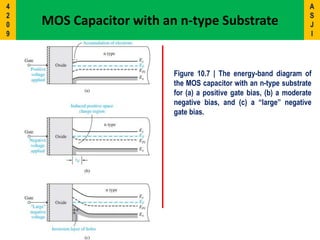
 Figure 10.7a shows the case when a positive voltage is applied to the gate and an
accumulation layer of electrons is formed.
 Figure 10.7b shows the energy bands when a negative voltage is applied to the gate.
The conduction and valence bands now bend upward indicating that a space charge
region has been induced in the n-type substrate.
 Figure 10.7c shows the energy bands when a larger negative voltage is applied to the
gate. The conduction and valence bands are bent even more and the intrinsic Fermi
level has moved above the Fermi level.
 The valence band at the surface is now close to the Fermi level, whereas the
conduction band is close to the Fermi level in the bulk semiconductor. This result
implies that the semiconductor surface adjacent to the oxide–semiconductor interface
is p type.
 By applying a sufficiently large negative voltage to the gate of the MOS capacitor, the
semiconductor surface has been inverted from n type to p type. An inversion layer of
holes has been induced at the oxide–semiconductor interface.
MOS Capacitor with an n-type Substrate
A
S
J
I
4
2
0
9
Figure 10.7 | The energy-band diagram of
the MOS capacitor with an n-type substrate
for (a) a positive gate bias, (b) a moderate
negative bias, and (c) a “large” negative
gate bias.
MOS Capacitor with an n-type Substrate
A
S
J
I
4
2
0
9
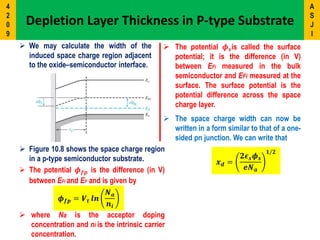
 Figure 10.8 shows the space charge region
in a p-type semiconductor substrate.
𝝓 𝒇𝒑 = 𝑽 𝒕 𝒍𝒏
𝑵 𝒂
𝒏𝒊
 The potential 𝝓 𝒔is called the surface
potential; it is the difference (in V)
between EFi measured in the bulk
semiconductor and EFi measured at the
surface. The surface potential is the
potential difference across the space
charge layer.
𝒙 𝒅 =
𝟐𝝐 𝒔 𝝓 𝒔
𝒆𝑵 𝒂
𝟏/𝟐
Depletion Layer Thickness in P-type Substrate
 where Na is the acceptor doping
concentration and ni is the intrinsic carrier
concentration.
 We may calculate the width of the
induced space charge region adjacent
to the oxide–semiconductor interface.
 The space charge width can now be
written in a form similar to that of a one-
sided pn junction. We can write that
 The potential 𝝓 𝒇𝒑 is the difference (in V)
between EFi and EF and is given by
A
S
J
I
4
2
0
9
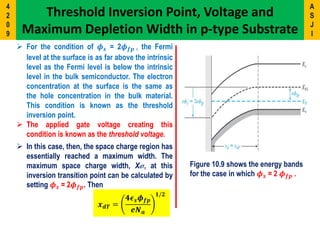
 For the condition of 𝝓 𝒔 = 2𝝓 𝒇𝒑 , the Fermi
level at the surface is as far above the intrinsic
level as the Fermi level is below the intrinsic
level in the bulk semiconductor. The electron
concentration at the surface is the same as
the hole concentration in the bulk material.
This condition is known as the threshold
inversion point.
 The applied gate voltage creating this
condition is known as the threshold voltage.
Threshold Inversion Point, Voltage and
Maximum Depletion Width in p-type Substrate
𝒙 𝒅𝑻 =
𝟒𝝐 𝒔 𝝓 𝒇𝒑
𝒆𝑵 𝒂
𝟏/𝟐
Figure 10.9 shows the energy bands
for the case in which 𝝓 𝒔 = 2 𝝓 𝒇𝒑 .
 In this case, then, the space charge region has
essentially reached a maximum width. The
maximum space charge width, XdT, at this
inversion transition point can be calculated by
setting 𝝓 𝒔 = 2𝝓 𝒇𝒑. Then
A
S
J
I
4
2
0
9
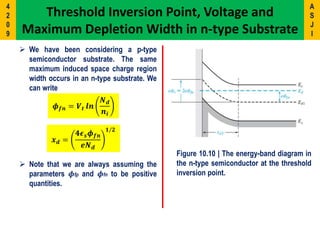
 We have been considering a p-type
semiconductor substrate. The same
maximum induced space charge region
width occurs in an n-type substrate. We
can write
𝒙 𝒅 =
𝟒𝝐 𝒔 𝝓 𝒇𝒏
𝒆𝑵 𝒅
𝟏/𝟐
𝝓 𝒇𝒏 = 𝑽 𝒕 𝒍𝒏
𝑵 𝒅
𝒏𝒊
 Note that we are always assuming the
parameters 𝝓fp and 𝝓fn to be positive
quantities.
Threshold Inversion Point, Voltage and
Maximum Depletion Width in n-type Substrate
Figure 10.10 | The energy-band diagram in
the n-type semiconductor at the threshold
inversion point.
A
S
J
I
4
2
0
9
 Figure 10.13a shows the energy levels in the metal, silicon dioxide (SiO2), and silicon
relative to the vacuum level. The metal work function is 𝝓m and the electron affinity is
𝝌𝒊 .The parameter 𝝌𝒊 is the oxide electron affinity and, for SiO2, 𝝌𝒊 0.9 V.
Work Function Differences in p-type Substrate
A
S
J
I
4
2
0
9
 Figure 10.13b shows the energy-band
diagram of the entire MOS structure with
zero gate voltage applied.
 The Fermi level is a constant through
the entire system at thermal equilibrium.
We may define 𝝓 𝒎
′
as a modified metal
work function—the potential required to
inject an electron from the metal into the
conduction band of the oxide.
 Similarly, 𝝌′
is defined as a modified
electron affinity. The voltage Vox0 is the
potential drop across the oxide for zero
applied gate voltage and is not
necessarily zero because of the
difference between 𝝓m and 𝝌.
 The potential 𝝓 𝒔𝟎 is the surface
potential for this case.
𝒆𝝓 𝒎
′ + 𝒆𝑽 𝒐𝒙𝟎 = 𝒆𝝌′ +
𝑬 𝒈
𝟐
− 𝒆𝝓 𝒔𝟎 + 𝒆𝝓 𝒇𝒑
𝑽 𝒐𝒙𝟎 + 𝝓 𝒔𝟎 = − 𝝓 𝒎
′ − 𝝌′ +
𝑬 𝒈
𝟐𝒆
+ 𝝓 𝒇𝒑
Work Function Differences in p-type Substrate
 We can define a potential 𝝓 𝒎𝒔 as
𝝓 𝒎𝒔 = 𝝓 𝒎
′ − 𝝌′ +
𝑬 𝒈
𝟐𝒆
+ 𝝓 𝒇𝒑
 which is known as the metal–
semiconductor work function difference.
 If we sum the energies from the Fermi
level on the metal side to the Fermi
level on the semiconductor side, we
have
A
S
J
I
4
2
0
9
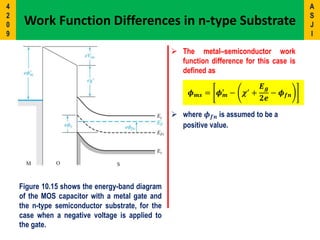
 The metal–semiconductor work
function difference for this case is
defined as
𝝓 𝒎𝒔 = 𝝓 𝒎
′ − 𝝌′ +
𝑬 𝒈
𝟐𝒆
− 𝝓 𝒇𝒏
 where 𝝓 𝒇𝒏 is assumed to be a
positive value.
Work Function Differences in n-type Substrate
Figure 10.15 shows the energy-band diagram
of the MOS capacitor with a metal gate and
the n-type semiconductor substrate, for the
case when a negative voltage is applied to
the gate.
A
S
J
I
4
2
0
9
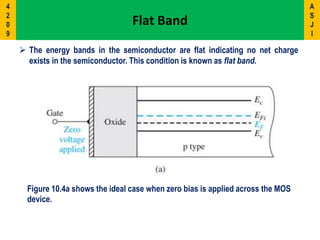
 The energy bands in the semiconductor are flat indicating no net charge
exists in the semiconductor. This condition is known as flat band.
Flat Band
Figure 10.4a shows the ideal case when zero bias is applied across the MOS
device.
A
S
J
I
4
2
0
9
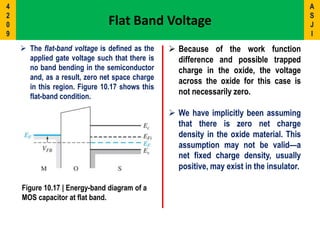
 Because of the work function
difference and possible trapped
charge in the oxide, the voltage
across the oxide for this case is
not necessarily zero.
 We have implicitly been assuming
that there is zero net charge
density in the oxide material. This
assumption may not be valid—a
net fixed charge density, usually
positive, may exist in the insulator.
Figure 10.17 | Energy-band diagram of a
MOS capacitor at flat band.
Flat Band Voltage
 The flat-band voltage is defined as the
applied gate voltage such that there is
no band bending in the semiconductor
and, as a result, zero net space charge
in this region. Figure 10.17 shows this
flat-band condition.
A
S
J
I
4
2
0
9
Oxide Charges
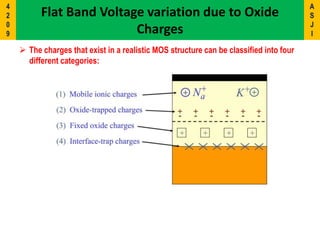
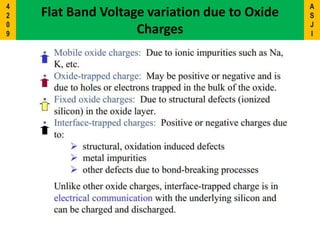
 The charges that exist in a realistic MOS structure can be classified into four
different categories:
Flat Band Voltage variation due to Oxide
Charges
A
S
J
I
4
2
0
9
Flat Band Voltage variation due to Oxide
Charges
A
S
J
I
4
2
0
9
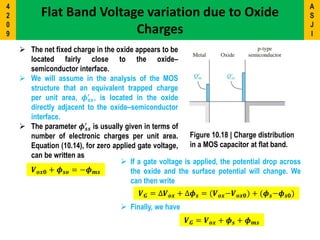
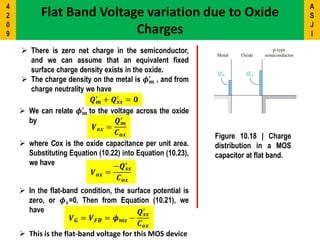
 The net fixed charge in the oxide appears to be
located fairly close to the oxide–
semiconductor interface.
 We will assume in the analysis of the MOS
structure that an equivalent trapped charge
per unit area, 𝝓 𝒔𝒔
′
, is located in the oxide
directly adjacent to the oxide–semiconductor
interface.
 The parameter 𝝓 𝒔𝒔
′
is usually given in terms of
number of electronic charges per unit area.
Equation (10.14), for zero applied gate voltage,
can be written as
𝑽 𝒐𝒙𝟎 + 𝝓 𝒔𝒐 = −𝝓 𝒎𝒔
Flat Band Voltage variation due to Oxide
Charges
 If a gate voltage is applied, the potential drop across
the oxide and the surface potential will change. We
can then write
𝑽 𝑮 = ∆𝑽 𝒐𝒙 + ∆𝝓 𝒔 = (𝑽 𝒐𝒙−𝑽 𝒐𝒙𝟎) + (𝝓 𝒔−𝝓 𝒔𝟎)
 Finally, we have
𝑽 𝑮 = 𝑽 𝒐𝒙 + 𝝓 𝒔 + 𝝓 𝒎𝒔
Figure 10.18 | Charge distribution
in a MOS capacitor at flat band.
A
S
J
I
4
2
0
9
 There is zero net charge in the semiconductor,
and we can assume that an equivalent fixed
surface charge density exists in the oxide.
 The charge density on the metal is 𝝓 𝒎
′
, and from
charge neutrality we have
𝑸 𝒎
′ + 𝑸 𝒔𝒔
′ = 𝟎
 We can relate 𝝓 𝒎
′
to the voltage across the oxide
by
𝑽 𝒐𝒙 =
𝑸 𝒎
′
𝑪 𝒐𝒙
Flat Band Voltage variation due to Oxide
Charges
Figure 10.18 | Charge
distribution in a MOS
capacitor at flat band.
 where Cox is the oxide capacitance per unit area.
Substituting Equation (10.22) into Equation (10.23),
we have
𝑽 𝒐𝒙 =
−𝑸 𝒔𝒔
′
𝑪 𝒐𝒙
 In the flat-band condition, the surface potential is
zero, or 𝝓 𝒔=0. Then from Equation (10.21), we
have
𝑽 𝑮 = 𝑽 𝑭𝑩 = 𝝓 𝒎𝒔 −
𝑸 𝒔𝒔
′
𝑪 𝒐𝒙
 This is the flat-band voltage for this MOS device
A
S
J
I
4
2
0
9
 The threshold voltage is defined as the
applied gate voltage required to achieve the
threshold inversion point.
 The threshold inversion point, in turn, is
defined as the condition when the surface
potential is 𝝓 𝒔 = 2 𝝓 𝒇𝒑 for the p-type
semiconductor and 𝝓 𝒔= 2𝝓 𝒇𝒏 for the n-type
semiconductor.
 The space charge width has reached its
maximum value.
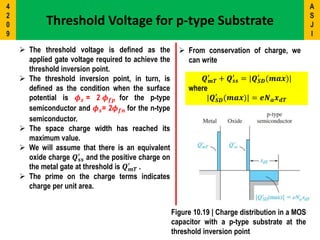
 We will assume that there is an equivalent
oxide charge 𝑸 𝒔𝒔
′
and the positive charge on
the metal gate at threshold is 𝑸 𝒎𝑻
′
.
 The prime on the charge terms indicates
charge per unit area.
𝑸 𝒎𝑻
′
+ 𝑸 𝒔𝒔
′
= |𝑸 𝑺𝑫
′
(𝒎𝒂𝒙)|
where
|𝑸 𝑺𝑫
′
(𝒎𝒂𝒙)| = 𝒆𝑵 𝒂 𝒙 𝒅𝑻
Threshold Voltage for p-type Substrate
Figure 10.19 | Charge distribution in a MOS
capacitor with a p-type substrate at the
threshold inversion point
 From conservation of charge, we
can write
A
S
J
I
4
2
0
9
Figure 10.20 | Energy-band diagram
through the MOS structure with a
positive applied gate bias.
Threshold Voltage for p-type Substrate
 As we mentioned, an applied gate voltage will
change the voltage across the oxide and will
change the surface potential. We had from
Equation (10.20) that
𝑽 𝑮 = ∆𝑽 𝒐𝒙 + ∆𝝓 𝒔 = 𝑽 𝒐𝒙 + 𝝓 𝒔 + 𝝓 𝒎𝒔
 At threshold, we can define 𝑽 𝑮 = 𝑽 𝑻𝑵, where
𝑽 𝑻𝑵 is the threshold voltage that creates the
electron inversion layer charge. The surface
potential is 𝝓 𝒔= 𝟐𝝓 𝒇𝒑 at threshold, so
Equation (10.20) can be written as
𝑽 𝑻𝑵 = 𝑽 𝒐𝒙𝑻 + 𝟐𝝓 𝒇𝒑 + 𝝓 𝒎𝒔
 where 𝑽 𝒐𝒙𝑻 is the voltage across the oxide
at this threshold inversion point. The voltage
𝑽 𝒐𝒙𝑻 can be related to the charge on the
metal and to the oxide capacitance by
𝑽 𝒐𝒙𝑻 =
𝑸 𝒎𝑻
′
𝑪 𝒐𝒙
A
S
J
I
4
2
0
9
 where again Cox is the oxide capacitance per unit area. Using Equation (10.26), we can
write
Threshold Voltage for p-type Substrate
𝑽 𝒐𝒙𝑻 =
𝑸 𝒎𝑻
′
𝑪 𝒐𝒙
=
𝟏
𝑪 𝒐𝒙
|𝑸 𝑺𝑫
′
𝒎𝒂𝒙 − 𝑸 𝒔𝒔
′
 Finally, the threshold voltage can be written as
𝑽 𝑻𝑵 =
|𝑸 𝑺𝑫
′
𝒎𝒂𝒙 |
𝑪 𝒐𝒙
−
𝑸 𝒔𝒔
′
𝑪 𝒐𝒙
+ 𝝓 𝒎𝒔 + 𝟐𝝓 𝒇𝒑
𝑽 𝑻𝑵 = |𝑸 𝑺𝑫
′
𝒎𝒂𝒙 −𝑸 𝒔𝒔
′
𝒕 𝒐𝒙
𝝐 𝒐𝒙
+ 𝝓 𝒎𝒔 + 𝟐𝝓 𝒇𝒑
 Using the definition of flat-band voltage from Equation (10.25), we can also express the
threshold voltage as
𝑽 𝑻𝑵 =
|𝑸 𝑺𝑫
′
𝒎𝒂𝒙 |
𝑪 𝒐𝒙
+ 𝑽 𝑭𝑩 + 𝟐𝝓 𝒇𝒑
A
S
J
I
4
2
0
9
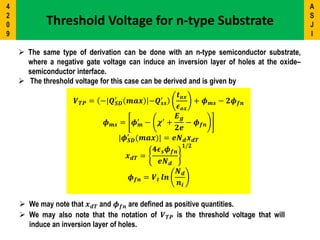
 The same type of derivation can be done with an n-type semiconductor substrate,
where a negative gate voltage can induce an inversion layer of holes at the oxide–
semiconductor interface.
 The threshold voltage for this case can be derived and is given by
𝑽 𝑻𝑷 = −|𝑸 𝑺𝑫
′
𝒎𝒂𝒙 −𝑸 𝒔𝒔
′
𝒕 𝒐𝒙
𝝐 𝒐𝒙
+ 𝝓 𝒎𝒔 − 𝟐𝝓 𝒇𝒏
𝝓 𝒎𝒔 = 𝝓 𝒎
′ − 𝝌′ +
𝑬 𝒈
𝟐𝒆
− 𝝓 𝒇𝒏
|𝝓 𝑺𝑫
′
(𝒎𝒂𝒙)| = 𝒆𝑵 𝒅 𝒙 𝒅𝑻
𝒙 𝒅𝑻 =
𝟒𝝐 𝒔 𝝓 𝒇𝒏
𝒆𝑵 𝒅
𝟏/𝟐
𝝓 𝒇𝒏 = 𝑽 𝒕 𝒍𝒏
𝑵 𝒅
𝒏𝒊
 We may note that 𝒙 𝒅𝑻 and 𝝓 𝒇𝒏 are defined as positive quantities.
 We may also note that the notation of 𝑽 𝑻𝑷 is the threshold voltage that will
induce an inversion layer of holes.
Threshold Voltage for n-type Substrate
A
S
J
I
4
2
0
9
C–V Characteristics
 The MOS capacitor structure is the heart of the MOSFET.
 A great deal of information about the MOS device and the oxide semiconductor
interface can be obtained from the capacitance versus voltage or C–V characteristics
of the device.
 The capacitance of a device is defined as
𝑪 =
𝒅𝑸
𝒅𝑽
 where 𝒅𝑸 is the magnitude of the differential change in charge on one plate as a
function of the differential change in voltage 𝒅𝑽 across the capacitor.
 The capacitance is a small-signal or ac parameter and is measured by superimposing
a small ac voltage on an applied dc gate voltage.
 The capacitance, then, is measured as a function of the applied dc gate voltage.
A
S
J
I
4
2
0
9
 First we will consider the ideal C–V characteristics of the MOS capacitor and then
discuss some of the deviations that occur from these idealized results.
 We will initially assume that there is zero charge trapped in the oxide and also that
there is no charge trapped at the oxide–semiconductor interface.
 There are three operating conditions of interest in the MOS capacitor: accumulation,
depletion, and inversion.
Ideal C–V Characteristics
A
S
J
I
4
2
0
9
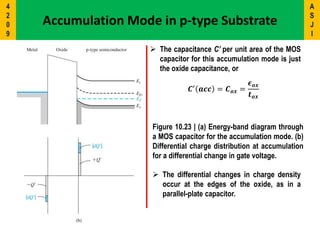
Figure 10.23 | (a) Energy-band diagram through
a MOS capacitor for the accumulation mode. (b)
Differential charge distribution at accumulation
for a differential change in gate voltage.
Accumulation Mode in p-type Substrate
 The capacitance C’ per unit area of the MOS
capacitor for this accumulation mode is just
the oxide capacitance, or
𝑪′
𝒂𝒄𝒄 = 𝑪 𝒐𝒙 =
𝝐 𝒐𝒙
𝒕 𝒐𝒙
 The differential changes in charge density
occur at the edges of the oxide, as in a
parallel-plate capacitor.
A
S
J
I
4
2
0
9
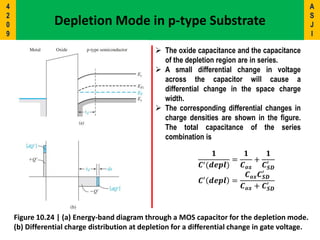
Figure 10.24 | (a) Energy-band diagram through a MOS capacitor for the depletion mode.
(b) Differential charge distribution at depletion for a differential change in gate voltage.
Depletion Mode in p-type Substrate
 The oxide capacitance and the capacitance
of the depletion region are in series.
 A small differential change in voltage
across the capacitor will cause a
differential change in the space charge
width.
 The corresponding differential changes in
charge densities are shown in the figure.
The total capacitance of the series
combination is
𝟏
𝑪′(𝒅𝒆𝒑𝒍)
=
𝟏
𝑪 𝒐𝒙
+
𝟏
𝑪 𝑺𝑫
′
𝑪′ 𝒅𝒆𝒑𝒍 =
𝑪 𝒐𝒙 𝑪 𝑺𝑫
′
𝑪 𝒐𝒙 + 𝑪 𝑺𝑫
′
A
S
J
I
4
2
0
9
𝟏
𝑪′(𝒅𝒆𝒑𝒍)
=
𝟏
𝑪 𝒐𝒙
+
𝟏
𝑪 𝑺𝑫
′
𝑪′ 𝒅𝒆𝒑𝒍 =
𝑪 𝒐𝒙 𝑪 𝑺𝑫
′
𝑪 𝒐𝒙 + 𝑪 𝑺𝑫
′
Depletion Mode in p-type Substrate
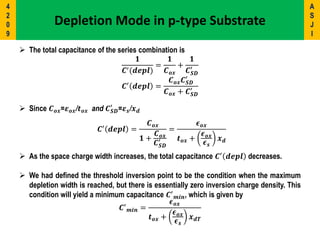
 The total capacitance of the series combination is
 Since 𝑪 𝒐𝒙=𝜺 𝒐𝒙/𝒕 𝒐𝒙 and 𝑪 𝑺𝑫
′
=𝜺 𝒔/𝒙 𝒅
 As the space charge width increases, the total capacitance 𝑪′ 𝒅𝒆𝒑𝒍 decreases.
 We had defined the threshold inversion point to be the condition when the maximum
depletion width is reached, but there is essentially zero inversion charge density. This
condition will yield a minimum capacitance 𝑪′
𝒎𝒊𝒏, which is given by
𝑪′
𝒎𝒊𝒏 =
𝝐 𝒐𝒙
𝒕 𝒐𝒙 +
𝝐 𝒐𝒙
𝝐 𝒔
𝒙 𝒅𝑻
𝑪′
𝒅𝒆𝒑𝒍 =
𝑪 𝒐𝒙
𝟏 +
𝑪 𝒐𝒙
𝑪 𝑺𝑫
′
=
𝝐 𝒐𝒙
𝒕 𝒐𝒙 +
𝝐 𝒐𝒙
𝝐 𝒔
𝒙 𝒅
A
S
J
I
4
2
0
9
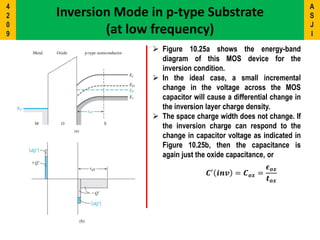
 Figure 10.25a shows the energy-band
diagram of this MOS device for the
inversion condition.
 In the ideal case, a small incremental
change in the voltage across the MOS
capacitor will cause a differential change in
the inversion layer charge density.
 The space charge width does not change. If
the inversion charge can respond to the
change in capacitor voltage as indicated in
Figure 10.25b, then the capacitance is
again just the oxide capacitance, or
Inversion Mode in p-type Substrate
(at low frequency)
𝑪′
𝒊𝒏𝒗 = 𝑪 𝒐𝒙 =
𝝐 𝒐𝒙
𝒕 𝒐𝒙
A
S
J
I
4
2
0
9
C-V curve for p-type Substrate
(at low-frequency)
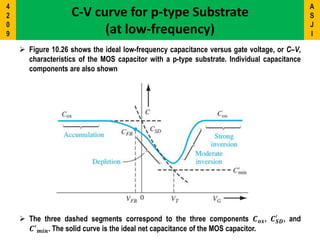
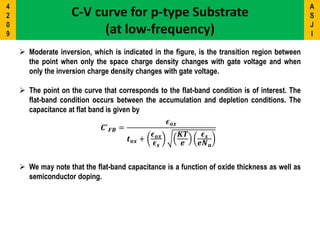
 The three dashed segments correspond to the three components 𝑪 𝒐𝒙, 𝑪 𝑺𝑫
′
, and
𝑪′
𝒎𝒊𝒏. The solid curve is the ideal net capacitance of the MOS capacitor.
 Figure 10.26 shows the ideal low-frequency capacitance versus gate voltage, or C–V,
characteristics of the MOS capacitor with a p-type substrate. Individual capacitance
components are also shown
A
S
J
I
4
2
0
9
 Moderate inversion, which is indicated in the figure, is the transition region between
the point when only the space charge density changes with gate voltage and when
only the inversion charge density changes with gate voltage.
 The point on the curve that corresponds to the flat-band condition is of interest. The
flat-band condition occurs between the accumulation and depletion conditions. The
capacitance at flat band is given by
𝑪′
𝑭𝑩 =
𝝐 𝒐𝒙
𝒕 𝒐𝒙 +
𝝐 𝒐𝒙
𝝐 𝒔
𝑲𝑻
𝒆
𝝐 𝒔
𝒆𝑵 𝒂
 We may note that the flat-band capacitance is a function of oxide thickness as well as
semiconductor doping.
C-V curve for p-type Substrate
(at low-frequency)
A
S
J
I
4
2
0
9
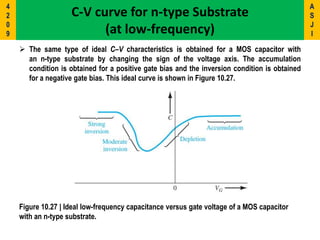
 The same type of ideal C–V characteristics is obtained for a MOS capacitor with
an n-type substrate by changing the sign of the voltage axis. The accumulation
condition is obtained for a positive gate bias and the inversion condition is obtained
for a negative gate bias. This ideal curve is shown in Figure 10.27.
Figure 10.27 | Ideal low-frequency capacitance versus gate voltage of a MOS capacitor
with an n-type substrate.
C-V curve for n-type Substrate
(at low-frequency)
A
S
J
I
4
2
0
9
C-V curve with Frequency effects
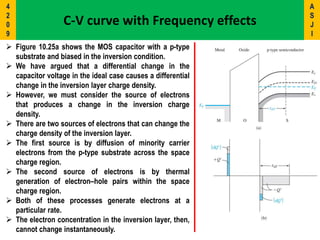
 Figure 10.25a shows the MOS capacitor with a p-type
substrate and biased in the inversion condition.
 We have argued that a differential change in the
capacitor voltage in the ideal case causes a differential
change in the inversion layer charge density.
 However, we must consider the source of electrons
that produces a change in the inversion charge
density.
 There are two sources of electrons that can change the
charge density of the inversion layer.
 The first source is by diffusion of minority carrier
electrons from the p-type substrate across the space
charge region.
 The second source of electrons is by thermal
generation of electron–hole pairs within the space
charge region.
 Both of these processes generate electrons at a
particular rate.
 The electron concentration in the inversion layer, then,
cannot change instantaneously.
A
S
J
I
4
2
0
9
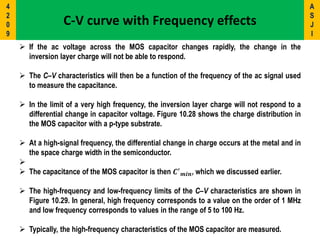
 If the ac voltage across the MOS capacitor changes rapidly, the change in the
inversion layer charge will not be able to respond.
 The C–V characteristics will then be a function of the frequency of the ac signal used
to measure the capacitance.
 In the limit of a very high frequency, the inversion layer charge will not respond to a
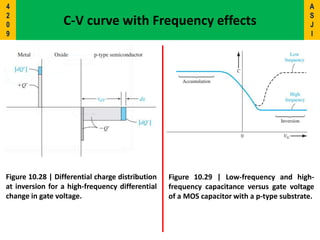
differential change in capacitor voltage. Figure 10.28 shows the charge distribution in
the MOS capacitor with a p-type substrate.
 At a high-signal frequency, the differential change in charge occurs at the metal and in
the space charge width in the semiconductor.

 The capacitance of the MOS capacitor is then 𝑪′
𝒎𝒊𝒏, which we discussed earlier.
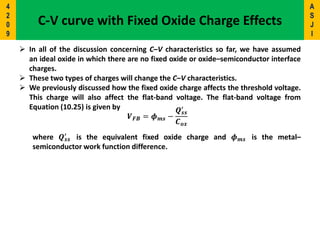
 The high-frequency and low-frequency limits of the C–V characteristics are shown in
Figure 10.29. In general, high frequency corresponds to a value on the order of 1 MHz
and low frequency corresponds to values in the range of 5 to 100 Hz.
 Typically, the high-frequency characteristics of the MOS capacitor are measured.
C-V curve with Frequency effects
A
S
J
I
4
2
0
9
Figure 10.28 | Differential charge distribution
at inversion for a high-frequency differential
change in gate voltage.
C-V curve with Frequency effects
Figure 10.29 | Low-frequency and high-
frequency capacitance versus gate voltage
of a MOS capacitor with a p-type substrate.
A
S
J
I
4
2
0
9
 In all of the discussion concerning C–V characteristics so far, we have assumed
an ideal oxide in which there are no fixed oxide or oxide–semiconductor interface
charges.
 These two types of charges will change the C–V characteristics.
 We previously discussed how the fixed oxide charge affects the threshold voltage.
This charge will also affect the flat-band voltage. The flat-band voltage from
Equation (10.25) is given by
𝑽 𝑭𝑩 = 𝝓 𝒎𝒔 −
𝑸 𝒔𝒔
′
𝑪 𝒐𝒙
C-V curve with Fixed Oxide Charge Effects
where 𝑸 𝒔𝒔
′
is the equivalent fixed oxide charge and 𝝓 𝒎𝒔 is the metal–
semiconductor work function difference.
A
S
J
I
4
2
0
9
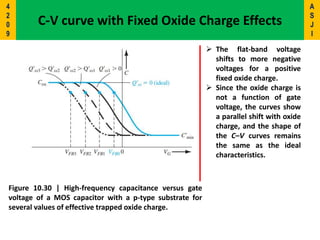
Figure 10.30 | High-frequency capacitance versus gate
voltage of a MOS capacitor with a p-type substrate for
several values of effective trapped oxide charge.
C-V curve with Fixed Oxide Charge Effects
 The flat-band voltage
shifts to more negative
voltages for a positive
fixed oxide charge.
 Since the oxide charge is
not a function of gate
voltage, the curves show
a parallel shift with oxide
charge, and the shape of
the C–V curves remains
the same as the ideal
characteristics.
A
S
J
I
4
2
0
9
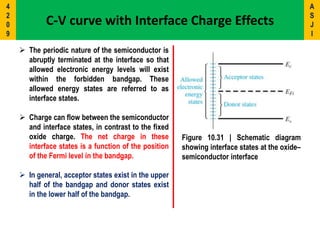
 The periodic nature of the semiconductor is
abruptly terminated at the interface so that
allowed electronic energy levels will exist
within the forbidden bandgap. These
allowed energy states are referred to as
interface states.
 Charge can flow between the semiconductor
and interface states, in contrast to the fixed
oxide charge. The net charge in these
interface states is a function of the position
of the Fermi level in the bandgap.
 In general, acceptor states exist in the upper
half of the bandgap and donor states exist
in the lower half of the bandgap.
C-V curve with Interface Charge Effects
Figure 10.31 | Schematic diagram
showing interface states at the oxide–
semiconductor interface
A
S
J
I
4
2
0
9
C-V curve with Interface Charge Effects
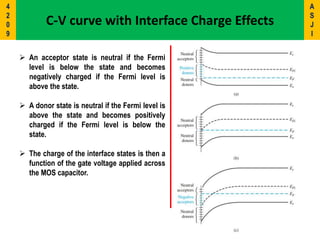
 An acceptor state is neutral if the Fermi
level is below the state and becomes
negatively charged if the Fermi level is
above the state.
 A donor state is neutral if the Fermi level is
above the state and becomes positively
charged if the Fermi level is below the
state.
 The charge of the interface states is then a
function of the gate voltage applied across
the MOS capacitor.
A
S
J
I
4
2
0
9
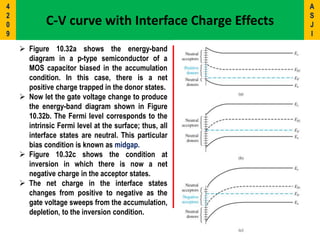
 Figure 10.32a shows the energy-band
diagram in a p-type semiconductor of a
MOS capacitor biased in the accumulation
condition. In this case, there is a net
positive charge trapped in the donor states.
 Now let the gate voltage change to produce
the energy-band diagram shown in Figure
10.32b. The Fermi level corresponds to the
intrinsic Fermi level at the surface; thus, all
interface states are neutral. This particular
bias condition is known as midgap.
 Figure 10.32c shows the condition at
inversion in which there is now a net
negative charge in the acceptor states.
 The net charge in the interface states
changes from positive to negative as the
gate voltage sweeps from the accumulation,
depletion, to the inversion condition.
C-V curve with Interface Charge Effects
A
S
J
I
4
2
0
9
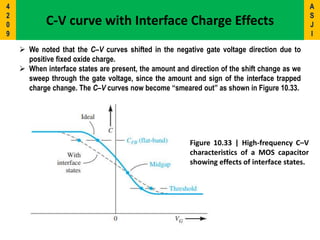
 We noted that the C–V curves shifted in the negative gate voltage direction due to
positive fixed oxide charge.
 When interface states are present, the amount and direction of the shift change as we
sweep through the gate voltage, since the amount and sign of the interface trapped
charge change. The C–V curves now become “smeared out” as shown in Figure 10.33.
C-V curve with Interface Charge Effects
Figure 10.33 | High-frequency C–V
characteristics of a MOS capacitor
showing effects of interface states.
A
S
J
I
4
2
0
9
C-V curve with Interface Charge Effects
 Again, the C–V measurements can be used as a diagnostic tool in semiconductor
device process control. For a given MOS device, the ideal C–V curve can be
determined.
 Any “smearing out” in the experimental curve indicates the presence of interface
states and any parallel shift indicates the presence of fixed oxide charge.
 The amount of smearing out can be used to determine the density of interface states.
 These types of measurement are extremely useful in the study of radiation effects on
MOS devices.
MATH Problems: 10.1 to 10.6
A
S
J
I
4
2
0
9

MOS Capacitor

  • 1.
    Metal–Oxide–Semiconductor Capacitor Instructor Abu Syed Md.Jannatul Islam Lecturer, Dept. of EEE, KUET, BD M O S
  • 2.
    MOS Capacitor  TheSi MOSFET is the most important solid-state device for modern electronics. To understand its operation, we first need to understand the MOS capacitor: Source Gate Drain A S J I 4 2 0 9
  • 3.
    Energy-band diagram ofIDEAL MOS Capacitor A S J I 4 2 0 9
  • 4.
    Accumulation in MOSfor p-type Substrate  Ideal MOS capacitor under accumulation bias conditions: The valence-band edge is closer to the Fermi level at the oxide–semiconductor interface than in the bulk material, which implies that there is an accumulation of holes. A S J I 4 2 0 9
  • 5.
     The semiconductorsurface appears to be more p-type than the bulk material. The Fermi level is a constant in the semiconductor since the MOS system is in thermal equilibrium and there is no current through the oxide. Accumulation in MOS for p-type Substrate A S J I 4 2 0 9
  • 6.
     Ideal MOScapacitor under depletion bias conditions: Depletion in MOS for p-type Substrate A S J I 4 2 0 9
  • 7.
     Figure c: shows the energy-band diagram of the MOS system when a positive voltage is applied to the gate.  The conduction- and valence-band edges bend as shown in the figure, indicating a space charge region similar to that in a pn junction.  The conduction band and intrinsic Fermi levels move closer to the Fermi level.  The induced space charge width is Xd or W. A larger negative charge in the MOS capacitor implies a larger induced space charge region and more band bending. Depletion in MOS for p-type Substrate A S J I 4 2 0 9
  • 8.
     Ideal MOScapacitor under inversion bias conditions: Inversion in MOS for p-type Substrate A S J I 4 2 0 9
  • 9.
     The intrinsicFermi level at the surface is now below the Fermi level. The conduction band at the surface is now close to the Fermi level, whereas the valence band is close to the Fermi level in the bulk semiconductor.  This result implies that the surface in the semiconductor adjacent to the oxide– semiconductor interface is n type.  By applying a sufficiently large positive gate voltage, we have inverted the surface of the semiconductor from a p-type to an n-type semiconductor. We have created an inversion layer of electrons at the oxide–semiconductor interface. Inversion in MOS for p-type Substrate A S J I 4 2 0 9
  • 10.
     Figure 10.7ashows the case when a positive voltage is applied to the gate and an accumulation layer of electrons is formed.  Figure 10.7b shows the energy bands when a negative voltage is applied to the gate. The conduction and valence bands now bend upward indicating that a space charge region has been induced in the n-type substrate.  Figure 10.7c shows the energy bands when a larger negative voltage is applied to the gate. The conduction and valence bands are bent even more and the intrinsic Fermi level has moved above the Fermi level.  The valence band at the surface is now close to the Fermi level, whereas the conduction band is close to the Fermi level in the bulk semiconductor. This result implies that the semiconductor surface adjacent to the oxide–semiconductor interface is p type.  By applying a sufficiently large negative voltage to the gate of the MOS capacitor, the semiconductor surface has been inverted from n type to p type. An inversion layer of holes has been induced at the oxide–semiconductor interface. MOS Capacitor with an n-type Substrate A S J I 4 2 0 9
  • 11.
    Figure 10.7 |The energy-band diagram of the MOS capacitor with an n-type substrate for (a) a positive gate bias, (b) a moderate negative bias, and (c) a “large” negative gate bias. MOS Capacitor with an n-type Substrate A S J I 4 2 0 9
  • 12.
     Figure 10.8shows the space charge region in a p-type semiconductor substrate. 𝝓 𝒇𝒑 = 𝑽 𝒕 𝒍𝒏 𝑵 𝒂 𝒏𝒊  The potential 𝝓 𝒔is called the surface potential; it is the difference (in V) between EFi measured in the bulk semiconductor and EFi measured at the surface. The surface potential is the potential difference across the space charge layer. 𝒙 𝒅 = 𝟐𝝐 𝒔 𝝓 𝒔 𝒆𝑵 𝒂 𝟏/𝟐 Depletion Layer Thickness in P-type Substrate  where Na is the acceptor doping concentration and ni is the intrinsic carrier concentration.  We may calculate the width of the induced space charge region adjacent to the oxide–semiconductor interface.  The space charge width can now be written in a form similar to that of a one- sided pn junction. We can write that  The potential 𝝓 𝒇𝒑 is the difference (in V) between EFi and EF and is given by A S J I 4 2 0 9
  • 13.
     For thecondition of 𝝓 𝒔 = 2𝝓 𝒇𝒑 , the Fermi level at the surface is as far above the intrinsic level as the Fermi level is below the intrinsic level in the bulk semiconductor. The electron concentration at the surface is the same as the hole concentration in the bulk material. This condition is known as the threshold inversion point.  The applied gate voltage creating this condition is known as the threshold voltage. Threshold Inversion Point, Voltage and Maximum Depletion Width in p-type Substrate 𝒙 𝒅𝑻 = 𝟒𝝐 𝒔 𝝓 𝒇𝒑 𝒆𝑵 𝒂 𝟏/𝟐 Figure 10.9 shows the energy bands for the case in which 𝝓 𝒔 = 2 𝝓 𝒇𝒑 .  In this case, then, the space charge region has essentially reached a maximum width. The maximum space charge width, XdT, at this inversion transition point can be calculated by setting 𝝓 𝒔 = 2𝝓 𝒇𝒑. Then A S J I 4 2 0 9
  • 14.
     We havebeen considering a p-type semiconductor substrate. The same maximum induced space charge region width occurs in an n-type substrate. We can write 𝒙 𝒅 = 𝟒𝝐 𝒔 𝝓 𝒇𝒏 𝒆𝑵 𝒅 𝟏/𝟐 𝝓 𝒇𝒏 = 𝑽 𝒕 𝒍𝒏 𝑵 𝒅 𝒏𝒊  Note that we are always assuming the parameters 𝝓fp and 𝝓fn to be positive quantities. Threshold Inversion Point, Voltage and Maximum Depletion Width in n-type Substrate Figure 10.10 | The energy-band diagram in the n-type semiconductor at the threshold inversion point. A S J I 4 2 0 9
  • 15.
     Figure 10.13ashows the energy levels in the metal, silicon dioxide (SiO2), and silicon relative to the vacuum level. The metal work function is 𝝓m and the electron affinity is 𝝌𝒊 .The parameter 𝝌𝒊 is the oxide electron affinity and, for SiO2, 𝝌𝒊 0.9 V. Work Function Differences in p-type Substrate A S J I 4 2 0 9
  • 16.
     Figure 10.13bshows the energy-band diagram of the entire MOS structure with zero gate voltage applied.  The Fermi level is a constant through the entire system at thermal equilibrium. We may define 𝝓 𝒎 ′ as a modified metal work function—the potential required to inject an electron from the metal into the conduction band of the oxide.  Similarly, 𝝌′ is defined as a modified electron affinity. The voltage Vox0 is the potential drop across the oxide for zero applied gate voltage and is not necessarily zero because of the difference between 𝝓m and 𝝌.  The potential 𝝓 𝒔𝟎 is the surface potential for this case. 𝒆𝝓 𝒎 ′ + 𝒆𝑽 𝒐𝒙𝟎 = 𝒆𝝌′ + 𝑬 𝒈 𝟐 − 𝒆𝝓 𝒔𝟎 + 𝒆𝝓 𝒇𝒑 𝑽 𝒐𝒙𝟎 + 𝝓 𝒔𝟎 = − 𝝓 𝒎 ′ − 𝝌′ + 𝑬 𝒈 𝟐𝒆 + 𝝓 𝒇𝒑 Work Function Differences in p-type Substrate  We can define a potential 𝝓 𝒎𝒔 as 𝝓 𝒎𝒔 = 𝝓 𝒎 ′ − 𝝌′ + 𝑬 𝒈 𝟐𝒆 + 𝝓 𝒇𝒑  which is known as the metal– semiconductor work function difference.  If we sum the energies from the Fermi level on the metal side to the Fermi level on the semiconductor side, we have A S J I 4 2 0 9
  • 17.
     The metal–semiconductorwork function difference for this case is defined as 𝝓 𝒎𝒔 = 𝝓 𝒎 ′ − 𝝌′ + 𝑬 𝒈 𝟐𝒆 − 𝝓 𝒇𝒏  where 𝝓 𝒇𝒏 is assumed to be a positive value. Work Function Differences in n-type Substrate Figure 10.15 shows the energy-band diagram of the MOS capacitor with a metal gate and the n-type semiconductor substrate, for the case when a negative voltage is applied to the gate. A S J I 4 2 0 9
  • 18.
     The energybands in the semiconductor are flat indicating no net charge exists in the semiconductor. This condition is known as flat band. Flat Band Figure 10.4a shows the ideal case when zero bias is applied across the MOS device. A S J I 4 2 0 9
  • 19.
     Because ofthe work function difference and possible trapped charge in the oxide, the voltage across the oxide for this case is not necessarily zero.  We have implicitly been assuming that there is zero net charge density in the oxide material. This assumption may not be valid—a net fixed charge density, usually positive, may exist in the insulator. Figure 10.17 | Energy-band diagram of a MOS capacitor at flat band. Flat Band Voltage  The flat-band voltage is defined as the applied gate voltage such that there is no band bending in the semiconductor and, as a result, zero net space charge in this region. Figure 10.17 shows this flat-band condition. A S J I 4 2 0 9
  • 20.
    Oxide Charges  Thecharges that exist in a realistic MOS structure can be classified into four different categories: Flat Band Voltage variation due to Oxide Charges A S J I 4 2 0 9
  • 21.
    Flat Band Voltagevariation due to Oxide Charges A S J I 4 2 0 9
  • 22.
     The netfixed charge in the oxide appears to be located fairly close to the oxide– semiconductor interface.  We will assume in the analysis of the MOS structure that an equivalent trapped charge per unit area, 𝝓 𝒔𝒔 ′ , is located in the oxide directly adjacent to the oxide–semiconductor interface.  The parameter 𝝓 𝒔𝒔 ′ is usually given in terms of number of electronic charges per unit area. Equation (10.14), for zero applied gate voltage, can be written as 𝑽 𝒐𝒙𝟎 + 𝝓 𝒔𝒐 = −𝝓 𝒎𝒔 Flat Band Voltage variation due to Oxide Charges  If a gate voltage is applied, the potential drop across the oxide and the surface potential will change. We can then write 𝑽 𝑮 = ∆𝑽 𝒐𝒙 + ∆𝝓 𝒔 = (𝑽 𝒐𝒙−𝑽 𝒐𝒙𝟎) + (𝝓 𝒔−𝝓 𝒔𝟎)  Finally, we have 𝑽 𝑮 = 𝑽 𝒐𝒙 + 𝝓 𝒔 + 𝝓 𝒎𝒔 Figure 10.18 | Charge distribution in a MOS capacitor at flat band. A S J I 4 2 0 9
  • 23.
     There iszero net charge in the semiconductor, and we can assume that an equivalent fixed surface charge density exists in the oxide.  The charge density on the metal is 𝝓 𝒎 ′ , and from charge neutrality we have 𝑸 𝒎 ′ + 𝑸 𝒔𝒔 ′ = 𝟎  We can relate 𝝓 𝒎 ′ to the voltage across the oxide by 𝑽 𝒐𝒙 = 𝑸 𝒎 ′ 𝑪 𝒐𝒙 Flat Band Voltage variation due to Oxide Charges Figure 10.18 | Charge distribution in a MOS capacitor at flat band.  where Cox is the oxide capacitance per unit area. Substituting Equation (10.22) into Equation (10.23), we have 𝑽 𝒐𝒙 = −𝑸 𝒔𝒔 ′ 𝑪 𝒐𝒙  In the flat-band condition, the surface potential is zero, or 𝝓 𝒔=0. Then from Equation (10.21), we have 𝑽 𝑮 = 𝑽 𝑭𝑩 = 𝝓 𝒎𝒔 − 𝑸 𝒔𝒔 ′ 𝑪 𝒐𝒙  This is the flat-band voltage for this MOS device A S J I 4 2 0 9
  • 24.
     The thresholdvoltage is defined as the applied gate voltage required to achieve the threshold inversion point.  The threshold inversion point, in turn, is defined as the condition when the surface potential is 𝝓 𝒔 = 2 𝝓 𝒇𝒑 for the p-type semiconductor and 𝝓 𝒔= 2𝝓 𝒇𝒏 for the n-type semiconductor.  The space charge width has reached its maximum value.  We will assume that there is an equivalent oxide charge 𝑸 𝒔𝒔 ′ and the positive charge on the metal gate at threshold is 𝑸 𝒎𝑻 ′ .  The prime on the charge terms indicates charge per unit area. 𝑸 𝒎𝑻 ′ + 𝑸 𝒔𝒔 ′ = |𝑸 𝑺𝑫 ′ (𝒎𝒂𝒙)| where |𝑸 𝑺𝑫 ′ (𝒎𝒂𝒙)| = 𝒆𝑵 𝒂 𝒙 𝒅𝑻 Threshold Voltage for p-type Substrate Figure 10.19 | Charge distribution in a MOS capacitor with a p-type substrate at the threshold inversion point  From conservation of charge, we can write A S J I 4 2 0 9
  • 25.
    Figure 10.20 |Energy-band diagram through the MOS structure with a positive applied gate bias. Threshold Voltage for p-type Substrate  As we mentioned, an applied gate voltage will change the voltage across the oxide and will change the surface potential. We had from Equation (10.20) that 𝑽 𝑮 = ∆𝑽 𝒐𝒙 + ∆𝝓 𝒔 = 𝑽 𝒐𝒙 + 𝝓 𝒔 + 𝝓 𝒎𝒔  At threshold, we can define 𝑽 𝑮 = 𝑽 𝑻𝑵, where 𝑽 𝑻𝑵 is the threshold voltage that creates the electron inversion layer charge. The surface potential is 𝝓 𝒔= 𝟐𝝓 𝒇𝒑 at threshold, so Equation (10.20) can be written as 𝑽 𝑻𝑵 = 𝑽 𝒐𝒙𝑻 + 𝟐𝝓 𝒇𝒑 + 𝝓 𝒎𝒔  where 𝑽 𝒐𝒙𝑻 is the voltage across the oxide at this threshold inversion point. The voltage 𝑽 𝒐𝒙𝑻 can be related to the charge on the metal and to the oxide capacitance by 𝑽 𝒐𝒙𝑻 = 𝑸 𝒎𝑻 ′ 𝑪 𝒐𝒙 A S J I 4 2 0 9
  • 26.
     where againCox is the oxide capacitance per unit area. Using Equation (10.26), we can write Threshold Voltage for p-type Substrate 𝑽 𝒐𝒙𝑻 = 𝑸 𝒎𝑻 ′ 𝑪 𝒐𝒙 = 𝟏 𝑪 𝒐𝒙 |𝑸 𝑺𝑫 ′ 𝒎𝒂𝒙 − 𝑸 𝒔𝒔 ′  Finally, the threshold voltage can be written as 𝑽 𝑻𝑵 = |𝑸 𝑺𝑫 ′ 𝒎𝒂𝒙 | 𝑪 𝒐𝒙 − 𝑸 𝒔𝒔 ′ 𝑪 𝒐𝒙 + 𝝓 𝒎𝒔 + 𝟐𝝓 𝒇𝒑 𝑽 𝑻𝑵 = |𝑸 𝑺𝑫 ′ 𝒎𝒂𝒙 −𝑸 𝒔𝒔 ′ 𝒕 𝒐𝒙 𝝐 𝒐𝒙 + 𝝓 𝒎𝒔 + 𝟐𝝓 𝒇𝒑  Using the definition of flat-band voltage from Equation (10.25), we can also express the threshold voltage as 𝑽 𝑻𝑵 = |𝑸 𝑺𝑫 ′ 𝒎𝒂𝒙 | 𝑪 𝒐𝒙 + 𝑽 𝑭𝑩 + 𝟐𝝓 𝒇𝒑 A S J I 4 2 0 9
  • 27.
     The sametype of derivation can be done with an n-type semiconductor substrate, where a negative gate voltage can induce an inversion layer of holes at the oxide– semiconductor interface.  The threshold voltage for this case can be derived and is given by 𝑽 𝑻𝑷 = −|𝑸 𝑺𝑫 ′ 𝒎𝒂𝒙 −𝑸 𝒔𝒔 ′ 𝒕 𝒐𝒙 𝝐 𝒐𝒙 + 𝝓 𝒎𝒔 − 𝟐𝝓 𝒇𝒏 𝝓 𝒎𝒔 = 𝝓 𝒎 ′ − 𝝌′ + 𝑬 𝒈 𝟐𝒆 − 𝝓 𝒇𝒏 |𝝓 𝑺𝑫 ′ (𝒎𝒂𝒙)| = 𝒆𝑵 𝒅 𝒙 𝒅𝑻 𝒙 𝒅𝑻 = 𝟒𝝐 𝒔 𝝓 𝒇𝒏 𝒆𝑵 𝒅 𝟏/𝟐 𝝓 𝒇𝒏 = 𝑽 𝒕 𝒍𝒏 𝑵 𝒅 𝒏𝒊  We may note that 𝒙 𝒅𝑻 and 𝝓 𝒇𝒏 are defined as positive quantities.  We may also note that the notation of 𝑽 𝑻𝑷 is the threshold voltage that will induce an inversion layer of holes. Threshold Voltage for n-type Substrate A S J I 4 2 0 9
  • 28.
    C–V Characteristics  TheMOS capacitor structure is the heart of the MOSFET.  A great deal of information about the MOS device and the oxide semiconductor interface can be obtained from the capacitance versus voltage or C–V characteristics of the device.  The capacitance of a device is defined as 𝑪 = 𝒅𝑸 𝒅𝑽  where 𝒅𝑸 is the magnitude of the differential change in charge on one plate as a function of the differential change in voltage 𝒅𝑽 across the capacitor.  The capacitance is a small-signal or ac parameter and is measured by superimposing a small ac voltage on an applied dc gate voltage.  The capacitance, then, is measured as a function of the applied dc gate voltage. A S J I 4 2 0 9
  • 29.
     First wewill consider the ideal C–V characteristics of the MOS capacitor and then discuss some of the deviations that occur from these idealized results.  We will initially assume that there is zero charge trapped in the oxide and also that there is no charge trapped at the oxide–semiconductor interface.  There are three operating conditions of interest in the MOS capacitor: accumulation, depletion, and inversion. Ideal C–V Characteristics A S J I 4 2 0 9
  • 30.
    Figure 10.23 |(a) Energy-band diagram through a MOS capacitor for the accumulation mode. (b) Differential charge distribution at accumulation for a differential change in gate voltage. Accumulation Mode in p-type Substrate  The capacitance C’ per unit area of the MOS capacitor for this accumulation mode is just the oxide capacitance, or 𝑪′ 𝒂𝒄𝒄 = 𝑪 𝒐𝒙 = 𝝐 𝒐𝒙 𝒕 𝒐𝒙  The differential changes in charge density occur at the edges of the oxide, as in a parallel-plate capacitor. A S J I 4 2 0 9
  • 31.
    Figure 10.24 |(a) Energy-band diagram through a MOS capacitor for the depletion mode. (b) Differential charge distribution at depletion for a differential change in gate voltage. Depletion Mode in p-type Substrate  The oxide capacitance and the capacitance of the depletion region are in series.  A small differential change in voltage across the capacitor will cause a differential change in the space charge width.  The corresponding differential changes in charge densities are shown in the figure. The total capacitance of the series combination is 𝟏 𝑪′(𝒅𝒆𝒑𝒍) = 𝟏 𝑪 𝒐𝒙 + 𝟏 𝑪 𝑺𝑫 ′ 𝑪′ 𝒅𝒆𝒑𝒍 = 𝑪 𝒐𝒙 𝑪 𝑺𝑫 ′ 𝑪 𝒐𝒙 + 𝑪 𝑺𝑫 ′ A S J I 4 2 0 9
  • 32.
    𝟏 𝑪′(𝒅𝒆𝒑𝒍) = 𝟏 𝑪 𝒐𝒙 + 𝟏 𝑪 𝑺𝑫 ′ 𝑪′𝒅𝒆𝒑𝒍 = 𝑪 𝒐𝒙 𝑪 𝑺𝑫 ′ 𝑪 𝒐𝒙 + 𝑪 𝑺𝑫 ′ Depletion Mode in p-type Substrate  The total capacitance of the series combination is  Since 𝑪 𝒐𝒙=𝜺 𝒐𝒙/𝒕 𝒐𝒙 and 𝑪 𝑺𝑫 ′ =𝜺 𝒔/𝒙 𝒅  As the space charge width increases, the total capacitance 𝑪′ 𝒅𝒆𝒑𝒍 decreases.  We had defined the threshold inversion point to be the condition when the maximum depletion width is reached, but there is essentially zero inversion charge density. This condition will yield a minimum capacitance 𝑪′ 𝒎𝒊𝒏, which is given by 𝑪′ 𝒎𝒊𝒏 = 𝝐 𝒐𝒙 𝒕 𝒐𝒙 + 𝝐 𝒐𝒙 𝝐 𝒔 𝒙 𝒅𝑻 𝑪′ 𝒅𝒆𝒑𝒍 = 𝑪 𝒐𝒙 𝟏 + 𝑪 𝒐𝒙 𝑪 𝑺𝑫 ′ = 𝝐 𝒐𝒙 𝒕 𝒐𝒙 + 𝝐 𝒐𝒙 𝝐 𝒔 𝒙 𝒅 A S J I 4 2 0 9
  • 33.
     Figure 10.25ashows the energy-band diagram of this MOS device for the inversion condition.  In the ideal case, a small incremental change in the voltage across the MOS capacitor will cause a differential change in the inversion layer charge density.  The space charge width does not change. If the inversion charge can respond to the change in capacitor voltage as indicated in Figure 10.25b, then the capacitance is again just the oxide capacitance, or Inversion Mode in p-type Substrate (at low frequency) 𝑪′ 𝒊𝒏𝒗 = 𝑪 𝒐𝒙 = 𝝐 𝒐𝒙 𝒕 𝒐𝒙 A S J I 4 2 0 9
  • 34.
    C-V curve forp-type Substrate (at low-frequency)  The three dashed segments correspond to the three components 𝑪 𝒐𝒙, 𝑪 𝑺𝑫 ′ , and 𝑪′ 𝒎𝒊𝒏. The solid curve is the ideal net capacitance of the MOS capacitor.  Figure 10.26 shows the ideal low-frequency capacitance versus gate voltage, or C–V, characteristics of the MOS capacitor with a p-type substrate. Individual capacitance components are also shown A S J I 4 2 0 9
  • 35.
     Moderate inversion,which is indicated in the figure, is the transition region between the point when only the space charge density changes with gate voltage and when only the inversion charge density changes with gate voltage.  The point on the curve that corresponds to the flat-band condition is of interest. The flat-band condition occurs between the accumulation and depletion conditions. The capacitance at flat band is given by 𝑪′ 𝑭𝑩 = 𝝐 𝒐𝒙 𝒕 𝒐𝒙 + 𝝐 𝒐𝒙 𝝐 𝒔 𝑲𝑻 𝒆 𝝐 𝒔 𝒆𝑵 𝒂  We may note that the flat-band capacitance is a function of oxide thickness as well as semiconductor doping. C-V curve for p-type Substrate (at low-frequency) A S J I 4 2 0 9
  • 36.
     The sametype of ideal C–V characteristics is obtained for a MOS capacitor with an n-type substrate by changing the sign of the voltage axis. The accumulation condition is obtained for a positive gate bias and the inversion condition is obtained for a negative gate bias. This ideal curve is shown in Figure 10.27. Figure 10.27 | Ideal low-frequency capacitance versus gate voltage of a MOS capacitor with an n-type substrate. C-V curve for n-type Substrate (at low-frequency) A S J I 4 2 0 9
  • 37.
    C-V curve withFrequency effects  Figure 10.25a shows the MOS capacitor with a p-type substrate and biased in the inversion condition.  We have argued that a differential change in the capacitor voltage in the ideal case causes a differential change in the inversion layer charge density.  However, we must consider the source of electrons that produces a change in the inversion charge density.  There are two sources of electrons that can change the charge density of the inversion layer.  The first source is by diffusion of minority carrier electrons from the p-type substrate across the space charge region.  The second source of electrons is by thermal generation of electron–hole pairs within the space charge region.  Both of these processes generate electrons at a particular rate.  The electron concentration in the inversion layer, then, cannot change instantaneously. A S J I 4 2 0 9
  • 38.
     If theac voltage across the MOS capacitor changes rapidly, the change in the inversion layer charge will not be able to respond.  The C–V characteristics will then be a function of the frequency of the ac signal used to measure the capacitance.  In the limit of a very high frequency, the inversion layer charge will not respond to a differential change in capacitor voltage. Figure 10.28 shows the charge distribution in the MOS capacitor with a p-type substrate.  At a high-signal frequency, the differential change in charge occurs at the metal and in the space charge width in the semiconductor.   The capacitance of the MOS capacitor is then 𝑪′ 𝒎𝒊𝒏, which we discussed earlier.  The high-frequency and low-frequency limits of the C–V characteristics are shown in Figure 10.29. In general, high frequency corresponds to a value on the order of 1 MHz and low frequency corresponds to values in the range of 5 to 100 Hz.  Typically, the high-frequency characteristics of the MOS capacitor are measured. C-V curve with Frequency effects A S J I 4 2 0 9
  • 39.
    Figure 10.28 |Differential charge distribution at inversion for a high-frequency differential change in gate voltage. C-V curve with Frequency effects Figure 10.29 | Low-frequency and high- frequency capacitance versus gate voltage of a MOS capacitor with a p-type substrate. A S J I 4 2 0 9
  • 40.
     In allof the discussion concerning C–V characteristics so far, we have assumed an ideal oxide in which there are no fixed oxide or oxide–semiconductor interface charges.  These two types of charges will change the C–V characteristics.  We previously discussed how the fixed oxide charge affects the threshold voltage. This charge will also affect the flat-band voltage. The flat-band voltage from Equation (10.25) is given by 𝑽 𝑭𝑩 = 𝝓 𝒎𝒔 − 𝑸 𝒔𝒔 ′ 𝑪 𝒐𝒙 C-V curve with Fixed Oxide Charge Effects where 𝑸 𝒔𝒔 ′ is the equivalent fixed oxide charge and 𝝓 𝒎𝒔 is the metal– semiconductor work function difference. A S J I 4 2 0 9
  • 41.
    Figure 10.30 |High-frequency capacitance versus gate voltage of a MOS capacitor with a p-type substrate for several values of effective trapped oxide charge. C-V curve with Fixed Oxide Charge Effects  The flat-band voltage shifts to more negative voltages for a positive fixed oxide charge.  Since the oxide charge is not a function of gate voltage, the curves show a parallel shift with oxide charge, and the shape of the C–V curves remains the same as the ideal characteristics. A S J I 4 2 0 9
  • 42.
     The periodicnature of the semiconductor is abruptly terminated at the interface so that allowed electronic energy levels will exist within the forbidden bandgap. These allowed energy states are referred to as interface states.  Charge can flow between the semiconductor and interface states, in contrast to the fixed oxide charge. The net charge in these interface states is a function of the position of the Fermi level in the bandgap.  In general, acceptor states exist in the upper half of the bandgap and donor states exist in the lower half of the bandgap. C-V curve with Interface Charge Effects Figure 10.31 | Schematic diagram showing interface states at the oxide– semiconductor interface A S J I 4 2 0 9
  • 43.
    C-V curve withInterface Charge Effects  An acceptor state is neutral if the Fermi level is below the state and becomes negatively charged if the Fermi level is above the state.  A donor state is neutral if the Fermi level is above the state and becomes positively charged if the Fermi level is below the state.  The charge of the interface states is then a function of the gate voltage applied across the MOS capacitor. A S J I 4 2 0 9
  • 44.
     Figure 10.32ashows the energy-band diagram in a p-type semiconductor of a MOS capacitor biased in the accumulation condition. In this case, there is a net positive charge trapped in the donor states.  Now let the gate voltage change to produce the energy-band diagram shown in Figure 10.32b. The Fermi level corresponds to the intrinsic Fermi level at the surface; thus, all interface states are neutral. This particular bias condition is known as midgap.  Figure 10.32c shows the condition at inversion in which there is now a net negative charge in the acceptor states.  The net charge in the interface states changes from positive to negative as the gate voltage sweeps from the accumulation, depletion, to the inversion condition. C-V curve with Interface Charge Effects A S J I 4 2 0 9
  • 45.
     We notedthat the C–V curves shifted in the negative gate voltage direction due to positive fixed oxide charge.  When interface states are present, the amount and direction of the shift change as we sweep through the gate voltage, since the amount and sign of the interface trapped charge change. The C–V curves now become “smeared out” as shown in Figure 10.33. C-V curve with Interface Charge Effects Figure 10.33 | High-frequency C–V characteristics of a MOS capacitor showing effects of interface states. A S J I 4 2 0 9
  • 46.
    C-V curve withInterface Charge Effects  Again, the C–V measurements can be used as a diagnostic tool in semiconductor device process control. For a given MOS device, the ideal C–V curve can be determined.  Any “smearing out” in the experimental curve indicates the presence of interface states and any parallel shift indicates the presence of fixed oxide charge.  The amount of smearing out can be used to determine the density of interface states.  These types of measurement are extremely useful in the study of radiation effects on MOS devices. MATH Problems: 10.1 to 10.6 A S J I 4 2 0 9