Outline Quantum Dots (QD) Confinement Effect Quantum Dot Lasers (QDL) Historical Evolution Predicted Advantages Basic Characteristics Application Requirements Q. Dot Lasers vs. Q. Well Lasers Comparison of different types of QDLs Bottlenecks Breakthroughs Future Directions Conclusion
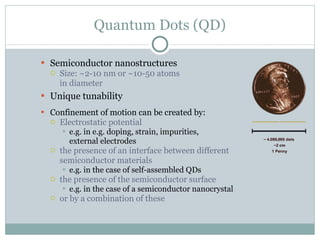
Quantum Dots (QD) Semiconductor nanostructures Size: ~2-10 nm or ~10-50 atoms  in diameter Unique tunability Confinement of motion can be created by: Electrostatic potential e.g. in e.g. doping, strain, impurities,  external electrodes the presence of an interface between different  semiconductor materials e.g. in the case of self-assembled QDs the presence of the semiconductor surface e.g. in the case of a semiconductor nanocrystal or by a combination of these
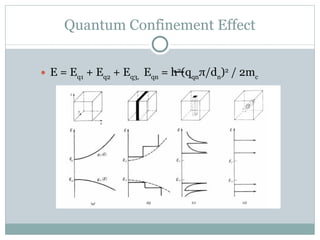
Quantum Confinement Effect E = E q1  + E q2  + E q3,  E qn  = h 2 (q qn π/d n ) 2  / 2m c  Quantization of density of states: (a) bulk (b) quantum well (c) quantum wire (d) QD
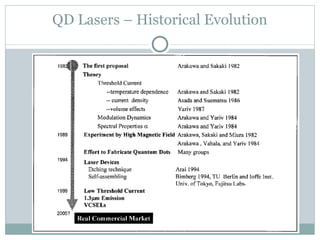
QD Lasers – Historical Evolution
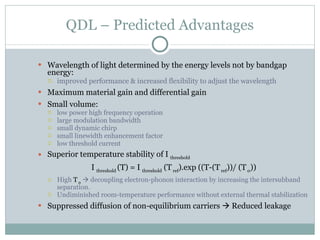
QDL – Predicted Advantages Wavelength of light determined by the energy levels not by bandgap energy: improved performance & increased flexibility to adjust the wavelength Maximum material gain and differential gain   Small volume: low power high frequency operation  large modulation bandwidth small dynamic chirp small linewidth enhancement factor low threshold current Superior temperature stability of  I  threshold   I  threshold  (T) = I  threshold  (T  ref ).exp ((T-(T  ref ))/ (T  0 ))   High  T  0     decoupling electron-phonon interaction by increasing the intersubband separation.  Undiminished room-temperature performance without external thermal stabilization   Suppressed diffusion of non-equilibrium carriers    Reduced leakage
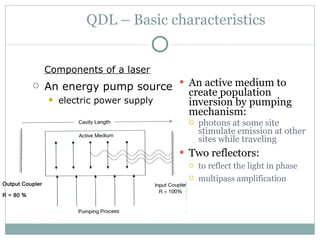
QDL – Basic characteristics An active medium to create population inversion by pumping mechanism:   photons at some site stimulate emission at other sites while traveling Two reflectors: to reflect the light in phase multipass amplification   Components of a laser An energy pump source   electric power supply
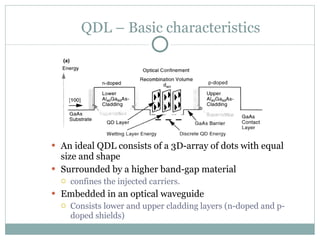
QDL – Basic characteristics An ideal QDL consists of a 3D-array of dots with equal size and shape Surrounded by a higher band-gap material  confines the injected carriers.  Embedded in an optical waveguide  Consists lower and upper cladding layers (n-doped and p-doped shields)
QDL – Application Requirements Same energy level Size, shape and alloy composition of QDs close to identical Inhomogeneous broadening eliminated    real concentration of energy states obtained High density of interacting QDs Macroscopic physical parameter    light output Reduction of non-radiative centers Nanostructures made by high-energy beam patterning cannot be used since damage is incurred  Electrical control  Electric field applied can change physical properties of QDs  Carriers can be injected to create light emission
Q. Dot Laser vs. Q. Well Laser In order for QD lasers compete with QW lasers:  A large array of QDs since their active volume is small An array with a narrow size distribution has to be produced to reduce inhomogeneous broadening Array has to be without defects  may degrade the optical emission by providing alternate nonradiative defect channels The phonon bottleneck created by confinement limits the number of states that are efficiently coupled by phonons due to energy conservation  Limits the relaxation of excited carriers into lasing states Causes degradation of stimulated emission  Other mechanisms can be used to suppress that bottleneck effect (e.g. Auger interactions)
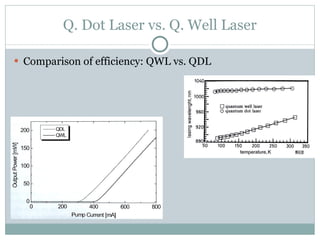
Q. Dot Laser vs. Q. Well Laser Comparison of efficiency: QWL vs. QDL
Comparison High speed quantum dot lasers Advantages Directly Modulated Quantum Dot Lasers Datacom application Rate of 10Gb/s Mode-Locked Quantum Dot Lasers Short optical pulses Narrow spectral width Broad gain spectrum InP Based Quantum Dot Lasers   Low emission wavelength Wide temperature range Used for data transmission
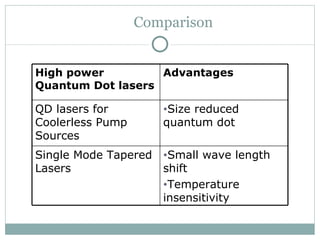
Comparison High power Quantum Dot lasers Advantages QD lasers for Coolerless Pump Sources Size reduced quantum dot Single Mode Tapered Lasers Small wave length shift Temperature insensitivity
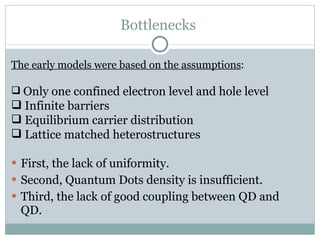
Bottlenecks  First, the lack of uniformity. Second, Quantum Dots density is insufficient. Third, the lack of good coupling between QD and QD.  The early models were based on the assumptions : Only one confined electron level and hole level Infinite barriers Equilibrium carrier distribution Lattice matched heterostructures
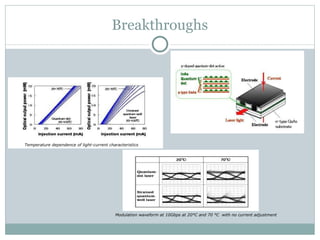
Breakthroughs Temperature dependence of light-current characteristics Modulation waveform at 10Gbps at 20°C and 70 °C  with no current adjustment
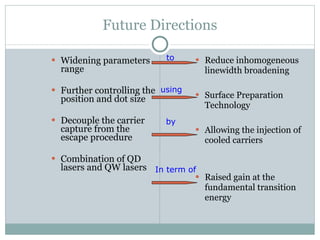
Future Directions Widening parameters range Further controlling the position and dot size  Decouple the carrier capture from the escape procedure Combination of QD lasers and QW lasers Reduce inhomogeneous linewidth broadening Surface Preparation Technology Allowing the injection of cooled carriers Raised gain at the fundamental transition energy  using by In term of to
Conclusion During the previous decade, there was an intensive interest on the development of quantum dot lasers. The unique properties of quantum dots allow QD lasers obtain several excellent properties and performances compared to traditional lasers and even QW lasers.  Although bottlenecks block the way of realizing quantum dot lasers to commercial markets, breakthroughs in the aspects of material and other properties will still keep the research area active in a few years.  According to the market demand and higher requirements of applications, future research directions are figured out and needed to be realized soon.
Thank you! Q & A

Quantum dot lasers

  • 1.
    Outline Quantum Dots(QD) Confinement Effect Quantum Dot Lasers (QDL) Historical Evolution Predicted Advantages Basic Characteristics Application Requirements Q. Dot Lasers vs. Q. Well Lasers Comparison of different types of QDLs Bottlenecks Breakthroughs Future Directions Conclusion
  • 2.
    Quantum Dots (QD)Semiconductor nanostructures Size: ~2-10 nm or ~10-50 atoms in diameter Unique tunability Confinement of motion can be created by: Electrostatic potential e.g. in e.g. doping, strain, impurities, external electrodes the presence of an interface between different semiconductor materials e.g. in the case of self-assembled QDs the presence of the semiconductor surface e.g. in the case of a semiconductor nanocrystal or by a combination of these
  • 3.
    Quantum Confinement EffectE = E q1 + E q2 + E q3, E qn = h 2 (q qn π/d n ) 2 / 2m c Quantization of density of states: (a) bulk (b) quantum well (c) quantum wire (d) QD
  • 4.
    QD Lasers –Historical Evolution
  • 5.
    QDL – PredictedAdvantages Wavelength of light determined by the energy levels not by bandgap energy: improved performance & increased flexibility to adjust the wavelength Maximum material gain and differential gain Small volume: low power high frequency operation large modulation bandwidth small dynamic chirp small linewidth enhancement factor low threshold current Superior temperature stability of I threshold I threshold (T) = I threshold (T ref ).exp ((T-(T ref ))/ (T 0 )) High T 0  decoupling electron-phonon interaction by increasing the intersubband separation. Undiminished room-temperature performance without external thermal stabilization Suppressed diffusion of non-equilibrium carriers  Reduced leakage
  • 6.
    QDL – Basiccharacteristics An active medium to create population inversion by pumping mechanism: photons at some site stimulate emission at other sites while traveling Two reflectors: to reflect the light in phase multipass amplification Components of a laser An energy pump source electric power supply
  • 7.
    QDL – Basiccharacteristics An ideal QDL consists of a 3D-array of dots with equal size and shape Surrounded by a higher band-gap material confines the injected carriers. Embedded in an optical waveguide Consists lower and upper cladding layers (n-doped and p-doped shields)
  • 8.
    QDL – ApplicationRequirements Same energy level Size, shape and alloy composition of QDs close to identical Inhomogeneous broadening eliminated  real concentration of energy states obtained High density of interacting QDs Macroscopic physical parameter  light output Reduction of non-radiative centers Nanostructures made by high-energy beam patterning cannot be used since damage is incurred Electrical control Electric field applied can change physical properties of QDs Carriers can be injected to create light emission
  • 9.
    Q. Dot Laservs. Q. Well Laser In order for QD lasers compete with QW lasers: A large array of QDs since their active volume is small An array with a narrow size distribution has to be produced to reduce inhomogeneous broadening Array has to be without defects may degrade the optical emission by providing alternate nonradiative defect channels The phonon bottleneck created by confinement limits the number of states that are efficiently coupled by phonons due to energy conservation Limits the relaxation of excited carriers into lasing states Causes degradation of stimulated emission Other mechanisms can be used to suppress that bottleneck effect (e.g. Auger interactions)
  • 10.
    Q. Dot Laservs. Q. Well Laser Comparison of efficiency: QWL vs. QDL
  • 11.
    Comparison High speedquantum dot lasers Advantages Directly Modulated Quantum Dot Lasers Datacom application Rate of 10Gb/s Mode-Locked Quantum Dot Lasers Short optical pulses Narrow spectral width Broad gain spectrum InP Based Quantum Dot Lasers Low emission wavelength Wide temperature range Used for data transmission
  • 12.
    Comparison High powerQuantum Dot lasers Advantages QD lasers for Coolerless Pump Sources Size reduced quantum dot Single Mode Tapered Lasers Small wave length shift Temperature insensitivity
  • 13.
    Bottlenecks First,the lack of uniformity. Second, Quantum Dots density is insufficient. Third, the lack of good coupling between QD and QD. The early models were based on the assumptions : Only one confined electron level and hole level Infinite barriers Equilibrium carrier distribution Lattice matched heterostructures
  • 14.
    Breakthroughs Temperature dependenceof light-current characteristics Modulation waveform at 10Gbps at 20°C and 70 °C with no current adjustment
  • 15.
    Future Directions Wideningparameters range Further controlling the position and dot size Decouple the carrier capture from the escape procedure Combination of QD lasers and QW lasers Reduce inhomogeneous linewidth broadening Surface Preparation Technology Allowing the injection of cooled carriers Raised gain at the fundamental transition energy using by In term of to
  • 16.
    Conclusion During theprevious decade, there was an intensive interest on the development of quantum dot lasers. The unique properties of quantum dots allow QD lasers obtain several excellent properties and performances compared to traditional lasers and even QW lasers. Although bottlenecks block the way of realizing quantum dot lasers to commercial markets, breakthroughs in the aspects of material and other properties will still keep the research area active in a few years. According to the market demand and higher requirements of applications, future research directions are figured out and needed to be realized soon.
  • 17.