Chapter 4: FIELD EFFECT TRANSISTOR
Advantages of FET over BJT
1. Unipolar device i. e. operation depends on only
one type of charge carriers (h or e)
2. Voltage controlled Device (gate voltage controls
drain current)
3. Very high input impedance (109-1012 )
4. Source and drain are interchangeable in most
Low-frequency applications
5. Low Voltage Low Current Operation is possible
(Low-power consumption)
6. Less Noisy as Compared to BJT
7. No minority carrier storage (Turn off is faster)
8. Very small in size, occupies very small space in
ICs
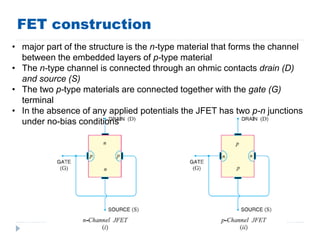
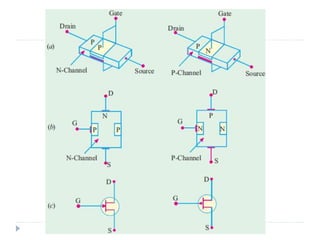
FET construction
• major part of the structure is the n-type material that forms the channel
between the embedded layers of p-type material
• The n-type channel is connected through an ohmic contacts drain (D)
and source (S)
• The two p-type materials are connected together with the gate (G)
terminal
• In the absence of any applied potentials the JFET has two p-n junctions
under no-bias conditions
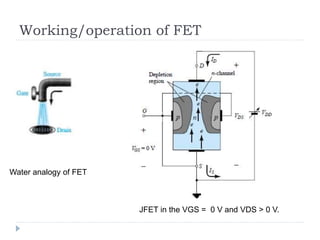
Working/operation of FET
Water analogy of FET
JFET in the VGS = 0 V and VDS > 0 V.
Salient Features of JFET
(i) A JFET is a three-terminal voltage-controlled semiconductor device i.e.
input voltage controls the output characteristics of JFET.
(ii) The JFET is always operated with gate-source pn junction *reverse biased.
(iii) In a JFET, the gate current is zero i.e. IG = 0A.
(iv) Since there is no gate current, ID = IS.
(v) The JFET must be operated between VGS and VGS (off). For this range of gate-
to-source voltages, ID will vary from a maximum of IDSS to a minimum of
almost zero.
(vi) Because the two gates are at the same potential, both depletion layers
widen or narrow down by an equal amount.
(vii) The JFET is not subjected to thermal runaway when the temperature of the
device increases.
(viii) The drain current ID is controlled by changing the channel width.
(ix) Since JFET has no gate current, there is no  rating of the device.
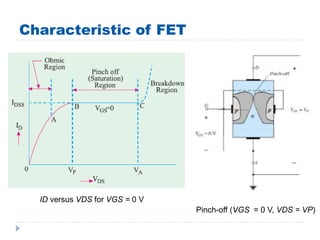
Characteristic of FET
ID versus VDS for VGS = 0 V
Pinch-off (VGS = 0 V, VDS = VP)
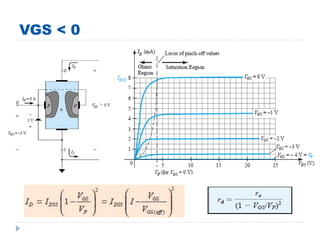
VGS < 0
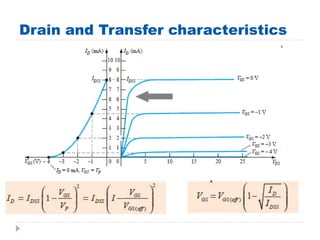
Drain and Transfer characteristics
Expression for Drain Current (ID)
The relation between IDSS and VP is shown in Fig.
We note that gate-source cut off voltage [i.e.VGS (off)] on the transfer characteristic is
equal to pinch off voltage VP on the drain characteristic i.e.
The transfer characteristic of JFET shown in Fig. is part of a parabola. A rather
complex mathematical analysis yields the following expression for drain current :
Advantages of JFET
 A JFET is a voltage controlled, constant current device (similar to a vacuum
pentode) in which variations in input voltage control the output current. It
combines the many advantages of both bipolar transistor and vacuum
pentode. Some of the advantages of a JFET are :
(i) It has a very high input impedance (of the order of 100 MΩ). This
permits high degree of isolation between the input and output circuits.
(ii)The operation of a JFET depends upon the bulk material current
carriers that do not cross junctions. Therefore, the inherent noise of
tubes (due to high-temperature operation) and those of transistors (due
to junction transitions) are not present in a JFET.
(iii)A JFET has a negative temperature co-efficient of resistance. This
avoids the risk of thermal runaway.
(iv)A JFET has a very high power gain. This eliminates the necessity of
using driver stages.
(v)A JFET has a smaller size, longer life and high efficiency.
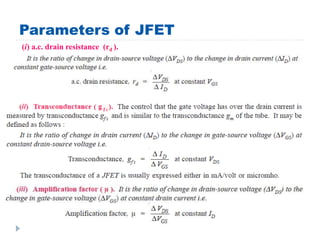
Parameters of JFET
(i) a.c. drain resistance (rd ).
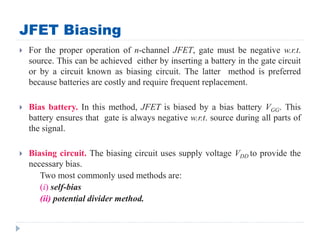
JFET Biasing
 For the proper operation of n-channel JFET, gate must be negative w.r.t.
source. This can be achieved either by inserting a battery in the gate circuit
or by a circuit known as biasing circuit. The latter method is preferred
because batteries are costly and require frequent replacement.
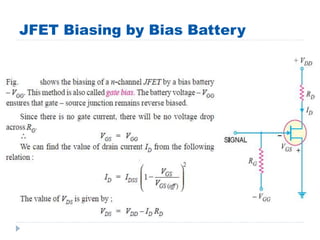
 Bias battery. In this method, JFET is biased by a bias battery VGG. This
battery ensures that gate is always negative w.r.t. source during all parts of
the signal.
 Biasing circuit. The biasing circuit uses supply voltage VDD to provide the
necessary bias.
Two most commonly used methods are:
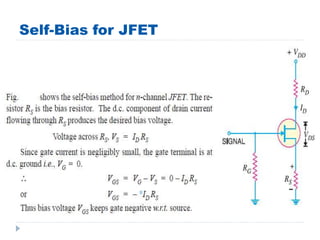
(i) self-bias
(ii) potential divider method.
JFET Biasing by Bias Battery
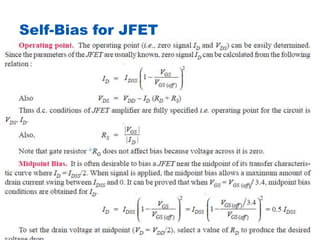
Self-Bias for JFET
Self-Bias for JFET
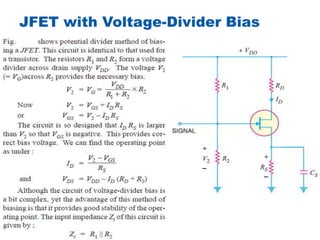
JFET with Voltage-Divider Bias
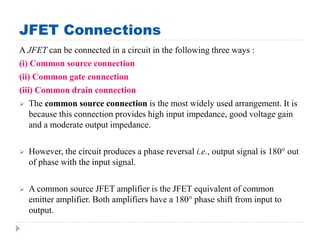
JFET Connections
A JFET can be connected in a circuit in the following three ways :
(i) Common source connection
(ii) Common gate connection
(iii) Common drain connection
 The common source connection is the most widely used arrangement. It is
because this connection provides high input impedance, good voltage gain
and a moderate output impedance.
 However, the circuit produces a phase reversal i.e., output signal is 180° out
of phase with the input signal.
 A common source JFET amplifier is the JFET equivalent of common
emitter amplifier. Both amplifiers have a 180° phase shift from input to
output.
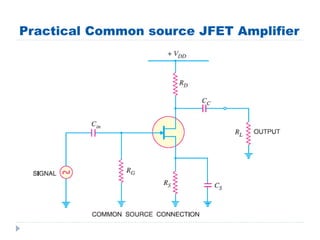
Practical Common source JFET Amplifier
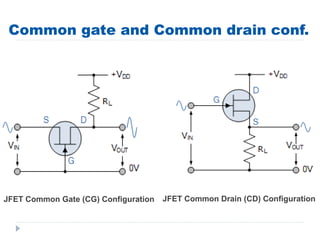
Common gate and Common drain conf.
JFET Common Gate (CG) Configuration JFET Common Drain (CD) Configuration
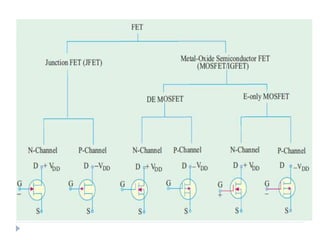
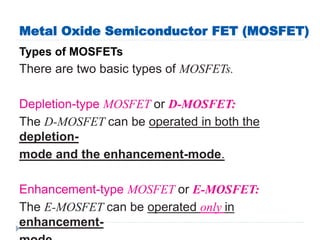
Metal Oxide Semiconductor FET (MOSFET)
Types of MOSFETs
There are two basic types of MOSFETs.
Depletion-type MOSFET or D-MOSFET:
The D-MOSFET can be operated in both the
depletion-
mode and the enhancement-mode.
Enhancement-type MOSFET or E-MOSFET:
The E-MOSFET can be operated only in
enhancement-
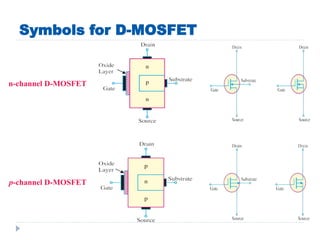
Symbols for D-MOSFET
n-channel D-MOSFET
p-channel D-MOSFET
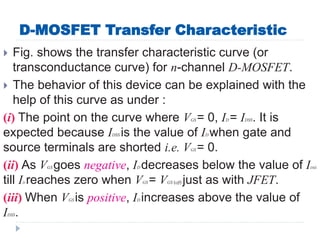
D-MOSFET Transfer Characteristic
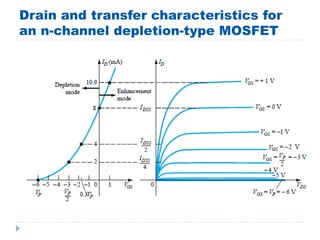
 Fig. shows the transfer characteristic curve (or
transconductance curve) for n-channel D-MOSFET.
 The behavior of this device can be explained with the
help of this curve as under :
(i) The point on the curve where VGS = 0, ID = IDSS. It is
expected because IDSS is the value of ID when gate and
source terminals are shorted i.e. VGS = 0.
(ii) As VGS goes negative, ID decreases below the value of IDSS
till ID reaches zero when VGS = VGS (off) just as with JFET.
(iii) When VGS is positive, ID increases above the value of
IDSS.
Drain and transfer characteristics for
an n-channel depletion-type MOSFET
D-MOSFET Transfer Characteristic
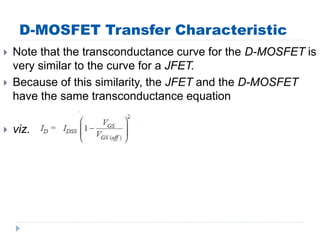
 Note that the transconductance curve for the D-MOSFET is
very similar to the curve for a JFET.
 Because of this similarity, the JFET and the D-MOSFET
have the same transconductance equation
 viz.
E-MOSFET
 Two things are worth noting about E-MOSFET.
 First, E-MOSFET operates only in the enhancement
mode and has no depletion mode.
 Secondly, the E-MOSFET has no physical channel
from source to drain.
 The minimum value of VGS of proper polarity that
turns on the E-MOSFET is called Threshold voltage
[VGS (th)].
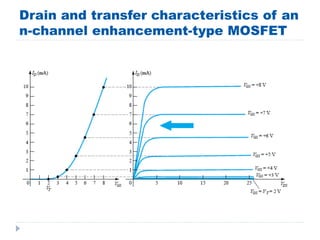
Drain and transfer characteristics of an
n-channel enhancement-type MOSFET
E-MOSFET
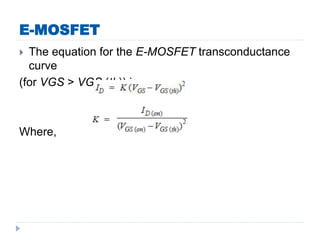
 The equation for the E-MOSFET transconductance
curve
(for VGS > VGS (th)) is
Where,
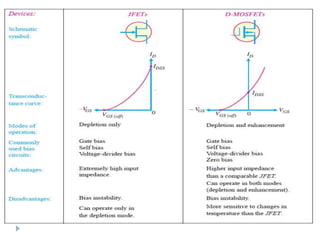
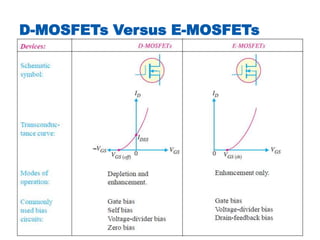
D-MOSFETs Versus E-MOSFETs
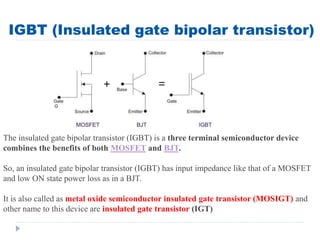
IGBT (Insulated gate bipolar transistor)
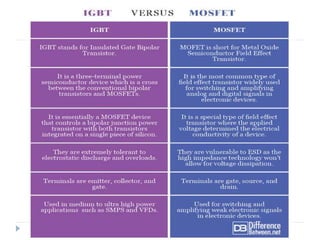
The insulated gate bipolar transistor (IGBT) is a three terminal semiconductor device
combines the benefits of both MOSFET and BJT.
So, an insulated gate bipolar transistor (IGBT) has input impedance like that of a MOSFET
and low ON state power loss as in a BJT.
It is also called as metal oxide semiconductor insulated gate transistor (MOSIGT) and
other name to this device are insulated gate transistor (IGT)
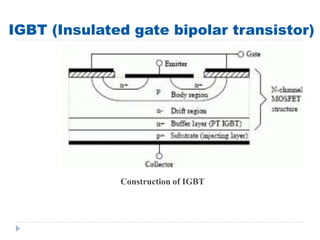
IGBT (Insulated gate bipolar transistor)
Construction of IGBT
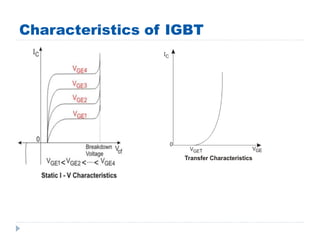
Characteristics of IGBT
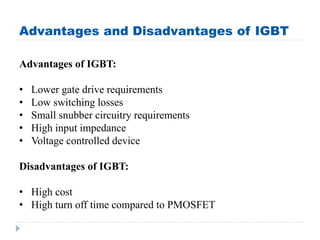
Advantages and Disadvantages of IGBT
Advantages of IGBT:
• Lower gate drive requirements
• Low switching losses
• Small snubber circuitry requirements
• High input impedance
• Voltage controlled device
Disadvantages of IGBT:
• High cost
• High turn off time compared to PMOSFET
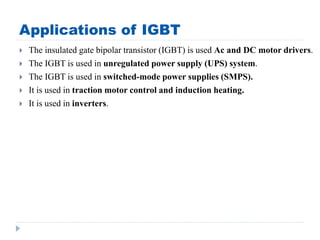
Applications of IGBT
 The insulated gate bipolar transistor (IGBT) is used Ac and DC motor drivers.
 The IGBT is used in unregulated power supply (UPS) system.
 The IGBT is used in switched-mode power supplies (SMPS).
 It is used in traction motor control and induction heating.
 It is used in inverters.
Thanks

Chapter-4 FET (1).ppt

  • 1.
    Chapter 4: FIELDEFFECT TRANSISTOR
  • 2.
    Advantages of FETover BJT 1. Unipolar device i. e. operation depends on only one type of charge carriers (h or e) 2. Voltage controlled Device (gate voltage controls drain current) 3. Very high input impedance (109-1012 ) 4. Source and drain are interchangeable in most Low-frequency applications 5. Low Voltage Low Current Operation is possible (Low-power consumption) 6. Less Noisy as Compared to BJT 7. No minority carrier storage (Turn off is faster) 8. Very small in size, occupies very small space in ICs
  • 4.
    FET construction • majorpart of the structure is the n-type material that forms the channel between the embedded layers of p-type material • The n-type channel is connected through an ohmic contacts drain (D) and source (S) • The two p-type materials are connected together with the gate (G) terminal • In the absence of any applied potentials the JFET has two p-n junctions under no-bias conditions
  • 6.
    Working/operation of FET Wateranalogy of FET JFET in the VGS = 0 V and VDS > 0 V.
  • 7.
    Salient Features ofJFET (i) A JFET is a three-terminal voltage-controlled semiconductor device i.e. input voltage controls the output characteristics of JFET. (ii) The JFET is always operated with gate-source pn junction *reverse biased. (iii) In a JFET, the gate current is zero i.e. IG = 0A. (iv) Since there is no gate current, ID = IS. (v) The JFET must be operated between VGS and VGS (off). For this range of gate- to-source voltages, ID will vary from a maximum of IDSS to a minimum of almost zero. (vi) Because the two gates are at the same potential, both depletion layers widen or narrow down by an equal amount. (vii) The JFET is not subjected to thermal runaway when the temperature of the device increases. (viii) The drain current ID is controlled by changing the channel width. (ix) Since JFET has no gate current, there is no  rating of the device.
  • 8.
    Characteristic of FET IDversus VDS for VGS = 0 V Pinch-off (VGS = 0 V, VDS = VP)
  • 9.
  • 10.
    Drain and Transfercharacteristics
  • 11.
    Expression for DrainCurrent (ID) The relation between IDSS and VP is shown in Fig. We note that gate-source cut off voltage [i.e.VGS (off)] on the transfer characteristic is equal to pinch off voltage VP on the drain characteristic i.e. The transfer characteristic of JFET shown in Fig. is part of a parabola. A rather complex mathematical analysis yields the following expression for drain current :
  • 12.
    Advantages of JFET A JFET is a voltage controlled, constant current device (similar to a vacuum pentode) in which variations in input voltage control the output current. It combines the many advantages of both bipolar transistor and vacuum pentode. Some of the advantages of a JFET are : (i) It has a very high input impedance (of the order of 100 MΩ). This permits high degree of isolation between the input and output circuits. (ii)The operation of a JFET depends upon the bulk material current carriers that do not cross junctions. Therefore, the inherent noise of tubes (due to high-temperature operation) and those of transistors (due to junction transitions) are not present in a JFET. (iii)A JFET has a negative temperature co-efficient of resistance. This avoids the risk of thermal runaway. (iv)A JFET has a very high power gain. This eliminates the necessity of using driver stages. (v)A JFET has a smaller size, longer life and high efficiency.
  • 13.
    Parameters of JFET (i)a.c. drain resistance (rd ).
  • 14.
    JFET Biasing  Forthe proper operation of n-channel JFET, gate must be negative w.r.t. source. This can be achieved either by inserting a battery in the gate circuit or by a circuit known as biasing circuit. The latter method is preferred because batteries are costly and require frequent replacement.  Bias battery. In this method, JFET is biased by a bias battery VGG. This battery ensures that gate is always negative w.r.t. source during all parts of the signal.  Biasing circuit. The biasing circuit uses supply voltage VDD to provide the necessary bias. Two most commonly used methods are: (i) self-bias (ii) potential divider method.
  • 15.
    JFET Biasing byBias Battery
  • 16.
  • 17.
  • 18.
  • 19.
    JFET Connections A JFETcan be connected in a circuit in the following three ways : (i) Common source connection (ii) Common gate connection (iii) Common drain connection  The common source connection is the most widely used arrangement. It is because this connection provides high input impedance, good voltage gain and a moderate output impedance.  However, the circuit produces a phase reversal i.e., output signal is 180° out of phase with the input signal.  A common source JFET amplifier is the JFET equivalent of common emitter amplifier. Both amplifiers have a 180° phase shift from input to output.
  • 20.
  • 21.
    Common gate andCommon drain conf. JFET Common Gate (CG) Configuration JFET Common Drain (CD) Configuration
  • 22.
    Metal Oxide SemiconductorFET (MOSFET) Types of MOSFETs There are two basic types of MOSFETs. Depletion-type MOSFET or D-MOSFET: The D-MOSFET can be operated in both the depletion- mode and the enhancement-mode. Enhancement-type MOSFET or E-MOSFET: The E-MOSFET can be operated only in enhancement-
  • 23.
    Symbols for D-MOSFET n-channelD-MOSFET p-channel D-MOSFET
  • 24.
    D-MOSFET Transfer Characteristic Fig. shows the transfer characteristic curve (or transconductance curve) for n-channel D-MOSFET.  The behavior of this device can be explained with the help of this curve as under : (i) The point on the curve where VGS = 0, ID = IDSS. It is expected because IDSS is the value of ID when gate and source terminals are shorted i.e. VGS = 0. (ii) As VGS goes negative, ID decreases below the value of IDSS till ID reaches zero when VGS = VGS (off) just as with JFET. (iii) When VGS is positive, ID increases above the value of IDSS.
  • 25.
    Drain and transfercharacteristics for an n-channel depletion-type MOSFET
  • 26.
    D-MOSFET Transfer Characteristic Note that the transconductance curve for the D-MOSFET is very similar to the curve for a JFET.  Because of this similarity, the JFET and the D-MOSFET have the same transconductance equation  viz.
  • 28.
    E-MOSFET  Two thingsare worth noting about E-MOSFET.  First, E-MOSFET operates only in the enhancement mode and has no depletion mode.  Secondly, the E-MOSFET has no physical channel from source to drain.  The minimum value of VGS of proper polarity that turns on the E-MOSFET is called Threshold voltage [VGS (th)].
  • 29.
    Drain and transfercharacteristics of an n-channel enhancement-type MOSFET
  • 30.
    E-MOSFET  The equationfor the E-MOSFET transconductance curve (for VGS > VGS (th)) is Where,
  • 31.
  • 32.
    IGBT (Insulated gatebipolar transistor) The insulated gate bipolar transistor (IGBT) is a three terminal semiconductor device combines the benefits of both MOSFET and BJT. So, an insulated gate bipolar transistor (IGBT) has input impedance like that of a MOSFET and low ON state power loss as in a BJT. It is also called as metal oxide semiconductor insulated gate transistor (MOSIGT) and other name to this device are insulated gate transistor (IGT)
  • 33.
    IGBT (Insulated gatebipolar transistor) Construction of IGBT
  • 34.
  • 35.
    Advantages and Disadvantagesof IGBT Advantages of IGBT: • Lower gate drive requirements • Low switching losses • Small snubber circuitry requirements • High input impedance • Voltage controlled device Disadvantages of IGBT: • High cost • High turn off time compared to PMOSFET
  • 36.
    Applications of IGBT The insulated gate bipolar transistor (IGBT) is used Ac and DC motor drivers.  The IGBT is used in unregulated power supply (UPS) system.  The IGBT is used in switched-mode power supplies (SMPS).  It is used in traction motor control and induction heating.  It is used in inverters.
  • 38.