Types of Experimental Research
Designs
Joshiah Jephtan P. Gula, BS CS - 1
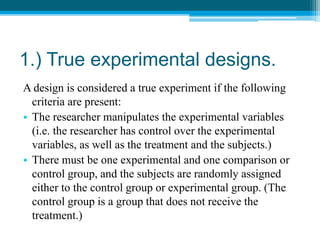
1.) True experimental designs.
A design is considered a true experiment if the following
criteria are present:
• The researcher manipulates the experimental variables
(i.e. the researcher has control over the experimental
variables, as well as the treatment and the subjects.)
• There must be one experimental and one comparison or
control group, and the subjects are randomly assigned
either to the control group or experimental group. (The
control group is a group that does not receive the
treatment.)
a.) Pretest-posttest controlled group design
i. Subjects are randomly assigned to groups.
ii. A pretest is given to both groups.
iii. The experimental group receives the treatment while the
control group does not.
iv. A posttest is given to both groups.
The procedure is summarized as follows:
R O1 X O2 (experimental group)
R O1 O2 (control group)
Where: R stands for random selection
O1 stands for pretest
O2 stands for posttest
X stands for intervention
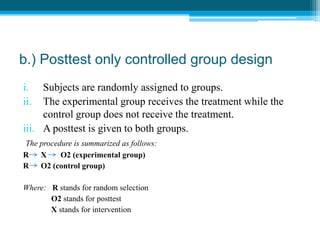
b.) Posttest only controlled group design
i. Subjects are randomly assigned to groups.
ii. The experimental group receives the treatment while the
control group does not receive the treatment.
iii. A posttest is given to both groups.
The procedure is summarized as follows:
R X O2 (experimental group)
R O2 (control group)
Where: R stands for random selection
O2 stands for posttest
X stands for intervention
c.) Solomon four-group design
It is considered as the most prestigious experimental design. It
minimizes threats to both internal and external validity.
i. Subjects are randomly assigned to one or four groups.
ii. Two of the groups (experimental group 1 and control group 1) are pretested.
iii. The other two groups (experimental group 2 and control group 2) receive
routine or no treatment.
iv. A posttest is given to all four groups.
The procedure is summarized as follows:
R O1 X O2 (experimental group)
R O1 O2 (control group)
R X O2 (experimental group)
R O2 (control group)
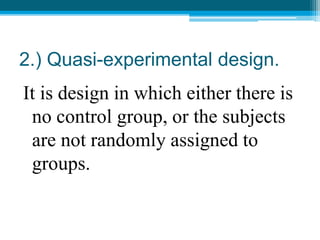
2.) Quasi-experimental design.
It is design in which either there is
no control group, or the subjects
are not randomly assigned to
groups.
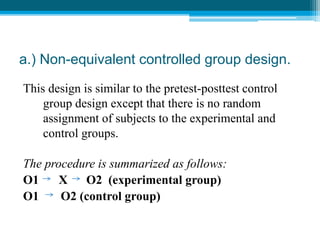
a.) Non-equivalent controlled group design.
This design is similar to the pretest-posttest control
group design except that there is no random
assignment of subjects to the experimental and
control groups.
The procedure is summarized as follows:
O1 X O2 (experimental group)
O1 O2 (control group)
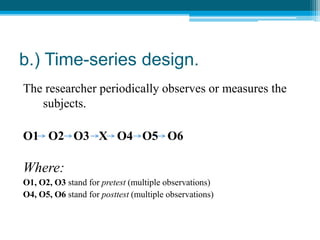
b.) Time-series design.
The researcher periodically observes or measures the
subjects.
O1 O2 O3 X O4 O5 O6
Where:
O1, O2, O3 stand for pretest (multiple observations)
O4, O5, O6 stand for posttest (multiple observations)
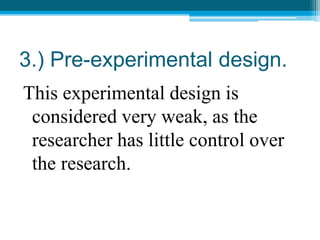
3.) Pre-experimental design.
This experimental design is
considered very weak, as the
researcher has little control over
the research.
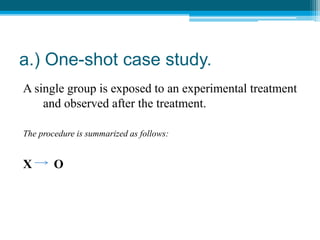
a.) One-shot case study.
A single group is exposed to an experimental treatment
and observed after the treatment.
The procedure is summarized as follows:
X O
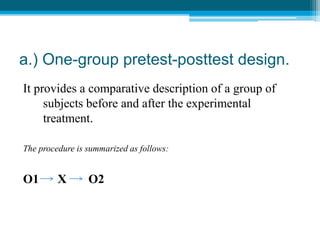
a.) One-group pretest-posttest design.
It provides a comparative description of a group of
subjects before and after the experimental
treatment.
The procedure is summarized as follows:
O1 X O2

Types of experimental research designs

  • 1.
    Types of ExperimentalResearch Designs Joshiah Jephtan P. Gula, BS CS - 1
  • 2.
    1.) True experimentaldesigns. A design is considered a true experiment if the following criteria are present: • The researcher manipulates the experimental variables (i.e. the researcher has control over the experimental variables, as well as the treatment and the subjects.) • There must be one experimental and one comparison or control group, and the subjects are randomly assigned either to the control group or experimental group. (The control group is a group that does not receive the treatment.)
  • 3.
    a.) Pretest-posttest controlledgroup design i. Subjects are randomly assigned to groups. ii. A pretest is given to both groups. iii. The experimental group receives the treatment while the control group does not. iv. A posttest is given to both groups. The procedure is summarized as follows: R O1 X O2 (experimental group) R O1 O2 (control group) Where: R stands for random selection O1 stands for pretest O2 stands for posttest X stands for intervention
  • 4.
    b.) Posttest onlycontrolled group design i. Subjects are randomly assigned to groups. ii. The experimental group receives the treatment while the control group does not receive the treatment. iii. A posttest is given to both groups. The procedure is summarized as follows: R X O2 (experimental group) R O2 (control group) Where: R stands for random selection O2 stands for posttest X stands for intervention
  • 5.
    c.) Solomon four-groupdesign It is considered as the most prestigious experimental design. It minimizes threats to both internal and external validity. i. Subjects are randomly assigned to one or four groups. ii. Two of the groups (experimental group 1 and control group 1) are pretested. iii. The other two groups (experimental group 2 and control group 2) receive routine or no treatment. iv. A posttest is given to all four groups. The procedure is summarized as follows: R O1 X O2 (experimental group) R O1 O2 (control group) R X O2 (experimental group) R O2 (control group)
  • 6.
    2.) Quasi-experimental design. Itis design in which either there is no control group, or the subjects are not randomly assigned to groups.
  • 7.
    a.) Non-equivalent controlledgroup design. This design is similar to the pretest-posttest control group design except that there is no random assignment of subjects to the experimental and control groups. The procedure is summarized as follows: O1 X O2 (experimental group) O1 O2 (control group)
  • 8.
    b.) Time-series design. Theresearcher periodically observes or measures the subjects. O1 O2 O3 X O4 O5 O6 Where: O1, O2, O3 stand for pretest (multiple observations) O4, O5, O6 stand for posttest (multiple observations)
  • 9.
    3.) Pre-experimental design. Thisexperimental design is considered very weak, as the researcher has little control over the research.
  • 10.
    a.) One-shot casestudy. A single group is exposed to an experimental treatment and observed after the treatment. The procedure is summarized as follows: X O
  • 11.
    a.) One-group pretest-posttestdesign. It provides a comparative description of a group of subjects before and after the experimental treatment. The procedure is summarized as follows: O1 X O2