SAMPLE AND SAMPLE
SIZE
Presented by : Roshni Maurya
What is the need for statistics?
Generalization of the results
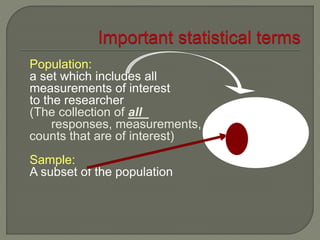
Population:
a set which includes all
measurements of interest
to the researcher
(The collection of all
responses, measurements, or
counts that are of interest)
Sample:
A subset of the population
Target Population:
The population to be studied/ to which the investigator wants to
generalize his results.
Sampling Unit:
Smallest unit from which sample can be selected.
Sampling frame
List of all the sampling units from which sample is drawn.
Sampling scheme
Method of selecting sampling units from sampling frame.
Get information about large populations
 Less costs
 Less field time
 More accuracy i.e. Can Do A Better Job of
Data Collection
 When it’s impossible to study the whole
population
1. Sampling makes possible the study of a
large, heterogeneous (different
characteristics) population.
- The universe or population to be studied
may be too large or unlimited that it is almost
impossible to reach all of them. Sampling
makes possible this kind of study because in
sampling only a small portion of the
population may be involved in the study,
enabling the researcher to reach all through
this small portion of the population.
2. Sampling is for economy.
- Research without sampling may be
too costly. Sampling reduces the study
population to a reasonable size that
expenses are greatly reduced.
3. Sampling is for speed.
- Research without sampling might be
too time consuming.
4. Sampling is for accuracy.
- If it takes too long a time to cover the
whole study population, there may be
inaccuracy. The research must be
finished within a reasonable period of
time so that the data are still true, valid
and reasonable.
5. Sampling saves the sources of
data from being all consumed.
- The act of gathering data may
consume all the sources of
information without sampling. In
such a case, there is no more data
to apply the conclusion to.
1. If sampling is biased, or not
representative, or too small, the
conclusion may not be valid and reliable.
2. In research, the respondents to a study
must have a common characteristics
which is the basis of the study.
3. If the population is very large and there
are many sections and subsections, the
sampling procedure becomes very
complicated.
4. If the researcher does not possess the
necessary skill and technical knowhow in
sampling procedure.
 The sample must be valid.
Validity depends on 2 considerations:
1. Accuracy – bias is absent from the sample
2. Precision – sample represents the
population
Actual sample selection can be
accomplished in 2 basic ways:
Purposive selection
Random selection
Depending upon the type ; nature of
population ; objectives of investigation;
some commonly used designs are :
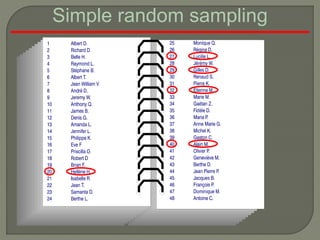
 Simple random sampling;
 Systematic random sampling;
 Stratified random sampling;
 Cluster sampling;
 Multiphase sampling;
 Pathfinder surveys;
 this type of sampling is one in which each
and every unit in the population of the
inquiry has an equal chance of being
selected ; to be included in the sample.
Selection of unit is determined by chance
only.
o To ensure randomness, foll. methods
are chosen:
Lottery method.
Table of Random Numbers.
Simple random sampling
6 8 4 2 5 7 9 5 4 1 2 5 6 3 2 1 4 0
5 8 2 0 3 2 1 5 4 7 8 5 9 6 2 0 2 4
3 6 2 3 3 3 2 5 4 7 8 9 1 2 0 3 2 5
9 8 5 2 6 3 0 1 7 4 2 4 5 0 3 6 8 6
 main advantage of this technique of sampling
is that, it is easy to understand and it is easy
to apply too, it assures randomness and
eliminates personal bias.
 disadvantage is that, it is hard to use with too
large a population as selection may be widely
spread that it enhances the cost and time to
collect data.
SYSTEMATIC RANDOM SAMPLING
 a technique of sampling in which every kth name in a
list may be selected to be included in a sample.
 also called as interval sampling, there is a gap or
interval, between each selected unit in the sample.
 Formed by selecting one unit at random and then
selecting additional units at evenly spaced interval till
sample of required size has been formed.
Sampling fraction
Ratio between sample size and population
size
This method may be selected to obtain a
sample out of pts attending OPD of dental
clinic.
Systematic sampling
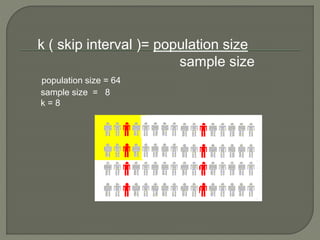
k ( skip interval )= population size
sample size
population size = 64
sample size = 8
k = 8
main advantage is that it is more
convenient, faster, and more economical
disadvantage is that it can be adopted as
long as there is no periodicity of
occurrence of any particular event in
population.
 the process of selecting randomly, samples from
the different strata of the population used in the
study.
 This means that a framework is laid down initially,
and the subjects of study in a random sample are
then allotted to compartments of framework.
 .
Ex: If it is decided to know prevalence of DMF
teeth in diff. age grps, then the age grps form the
strata and a random sample is to be chosen from
each stratum i.e, age grp.
ADVANTAGE:
contributes much to the representative of the
sample,
provides greater accuracy,
can conc. on wider geographical area.
LIMITATION:
Care of homogeneity in each stratum while dividing
population into strata.
 used when the population is so big or the
geographical area of the research is so
large.(population forms natural grps or clusters like
villages , wards block or children of school etc.)
 First a sample of clusters is selected and then all
units in each of selected clusters are surveyed.
 Advantage : Efficiency; less time and cost.
 Disadvantage: reduced accuracy or
representativeness, on the account of the fact that in
every stage there is a sampling error.
Section 4
Section 5
Section 3
Section 2Section 1
 In this, a part of information is collected
from the sample and a part from sub-
sample.
Adopted when interest is in any specific
disease.
Procedure is less costly; less laborious;
more purposeful.
o Method used is a stratified cluster
sampling technique ; includes most
Population subgroups likely to have
differing disease levels ; to cover a
standard number of subjects in specific
index age grp in any one location.
Method is suitable for foll. Situation :
Overall prevalence of various oral diseases
affecting the population.
 Imp. variations in disease level, severity and
need for treatment in subgroups of population
 To provide information about severity ,
progression of disease, to give an indication of
increasing/ decreasing levels.
An optimum size of sample is to be
considered on basis of foll. factors :
 An approximate idea of estimate of characteristics under
study and its variability from unit to unit in population.
 Knowledge about the precision of the estimate of
characteristic.
 Probability level within which the desired precision is to
be maintained.
 Availability of exp. material , resources and other
practical consideration.
 Sample size is calculated by the formula:
 n= Z2 * p * ( 1 – p )
 L2
Must result in a truly representative sample
Must result in small sampling errors
Must be viable in context of funds available for
the research study.
Must be such so that systematic bias can be
controlled in a better way.
33
• Evaluation of oral health status of a
community.
• Evaluation of health education on oral hygiene.
• Studies on administrative aspects of services like
availability and utilization of oral health facilitates
in the community.
• Advance data from surveys.
Biostatistics as a discipline is concerned with
inferring about the behaviour of a population given
evidence from a sample. Depending on the objective
of study any one of methods may be used to select
sample . At times several methods of sampling may
be used in the same study . Sample size has to be
decided before selection of sample.
Sample and sample size

Sample and sample size

  • 1.
  • 2.
    What is theneed for statistics? Generalization of the results
  • 3.
    Population: a set whichincludes all measurements of interest to the researcher (The collection of all responses, measurements, or counts that are of interest) Sample: A subset of the population
  • 4.
    Target Population: The populationto be studied/ to which the investigator wants to generalize his results. Sampling Unit: Smallest unit from which sample can be selected. Sampling frame List of all the sampling units from which sample is drawn. Sampling scheme Method of selecting sampling units from sampling frame.
  • 5.
    Get information aboutlarge populations  Less costs  Less field time  More accuracy i.e. Can Do A Better Job of Data Collection  When it’s impossible to study the whole population
  • 6.
    1. Sampling makespossible the study of a large, heterogeneous (different characteristics) population. - The universe or population to be studied may be too large or unlimited that it is almost impossible to reach all of them. Sampling makes possible this kind of study because in sampling only a small portion of the population may be involved in the study, enabling the researcher to reach all through this small portion of the population.
  • 7.
    2. Sampling isfor economy. - Research without sampling may be too costly. Sampling reduces the study population to a reasonable size that expenses are greatly reduced. 3. Sampling is for speed. - Research without sampling might be too time consuming.
  • 8.
    4. Sampling isfor accuracy. - If it takes too long a time to cover the whole study population, there may be inaccuracy. The research must be finished within a reasonable period of time so that the data are still true, valid and reasonable.
  • 9.
    5. Sampling savesthe sources of data from being all consumed. - The act of gathering data may consume all the sources of information without sampling. In such a case, there is no more data to apply the conclusion to.
  • 10.
    1. If samplingis biased, or not representative, or too small, the conclusion may not be valid and reliable. 2. In research, the respondents to a study must have a common characteristics which is the basis of the study.
  • 11.
    3. If thepopulation is very large and there are many sections and subsections, the sampling procedure becomes very complicated. 4. If the researcher does not possess the necessary skill and technical knowhow in sampling procedure.
  • 12.
     The samplemust be valid. Validity depends on 2 considerations: 1. Accuracy – bias is absent from the sample 2. Precision – sample represents the population
  • 13.
    Actual sample selectioncan be accomplished in 2 basic ways: Purposive selection Random selection
  • 14.
    Depending upon thetype ; nature of population ; objectives of investigation; some commonly used designs are :  Simple random sampling;  Systematic random sampling;  Stratified random sampling;  Cluster sampling;  Multiphase sampling;  Pathfinder surveys;
  • 15.
     this typeof sampling is one in which each and every unit in the population of the inquiry has an equal chance of being selected ; to be included in the sample. Selection of unit is determined by chance only. o To ensure randomness, foll. methods are chosen: Lottery method. Table of Random Numbers.
  • 16.
  • 17.
    6 8 42 5 7 9 5 4 1 2 5 6 3 2 1 4 0 5 8 2 0 3 2 1 5 4 7 8 5 9 6 2 0 2 4 3 6 2 3 3 3 2 5 4 7 8 9 1 2 0 3 2 5 9 8 5 2 6 3 0 1 7 4 2 4 5 0 3 6 8 6
  • 18.
     main advantageof this technique of sampling is that, it is easy to understand and it is easy to apply too, it assures randomness and eliminates personal bias.  disadvantage is that, it is hard to use with too large a population as selection may be widely spread that it enhances the cost and time to collect data.
  • 19.
    SYSTEMATIC RANDOM SAMPLING a technique of sampling in which every kth name in a list may be selected to be included in a sample.  also called as interval sampling, there is a gap or interval, between each selected unit in the sample.  Formed by selecting one unit at random and then selecting additional units at evenly spaced interval till sample of required size has been formed.
  • 20.
    Sampling fraction Ratio betweensample size and population size This method may be selected to obtain a sample out of pts attending OPD of dental clinic. Systematic sampling
  • 21.
    k ( skipinterval )= population size sample size population size = 64 sample size = 8 k = 8
  • 22.
    main advantage isthat it is more convenient, faster, and more economical disadvantage is that it can be adopted as long as there is no periodicity of occurrence of any particular event in population.
  • 23.
     the processof selecting randomly, samples from the different strata of the population used in the study.  This means that a framework is laid down initially, and the subjects of study in a random sample are then allotted to compartments of framework.  .
  • 24.
    Ex: If itis decided to know prevalence of DMF teeth in diff. age grps, then the age grps form the strata and a random sample is to be chosen from each stratum i.e, age grp. ADVANTAGE: contributes much to the representative of the sample, provides greater accuracy, can conc. on wider geographical area. LIMITATION: Care of homogeneity in each stratum while dividing population into strata.
  • 25.
     used whenthe population is so big or the geographical area of the research is so large.(population forms natural grps or clusters like villages , wards block or children of school etc.)  First a sample of clusters is selected and then all units in each of selected clusters are surveyed.  Advantage : Efficiency; less time and cost.  Disadvantage: reduced accuracy or representativeness, on the account of the fact that in every stage there is a sampling error.
  • 26.
    Section 4 Section 5 Section3 Section 2Section 1
  • 27.
     In this,a part of information is collected from the sample and a part from sub- sample. Adopted when interest is in any specific disease. Procedure is less costly; less laborious; more purposeful.
  • 28.
    o Method usedis a stratified cluster sampling technique ; includes most Population subgroups likely to have differing disease levels ; to cover a standard number of subjects in specific index age grp in any one location.
  • 29.
    Method is suitablefor foll. Situation : Overall prevalence of various oral diseases affecting the population.  Imp. variations in disease level, severity and need for treatment in subgroups of population  To provide information about severity , progression of disease, to give an indication of increasing/ decreasing levels.
  • 30.
    An optimum sizeof sample is to be considered on basis of foll. factors :  An approximate idea of estimate of characteristics under study and its variability from unit to unit in population.  Knowledge about the precision of the estimate of characteristic.  Probability level within which the desired precision is to be maintained.
  • 31.
     Availability ofexp. material , resources and other practical consideration.  Sample size is calculated by the formula:  n= Z2 * p * ( 1 – p )  L2
  • 32.
    Must result ina truly representative sample Must result in small sampling errors Must be viable in context of funds available for the research study. Must be such so that systematic bias can be controlled in a better way.
  • 33.
  • 34.
    • Evaluation oforal health status of a community. • Evaluation of health education on oral hygiene. • Studies on administrative aspects of services like availability and utilization of oral health facilitates in the community. • Advance data from surveys.
  • 35.
    Biostatistics as adiscipline is concerned with inferring about the behaviour of a population given evidence from a sample. Depending on the objective of study any one of methods may be used to select sample . At times several methods of sampling may be used in the same study . Sample size has to be decided before selection of sample.