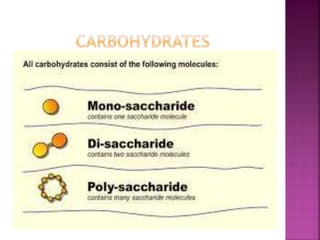
Carbohydrates are organic
compound consisting of carbon,
hydrogen, and oxygen where the
proportion of hydrogen atoms to
oxygen atom is two to one.
 The role of carbohydrate is to provide energy,
as they are the body’s main source of fuel,
needed for physical activity, brain function and
operation of the organs. All the cell and
tissues in your body need carbs,and they are
also important to internal health and waste
elimination.
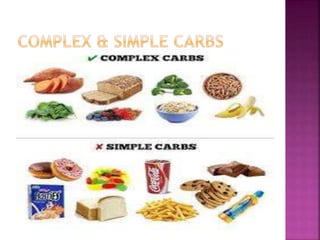
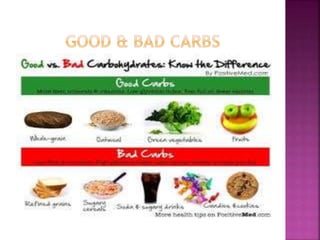
 Simple Carbohydrates
– consist of monosaccharide, the most
basic unit of carbohydrate.
 Complex Carbohydrates
– consist of polysaccharides.
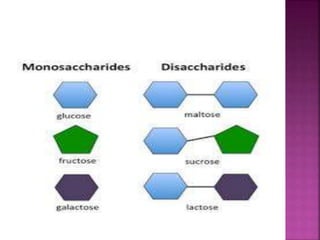
 Monosaccharide's – are the building
blocks of more complex forms of sugars.
 Glucose (dextrose)
– carbohydrate form used by the body,
referred to as “blood sugar”
 Galactose
 – combines with glucose to form lactose,
“milk sugar”
 Fructose
 - sweetest of the sugars
 - occurs naturally in fruits & honey, “fruit
sugar”
 - combines with glucose to form sucrose
 Disaccharides – when two monosaccharide
molecules bond together.
 sucrose
 lactose
 maltose
 Polysaccharides – consist of a number of
sugar molecules bounded together.
 starch
 cellulose
 glycogen
Carbohydrates
Carbohydrates

Carbohydrates

  • 2.
    Carbohydrates are organic compoundconsisting of carbon, hydrogen, and oxygen where the proportion of hydrogen atoms to oxygen atom is two to one.
  • 3.
     The roleof carbohydrate is to provide energy, as they are the body’s main source of fuel, needed for physical activity, brain function and operation of the organs. All the cell and tissues in your body need carbs,and they are also important to internal health and waste elimination.
  • 4.
     Simple Carbohydrates –consist of monosaccharide, the most basic unit of carbohydrate.  Complex Carbohydrates – consist of polysaccharides.
  • 7.
     Monosaccharide's –are the building blocks of more complex forms of sugars.  Glucose (dextrose) – carbohydrate form used by the body, referred to as “blood sugar”
  • 8.
     Galactose  –combines with glucose to form lactose, “milk sugar”  Fructose  - sweetest of the sugars  - occurs naturally in fruits & honey, “fruit sugar”  - combines with glucose to form sucrose
  • 9.
     Disaccharides –when two monosaccharide molecules bond together.  sucrose  lactose  maltose
  • 10.
     Polysaccharides –consist of a number of sugar molecules bounded together.  starch  cellulose  glycogen