Genetic Disorders /Diseases
Presenter: Psyche Arnoco
• Congenital Adrenal Hyperplasia
• Galactosemia
Congenital Adrenal Hyperplasia (CAH)
Congenital - present from birth
Adrenal - denoting a pair of ductless glands
situated above the kidneys.
Hyperplasia - the enlargement of an organ or
tissue caused by an increase in the
reproduction rate of its cells, often as an initial
stage in the development of cancer.
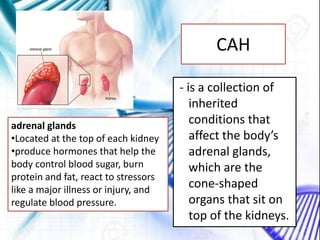
CAH
- is a collection of
inherited
conditions that
affect the body’s
adrenal glands,
which are the
cone-shaped
organs that sit on
top of the kidneys.
adrenal glands
•Located at the top of each kidney
•produce hormones that help the
body control blood sugar, burn
protein and fat, react to stressors
like a major illness or injury, and
regulate blood pressure.
• What are hormones?
Hormones are chemical messengers that are secreted
directly into the blood, which carries them to organs and
tissues of the body to exert their functions. There are many
types of hormones that act on different aspects of bodily
functions and processes.
• What is an enzyme?
a substance that acts as a catalyst in living organisms,
regulating the rate at which chemical reactions proceed
without itself being altered in the process.
Hormones in the adrenal glands that are
affected:
Cortisol
• Involved in the regulation of metabolism in cells
• also help us regulate various stressors in the body
Aldosterone
• affects the body's ability to regulate blood pressure.
• It sends the signal to organs, like the kidney and
colon, that can increase the amount of sodium the
body sends into the bloodstream or the amount of
potassium released in the urine.
Hormones in the adrenal glands that are
affected:
Androgens
• Androgens are a group of chemically related sex
steroid hormones. Steroids are a special kind of fat
molecule with a four-ringed, carbon atom backbone
or core, like their cholesterol predecessor.
• Say the word androgen and most people think male. Indeed,
they are dubbed the male hormones mainly because males
make and use more testosterone and other androgens than
females
• In CAH, the body is missing an enzyme (chemical substance)
that helps the adrenal glands to release the hormones. As a
result hormones cannot be produced.
• The brain then detects low level of hormones and tries to send
signals to the adrenal gland to work harder. However, this
mechanism is futile because of the absence of the enzyme
needed to stimulate the adrenal glands to release the hormone
• As a result, the adrenals grow in size.
• With the adrenals working harder, but still unable to make the
hormones, more of the sex hormones are made instead.
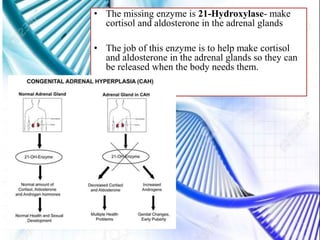
• The missing enzyme is 21-Hydroxylase- make
cortisol and aldosterone in the adrenal glands
• The job of this enzyme is to help make cortisol
and aldosterone in the adrenal glands so they can
be released when the body needs them.
Causes of CAH
• In 95 percent of cases, the enzyme lacking in
congenital adrenal hyperplasia is 21-
hydroxylase. CAH may sometimes be called
21-hydroxylase deficiency.
• CAH is passed along in an inheritance pattern
called autosomal recessive. Children who have
the condition have two parents who either have
CAH themselves or who are both carriers of
the genetic mutation that causes the condition.
• What causes the 21-hydroxylase enzyme to
be absent or not working correctly?
Genes tell the body to make various enzymes.
People with CAH have a pair of genes that do
not work correctly. Because of the changes in
this pair of genes, the 21-OH enzyme either
does not work properly or is not made at all.
A child with classic CAH may experience:
• A lack in the production of cortisol in both the
salt-losing and simple-virilizing forms.
• A lack in the production of aldosterone in the salt-
losing form.
• Excess production of the male sex hormones
(androgens such as testosterone).
two major types of congenital adrenal
hyperplasia:
• Classic CAH. This more-severe form of the
disease is usually detected in infancy.
- Salt-wasting
- Simple-virilizing
• Nonclassic CAH. This milder and more
common form may not become evident until
childhood or early adulthood.
Salt-wasting Classic CAH
Salt-wasting classic CAH
• 75% of classic CAH cases.
• This is the most severe form. Signs of salt-wasting CAH
usually begin within the first few weeks of life.
• These signs include:
* Poor feeding * Sleeping longer or more often
* Tiredness * Vomiting
* Diarrhea *Irritability
* Rapid heart rate * Male-like genitals in females
* Weight loss
Simple-virilizing classic CAH
• 25% of classic CAH cases.
• less severe than salt-wasting CAH, but more severe than
non-classic CAH.
• Signs begin before birth.
• These signs differ between males and females, which
usually become apparent during childhood due to early
puberty.
• Early signs of simple-virilizing CAH include:
– Enlarged clitoris (it may look like a small penis)
– Labia that are fused together (they may resemble a scrotum)
– Small testicles
Simple-virilizing Classic CAH
Non – classic CAH
Non-classic CAH is much less severe than classic forms of
CAH. Signs of non-classic CAH can begin in childhood,
adolescence, or adulthood. Both males and females with non-
classic CAH may show signs of early puberty.
• later signs and symptoms often include:
- Irregular or absent menstrual periods
- Masculine characteristics such as facial hair, excessive body
hair and a deepening voice
• In both females and males, signs and symptoms of nonclassic
CAH also may include:
- Early appearance of pubic hair
- Rapid growth during childhood, but shorter than average final
height
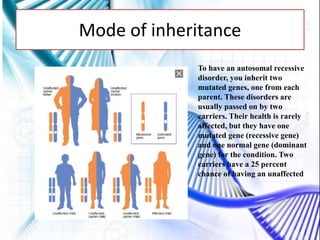
Mode of inheritance
To have an autosomal recessive
disorder, you inherit two
mutated genes, one from each
parent. These disorders are
usually passed on by two
carriers. Their health is rarely
affected, but they have one
mutated gene (recessive gene)
and one normal gene (dominant
gene) for the condition. Two
carriers have a 25 percent
chance of having an unaffected
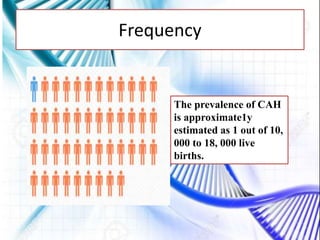
Frequency
The prevalence of CAH
is approximate1y
estimated as 1 out of 10,
000 to 18, 000 live
births.
Treatment for CAH
• The main treatment for classic CAH is a drug called
‘hydrocortisone’ (also called ‘cortisone’), taken in pill
form. This medication replaces the cortisol that your baby
cannot make on his or her own.
• Surgery for girls with classic CAH
Girls who are born with an enlarged clitoris or changes to the
labia have the option of surgery to change their outer genitals
to a more female appearance.
• Treatment to prevent short stature
Your doctor may take periodic X-rays to check your
child’s ‘bone age’. This allows your doctor to tell whether
your child is growing at too rapid a rate.
• Treatment for early puberty
Children who show changes of puberty at a young age are
sometimes treated with medications that lower the
amount of androgen hormones.
• Additional treatment for classic CAH – salt-wasting form
- need to take an additional medication called Florinef
(is a ‘salt-retaining’ drug that replaces the aldosterone
absent in children with salt-wasting CAH)
- follow a food plan that contains more salt than usual
• Children and adults with nonclassic CAH usually need
less medication than children with classic CAH.
Treatment for CAH
Review
• CAH is an inherited disorder that affects the adrenal
gland.
• CAH is caused by a deficiency of an enzyme (adrenal
steroid 21-hydroxylase) necessary for the synthesis of
two vital hormones, cortisol and aldosterone, by the
human body. In its severest form, classical CAH results
in the uncontrolled loss of salt and fluids from the body,
a condition which, if undetected, can lead to adrenal
crisis and death.
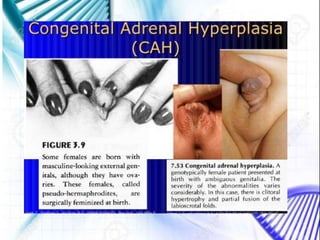
• Classical, severe CAH can cause genital anomalies in
affected females, with baby girls occasionally
misidentified as boys
Galactosemia
What is galactosemia?
Galactosemia is a family of genetic disorders that
result from compromised ability to metabolize the
sugar galactose; the term “galactosemia” literally
means too much galactose in the blood. The different
types of galactosemia include:
• Classic and clinical variant galactosemia (aka Type I
galactosemia)
• Duarte variant galactosemia
• Galactokinase deficiency (aka Type II galactosemia)
• Epimerase deficiency (aka Type III galactosemia)
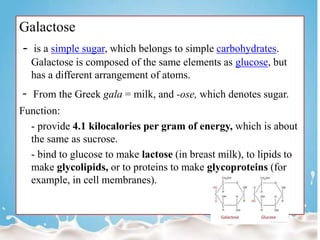
Galactose
- is a simple sugar, which belongs to simple carbohydrates.
Galactose is composed of the same elements as glucose, but
has a different arrangement of atoms.
- From the Greek gala = milk, and -ose, which denotes sugar.
Function:
- provide 4.1 kilocalories per gram of energy, which is about
the same as sucrose.
- bind to glucose to make lactose (in breast milk), to lipids to
make glycolipids, or to proteins to make glycoproteins (for
example, in cell membranes).
Sources of Galactose
• lactose from milk and yogurt, which is
digested to galactose and glucose
• certain yogurts, cheeses, creams, ice creams
and other foods artificially sweetened with
galactose
• Plain natural foods (fruits, vegetables, nuts,
grains, fresh meats, eggs, milk) usually contain
less than 0.3 g galactose per serving
Galactosemia is an autosomal recessive disorder
caused by deficient or absent activities of one
of the three enzymes involved in the galactose
metabolic pathway:
- galactokinase
- galactose-1- phosphate uridyltransferase
- and UDP-galactose 4’-epimerase
• The classical and most severe form is caused by a
deficiency of the enzyme galactose-1-phosphate
uridyl transferase (GALT).
• The gene for galactose-1-phosphate
uridylyltransferase ( GALT gene ) is located on
the short arm of chromosome 9, in the region
9p13.
• Galactose-1-phosphate
uridylyltransferase(GALT) is an enzyme
responsible for converting ingested galactose to
glucose.
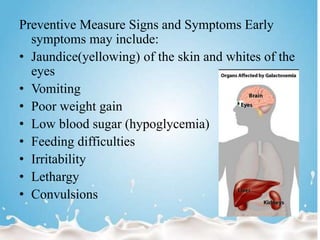
Preventive Measure Signs and Symptoms Early
symptoms may include:
• Jaundice(yellowing) of the skin and whites of the
eyes
• Vomiting
• Poor weight gain
• Low blood sugar (hypoglycemia)
• Feeding difficulties
• Irritability
• Lethargy
• Convulsions
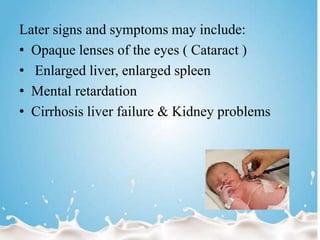
Later signs and symptoms may include:
• Opaque lenses of the eyes ( Cataract )
• Enlarged liver, enlarged spleen
• Mental retardation
• Cirrhosis liver failure & Kidney problems
Diagnosis
Prenatal Testing A doctor can determine during a
woman’s pregnancy whether her baby has
galactosemia through:
a. amniocentesis . This procedure involves using a
needle to withdraw a sample of amniotic fluid
from the womb, and then examining the cells.
b. chronic villus sampling or CVS
c. NewBorn Screening -Babies are tested for
Galactosemia at birth using a tiny blood sample
taken from the baby’s heel, the test for low level
of the GALT enzyme.
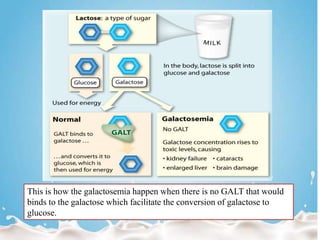
This is how the galactosemia happen when there is no GALT that would
binds to the galactose which facilitate the conversion of galactose to
glucose.
Treatment
• No treatment or cannot be cure but with
maturation most children develop another
enzyme capable of metabolizing galactose.
• As a consequence, they are able to tolerate
galactose as they mature.
• Dietary restriction, avoid food and drinks
containing galactose like milk, cheese,
legumes (dried beans), fermented soy
products, organ meat and hydrolyzed proteins.
Frequency
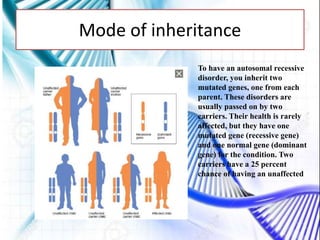
Classic galactosemia occurs
in 1 in 30,000 to 60,000
newborns. Galactosemia
type II and type III are less
common; type II probably
affects fewer than 1 in
100,000 newborns and type
III appears to be very rare.
Mode of inheritance
To have an autosomal recessive
disorder, you inherit two
mutated genes, one from each
parent. These disorders are
usually passed on by two
carriers. Their health is rarely
affected, but they have one
mutated gene (recessive gene)
and one normal gene (dominant
gene) for the condition. Two
carriers have a 25 percent
chance of having an unaffected
Review
• The condition is caused by a mutation in the gene
that codes for the GALT enzyme.
• The enzymes involved is galactose-1-phosphate
uridyl transferase (GALT) and in galactosemia,
this enzyme is either defective or missing. When
this happens, an infant is unable to convert the
galactose into glucose which causes galactose to
accumulate in the blood. This can lead to serious
problems such as liver enlargement, kidney
failure, brain damage and cataracts. Left
untreated, this condition kills as many as 75% of
sufferers.
• http://www.mayoclinic.org/diseases-
conditions/congenital-adrenal-
hyperplasia/symptoms-causes/dxc-20309080
• http://www.babysfirsttest.org/newborn-
screening/conditions/congenital-adrenal-
hyperplasia
• http://www.galactosemia.org/understanding-
galactosemia/

CAH and Galactosemia

  • 1.
  • 2.
    • Congenital AdrenalHyperplasia • Galactosemia
  • 3.
    Congenital Adrenal Hyperplasia(CAH) Congenital - present from birth Adrenal - denoting a pair of ductless glands situated above the kidneys. Hyperplasia - the enlargement of an organ or tissue caused by an increase in the reproduction rate of its cells, often as an initial stage in the development of cancer.
  • 4.
    CAH - is acollection of inherited conditions that affect the body’s adrenal glands, which are the cone-shaped organs that sit on top of the kidneys. adrenal glands •Located at the top of each kidney •produce hormones that help the body control blood sugar, burn protein and fat, react to stressors like a major illness or injury, and regulate blood pressure.
  • 5.
    • What arehormones? Hormones are chemical messengers that are secreted directly into the blood, which carries them to organs and tissues of the body to exert their functions. There are many types of hormones that act on different aspects of bodily functions and processes. • What is an enzyme? a substance that acts as a catalyst in living organisms, regulating the rate at which chemical reactions proceed without itself being altered in the process.
  • 6.
    Hormones in theadrenal glands that are affected: Cortisol • Involved in the regulation of metabolism in cells • also help us regulate various stressors in the body Aldosterone • affects the body's ability to regulate blood pressure. • It sends the signal to organs, like the kidney and colon, that can increase the amount of sodium the body sends into the bloodstream or the amount of potassium released in the urine.
  • 7.
    Hormones in theadrenal glands that are affected: Androgens • Androgens are a group of chemically related sex steroid hormones. Steroids are a special kind of fat molecule with a four-ringed, carbon atom backbone or core, like their cholesterol predecessor. • Say the word androgen and most people think male. Indeed, they are dubbed the male hormones mainly because males make and use more testosterone and other androgens than females
  • 8.
    • In CAH,the body is missing an enzyme (chemical substance) that helps the adrenal glands to release the hormones. As a result hormones cannot be produced. • The brain then detects low level of hormones and tries to send signals to the adrenal gland to work harder. However, this mechanism is futile because of the absence of the enzyme needed to stimulate the adrenal glands to release the hormone • As a result, the adrenals grow in size. • With the adrenals working harder, but still unable to make the hormones, more of the sex hormones are made instead.
  • 9.
    • The missingenzyme is 21-Hydroxylase- make cortisol and aldosterone in the adrenal glands • The job of this enzyme is to help make cortisol and aldosterone in the adrenal glands so they can be released when the body needs them.
  • 10.
    Causes of CAH •In 95 percent of cases, the enzyme lacking in congenital adrenal hyperplasia is 21- hydroxylase. CAH may sometimes be called 21-hydroxylase deficiency. • CAH is passed along in an inheritance pattern called autosomal recessive. Children who have the condition have two parents who either have CAH themselves or who are both carriers of the genetic mutation that causes the condition.
  • 11.
    • What causesthe 21-hydroxylase enzyme to be absent or not working correctly? Genes tell the body to make various enzymes. People with CAH have a pair of genes that do not work correctly. Because of the changes in this pair of genes, the 21-OH enzyme either does not work properly or is not made at all.
  • 12.
    A child withclassic CAH may experience: • A lack in the production of cortisol in both the salt-losing and simple-virilizing forms. • A lack in the production of aldosterone in the salt- losing form. • Excess production of the male sex hormones (androgens such as testosterone).
  • 13.
    two major typesof congenital adrenal hyperplasia: • Classic CAH. This more-severe form of the disease is usually detected in infancy. - Salt-wasting - Simple-virilizing • Nonclassic CAH. This milder and more common form may not become evident until childhood or early adulthood.
  • 14.
    Salt-wasting Classic CAH Salt-wastingclassic CAH • 75% of classic CAH cases. • This is the most severe form. Signs of salt-wasting CAH usually begin within the first few weeks of life. • These signs include: * Poor feeding * Sleeping longer or more often * Tiredness * Vomiting * Diarrhea *Irritability * Rapid heart rate * Male-like genitals in females * Weight loss
  • 15.
    Simple-virilizing classic CAH •25% of classic CAH cases. • less severe than salt-wasting CAH, but more severe than non-classic CAH. • Signs begin before birth. • These signs differ between males and females, which usually become apparent during childhood due to early puberty. • Early signs of simple-virilizing CAH include: – Enlarged clitoris (it may look like a small penis) – Labia that are fused together (they may resemble a scrotum) – Small testicles Simple-virilizing Classic CAH
  • 17.
    Non – classicCAH Non-classic CAH is much less severe than classic forms of CAH. Signs of non-classic CAH can begin in childhood, adolescence, or adulthood. Both males and females with non- classic CAH may show signs of early puberty. • later signs and symptoms often include: - Irregular or absent menstrual periods - Masculine characteristics such as facial hair, excessive body hair and a deepening voice • In both females and males, signs and symptoms of nonclassic CAH also may include: - Early appearance of pubic hair - Rapid growth during childhood, but shorter than average final height
  • 18.
    Mode of inheritance Tohave an autosomal recessive disorder, you inherit two mutated genes, one from each parent. These disorders are usually passed on by two carriers. Their health is rarely affected, but they have one mutated gene (recessive gene) and one normal gene (dominant gene) for the condition. Two carriers have a 25 percent chance of having an unaffected
  • 19.
    Frequency The prevalence ofCAH is approximate1y estimated as 1 out of 10, 000 to 18, 000 live births.
  • 20.
    Treatment for CAH •The main treatment for classic CAH is a drug called ‘hydrocortisone’ (also called ‘cortisone’), taken in pill form. This medication replaces the cortisol that your baby cannot make on his or her own. • Surgery for girls with classic CAH Girls who are born with an enlarged clitoris or changes to the labia have the option of surgery to change their outer genitals to a more female appearance. • Treatment to prevent short stature Your doctor may take periodic X-rays to check your child’s ‘bone age’. This allows your doctor to tell whether your child is growing at too rapid a rate.
  • 21.
    • Treatment forearly puberty Children who show changes of puberty at a young age are sometimes treated with medications that lower the amount of androgen hormones. • Additional treatment for classic CAH – salt-wasting form - need to take an additional medication called Florinef (is a ‘salt-retaining’ drug that replaces the aldosterone absent in children with salt-wasting CAH) - follow a food plan that contains more salt than usual • Children and adults with nonclassic CAH usually need less medication than children with classic CAH. Treatment for CAH
  • 22.
    Review • CAH isan inherited disorder that affects the adrenal gland. • CAH is caused by a deficiency of an enzyme (adrenal steroid 21-hydroxylase) necessary for the synthesis of two vital hormones, cortisol and aldosterone, by the human body. In its severest form, classical CAH results in the uncontrolled loss of salt and fluids from the body, a condition which, if undetected, can lead to adrenal crisis and death. • Classical, severe CAH can cause genital anomalies in affected females, with baby girls occasionally misidentified as boys
  • 23.
  • 24.
    What is galactosemia? Galactosemiais a family of genetic disorders that result from compromised ability to metabolize the sugar galactose; the term “galactosemia” literally means too much galactose in the blood. The different types of galactosemia include: • Classic and clinical variant galactosemia (aka Type I galactosemia) • Duarte variant galactosemia • Galactokinase deficiency (aka Type II galactosemia) • Epimerase deficiency (aka Type III galactosemia)
  • 25.
    Galactose - is asimple sugar, which belongs to simple carbohydrates. Galactose is composed of the same elements as glucose, but has a different arrangement of atoms. - From the Greek gala = milk, and -ose, which denotes sugar. Function: - provide 4.1 kilocalories per gram of energy, which is about the same as sucrose. - bind to glucose to make lactose (in breast milk), to lipids to make glycolipids, or to proteins to make glycoproteins (for example, in cell membranes).
  • 26.
    Sources of Galactose •lactose from milk and yogurt, which is digested to galactose and glucose • certain yogurts, cheeses, creams, ice creams and other foods artificially sweetened with galactose • Plain natural foods (fruits, vegetables, nuts, grains, fresh meats, eggs, milk) usually contain less than 0.3 g galactose per serving
  • 27.
    Galactosemia is anautosomal recessive disorder caused by deficient or absent activities of one of the three enzymes involved in the galactose metabolic pathway: - galactokinase - galactose-1- phosphate uridyltransferase - and UDP-galactose 4’-epimerase
  • 28.
    • The classicaland most severe form is caused by a deficiency of the enzyme galactose-1-phosphate uridyl transferase (GALT). • The gene for galactose-1-phosphate uridylyltransferase ( GALT gene ) is located on the short arm of chromosome 9, in the region 9p13. • Galactose-1-phosphate uridylyltransferase(GALT) is an enzyme responsible for converting ingested galactose to glucose.
  • 29.
    Preventive Measure Signsand Symptoms Early symptoms may include: • Jaundice(yellowing) of the skin and whites of the eyes • Vomiting • Poor weight gain • Low blood sugar (hypoglycemia) • Feeding difficulties • Irritability • Lethargy • Convulsions
  • 30.
    Later signs andsymptoms may include: • Opaque lenses of the eyes ( Cataract ) • Enlarged liver, enlarged spleen • Mental retardation • Cirrhosis liver failure & Kidney problems
  • 31.
    Diagnosis Prenatal Testing Adoctor can determine during a woman’s pregnancy whether her baby has galactosemia through: a. amniocentesis . This procedure involves using a needle to withdraw a sample of amniotic fluid from the womb, and then examining the cells. b. chronic villus sampling or CVS c. NewBorn Screening -Babies are tested for Galactosemia at birth using a tiny blood sample taken from the baby’s heel, the test for low level of the GALT enzyme.
  • 32.
    This is howthe galactosemia happen when there is no GALT that would binds to the galactose which facilitate the conversion of galactose to glucose.
  • 33.
    Treatment • No treatmentor cannot be cure but with maturation most children develop another enzyme capable of metabolizing galactose. • As a consequence, they are able to tolerate galactose as they mature. • Dietary restriction, avoid food and drinks containing galactose like milk, cheese, legumes (dried beans), fermented soy products, organ meat and hydrolyzed proteins.
  • 34.
    Frequency Classic galactosemia occurs in1 in 30,000 to 60,000 newborns. Galactosemia type II and type III are less common; type II probably affects fewer than 1 in 100,000 newborns and type III appears to be very rare.
  • 35.
    Mode of inheritance Tohave an autosomal recessive disorder, you inherit two mutated genes, one from each parent. These disorders are usually passed on by two carriers. Their health is rarely affected, but they have one mutated gene (recessive gene) and one normal gene (dominant gene) for the condition. Two carriers have a 25 percent chance of having an unaffected
  • 36.
    Review • The conditionis caused by a mutation in the gene that codes for the GALT enzyme. • The enzymes involved is galactose-1-phosphate uridyl transferase (GALT) and in galactosemia, this enzyme is either defective or missing. When this happens, an infant is unable to convert the galactose into glucose which causes galactose to accumulate in the blood. This can lead to serious problems such as liver enlargement, kidney failure, brain damage and cataracts. Left untreated, this condition kills as many as 75% of sufferers.
  • 37.