Research
Instruments
FR
2
- described as a device
used to collect data
RESEARCH INSTRUMENT
FR
1. Questionnaire
2. Interview
3. Observation
3
Types of Research
Instrument
FR
•A series of questions designed
to elicit information, which is
filled in by all participants.
4
1.
Questionnaire
FR
•Simple method of obtaining data
•Less time is consumed
•Researcher is able to gather data from
a widely scattered sample.
5
Advantages of Using
Questionnaire
FR
•responses lack depth
•respondents may omit or disregard any
item he chooses
•some items maybe misunderstood
•length of the questionnaire is limited
6
Disadvantages of a
Questionnaire
FR
•Closed form / Closed- ended
•Open form / Open- ended
7
Two forms of questionnaire
FR
•gives the respondents the ability to
respond on their own words
8
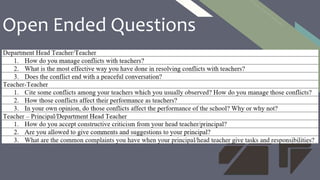
Open-ended questions
Close-ended questions
•allows the subject to choose one of
the given alternatives
FR
9
Close Ended Questions Open Ended Questions
Do you like working with us?
•Yes
•No
Tell us about your experience with
our organization so far.
Have you been stressed lately?
•Yes
•Unsure
•No
Share with us what has been
troubling you.
How satisfied are you with your
current job role?
•Very satisfied
•Somewhat satisfied
•Somewhat unsatisfied
•Very unsatisfied
What do you expect from this?
FR
Close Ended Questions
FR
Open Ended Questions
FR
•Clarity of language
•Singleness of purpose
•Relevant to the
objective of the study
•Correct grammar
12
the
Questionnaire
FR
•use simple terms
•define or qualify terms that
could easily be misinterpret
•be careful in using descriptive
adjectives and adverbs that
have no agreed-upon meaning
13
Guidelines in Constructing
the Questionnaire
FR
•beware of double negative
•underline the word if you wish
to indicate special emphasis
• when asking for rating or
comparisons a point of
reference is necessary
•design question that will give a
complete answer
14
FR
• this involves either structure or
unstructured verbal communication
between the researcher and the
subject, during which information is
obtained for the study
15
2. Interview
FR
The purposes of interview are :
- to verify information gathered
from written sources
- to clarify points of information
- to update information and to
collect data
16
FR
1. Unstructured interview
2. Structured interview
17
Types of Interview
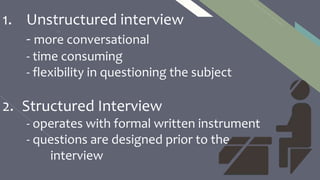
FR
1. Unstructured interview
- more conversational
- time consuming
- flexibility in questioning the subject
2. Structured Interview
- operates with formal written instrument
- questions are designed prior to the
interview
18
FR
- depth of responses can be
assured
- clarification is possible
- no items overlooked
- greater amount of flexibility
19
Advantages
FR
- time consuming
- prone to biases
20
Disadvantages
FR
• perceiving data through the
senses: sight, hearing, taste
touch and smell
• most direct way used in
studying individual behavior
21
3. Observation
FR
- produce large quantities of data
- observation can be stopped or
begun at any time
- subjects are easily available
- may be recorded at the time
they occur, eliminating bias
because of the recall
22
Advantages
FR
- accurate prediction of a situation to
be observed is unlikely.
- the presence of an observer gives
the subjects a quality normally
absent
- observed events are subject to
biases
23
Disadvantages
FR
1. Reliability – the degree of
consistency and accuracy with
which an instrument measures a
variable
2. Validity- refers to the extent to
which an instrument measures
what it is designed to measure.
24
Criteria for Measuring
Research Instruments
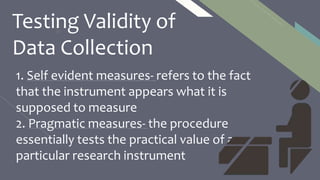
FR
1. Self evident measures- refers to the fact
that the instrument appears what it is
supposed to measure
2. Pragmatic measures- the procedure
essentially tests the practical value of a
particular research instrument
25
Testing Validity of
Data Collection
FR
a. Face Validity
- refers to the degree to which an
assessment or test subjectively appears
to measure the variable or construct that
it is supposed to measure.
- the researcher verifies face validity by
asking experts to evaluate the
instrument’s intent.
26Self-evident measures
b. Content Validity
- relies on the assurance that you can
demonstrate an adequate coverage of the
study
- The researcher typically verifies this by
asking experts to evaluate the instrument’s
representativeness of the content.
FR
27
FR
- Concurrent validity
- Predictive validity
- Construct validity
28
Pragmatic Measures
FR
- refers to the extent to which an
instrument can accurately identify
subjects that differ with respect to a
given characteristics
- Ex: a measure of job satisfaction might
be correlated with work performance
29
Concurrent validity
FR
- to predict future occurrence
- The researcher commonly validates
this by using the instrument then
comparing the result with some
future outcomes.
30
Predictive validity
FR
- useful mainly for measuring the
traits or feelings such as generosity,
grief or satisfaction
- related to the theoretical ideas
behind the personality trait under
consideration
31Construct validity
FR
32
FR
33

Research instruments

  • 1.
  • 2.
    FR 2 - described asa device used to collect data RESEARCH INSTRUMENT
  • 3.
    FR 1. Questionnaire 2. Interview 3.Observation 3 Types of Research Instrument
  • 4.
    FR •A series ofquestions designed to elicit information, which is filled in by all participants. 4 1. Questionnaire
  • 5.
    FR •Simple method ofobtaining data •Less time is consumed •Researcher is able to gather data from a widely scattered sample. 5 Advantages of Using Questionnaire
  • 6.
    FR •responses lack depth •respondentsmay omit or disregard any item he chooses •some items maybe misunderstood •length of the questionnaire is limited 6 Disadvantages of a Questionnaire
  • 7.
    FR •Closed form /Closed- ended •Open form / Open- ended 7 Two forms of questionnaire
  • 8.
    FR •gives the respondentsthe ability to respond on their own words 8 Open-ended questions Close-ended questions •allows the subject to choose one of the given alternatives
  • 9.
    FR 9 Close Ended QuestionsOpen Ended Questions Do you like working with us? •Yes •No Tell us about your experience with our organization so far. Have you been stressed lately? •Yes •Unsure •No Share with us what has been troubling you. How satisfied are you with your current job role? •Very satisfied •Somewhat satisfied •Somewhat unsatisfied •Very unsatisfied What do you expect from this?
  • 10.
  • 11.
  • 12.
    FR •Clarity of language •Singlenessof purpose •Relevant to the objective of the study •Correct grammar 12 the Questionnaire
  • 13.
    FR •use simple terms •defineor qualify terms that could easily be misinterpret •be careful in using descriptive adjectives and adverbs that have no agreed-upon meaning 13 Guidelines in Constructing the Questionnaire
  • 14.
    FR •beware of doublenegative •underline the word if you wish to indicate special emphasis • when asking for rating or comparisons a point of reference is necessary •design question that will give a complete answer 14
  • 15.
    FR • this involveseither structure or unstructured verbal communication between the researcher and the subject, during which information is obtained for the study 15 2. Interview
  • 16.
    FR The purposes ofinterview are : - to verify information gathered from written sources - to clarify points of information - to update information and to collect data 16
  • 17.
    FR 1. Unstructured interview 2.Structured interview 17 Types of Interview
  • 18.
    FR 1. Unstructured interview -more conversational - time consuming - flexibility in questioning the subject 2. Structured Interview - operates with formal written instrument - questions are designed prior to the interview 18
  • 19.
    FR - depth ofresponses can be assured - clarification is possible - no items overlooked - greater amount of flexibility 19 Advantages
  • 20.
    FR - time consuming -prone to biases 20 Disadvantages
  • 21.
    FR • perceiving datathrough the senses: sight, hearing, taste touch and smell • most direct way used in studying individual behavior 21 3. Observation
  • 22.
    FR - produce largequantities of data - observation can be stopped or begun at any time - subjects are easily available - may be recorded at the time they occur, eliminating bias because of the recall 22 Advantages
  • 23.
    FR - accurate predictionof a situation to be observed is unlikely. - the presence of an observer gives the subjects a quality normally absent - observed events are subject to biases 23 Disadvantages
  • 24.
    FR 1. Reliability –the degree of consistency and accuracy with which an instrument measures a variable 2. Validity- refers to the extent to which an instrument measures what it is designed to measure. 24 Criteria for Measuring Research Instruments
  • 25.
    FR 1. Self evidentmeasures- refers to the fact that the instrument appears what it is supposed to measure 2. Pragmatic measures- the procedure essentially tests the practical value of a particular research instrument 25 Testing Validity of Data Collection
  • 26.
    FR a. Face Validity -refers to the degree to which an assessment or test subjectively appears to measure the variable or construct that it is supposed to measure. - the researcher verifies face validity by asking experts to evaluate the instrument’s intent. 26Self-evident measures b. Content Validity - relies on the assurance that you can demonstrate an adequate coverage of the study - The researcher typically verifies this by asking experts to evaluate the instrument’s representativeness of the content.
  • 27.
  • 28.
    FR - Concurrent validity -Predictive validity - Construct validity 28 Pragmatic Measures
  • 29.
    FR - refers tothe extent to which an instrument can accurately identify subjects that differ with respect to a given characteristics - Ex: a measure of job satisfaction might be correlated with work performance 29 Concurrent validity
  • 30.
    FR - to predictfuture occurrence - The researcher commonly validates this by using the instrument then comparing the result with some future outcomes. 30 Predictive validity
  • 31.
    FR - useful mainlyfor measuring the traits or feelings such as generosity, grief or satisfaction - related to the theoretical ideas behind the personality trait under consideration 31Construct validity
  • 32.
  • 33.

Editor's Notes

  • #3 One of the most important components of a research design is the research instruments because they gather or collect data or information. These research instruments or tools are ways of gathering data. Without them, data would be impossible to put in hand.
  • #25 Reliability- stability in maintaining consistent measurement in a test administered twice - Refers to whether or not you get the same answer by using an instrument to measure something more than once. - Produces stable and consistent result (same result) VALIDITY is an indication of how sound your research is. More specifically, validity applies to both the design and the methods of your research.Validity in data collection means that your findings truly represent the phenomenon you are claiming to measure
  • #27 a. In other words, face validity is when an assessment or test appears to do what it claims to do. (validity of the observer)
  • #28 Answers the question “Does it work?”
  • #29 Answers the question “Does it work?”
  • #30 Validates using a second instrument already known to be valid Note: in concurrent validity, the two measures are taken at the same time
  • #32 A measure of how well the test measures the construct A tool that allows researchers researchers to perform a systematic analysis oof how well desisgn the research is
  • #33 Own perspective, depends on your opinion, or how you feel about the situation.