Prepared by; 
Abdul Shafwan T H 
2nd M.A IR&PS 
Central University of Kerala
Sampling 
 Measuring a small portion of something and then making 
a general statement about the whole thing. 
 Process of selecting a number of units for a study in such 
a way that the units represent the larger group from which 
they are selected.
Why We Need Sampling? 
 Sampling makes possible the study of a large, (different 
characteristics) population. 
 Sampling is for economy 
 Sampling is for speed. 
 Sampling is for accuracy. 
 Sampling saves the sources of data from being all 
consumed.
General Types of Sampling 
1. Probability sampling 
2. Non-probability sampling
Non-probability sampling 
 Unequal chance of being included in the sample (non-random) 
 Non random or non - probability sampling refers to the sampling process 
in which, the samples are selected for a specific purpose with a pre-determined 
basis of selection. 
 The sample is not a proportion of the population and there is no system in 
selecting the sample. The selection depends upon the situation. 
 No assurance is given that each item has a chance of being included as a sample 
 There is an assumption that there is an even distribution of characteristics within 
the population, believing that any sample would be representative.
Types of Non-Probability Sampling 
 Judgment or purposive or deliberate sampling 
 Convenience sampling 
 Quota sampling 
 Snow Ball Sampling
1. Judgment or purposive or deliberate 
sampling 
 In this method, the sample selection is purely based on the 
judgment of the investigator or the researcher. This is 
because, the researcher may lack information regarding the 
population from which he has to collect the sample. 
Population characteristics or qualities may not be known, 
but sample has to be selected. 
 In this method of sampling the choice of sample items 
depends primarily on the judgment of the researcher. In 
other words, the researcher determines and includes those 
items in the sample which he thinks are most typical of the 
universe with regard to the characteristics of research 
project.
 For example, suppose 100 boys are to be selected from 
a college with 1000 boys. If nothing is known about 
the students in this college, then the investigator may 
visit the college and choose the first 100 boys he meets. 
Or he may select 100 boys all belonging to III Year. Or 
he might select 25 boys from Commerce course, 25 
from Science courses, 25 boys from Arts courses and 25 
from Fine arts courses. Hence, when only the sample 
size is known, the investigator uses his discretion and 
select the sample.
The use of judgment sampling is justified by following premises: 
 If there are a small number of sampling units is in the universe, 
judgment sampling enables inclusion of important units. 
 Judgment stratification of population helps in obtaining a more 
representative sample in case research study wants to look into 
unknown traits of the population. 
 Judgment sampling is a practical method to arrive at some solution to 
everyday business problems. 
Limitations: 
 The judgment sampling involves the risk that the researcher may 
establish conclusions by including those items in the sample which 
conform to his preconceived ideas. 
 There is no objective way of evaluating the reliability of sample results.
2. Convenience sampling 
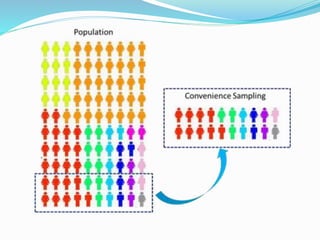
 Convenience sampling is commonly known as unsystematic, accidental 
or opportunistic sampling. According to this procedure a sample is 
selected according to the convenience of the investigator. 
 In this method of sampling the choice of sample items depends 
primarily on the judgment of the researcher. In other words, the 
researcher determines and includes those items in the sample which he 
thinks are most typical of the universe with regard to the 
characteristics of research project. 
 A type of non probability sampling which involves the sample being 
drawn from that part of the population which is close to hand. That is, 
readily available and convenient. 
 For example, suppose 100 car owners are to be selected. Then we may 
collect from the RTO's office the list of car owners and then make a 
selection of 100 from that to form the sample.
A convenience sampling may be used in the following 
cases: 
 i) When universe is not well defined, 
 ii) When sampling unit is not clear, and 
 iii) When complete list of the source is not available.
3. QUOTA SAMPLING 
 In this method, the sample size is determined first and then quota is 
fixed for various categories of population, which is followed while 
selecting the sample. 
 In this method the quota has to be determined in advance and 
intimated to the investigator. The quota for each segment of the 
population may be fixed at random or with a specific basis. Normally 
such a sampling method does not ensure representativeness of the 
population. 
 Example: - Suppose we want to select 100 students, then we might say 
that the sample should be according to the quota given below : Boys 
50%, Girls 50% Then among the boys, 20% college students, 40% plus 
two students, 30% high school students and 10% elementary school 
students. A different or the same quota may be fixed for the girls.
MERITS OF QUOTA SAMPLING 
 Reduces cost of preparing sample and field work, since ultimate 
units can be selected so that they are close together. 
 Introduces some stratification effect. 
DEMERITS OF QUOTA SAMPLING 
 Introduces bias of investigator is not involved at any stage, the 
errors of the method cannot be estimated by statistical 
procedures. 
 Since random sampling is not involved at any stage, the errors of 
the method cannot be estimated by statistical procedures. Quota 
sampling is most commonly used in marketing survey and 
election polls.
4. SNOWBALL SAMPLING 
 It refers to Identifying someone who meets the criteria 
for inclusion in the study. 
 Selection of additional respondents is based on 
referrals from the initial respondents.
Non probability sampling

Non probability sampling

  • 1.
    Prepared by; AbdulShafwan T H 2nd M.A IR&PS Central University of Kerala
  • 2.
    Sampling  Measuringa small portion of something and then making a general statement about the whole thing.  Process of selecting a number of units for a study in such a way that the units represent the larger group from which they are selected.
  • 3.
    Why We NeedSampling?  Sampling makes possible the study of a large, (different characteristics) population.  Sampling is for economy  Sampling is for speed.  Sampling is for accuracy.  Sampling saves the sources of data from being all consumed.
  • 4.
    General Types ofSampling 1. Probability sampling 2. Non-probability sampling
  • 5.
    Non-probability sampling Unequal chance of being included in the sample (non-random)  Non random or non - probability sampling refers to the sampling process in which, the samples are selected for a specific purpose with a pre-determined basis of selection.  The sample is not a proportion of the population and there is no system in selecting the sample. The selection depends upon the situation.  No assurance is given that each item has a chance of being included as a sample  There is an assumption that there is an even distribution of characteristics within the population, believing that any sample would be representative.
  • 6.
    Types of Non-ProbabilitySampling  Judgment or purposive or deliberate sampling  Convenience sampling  Quota sampling  Snow Ball Sampling
  • 7.
    1. Judgment orpurposive or deliberate sampling  In this method, the sample selection is purely based on the judgment of the investigator or the researcher. This is because, the researcher may lack information regarding the population from which he has to collect the sample. Population characteristics or qualities may not be known, but sample has to be selected.  In this method of sampling the choice of sample items depends primarily on the judgment of the researcher. In other words, the researcher determines and includes those items in the sample which he thinks are most typical of the universe with regard to the characteristics of research project.
  • 8.
     For example,suppose 100 boys are to be selected from a college with 1000 boys. If nothing is known about the students in this college, then the investigator may visit the college and choose the first 100 boys he meets. Or he may select 100 boys all belonging to III Year. Or he might select 25 boys from Commerce course, 25 from Science courses, 25 boys from Arts courses and 25 from Fine arts courses. Hence, when only the sample size is known, the investigator uses his discretion and select the sample.
  • 9.
    The use ofjudgment sampling is justified by following premises:  If there are a small number of sampling units is in the universe, judgment sampling enables inclusion of important units.  Judgment stratification of population helps in obtaining a more representative sample in case research study wants to look into unknown traits of the population.  Judgment sampling is a practical method to arrive at some solution to everyday business problems. Limitations:  The judgment sampling involves the risk that the researcher may establish conclusions by including those items in the sample which conform to his preconceived ideas.  There is no objective way of evaluating the reliability of sample results.
  • 10.
    2. Convenience sampling  Convenience sampling is commonly known as unsystematic, accidental or opportunistic sampling. According to this procedure a sample is selected according to the convenience of the investigator.  In this method of sampling the choice of sample items depends primarily on the judgment of the researcher. In other words, the researcher determines and includes those items in the sample which he thinks are most typical of the universe with regard to the characteristics of research project.  A type of non probability sampling which involves the sample being drawn from that part of the population which is close to hand. That is, readily available and convenient.  For example, suppose 100 car owners are to be selected. Then we may collect from the RTO's office the list of car owners and then make a selection of 100 from that to form the sample.
  • 11.
    A convenience samplingmay be used in the following cases:  i) When universe is not well defined,  ii) When sampling unit is not clear, and  iii) When complete list of the source is not available.
  • 13.
    3. QUOTA SAMPLING  In this method, the sample size is determined first and then quota is fixed for various categories of population, which is followed while selecting the sample.  In this method the quota has to be determined in advance and intimated to the investigator. The quota for each segment of the population may be fixed at random or with a specific basis. Normally such a sampling method does not ensure representativeness of the population.  Example: - Suppose we want to select 100 students, then we might say that the sample should be according to the quota given below : Boys 50%, Girls 50% Then among the boys, 20% college students, 40% plus two students, 30% high school students and 10% elementary school students. A different or the same quota may be fixed for the girls.
  • 14.
    MERITS OF QUOTASAMPLING  Reduces cost of preparing sample and field work, since ultimate units can be selected so that they are close together.  Introduces some stratification effect. DEMERITS OF QUOTA SAMPLING  Introduces bias of investigator is not involved at any stage, the errors of the method cannot be estimated by statistical procedures.  Since random sampling is not involved at any stage, the errors of the method cannot be estimated by statistical procedures. Quota sampling is most commonly used in marketing survey and election polls.
  • 15.
    4. SNOWBALL SAMPLING  It refers to Identifying someone who meets the criteria for inclusion in the study.  Selection of additional respondents is based on referrals from the initial respondents.