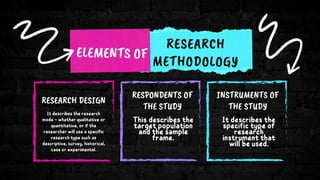
RESEARCH DESIGN
RESPONDENTS OF
THE STUDY
INSTRUMENTS OF
THE STUDY
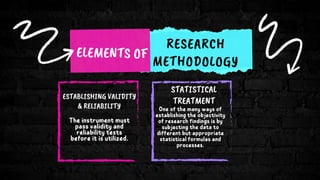
ESTABLISHING VALIDITY
& RELIABILITY
STATISTICAL
TREATMENT
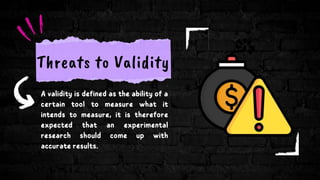
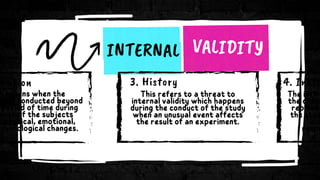
Threats to Validity
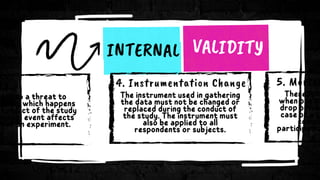
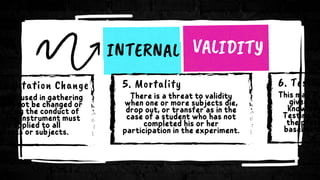
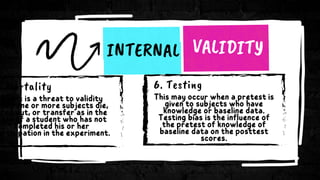
INTERNAL VALIDITY
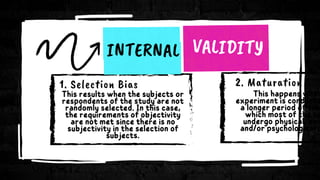
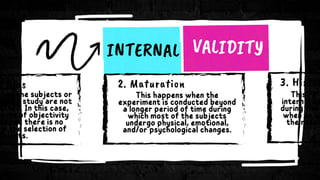
1. Selection Bias 2. Maturation

n Bias 2. Maturation 3. Histor
uration 3. History 4. Instr
ry 4. Instrumentation Change 5. Mortal
umentation Change 5. Mortality 6. Testin
. Mortality 6. Testing
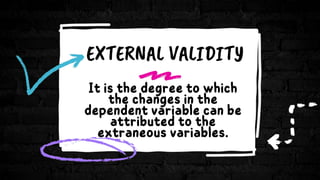
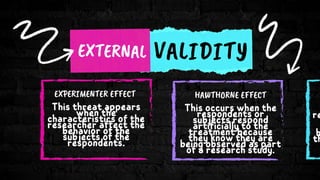
EXTERNAL VALIDITY
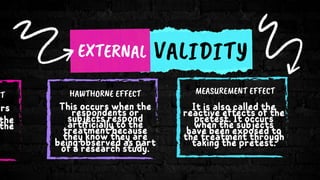
EXPERIMENTER EFFECT HAWTHORNE EFFECT
CT HAWTHORNE EFFECT MEASUREMENT EFFECT
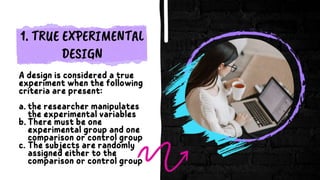
1. TRUE EXPERIMENTAL
DESIGN
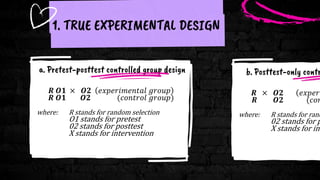
a. Pretest-posttest controlled group design
𝑹 𝑶𝟏 × 𝑶𝟐 𝑒𝑥𝑝𝑒𝑟𝑖𝑚𝑒𝑛𝑡𝑎𝑙 𝑔𝑟𝑜𝑢𝑝
𝑹 𝑶𝟏 𝑶𝟐 (𝑐𝑜𝑛𝑡𝑟𝑜𝑙 𝑔𝑟𝑜𝑢𝑝)
where: R stands for random selection
O1 stands for pretest
02 stands for posttest
X stands for intervention
1. TRUE EXPERIMENTAL DESIGN
b. Posttest-only contr
𝑹 × 𝑶𝟐 𝑒𝑥𝑝𝑒𝑟𝑖
𝑹 𝑶𝟐 (𝑐𝑜𝑛
where: R stands for rand
02 stands for p
X stands for int
group design
𝑙 𝑔𝑟𝑜𝑢𝑝
𝑙 𝑔𝑟𝑜𝑢𝑝)
ction
on
1. TRUE EXPERIMENTAL DESIGN
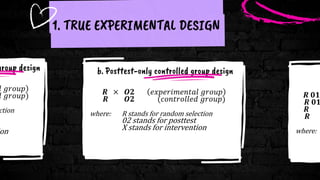
b. Posttest-only controlled group design
𝑹 × 𝑶𝟐 𝑒𝑥𝑝𝑒𝑟𝑖𝑚𝑒𝑛𝑡𝑎𝑙 𝑔𝑟𝑜𝑢𝑝
𝑹 𝑶𝟐 (𝑐𝑜𝑛𝑡𝑟𝑜𝑙𝑙𝑒𝑑 𝑔𝑟𝑜𝑢𝑝)
where: R stands for random selection
02 stands for posttest
X stands for intervention
𝑹 𝟎𝟏
𝑹 𝟎𝟏
𝑹
𝑹
where:
group design
𝑙 𝑔𝑟𝑜𝑢𝑝
𝑙 𝑔𝑟𝑜𝑢𝑝)
ction
on
1. TRUE EXPERIMENTAL DESIGN
roup design
𝑙 𝑔𝑟𝑜𝑢𝑝
𝑑 𝑔𝑟𝑜𝑢𝑝)
ection
ion
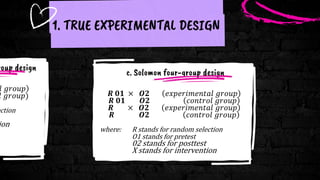
c. Solomon four-group design
𝑹 𝟎𝟏 × 𝑶𝟐 𝑒𝑥𝑝𝑒𝑟𝑖𝑚𝑒𝑛𝑡𝑎𝑙 𝑔𝑟𝑜𝑢𝑝
𝑹 𝟎𝟏 𝑶𝟐 𝑐𝑜𝑛𝑡𝑟𝑜𝑙 𝑔𝑟𝑜𝑢𝑝
𝑹 × 𝑶𝟐 𝑒𝑥𝑝𝑒𝑟𝑖𝑚𝑒𝑛𝑡𝑎𝑙 𝑔𝑟𝑜𝑢𝑝
𝑹 𝑶𝟐 𝑐𝑜𝑛𝑡𝑟𝑜𝑙 𝑔𝑟𝑜𝑢𝑝
where: R stands for random selection
O1 stands for pretest
02 stands for posttest
X stands for intervention
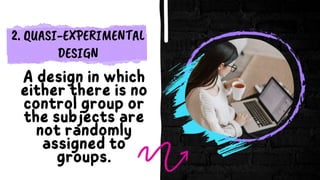
2. QUASI-EXPERIMENTAL
DESIGN
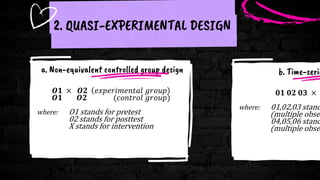
a. Non-equivalent controlled group design
𝑶𝟏 × 𝑶𝟐 𝑒𝑥𝑝𝑒𝑟𝑖𝑚𝑒𝑛𝑡𝑎𝑙 𝑔𝑟𝑜𝑢𝑝
𝑶𝟏 𝑶𝟐 (𝑐𝑜𝑛𝑡𝑟𝑜𝑙 𝑔𝑟𝑜𝑢𝑝)
where: O1 stands for pretest
02 stands for posttest
X stands for intervention
2. QUASI-EXPERIMENTAL DESIGN
𝟎𝟏 𝟎𝟐 𝟎𝟑 ×
where: 01,02,03 stand
(multiple obser
04,05,06 stand
(multiple obser
b. Time-serie
olled group design
𝑚𝑒𝑛𝑡𝑎𝑙 𝑔𝑟𝑜𝑢𝑝
𝑜𝑛𝑡𝑟𝑜𝑙 𝑔𝑟𝑜𝑢𝑝)
retest
osttest
ervention
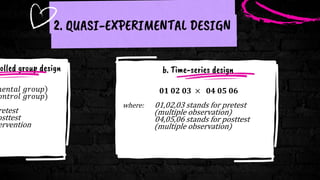
2. QUASI-EXPERIMENTAL DESIGN
𝟎𝟏 𝟎𝟐 𝟎𝟑 × 𝟎𝟒 𝟎𝟓 𝟎𝟔
where: 01,02,03 stands for pretest
(multiple observation)
04,05,06 stands for posttest
(multiple observation)
b. Time-series design
3. PRE-EXPERIMENTAL
DESIGN
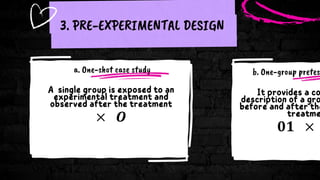
a. One-shot case study
× 𝑶
3. PRE-EXPERIMENTAL DESIGN
b. One-group pretes
𝟎𝟏 ×
se study
𝑶
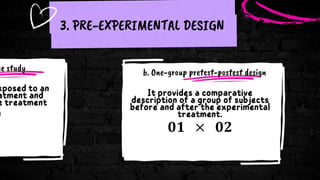
3. PRE-EXPERIMENTAL DESIGN
b. One-group pretest-postest design
𝟎𝟏 × 𝟎𝟐
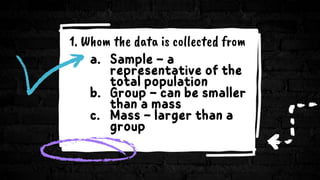
1. Whom the data is collected from
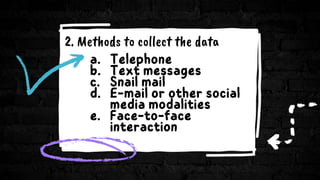
2. Methods to collect the data
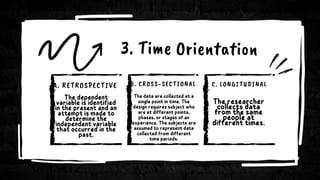
A. RETROSPECTIVE B. CROSS-SECTIONAL C. LONGITUDINAL
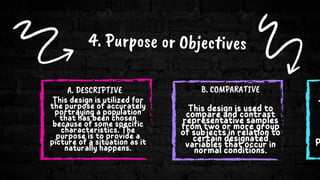
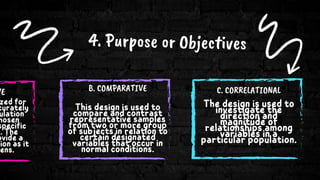
A. DESCRIPTIVE B. COMPARATIVE
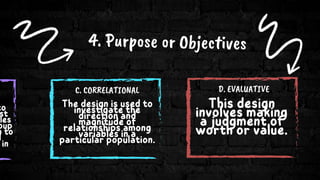
VE B. COMPARATIVE C. CORRELATIONAL
C. CORRELATIONAL D. EVALUATIVE
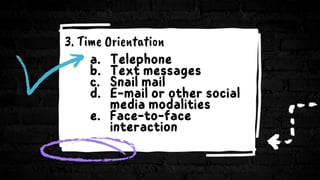
3. Time Orientation
About me
Objectives
MISSION VISION VALUES
Portfolio
RESEARCH PRACTICE IMPROVEMENT
CONCLUSION 1 CONCLUSION 2
Conclusions

Research Design and Methodology PowerPoint presentation