Type B Aortic dissection
Origin Of Type B Dissection
Type B dissection- PIT
• Smooth muscle degeneration
in aortic media.
• Initial event- PIT
• Blood flows within aortic wall
seperating layers of media.
• Outer third of media.
• Left posterolateral wall.
• Antegrade / retrograde propagation.
• Distal reentry multiple- sheared-off ostia of arterial branches – “imperfect natural
cure of the disease”.
Type B Dissection- PAU
• PAU: localized intimal lesion burrowing into media
leading to localized dissection.
• Mushroom cap appearance on CT / MRI Scan
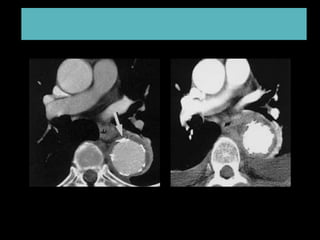
Type B Dissection- IMH
• Spontaneous rupture of vasa vasorum within outer third of aortic media.
• No intimal defect.
• Mechanism- Spontaneously in predisposed individuals
Secondary to rupture of atheromatous plaque
• Type B IMH higher propensity for aortic rupture-
severe symptoms / associated deep PAU
Factors influencing dissection propagation
• Rate of increase of aortic systolic pressure
dP/dT.
• Aortic diastolic elastic recoil pressure.
• Mean arterial pressure.
• Aortic wall integrity.
Fate of False Lumen
• Patent false lumen multiple reentry.
• Thrombosis (partial or complete): rare
Fate of False Lumen
• Rupture:
Pleural cavity
Abdomen
• Contained leak.
• Proximal extension:
Retro-A Dissection.
Fate Of False Lumen
• Visceral malperfusion:
Paraplegia.
Renal ischemia.
Mesenteric ischemia.
Limb ischemia
• Obstruction to flow-
dynamic / static obstruction.
• Pseudoaneurysm: False
lumen prone for progressive
expansion.
AIMS of Investigation
• Confirm diagnosis.
Type of dissection
Extent of dissection.
Location of PIT.
• Aortic branch compromise-
Thoracoabdominal visceral malperfusion
Peripheral limb ischemia.
• Coronary evaluation.
True Vs False Lumen
C.T. Angiography
• Rapid, non invasive
• Confirms diagnosis:
Two distinct lumens in DTA separated by intimal flap.
Displaced intimal calcification.
C.T. Angiography
• Location of PIT.
• Thrombosis of false
lumen
C.T. Angiography
• Extent of dissection
C.T. Angiography
• Perfusion status of
individual branches.
C.T. Angiography
Involvement of limb
vessels
Compression of true
lumen
C.T. Angiography
Active extravasation PAU / IMH / Hemothorax
C.T. Angiography
CT
Angiography
Sensitivity Specificity Positive
predictive
value
Negative
predicitve
value
82 - 100 % 89 – 100 % 80% 98%
• Drawback: Intravenous Contrast
administration
Trans Esophageal Echocardiography
• Rapid, convinent, non-invasive.
• Intimal flap, PIT, secondary
fenestrations.
• Limitations:
Abdominal branch vessel
involvement.
Extent of dissection below
diaphragm.
M.R.A
• Delineate entire thoracoabdominal aorta.
• Demonstrate intimal flap, TL, FL.
• Involvement of major aortic branches.
• High sensitivity and specificity.
• Not suitable for critically ill patients.
• Useful for long term follow up of chronic
dissection and post-operative or medically
treated patients.
Aortography
• Diagnostic importance- Historical.
• Invasive, time consuming.
• Contrast use, technique carries risk of morbidity and mortality.
• Indication:
Persistent peripheral vascular complication after proximal
aortic repair, to delineate mechanism of aortic branch vessel
compromise before endovascular intervention.
Additional Investigations
• Renal USG and Doppler:
Renal parenchymal assessment.
Renal doppler
• Doppler for lower limb arterial system.
• Cardiac fuction evaluation:
ECHO
CT Coronary
Intra Vascular Ultrasound (IVUS)
• Novel technique.
• Highest accuracy.
• Imporatant in
endovascular
treatment
Management strategy
• Aim of therapy-
Prevent death
Prevent irreversible end organ damage.
• Optimal treatment strategy- debated ????
Optimal treatment strategy ???
Optimal treatment strategy???
Approach to type B Dissection
Arguments in favour of medical treatment
• Medical treatment prevents death in majority.
• Operative mortality type B dissection high.
• Similar long term outcome of surgically and
medically managed patients.
• “Complication Specific” approach for Type B
Dissection
Indications for Intervention
• Persistent pain.
• Refractory arterial hypertension.
• Progression / expansion of dissection.
• Aortic rupture / impending rupture.
• Impaired distal organ perfusion.
• Sizable localized false aneurysm.
• Young with CTD- Marfan syndrome without complications.
Management Strategy for IMH
• Uncomplicated Type B IMH: Medical.
• Type B IMH with persistent pain / associated
large – deep PAU: high incidence of aortic
rupture.
• Intervention for complicated Type B IMH
Initial Medical Treatment
• Goal of medical treatment:
Relieve pain.
Control blood pressure.
Limit extension of dissection.
• Extensive monitoring:
• ECG / Radial – Femoral arterial line / CVP /
Pulse Oxymeter / Foley catheter.
Anti impulsive therapy
• Target: Mean arterial pressure = 60 – 75mmhg
Systolic presure = 100 – 110mm hg
Heart rate = 60 – 80bpm
• Eliminate Pain: Morphine.
• Beta blockade:
Esmolol- 500mcg/kg iv bolus
50 mcg/kg/min infusion (max 200mcg/kg/min)
Propranolol – 1mg every 5 min to achieve target HR
(max 10 mg)
• SNP – 20 mcg/min (max 800mcg/min)
• Refractory hypertension: ACEI - Enalapril
Definitive long term medical management
• Oral beta blockers-
Labetalol, Metoprolol, Atenolol.
• Calcium channel antagonists.
• Oral ACEI / ARB
Lisinopril.
• Hydralizine avoided-
Incorporated into mucopolysaccharides of media and
weaken aortic wall.
Aims Of Intervention
(Surgical / Endovascular)
• Seal the entry Point.
• Seal area of leak (if any).
• Establish perfusion to branch arteries.
• Expansion of true lumen and obliteration of false
lumen.
Surgical Principles
Acute Type B Dissection
No visceral malperfusion Visceral malperfusion
Replace the tear point Fenestation
Graft replacement
with visceral
artery reconstruction
Surgical Approach
• Full CPB
• Venous Cannulation- Right Femoral Vein.
• Arterial Cannulation- Left subclavian artery.
Undissected ascending aorta
Descending aortic true lumen
• Moderate hypothermia 25 – 28oC.
• Open Proximal Anastamosis (OPA) in distal arch
under HCA.
Management of visceral malperfusion
Aortic dissection + Visceral malperfusion
Dynamic Obstruction Static Obstruction
Visceral artery Visceral artery
from true lumen from false lumen
Central aortic repair Central aortic repair
visceral artery revascularisation
Surgical fenestration
Mortality according to indication for surgery
Endovascular treatment
• JACC 2008
Endovascular therapy
• Medical management
70% patients- persistent patent false lumen
20 – 30% eventually aneurysmal
• Surgical replacement:
High mortality – 20 – 30%
Visceral ischemia – 30 – 50%
Endovascular treatment
• Balloon Fenestration.
• Stenting
• Stent grafting
Endovascular Balloon Fenestration
Visceral malperfusion- Stenting
Stent Graft
Stent Grafting
Penetrating Atherosclerotic Ulcer
Future developments in endovascular repair
Thank you

Type B AORTIC DISSECTION

  • 1.
    Type B Aorticdissection
  • 2.
    Origin Of TypeB Dissection
  • 3.
    Origin Of TypeB Dissection
  • 4.
    Type B dissection-PIT • Smooth muscle degeneration in aortic media. • Initial event- PIT • Blood flows within aortic wall seperating layers of media. • Outer third of media. • Left posterolateral wall. • Antegrade / retrograde propagation. • Distal reentry multiple- sheared-off ostia of arterial branches – “imperfect natural cure of the disease”.
  • 5.
    Type B Dissection-PAU • PAU: localized intimal lesion burrowing into media leading to localized dissection. • Mushroom cap appearance on CT / MRI Scan
  • 6.
    Type B Dissection-IMH • Spontaneous rupture of vasa vasorum within outer third of aortic media. • No intimal defect. • Mechanism- Spontaneously in predisposed individuals Secondary to rupture of atheromatous plaque • Type B IMH higher propensity for aortic rupture- severe symptoms / associated deep PAU
  • 7.
    Factors influencing dissectionpropagation • Rate of increase of aortic systolic pressure dP/dT. • Aortic diastolic elastic recoil pressure. • Mean arterial pressure. • Aortic wall integrity.
  • 8.
    Fate of FalseLumen • Patent false lumen multiple reentry. • Thrombosis (partial or complete): rare
  • 9.
    Fate of FalseLumen • Rupture: Pleural cavity Abdomen • Contained leak. • Proximal extension: Retro-A Dissection.
  • 10.
    Fate Of FalseLumen • Visceral malperfusion: Paraplegia. Renal ischemia. Mesenteric ischemia. Limb ischemia • Obstruction to flow- dynamic / static obstruction. • Pseudoaneurysm: False lumen prone for progressive expansion.
  • 11.
    AIMS of Investigation •Confirm diagnosis. Type of dissection Extent of dissection. Location of PIT. • Aortic branch compromise- Thoracoabdominal visceral malperfusion Peripheral limb ischemia. • Coronary evaluation.
  • 12.
  • 13.
    C.T. Angiography • Rapid,non invasive • Confirms diagnosis: Two distinct lumens in DTA separated by intimal flap. Displaced intimal calcification.
  • 14.
    C.T. Angiography • Locationof PIT. • Thrombosis of false lumen
  • 15.
  • 16.
    C.T. Angiography • Perfusionstatus of individual branches.
  • 17.
    C.T. Angiography Involvement oflimb vessels Compression of true lumen
  • 18.
  • 19.
    C.T. Angiography CT Angiography Sensitivity SpecificityPositive predictive value Negative predicitve value 82 - 100 % 89 – 100 % 80% 98% • Drawback: Intravenous Contrast administration
  • 20.
    Trans Esophageal Echocardiography •Rapid, convinent, non-invasive. • Intimal flap, PIT, secondary fenestrations. • Limitations: Abdominal branch vessel involvement. Extent of dissection below diaphragm.
  • 21.
    M.R.A • Delineate entirethoracoabdominal aorta. • Demonstrate intimal flap, TL, FL. • Involvement of major aortic branches. • High sensitivity and specificity. • Not suitable for critically ill patients. • Useful for long term follow up of chronic dissection and post-operative or medically treated patients.
  • 22.
    Aortography • Diagnostic importance-Historical. • Invasive, time consuming. • Contrast use, technique carries risk of morbidity and mortality. • Indication: Persistent peripheral vascular complication after proximal aortic repair, to delineate mechanism of aortic branch vessel compromise before endovascular intervention.
  • 23.
    Additional Investigations • RenalUSG and Doppler: Renal parenchymal assessment. Renal doppler • Doppler for lower limb arterial system. • Cardiac fuction evaluation: ECHO CT Coronary
  • 24.
    Intra Vascular Ultrasound(IVUS) • Novel technique. • Highest accuracy. • Imporatant in endovascular treatment
  • 25.
    Management strategy • Aimof therapy- Prevent death Prevent irreversible end organ damage. • Optimal treatment strategy- debated ????
  • 26.
  • 27.
  • 28.
    Approach to typeB Dissection Arguments in favour of medical treatment • Medical treatment prevents death in majority. • Operative mortality type B dissection high. • Similar long term outcome of surgically and medically managed patients. • “Complication Specific” approach for Type B Dissection
  • 29.
    Indications for Intervention •Persistent pain. • Refractory arterial hypertension. • Progression / expansion of dissection. • Aortic rupture / impending rupture. • Impaired distal organ perfusion. • Sizable localized false aneurysm. • Young with CTD- Marfan syndrome without complications.
  • 30.
    Management Strategy forIMH • Uncomplicated Type B IMH: Medical. • Type B IMH with persistent pain / associated large – deep PAU: high incidence of aortic rupture. • Intervention for complicated Type B IMH
  • 31.
    Initial Medical Treatment •Goal of medical treatment: Relieve pain. Control blood pressure. Limit extension of dissection. • Extensive monitoring: • ECG / Radial – Femoral arterial line / CVP / Pulse Oxymeter / Foley catheter.
  • 32.
    Anti impulsive therapy •Target: Mean arterial pressure = 60 – 75mmhg Systolic presure = 100 – 110mm hg Heart rate = 60 – 80bpm • Eliminate Pain: Morphine. • Beta blockade: Esmolol- 500mcg/kg iv bolus 50 mcg/kg/min infusion (max 200mcg/kg/min) Propranolol – 1mg every 5 min to achieve target HR (max 10 mg) • SNP – 20 mcg/min (max 800mcg/min) • Refractory hypertension: ACEI - Enalapril
  • 33.
    Definitive long termmedical management • Oral beta blockers- Labetalol, Metoprolol, Atenolol. • Calcium channel antagonists. • Oral ACEI / ARB Lisinopril. • Hydralizine avoided- Incorporated into mucopolysaccharides of media and weaken aortic wall.
  • 34.
    Aims Of Intervention (Surgical/ Endovascular) • Seal the entry Point. • Seal area of leak (if any). • Establish perfusion to branch arteries. • Expansion of true lumen and obliteration of false lumen.
  • 35.
    Surgical Principles Acute TypeB Dissection No visceral malperfusion Visceral malperfusion Replace the tear point Fenestation Graft replacement with visceral artery reconstruction
  • 36.
    Surgical Approach • FullCPB • Venous Cannulation- Right Femoral Vein. • Arterial Cannulation- Left subclavian artery. Undissected ascending aorta Descending aortic true lumen • Moderate hypothermia 25 – 28oC. • Open Proximal Anastamosis (OPA) in distal arch under HCA.
  • 41.
    Management of visceralmalperfusion Aortic dissection + Visceral malperfusion Dynamic Obstruction Static Obstruction Visceral artery Visceral artery from true lumen from false lumen Central aortic repair Central aortic repair visceral artery revascularisation
  • 42.
  • 43.
    Mortality according toindication for surgery
  • 44.
  • 45.
    Endovascular therapy • Medicalmanagement 70% patients- persistent patent false lumen 20 – 30% eventually aneurysmal • Surgical replacement: High mortality – 20 – 30% Visceral ischemia – 30 – 50%
  • 46.
    Endovascular treatment • BalloonFenestration. • Stenting • Stent grafting
  • 47.
  • 48.
  • 49.
  • 50.
  • 51.
  • 53.
  • 54.
    Future developments inendovascular repair
  • 55.
    Future developments inendovascular repair
  • 56.
    Future developments inendovascular repair
  • 57.