AORTIC DISSECTION &
AORTIC RELATED
SYNDROMES
Shauqi Norizan
Supervisor : Dr Asmalia Khalid
OUTLINES
• Introduction
• Prevalence
• Anatomy
• Pathophysiology
• Classification
• Risk factors
• Clinical Manifestation
• Approach
• Investigation
• Management
INTRODUCTION
• Aortic disease includes conditions such as:
Chronic aortic aneurysms
Acute aortic syndromes (aortic dissection, intramural hematoma,
penetrating atherosclerotic ulcer, periaotic hematoma, intimal tear
without tear, aortic trauma)
Congenital aortic abnormalities (Marfan’s syndrome and
coarctation of the aorta)
• The incidence of aortic diseases is expected to rise with the
increasing age of the population
ANATOMY
Divided into 4 section:
• Ascending aorta
 left and right coronary artery
• Aortic arch
 brachiocephalic trunk/left common carotid artery/ left subclavian artery
• Descending aorta
 bronchial arteries/mediasternal artery/oesophageal artery/pericardial
artery/superior phrenic artery/ intercostal and subcostal artery
• Abdominal aorta
 inferior phrenic artery/ superior mesenteric artery/inferior mesenteric
arteries/ celiac trunk/ suprarenal /renal artery/gonadal artery/lumbar
artery/common celiac artery
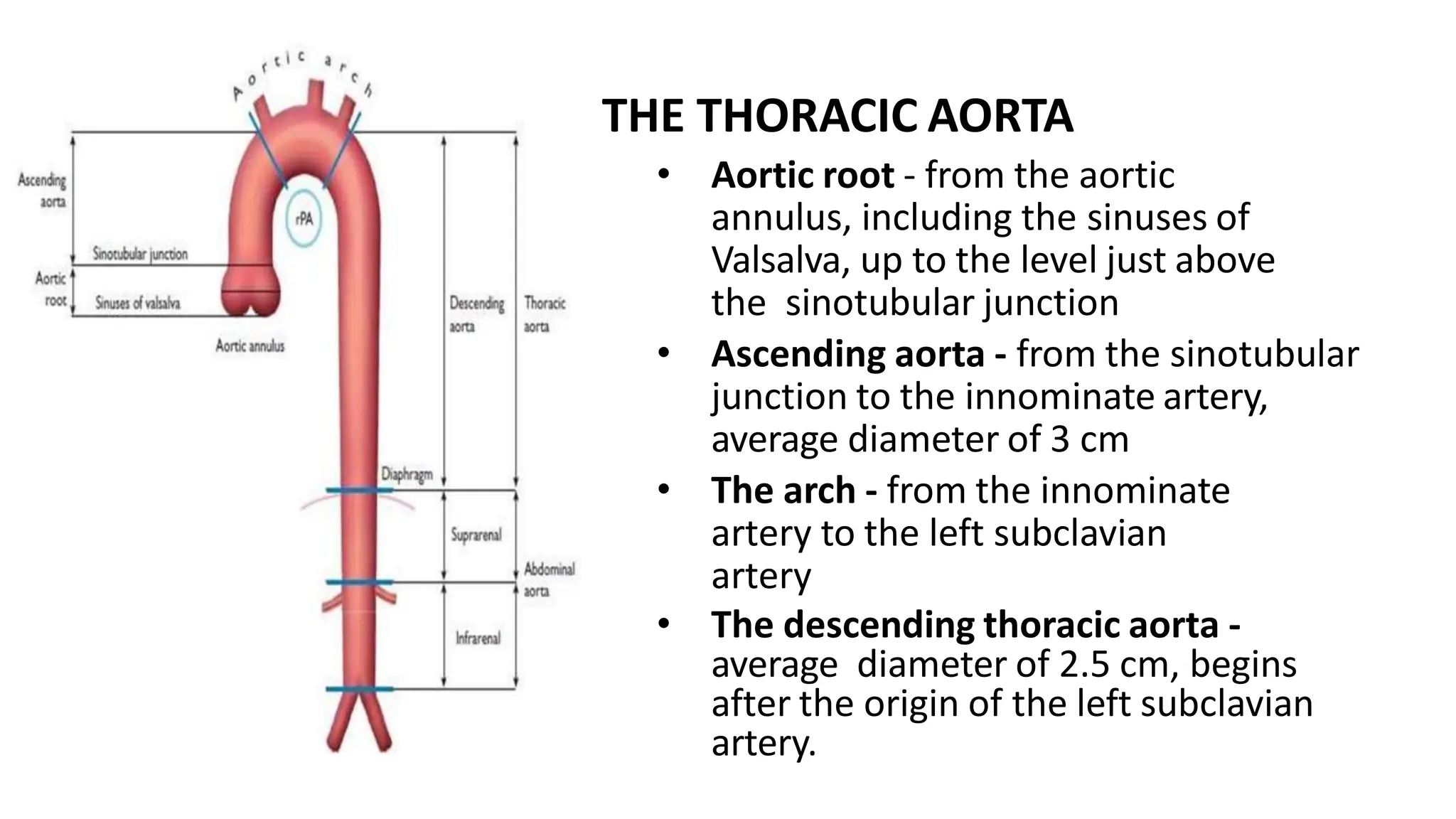
THE THORACIC AORTA
• Aortic root - from the aortic
annulus, including the sinuses of
Valsalva, up to the level just above
the sinotubular junction
• Ascending aorta - from the sinotubular
junction to the innominate artery,
average diameter of 3 cm
• The arch - from the innominate
artery to the left subclavian
artery
• The descending thoracic aorta -
average diameter of 2.5 cm, begins
after the origin of the left subclavian
artery.
THE ABDOMINAL AORTA
• Begins when the descending thoracic aorta passes through
the diaphragm.
• The abdominal aorta (average diameter 2.0 cm) is further
branches into Suprarenal and Infrarenal portion
HISTOLOGY
It is composed of three layers:
• The intima - is the innermost layer and includes the
single-layered endothelium.
• The media - is the thickest layer of the aortic wall and is
composed of sheets of elastic tissue, smooth muscle cells,
and collagen, which provide the aorta with its tensile
strength and distensibility.
• The adventitia - is the outermost layer; it is composed
of loose connective tissue and contains the vasa
vasorum, which constitutes the blood supply to the
aortic wall
AORTIC DISSECTION
• Separation of the layers of the aortic wall due to an intimal
tear
• Involves splitting of the aortic wall within the media,
which results in the formation of an aortic false lumen that
courses along with a true lumen.
• The hallmark of aortic dissection is an intimal tear, which
allows access of pulsatile high pressured blood into the
aortic media, separating it from the outer layers. Often, the
so-called intimal flap is usually an intimal-medial flap.
• Often occurs along the
right lateral wall of the
ascending aorta where
the hydraulic shear
stress is high.
• Another common site is the
descending thoracic aorta
just below the ligamentum
arteriosum.
• The initiating event is either a
primary intimal tear with
secondary dissection into the
media or a medial hemorrhage
that dissects into and disrupts
the intima.
• The pulsatile aortic flow then
dissects along the elastic
lamellar plates of the aorta and
creates a false lumen.
• The dissection usually
propagates distally down the
descending aorta and into its
major branches, but it may
propagate proximally
CLASSIFICATION
• 2 commonly used classifications
are De Bakey and Stanford
• Others like Svensson, and the newly
considered classification TEM (Type of
dissection, location of the tear of the
primary Entry and Malperfusion)
Type Extent of Aortic Involvement
DeBakey
I Originates in ascending aorta, propagates to involve descending aorta
II Confined to ascending aorta
IIIa Confined to descending thoracic aorta
IIIb Involves descending aorta, extending to abdominal aorta
Stanford
A Involves ascending aorta
B Restricted to descending aorta
RISK FACTORS
2 categories:
• Condition that contribute to medial degeneration
• Condition that increase aortic wall stress
CLINICAL MANIFESTATION
SYMPTOM
• Acute onset of chest or back
pain (80 to 90 %)
• Severe, sharp, or ‘tearing’ and is
located in the anterior chest
pain for type A
• and in the posterior chest or
back pain for type B.
SIGN
• asymmetry limb pulse
• shock, syncope, acute congestive
heart failure, MI, stroke,
paraplegia, extremity ischemia,
mesenteric ischemia
• aortic regurgitation
• pericardial effusion
• acute coronary syndrome
• Patients typically present with acute onset of pain
• Pain is often most severe at its onset and described as a tearing,
ripping, or stabbing sensation. Often, the pain is migratory, a crucial
component of the history, reflecting propagation of the dissection.
– Involvement of the ascending aorta results in anterior chest or neck pain,
– Involvement of the descending thoracic aorta results in intrascapular
or subscapular pain
– Involvement of thoraco abdominal aortia results in lower back and left
flank pain.
• Hypertension on presentation is common, more so in distal
dissection, although hypotension can be seen if complications have
developed, particularly in proximal dissections.
• The dissection may compromise flow to the great vessels and lead
to pulse deficits.
• If the dissection involves the aortic root, commissural involvement of
the aortic valve can lead to aortic regurgitation. A diastolic murmur
is evident in these cases.
• Dissections can involve the ostia of the coronary arteries,
resulting in acute myocardial ischemia and infarction.
• The dissection can extend proximally into the pericardial space,
resulting in pericardial effusion and tamponade.
• Rupture into the pericardial space represents a common mode of
death in patients with aortic dissection.
• Malperfusion syndromes with acute lower extremity, renal, or
mesenteric ischemia can be seen in descending aortic dissections.
• Focal neurologic deficits can occur with involvement of the great
vessels. Compromise of spinal artery perfusion may result in
paraparesis.
DDX
• acute coronary syndrome
• pulmonary embolus
• spontaneous pneumothorax
• aortic regurgitation without dissection
• oesophageal rupture
• pericarditis
• pleuritis
INVESTIGATION
• Biochemicals
• D-dimer, fbc, busec, electrolytes, LDH, GXM, cardiac biomarkers, coagulation profile
• Electrocradiogram
• can be normal but often shows nonspecific ST-T wave changes. Involvement of the
coronary artery ostia can result in ST-segment elevation, representing an acute
myocardial injury pattern
• Chest radiography
• may be normal in cases of dissection
• Mediastinal widening, present in about 60% of cases
• Rupture into the pleural or pericardial space manifests as pleural effusions or an
enlarged cardiac silhouette
• A 'normal' chest x-ray does not rule out the possibility of
an aortic dissection.
• Chest x-ray sensitivity for the diagnosis of aortic disease is
64%.
• Chest x-ray specificity for the diagnosis of aortic disease is
86%.
• Chest x-ray has particularly low accuracy in the diagnosis of
ascending aortic dissection.
• More definitive diagnostic modalities include
Echocardiography & Ultrasonography, Computed
tomography (CT) and Magnetic resonance angiography
(MRA).
Echocardiography & Ultrasonography
• Is a useful bedside tool for the rapid diagnosis of aortic dissection in
the ED, bedside, fast, no need contrast, no radiation
• TEE is more superior than TTE but need a skillful operator.
• The aortic root dilatation seen on the PSLA view & the presence of an
intimal flap seen on either transthoracic or transabdominal views of
the aorta are both highly sensitive for aortic dissection
• TTE can measure aortic root via parasternal long-axis view or apical
view. Aortic valves can also be assessed.
• Suprasternal view can visualise aortic arch with three major vessel
• Subcostal view can depict abdominal aorta.
• Dx of AD require identification of flap – major limitation due to
frequent artefact
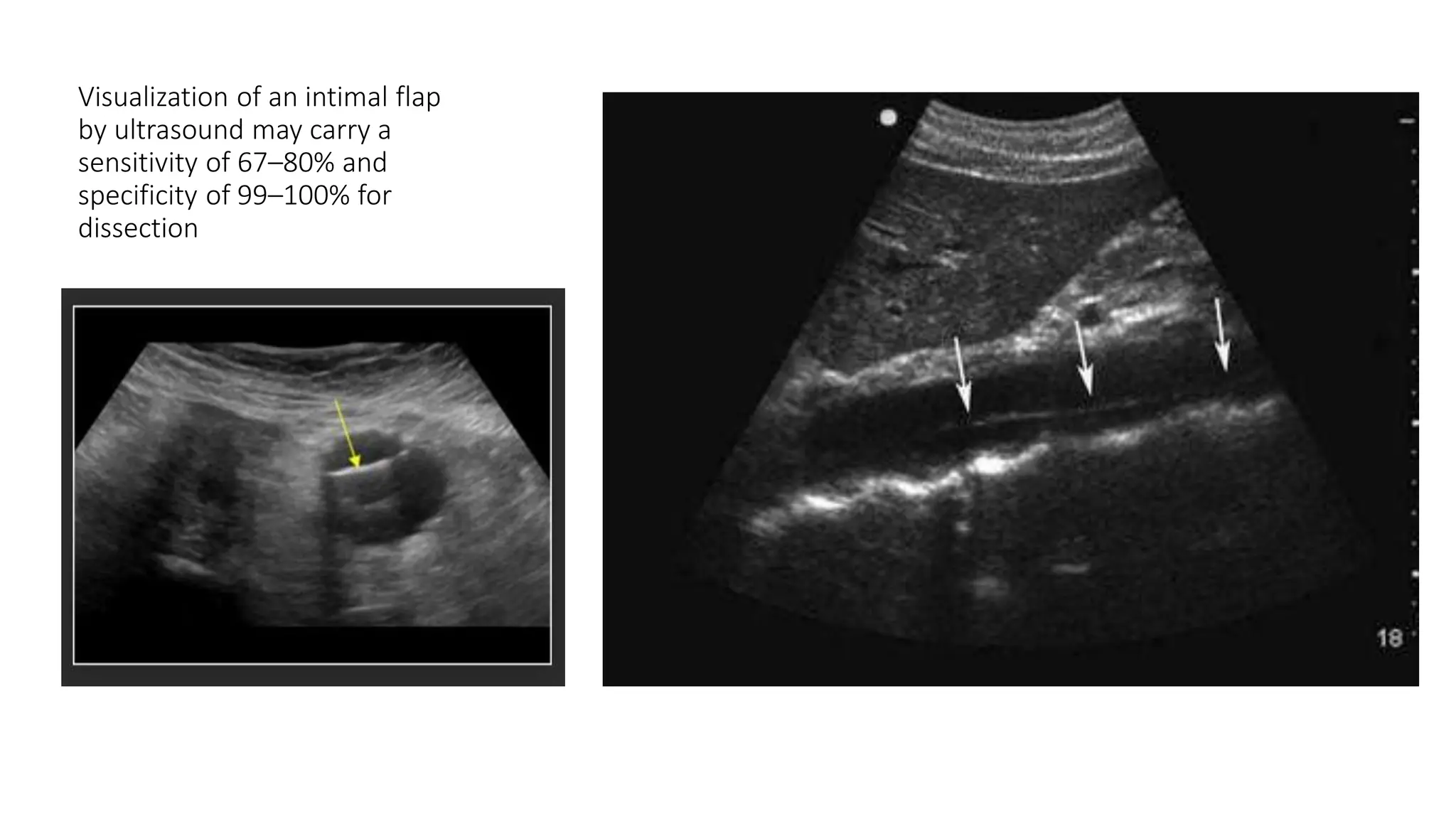
Visualization of an intimal flap
by ultrasound may carry a
sensitivity of 67–80% and
specificity of 99–100% for
dissection
CT & MRI
• CT and MRI are both highly accurate in identifying the intimal flap
and the extent of the dissection and involvement of major arteries;
each has a sensitivity and specificity >90%
• Contrast enhancement can visualised hemopericardium, aortic
rupture and branch vessel involvement.
MANAGEMENT
1. Pain management
• IV opioids for analgesia (eg, fentanyl, morphine)
2. Blood pressure control
• Anti – impulsive/anti hypertensive therapy by controlling the blood pressure
to minimize the likelihood of rupture or progression
• Control heart rate <60 BPM
3. Immediate transfer for CTVS or endovascular intervention
Choice of anti hypertensive agent: B-blocker
• Esmolol :250 to 500 mcg/kg IV loading dose, then infuse at 25 to 50
mcg/kg/minute; titrate to maximum dose of 300 mcg/kg/minute)
• Labetolol (20 mg IV initially, followed by either 20 to 80 mg IV boluses
every 10 minutes to a maximal dose of 300 mg, or an infusion of 0.5 to 2
mg/minute IV)
If Beta blockers are not tolerated, alternatives are verapamil, diltiazem, or
nicardipine.
• IF SBP >120 mmHg, initiate nitroprusside infusion (0.25 to 0.5
mcg/kg/minute titrated to a maximum of 10 mcg/kg/minute) or
nicardipine infusion (2.5 to 5 mg/hour titrated to a maximum of 15
mg/hour)
• Vasodilator therapy (eg, nitroprusside, nicardipine) should not be used
without first controlling heart rate with beta blockade.
CONSULTATION
• Aortic dissection involving the ascending aorta is a cardiac surgical
emergency
• Aortic dissection involving only the descending thoracic aorta or
abdominal aorta and with evidence of malperfusion is treated with
urgent aortic stent-grafting or surgery.
• Aortic dissection involving only the descending thoracic aorta or
abdominal aorta without evidence for ischemia is admitted to the
ICU/medical for medical management of hemodynamics and serial
aortic imaging.
• If appropriate surgical services◊ are not available, initiate emergent
transfer to nearest available cardiovascular center.
AORTIC ANEURYSM
• Aortic aneurysm, refers to enlargement of
the aorta beyond its normal diameter.
• A segment of the aorta is called aneurysmal if
its maximal diameter is greater than 1.5 times
that of the adjacent proximal normal
segment.
• Fusiform Aneurysm - if it symmetrically
involves the entire circumference of the aorta.
• Saccular aneurysm involves a localized
protrusion of one of an area of the vessel
wall.
CAUSES
• Congenital:- primary connective tissue disorder (Marfan’s, syndrome,
Ehlers- Danlos Syndrome) and other diseases (focal medial agenesis,
tuberious scierosis, Turner’s Syndrome, Menkes’syndrome)
• Mechanical (hemodynamic):-Poststenotic and Arteriovenous fistula
and amputation related.
• Traumatic (pseudoaneurysms): Penetrating arterial injuries blunt arterial
injuries pseudoaneurysms
• Inflammatory (noninfectionus ): Associated with arteritist
(Takayasu’s diseases giant cell arteritis ,systemic lupus erythematosus
,Behcet’s syndrome, Kawasaki’s disease) and periarterial
inflammation (i.e percreatitis).
• Infectious (mycotic ): Bacterial, fungal, spirochetal infections.
• Pregnancy –related degenerative: Nonspecific inflammatory variant
.
• Anastomotic (post-arteriotomy) and graft aneurysms:
Infection, arterial wall failure, suture failure, graft failure.
True Aneursym
• When an aneurysm involves all three layers of the arterial wall or
the attenuated wall of the heart.
• Further divided according to the shape and size into Saccular &
Fusiform aneurysms.
Fasle Aneurysm
• Or pseudoaneurysm, is not an aneusysm but a disruption of all
layers of the arterial wall resulting in bleeding that is contained by
surrounding structure
CLINICAL PRESENTATION
• Often asymptomatic at time of presentation. Physical findings
may also be absent.
• When signs and symptoms occur, they are often the result of
mass effect:
– The enlarging aorta can compress nearby structures, such as the SVC,
trachea, esophagus, and recurrent laryngeal nerve. This can result in
the SVC syndrome, stridor, dysphagia, and hoarseness.
– Progressive dilation of the aortic root can lead to aortic regurgitation,
which may produce symptoms of congestive heart failure.
– Enlargement of the aortic sinuses can lead to narrowing of the
coronary artery ostia, lead to myocardial ischemia/infarction.
– Blood flow can be static in large aneurysms, predisposing to atheroma
and thrombus formation and distal embolization.
DIAGNOSTIC
• Chest X-Ray are useful in demonstrating the mediastinal silhouette
and any abnormal widening of the thoracic aorta.
• Plain X-Ray of the abdomen may show calcification within the wall of
abdominal aorta aneurysms
• Electrocardiogram (ECG)may be performed to rule out evidence of
myocardial infarction (MI)
• Echocardiography assists in the diagnosis of aortic valve insufficiency
related to ascending aortic dilation
EMERGENCY DEPARTMENT CARE &
DISPOSITION
• Stabilize hemodynamics by obtaining large-bore IV access and
administering fluids judiciously to treat hypotension.
• Target a goal systolic blood pressure of 90 mm Hg, and transfuse packed
red blood cells if needed.
• Provide pain control while avoiding hypotension.
• Consult emergently with a vascular surgeon when a rupturing AAA or
aortoenteric fistula is suspected.
• When a small asymptomatic AAA (3.0 to 5.0 cm) is identified as an
incidental finding, refer the patient to see a vascular surgeon.
• Large AAAs (>5.0 cm) are at higher risk for spontaneous rupture and may
warrant close follow-up
AORTIC INTRAMURAL
HEMATOMA
Defined as a hematoma confined
within the medial layer of the
aorta in the absence of a
detectable intimal tear, although
microtears may be present
PENETRATING AORTIC ULCER
• Refers to a region of the aorta (ulcer like
projection) where the aortic intima is denuded
with the lesion progressing through a variable
amount of the aortic wall
• which there may or may not be overlying
thrombus.
• Penetrating aortic ulcers are typically
associated with atherosclerotic changes of the
adjacent aortic wall
Reference
• Tintinalli’s Emergency Medicine Manual 8th Edition: Chapter 42
• UPTODATE, Overview of acute aortic dissection and other acute aortic syndromes
• A review of aortic disease research in Malaysia, Gerald Tan Jack Soon, MBBS1 , Paul Khoo Li Zhi, MBBS1 , Sailesh Mohana Krishnan, MBBS1 ,
Chan Kok Meng John, FRCS CTh2 1 Newcastle University Medical School, Johor, Malaysia, 2 Cardiothoracic Department, Cardiac Vascular
Sentral Kuala Lumpur (CVSKL) Hospital, Kuala Lumpur, Malaysia
• https://www.mdedge.com/emergencymedicine/article/132738/imaging/identification-aortic-dissection-using-limited-bedside
• http://www.meddean.luc.edu/lumen/meded/radio/curriculum/surgery/dissecting_aorta.htm

AORTIC DISSECTION & AORTIC RELATED SYNDROMES 2.pdf

  • 1.
    AORTIC DISSECTION & AORTICRELATED SYNDROMES Shauqi Norizan Supervisor : Dr Asmalia Khalid
  • 2.
    OUTLINES • Introduction • Prevalence •Anatomy • Pathophysiology • Classification • Risk factors • Clinical Manifestation • Approach • Investigation • Management
  • 3.
    INTRODUCTION • Aortic diseaseincludes conditions such as: Chronic aortic aneurysms Acute aortic syndromes (aortic dissection, intramural hematoma, penetrating atherosclerotic ulcer, periaotic hematoma, intimal tear without tear, aortic trauma) Congenital aortic abnormalities (Marfan’s syndrome and coarctation of the aorta) • The incidence of aortic diseases is expected to rise with the increasing age of the population
  • 4.
    ANATOMY Divided into 4section: • Ascending aorta  left and right coronary artery • Aortic arch  brachiocephalic trunk/left common carotid artery/ left subclavian artery • Descending aorta  bronchial arteries/mediasternal artery/oesophageal artery/pericardial artery/superior phrenic artery/ intercostal and subcostal artery • Abdominal aorta  inferior phrenic artery/ superior mesenteric artery/inferior mesenteric arteries/ celiac trunk/ suprarenal /renal artery/gonadal artery/lumbar artery/common celiac artery
  • 5.
    THE THORACIC AORTA •Aortic root - from the aortic annulus, including the sinuses of Valsalva, up to the level just above the sinotubular junction • Ascending aorta - from the sinotubular junction to the innominate artery, average diameter of 3 cm • The arch - from the innominate artery to the left subclavian artery • The descending thoracic aorta - average diameter of 2.5 cm, begins after the origin of the left subclavian artery.
  • 6.
    THE ABDOMINAL AORTA •Begins when the descending thoracic aorta passes through the diaphragm. • The abdominal aorta (average diameter 2.0 cm) is further branches into Suprarenal and Infrarenal portion
  • 7.
    HISTOLOGY It is composedof three layers: • The intima - is the innermost layer and includes the single-layered endothelium. • The media - is the thickest layer of the aortic wall and is composed of sheets of elastic tissue, smooth muscle cells, and collagen, which provide the aorta with its tensile strength and distensibility. • The adventitia - is the outermost layer; it is composed of loose connective tissue and contains the vasa vasorum, which constitutes the blood supply to the aortic wall
  • 9.
    AORTIC DISSECTION • Separationof the layers of the aortic wall due to an intimal tear • Involves splitting of the aortic wall within the media, which results in the formation of an aortic false lumen that courses along with a true lumen. • The hallmark of aortic dissection is an intimal tear, which allows access of pulsatile high pressured blood into the aortic media, separating it from the outer layers. Often, the so-called intimal flap is usually an intimal-medial flap.
  • 10.
    • Often occursalong the right lateral wall of the ascending aorta where the hydraulic shear stress is high. • Another common site is the descending thoracic aorta just below the ligamentum arteriosum.
  • 11.
    • The initiatingevent is either a primary intimal tear with secondary dissection into the media or a medial hemorrhage that dissects into and disrupts the intima. • The pulsatile aortic flow then dissects along the elastic lamellar plates of the aorta and creates a false lumen. • The dissection usually propagates distally down the descending aorta and into its major branches, but it may propagate proximally
  • 12.
    CLASSIFICATION • 2 commonlyused classifications are De Bakey and Stanford • Others like Svensson, and the newly considered classification TEM (Type of dissection, location of the tear of the primary Entry and Malperfusion)
  • 13.
    Type Extent ofAortic Involvement DeBakey I Originates in ascending aorta, propagates to involve descending aorta II Confined to ascending aorta IIIa Confined to descending thoracic aorta IIIb Involves descending aorta, extending to abdominal aorta Stanford A Involves ascending aorta B Restricted to descending aorta
  • 14.
    RISK FACTORS 2 categories: •Condition that contribute to medial degeneration • Condition that increase aortic wall stress
  • 16.
    CLINICAL MANIFESTATION SYMPTOM • Acuteonset of chest or back pain (80 to 90 %) • Severe, sharp, or ‘tearing’ and is located in the anterior chest pain for type A • and in the posterior chest or back pain for type B. SIGN • asymmetry limb pulse • shock, syncope, acute congestive heart failure, MI, stroke, paraplegia, extremity ischemia, mesenteric ischemia • aortic regurgitation • pericardial effusion • acute coronary syndrome
  • 17.
    • Patients typicallypresent with acute onset of pain • Pain is often most severe at its onset and described as a tearing, ripping, or stabbing sensation. Often, the pain is migratory, a crucial component of the history, reflecting propagation of the dissection. – Involvement of the ascending aorta results in anterior chest or neck pain, – Involvement of the descending thoracic aorta results in intrascapular or subscapular pain – Involvement of thoraco abdominal aortia results in lower back and left flank pain. • Hypertension on presentation is common, more so in distal dissection, although hypotension can be seen if complications have developed, particularly in proximal dissections. • The dissection may compromise flow to the great vessels and lead to pulse deficits.
  • 18.
    • If thedissection involves the aortic root, commissural involvement of the aortic valve can lead to aortic regurgitation. A diastolic murmur is evident in these cases. • Dissections can involve the ostia of the coronary arteries, resulting in acute myocardial ischemia and infarction. • The dissection can extend proximally into the pericardial space, resulting in pericardial effusion and tamponade. • Rupture into the pericardial space represents a common mode of death in patients with aortic dissection. • Malperfusion syndromes with acute lower extremity, renal, or mesenteric ischemia can be seen in descending aortic dissections. • Focal neurologic deficits can occur with involvement of the great vessels. Compromise of spinal artery perfusion may result in paraparesis.
  • 20.
    DDX • acute coronarysyndrome • pulmonary embolus • spontaneous pneumothorax • aortic regurgitation without dissection • oesophageal rupture • pericarditis • pleuritis
  • 21.
    INVESTIGATION • Biochemicals • D-dimer,fbc, busec, electrolytes, LDH, GXM, cardiac biomarkers, coagulation profile • Electrocradiogram • can be normal but often shows nonspecific ST-T wave changes. Involvement of the coronary artery ostia can result in ST-segment elevation, representing an acute myocardial injury pattern • Chest radiography • may be normal in cases of dissection • Mediastinal widening, present in about 60% of cases • Rupture into the pleural or pericardial space manifests as pleural effusions or an enlarged cardiac silhouette
  • 25.
    • A 'normal'chest x-ray does not rule out the possibility of an aortic dissection. • Chest x-ray sensitivity for the diagnosis of aortic disease is 64%. • Chest x-ray specificity for the diagnosis of aortic disease is 86%. • Chest x-ray has particularly low accuracy in the diagnosis of ascending aortic dissection. • More definitive diagnostic modalities include Echocardiography & Ultrasonography, Computed tomography (CT) and Magnetic resonance angiography (MRA).
  • 26.
    Echocardiography & Ultrasonography •Is a useful bedside tool for the rapid diagnosis of aortic dissection in the ED, bedside, fast, no need contrast, no radiation • TEE is more superior than TTE but need a skillful operator. • The aortic root dilatation seen on the PSLA view & the presence of an intimal flap seen on either transthoracic or transabdominal views of the aorta are both highly sensitive for aortic dissection • TTE can measure aortic root via parasternal long-axis view or apical view. Aortic valves can also be assessed. • Suprasternal view can visualise aortic arch with three major vessel • Subcostal view can depict abdominal aorta. • Dx of AD require identification of flap – major limitation due to frequent artefact
  • 28.
    Visualization of anintimal flap by ultrasound may carry a sensitivity of 67–80% and specificity of 99–100% for dissection
  • 30.
    CT & MRI •CT and MRI are both highly accurate in identifying the intimal flap and the extent of the dissection and involvement of major arteries; each has a sensitivity and specificity >90% • Contrast enhancement can visualised hemopericardium, aortic rupture and branch vessel involvement.
  • 35.
    MANAGEMENT 1. Pain management •IV opioids for analgesia (eg, fentanyl, morphine) 2. Blood pressure control • Anti – impulsive/anti hypertensive therapy by controlling the blood pressure to minimize the likelihood of rupture or progression • Control heart rate <60 BPM 3. Immediate transfer for CTVS or endovascular intervention
  • 36.
    Choice of antihypertensive agent: B-blocker • Esmolol :250 to 500 mcg/kg IV loading dose, then infuse at 25 to 50 mcg/kg/minute; titrate to maximum dose of 300 mcg/kg/minute) • Labetolol (20 mg IV initially, followed by either 20 to 80 mg IV boluses every 10 minutes to a maximal dose of 300 mg, or an infusion of 0.5 to 2 mg/minute IV) If Beta blockers are not tolerated, alternatives are verapamil, diltiazem, or nicardipine. • IF SBP >120 mmHg, initiate nitroprusside infusion (0.25 to 0.5 mcg/kg/minute titrated to a maximum of 10 mcg/kg/minute) or nicardipine infusion (2.5 to 5 mg/hour titrated to a maximum of 15 mg/hour) • Vasodilator therapy (eg, nitroprusside, nicardipine) should not be used without first controlling heart rate with beta blockade.
  • 37.
    CONSULTATION • Aortic dissectioninvolving the ascending aorta is a cardiac surgical emergency • Aortic dissection involving only the descending thoracic aorta or abdominal aorta and with evidence of malperfusion is treated with urgent aortic stent-grafting or surgery. • Aortic dissection involving only the descending thoracic aorta or abdominal aorta without evidence for ischemia is admitted to the ICU/medical for medical management of hemodynamics and serial aortic imaging. • If appropriate surgical services◊ are not available, initiate emergent transfer to nearest available cardiovascular center.
  • 38.
    AORTIC ANEURYSM • Aorticaneurysm, refers to enlargement of the aorta beyond its normal diameter. • A segment of the aorta is called aneurysmal if its maximal diameter is greater than 1.5 times that of the adjacent proximal normal segment. • Fusiform Aneurysm - if it symmetrically involves the entire circumference of the aorta. • Saccular aneurysm involves a localized protrusion of one of an area of the vessel wall.
  • 39.
    CAUSES • Congenital:- primaryconnective tissue disorder (Marfan’s, syndrome, Ehlers- Danlos Syndrome) and other diseases (focal medial agenesis, tuberious scierosis, Turner’s Syndrome, Menkes’syndrome) • Mechanical (hemodynamic):-Poststenotic and Arteriovenous fistula and amputation related. • Traumatic (pseudoaneurysms): Penetrating arterial injuries blunt arterial injuries pseudoaneurysms
  • 40.
    • Inflammatory (noninfectionus): Associated with arteritist (Takayasu’s diseases giant cell arteritis ,systemic lupus erythematosus ,Behcet’s syndrome, Kawasaki’s disease) and periarterial inflammation (i.e percreatitis). • Infectious (mycotic ): Bacterial, fungal, spirochetal infections. • Pregnancy –related degenerative: Nonspecific inflammatory variant . • Anastomotic (post-arteriotomy) and graft aneurysms: Infection, arterial wall failure, suture failure, graft failure.
  • 41.
    True Aneursym • Whenan aneurysm involves all three layers of the arterial wall or the attenuated wall of the heart. • Further divided according to the shape and size into Saccular & Fusiform aneurysms. Fasle Aneurysm • Or pseudoaneurysm, is not an aneusysm but a disruption of all layers of the arterial wall resulting in bleeding that is contained by surrounding structure
  • 44.
    CLINICAL PRESENTATION • Oftenasymptomatic at time of presentation. Physical findings may also be absent. • When signs and symptoms occur, they are often the result of mass effect: – The enlarging aorta can compress nearby structures, such as the SVC, trachea, esophagus, and recurrent laryngeal nerve. This can result in the SVC syndrome, stridor, dysphagia, and hoarseness. – Progressive dilation of the aortic root can lead to aortic regurgitation, which may produce symptoms of congestive heart failure. – Enlargement of the aortic sinuses can lead to narrowing of the coronary artery ostia, lead to myocardial ischemia/infarction. – Blood flow can be static in large aneurysms, predisposing to atheroma and thrombus formation and distal embolization.
  • 45.
    DIAGNOSTIC • Chest X-Rayare useful in demonstrating the mediastinal silhouette and any abnormal widening of the thoracic aorta. • Plain X-Ray of the abdomen may show calcification within the wall of abdominal aorta aneurysms • Electrocardiogram (ECG)may be performed to rule out evidence of myocardial infarction (MI) • Echocardiography assists in the diagnosis of aortic valve insufficiency related to ascending aortic dilation
  • 46.
    EMERGENCY DEPARTMENT CARE& DISPOSITION • Stabilize hemodynamics by obtaining large-bore IV access and administering fluids judiciously to treat hypotension. • Target a goal systolic blood pressure of 90 mm Hg, and transfuse packed red blood cells if needed. • Provide pain control while avoiding hypotension. • Consult emergently with a vascular surgeon when a rupturing AAA or aortoenteric fistula is suspected. • When a small asymptomatic AAA (3.0 to 5.0 cm) is identified as an incidental finding, refer the patient to see a vascular surgeon. • Large AAAs (>5.0 cm) are at higher risk for spontaneous rupture and may warrant close follow-up
  • 47.
    AORTIC INTRAMURAL HEMATOMA Defined asa hematoma confined within the medial layer of the aorta in the absence of a detectable intimal tear, although microtears may be present
  • 48.
    PENETRATING AORTIC ULCER •Refers to a region of the aorta (ulcer like projection) where the aortic intima is denuded with the lesion progressing through a variable amount of the aortic wall • which there may or may not be overlying thrombus. • Penetrating aortic ulcers are typically associated with atherosclerotic changes of the adjacent aortic wall
  • 49.
    Reference • Tintinalli’s EmergencyMedicine Manual 8th Edition: Chapter 42 • UPTODATE, Overview of acute aortic dissection and other acute aortic syndromes • A review of aortic disease research in Malaysia, Gerald Tan Jack Soon, MBBS1 , Paul Khoo Li Zhi, MBBS1 , Sailesh Mohana Krishnan, MBBS1 , Chan Kok Meng John, FRCS CTh2 1 Newcastle University Medical School, Johor, Malaysia, 2 Cardiothoracic Department, Cardiac Vascular Sentral Kuala Lumpur (CVSKL) Hospital, Kuala Lumpur, Malaysia • https://www.mdedge.com/emergencymedicine/article/132738/imaging/identification-aortic-dissection-using-limited-bedside • http://www.meddean.luc.edu/lumen/meded/radio/curriculum/surgery/dissecting_aorta.htm