Raja Lahiri
Introduction
 Angiography: Visualisation of the vascular bed via X-
ray/MRI with contrast injection
 Conventional
 CT
 MRA
 Conventional CAG: Current gold standard
History
1927
• Egas Moniz: Cerebral angiography
1929
• Werner Forssmann: Cardiac
catheterisation
1940
• Andre Cournand and Dickinson Richards:
Catheterisation and hemodynamics
History
 Initial attempts focussed on non
selective contrast injections in
aortic root
 Selective injections feared with
risk of ventricular fibrillation
based on animal studies
 Transient cardiac arrest with aortic
occlusion with balloon was used to
obtain better quality images
 1958: Accidental injection of
contrast in right coronary artery by
Dr. Mason Sones and his associateDr. F. Mason Sones
History
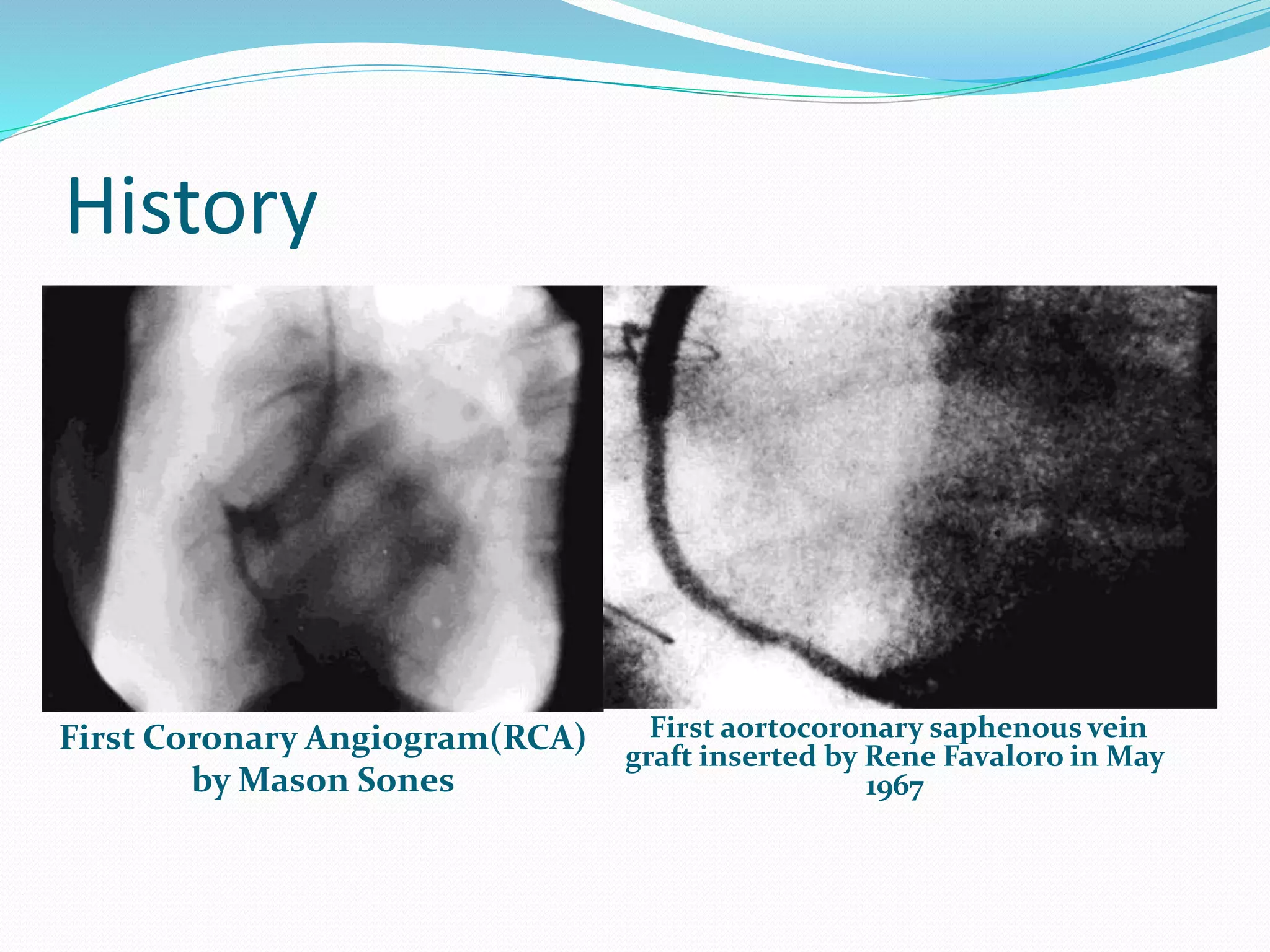
First Coronary Angiogram(RCA)
by Mason Sones
First aortocoronary saphenous vein
graft inserted by Rene Favaloro in May
1967
Indications
 Established CAD:
 To define coronary anatomy and formulate management
plan
 Emergent revascularisation in STEMI
 To confirm non invasive diagnosis of CAD
 Left ventricular dysfunction, ventricular arrhythmias,
ambiguous non invasive test results, out of hospital
cardiac arrest survivors
 Pre Surgical evaluation
Contraindications
 No absolute contraindication
 Anemia
 Renal dysfunction
 Active infection
 High bleeding risk
 Contrast Allergy
Cardiac catheterisation laboratory
Coronary angiography catheters
Contrast material
 High osmolality ionic contrast media:
 Not used nowadays
 High incidence of adverse events
 Low osmolar non ionic contrast agents:
 Most commonly used agent
 Well tolerated
 Iso osmolar non ionic contrast agents
Femoral
 Most frequently used access site
 Ease of access, lesser contrast and radiation exposure,
freedom to upgrade to bigger size sheaths
 Need for immobilisation, local site complications:
main drawbacks
Femoral
Access technique
Radial
 No need for immobilisation
 Lower rate of local vascular complications
 Increasingly being used as primary access site
 Slightly higher contrast and radiation exposure with
beginners
 Spasm, loops, failure to get access may require switch to
femoral route
Radial access tools
Radial access
Access sites (Other)
 Brachial
 Ulnar
 Radial in anatomical snuffbox
Angiography techniques
 Prior heparinisation
 Hemodynamic monitoring (Utmost important)
 Always check for pressure damping/ventricularisation
before injection
 Beware of air and clots
Contrast Injection
 Left coronary artery: 6-8ml over 2-3 seconds
 Right coronary artery: 4-6ml over 2-3 seconds
 Should be adequate to fill the coronary artery completely
without streaming
 Excessive contrast injection should be avoided
 Cine acquisition (@10fps) should continue till contrast
clears from the system
Angiographic projections
Angiographic views of the left coronary artery
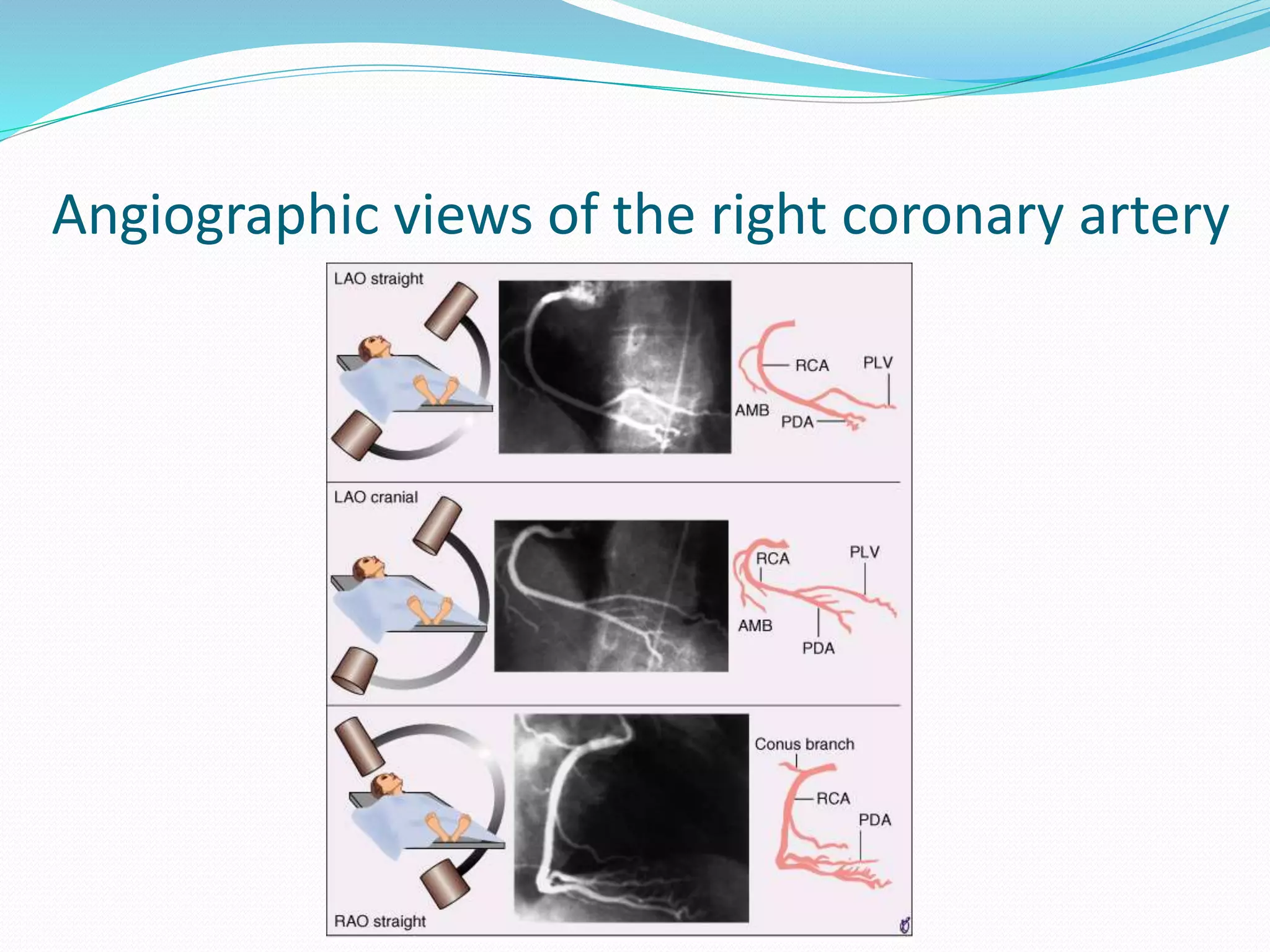
Angiographic views of the right coronary artery
Angiographic projections
Left coronary artery angiogram
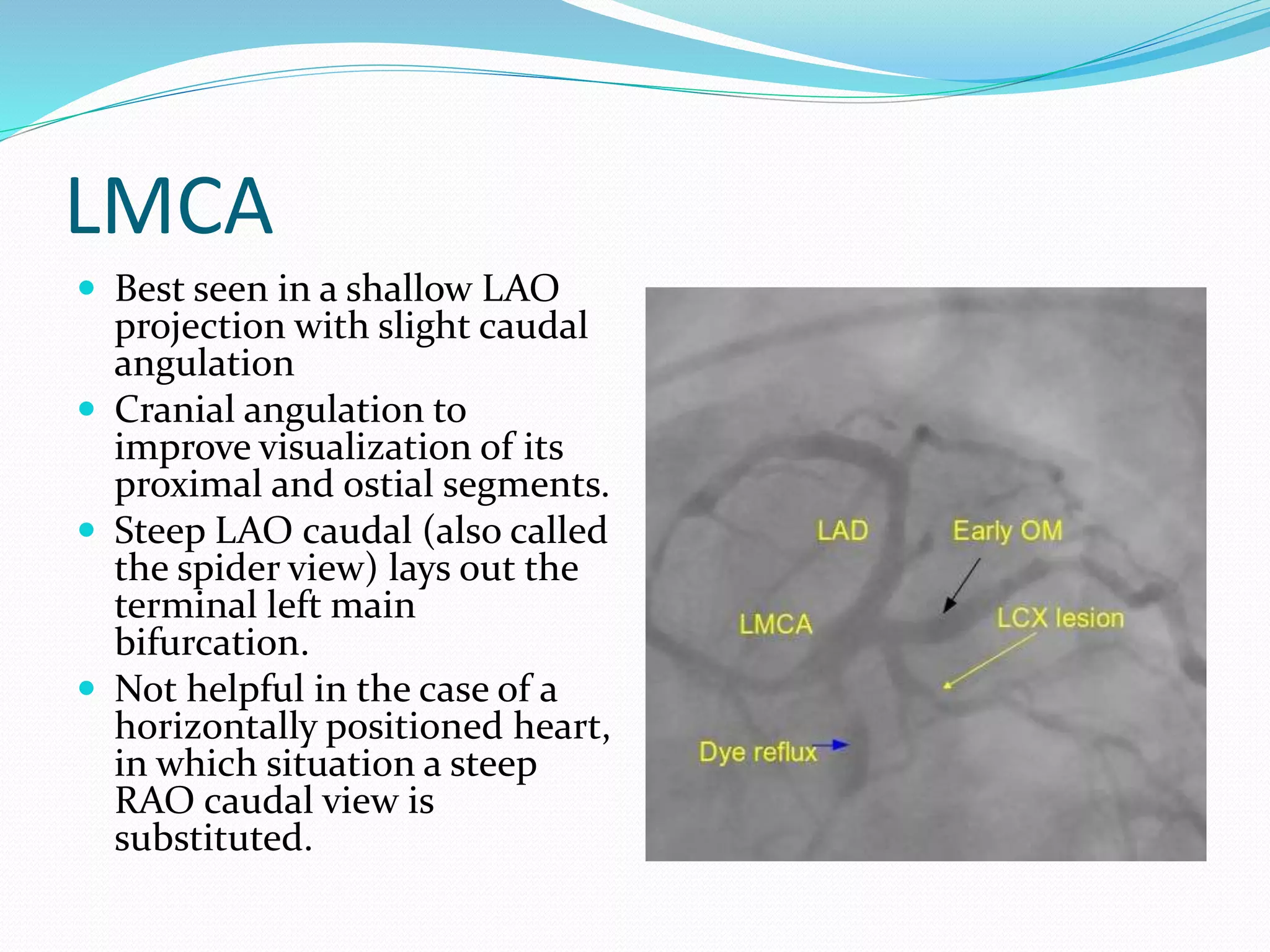
LMCA
 Best seen in a shallow LAO
projection with slight caudal
angulation
 Cranial angulation to
improve visualization of its
proximal and ostial segments.
 Steep LAO caudal (also called
the spider view) lays out the
terminal left main
bifurcation.
 Not helpful in the case of a
horizontally positioned heart,
in which situation a steep
RAO caudal view is
substituted.
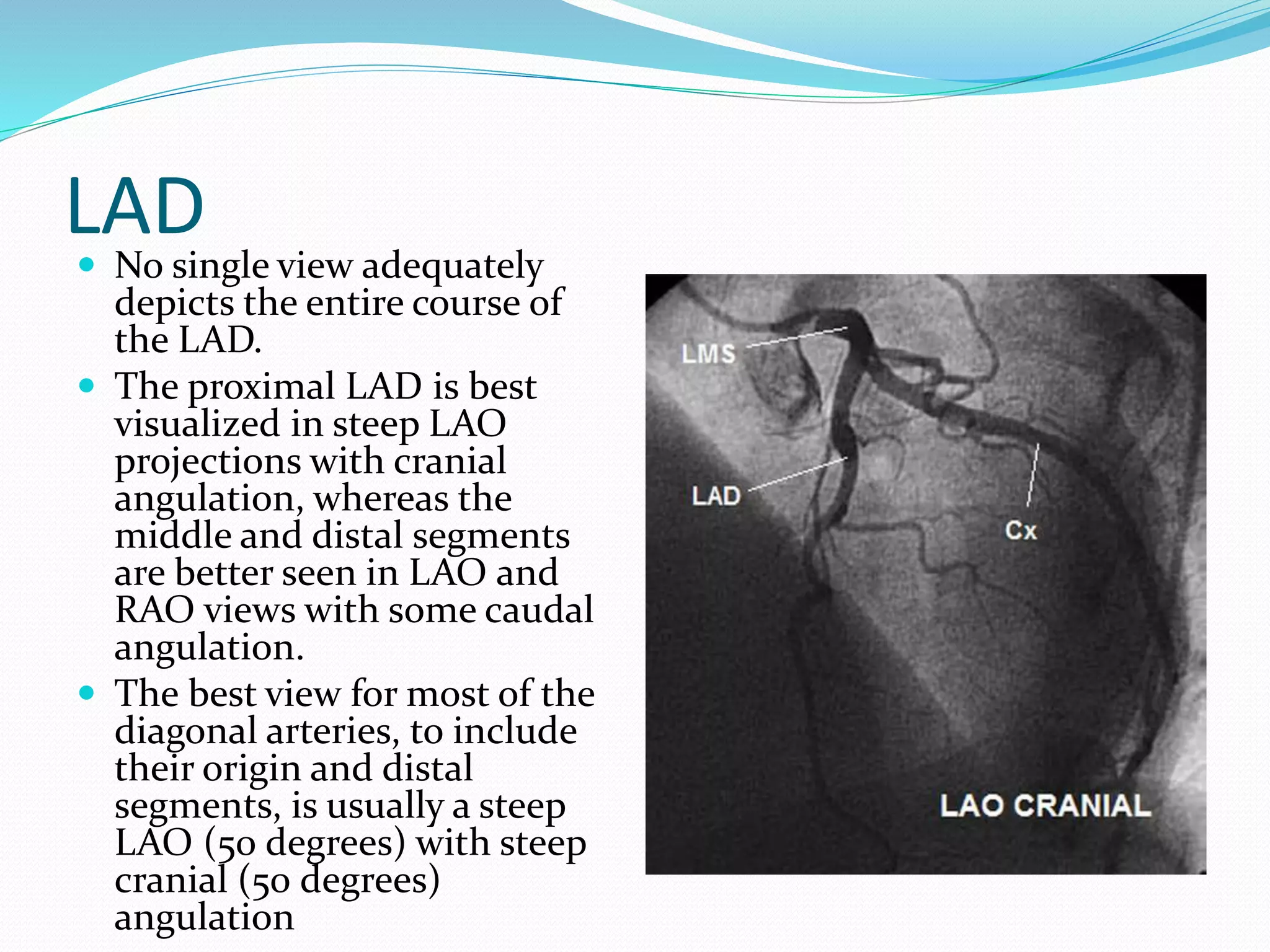
LAD
 No single view adequately
depicts the entire course of
the LAD.
 The proximal LAD is best
visualized in steep LAO
projections with cranial
angulation, whereas the
middle and distal segments
are better seen in LAO and
RAO views with some caudal
angulation.
 The best view for most of the
diagonal arteries, to include
their origin and distal
segments, is usually a steep
LAO (50 degrees) with steep
cranial (50 degrees)
angulation
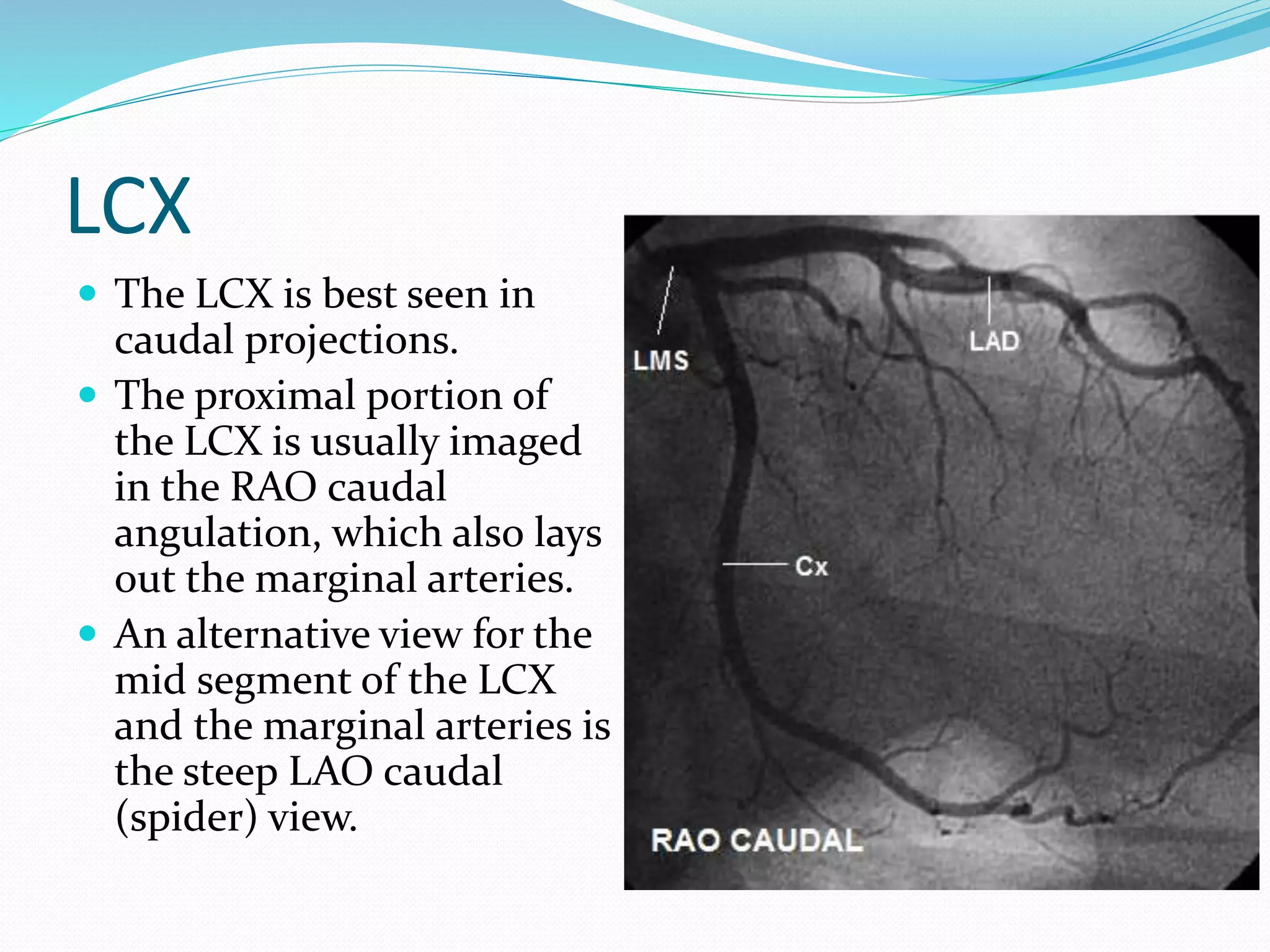
LCX
 The LCX is best seen in
caudal projections.
 The proximal portion of
the LCX is usually imaged
in the RAO caudal
angulation, which also lays
out the marginal arteries.
 An alternative view for the
mid segment of the LCX
and the marginal arteries is
the steep LAO caudal
(spider) view.
Right coronary artery angiogram
RCA The proximal segment of the
RCA is best seen in the flat LAO
angulation.
 For optimal visualization of the
ostium, a steep (50 degrees)
LAO projection is preferred.
 The mid segment of the RCA is
best seen in the LAO and flat
RAO projections.
 The crux, or distal RCA, and the
proximal portions of the right
PDA and PLB arteries are best
seen with an AP or slight LAO
projection with 20 to 30 degrees
of cranial angulation.
 The middle and distal segments
of the right PDA are best
visualized with a flat RAO
projection.
Description of coronary angiograms
• Left
• RightArtery
• LAO
• RAO
• Cranial/Caudal
Projection
• Diseased segment, percentage stenosis, length
• Calcification, thrombus, tortuousity, side branches, distal
vessel size, flow
Lesion
description
• Right/leftDominance
Stenosis
Calcification
Thrombus
Tortuousity
Dissection
Myocardial bridge
Flow
 TIMI grade:
 TIMI 0 flow (no perfusion) refers to the absence of any
antegrade flow beyond a coronary occlusion.
 TIMI 1 flow (penetration without perfusion) is faint
antegrade coronary flow beyond the occlusion, with
incomplete filling of the distal coronary bed.
 TIMI 2 flow (partial reperfusion) is delayed or sluggish
antegrade flow with complete filling of the distal
territory.
 TIMI 3 is normal flow which fills the distal coronary bed
completely
Dominance
Right Dominance Left Dominance Co- Dominance
Coronary anomalies
 Anomalous origin
 From same sinus
 From different sinus
 From other coronary artery
 Single coronary
 Aneurysms
 Coronary fistulas
Coronary anomalies
Coronary aneurysms
Graft Angiography
 JR4: Most commonly used for various grafts
 Amplatz right, LIMA catheter, dedicated bypass graft
catheters may be needed
 Clips at sites of graft may be useful guides
 Prior CTA gives valuable information
 Root angio with pigtail to identify grafts
Graft Angiography
LIMA Angiography
LV angiography
 Not routine nowadays
 Pigtail with contrast injection via power injector
 Done in RAO 30 to estimate LV function and mitral
regurgitation
 Assessment of LVEDP and LV to aorta gradient
LV Angiography
1: Basal 2: Lateral 3: Apical 4: Septal
5: Inferior
basal
Complications
 Local:
 Bleeding
 Hematoma
 Infection
 Pseudoaneurysm
 Compartment Syndrome
 Coronary
 Dissection, embolism, spasm
Complications
 Contrast related
 Contrast nephropathy
 Allergic reactions
 CHF
 Arrhythmias
 Access vessel dissection
 Stroke
 Death
Other coronary imaging modalities
 CTA
 MRA
 IVUS
 OCT (Optical Coherence Tomography)
 Angioscopy
Coronary angiography

Coronary angiography

  • 1.
  • 2.
    Introduction  Angiography: Visualisationof the vascular bed via X- ray/MRI with contrast injection  Conventional  CT  MRA  Conventional CAG: Current gold standard
  • 3.
    History 1927 • Egas Moniz:Cerebral angiography 1929 • Werner Forssmann: Cardiac catheterisation 1940 • Andre Cournand and Dickinson Richards: Catheterisation and hemodynamics
  • 4.
    History  Initial attemptsfocussed on non selective contrast injections in aortic root  Selective injections feared with risk of ventricular fibrillation based on animal studies  Transient cardiac arrest with aortic occlusion with balloon was used to obtain better quality images  1958: Accidental injection of contrast in right coronary artery by Dr. Mason Sones and his associateDr. F. Mason Sones
  • 5.
    History First Coronary Angiogram(RCA) byMason Sones First aortocoronary saphenous vein graft inserted by Rene Favaloro in May 1967
  • 6.
    Indications  Established CAD: To define coronary anatomy and formulate management plan  Emergent revascularisation in STEMI  To confirm non invasive diagnosis of CAD  Left ventricular dysfunction, ventricular arrhythmias, ambiguous non invasive test results, out of hospital cardiac arrest survivors  Pre Surgical evaluation
  • 7.
    Contraindications  No absolutecontraindication  Anemia  Renal dysfunction  Active infection  High bleeding risk  Contrast Allergy
  • 9.
  • 10.
  • 11.
    Contrast material  Highosmolality ionic contrast media:  Not used nowadays  High incidence of adverse events  Low osmolar non ionic contrast agents:  Most commonly used agent  Well tolerated  Iso osmolar non ionic contrast agents
  • 13.
    Femoral  Most frequentlyused access site  Ease of access, lesser contrast and radiation exposure, freedom to upgrade to bigger size sheaths  Need for immobilisation, local site complications: main drawbacks
  • 14.
  • 15.
  • 16.
    Radial  No needfor immobilisation  Lower rate of local vascular complications  Increasingly being used as primary access site  Slightly higher contrast and radiation exposure with beginners  Spasm, loops, failure to get access may require switch to femoral route
  • 17.
  • 18.
  • 19.
    Access sites (Other) Brachial  Ulnar  Radial in anatomical snuffbox
  • 21.
    Angiography techniques  Priorheparinisation  Hemodynamic monitoring (Utmost important)  Always check for pressure damping/ventricularisation before injection  Beware of air and clots
  • 22.
    Contrast Injection  Leftcoronary artery: 6-8ml over 2-3 seconds  Right coronary artery: 4-6ml over 2-3 seconds  Should be adequate to fill the coronary artery completely without streaming  Excessive contrast injection should be avoided  Cine acquisition (@10fps) should continue till contrast clears from the system
  • 23.
  • 25.
    Angiographic views ofthe left coronary artery
  • 26.
    Angiographic views ofthe right coronary artery
  • 27.
  • 28.
  • 29.
    LMCA  Best seenin a shallow LAO projection with slight caudal angulation  Cranial angulation to improve visualization of its proximal and ostial segments.  Steep LAO caudal (also called the spider view) lays out the terminal left main bifurcation.  Not helpful in the case of a horizontally positioned heart, in which situation a steep RAO caudal view is substituted.
  • 30.
    LAD  No singleview adequately depicts the entire course of the LAD.  The proximal LAD is best visualized in steep LAO projections with cranial angulation, whereas the middle and distal segments are better seen in LAO and RAO views with some caudal angulation.  The best view for most of the diagonal arteries, to include their origin and distal segments, is usually a steep LAO (50 degrees) with steep cranial (50 degrees) angulation
  • 31.
    LCX  The LCXis best seen in caudal projections.  The proximal portion of the LCX is usually imaged in the RAO caudal angulation, which also lays out the marginal arteries.  An alternative view for the mid segment of the LCX and the marginal arteries is the steep LAO caudal (spider) view.
  • 32.
  • 33.
    RCA The proximalsegment of the RCA is best seen in the flat LAO angulation.  For optimal visualization of the ostium, a steep (50 degrees) LAO projection is preferred.  The mid segment of the RCA is best seen in the LAO and flat RAO projections.  The crux, or distal RCA, and the proximal portions of the right PDA and PLB arteries are best seen with an AP or slight LAO projection with 20 to 30 degrees of cranial angulation.  The middle and distal segments of the right PDA are best visualized with a flat RAO projection.
  • 44.
    Description of coronaryangiograms • Left • RightArtery • LAO • RAO • Cranial/Caudal Projection • Diseased segment, percentage stenosis, length • Calcification, thrombus, tortuousity, side branches, distal vessel size, flow Lesion description • Right/leftDominance
  • 45.
  • 46.
  • 47.
  • 48.
  • 49.
  • 50.
  • 51.
    Flow  TIMI grade: TIMI 0 flow (no perfusion) refers to the absence of any antegrade flow beyond a coronary occlusion.  TIMI 1 flow (penetration without perfusion) is faint antegrade coronary flow beyond the occlusion, with incomplete filling of the distal coronary bed.  TIMI 2 flow (partial reperfusion) is delayed or sluggish antegrade flow with complete filling of the distal territory.  TIMI 3 is normal flow which fills the distal coronary bed completely
  • 52.
    Dominance Right Dominance LeftDominance Co- Dominance
  • 53.
    Coronary anomalies  Anomalousorigin  From same sinus  From different sinus  From other coronary artery  Single coronary  Aneurysms  Coronary fistulas
  • 54.
  • 55.
  • 56.
    Graft Angiography  JR4:Most commonly used for various grafts  Amplatz right, LIMA catheter, dedicated bypass graft catheters may be needed  Clips at sites of graft may be useful guides  Prior CTA gives valuable information  Root angio with pigtail to identify grafts
  • 57.
  • 58.
  • 59.
    LV angiography  Notroutine nowadays  Pigtail with contrast injection via power injector  Done in RAO 30 to estimate LV function and mitral regurgitation  Assessment of LVEDP and LV to aorta gradient
  • 60.
    LV Angiography 1: Basal2: Lateral 3: Apical 4: Septal 5: Inferior basal
  • 61.
    Complications  Local:  Bleeding Hematoma  Infection  Pseudoaneurysm  Compartment Syndrome  Coronary  Dissection, embolism, spasm
  • 62.
    Complications  Contrast related Contrast nephropathy  Allergic reactions  CHF  Arrhythmias  Access vessel dissection  Stroke  Death
  • 63.
    Other coronary imagingmodalities  CTA  MRA  IVUS  OCT (Optical Coherence Tomography)  Angioscopy