STRAIN and STRAIN RATE
 Echocardiographic strain imaging= deformation imaging
 quantify regional myocardial function .
Deformation parameters can be estimated by
multiple methods
 Doppler-derived Deformation imaging
 Echo-cardiographic Acoustic Speckle Tracking 2D
Strain ( including velocity vector imaging)
 Echocardiographic Acoustic Speckle Tracking 3D
Strain
 Sono-micrometry
 Tagged MRI
STRAIN
 Sarcomeric unidirectional shortening results in
multi-directional change in size and shape of
the tissue = myocardial deformation .
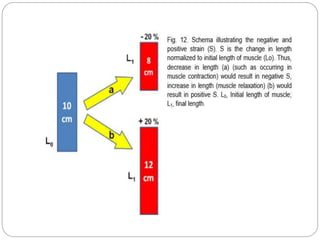
• Strain - fractional change in length of a
myocardial segment relative to its baseline
length, and it is expressed as a percentage.
• Shear strain is change in the angle between two line
segments.
• It’s is distortion of tissue & analogous to differental
contraction of epi & endocardium.
 myocardial wall =3D object
 strain along 3 planes (x-, y-, and z-axes)= known as
normal strains, and 6 shear strains.
 simplified linear strain or deformation model by
echocardiography.
 4 principal types of strain or deformation
 Longitudinal
 radial
 Circumferential
 rotational
STRAIN RATE -speed at which the deformation
occurs and is expressed as per second (s-1).
 STRAIN RATE ANALYSIS
 BULL’S EYE REPRESENTATION
 STRAIN RATE CURVES .
Strain By TDI
 indirect computation of myocardial deformation
 velocity gradients along the myocardial tissue
 viability and deformation (strain) of the myocardium.
 Strain rate (strain per unit of time)
ε = V1 − V2/L,
ε = strain rate, V1 = velocity at point 1, V2 = velocity at
point 2, and L = length, usually set at 10 mm.
 TDI strain rate data could be integrated over time to
determine strain.
 direction of myocardial contractility needs to be aligned in
parallel with the direction of the ultrasound beam.
 reliable only in the apical imaging planes
 unpredictable in PLAX and SAX planes.
 Drawback of -Doppler angle of incidence.
 e velocity of the endocardium is normally higher
than that of the epicardium= tissue velocity gradient.
 akinetic but viable or nontransmurally infarcted
myocardium, - myocardial velocity gradient persists,
but there is no velocity gradient in scarred or
transmurally infarcted myocardium.
Strain By Speckle Tracking
 Speckle-tracking echocardiography (STE)
 alternative technique t
 analyzes motion by tracking natural acoustic
reflections and interference patterns within an
ultrasonic window
 post-processing computer algorithm
 uses the routine gray scale digital images of the
myocardium contain unique speckle patterns
 user-defined region of interest is placed on the
myocardial wall.
 Within this region of interest, the image-processing
algorithm automatically subdivides regions into blocks
of pixels tracking stable patterns of speckles.
 Subsequent frames are then automatically analyzed by
searching for the new location of the speckle patterns
within each of the blocks using correlation criteria and the
sum of absolute differences
 The location shift of these acoustic markers from frame to
frame representing tissue movement provides the spatial
and temporal data used to calculate velocity vectors
 Temporal alterations in these stable speckle patterns are
identified as moving farther apart or closer together and
create a series of regional strain vectors.
 The potential to track the speckles in any direction within
a 2D image allows the calculation of myocardial
velocities, displacement, strain and strain rate in any
given direction.
 multidirectional tracking ability
 angle independency
 depend significantly on good image quality and proper
image geometry
 physiological factors -age, gender, loading conditions
 technical factors -orientation of the imaging planes,
quality of the gray-scale images
 significant inter-vendor differences
 no universally accepted normal values are available for
the different myocardial deformation parameters.
TDI vs STE
 Among all the strain parameters, longitudinal strain is
more reproducible than the radial and circumferential
strain and rotation
 global strain has much better reproducibility than the
segmental strain.
 negative longitudinally and circumferentially (negative LS
and CS)
 positive radially (positive RS).
 normal GLS -16 to 18% or more (i.e. more negative).
 circumferential strain - greater than the longitudinal
strain with average values in excess of -20%.
 radial strain -+40 to +60%.
 Peak systolic SR varies between −1 to 1.4/sec.
 Radial Strain rate 3.1-4.1 sec-1
 The apical rotation is normally much greater than the
basal rotation which is limited by the tethering effect of
MYOCARDIAL ARCHITECTURE
 outer layer of oblique fibers
 middle layer of circumferential fibers
 inner layer of longitudinal and oblique fibers.
 subendocardial fibres -longitudinal strain
 mid-myocardial and subepicardial fibres -circumferential
and radial strain and rotation.
 most of the cardiac pathologies involve the
subendocardial layers first- longitudinal strain is usually
the earliest to get compromised.
 radial and circumferential strain remain preserved or
may even be accentuated during the early stages to
compensate for the loss of the longitudinal function.
 As the disease becomes more extensive and more
transmural, the radial and circumferential strain also
get progressively impaired.
 conditions that affect the heart from the outside-
constrictive pericarditis, circumferential strain and
rotation may get compromised earlier than the
longitudinal strain.
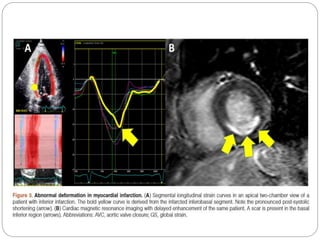
Coronary artery disease
 regional dysfunction
 extent of the ischemic area and differentiate
between transmural and non-transmural scar.
 POST SYSTOLIC SHORTENING- segment continues
shortening after the aortic valve closure( AVC), often
after a short relaxation giving one or two peaks a
systolic and a post systolic, or a single peak after AVC .
 A small amount of post systolic shortening may be
present in up to 1/3 of normal segments but not more
than 3%.
 Pathological strain = reduced systolic strain, and higher
post systolic strain (in magnitude), as well as later peak
PSS.
 longer persistence of the PSS after an ischemic event
was= severe coronary obstruction.
 PSS = inhomogeneity of force development, due to
differences in activation, load or contractility, and not as
specific marker of ischemia
 PSS at rest can be a sign of ischemia, myocardial scar, or
other conditions.
 PSS which occurs during stress echocardiography=
ischemia, so it can improve the accuracy of detecting CAD
during a dobutamine stress test.
Pattern of post-systolic shortening occurring after aortic
valve closure (AVC) during coronary occlusion and
reperfusion in a patient with coronary disease
CORONARY ARTERY DISEASE
ACUTE MI –
 systolic thinning, decreases systolic deformation, and
increases post-systolic thickening ( PST). = directly
related to perfusion .
 acute total vessel occlusion- systolic deformation is
totally ablated and replaced by systolic lengthening (
paradoxical strain).
 Reperfusion restores deformation to near normal, but
some early systolic lengthening and PST remains present
in the early phase as a result of stunning.
 LS - significantly reduced in the infarcted segments
proportional to the area of the infarcted region.
 subendocardial infarcts - LS are attenuated +
preservation of CS and RS
 transmural MI - CS and RS are also impaired.
 segmental RS cutoff of 16.5% and CS <11.1%
differentiated non-transmural and transmural
infarction
 rotational mechanics are also impaired (LV TWIST
and untwisting rate)
Preserved radial thickening in the
noninfarct region and dyskinesis in the
infarct region
Chronic Ischemia
 without infarction - LS may show impairment at rest
or during exercise stress.
 peak SR of −0.83/sec and early diastolic SR of
0.96/sec predicts
 peak basal and mid segmental strain cutoff value of
−17.9% = three vessel or left main CAD
Ischemic CMP and Viability
 identifying viability and myocardial contractile
reserve.
 A radial peak strain cutoff value of 17.2% = viable
myocardium
 LS value of −10.2% following the reperfusion
therapy after MI = nonviable myocardium
STRAIN IMAGING TO IDENTIFY
SCAR
 mean longitudinal strain
 without scarring −10.4 ± 5.2%
 0.6 ± 4.9% in segments with transmural scarring
 A strain cutoff value of −4.5% -viable myocardium
from segments with transmural scarring
Stress Echocardiography
 tissue velocity derived strains and STE LS
 Reduced Doppler derived peak LS, CS and RS
 CS showing the greatest reduction.
 STE-LS - reduced accuracy for LCx and RCA
territories( dependence of the STE on gray scale image
quality.)
 Assessment of diastolic strains during stress -useful
in identifying the ischemic regions.
 LV radial strains measured during the first 1/3 of
diastole at baseline, and after 5–10 minutes of
exercise = significant coronary stenosis.
 strain imaging diastolic index ratio of 0.74
predicted significant CADs
 Speckle strain -viability and LV myocardial
contractile reserve.
 Reduced CS and reduced torsion differentiate
transmural MI from nontransmural MI.
LV functional dispersion and
dyssynchrony
 Strain imaging = asynchronous LV deformation (e.g., by
measuring the time to peak strain).
 abnormalities in synchronicity= standard deviation of
the time to peak regional shortening= high risk for
arrhythmias.
HFpEF vs HFrEF
 Decreased LS but preserved apical rotational
mechanics =HFpEF,
 patterns of CS and RS could be variable
 systolic dysfunction = LV torsion and peak untwisting
rate are also reduced.
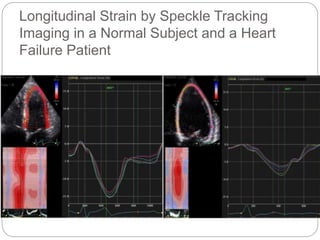
Longitudinal Strain by Speckle Tracking
Imaging in a Normal Subject and a Heart
Failure Patient
DILATED CARDIOMYOPATHY
 impairment of all the three directional strains (LS, CS
and RS).
 rotational mechanics - significant reduction at both base
and apex
 decrease in apical twist and untwisting velocity
 some -clockwise rotation at LV apex and
counterclockwise at LV base (reverse of normal pattern).
DYSSYNCHRONY
 LBBB - early septal radial thickening, followed by
delayed posterior and lateral wall thickening.
 speckle tracking radial strain – dyssynchrony
 time difference in peak anteroseptum to posterior wall
strain ≥130 ms=EF response to CRT
 Speckle tracking radial strain and transverse strain
were associated with response to CRT
 longitudinal and circumferential strain appeared less
sensitive in detecting important dyssynchrony.
LEFT- In a normal subject demonstrating synchronous peak
radial strain curves
RIGHT- In a heart failure patient with left bundle branch block
(LBBB) early anteroseptal peak strain followed by late
posterior wall peak strain
(A)tracking transverse (Trans.) strain using the apical 4-chamber view in a
normal subject demonstrating synchronous peak transverse strain curves
(B) Heart failure patient with LBBB showing early septal peak strain
followed by late lateral wall peak strain
STRESS CARDIOMYOPATHY
 Reduction in various LV strains that extend beyond any
single coronary artery territory
 Peak systolic strain and SRs are reduced in the apical
and basal regions
PERICARDIAL DISEASES AND
RESTRICTIVE CARDIOMYOPATHY
 The pericardium has = LV TWISTS deformation:
 congenital absence of pericardium = marked
impairment in LV torsion while the LS, CS and RS are
preserved.
 constrictive pericarditis -significant reduction in CS, RS
, apical twist while the LS is relatively preserved.
 restrictive CMP- significant attenuation of LS while CS,
RS and LV torsion are relatively unaffected until late
stages and these help maintain the LV-EF.
 continued progression of the disease process -
involvement of CS, RS and torsional mechanics
VALVULAR HEART DISEASE
 Identification of subclinical LV myocardial
dysfunction
 Impaired LS = first sign of myocardial dysfunction
 multidirectional strain and SR impairment occur with
increasing severity and chronicity.
 twist mechanics - relatively preserved in AS, AR and
MR, including peak systolic twist, systolic twist
velocity and untwisting velocity.
 LS, CS, RS-improve after surgical intervention in AS.
 AR -initial decline in CS and RS, which improves
over next 3–6 months.
Preoperative Systolic Strain Rate Predicts
Postoperative Left Ventricular Dysfunction in
Patients With Chronic Aortic Regurgitation
LEFT - normal
subject);
MIDDLE, pre-Ssr
2.06 per second, pre-
EF 58%, post-EF 65%;
RIGHT - pre-Ssr 1.50
per second, pre-EF
56%, post-EF 38%.
Although patients with AR
had similar preoperative EF,
intrinsic myocardial
dysfunction, as assessed by
Ssr, influenced postoperative
EF.
HYPERTENSION
 longitudinal strains are impaired
 CS, RS and LV torsional mechanics are preserved.
ATHLETE’S HEART
 pathological LVH - depressed LS and RS
 endurance athletes -enhanced strain values.
HYPERTROPHIC CARDIOMYOPATHY
 reduction in the LS
 relative preservation of the CS.
 apical variant -reduction in apical strain values relative to
the strain values in the basal segments with loss of the
normal apical to base gradient
 GLS and EF - global LV function, but both do it in a
different way.
 They follow a linear fit of EF=3|GLS| in most situations,
GLS and EF may diverge depending on the underlying
pathology.
 In hypertrophic pathology, GLS is frequently reduced
while EF is still normal.
AMYLOIDOSIS
 A higher EF/GLS ratio was found to differentiate
cardiac amyloidosis from other pathologies with
increased LV wall thickness, such as hypertrophic
cardiomyopathy.
 A relative “apical sparing” pattern of longitudinal strain
should raise the clinical suspicion for cardiac amyloid
in the differential diagnosis of LV hypertrophy.
CONGENITAL HEART DISEASE
 Objective and quantitative evaluation of RV mechanics is
= biventricular repair.
 Objective evaluation of the dominant ventricle function -
Fontan’s repair
 multidirectional strains -surgical selection
 morphological RV supports the systemic circulation-
apical twist is impaired.
 Loss of the apical twist -myocardial dysfunction.
 TOF - reduced LS in septal and lateral walls.
 ASD - reduced systolic LV TWIST due to reduced LV
filling
HEART TRANSPLANT AND
REJECTION
 normal transplanted hearts there is usually an
impaired apical twist mechanism while the LV-EF and
other multidirectional strains remain relatively
unaffected=denervation in the early weeks after
 rejection -reduced LS.
 a cutoff in LS of −11.4%, LS could predict cellular
rejection
CHEMOTHERAPY
 early subclinical LV dysfunction
 reduction in LV global LS by 10%
SUBCLINICAL CARDIAC INVOLVEMENT IN
SYSTEMIC
DISEASES
 type 1 diabetes mellitus - increased torsion,
suggesting the presence of subclinical microvascular
disease
 Impaired LV longitudinal and circumferential shortening
=Cushing’s disease
Right Ventricular Deformation
 RV has complex geometry with mainly
longitudinal/circumferential fibre orientation in the
free wall
 minimal radial function due to thin walls.
 Longitudinal deformation of the RV free wall =
systolic function
 RV free wall longitudinal strain is 5-10% more than
the LV free wall
 Abase-to-apex gradient is also seen but is not a
consistent finding.
Right Ventricle STE
 Peak systolic strains at the basal free wall of > 25% and
SR of more than 4/sec =RVEF more than 50%.
 RV dysfunction = peak systolic strain and SR are
significantly reduced
 less influenced by motion of translation
 n inverse relationship has been noted in RV systolic
pressure and RV LS.
LEFT ATRIAL STRAINS
 A total of 12 equidistance region (6 in 4C and 6 in
2C), with reference point of QRS onset
 positive peak atrial longitudinal strain (PALS) -atrial
reservoir function.
 atrial contractile function-total of 15 equidistance
regions (6 in 4C, 6 in 2C and 3 in inferoposterior wall
in apical long axis view) and timed with the “p” wave
=contractile functional strain is always negative.
 conduit functional strain -second positive peak
corresponding to early diastole (just beyond the T
wave).
 Normal values of PALS using the 12 segment model and
the QRS reference point is 32.2–53.2%.
The average values of positive and negative peak strains
23.2 ± 6.7% and −14.6 ± 3.5% in 15 segment model using
the p wave as reference point.
 Reduced PALS
1. Atrial septal device occlusion
sinus rhythm who have undergone catheter
ablation or cardioversion
LV diastolic dysfunction.
 Increased PALS is -MR.
 Peak atrial positive strain -inverse correlation with
invasively determined LVEDP, as well as with LA
volumes, Doppler mitral inflow indices and pulmonary
vein Doppler data.
TWIST
 subtracting basal rotation from the apical rotation
 twist deformation of the left ventricle =movement of two
orthogonally oriented muscular bands of a helical
myocardial structure with consequent clockwise rotation
of the base and counterclockwise rotation of the apex.
 As viewed from apex
 apical region = counterclockwise rotation during systole (8 – 12
degrees)
 basal region = clockwise rotation (5–8 degrees).
 counterclockwise apical rotation -positive value (+10 degrees)
 clockwise basal rotation = negative value (−6 degrees). The
LV TWIST is therefore 10 − (−6) = 16 degrees.
 Torsion = Twist/Length (base to apex) degrees/cm
(normal = 1.5 – 2 degrees/cm)
Rotational Strain Imaging From a Normal Subject

dilated cardiomyopathy (CMP), aortic stenosis,
hypertrophic CMP and ischemia=twist is increased,
while the untwist rate is decreased.
LEFT- synchronous time-to-peak strain curves = homogeneous coloring
at end-systole (arrow)
RIGHT- heart failure patient with LBBB= dyssynchronous time to peak
strain curves = heterogeneous coloring at end-systole, with early peak
strain in septal segments and delayed peak strain in posterior lateral
segments (arrow)
Patient A -latest mechanical activation in the midposterior
segment (red arrow).
Patient B - echanical activation in the midlateral segment (red
arrow).
Patient C -broad site of latest mechanical activation
THANK
YOU

Strain and strain rate

  • 1.
  • 2.
     Echocardiographic strainimaging= deformation imaging  quantify regional myocardial function .
  • 3.
    Deformation parameters canbe estimated by multiple methods  Doppler-derived Deformation imaging  Echo-cardiographic Acoustic Speckle Tracking 2D Strain ( including velocity vector imaging)  Echocardiographic Acoustic Speckle Tracking 3D Strain  Sono-micrometry  Tagged MRI
  • 4.
    STRAIN  Sarcomeric unidirectionalshortening results in multi-directional change in size and shape of the tissue = myocardial deformation .
  • 5.
    • Strain -fractional change in length of a myocardial segment relative to its baseline length, and it is expressed as a percentage. • Shear strain is change in the angle between two line segments. • It’s is distortion of tissue & analogous to differental contraction of epi & endocardium.  myocardial wall =3D object  strain along 3 planes (x-, y-, and z-axes)= known as normal strains, and 6 shear strains.  simplified linear strain or deformation model by echocardiography.
  • 6.
     4 principaltypes of strain or deformation  Longitudinal  radial  Circumferential  rotational
  • 11.
    STRAIN RATE -speedat which the deformation occurs and is expressed as per second (s-1).
  • 12.
     STRAIN RATEANALYSIS  BULL’S EYE REPRESENTATION  STRAIN RATE CURVES .
  • 14.
    Strain By TDI indirect computation of myocardial deformation  velocity gradients along the myocardial tissue  viability and deformation (strain) of the myocardium.  Strain rate (strain per unit of time) ε = V1 − V2/L, ε = strain rate, V1 = velocity at point 1, V2 = velocity at point 2, and L = length, usually set at 10 mm.  TDI strain rate data could be integrated over time to determine strain.  direction of myocardial contractility needs to be aligned in parallel with the direction of the ultrasound beam.  reliable only in the apical imaging planes  unpredictable in PLAX and SAX planes.  Drawback of -Doppler angle of incidence.
  • 15.
     e velocityof the endocardium is normally higher than that of the epicardium= tissue velocity gradient.  akinetic but viable or nontransmurally infarcted myocardium, - myocardial velocity gradient persists, but there is no velocity gradient in scarred or transmurally infarcted myocardium.
  • 17.
    Strain By SpeckleTracking  Speckle-tracking echocardiography (STE)  alternative technique t  analyzes motion by tracking natural acoustic reflections and interference patterns within an ultrasonic window  post-processing computer algorithm  uses the routine gray scale digital images of the myocardium contain unique speckle patterns  user-defined region of interest is placed on the myocardial wall.  Within this region of interest, the image-processing algorithm automatically subdivides regions into blocks of pixels tracking stable patterns of speckles.
  • 18.
     Subsequent framesare then automatically analyzed by searching for the new location of the speckle patterns within each of the blocks using correlation criteria and the sum of absolute differences  The location shift of these acoustic markers from frame to frame representing tissue movement provides the spatial and temporal data used to calculate velocity vectors  Temporal alterations in these stable speckle patterns are identified as moving farther apart or closer together and create a series of regional strain vectors.
  • 19.
     The potentialto track the speckles in any direction within a 2D image allows the calculation of myocardial velocities, displacement, strain and strain rate in any given direction.  multidirectional tracking ability  angle independency  depend significantly on good image quality and proper image geometry
  • 21.
     physiological factors-age, gender, loading conditions  technical factors -orientation of the imaging planes, quality of the gray-scale images  significant inter-vendor differences  no universally accepted normal values are available for the different myocardial deformation parameters.
  • 22.
  • 23.
     Among allthe strain parameters, longitudinal strain is more reproducible than the radial and circumferential strain and rotation  global strain has much better reproducibility than the segmental strain.  negative longitudinally and circumferentially (negative LS and CS)  positive radially (positive RS).  normal GLS -16 to 18% or more (i.e. more negative).  circumferential strain - greater than the longitudinal strain with average values in excess of -20%.  radial strain -+40 to +60%.  Peak systolic SR varies between −1 to 1.4/sec.  Radial Strain rate 3.1-4.1 sec-1  The apical rotation is normally much greater than the basal rotation which is limited by the tethering effect of
  • 24.
    MYOCARDIAL ARCHITECTURE  outerlayer of oblique fibers  middle layer of circumferential fibers  inner layer of longitudinal and oblique fibers.
  • 25.
     subendocardial fibres-longitudinal strain  mid-myocardial and subepicardial fibres -circumferential and radial strain and rotation.  most of the cardiac pathologies involve the subendocardial layers first- longitudinal strain is usually the earliest to get compromised.  radial and circumferential strain remain preserved or may even be accentuated during the early stages to compensate for the loss of the longitudinal function.
  • 26.
     As thedisease becomes more extensive and more transmural, the radial and circumferential strain also get progressively impaired.  conditions that affect the heart from the outside- constrictive pericarditis, circumferential strain and rotation may get compromised earlier than the longitudinal strain.
  • 27.
    Coronary artery disease regional dysfunction  extent of the ischemic area and differentiate between transmural and non-transmural scar.
  • 28.
     POST SYSTOLICSHORTENING- segment continues shortening after the aortic valve closure( AVC), often after a short relaxation giving one or two peaks a systolic and a post systolic, or a single peak after AVC .  A small amount of post systolic shortening may be present in up to 1/3 of normal segments but not more than 3%.  Pathological strain = reduced systolic strain, and higher post systolic strain (in magnitude), as well as later peak PSS.
  • 29.
     longer persistenceof the PSS after an ischemic event was= severe coronary obstruction.  PSS = inhomogeneity of force development, due to differences in activation, load or contractility, and not as specific marker of ischemia  PSS at rest can be a sign of ischemia, myocardial scar, or other conditions.  PSS which occurs during stress echocardiography= ischemia, so it can improve the accuracy of detecting CAD during a dobutamine stress test.
  • 32.
    Pattern of post-systolicshortening occurring after aortic valve closure (AVC) during coronary occlusion and reperfusion in a patient with coronary disease
  • 33.
    CORONARY ARTERY DISEASE ACUTEMI –  systolic thinning, decreases systolic deformation, and increases post-systolic thickening ( PST). = directly related to perfusion .  acute total vessel occlusion- systolic deformation is totally ablated and replaced by systolic lengthening ( paradoxical strain).  Reperfusion restores deformation to near normal, but some early systolic lengthening and PST remains present in the early phase as a result of stunning.
  • 34.
     LS -significantly reduced in the infarcted segments proportional to the area of the infarcted region.  subendocardial infarcts - LS are attenuated + preservation of CS and RS  transmural MI - CS and RS are also impaired.  segmental RS cutoff of 16.5% and CS <11.1% differentiated non-transmural and transmural infarction  rotational mechanics are also impaired (LV TWIST and untwisting rate)
  • 35.
    Preserved radial thickeningin the noninfarct region and dyskinesis in the infarct region
  • 36.
    Chronic Ischemia  withoutinfarction - LS may show impairment at rest or during exercise stress.  peak SR of −0.83/sec and early diastolic SR of 0.96/sec predicts  peak basal and mid segmental strain cutoff value of −17.9% = three vessel or left main CAD
  • 37.
    Ischemic CMP andViability  identifying viability and myocardial contractile reserve.  A radial peak strain cutoff value of 17.2% = viable myocardium  LS value of −10.2% following the reperfusion therapy after MI = nonviable myocardium
  • 38.
    STRAIN IMAGING TOIDENTIFY SCAR  mean longitudinal strain  without scarring −10.4 ± 5.2%  0.6 ± 4.9% in segments with transmural scarring  A strain cutoff value of −4.5% -viable myocardium from segments with transmural scarring
  • 39.
    Stress Echocardiography  tissuevelocity derived strains and STE LS  Reduced Doppler derived peak LS, CS and RS  CS showing the greatest reduction.  STE-LS - reduced accuracy for LCx and RCA territories( dependence of the STE on gray scale image quality.)
  • 40.
     Assessment ofdiastolic strains during stress -useful in identifying the ischemic regions.  LV radial strains measured during the first 1/3 of diastole at baseline, and after 5–10 minutes of exercise = significant coronary stenosis.  strain imaging diastolic index ratio of 0.74 predicted significant CADs  Speckle strain -viability and LV myocardial contractile reserve.  Reduced CS and reduced torsion differentiate transmural MI from nontransmural MI.
  • 41.
    LV functional dispersionand dyssynchrony  Strain imaging = asynchronous LV deformation (e.g., by measuring the time to peak strain).  abnormalities in synchronicity= standard deviation of the time to peak regional shortening= high risk for arrhythmias.
  • 43.
    HFpEF vs HFrEF Decreased LS but preserved apical rotational mechanics =HFpEF,  patterns of CS and RS could be variable  systolic dysfunction = LV torsion and peak untwisting rate are also reduced.
  • 44.
    Longitudinal Strain bySpeckle Tracking Imaging in a Normal Subject and a Heart Failure Patient
  • 45.
    DILATED CARDIOMYOPATHY  impairmentof all the three directional strains (LS, CS and RS).  rotational mechanics - significant reduction at both base and apex  decrease in apical twist and untwisting velocity  some -clockwise rotation at LV apex and counterclockwise at LV base (reverse of normal pattern).
  • 46.
    DYSSYNCHRONY  LBBB -early septal radial thickening, followed by delayed posterior and lateral wall thickening.  speckle tracking radial strain – dyssynchrony  time difference in peak anteroseptum to posterior wall strain ≥130 ms=EF response to CRT
  • 47.
     Speckle trackingradial strain and transverse strain were associated with response to CRT  longitudinal and circumferential strain appeared less sensitive in detecting important dyssynchrony.
  • 48.
    LEFT- In anormal subject demonstrating synchronous peak radial strain curves RIGHT- In a heart failure patient with left bundle branch block (LBBB) early anteroseptal peak strain followed by late posterior wall peak strain
  • 49.
    (A)tracking transverse (Trans.)strain using the apical 4-chamber view in a normal subject demonstrating synchronous peak transverse strain curves (B) Heart failure patient with LBBB showing early septal peak strain followed by late lateral wall peak strain
  • 50.
    STRESS CARDIOMYOPATHY  Reductionin various LV strains that extend beyond any single coronary artery territory  Peak systolic strain and SRs are reduced in the apical and basal regions
  • 52.
    PERICARDIAL DISEASES AND RESTRICTIVECARDIOMYOPATHY  The pericardium has = LV TWISTS deformation:  congenital absence of pericardium = marked impairment in LV torsion while the LS, CS and RS are preserved.  constrictive pericarditis -significant reduction in CS, RS , apical twist while the LS is relatively preserved.  restrictive CMP- significant attenuation of LS while CS, RS and LV torsion are relatively unaffected until late stages and these help maintain the LV-EF.  continued progression of the disease process - involvement of CS, RS and torsional mechanics
  • 53.
    VALVULAR HEART DISEASE Identification of subclinical LV myocardial dysfunction  Impaired LS = first sign of myocardial dysfunction  multidirectional strain and SR impairment occur with increasing severity and chronicity.  twist mechanics - relatively preserved in AS, AR and MR, including peak systolic twist, systolic twist velocity and untwisting velocity.  LS, CS, RS-improve after surgical intervention in AS.  AR -initial decline in CS and RS, which improves over next 3–6 months.
  • 54.
    Preoperative Systolic StrainRate Predicts Postoperative Left Ventricular Dysfunction in Patients With Chronic Aortic Regurgitation LEFT - normal subject); MIDDLE, pre-Ssr 2.06 per second, pre- EF 58%, post-EF 65%; RIGHT - pre-Ssr 1.50 per second, pre-EF 56%, post-EF 38%. Although patients with AR had similar preoperative EF, intrinsic myocardial dysfunction, as assessed by Ssr, influenced postoperative EF.
  • 55.
    HYPERTENSION  longitudinal strainsare impaired  CS, RS and LV torsional mechanics are preserved.
  • 56.
    ATHLETE’S HEART  pathologicalLVH - depressed LS and RS  endurance athletes -enhanced strain values.
  • 57.
    HYPERTROPHIC CARDIOMYOPATHY  reductionin the LS  relative preservation of the CS.  apical variant -reduction in apical strain values relative to the strain values in the basal segments with loss of the normal apical to base gradient
  • 58.
     GLS andEF - global LV function, but both do it in a different way.  They follow a linear fit of EF=3|GLS| in most situations, GLS and EF may diverge depending on the underlying pathology.  In hypertrophic pathology, GLS is frequently reduced while EF is still normal.
  • 59.
    AMYLOIDOSIS  A higherEF/GLS ratio was found to differentiate cardiac amyloidosis from other pathologies with increased LV wall thickness, such as hypertrophic cardiomyopathy.  A relative “apical sparing” pattern of longitudinal strain should raise the clinical suspicion for cardiac amyloid in the differential diagnosis of LV hypertrophy.
  • 61.
    CONGENITAL HEART DISEASE Objective and quantitative evaluation of RV mechanics is = biventricular repair.  Objective evaluation of the dominant ventricle function - Fontan’s repair  multidirectional strains -surgical selection
  • 62.
     morphological RVsupports the systemic circulation- apical twist is impaired.  Loss of the apical twist -myocardial dysfunction.  TOF - reduced LS in septal and lateral walls.  ASD - reduced systolic LV TWIST due to reduced LV filling
  • 63.
    HEART TRANSPLANT AND REJECTION normal transplanted hearts there is usually an impaired apical twist mechanism while the LV-EF and other multidirectional strains remain relatively unaffected=denervation in the early weeks after  rejection -reduced LS.  a cutoff in LS of −11.4%, LS could predict cellular rejection
  • 64.
    CHEMOTHERAPY  early subclinicalLV dysfunction  reduction in LV global LS by 10%
  • 65.
    SUBCLINICAL CARDIAC INVOLVEMENTIN SYSTEMIC DISEASES  type 1 diabetes mellitus - increased torsion, suggesting the presence of subclinical microvascular disease  Impaired LV longitudinal and circumferential shortening =Cushing’s disease
  • 66.
    Right Ventricular Deformation RV has complex geometry with mainly longitudinal/circumferential fibre orientation in the free wall  minimal radial function due to thin walls.  Longitudinal deformation of the RV free wall = systolic function  RV free wall longitudinal strain is 5-10% more than the LV free wall  Abase-to-apex gradient is also seen but is not a consistent finding.
  • 67.
    Right Ventricle STE Peak systolic strains at the basal free wall of > 25% and SR of more than 4/sec =RVEF more than 50%.  RV dysfunction = peak systolic strain and SR are significantly reduced  less influenced by motion of translation  n inverse relationship has been noted in RV systolic pressure and RV LS.
  • 68.
  • 69.
     A totalof 12 equidistance region (6 in 4C and 6 in 2C), with reference point of QRS onset  positive peak atrial longitudinal strain (PALS) -atrial reservoir function.  atrial contractile function-total of 15 equidistance regions (6 in 4C, 6 in 2C and 3 in inferoposterior wall in apical long axis view) and timed with the “p” wave =contractile functional strain is always negative.  conduit functional strain -second positive peak corresponding to early diastole (just beyond the T wave).
  • 70.
     Normal valuesof PALS using the 12 segment model and the QRS reference point is 32.2–53.2%. The average values of positive and negative peak strains 23.2 ± 6.7% and −14.6 ± 3.5% in 15 segment model using the p wave as reference point.
  • 71.
     Reduced PALS 1.Atrial septal device occlusion sinus rhythm who have undergone catheter ablation or cardioversion LV diastolic dysfunction.  Increased PALS is -MR.  Peak atrial positive strain -inverse correlation with invasively determined LVEDP, as well as with LA volumes, Doppler mitral inflow indices and pulmonary vein Doppler data.
  • 72.
    TWIST  subtracting basalrotation from the apical rotation  twist deformation of the left ventricle =movement of two orthogonally oriented muscular bands of a helical myocardial structure with consequent clockwise rotation of the base and counterclockwise rotation of the apex.
  • 73.
     As viewedfrom apex  apical region = counterclockwise rotation during systole (8 – 12 degrees)  basal region = clockwise rotation (5–8 degrees).  counterclockwise apical rotation -positive value (+10 degrees)  clockwise basal rotation = negative value (−6 degrees). The LV TWIST is therefore 10 − (−6) = 16 degrees.  Torsion = Twist/Length (base to apex) degrees/cm (normal = 1.5 – 2 degrees/cm)
  • 74.
    Rotational Strain ImagingFrom a Normal Subject
  • 76.
     dilated cardiomyopathy (CMP),aortic stenosis, hypertrophic CMP and ischemia=twist is increased, while the untwist rate is decreased.
  • 77.
    LEFT- synchronous time-to-peakstrain curves = homogeneous coloring at end-systole (arrow) RIGHT- heart failure patient with LBBB= dyssynchronous time to peak strain curves = heterogeneous coloring at end-systole, with early peak strain in septal segments and delayed peak strain in posterior lateral segments (arrow)
  • 78.
    Patient A -latestmechanical activation in the midposterior segment (red arrow). Patient B - echanical activation in the midlateral segment (red arrow). Patient C -broad site of latest mechanical activation
  • 79.