ACUTE AORTIC EMERGENCIES
Dr Andrew Crofton
ED Registrar
INTRODUCTION
• Acute aortic syndromes
• Aortic dissection, penetrating atherosclerotic ulcer, intramural haematoma and
aortic aneurysm leakage/rupture
• 3-6 cases per 100 000 per year
• Most common cardiovascular complication of Marfan’s syndrome is aortic root
disease and type A dissection
• Identification of gene mutations associated with Marfan’s (TGFBR2 and FBN1),
combined with regular follow-up can reduce fatal outcomes
PATHOPHYSIOLOGY
• Degeneration of the media of the aortic wall with
intimal stress leading to:
• Aortic dilation
• Aneurysm formation
• Development of penetrating ulcer
• Intramural haemorrhage
• Aortic dissection
• Aortic rupture
RISK FACTORS
• Risk factors
• Male (65% of cases)
• Chronic hypertension (70-90% of cases)
• Arteritis/syphilis
• Bicuspid aortic valve
• Marfan’s syndrome
• Ehlers-Danlos syndrome
• Family history of aortic dissection
• Chronic cocaine/amphetamine use
• Prior cardiac surgery
PATHOPHYSIOLOGY
• Aortic dissection
• Violation of intima allowing blood to enter media and dissect between the
intima and adventitia
• Dissecting column of blood forms a false lumen and can re-enter lumen
(spontaneous clinical recovery) or dissect through adventitia with
exsanguination
• First peak in younger patients with connective tissue disorders and second
peak in those >50yo with chronic hypertension
• Other atherosclerotic risk factors are relatively weak compared to chronic
HTN
• Atherosclerosis is NOT a major risk factor for aortic dissection and is rarely
present at site of dissection
PATHOPHYSIOLOGY
• Aortic dissection
• Classification
• Stanford A – Any involvement of the ascending aorta (proximal to ligamentum
arteriosum) – 60-70% of cases
• Stanford B – Descending aorta only
• DeBakey type I – Ascending, arch and descending aorta
• DeBakey type II – Ascending aorta only
• DeBakey III – Descending aorta only
• IIIa stops before diaphragm
• IIIb extends past diaphragm
AORTIC DISSECTION
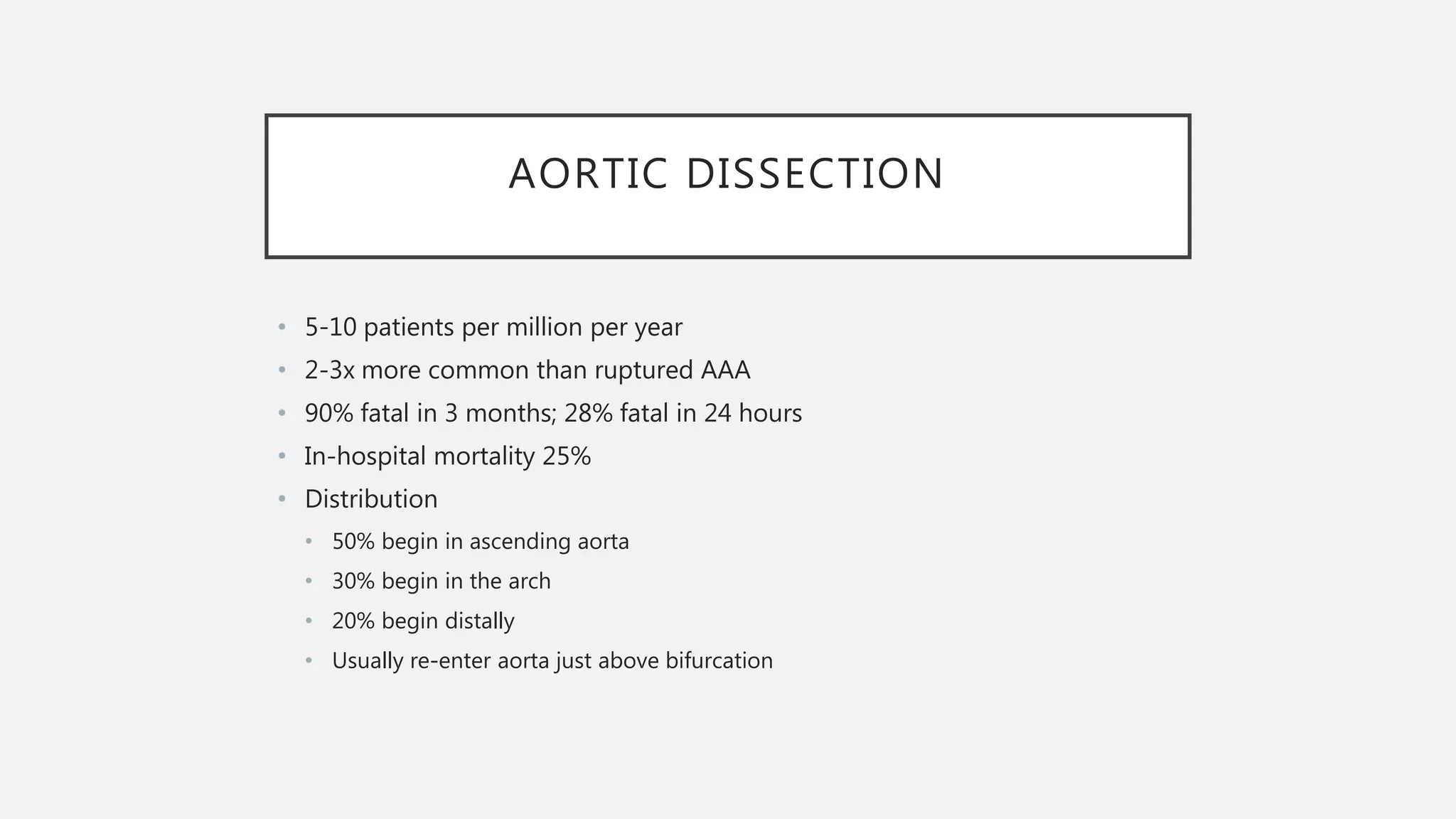
• 5-10 patients per million per year
• 2-3x more common than ruptured AAA
• 90% fatal in 3 months; 28% fatal in 24 hours
• In-hospital mortality 25%
• Distribution
• 50% begin in ascending aorta
• 30% begin in the arch
• 20% begin distally
• Usually re-enter aorta just above bifurcation
COMPLICATIONS
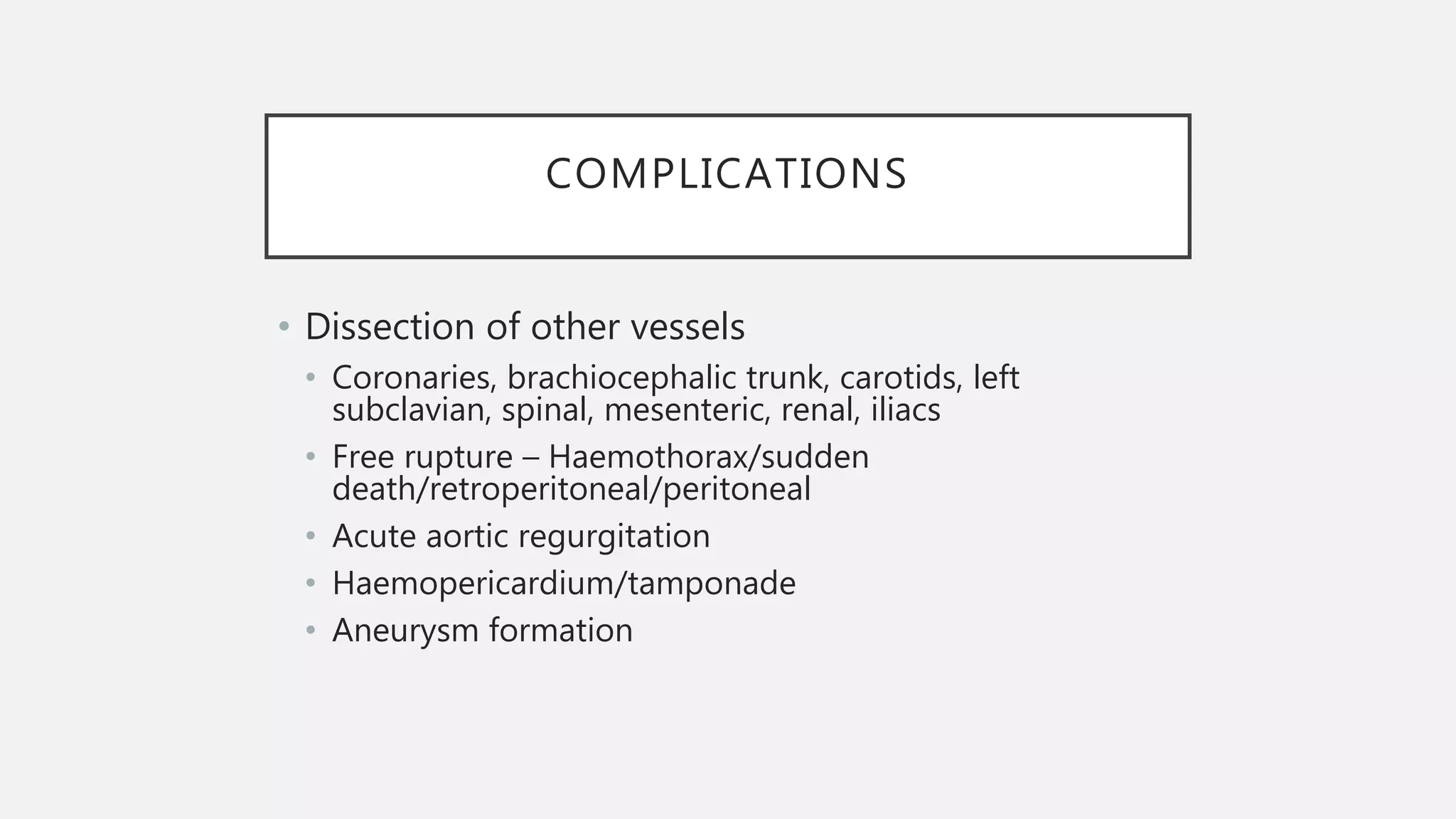
• Dissection of other vessels
• Coronaries, brachiocephalic trunk, carotids, left
subclavian, spinal, mesenteric, renal, iliacs
• Free rupture – Haemothorax/sudden
death/retroperitoneal/peritoneal
• Acute aortic regurgitation
• Haemopericardium/tamponade
• Aneurysm formation
PATHOPHYSIOLOGY
• Aortic intramural haematoma
• Results from infarction of the aortic media due to injury to vasa vasorum
• May resolve spontaneously or dissect
• 5-20% of cases of acute aortic syndrome
• Treated as for dissection
• Penetrating atherosclerotic ulcer
• Can lead to intramural haematoma, aortic dissection or perforation of the aorta
• Poorer outcome than mural haematoma
• Treatment is with early surgical graft replacement of aorta
CLINICAL FEATURES
• History
• Always think if chest pain PLUS
• Back pain
• Abdominal pain
• Neurological deficits
• Limb ischaemia
• Classically tearing chest pain radiating to interscapular region with impending doom
• 60% of patients had anterior chest pain (most common in Stanford A); 50% have back pain
• Abdominal pain (30%) and back pain are more common in Stanford B
• 25% have no chest pain
• 5% have no pain at all
• Most patients describe pain as worst pain they’ve ever had and abrupt onset (85%) - if not rapid onset LR -0.3 to -0.07
• 64% describe sharp pain and 50% as tearing
CLINICAL FEATURES
• History
• Syncope seen in 10% (mostly Stanford A)
• 22% occur in patients with prior cardiac surgery
• May present with stroke symptoms with carotid involvement
• 20% of type A dissections display neurological findings (poor prognosis)
• Focal neuro deficit + chest pain = LR + 6.6 to 33
• Paraplegia if blood supply to spinal cord interrupted
• Further distal dissection may lead to flank/back or abdominal pain
• Cardiac tamponade if more proximal dissection ensues +- ECG showing ACS-type
findings if coronary arteries involved
CLINICAL FEATURES
• Examination
• 1/3 have aortic insufficiency murmur – LR + 9.0
• 15% have pulse deficit in radial or femoral arteries
• 20% sensitive but 95% specific – LR + 29-33
• BP discrepancy of >20mmHg between arms – significant
• 30% sensitive and 85% specific for dissection
• 50% have hypertension (>150mmHg)
• Seen in 35% of Type A and 70% of type B
• Hypotension in 18-25% (worse prognosis)
• Pericardial tamponade occurs in 25% of type A dissections
• Aneurysmal aortic dilatation can compress surrounding structures
• Oesophagus (dysphagia)
• Recurrent laryngeal nerve (hoarsenss)
• Superior cervical sympathetic ganglion (Horner’s)
CLINICAL FEATURES
• DDx
• MI/ACS
• Pericardial disease
• Stroke
• Spinal cord injury/disorders
• Intra-abdominal disorders
• PE, pneumonia, pleurisy, pneumothorax
DIAGNOSIS
• ECG – Normal in 19-31%. Majority have non-specific
ST/T wave changes or ST depression
• 25% have features suggestive of ACS (usually type I
dissection)
• D-dimer
• False negative rate as high as 18%. Especially useless in
younger patients with short dissection length and
thrombosed false lumen
• Not to be used as sole rule-out criterion and not routinely
used in workup at all
DIAGNOSIS
• Imaging
• 12-37% of patients have normal CXR; conversely 90% of cases have
some abnormality
• 60% widened mediastinum; 50% abnormal aortic contour
• Normal CXR more common if younger (connective tissue) or
pregnancy-related
• CT (MDCT) is the modality of choice
• Highly sensitive/specific and can diagnose atherosclerotic ulcers and intramural haematomas
• Provides information on extent of dissection, other organs involved and signs of aortic rupture
• More accurate for proximal than distal aortic dissections; Sensitivity 95%, specificity 95-
100%
DIAGNOSIS
• Imaging continued…
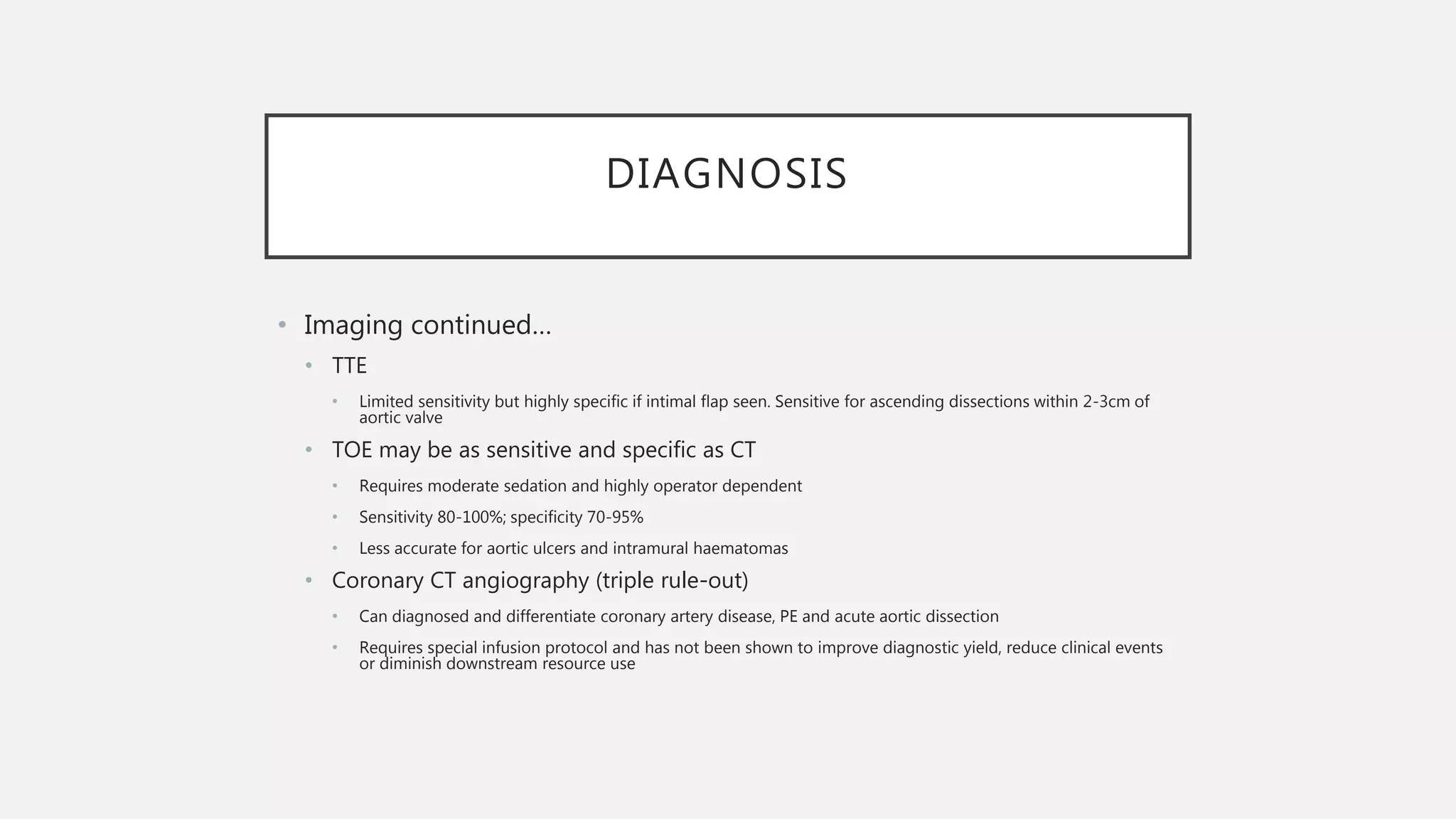
• TTE
• Limited sensitivity but highly specific if intimal flap seen. Sensitive for ascending dissections within 2-3cm of
aortic valve
• TOE may be as sensitive and specific as CT
• Requires moderate sedation and highly operator dependent
• Sensitivity 80-100%; specificity 70-95%
• Less accurate for aortic ulcers and intramural haematomas
• Coronary CT angiography (triple rule-out)
• Can diagnosed and differentiate coronary artery disease, PE and acute aortic dissection
• Requires special infusion protocol and has not been shown to improve diagnostic yield, reduce clinical events
or diminish downstream resource use
CXR FINDINGS
• Double density of aorta
• Tracheal deviation to the right and
anteriorly
• Depression of left main bronchus
• NGT deviation to the right
• Cardiomegaly
• Left sided pleural effusion
• Apical capping
Left mediastinal width at level of aortic
knob >5cm – 90% sensitive and specific
Blurred aortic knob – 70% sensitive
Loss of aortopulmonary window
Mediastinum > 7.5cm at level of aortic
knob – 90% sensitive and specific
Mediastinum >25% chest width
Subjective widening – Sensitivity of
65%; LR + 2.0
Disparity between ascending and
descending aorta diameter
TREATMENT
• Target HR<60 and then SBP 100-120mmHg
• Esmolol 0.1-0.5mg/kg IV bolus then 0.025-0.2mg/kg/min
• Labetalol 10-20mg IV bous, then repeat 20-40mg q10min up to 300mg
• Metoprolol 1-5mg IV boluses q3-5min
• Improved survival with beta-blocker use
• If significant aortic regurgitation, more vasodilator vs. rate control may improve haemodynamics
(tachycardia shortens time of regurgitation)
• Vasodilators
• Nitroprusside can be added once HR <60
• GTN preferred if coronary ischaemia evident
• Hydralazine 5-10mg IV over 5-10 min repeated q15-20min
TREATMENT
• Definitive repair
• Type A require prompt surgical repair
• Endovascular stent repairs with fenetrations can be used
for some type A and complicated type B dissections
(malperfusion, resistent hypertension, persistent severe
pain, persistent false lumens or expanding aortic
diameter), penetrating ulcers and intramural
haematomas
• All other Type B get medical management and
ongoing management from Cardiology/Vascular
Surgery
ANEURYSMAL DISEASE
• Aneurysm = Dilatation >1.5x normal diameter
• True aneurysm - involves all three layers of wall
• Risk factors:
• Connective tissue disorders
• Family Hx of aneurysm
• Atherosclerosis risk factors
• Thinning of media and reduced tensile strength
• Increased wall force and dilatation are intertwined as per LaPlace law: wall tension = pressure x
radius
• Larger aneurysms expand more quickly due to this (0.25-0.5cm per year)
• Abrupt expansion and rupture can occur and is not predictable
ANEURYSMAL DISEASE
• Pseudoaneurysm – Partly vessel wall and partly fibrous tissues
• Usually at site of previous cannulation, anastamoses of prior reconstructions, trauma or
infection
• Small ones may thrombose spontaneously
• Mycotic aneurysm – Infection in blood vessel wall, often in
immunocompromised
• Can be direct extension or embolisation from IE
• Peripheral and visceral aneurysms
• Popliteal artery most common (often co-exist with AAA)
• Renal, splenic and hepatic arteries most common visceral aneurysms
• Usually silent until rupture or thrombosis/embolic phenomena
SYMPTOMATIC AAA
• Defined as aorta >=3cm in diameter
• Repair considered for aneurysm >5cm
• 20% have first-degree relative with AAA
• Most patients >60 and more commonly male
• Clinical features
• Syncope, back, flank, abdominal pain, GI bleeding, extremity ischaemia from embolisation from intramural thrombus, shock or sudden death
• Sudden death usually occurs from intraperitoneal rupture
• Syncope without warning symptoms and subsequent severe pain suggests rupture with some temporary containment
• Patients may regain consciousness but irreversible haemorrhagic shock ensues if not promptly diagnosed
• Typically back or abdominal pain, 50% describe as ripping/tearing and 10% have syncope
• Non-classic sites of pain are still common (flank, groin, isolated quadrants, hip)
• Uncommon presentations are Grey-Turner, Cullen, scrotal haematoma, inguinal mass and femoral neuropathy from compression
AAA
• Prevalence
• 1% at age 50
• 4% at age 60
• 5-10% at age 70
• 10% at age 80
• Rupture <1% per year if <5cm and 17% per year if >6cm
• Risk of rupture higher in women (growth rate is faster) and in current
smokers/hypertension
• 0.3cm/year expansion if <5cm and 0.5cm/year if >5cm
AAA
• Diagnosis
• Abdominal palpation
• Sensitivity 29% for 3-4cm; 50% for 4-5cm; 76% for >5cm
• Lack of tenderness does not indicate intact aorta
• Periumbilical ecchymosis (Cullen sign) and flank ecchymosis (Grey-Turner sign) are rare
• Scrotal or vulvar haematomas or inguinal masses can be seen if retroperitoneal blood
dissects down
• Aortoenteric fistulas may present with small sentinel bleed
followed by catastrophic haemorrhage
• Aortovenous fistulas can cause high-output cardiac failure
AAA
• Imaging
• Plain film – May show calcified aneurysm but cannot determine rupture
• Bedside USS - >90% sensitivity for demonstrating aneurysm and measuring diameter if
technically adequate
• Obesity, bowel gas and abdominal tenderness make study difficult
• Need to measure transverse and longitudinally
• Identifying SMA distinguishes aorta from IVC
• If <3cm, this excludes aneurysmal disease
• CT with contrast
• Unenhanced CT still identifies aneurysm size and retroperitoneal haemorrhage
AAA
• Treatment
• Consultation
• Permissive hypotension to 90mmHg or LOC with blood products
• Pain control
• Use imaging only in those fully compensated or unlikely to have ruptured their aneurysm
• If asymptomatic
• >5cm needs follow-up within days
• >3cm needs follow-up at some point
• Repairing AAA <5.5cm does not improve survival in men but may do so in women
• Perioperative mortality for elective repair is 5% for open and 1.5% for endovascular repair (although 2 year survival rates are
the same for either method = 90%)
• Endovascular repair does NOT improve survival if deemed medically unfit for open repair
• Operative mortality is 15% if urgently repaired (non-ruptured) and 50% if ruptured
THORACIC AORTIC ANEURYSM
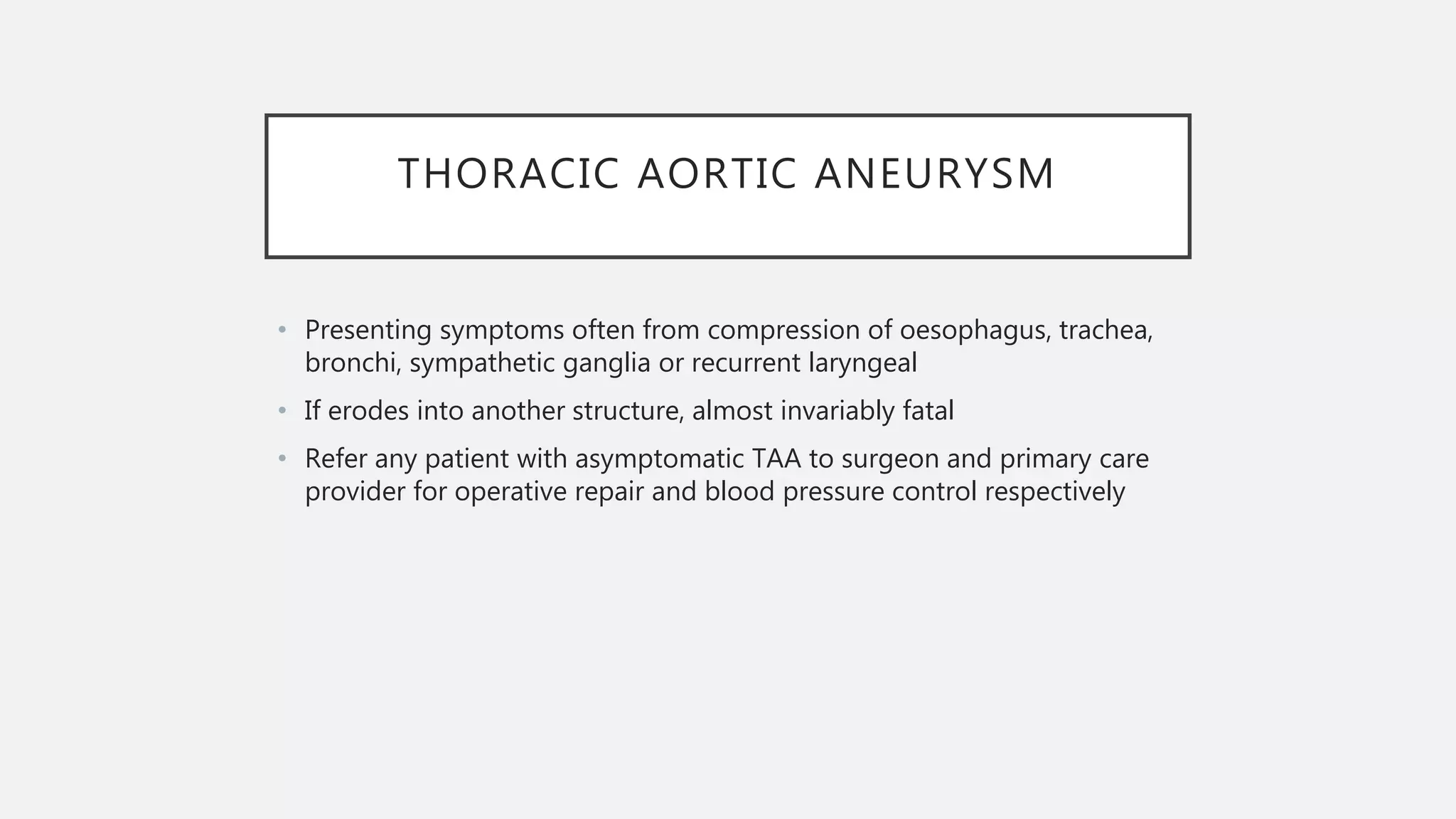
• Presenting symptoms often from compression of oesophagus, trachea,
bronchi, sympathetic ganglia or recurrent laryngeal
• If erodes into another structure, almost invariably fatal
• Refer any patient with asymptomatic TAA to surgeon and primary care
provider for operative repair and blood pressure control respectively
THORACIC AORTIC ANEURYSM
• Indications for repair
• Symptomatic
• Ruptured
• Dissection
• Asymptomatic
• Ascending
• End-diastolic aortic diameter >5.5cm
• Descending
• >5.5cm
• >7cm if high surgical risk
• Rapid expansion >1cm per year for aneurysms <5cm in diameter
SPONTANEOUS RETROPERITONEAL
HAEMORRHAGE
• Usually associated with vascular or malignant disease of the kidney or
adrenal gland, spontaneous rupture of retroperitoneal veins or with
anticoagulant therapy
• Presents as acute abdominal pain, shock and palpable abdominal or
groin mass
• Confirmed by CT
• IR is often the treatment of choice
VISCERAL ARTERIAL ANEURYSMS
• Defined as those affecting celiac, SMA, IMA and their branches
• Splenic artery (70%) and hepatic artery (20%) most commonly
• Often present with life-threatening haemorrhage due to delayed
diagnosis and high incidence of rupture
• Usual treatment is therefore early elective intervention rather than
watchful waiting
• Aneurysmal = 1.5x normal diameter
VAA
• Risk factors
• Atherosclerosis
• Pregnancy
• Portal HTN (splenic)
• Liver transplant (splenic)
• Marfan/Ehlers-Danlos
• Kawasaki
• Presenting complaints
• Usually vague abdominal pain, nausea/vomiting until rupture
VAA - SPLENIC
• Third most common true aneurysm after aortic and iliac artery
• 80% in those over 50
VAA - HEPATIC
• 80% extrahepatic
• Atherosclerosis is the most common underlying cause
• Symptomatic – Nausea and RUQ pain but most diagnosed incidentally
• Erosion into biliary tree leads to haemobilia
• Quincke’s triad = Jaundice, biliary colic and GI bleeding
• Occurs in 1/3
DISCLAIMER
This powerpoint provides general information and discussion about medicine, health and related subjects. The words and other con-
tent provided in this blog, and in any linked materials, are not intended and should not be construed as medical advice. If the reader or
any other person has a medical concern, he or she should consult with an appropriately-licensed physician or other health care worker.
Never disregard professional medical advice or delay in seeking it because of something you have read on this blog or in any linked
materials. If you think you may have a medical emergency, call your doctor or 000 immediately.
The views expressed on this blog and website have no relation to those of any academic, hospital, practice or other institution with
which the authors are affiliated.
TERMS OF USE AGREEMENT:
This Terms of Use Agreement (“agreement”) is entered between and by “you” (the reader or any other user of this weblog) and Dr
Andrew Crofton ”Principal Author”. Access to the weblog, and any use thereof, is subject to the terms and conditions set forth
herein. By accessing, reading or otherwise using the weblog, you hereby agree to these terms and conditions.
This agreement contains disclaimers and other provisions that limit the Author’s liability to you. Please read these terms and condi-
tions fully and carefully. If you do not agree to be bound to each and every term and condition set forth herein, please exit the weblog
and do not access, read or otherwise use information provided herein.
By accessing the weblog and/or reading its content, and/or using it to find information on any other website or informational resource,
you acknowledge and agree that you have read and understand these terms and conditions, that the provisions, disclosures and dis-
claimers set forth herein are fair and reasonable, and that your agreement to follow and be bound by these terms and conditions is
voluntary and is not the result of fraud, duress or undue influence exercised upon you by any person or entity.
DISCLAIMER
DISCLAIMER REGARDING MEDICAL ADVICE
The Principal author provides the weblog and any services, information, opinions, content, references and links to other knowledge resources (collectively, “Content”) for informational purposes only. The Author does not provide any medical advice on the Site.
Accessing, reading or otherwise using the weblog does not create a physician-patient relationship between you and the Principal author. Providing personal or medical information to the Principal author does not create a physician-patient relationship between you
and the Principal author or authors.
Nothing contained in the weblog is intended to establish a physician-patient relationship, to replace the services of a trained physician or health care professional, or otherwise to be a substitute for professional medical advice, diagnosis, or treatment.
You hereby agree that you shall not make any medical or health-related decision based in whole or in part on anything contained in the Site. You should not rely on any information contained in the Site and related materials in making medical, health-related or other
decisions. You should consult a licensed physician or appropriately-credentialed health care worker in your community in all matters relating to your health.
DISCLAIMER REGARDING SITE CONTENT AND RELATED MATERIALS
The Content may be changed without notice and is not guaranteed to be complete, correct, timely, current or up-to-date. Similar to any printed materials, the Content may become out-of-date. The Author undertakes no obligation to update any Content on the
Site. The Principal author may update the Content at any time without notice, based on the Principal author’s sole and absolute discretion. The Principal author reserves the right to make alterations or deletions to the Content at any time without notice.
Opinions expressed in the weblog are not necessarily those of the Principal author or team. Any opinions of the Principal author have been considered in the context of certain conditions and subject to assumptions that cannot necessarily be applied to an individual
case or particular circumstance. The Content may not and should not be used or relied upon for any other purpose, including, but not limited to, use in or in connection with any legal proceeding.
From time to time, the weblog may contain health– or medical-related information that is sexually explicit. If you find this information offensive, you may not want to use the Site.
GUIDELINES FOR POSTING
This weblog is open to the public. You should consider comments carefully and do not post any information or ideas that you would like to keep private. By uploading or otherwise making available any information to the Principal author in the form of user generated
comments or otherwise, you grant the Principal author the unlimited, perpetual right to distribute, display, publish, reproduce, reuse and copy the information contained therein.
You are responsible for the comments you post. You may not impersonate any other person through the weblog. You may not post content that is defamatory, fraudulent, obscene, threatening, invasive of another person’s privacy rights or that is otherwise unlaw-
ful. You may not post content that infringes on the intellectual property rights of any other person or entity. You may not post any content that includes any computer virus or other code designed to disrupt, damage, or limit the functioning of any computer software
or hardware.
By submitting or posting content on the weblog, you grant the Principal author, team and any company substantially under the control of the Principal author, the right to remove any content or comment that, in Principal author’s sole judgment, does not comply with
the terms and conditions of this Agreement or is otherwise objectionable. You also grant the Principal author and any company substantially under the control of Principal author the right to modify, adapt, and edit any content.
DISCLAIMER
DISCLAIMER REGARDING THIRD PARTY LINKS
The weblog may, from time to time, contain links to other (“third party”) web sites. These links are provided solely as a convenience and not as a guarantee or recommendation by the Principal author for the services, information, opinion or any other content on such
third party web sites or as an indication of any affiliation, sponsorship or endorsement of such third party web sites.
If you decide to access a linked website, you do so at your own risk. Your use of other websites is subject to the terms of use for such sites.
The Principal author is not responsible for the content of any linked or otherwise connected web sites. The Principal author does not make any representations or guarantees regarding the privacy practices of, or the content or accuracy of materials included in, any
linked or third party websites. The inclusion of third party advertisements on the weblog does not constitute an endorsement, guarantee, or recommendation. The Principal author makes no representations and/or guarantees regarding any product or service con-
tained therein.
DISCLAIMER OF ALL WARRANTIES
Content made available at the weblog is provided on an “as is” and “as available” basis without warranties of any kind, either express or implied. Under no circumstances, as a result of your use of the weblog, will the Principal author be liable to you or to any other per-
son for any direct, indirect, incidental, consequential, special, exemplary or other damages under any legal theory, including, without limitation, tort, contract, strict liability or otherwise, even if advised of the possibility of such damages.
AGE RESTRICTION
The Site is intended for persons eighteen (18) years or older. Persons under the age of eighteen (18) should not access, use and/or browse the Site.
INDEMNIFICATION
You agree to indemnify and hold the Author harmless from any claim or demand, including attorneys’ fees, made by any third party as a result of (1) any content posted or made available by you on this weblog, (2) any violation of law that occurs by you through the
weblog, and/or (3) anything you do using the weblog and/or the Content contained therein.
MODIFICATION
The Author may modify the terms and conditions of this Agreement in whole or in party at any time for any reason without any notice to you, based on her discretion. Such modified terms and conditions shall supersede these terms and conditions and shall become
binding when published online on the Site.
ENTIRE AGREEMENT
You accept that this Agreement represents the entire understanding between you and the Author concerning use of the Site.

Acute aortic emergencies

  • 1.
    ACUTE AORTIC EMERGENCIES DrAndrew Crofton ED Registrar
  • 2.
    INTRODUCTION • Acute aorticsyndromes • Aortic dissection, penetrating atherosclerotic ulcer, intramural haematoma and aortic aneurysm leakage/rupture • 3-6 cases per 100 000 per year • Most common cardiovascular complication of Marfan’s syndrome is aortic root disease and type A dissection • Identification of gene mutations associated with Marfan’s (TGFBR2 and FBN1), combined with regular follow-up can reduce fatal outcomes
  • 3.
    PATHOPHYSIOLOGY • Degeneration ofthe media of the aortic wall with intimal stress leading to: • Aortic dilation • Aneurysm formation • Development of penetrating ulcer • Intramural haemorrhage • Aortic dissection • Aortic rupture
  • 4.
    RISK FACTORS • Riskfactors • Male (65% of cases) • Chronic hypertension (70-90% of cases) • Arteritis/syphilis • Bicuspid aortic valve • Marfan’s syndrome • Ehlers-Danlos syndrome • Family history of aortic dissection • Chronic cocaine/amphetamine use • Prior cardiac surgery
  • 5.
    PATHOPHYSIOLOGY • Aortic dissection •Violation of intima allowing blood to enter media and dissect between the intima and adventitia • Dissecting column of blood forms a false lumen and can re-enter lumen (spontaneous clinical recovery) or dissect through adventitia with exsanguination • First peak in younger patients with connective tissue disorders and second peak in those >50yo with chronic hypertension • Other atherosclerotic risk factors are relatively weak compared to chronic HTN • Atherosclerosis is NOT a major risk factor for aortic dissection and is rarely present at site of dissection
  • 6.
    PATHOPHYSIOLOGY • Aortic dissection •Classification • Stanford A – Any involvement of the ascending aorta (proximal to ligamentum arteriosum) – 60-70% of cases • Stanford B – Descending aorta only • DeBakey type I – Ascending, arch and descending aorta • DeBakey type II – Ascending aorta only • DeBakey III – Descending aorta only • IIIa stops before diaphragm • IIIb extends past diaphragm
  • 7.
    AORTIC DISSECTION • 5-10patients per million per year • 2-3x more common than ruptured AAA • 90% fatal in 3 months; 28% fatal in 24 hours • In-hospital mortality 25% • Distribution • 50% begin in ascending aorta • 30% begin in the arch • 20% begin distally • Usually re-enter aorta just above bifurcation
  • 8.
    COMPLICATIONS • Dissection ofother vessels • Coronaries, brachiocephalic trunk, carotids, left subclavian, spinal, mesenteric, renal, iliacs • Free rupture – Haemothorax/sudden death/retroperitoneal/peritoneal • Acute aortic regurgitation • Haemopericardium/tamponade • Aneurysm formation
  • 9.
    PATHOPHYSIOLOGY • Aortic intramuralhaematoma • Results from infarction of the aortic media due to injury to vasa vasorum • May resolve spontaneously or dissect • 5-20% of cases of acute aortic syndrome • Treated as for dissection • Penetrating atherosclerotic ulcer • Can lead to intramural haematoma, aortic dissection or perforation of the aorta • Poorer outcome than mural haematoma • Treatment is with early surgical graft replacement of aorta
  • 10.
    CLINICAL FEATURES • History •Always think if chest pain PLUS • Back pain • Abdominal pain • Neurological deficits • Limb ischaemia • Classically tearing chest pain radiating to interscapular region with impending doom • 60% of patients had anterior chest pain (most common in Stanford A); 50% have back pain • Abdominal pain (30%) and back pain are more common in Stanford B • 25% have no chest pain • 5% have no pain at all • Most patients describe pain as worst pain they’ve ever had and abrupt onset (85%) - if not rapid onset LR -0.3 to -0.07 • 64% describe sharp pain and 50% as tearing
  • 11.
    CLINICAL FEATURES • History •Syncope seen in 10% (mostly Stanford A) • 22% occur in patients with prior cardiac surgery • May present with stroke symptoms with carotid involvement • 20% of type A dissections display neurological findings (poor prognosis) • Focal neuro deficit + chest pain = LR + 6.6 to 33 • Paraplegia if blood supply to spinal cord interrupted • Further distal dissection may lead to flank/back or abdominal pain • Cardiac tamponade if more proximal dissection ensues +- ECG showing ACS-type findings if coronary arteries involved
  • 12.
    CLINICAL FEATURES • Examination •1/3 have aortic insufficiency murmur – LR + 9.0 • 15% have pulse deficit in radial or femoral arteries • 20% sensitive but 95% specific – LR + 29-33 • BP discrepancy of >20mmHg between arms – significant • 30% sensitive and 85% specific for dissection • 50% have hypertension (>150mmHg) • Seen in 35% of Type A and 70% of type B • Hypotension in 18-25% (worse prognosis) • Pericardial tamponade occurs in 25% of type A dissections • Aneurysmal aortic dilatation can compress surrounding structures • Oesophagus (dysphagia) • Recurrent laryngeal nerve (hoarsenss) • Superior cervical sympathetic ganglion (Horner’s)
  • 13.
    CLINICAL FEATURES • DDx •MI/ACS • Pericardial disease • Stroke • Spinal cord injury/disorders • Intra-abdominal disorders • PE, pneumonia, pleurisy, pneumothorax
  • 14.
    DIAGNOSIS • ECG –Normal in 19-31%. Majority have non-specific ST/T wave changes or ST depression • 25% have features suggestive of ACS (usually type I dissection) • D-dimer • False negative rate as high as 18%. Especially useless in younger patients with short dissection length and thrombosed false lumen • Not to be used as sole rule-out criterion and not routinely used in workup at all
  • 15.
    DIAGNOSIS • Imaging • 12-37%of patients have normal CXR; conversely 90% of cases have some abnormality • 60% widened mediastinum; 50% abnormal aortic contour • Normal CXR more common if younger (connective tissue) or pregnancy-related • CT (MDCT) is the modality of choice • Highly sensitive/specific and can diagnose atherosclerotic ulcers and intramural haematomas • Provides information on extent of dissection, other organs involved and signs of aortic rupture • More accurate for proximal than distal aortic dissections; Sensitivity 95%, specificity 95- 100%
  • 16.
    DIAGNOSIS • Imaging continued… •TTE • Limited sensitivity but highly specific if intimal flap seen. Sensitive for ascending dissections within 2-3cm of aortic valve • TOE may be as sensitive and specific as CT • Requires moderate sedation and highly operator dependent • Sensitivity 80-100%; specificity 70-95% • Less accurate for aortic ulcers and intramural haematomas • Coronary CT angiography (triple rule-out) • Can diagnosed and differentiate coronary artery disease, PE and acute aortic dissection • Requires special infusion protocol and has not been shown to improve diagnostic yield, reduce clinical events or diminish downstream resource use
  • 17.
    CXR FINDINGS • Doubledensity of aorta • Tracheal deviation to the right and anteriorly • Depression of left main bronchus • NGT deviation to the right • Cardiomegaly • Left sided pleural effusion • Apical capping Left mediastinal width at level of aortic knob >5cm – 90% sensitive and specific Blurred aortic knob – 70% sensitive Loss of aortopulmonary window Mediastinum > 7.5cm at level of aortic knob – 90% sensitive and specific Mediastinum >25% chest width Subjective widening – Sensitivity of 65%; LR + 2.0 Disparity between ascending and descending aorta diameter
  • 18.
    TREATMENT • Target HR<60and then SBP 100-120mmHg • Esmolol 0.1-0.5mg/kg IV bolus then 0.025-0.2mg/kg/min • Labetalol 10-20mg IV bous, then repeat 20-40mg q10min up to 300mg • Metoprolol 1-5mg IV boluses q3-5min • Improved survival with beta-blocker use • If significant aortic regurgitation, more vasodilator vs. rate control may improve haemodynamics (tachycardia shortens time of regurgitation) • Vasodilators • Nitroprusside can be added once HR <60 • GTN preferred if coronary ischaemia evident • Hydralazine 5-10mg IV over 5-10 min repeated q15-20min
  • 19.
    TREATMENT • Definitive repair •Type A require prompt surgical repair • Endovascular stent repairs with fenetrations can be used for some type A and complicated type B dissections (malperfusion, resistent hypertension, persistent severe pain, persistent false lumens or expanding aortic diameter), penetrating ulcers and intramural haematomas • All other Type B get medical management and ongoing management from Cardiology/Vascular Surgery
  • 20.
    ANEURYSMAL DISEASE • Aneurysm= Dilatation >1.5x normal diameter • True aneurysm - involves all three layers of wall • Risk factors: • Connective tissue disorders • Family Hx of aneurysm • Atherosclerosis risk factors • Thinning of media and reduced tensile strength • Increased wall force and dilatation are intertwined as per LaPlace law: wall tension = pressure x radius • Larger aneurysms expand more quickly due to this (0.25-0.5cm per year) • Abrupt expansion and rupture can occur and is not predictable
  • 21.
    ANEURYSMAL DISEASE • Pseudoaneurysm– Partly vessel wall and partly fibrous tissues • Usually at site of previous cannulation, anastamoses of prior reconstructions, trauma or infection • Small ones may thrombose spontaneously • Mycotic aneurysm – Infection in blood vessel wall, often in immunocompromised • Can be direct extension or embolisation from IE • Peripheral and visceral aneurysms • Popliteal artery most common (often co-exist with AAA) • Renal, splenic and hepatic arteries most common visceral aneurysms • Usually silent until rupture or thrombosis/embolic phenomena
  • 22.
    SYMPTOMATIC AAA • Definedas aorta >=3cm in diameter • Repair considered for aneurysm >5cm • 20% have first-degree relative with AAA • Most patients >60 and more commonly male • Clinical features • Syncope, back, flank, abdominal pain, GI bleeding, extremity ischaemia from embolisation from intramural thrombus, shock or sudden death • Sudden death usually occurs from intraperitoneal rupture • Syncope without warning symptoms and subsequent severe pain suggests rupture with some temporary containment • Patients may regain consciousness but irreversible haemorrhagic shock ensues if not promptly diagnosed • Typically back or abdominal pain, 50% describe as ripping/tearing and 10% have syncope • Non-classic sites of pain are still common (flank, groin, isolated quadrants, hip) • Uncommon presentations are Grey-Turner, Cullen, scrotal haematoma, inguinal mass and femoral neuropathy from compression
  • 23.
    AAA • Prevalence • 1%at age 50 • 4% at age 60 • 5-10% at age 70 • 10% at age 80 • Rupture <1% per year if <5cm and 17% per year if >6cm • Risk of rupture higher in women (growth rate is faster) and in current smokers/hypertension • 0.3cm/year expansion if <5cm and 0.5cm/year if >5cm
  • 24.
    AAA • Diagnosis • Abdominalpalpation • Sensitivity 29% for 3-4cm; 50% for 4-5cm; 76% for >5cm • Lack of tenderness does not indicate intact aorta • Periumbilical ecchymosis (Cullen sign) and flank ecchymosis (Grey-Turner sign) are rare • Scrotal or vulvar haematomas or inguinal masses can be seen if retroperitoneal blood dissects down • Aortoenteric fistulas may present with small sentinel bleed followed by catastrophic haemorrhage • Aortovenous fistulas can cause high-output cardiac failure
  • 25.
    AAA • Imaging • Plainfilm – May show calcified aneurysm but cannot determine rupture • Bedside USS - >90% sensitivity for demonstrating aneurysm and measuring diameter if technically adequate • Obesity, bowel gas and abdominal tenderness make study difficult • Need to measure transverse and longitudinally • Identifying SMA distinguishes aorta from IVC • If <3cm, this excludes aneurysmal disease • CT with contrast • Unenhanced CT still identifies aneurysm size and retroperitoneal haemorrhage
  • 26.
    AAA • Treatment • Consultation •Permissive hypotension to 90mmHg or LOC with blood products • Pain control • Use imaging only in those fully compensated or unlikely to have ruptured their aneurysm • If asymptomatic • >5cm needs follow-up within days • >3cm needs follow-up at some point • Repairing AAA <5.5cm does not improve survival in men but may do so in women • Perioperative mortality for elective repair is 5% for open and 1.5% for endovascular repair (although 2 year survival rates are the same for either method = 90%) • Endovascular repair does NOT improve survival if deemed medically unfit for open repair • Operative mortality is 15% if urgently repaired (non-ruptured) and 50% if ruptured
  • 27.
    THORACIC AORTIC ANEURYSM •Presenting symptoms often from compression of oesophagus, trachea, bronchi, sympathetic ganglia or recurrent laryngeal • If erodes into another structure, almost invariably fatal • Refer any patient with asymptomatic TAA to surgeon and primary care provider for operative repair and blood pressure control respectively
  • 28.
    THORACIC AORTIC ANEURYSM •Indications for repair • Symptomatic • Ruptured • Dissection • Asymptomatic • Ascending • End-diastolic aortic diameter >5.5cm • Descending • >5.5cm • >7cm if high surgical risk • Rapid expansion >1cm per year for aneurysms <5cm in diameter
  • 29.
    SPONTANEOUS RETROPERITONEAL HAEMORRHAGE • Usuallyassociated with vascular or malignant disease of the kidney or adrenal gland, spontaneous rupture of retroperitoneal veins or with anticoagulant therapy • Presents as acute abdominal pain, shock and palpable abdominal or groin mass • Confirmed by CT • IR is often the treatment of choice
  • 30.
    VISCERAL ARTERIAL ANEURYSMS •Defined as those affecting celiac, SMA, IMA and their branches • Splenic artery (70%) and hepatic artery (20%) most commonly • Often present with life-threatening haemorrhage due to delayed diagnosis and high incidence of rupture • Usual treatment is therefore early elective intervention rather than watchful waiting • Aneurysmal = 1.5x normal diameter
  • 31.
    VAA • Risk factors •Atherosclerosis • Pregnancy • Portal HTN (splenic) • Liver transplant (splenic) • Marfan/Ehlers-Danlos • Kawasaki • Presenting complaints • Usually vague abdominal pain, nausea/vomiting until rupture
  • 32.
    VAA - SPLENIC •Third most common true aneurysm after aortic and iliac artery • 80% in those over 50
  • 33.
    VAA - HEPATIC •80% extrahepatic • Atherosclerosis is the most common underlying cause • Symptomatic – Nausea and RUQ pain but most diagnosed incidentally • Erosion into biliary tree leads to haemobilia • Quincke’s triad = Jaundice, biliary colic and GI bleeding • Occurs in 1/3
  • 34.
    DISCLAIMER This powerpoint providesgeneral information and discussion about medicine, health and related subjects. The words and other con- tent provided in this blog, and in any linked materials, are not intended and should not be construed as medical advice. If the reader or any other person has a medical concern, he or she should consult with an appropriately-licensed physician or other health care worker. Never disregard professional medical advice or delay in seeking it because of something you have read on this blog or in any linked materials. If you think you may have a medical emergency, call your doctor or 000 immediately. The views expressed on this blog and website have no relation to those of any academic, hospital, practice or other institution with which the authors are affiliated. TERMS OF USE AGREEMENT: This Terms of Use Agreement (“agreement”) is entered between and by “you” (the reader or any other user of this weblog) and Dr Andrew Crofton ”Principal Author”. Access to the weblog, and any use thereof, is subject to the terms and conditions set forth herein. By accessing, reading or otherwise using the weblog, you hereby agree to these terms and conditions. This agreement contains disclaimers and other provisions that limit the Author’s liability to you. Please read these terms and condi- tions fully and carefully. If you do not agree to be bound to each and every term and condition set forth herein, please exit the weblog and do not access, read or otherwise use information provided herein. By accessing the weblog and/or reading its content, and/or using it to find information on any other website or informational resource, you acknowledge and agree that you have read and understand these terms and conditions, that the provisions, disclosures and dis- claimers set forth herein are fair and reasonable, and that your agreement to follow and be bound by these terms and conditions is voluntary and is not the result of fraud, duress or undue influence exercised upon you by any person or entity.
  • 35.
    DISCLAIMER DISCLAIMER REGARDING MEDICALADVICE The Principal author provides the weblog and any services, information, opinions, content, references and links to other knowledge resources (collectively, “Content”) for informational purposes only. The Author does not provide any medical advice on the Site. Accessing, reading or otherwise using the weblog does not create a physician-patient relationship between you and the Principal author. Providing personal or medical information to the Principal author does not create a physician-patient relationship between you and the Principal author or authors. Nothing contained in the weblog is intended to establish a physician-patient relationship, to replace the services of a trained physician or health care professional, or otherwise to be a substitute for professional medical advice, diagnosis, or treatment. You hereby agree that you shall not make any medical or health-related decision based in whole or in part on anything contained in the Site. You should not rely on any information contained in the Site and related materials in making medical, health-related or other decisions. You should consult a licensed physician or appropriately-credentialed health care worker in your community in all matters relating to your health. DISCLAIMER REGARDING SITE CONTENT AND RELATED MATERIALS The Content may be changed without notice and is not guaranteed to be complete, correct, timely, current or up-to-date. Similar to any printed materials, the Content may become out-of-date. The Author undertakes no obligation to update any Content on the Site. The Principal author may update the Content at any time without notice, based on the Principal author’s sole and absolute discretion. The Principal author reserves the right to make alterations or deletions to the Content at any time without notice. Opinions expressed in the weblog are not necessarily those of the Principal author or team. Any opinions of the Principal author have been considered in the context of certain conditions and subject to assumptions that cannot necessarily be applied to an individual case or particular circumstance. The Content may not and should not be used or relied upon for any other purpose, including, but not limited to, use in or in connection with any legal proceeding. From time to time, the weblog may contain health– or medical-related information that is sexually explicit. If you find this information offensive, you may not want to use the Site. GUIDELINES FOR POSTING This weblog is open to the public. You should consider comments carefully and do not post any information or ideas that you would like to keep private. By uploading or otherwise making available any information to the Principal author in the form of user generated comments or otherwise, you grant the Principal author the unlimited, perpetual right to distribute, display, publish, reproduce, reuse and copy the information contained therein. You are responsible for the comments you post. You may not impersonate any other person through the weblog. You may not post content that is defamatory, fraudulent, obscene, threatening, invasive of another person’s privacy rights or that is otherwise unlaw- ful. You may not post content that infringes on the intellectual property rights of any other person or entity. You may not post any content that includes any computer virus or other code designed to disrupt, damage, or limit the functioning of any computer software or hardware. By submitting or posting content on the weblog, you grant the Principal author, team and any company substantially under the control of the Principal author, the right to remove any content or comment that, in Principal author’s sole judgment, does not comply with the terms and conditions of this Agreement or is otherwise objectionable. You also grant the Principal author and any company substantially under the control of Principal author the right to modify, adapt, and edit any content.
  • 36.
    DISCLAIMER DISCLAIMER REGARDING THIRDPARTY LINKS The weblog may, from time to time, contain links to other (“third party”) web sites. These links are provided solely as a convenience and not as a guarantee or recommendation by the Principal author for the services, information, opinion or any other content on such third party web sites or as an indication of any affiliation, sponsorship or endorsement of such third party web sites. If you decide to access a linked website, you do so at your own risk. Your use of other websites is subject to the terms of use for such sites. The Principal author is not responsible for the content of any linked or otherwise connected web sites. The Principal author does not make any representations or guarantees regarding the privacy practices of, or the content or accuracy of materials included in, any linked or third party websites. The inclusion of third party advertisements on the weblog does not constitute an endorsement, guarantee, or recommendation. The Principal author makes no representations and/or guarantees regarding any product or service con- tained therein. DISCLAIMER OF ALL WARRANTIES Content made available at the weblog is provided on an “as is” and “as available” basis without warranties of any kind, either express or implied. Under no circumstances, as a result of your use of the weblog, will the Principal author be liable to you or to any other per- son for any direct, indirect, incidental, consequential, special, exemplary or other damages under any legal theory, including, without limitation, tort, contract, strict liability or otherwise, even if advised of the possibility of such damages. AGE RESTRICTION The Site is intended for persons eighteen (18) years or older. Persons under the age of eighteen (18) should not access, use and/or browse the Site. INDEMNIFICATION You agree to indemnify and hold the Author harmless from any claim or demand, including attorneys’ fees, made by any third party as a result of (1) any content posted or made available by you on this weblog, (2) any violation of law that occurs by you through the weblog, and/or (3) anything you do using the weblog and/or the Content contained therein. MODIFICATION The Author may modify the terms and conditions of this Agreement in whole or in party at any time for any reason without any notice to you, based on her discretion. Such modified terms and conditions shall supersede these terms and conditions and shall become binding when published online on the Site. ENTIRE AGREEMENT You accept that this Agreement represents the entire understanding between you and the Author concerning use of the Site.