Weaning from Mechanical Ventilation
•What is weaning?
Weaning covers the entire process of liberating the patient from
mechanical support and from the endotracheal tube, including
relevant aspects of terminal care.
Terminologies
• Liberation or Weaning
• Extubation
• Spontaneous breathing trial(SBT)
• Weaning success/failure
• Extubation success/failure
• Weaning in progress
• Simple Weaning vs Difficult Weaning
• Early vs Slow & gradual weaning
Liberation & Extubation
• Liberation- refers to weaning from MV, patient no longer
requires V support 
• Will the patient be able to breathe spontaneously without
ETT?
• Extubation –refers to Removal of ETT
What is SBT?
• A process of trial while weaning from MV(a diagnostic test)
• Process T-Piece trail/ low PS/CPAP trial for short period of
time from 30 – 120 minutes
• This process is called simple weaning and prognosis is good
• 70% of mechanically ventilated patients are extubated on 1st
SBT attempt
• Remaining 30% of patients need progressive weaning
What is Weaning Success?
• Extubation AND
• Absence of ventilatory support 48 hours following
the extubation.
What is Weaning failure?
• Failure of weaning
1) Failed SBT
2) Re-intubation and/or resumption of MVS following
successful extubation
3) Death within 48 h following extubation
Predictors of extubation failure
• excess secretions
• PaCO2 > 45 mmHg
• duration of mechanical ventilation >72 h
• upper airway disorders
• a prior failed weaning attempt
• Failure of extubation is associated with high mortality rate
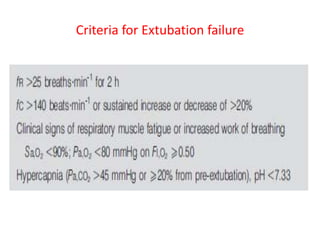
Criteria for Extubation failure
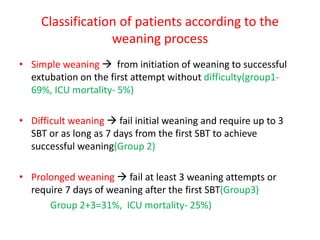
Classification of patients according to the
weaning process
• Simple weaning  from initiation of weaning to successful
extubation on the first attempt without difficulty(group1-
69%, ICU mortality- 5%)
• Difficult weaning  fail initial weaning and require up to 3
SBT or as long as 7 days from the first SBT to achieve
successful weaning(Group 2)
• Prolonged weaning  fail at least 3 weaning attempts or
require 7 days of weaning after the first SBT(Group3)
Group 2+3=31%, ICU mortality- 25%)
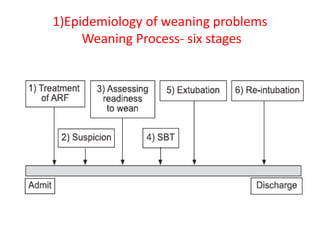
1)Epidemiology of weaning problems
Weaning Process- six stages
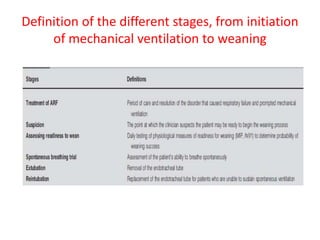
Definition of the different stages, from initiation
of mechanical ventilation to weaning
Epidemiology contd......
• incidence of unplanned extubation ranges 0.3–16%
• In most cases (83%), the unplanned extubation is
initiated by the patient, while 17% are accidental
• Almost half of patients with self- extubation during
the weaning period do not require re-intubation ,
suggesting that many patients are maintained on MV
longer than is necessary
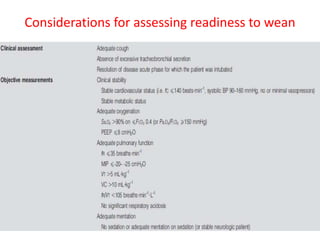
Considerations for assessing readiness to wean
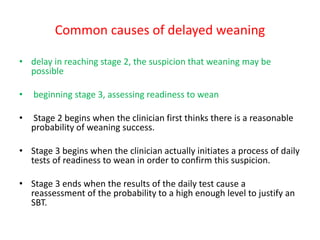
Common causes of delayed weaning
• delay in reaching stage 2, the suspicion that weaning may be
possible
• beginning stage 3, assessing readiness to wean
• Stage 2 begins when the clinician first thinks there is a reasonable
probability of weaning success.
• Stage 3 begins when the clinician actually initiates a process of daily
tests of readiness to wean in order to confirm this suspicion.
• Stage 3 ends when the results of the daily test cause a
reassessment of the probability to a high enough level to justify an
SBT.
What happens when weaning is delayed?
• Unnecessary discomfort
• Increased risk of complications  Increased Infection risk(VAP),
Barotrauma, Cardiovascular compromise, Tracheal injury, Muscle
deconditioning
• Increasing the cost of care
• Mortality increases with increasing duration of mechanical
ventilation(12% vs 27%)
• Prolonged MV account for 6% of all ventilated patients but
consume 37% of ICU resources
What is Weaning in Progress?
• Since NIV may allow extubation while MV is continued in the form of NIV,
an intermediate category weaning in progress
• Several studies have recently proposed the use of NIV for extubated
patients in different clinical situations
• prophylactic intervention in COPD patients who failed SBT
• Patients with repeated SBT failure
• Post-Surgical patients
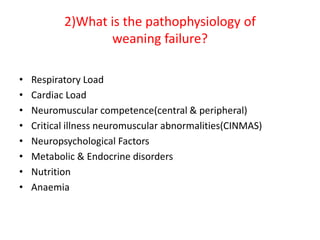
2)What is the pathophysiology of
weaning failure?
• Respiratory Load
• Cardiac Load
• Neuromuscular competence(central & peripheral)
• Critical illness neuromuscular abnormalities(CINMAS)
• Neuropsychological Factors
• Metabolic & Endocrine disorders
• Nutrition
• Anaemia
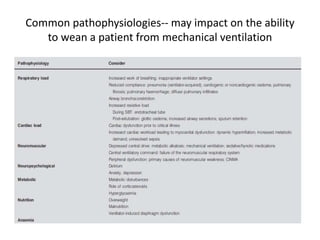
Common pathophysiologies-- may impact on the ability
to wean a patient from mechanical ventilation
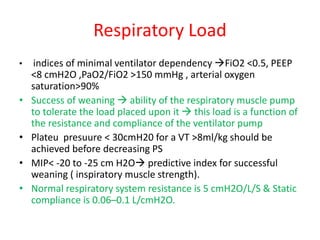
Respiratory Load
• indices of minimal ventilator dependency FiO2 <0.5, PEEP
<8 cmH2O ,PaO2/FiO2 >150 mmHg , arterial oxygen
saturation>90%
• Success of weaning  ability of the respiratory muscle pump
to tolerate the load placed upon it  this load is a function of
the resistance and compliance of the ventilator pump
• Plateu presuure < 30cmH20 for a VT >8ml/kg should be
achieved before decreasing PS
• MIP< -20 to -25 cm H2O predictive index for successful
weaning ( inspiratory muscle strength).
• Normal respiratory system resistance is 5 cmH2O/L/S & Static
compliance is 0.06–0.1 L/cmH2O.
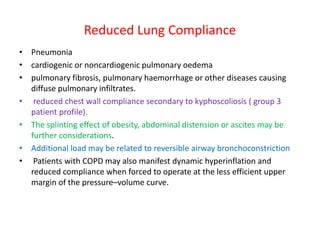
Reduced Lung Compliance
• Pneumonia
• cardiogenic or noncardiogenic pulmonary oedema
• pulmonary fibrosis, pulmonary haemorrhage or other diseases causing
diffuse pulmonary infiltrates.
• reduced chest wall compliance secondary to kyphoscoliosis ( group 3
patient profile).
• The splinting effect of obesity, abdominal distension or ascites may be
further considerations.
• Additional load may be related to reversible airway bronchoconstriction
• Patients with COPD may also manifest dynamic hyperinflation and
reduced compliance when forced to operate at the less efficient upper
margin of the pressure–volume curve.
Resistive Load
• The process of weaning may impose an increased resistive
load
• on the ventilatory muscles, either from the endotracheal tube
during an SBT
or
• post-extubation from glottic oedema or increased airway
secretions and sputum retention
Cardiac Load
• The transfer of a patient from PPV to spontaneous
ventilation is associated with increased venous return
and negative ITP causing increased LV afterload and
increased myocardial oxygen consumption.
• Thus, latent or unrecognised myocardial dysfunction may
become manifest at the commencement of the weaning
attempts
Contributors to increased cardiac workload
• Dynamic hyperinflation (intrinsic PEEP), which increases PVR,
reduces RV filling and impairs CO
• The increased metabolic demand of the weaning process; and
unresolved systemic disease (e.g. sepsis)
• There is an obligatory increase in CO to meet the metabolic
demand of a weaning trial
• Measurable indices include increased S.Lactate and decreased
SVO2.
• MI may become manifest during SBT. This may result in
reduced LV compliance, pulmonary oedema and increased
WOB.
Neuromuscular competence
• Adequate signal generation from CNS
• Intact transmission to spinal respiratory motor neurons, respiratory
muscles and neuromuscular junctions
• Liberation from mechanical ventilation requires the resumption of
neuromuscular activity to overcome the impedance of the respiratory
system, to meet metabolic demands and to maintain carbon dioxide
homeostasis
Depressed central drive
• encephalitis, brainstem haemorrhage/ ischaemia and
neurosurgical complications
• metabolic alkalosis, mechanical ventilation itself or the use of
sedative/hypnotic medications
• importance of - daily awakening favours early weaning??
• over-sedation  prolonged weaning and ICU stay
Central ventilatory command
• Failure of the neuromuscular respiratory system to maintain homeostasis
results in an increased central drive to breathe ventilatory failure
• Increased resistive load from upper airway obstruction an imbalance
between mechanical load and respiratory muscle capacity or isolated
muscle weakness
• Abnormalities of upper airway motor control are a potential cause of
extubation failure
Peripheral neuromuscular dysfunction
• Guillain–Barre´ syndrome
• Myasthenia gravis
• Motor neuron disease
• Critical illness neuromuscular abnormalities
(CINMA)
Critical illness neuromuscular abnormalities
(CINMA)
• most common peripheral neuromuscular disorders encountered in the ICU setting and
usually involve both muscle and nerve(prevalence-50-100%)
• this has been associated with severity of illness, multiple organ dysfunction, exposure
to corticosteroids, presence of hyperglycaemia and prolonged ICU stay
• CINMA presents as a motor deficit where muscle weakness is bilateral, symmetrical and
most marked in the proximal muscles.
• Sensorymotor axonopathy, myopathy
• diaphragmatic electrophysiological abnormalities are common in patients with
locomotor electroneuromyographic abnormalities
• CINMA was an independent risk factor for duration of mechanical ventilation and
weaning failure, including the need for tracheostomy
Psychological depression
• Delirium/acute brain dysfunction- a disturbance of the level of cognition
and arousal(22-80%)
• Risk factors use of psychoactive drugs; untreated pain; prolonged
immobilisation; hypoxaemia; anaemia; sepsis; and sleep deprivation
• Anxiety & Depression--(30-75%) Patients report the following as important
contributors to anxiety: dyspnoea; inability to communicate; and sleep
disruption
• Polysomnographic studies show that ICU patients suffer from frequent
arousals and sleep fragmentation
Metabolic & endocrine disturbances
• Metabolic disturbances-
Hypophosphataemia, hypomagnesaemia and hypokalaemia all cause muscle
weakness.
Hypothyroidism and hypoadrenalism may also contribute to difficulty
weaning.
• Role of corticosteroids-
The importance of corticosteroids in weaning failure, either their relative
deficiency or supplementation, needs further analysis
• exposure to exogenous corticosteroids during the ICU stay might cause
muscle weakness and possibly contribute to the duration of mechanical
ventilation. Corticosteroid therapy impairs glycaemic control.
Nutrition
Obesity(Overweight)  decreased respiratory compliance, high
closing volume/functional residual capacity ratio and elevated
WOB impact on the duration of MV.
Malnutrition-Underweight patients(BMI < 20 kg/m2), may suffer
depressed ventilatory drive , limited muscle mass and
weaning difficulty.
Anaemia
• There remains considerable debate as to the desired
haemoglobin level when considering whether a patient is
suitable for weaning.
• Previous weaning guidelines referenced a haemoglobin target
of 8–10 g/dL
• In a smaller group of COPD patients, transfusion led to a
significant decrease of both the minute ventilation and the
WOB
Ventilator-induced diaphragm dysfunction and critical
illness oxidative stress
• defined as loss of diaphragm force-generating capacity that is
specifically related to use of controlled mechanical ventilation
• The pathophysiology comprises muscle atrophy, structural injury,
fibre-type transformation and remodelling(mitochondrial swelling,
myofibril damage and increased lipid vacuoles)
• The role of trace element and vitamin supplementations that
support antioxidant function in the critically ill patient is evolving
• Alfa-tocoferol, vitC, selenium
3)What is the usual process of initial
weaning from the ventilator?
• Assessing readiness to wean  SBT(a diagnostic test to determine
likelihood of successful extubation)– met the probable
criteriathese criteria are to be taken as considerations rather
than as rigid requirements-
• An initial assessment of the likelihood of a successful SBT is
appropriate in order to avoid trials in patients with a high
probability of failure.
• discontinuation of sedation is a critical step that can be achieved by
either daily interruption of sedation or continuous titration of
sedation to a level that allows the patient to be adequately
responsive
• SBT T tube trial/ low level pressure support(<8 cm H2O)
SBT
• a T-tube trial is compared with the use of low levels of pressure support
(PS), such as 7 cmH2O or 8 cmH2O in adults or 10 cmH2O in paediatric
patients, or the use of CPAP
• use of automatic tube compensation (ATC), which adjusts for the assumed
resistance of the endotracheal tube, is at least as successful as the use of
simple T-tube or low-level PS
• In the case of SBT failure because of a particularly narrow endotracheal
tube, ATC may be beneficial
• The impact of low levels (5 cmH2O) of PEEP during an SBT has not been
formally studied but is likely to be small
• Due to dynamic hyperinflation, patients with COPD may have improved
pulmonary function with CPAP
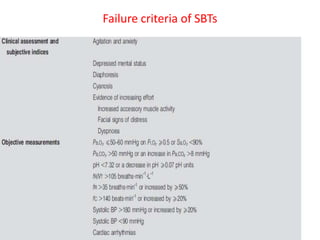
How to recognise the SBT failure?
1) objective indices  tachypnoea, tachycardia,
hypertension, hypotension, hypoxaemia or acidosis,
arrhythmia
2) subjective indices agitation or distress, depressed
mental status, diaphoresis and evidence of increasing
effort
Failure criteria of SBTs
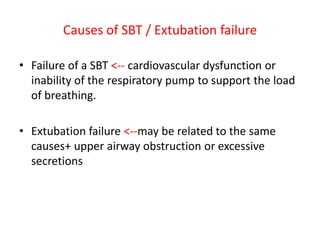
Causes of SBT / Extubation failure
• Failure of a SBT <-- cardiovascular dysfunction or
inability of the respiratory pump to support the load
of breathing.
• Extubation failure <--may be related to the same
causes+ upper airway obstruction or excessive
secretions
Is SBT a must before extubation?
• Failure rate is more without SBT-40% vs 13% of reintubation if
extubated after Passed SBT
• Patients who successfully pass the SBT should be extubated if
neurological status, excessive secretions and airway
obstruction are not issues.
• Poor cough strength and excessive endotracheal secretions
were more common in patients who failed extubation
following a successful SBT
• upper airway obstruction due to oedema is a potential
concern, a positive leak test
Faileed SBT- what next?
• review possible reversible aetiologies for failure
• The SBT should be repeated frequently (daily) in order to
determine the earliest time at which the patient can be
successfully extubated
• respiratory muscle fatigue has been considered to be a major
reason for continuing failure
• should receive a nonfatiguing mode of mechanical ventilation
• PS in 36%, SIMV in 5%, SIMV and PS in 28%, intermittent SBT
in 17% and daily SBTs in 4%.
• T-tube in 52% of attempts, CPAP in 19%, PS in 28%
Weaning protocols
• Weaning protocols may be valuable in standardising the
process of weaning
• Protocol-directed daily screening of respiratory function and
trials of SBT decrease the time required for extubation, the
incidence of self-extubation, tracheostomy , ICU costs, and
results in no increase in the incidence of reintubation,
decreased incidence of VAP and death
• Weaning protocols incorporating SBT may be particularly
effective in helping physicians utilise the most effective
techniques
4)is there a role for different
ventilator modes in more difficult weaning?
• weaning failure is relatively common, with an estimated
prevalence of 31% and a range 26–42%
• choose appropriate mode(s) of ventilatory support which:
• 1) maintain a favourable balance between respiratory system
capacity and load
• 2) attempt to avoid diaphragm muscle atrophy
• 3) aid in the weaning process
PSV/SIMV/SIMV+PS/T-piece
• PSV compared with SIMV and intermittent T-piece trials
resulted in shorter duration of weaning
• PSV was decreased from a mean of 19 cmH2O by 2 or 4
cmH2O per day.
• One daily trial or multiple daily trials of unassisted,
spontaneous breathing (T-piece) reduced the duration
of weaning than either SIMV or PSV
• patients who have repeated difficulty tolerating weaning,
i.e. group 3, PSV has also been observed to reduce the
duration of MV
• intermittent use of spontaneous breathing via a T-tube
was comparable to PSV as a weaning mode
NIV- indications
• Firstly, NIV has been used as an alternative weaning modality
• Secondly, NIV has been used as a treatment option
• Thirdly, NIV has been used as a prophylactic measure after
extubation
• Physiological studies suggest that similar levels of VS can be
delivered by NIV compared to PSV in stable COPD patients
who cannot tolerate spontaneous breathing
Alternative weaning technique for patients who failed
conventional weaning
NIV:
• 1) might be useful as a bridge to total withdrawal of VS,
• 2) would lower ICU morbidity
• NIV use for weaning shortened the total duration of invasive
MV and ICU stay, and substantially reduced the rate of NI &
higher survival rate
• Although NIV is useful in very selected populations, its use
cannot be recommended for all patients failing a SBT
• patients who are extubated to NIV should not be considered a
weaning success until they are completely liberated from NIV
as a form of therapy .
CPAP
• reduces mean ITP, has beneficial effects on right and left ventricular
performance, improves oxygenation and reduces the WOB
• additional application of PEEP either alone or with PSV seems logical for
weaning
• In cardiac surgical patients, typically included in the previously discussed
weaning group 1, BAILEY et al. randomised patients to receive CPAP or T-
piece trials prior to extubation and observed no significant difference in
oxygenation or time spent on mechanical ventilation
• compared to T-piece trials no clear improvement in outcomes has been
observed. Lastly, CPAP has been used for prophylaxis against post-
operative extubation failure.
• CPAP compared to oxygen supplementation substantially reduced the
reintubation rate.
• CPAP & PSV COMBINATION
Automatic tube compensation
• The use of ATC, a ventilatory method aimed at
compensating for the nonlinear pressure drop across
the ETT during spontaneous breathing.
• It is as successful as the use of simple T-tube or low-
level PS for weaning
• If an SBT fails because of a particularly narrow
endotracheal tube, ATC may be beneficial
Proportional assist ventilation
• PAV is available with some ventilators but its application is
sometimes regarded as difficult and has not been investigated
thoroughly in weaning trials.
• PAV has been studied in ventilator-dependent patients with
COPD. In comparison to PSV and CPAP, there was no
substantial difference in oxygenation, pressure time product
and other physiological variables
Servo-controlled ventilation
• Rapid adaptation of the VS to the changing situations of a
patient is one of the major factors determining the length of
the weaning process.
• Automatic ventilatory modes provide a tool to achieve
optimal VS and an individual level of PS with the aim of rapid
extubation.
• adaptive support ventilation (ASV) and a knowledge-based
expert system (Smartcare1)
Adaptive support ventilation
-ASV
• ASV is based on a computer-driven closed-loop regulation
system of the ventilator settings which is responsive to
changes in both respiratory system mechanics and
spontaneous breathing efforts
• ASV can thus manage the spectrum of ventilatory support
ranging from controlled mechanical ventilation to PS, up to
the pre-extubation weaning trial.
• Earlier extubation and fewer ventilator adjustments, as well as
a reduced need for arterial blood gas measurements and
high-pressure alarms have been documented
• ASV was compared with SIMV, which has been shown to be
the worst weaning mode
Knowledge-based expert system-Smartcare
• based on fuzzy logic algorithms
• two main goals. The first is a real-time adaptation of the level
of pressure support to maintain the patient within a
‘‘comfort’’ zone
• To reach these targets, the level of PS is periodically adapted
by the system in steps of 2–4 cmH2O.
• Secondly, the device also includes an algorithm of a stepwise
decrease of PS with the aim of automatically performing an
SBT
• The system has been shown to maintain a patient in the
comfort zone more successfully than clinician-directed
adjustments
Controlled mechanical ventilation
• there is evidence of diaphragm fatigue and possibly injury
• because of increased load on the respiratory muscles of
patients who fail to wean , that produces fatigue in the
respiratory muscles if patients were allowed to continue
spontaneous breathing without ventilator assistance (i.e. the
tension–time index is substantially increased)
• CMV to rest the fatiguing diaphragm seems reasonable
• number of animal studies have demonstrated that CMV
induces diaphragm muscle injury (ventilator-induced
diaphragm dysfunction
• attributed to oxidative stress within the muscle and muscle
atrophy
Recommendations
• In group 2 and 3 patients (patients failing prior attempts at
SBT), PSV or assist–control ventilation should be favoured.
• NIV techniques to shorten the duration of intubation should
be considered in selected patients
• NIV should not be routinely used as in the event of extubation
failure and should be used with caution in those patients with
hypoxic respiratory failure
• CPAP may be effective in preventing hypoxic respiratory
failure in patients after major surgery
• Servo-controlled ventilation may be an additional tool for
reducing time on mechanical ventilation
5)How should patients with
prolonged weaning failure be managed?
• 10% of ICU admissions and consumes a significant amount of
the overall ICU patient-days and ,50% of financial resources
• Optimise reversible causes- cardiac & metabolic
• Treatment of the underlying disease
• patients with neuromuscular and chest wall disorders are less
likely to be weaned completely compared with patients with
COPD
The role of tracheostomy
• Advantages easier airway management, improved patient
comfort and communication, reduction in sedative use, earlier
weaning from respiratory support, improved respiratory
mechanics, earlier transition to oral feeding, reduced
oropharyngeal trauma and prevention of VAP
• Disadvantages  misplacement, haemorrhage, obstruction,
displacement, impairment of swallowing reflexes and late
tracheal stenosis.
Tracheostomy
• prolonged translaryngeal intubation tissue trauma,
promotes bacterial translocation and infection, and usually
requires sedation to reduce patient discomfort
• Tracheostomy  Patient comfort and sedation
minimised/stoped
• Technical, mechanical and safety aspects
• Timing of tracheostomy  little evidence to guide optimal
timing for a tracheostomy????
• Outcome  Cohort studies report longer duration of
mechanical ventilation and ICU and hospital stay in
tracheostomised patients ????
Rehabilitation
• the process of restoring health or normal life by training and
therapy after illness
• Patients who survive the acute phase of critical illness
experience a wide range of physical disabilities including:
neuromyopathies,muscle wasting, weakness and fatigability
etc. and the additional residual disease-related damage to
specific organ systems
• Patients who remain ventilator-dependent  continued
systemic inflammation and catabolism combined with limited
mobility and suboptimal nutrition, and this particularly affects
the neuromuscular system.
• Rehabilitation efforts have focused on improving muscle
power and endurance through passive and active movements,
posture and different forms of exercise
Rehabilitation
• effects of modest magnitude on various surrogate measures,
such as respiratory physiology, oxygen consumption, muscle
fibre atrophy and protein loss
• patients experience other physical and psychosocial effects,
such as: changes to skin and hair; endocrine impairment;
disorders of sleep, mood and libido; and pain
• Close family members are also affected by what is in effect a
form of post-traumatic stress syndrome
• Chronic critical illness- mortality 50% at 3 months
Rehabilitation
• Specialised weaning units  offer specialised teams and an
appropriate ‘‘bridge to home’’ environment for such patients
and their families
• SWUs may be cost-effective alternatives to acute ICUs(1) step-
down units, 2) regional weaning centres)
• Home ventilation  A study from Cleveland clinic in patients
following ARDS, cardiothoracic surgery or with COPD showed
that 9% of patients were discharged home with partial
ventilatory support, with 1% using NIV and 8% requiring
partial mechanical ventilation via the tracheostomy
• Terminal care for the ventilator-dependent patient poor
QOL + prospect of low survival rate(shared decision), clinician
must prognosticate truely

Weaning from MECHANICAL VENTILATION

  • 1.
    Weaning from MechanicalVentilation •What is weaning? Weaning covers the entire process of liberating the patient from mechanical support and from the endotracheal tube, including relevant aspects of terminal care.
  • 2.
    Terminologies • Liberation orWeaning • Extubation • Spontaneous breathing trial(SBT) • Weaning success/failure • Extubation success/failure • Weaning in progress • Simple Weaning vs Difficult Weaning • Early vs Slow & gradual weaning
  • 3.
    Liberation & Extubation •Liberation- refers to weaning from MV, patient no longer requires V support  • Will the patient be able to breathe spontaneously without ETT? • Extubation –refers to Removal of ETT
  • 4.
    What is SBT? •A process of trial while weaning from MV(a diagnostic test) • Process T-Piece trail/ low PS/CPAP trial for short period of time from 30 – 120 minutes • This process is called simple weaning and prognosis is good • 70% of mechanically ventilated patients are extubated on 1st SBT attempt • Remaining 30% of patients need progressive weaning
  • 5.
    What is WeaningSuccess? • Extubation AND • Absence of ventilatory support 48 hours following the extubation.
  • 6.
    What is Weaningfailure? • Failure of weaning 1) Failed SBT 2) Re-intubation and/or resumption of MVS following successful extubation 3) Death within 48 h following extubation
  • 7.
    Predictors of extubationfailure • excess secretions • PaCO2 > 45 mmHg • duration of mechanical ventilation >72 h • upper airway disorders • a prior failed weaning attempt • Failure of extubation is associated with high mortality rate
  • 8.
  • 9.
    Classification of patientsaccording to the weaning process • Simple weaning  from initiation of weaning to successful extubation on the first attempt without difficulty(group1- 69%, ICU mortality- 5%) • Difficult weaning  fail initial weaning and require up to 3 SBT or as long as 7 days from the first SBT to achieve successful weaning(Group 2) • Prolonged weaning  fail at least 3 weaning attempts or require 7 days of weaning after the first SBT(Group3) Group 2+3=31%, ICU mortality- 25%)
  • 10.
    1)Epidemiology of weaningproblems Weaning Process- six stages
  • 11.
    Definition of thedifferent stages, from initiation of mechanical ventilation to weaning
  • 12.
    Epidemiology contd...... • incidenceof unplanned extubation ranges 0.3–16% • In most cases (83%), the unplanned extubation is initiated by the patient, while 17% are accidental • Almost half of patients with self- extubation during the weaning period do not require re-intubation , suggesting that many patients are maintained on MV longer than is necessary
  • 13.
  • 14.
    Common causes ofdelayed weaning • delay in reaching stage 2, the suspicion that weaning may be possible • beginning stage 3, assessing readiness to wean • Stage 2 begins when the clinician first thinks there is a reasonable probability of weaning success. • Stage 3 begins when the clinician actually initiates a process of daily tests of readiness to wean in order to confirm this suspicion. • Stage 3 ends when the results of the daily test cause a reassessment of the probability to a high enough level to justify an SBT.
  • 15.
    What happens whenweaning is delayed? • Unnecessary discomfort • Increased risk of complications  Increased Infection risk(VAP), Barotrauma, Cardiovascular compromise, Tracheal injury, Muscle deconditioning • Increasing the cost of care • Mortality increases with increasing duration of mechanical ventilation(12% vs 27%) • Prolonged MV account for 6% of all ventilated patients but consume 37% of ICU resources
  • 16.
    What is Weaningin Progress? • Since NIV may allow extubation while MV is continued in the form of NIV, an intermediate category weaning in progress • Several studies have recently proposed the use of NIV for extubated patients in different clinical situations • prophylactic intervention in COPD patients who failed SBT • Patients with repeated SBT failure • Post-Surgical patients
  • 17.
    2)What is thepathophysiology of weaning failure? • Respiratory Load • Cardiac Load • Neuromuscular competence(central & peripheral) • Critical illness neuromuscular abnormalities(CINMAS) • Neuropsychological Factors • Metabolic & Endocrine disorders • Nutrition • Anaemia
  • 18.
    Common pathophysiologies-- mayimpact on the ability to wean a patient from mechanical ventilation
  • 19.
    Respiratory Load • indicesof minimal ventilator dependency FiO2 <0.5, PEEP <8 cmH2O ,PaO2/FiO2 >150 mmHg , arterial oxygen saturation>90% • Success of weaning  ability of the respiratory muscle pump to tolerate the load placed upon it  this load is a function of the resistance and compliance of the ventilator pump • Plateu presuure < 30cmH20 for a VT >8ml/kg should be achieved before decreasing PS • MIP< -20 to -25 cm H2O predictive index for successful weaning ( inspiratory muscle strength). • Normal respiratory system resistance is 5 cmH2O/L/S & Static compliance is 0.06–0.1 L/cmH2O.
  • 20.
    Reduced Lung Compliance •Pneumonia • cardiogenic or noncardiogenic pulmonary oedema • pulmonary fibrosis, pulmonary haemorrhage or other diseases causing diffuse pulmonary infiltrates. • reduced chest wall compliance secondary to kyphoscoliosis ( group 3 patient profile). • The splinting effect of obesity, abdominal distension or ascites may be further considerations. • Additional load may be related to reversible airway bronchoconstriction • Patients with COPD may also manifest dynamic hyperinflation and reduced compliance when forced to operate at the less efficient upper margin of the pressure–volume curve.
  • 21.
    Resistive Load • Theprocess of weaning may impose an increased resistive load • on the ventilatory muscles, either from the endotracheal tube during an SBT or • post-extubation from glottic oedema or increased airway secretions and sputum retention
  • 22.
    Cardiac Load • Thetransfer of a patient from PPV to spontaneous ventilation is associated with increased venous return and negative ITP causing increased LV afterload and increased myocardial oxygen consumption. • Thus, latent or unrecognised myocardial dysfunction may become manifest at the commencement of the weaning attempts
  • 23.
    Contributors to increasedcardiac workload • Dynamic hyperinflation (intrinsic PEEP), which increases PVR, reduces RV filling and impairs CO • The increased metabolic demand of the weaning process; and unresolved systemic disease (e.g. sepsis) • There is an obligatory increase in CO to meet the metabolic demand of a weaning trial • Measurable indices include increased S.Lactate and decreased SVO2. • MI may become manifest during SBT. This may result in reduced LV compliance, pulmonary oedema and increased WOB.
  • 24.
    Neuromuscular competence • Adequatesignal generation from CNS • Intact transmission to spinal respiratory motor neurons, respiratory muscles and neuromuscular junctions • Liberation from mechanical ventilation requires the resumption of neuromuscular activity to overcome the impedance of the respiratory system, to meet metabolic demands and to maintain carbon dioxide homeostasis
  • 25.
    Depressed central drive •encephalitis, brainstem haemorrhage/ ischaemia and neurosurgical complications • metabolic alkalosis, mechanical ventilation itself or the use of sedative/hypnotic medications • importance of - daily awakening favours early weaning?? • over-sedation  prolonged weaning and ICU stay
  • 26.
    Central ventilatory command •Failure of the neuromuscular respiratory system to maintain homeostasis results in an increased central drive to breathe ventilatory failure • Increased resistive load from upper airway obstruction an imbalance between mechanical load and respiratory muscle capacity or isolated muscle weakness • Abnormalities of upper airway motor control are a potential cause of extubation failure
  • 27.
    Peripheral neuromuscular dysfunction •Guillain–Barre´ syndrome • Myasthenia gravis • Motor neuron disease • Critical illness neuromuscular abnormalities (CINMA)
  • 28.
    Critical illness neuromuscularabnormalities (CINMA) • most common peripheral neuromuscular disorders encountered in the ICU setting and usually involve both muscle and nerve(prevalence-50-100%) • this has been associated with severity of illness, multiple organ dysfunction, exposure to corticosteroids, presence of hyperglycaemia and prolonged ICU stay • CINMA presents as a motor deficit where muscle weakness is bilateral, symmetrical and most marked in the proximal muscles. • Sensorymotor axonopathy, myopathy • diaphragmatic electrophysiological abnormalities are common in patients with locomotor electroneuromyographic abnormalities • CINMA was an independent risk factor for duration of mechanical ventilation and weaning failure, including the need for tracheostomy
  • 29.
    Psychological depression • Delirium/acutebrain dysfunction- a disturbance of the level of cognition and arousal(22-80%) • Risk factors use of psychoactive drugs; untreated pain; prolonged immobilisation; hypoxaemia; anaemia; sepsis; and sleep deprivation • Anxiety & Depression--(30-75%) Patients report the following as important contributors to anxiety: dyspnoea; inability to communicate; and sleep disruption • Polysomnographic studies show that ICU patients suffer from frequent arousals and sleep fragmentation
  • 30.
    Metabolic & endocrinedisturbances • Metabolic disturbances- Hypophosphataemia, hypomagnesaemia and hypokalaemia all cause muscle weakness. Hypothyroidism and hypoadrenalism may also contribute to difficulty weaning. • Role of corticosteroids- The importance of corticosteroids in weaning failure, either their relative deficiency or supplementation, needs further analysis • exposure to exogenous corticosteroids during the ICU stay might cause muscle weakness and possibly contribute to the duration of mechanical ventilation. Corticosteroid therapy impairs glycaemic control.
  • 31.
    Nutrition Obesity(Overweight)  decreasedrespiratory compliance, high closing volume/functional residual capacity ratio and elevated WOB impact on the duration of MV. Malnutrition-Underweight patients(BMI < 20 kg/m2), may suffer depressed ventilatory drive , limited muscle mass and weaning difficulty.
  • 32.
    Anaemia • There remainsconsiderable debate as to the desired haemoglobin level when considering whether a patient is suitable for weaning. • Previous weaning guidelines referenced a haemoglobin target of 8–10 g/dL • In a smaller group of COPD patients, transfusion led to a significant decrease of both the minute ventilation and the WOB
  • 33.
    Ventilator-induced diaphragm dysfunctionand critical illness oxidative stress • defined as loss of diaphragm force-generating capacity that is specifically related to use of controlled mechanical ventilation • The pathophysiology comprises muscle atrophy, structural injury, fibre-type transformation and remodelling(mitochondrial swelling, myofibril damage and increased lipid vacuoles) • The role of trace element and vitamin supplementations that support antioxidant function in the critically ill patient is evolving • Alfa-tocoferol, vitC, selenium
  • 34.
    3)What is theusual process of initial weaning from the ventilator? • Assessing readiness to wean  SBT(a diagnostic test to determine likelihood of successful extubation)– met the probable criteriathese criteria are to be taken as considerations rather than as rigid requirements- • An initial assessment of the likelihood of a successful SBT is appropriate in order to avoid trials in patients with a high probability of failure. • discontinuation of sedation is a critical step that can be achieved by either daily interruption of sedation or continuous titration of sedation to a level that allows the patient to be adequately responsive • SBT T tube trial/ low level pressure support(<8 cm H2O)
  • 35.
    SBT • a T-tubetrial is compared with the use of low levels of pressure support (PS), such as 7 cmH2O or 8 cmH2O in adults or 10 cmH2O in paediatric patients, or the use of CPAP • use of automatic tube compensation (ATC), which adjusts for the assumed resistance of the endotracheal tube, is at least as successful as the use of simple T-tube or low-level PS • In the case of SBT failure because of a particularly narrow endotracheal tube, ATC may be beneficial • The impact of low levels (5 cmH2O) of PEEP during an SBT has not been formally studied but is likely to be small • Due to dynamic hyperinflation, patients with COPD may have improved pulmonary function with CPAP
  • 36.
    How to recognisethe SBT failure? 1) objective indices  tachypnoea, tachycardia, hypertension, hypotension, hypoxaemia or acidosis, arrhythmia 2) subjective indices agitation or distress, depressed mental status, diaphoresis and evidence of increasing effort
  • 37.
  • 38.
    Causes of SBT/ Extubation failure • Failure of a SBT <-- cardiovascular dysfunction or inability of the respiratory pump to support the load of breathing. • Extubation failure <--may be related to the same causes+ upper airway obstruction or excessive secretions
  • 39.
    Is SBT amust before extubation? • Failure rate is more without SBT-40% vs 13% of reintubation if extubated after Passed SBT • Patients who successfully pass the SBT should be extubated if neurological status, excessive secretions and airway obstruction are not issues. • Poor cough strength and excessive endotracheal secretions were more common in patients who failed extubation following a successful SBT • upper airway obstruction due to oedema is a potential concern, a positive leak test
  • 40.
    Faileed SBT- whatnext? • review possible reversible aetiologies for failure • The SBT should be repeated frequently (daily) in order to determine the earliest time at which the patient can be successfully extubated • respiratory muscle fatigue has been considered to be a major reason for continuing failure • should receive a nonfatiguing mode of mechanical ventilation • PS in 36%, SIMV in 5%, SIMV and PS in 28%, intermittent SBT in 17% and daily SBTs in 4%. • T-tube in 52% of attempts, CPAP in 19%, PS in 28%
  • 41.
    Weaning protocols • Weaningprotocols may be valuable in standardising the process of weaning • Protocol-directed daily screening of respiratory function and trials of SBT decrease the time required for extubation, the incidence of self-extubation, tracheostomy , ICU costs, and results in no increase in the incidence of reintubation, decreased incidence of VAP and death • Weaning protocols incorporating SBT may be particularly effective in helping physicians utilise the most effective techniques
  • 42.
    4)is there arole for different ventilator modes in more difficult weaning? • weaning failure is relatively common, with an estimated prevalence of 31% and a range 26–42% • choose appropriate mode(s) of ventilatory support which: • 1) maintain a favourable balance between respiratory system capacity and load • 2) attempt to avoid diaphragm muscle atrophy • 3) aid in the weaning process
  • 43.
    PSV/SIMV/SIMV+PS/T-piece • PSV comparedwith SIMV and intermittent T-piece trials resulted in shorter duration of weaning • PSV was decreased from a mean of 19 cmH2O by 2 or 4 cmH2O per day. • One daily trial or multiple daily trials of unassisted, spontaneous breathing (T-piece) reduced the duration of weaning than either SIMV or PSV • patients who have repeated difficulty tolerating weaning, i.e. group 3, PSV has also been observed to reduce the duration of MV • intermittent use of spontaneous breathing via a T-tube was comparable to PSV as a weaning mode
  • 44.
    NIV- indications • Firstly,NIV has been used as an alternative weaning modality • Secondly, NIV has been used as a treatment option • Thirdly, NIV has been used as a prophylactic measure after extubation • Physiological studies suggest that similar levels of VS can be delivered by NIV compared to PSV in stable COPD patients who cannot tolerate spontaneous breathing
  • 45.
    Alternative weaning techniquefor patients who failed conventional weaning NIV: • 1) might be useful as a bridge to total withdrawal of VS, • 2) would lower ICU morbidity • NIV use for weaning shortened the total duration of invasive MV and ICU stay, and substantially reduced the rate of NI & higher survival rate • Although NIV is useful in very selected populations, its use cannot be recommended for all patients failing a SBT • patients who are extubated to NIV should not be considered a weaning success until they are completely liberated from NIV as a form of therapy .
  • 46.
    CPAP • reduces meanITP, has beneficial effects on right and left ventricular performance, improves oxygenation and reduces the WOB • additional application of PEEP either alone or with PSV seems logical for weaning • In cardiac surgical patients, typically included in the previously discussed weaning group 1, BAILEY et al. randomised patients to receive CPAP or T- piece trials prior to extubation and observed no significant difference in oxygenation or time spent on mechanical ventilation • compared to T-piece trials no clear improvement in outcomes has been observed. Lastly, CPAP has been used for prophylaxis against post- operative extubation failure. • CPAP compared to oxygen supplementation substantially reduced the reintubation rate. • CPAP & PSV COMBINATION
  • 47.
    Automatic tube compensation •The use of ATC, a ventilatory method aimed at compensating for the nonlinear pressure drop across the ETT during spontaneous breathing. • It is as successful as the use of simple T-tube or low- level PS for weaning • If an SBT fails because of a particularly narrow endotracheal tube, ATC may be beneficial
  • 48.
    Proportional assist ventilation •PAV is available with some ventilators but its application is sometimes regarded as difficult and has not been investigated thoroughly in weaning trials. • PAV has been studied in ventilator-dependent patients with COPD. In comparison to PSV and CPAP, there was no substantial difference in oxygenation, pressure time product and other physiological variables
  • 49.
    Servo-controlled ventilation • Rapidadaptation of the VS to the changing situations of a patient is one of the major factors determining the length of the weaning process. • Automatic ventilatory modes provide a tool to achieve optimal VS and an individual level of PS with the aim of rapid extubation. • adaptive support ventilation (ASV) and a knowledge-based expert system (Smartcare1)
  • 50.
    Adaptive support ventilation -ASV •ASV is based on a computer-driven closed-loop regulation system of the ventilator settings which is responsive to changes in both respiratory system mechanics and spontaneous breathing efforts • ASV can thus manage the spectrum of ventilatory support ranging from controlled mechanical ventilation to PS, up to the pre-extubation weaning trial. • Earlier extubation and fewer ventilator adjustments, as well as a reduced need for arterial blood gas measurements and high-pressure alarms have been documented • ASV was compared with SIMV, which has been shown to be the worst weaning mode
  • 51.
    Knowledge-based expert system-Smartcare •based on fuzzy logic algorithms • two main goals. The first is a real-time adaptation of the level of pressure support to maintain the patient within a ‘‘comfort’’ zone • To reach these targets, the level of PS is periodically adapted by the system in steps of 2–4 cmH2O. • Secondly, the device also includes an algorithm of a stepwise decrease of PS with the aim of automatically performing an SBT • The system has been shown to maintain a patient in the comfort zone more successfully than clinician-directed adjustments
  • 52.
    Controlled mechanical ventilation •there is evidence of diaphragm fatigue and possibly injury • because of increased load on the respiratory muscles of patients who fail to wean , that produces fatigue in the respiratory muscles if patients were allowed to continue spontaneous breathing without ventilator assistance (i.e. the tension–time index is substantially increased) • CMV to rest the fatiguing diaphragm seems reasonable • number of animal studies have demonstrated that CMV induces diaphragm muscle injury (ventilator-induced diaphragm dysfunction • attributed to oxidative stress within the muscle and muscle atrophy
  • 53.
    Recommendations • In group2 and 3 patients (patients failing prior attempts at SBT), PSV or assist–control ventilation should be favoured. • NIV techniques to shorten the duration of intubation should be considered in selected patients • NIV should not be routinely used as in the event of extubation failure and should be used with caution in those patients with hypoxic respiratory failure • CPAP may be effective in preventing hypoxic respiratory failure in patients after major surgery • Servo-controlled ventilation may be an additional tool for reducing time on mechanical ventilation
  • 54.
    5)How should patientswith prolonged weaning failure be managed? • 10% of ICU admissions and consumes a significant amount of the overall ICU patient-days and ,50% of financial resources • Optimise reversible causes- cardiac & metabolic • Treatment of the underlying disease • patients with neuromuscular and chest wall disorders are less likely to be weaned completely compared with patients with COPD
  • 55.
    The role oftracheostomy • Advantages easier airway management, improved patient comfort and communication, reduction in sedative use, earlier weaning from respiratory support, improved respiratory mechanics, earlier transition to oral feeding, reduced oropharyngeal trauma and prevention of VAP • Disadvantages  misplacement, haemorrhage, obstruction, displacement, impairment of swallowing reflexes and late tracheal stenosis.
  • 56.
    Tracheostomy • prolonged translaryngealintubation tissue trauma, promotes bacterial translocation and infection, and usually requires sedation to reduce patient discomfort • Tracheostomy  Patient comfort and sedation minimised/stoped • Technical, mechanical and safety aspects • Timing of tracheostomy  little evidence to guide optimal timing for a tracheostomy???? • Outcome  Cohort studies report longer duration of mechanical ventilation and ICU and hospital stay in tracheostomised patients ????
  • 57.
    Rehabilitation • the processof restoring health or normal life by training and therapy after illness • Patients who survive the acute phase of critical illness experience a wide range of physical disabilities including: neuromyopathies,muscle wasting, weakness and fatigability etc. and the additional residual disease-related damage to specific organ systems • Patients who remain ventilator-dependent  continued systemic inflammation and catabolism combined with limited mobility and suboptimal nutrition, and this particularly affects the neuromuscular system. • Rehabilitation efforts have focused on improving muscle power and endurance through passive and active movements, posture and different forms of exercise
  • 58.
    Rehabilitation • effects ofmodest magnitude on various surrogate measures, such as respiratory physiology, oxygen consumption, muscle fibre atrophy and protein loss • patients experience other physical and psychosocial effects, such as: changes to skin and hair; endocrine impairment; disorders of sleep, mood and libido; and pain • Close family members are also affected by what is in effect a form of post-traumatic stress syndrome • Chronic critical illness- mortality 50% at 3 months
  • 59.
    Rehabilitation • Specialised weaningunits  offer specialised teams and an appropriate ‘‘bridge to home’’ environment for such patients and their families • SWUs may be cost-effective alternatives to acute ICUs(1) step- down units, 2) regional weaning centres) • Home ventilation  A study from Cleveland clinic in patients following ARDS, cardiothoracic surgery or with COPD showed that 9% of patients were discharged home with partial ventilatory support, with 1% using NIV and 8% requiring partial mechanical ventilation via the tracheostomy • Terminal care for the ventilator-dependent patient poor QOL + prospect of low survival rate(shared decision), clinician must prognosticate truely

Editor's Notes

  • #25 Disruption of any portion of this transmission may contribute to weaning failure.
  • #30 It is associated with prolonged ICU stay and is a predictor of higher mortality up to 6 months after discharge from the ICU
  • #34 Oxidative stress may play an important role in this process, with oxidative modifications noted within 6 h of commencing controlled mechanical ventilation