Ventricular Assist Devices
T.Ruangpratyakul, MD.
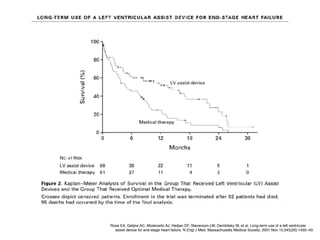
Rose EA, Gelijns AC, Moskowitz AJ, Heitjan DF, Stevenson LW, Dembitsky W, et al. Long-term use of a left ventricular
assist device for end-stage heart failure. N Engl J Med. Massachusetts Medical Society; 2001 Nov 15;345(20):1435–43.
Strategies for MCS
• Bridge to Transplantation
• Destination therapy
• Bridge to Candidacy
• Bridge to Decision
• Bridge to Recovery
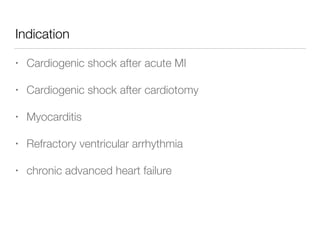
Indication
• Cardiogenic shock after acute MI
• Cardiogenic shock after cardiotomy
• Myocarditis
• Refractory ventricular arrhythmia
• chronic advanced heart failure
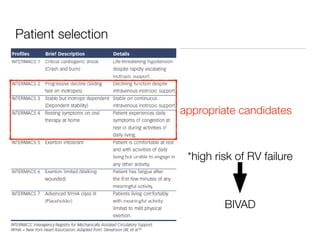
Patient selection
appropriate candidates
*high risk of RV failure
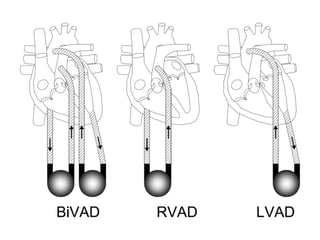
BIVAD
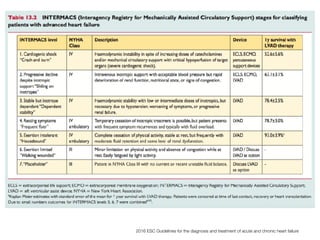
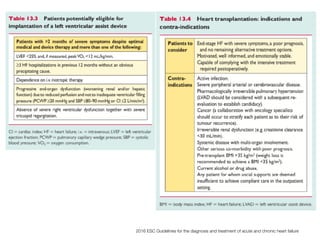
2016 ESC Guidelines for the diagnosis and treatment of acute and chronic heart failure
Contraindication
• Pulmonary Hypertension with elevated PVR (>5wood u)
• irreversible end organ failure
• severe, unrecoverable neurologic injury
• systemic sepsis
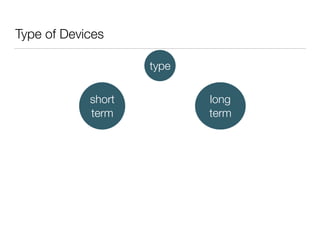
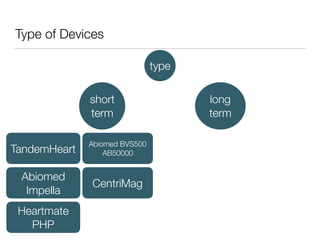
Type of Devices
type
short
term
long
term
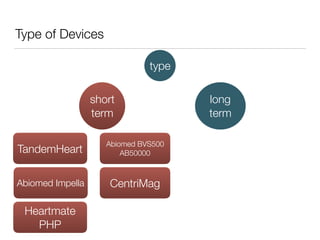
Type of Devices
type
short
term
long
term
Abiomed BVS500
AB50000
Heartmate
PHP
Abiomed Impella
TandemHeart
CentriMag
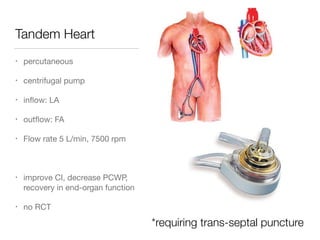
Tandem Heart
• percutaneous

• centrifugal pump

• inflow: LA

• outflow: FA

• Flow rate 5 L/min, 7500 rpm

• improve CI, decrease PCWP,
recovery in end-organ function

• no RCT
*requiring trans-septal puncture
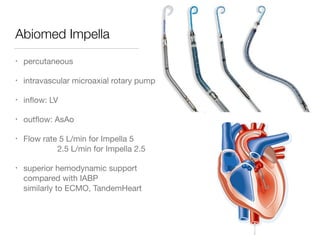
Abiomed Impella
• percutaneous

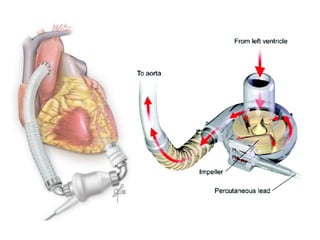
• intravascular microaxial rotary pump

• inflow: LV

• outflow: AsAo

• Flow rate 5 L/min for Impella 5

2.5 L/min for Impella 2.5

• superior hemodynamic support
compared with IABP

similarly to ECMO, TandemHeart
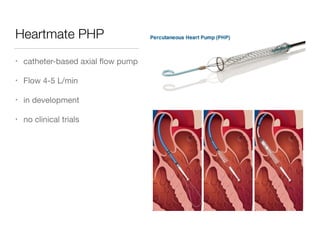
Heartmate PHP
• catheter-based axial flow pump

• Flow 4-5 L/min

• in development

• no clinical trials
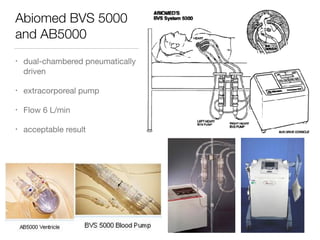
Abiomed BVS 5000
and AB5000
• dual-chambered pneumatically
driven

• extracorporeal pump

• Flow 6 L/min

• acceptable result
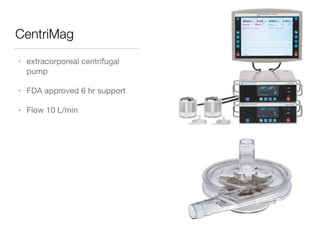
CentriMag
• extracorporeal centrifugal
pump

• FDA approved 6 hr support

• Flow 10 L/min
Type of Devices
type
short
term
long
term
Abiomed BVS500
AB50000
Heartmate
PHP
Abiomed
Impella
TandemHeart
CentriMag
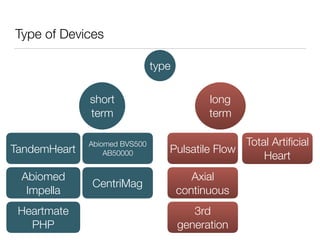
Type of Devices
type
short
term
long
term
Abiomed BVS500
AB50000
Heartmate
PHP
Abiomed
Impella
TandemHeart
CentriMag
Pulsatile Flow
3rd
generation
Axial
continuous
Total Artificial
Heart
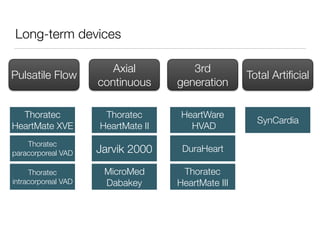
Long-term devices
Pulsatile Flow
3rd
generation
Axial
continuous
Total Artificial
Thoratec
HeartMate XVE
Thoratec
paracorporeal VAD
Thoratec
intracorporeal VAD
Thoratec
HeartMate II
HeartWare
HVAD
Jarvik 2000
MicroMed
Dabakey
Thoratec
HeartMate III
DuraHeart
SynCardia
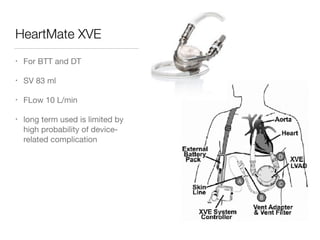
HeartMate XVE
• For BTT and DT

• SV 83 ml

• FLow 10 L/min

• long term used is limited by
high probability of device-
related complication
Thoratec
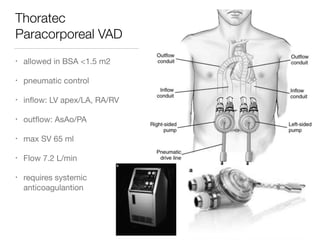
Paracorporeal VAD
• allowed in BSA <1.5 m2

• pneumatic control

• inflow: LV apex/LA, RA/RV 

• outflow: AsAo/PA

• max SV 65 ml

• Flow 7.2 L/min

• requires systemic
anticoagulantion
Thoratec
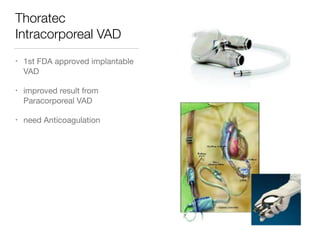
Intracorporeal VAD
• 1st FDA approved implantable
VAD

• improved result from
Paracorporeal VAD

• need Anticoagulation
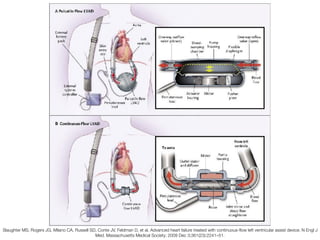
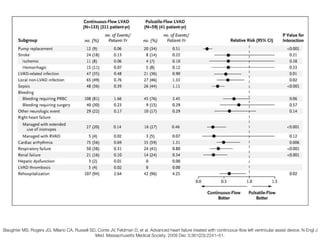
Slaughter MS, Rogers JG, Milano CA, Russell SD, Conte JV, Feldman D, et al. Advanced heart failure treated with continuous-flow left ventricular assist device. N Engl J
Med. Massachusetts Medical Society; 2009 Dec 3;361(23):2241–51.
Slaughter MS, Rogers JG, Milano CA, Russell SD, Conte JV, Feldman D, et al. Advanced heart failure treated with continuous-flow left ventricular assist device. N Engl J
Med. Massachusetts Medical Society; 2009 Dec 3;361(23):2241–51.
Slaughter MS, Rogers JG, Milano CA, Russell SD, Conte JV, Feldman D, et al. Advanced heart failure treated with continuous-flow left ventricular assist device. N Engl J
Med. Massachusetts Medical Society; 2009 Dec 3;361(23):2241–51.
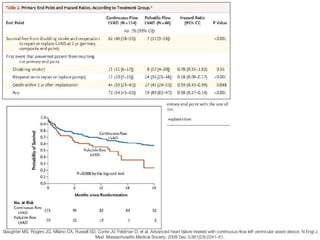
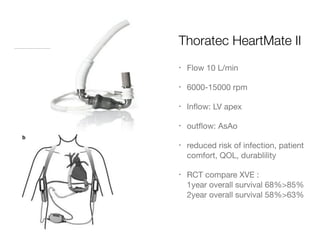
Thoratec HeartMate II
• Flow 10 L/min

• 6000-15000 rpm

• Inflow: LV apex

• outflow: AsAo

• reduced risk of infection, patient
comfort, QOL, durablility

• RCT compare XVE :

1year overall survival 68%>85%

2year overall survival 58%>63%
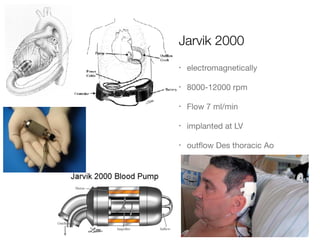
Jarvik 2000
• electromagnetically 

• 8000-12000 rpm

• Flow 7 ml/min

• implanted at LV

• outflow Des thoracic Ao
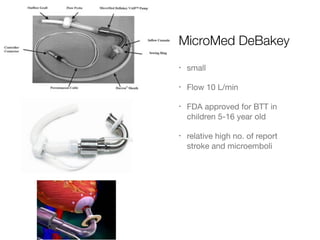
MicroMed DeBakey
• small

• Flow 10 L/min

• FDA approved for BTT in
children 5-16 year old

• relative high no. of report
stroke and microemboli
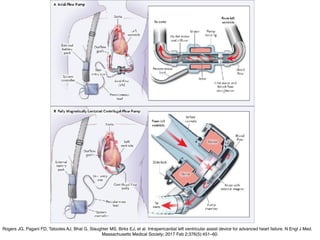
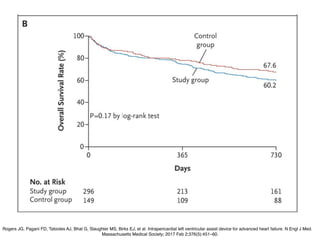
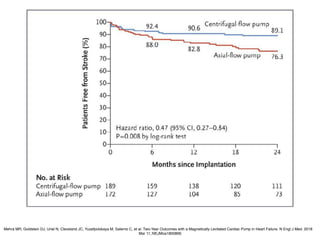
3rd Generation pumps
Rogers JG, Pagani FD, Tatooles AJ, Bhat G, Slaughter MS, Birks EJ, et al. Intrapericardial left ventricular assist device for advanced heart failure. N Engl J Med.
Massachusetts Medical Society; 2017 Feb 2;376(5):451–60.
Rogers JG, Pagani FD, Tatooles AJ, Bhat G, Slaughter MS, Birks EJ, et al. Intrapericardial left ventricular assist device for advanced heart failure. N Engl J Med.
Massachusetts Medical Society; 2017 Feb 2;376(5):451–60.
Mehra MR, Goldstein DJ, Uriel N, Cleveland JC, Yuzefpolskaya M, Salerno C, et al. Two-Year Outcomes with a Magnetically Levitated Cardiac Pump in Heart Failure. N Engl J Med. 2018
Mar 11;:NEJMoa1800866.
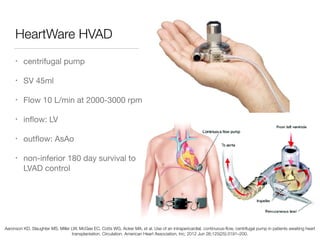
HeartWare HVAD
• centrifugal pump

• SV 45ml

• Flow 10 L/min at 2000-3000 rpm

• inflow: LV

• outflow: AsAo

• non-inferior 180 day survival to
LVAD control
Aaronson KD, Slaughter MS, Miller LW, McGee EC, Cotts WG, Acker MA, et al. Use of an intrapericardial, continuous-flow, centrifugal pump in patients awaiting heart
transplantation. Circulation. American Heart Association, Inc; 2012 Jun 26;125(25):3191–200.
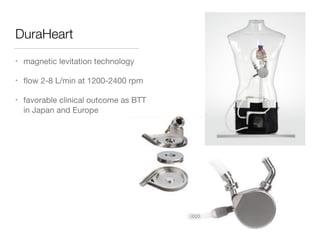
DuraHeart
• magnetic levitation technology

• flow 2-8 L/min at 1200-2400 rpm

• favorable clinical outcome as BTT
in Japan and Europe
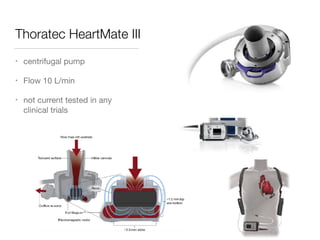
Thoratec HeartMate III
• centrifugal pump

• Flow 10 L/min

• not current tested in any
clinical trials
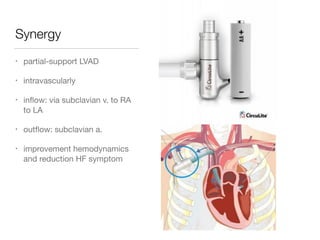
Synergy
• partial-support LVAD

• intravascularly

• inflow: via subclavian v. to RA
to LA

• outflow: subclavian a.

• improvement hemodynamics
and reduction HF symptom
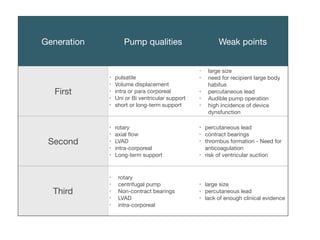
Generation Pump qualities Weak points
First
• pulsatile

• Volume displacement

• intra or para corporeal

• Uni or Bi ventricular support

• short or long-term support
• large size

• need for recipient large body
habitus

• percutaneous lead

• Audible pump operation

• high incidence of device
dynsfunction
Second
• rotary

• axial flow

• LVAD

• intra-corporeal

• Long-term support
• percutaneous lead

• contract bearings

• thrombus formation - Need for
anticoagulation

• risk of ventricular suction
Third
• rotary

• centrifugal pump

• Non-contract bearings

• LVAD

• intra-corporeal
• large size

• percutaneous lead

• lack of enough clinical evidence
Total Artificial Heart
• for long-term biventricular support
• continuous flow pumps
• FDA approved only for BTT
• Contraindication: transplant ineligibility, absence of
biventricular failure, inability to have coagulation, small
thoracic cavity size
• survival to transplant rate 68%
• no RCT compared with BiVAD
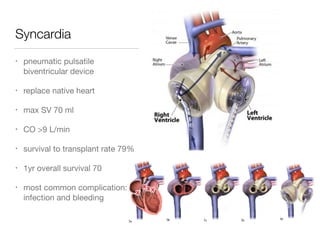
Syncardia
• pneumatic pulsatile
biventricular device

• replace native heart

• max SV 70 ml

• CO >9 L/min

• survival to transplant rate 79% 

• 1yr overall survival 70

• most common complication:
infection and bleeding
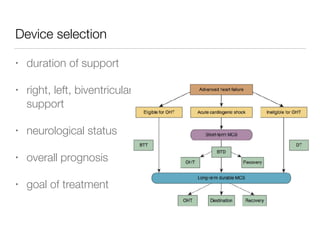
Device selection
• duration of support
• right, left, biventricular
support
• neurological status
• overall prognosis
• goal of treatment
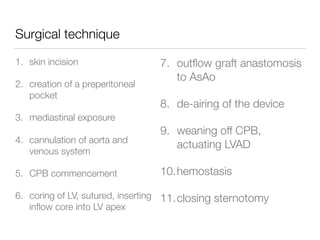
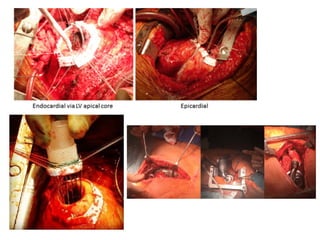
Surgical technique
1. skin incision
2. creation of a preperitoneal
pocket
3. mediastinal exposure
4. cannulation of aorta and
venous system
5. CPB commencement
6. coring of LV, sutured, inserting
inflow core into LV apex
7. outflow graft anastomosis
to AsAo
8. de-airing of the device
9. weaning off CPB,
actuating LVAD
10.hemostasis
11.closing sternotomy
Concomitant surgery
• moderate-severe AI
• severe MS
• MR is controversial
• ASD
• intracardiac thrombus
Postoperative management
• Antibiotic prophylaxis
• MAP 70-80 mmHg
• Optimize RV function
• Anti-arrhythmic agent if arrhythmia
• Anticoagulant: target INR 2.5
• Ambulation and rehabilitation
Complication
• Post-op bleeding
• GI bleeding, Epistaxis
• Infection
• Multisystem organ failure
• Thromboembolism
• RV failure
• arrhythmia
• aortic insufficiency
• device malfunction
THANK YOU

Ventricular assist devices

  • 1.
  • 4.
    Rose EA, GelijnsAC, Moskowitz AJ, Heitjan DF, Stevenson LW, Dembitsky W, et al. Long-term use of a left ventricular assist device for end-stage heart failure. N Engl J Med. Massachusetts Medical Society; 2001 Nov 15;345(20):1435–43.
  • 5.
    Strategies for MCS •Bridge to Transplantation • Destination therapy • Bridge to Candidacy • Bridge to Decision • Bridge to Recovery
  • 6.
    Indication • Cardiogenic shockafter acute MI • Cardiogenic shock after cardiotomy • Myocarditis • Refractory ventricular arrhythmia • chronic advanced heart failure
  • 7.
  • 8.
    2016 ESC Guidelinesfor the diagnosis and treatment of acute and chronic heart failure
  • 9.
    2016 ESC Guidelinesfor the diagnosis and treatment of acute and chronic heart failure
  • 10.
    Contraindication • Pulmonary Hypertensionwith elevated PVR (>5wood u) • irreversible end organ failure • severe, unrecoverable neurologic injury • systemic sepsis
  • 11.
  • 12.
    Type of Devices type short term long term AbiomedBVS500 AB50000 Heartmate PHP Abiomed Impella TandemHeart CentriMag
  • 13.
    Tandem Heart • percutaneous •centrifugal pump • inflow: LA • outflow: FA • Flow rate 5 L/min, 7500 rpm • improve CI, decrease PCWP, recovery in end-organ function • no RCT *requiring trans-septal puncture
  • 14.
    Abiomed Impella • percutaneous •intravascular microaxial rotary pump • inflow: LV • outflow: AsAo • Flow rate 5 L/min for Impella 5
 2.5 L/min for Impella 2.5 • superior hemodynamic support compared with IABP
 similarly to ECMO, TandemHeart
  • 15.
    Heartmate PHP • catheter-basedaxial flow pump • Flow 4-5 L/min • in development • no clinical trials
  • 16.
    Abiomed BVS 5000 andAB5000 • dual-chambered pneumatically driven • extracorporeal pump • Flow 6 L/min • acceptable result
  • 17.
    CentriMag • extracorporeal centrifugal pump •FDA approved 6 hr support • Flow 10 L/min
  • 18.
    Type of Devices type short term long term AbiomedBVS500 AB50000 Heartmate PHP Abiomed Impella TandemHeart CentriMag
  • 19.
    Type of Devices type short term long term AbiomedBVS500 AB50000 Heartmate PHP Abiomed Impella TandemHeart CentriMag Pulsatile Flow 3rd generation Axial continuous Total Artificial Heart
  • 20.
    Long-term devices Pulsatile Flow 3rd generation Axial continuous TotalArtificial Thoratec HeartMate XVE Thoratec paracorporeal VAD Thoratec intracorporeal VAD Thoratec HeartMate II HeartWare HVAD Jarvik 2000 MicroMed Dabakey Thoratec HeartMate III DuraHeart SynCardia
  • 21.
    HeartMate XVE • ForBTT and DT • SV 83 ml • FLow 10 L/min • long term used is limited by high probability of device- related complication
  • 22.
    Thoratec Paracorporeal VAD • allowedin BSA <1.5 m2 • pneumatic control • inflow: LV apex/LA, RA/RV • outflow: AsAo/PA • max SV 65 ml • Flow 7.2 L/min • requires systemic anticoagulantion
  • 23.
    Thoratec Intracorporeal VAD • 1stFDA approved implantable VAD • improved result from Paracorporeal VAD • need Anticoagulation
  • 24.
    Slaughter MS, RogersJG, Milano CA, Russell SD, Conte JV, Feldman D, et al. Advanced heart failure treated with continuous-flow left ventricular assist device. N Engl J Med. Massachusetts Medical Society; 2009 Dec 3;361(23):2241–51.
  • 25.
    Slaughter MS, RogersJG, Milano CA, Russell SD, Conte JV, Feldman D, et al. Advanced heart failure treated with continuous-flow left ventricular assist device. N Engl J Med. Massachusetts Medical Society; 2009 Dec 3;361(23):2241–51.
  • 26.
    Slaughter MS, RogersJG, Milano CA, Russell SD, Conte JV, Feldman D, et al. Advanced heart failure treated with continuous-flow left ventricular assist device. N Engl J Med. Massachusetts Medical Society; 2009 Dec 3;361(23):2241–51.
  • 27.
    Thoratec HeartMate II •Flow 10 L/min • 6000-15000 rpm • Inflow: LV apex • outflow: AsAo • reduced risk of infection, patient comfort, QOL, durablility • RCT compare XVE :
 1year overall survival 68%>85%
 2year overall survival 58%>63%
  • 28.
    Jarvik 2000 • electromagnetically • 8000-12000 rpm • Flow 7 ml/min • implanted at LV • outflow Des thoracic Ao
  • 29.
    MicroMed DeBakey • small •Flow 10 L/min • FDA approved for BTT in children 5-16 year old • relative high no. of report stroke and microemboli
  • 30.
  • 31.
    Rogers JG, PaganiFD, Tatooles AJ, Bhat G, Slaughter MS, Birks EJ, et al. Intrapericardial left ventricular assist device for advanced heart failure. N Engl J Med. Massachusetts Medical Society; 2017 Feb 2;376(5):451–60.
  • 32.
    Rogers JG, PaganiFD, Tatooles AJ, Bhat G, Slaughter MS, Birks EJ, et al. Intrapericardial left ventricular assist device for advanced heart failure. N Engl J Med. Massachusetts Medical Society; 2017 Feb 2;376(5):451–60.
  • 33.
    Mehra MR, GoldsteinDJ, Uriel N, Cleveland JC, Yuzefpolskaya M, Salerno C, et al. Two-Year Outcomes with a Magnetically Levitated Cardiac Pump in Heart Failure. N Engl J Med. 2018 Mar 11;:NEJMoa1800866.
  • 34.
    HeartWare HVAD • centrifugalpump • SV 45ml • Flow 10 L/min at 2000-3000 rpm • inflow: LV • outflow: AsAo • non-inferior 180 day survival to LVAD control Aaronson KD, Slaughter MS, Miller LW, McGee EC, Cotts WG, Acker MA, et al. Use of an intrapericardial, continuous-flow, centrifugal pump in patients awaiting heart transplantation. Circulation. American Heart Association, Inc; 2012 Jun 26;125(25):3191–200.
  • 35.
    DuraHeart • magnetic levitationtechnology • flow 2-8 L/min at 1200-2400 rpm • favorable clinical outcome as BTT in Japan and Europe
  • 36.
    Thoratec HeartMate III •centrifugal pump • Flow 10 L/min • not current tested in any clinical trials
  • 37.
    Synergy • partial-support LVAD •intravascularly • inflow: via subclavian v. to RA to LA • outflow: subclavian a. • improvement hemodynamics and reduction HF symptom
  • 38.
    Generation Pump qualitiesWeak points First • pulsatile • Volume displacement • intra or para corporeal • Uni or Bi ventricular support • short or long-term support • large size • need for recipient large body habitus • percutaneous lead • Audible pump operation • high incidence of device dynsfunction Second • rotary • axial flow • LVAD • intra-corporeal • Long-term support • percutaneous lead • contract bearings • thrombus formation - Need for anticoagulation • risk of ventricular suction Third • rotary • centrifugal pump • Non-contract bearings • LVAD • intra-corporeal • large size • percutaneous lead • lack of enough clinical evidence
  • 39.
    Total Artificial Heart •for long-term biventricular support • continuous flow pumps • FDA approved only for BTT • Contraindication: transplant ineligibility, absence of biventricular failure, inability to have coagulation, small thoracic cavity size • survival to transplant rate 68% • no RCT compared with BiVAD
  • 40.
    Syncardia • pneumatic pulsatile biventriculardevice • replace native heart • max SV 70 ml • CO >9 L/min • survival to transplant rate 79% • 1yr overall survival 70 • most common complication: infection and bleeding
  • 41.
    Device selection • durationof support • right, left, biventricular support • neurological status • overall prognosis • goal of treatment
  • 42.
    Surgical technique 1. skinincision 2. creation of a preperitoneal pocket 3. mediastinal exposure 4. cannulation of aorta and venous system 5. CPB commencement 6. coring of LV, sutured, inserting inflow core into LV apex 7. outflow graft anastomosis to AsAo 8. de-airing of the device 9. weaning off CPB, actuating LVAD 10.hemostasis 11.closing sternotomy
  • 45.
    Concomitant surgery • moderate-severeAI • severe MS • MR is controversial • ASD • intracardiac thrombus
  • 46.
    Postoperative management • Antibioticprophylaxis • MAP 70-80 mmHg • Optimize RV function • Anti-arrhythmic agent if arrhythmia • Anticoagulant: target INR 2.5 • Ambulation and rehabilitation
  • 47.
    Complication • Post-op bleeding •GI bleeding, Epistaxis • Infection • Multisystem organ failure • Thromboembolism • RV failure • arrhythmia • aortic insufficiency • device malfunction
  • 48.