
Truth Table
By Prof. Liwayway Memije-Cruz
What is a truth table?
• a handy little logical device
• a mathematical table used in logic—specifically
in connection with Boolean algebra, boolean
functions, and propositional calculus
• sets out the functional values of logical
expressions on each of their functional
arguments, that is, for each combination of
values taken by their logical variables.
Importance of truth tables
• help us determine all the truth value possibilities
of various statements.
• help us better understand logic.
• used to define logical connectives.
• help us identify various distinctions (such as
tautologies, self-contradictions, consistent
statements, equivalent statements, and valid
arguments).
Logical connectives
The five connectives used in propositional logic
are the following:
1. “and” (∧),
2. “not” (¬),
3. “or” (∨),
4. “implies” (→),
5. “if and only if” (↔). :
How to read the truth table:
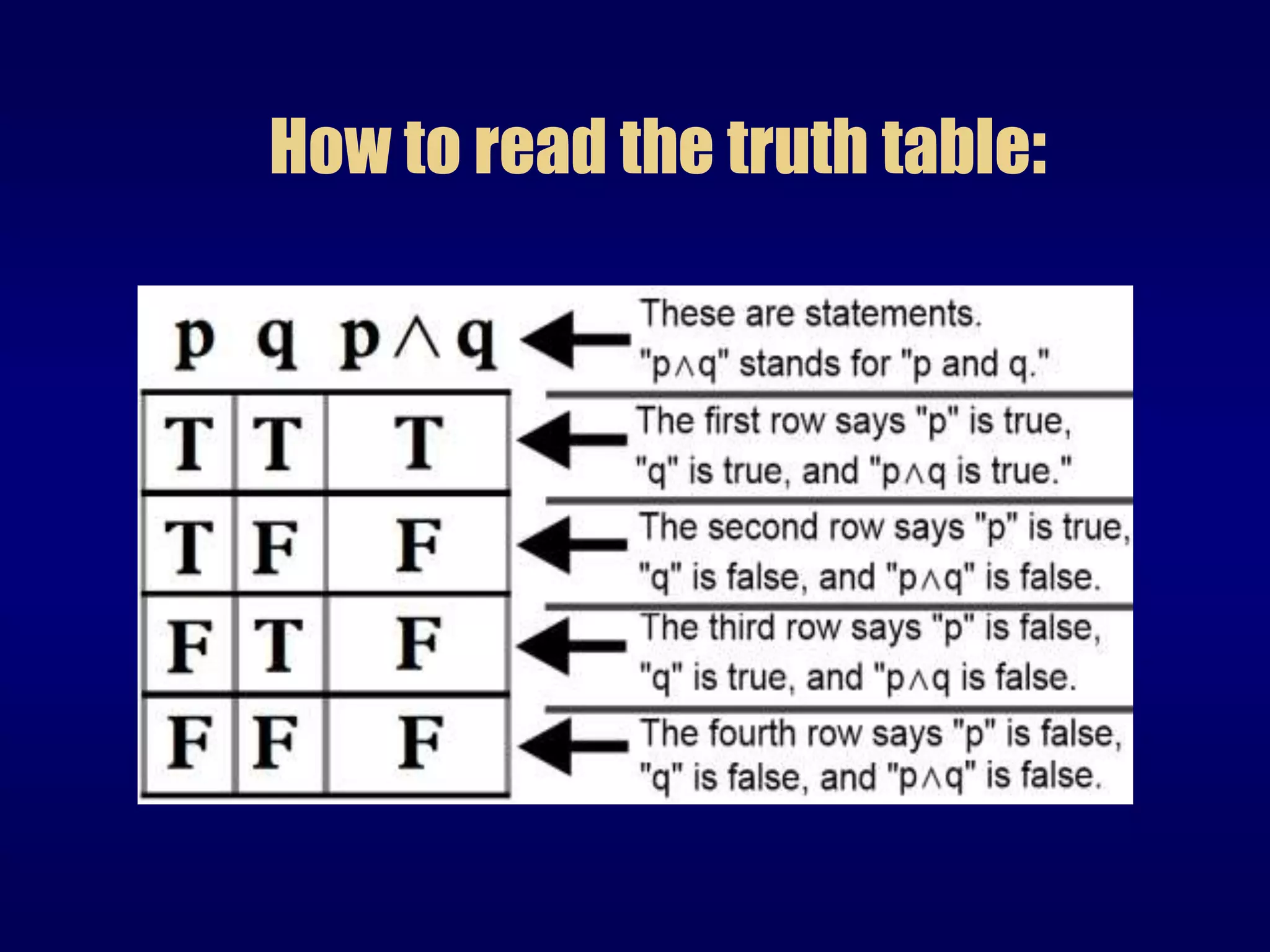
• There is a column (vertical area) under each statement,
which contains every possible truth value. The column
under “p” has “T, T, F, F” (true, true, false, false). The
column under “q” is “T, F, T, F” (true, false, true, false). The
column under “p ∧ q” contains “T, F, F, F” (true, false, false,
false).
• Every row (horizontal area) beneath the statements
contains every combination of truth values. The first row of
truth values states that “p,” “q,” and “p ∧ q” are all true. The
second row states that “p” is true, “q” is false, and “p ∧ q” is
false. The third states that “p” is false, “q” is true, and “p ∧
q” is false. The fourth states that “p,” “q” and “p ∧ q” are all
false.
Example:
Life used to exist on
Mars.
Life will exist on
Mars in the future.
Life used to exist on
Mars and life will
exist on Mars in the
future.
T T T
T F F
F T F
F F F
Possibilities
Row 1: It’s true that “life used to exist on Mars.” It’s true that “life will
exist on Mars in the future.” In that case it’s also true that “Life used to
exist on Mars, and that life will exist on Mars in the future.”
Row 2: It’s true that “life used to exist on Mars.” It’s false that “life will
exist on Mars in the future.” In that case it’s also false that “Life used to
exist on Mars, and that life will exist on Mars in the future.”
Row 3: It’s false that “life used to exist on Mars.” It’s true that “life will
exist on Mars in the future.” In that case it’s also false that “Life used to
exist on Mars, and that life will exist on Mars in the future.”
Row 4: It’s false that “life used to exist on Mars.” It’s false that “life will
exist on Mars in the future.” In that case it’s also false that “Life used to
exist on Mars, and that life will exist on Mars in the future.”
Logical false
• The output value is never true: that is, always
false, regardless of the input value of p
p F
T F
F F
Logical identity
• Logical identity is an operation on one logical
value p, for which the output value remains p.
p P
T T
F F
Logical negation
• Logical negation is an operation on one logical value,
typically the value of a proposition, that produces a
value of true if its operand is false and a value of false if
its operand is true.
p ¬p
T F
F T
Logical conjunction (AND)
• Logical conjunction is an operation on two logical values, typically
the values of two propositions, that produces a value of true if both
of its operands are true.
• p AND q (also written as p ∧ q, Kpq, p & q, or p ⋅ {displaystyle
cdot } cdot q
p q p ∧ q
T T T
T F F
F T F
F F F
Logical disjunction (OR)
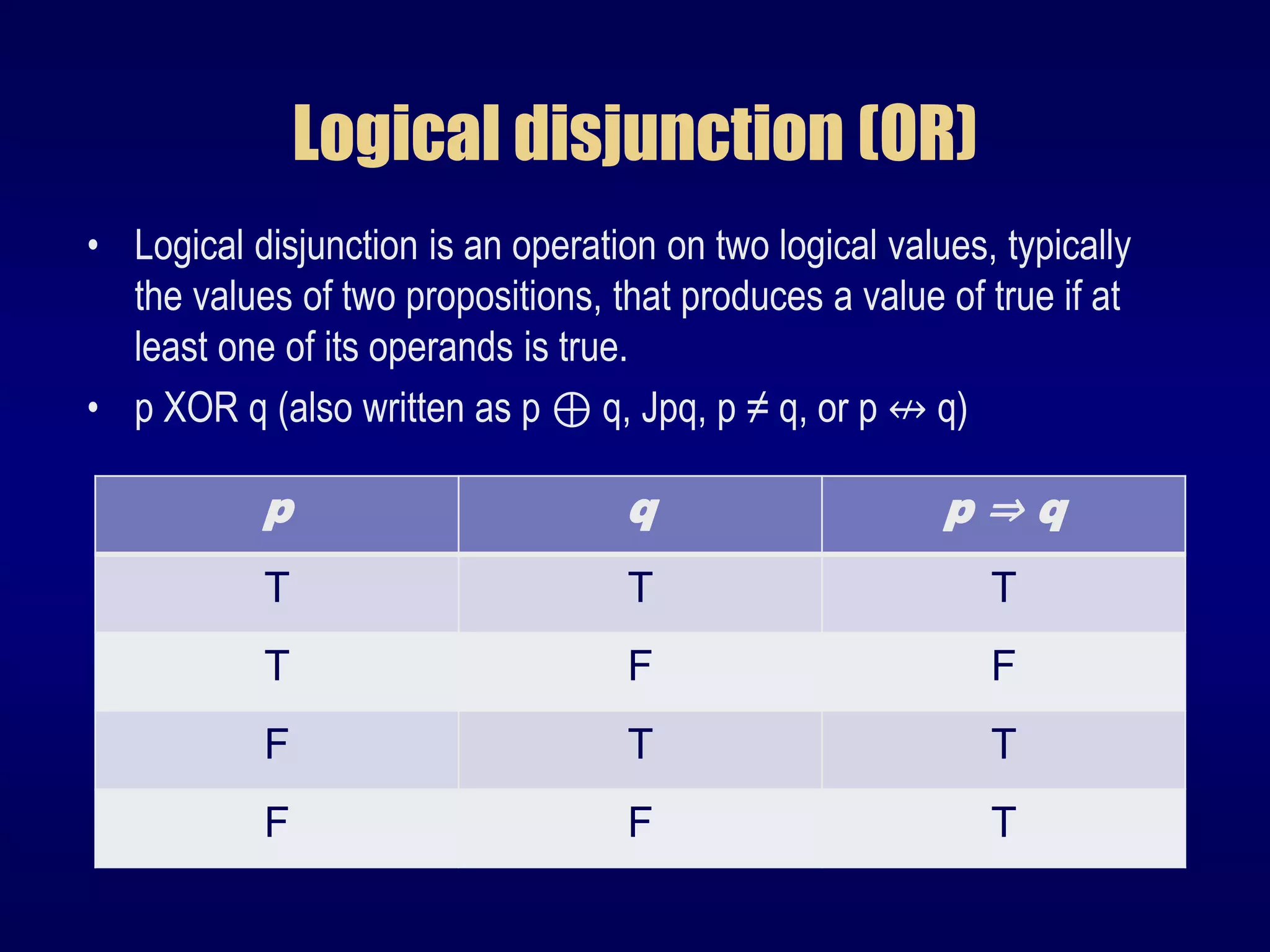
• Logical disjunction is an operation on two logical values, typically
the values of two propositions, that produces a value of true if at
least one of its operands is true.
• p XOR q (also written as p ⊕ q, Jpq, p ≠ q, or p ↮ q)
p q p ⇒ q
T T T
T F F
F T T
F F T
Logical equality
• Logical equality (also known as biconditional) is an operation on
two logical values, typically the values of two propositions, that
produces a value of true if both operands are false or both
operands are true.
• p XNOR q (also written as p ↔ q, Epq, p = q, or p ≡ q)
p q p ↔ q
T T T
T F F
F T F
F F T
Logical NAND
• The logical NAND is an operation on two logical values,
typically the values of two propositions, that produces a value
of false if both of its operands are true. In other words, it
produces a value of true if at least one of its operands is false.
• p NAND q (also written as p ↑ q, Dpq, or p | q)
p q p ↑ q
T T F
T F T
F T T
F F T
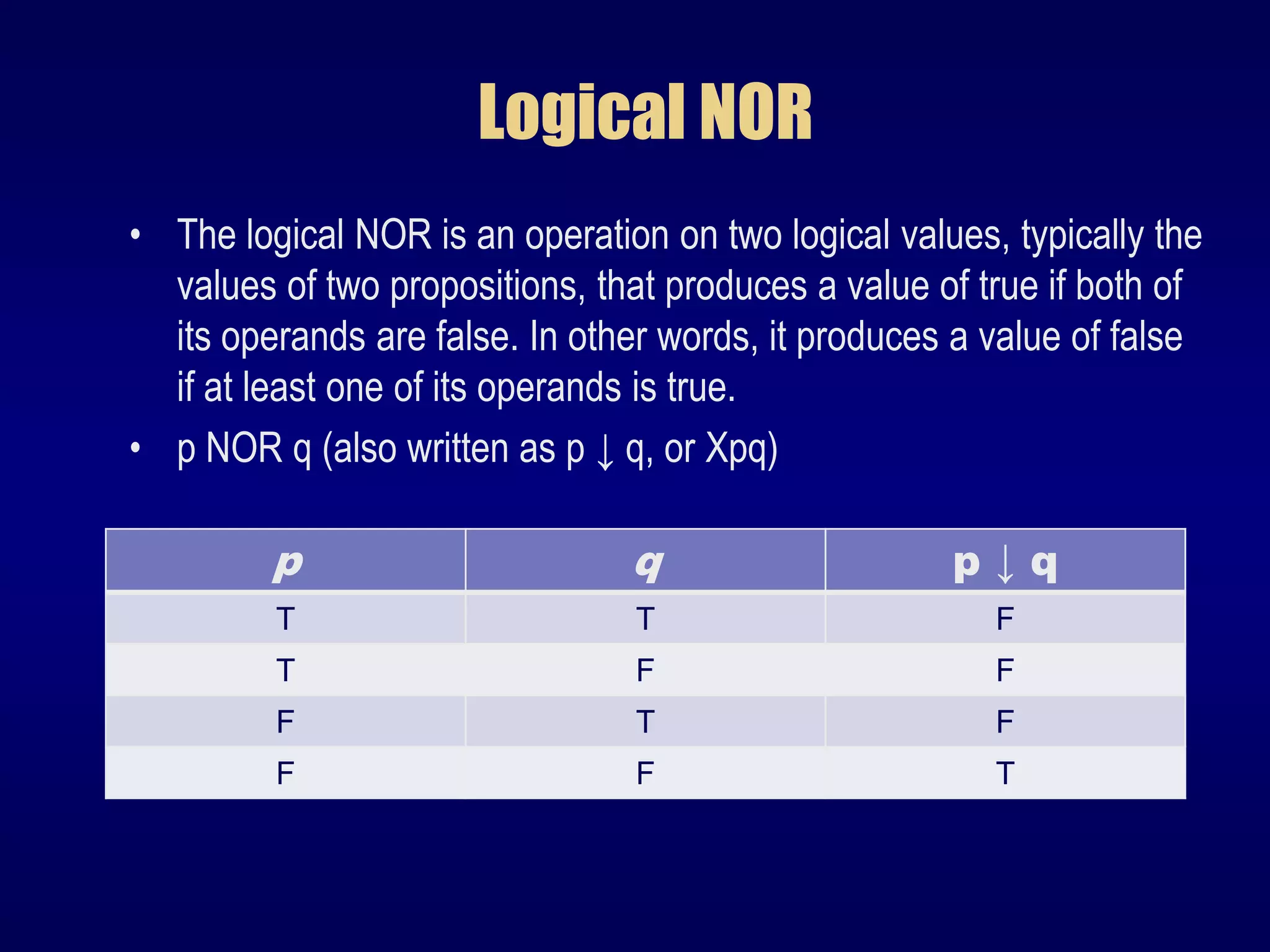
Logical NOR
• The logical NOR is an operation on two logical values, typically the
values of two propositions, that produces a value of true if both of
its operands are false. In other words, it produces a value of false
if at least one of its operands is true.
• p NOR q (also written as p ↓ q, or Xpq)
p q p ↓ q
T T F
T F F
F T F
F F T
References:
• https://ethicalrealism.wordpress.com/2013/01/14
/logic-part-3-truth-tables/
• https://en.wikipedia.org/wiki/Truth_table
• http://kias.dyndns.org/comath/21.html
• https://medium.com/i-math/intro-to-truth-tables-
boolean-algebra-73b331dd9b94

Truth table

  • 1.
    Truth Table By Prof.Liwayway Memije-Cruz
  • 2.
    What is atruth table? • a handy little logical device • a mathematical table used in logic—specifically in connection with Boolean algebra, boolean functions, and propositional calculus • sets out the functional values of logical expressions on each of their functional arguments, that is, for each combination of values taken by their logical variables.
  • 3.
    Importance of truthtables • help us determine all the truth value possibilities of various statements. • help us better understand logic. • used to define logical connectives. • help us identify various distinctions (such as tautologies, self-contradictions, consistent statements, equivalent statements, and valid arguments).
  • 4.
    Logical connectives The fiveconnectives used in propositional logic are the following: 1. “and” (∧), 2. “not” (¬), 3. “or” (∨), 4. “implies” (→), 5. “if and only if” (↔). :
  • 5.
    How to readthe truth table:
  • 6.
    • There isa column (vertical area) under each statement, which contains every possible truth value. The column under “p” has “T, T, F, F” (true, true, false, false). The column under “q” is “T, F, T, F” (true, false, true, false). The column under “p ∧ q” contains “T, F, F, F” (true, false, false, false). • Every row (horizontal area) beneath the statements contains every combination of truth values. The first row of truth values states that “p,” “q,” and “p ∧ q” are all true. The second row states that “p” is true, “q” is false, and “p ∧ q” is false. The third states that “p” is false, “q” is true, and “p ∧ q” is false. The fourth states that “p,” “q” and “p ∧ q” are all false.
  • 7.
    Example: Life used toexist on Mars. Life will exist on Mars in the future. Life used to exist on Mars and life will exist on Mars in the future. T T T T F F F T F F F F
  • 8.
    Possibilities Row 1: It’strue that “life used to exist on Mars.” It’s true that “life will exist on Mars in the future.” In that case it’s also true that “Life used to exist on Mars, and that life will exist on Mars in the future.” Row 2: It’s true that “life used to exist on Mars.” It’s false that “life will exist on Mars in the future.” In that case it’s also false that “Life used to exist on Mars, and that life will exist on Mars in the future.” Row 3: It’s false that “life used to exist on Mars.” It’s true that “life will exist on Mars in the future.” In that case it’s also false that “Life used to exist on Mars, and that life will exist on Mars in the future.” Row 4: It’s false that “life used to exist on Mars.” It’s false that “life will exist on Mars in the future.” In that case it’s also false that “Life used to exist on Mars, and that life will exist on Mars in the future.”
  • 10.
    Logical false • Theoutput value is never true: that is, always false, regardless of the input value of p p F T F F F
  • 11.
    Logical identity • Logicalidentity is an operation on one logical value p, for which the output value remains p. p P T T F F
  • 12.
    Logical negation • Logicalnegation is an operation on one logical value, typically the value of a proposition, that produces a value of true if its operand is false and a value of false if its operand is true. p ¬p T F F T
  • 13.
    Logical conjunction (AND) •Logical conjunction is an operation on two logical values, typically the values of two propositions, that produces a value of true if both of its operands are true. • p AND q (also written as p ∧ q, Kpq, p & q, or p ⋅ {displaystyle cdot } cdot q p q p ∧ q T T T T F F F T F F F F
  • 14.
    Logical disjunction (OR) •Logical disjunction is an operation on two logical values, typically the values of two propositions, that produces a value of true if at least one of its operands is true. • p XOR q (also written as p ⊕ q, Jpq, p ≠ q, or p ↮ q) p q p ⇒ q T T T T F F F T T F F T
  • 15.
    Logical equality • Logicalequality (also known as biconditional) is an operation on two logical values, typically the values of two propositions, that produces a value of true if both operands are false or both operands are true. • p XNOR q (also written as p ↔ q, Epq, p = q, or p ≡ q) p q p ↔ q T T T T F F F T F F F T
  • 16.
    Logical NAND • Thelogical NAND is an operation on two logical values, typically the values of two propositions, that produces a value of false if both of its operands are true. In other words, it produces a value of true if at least one of its operands is false. • p NAND q (also written as p ↑ q, Dpq, or p | q) p q p ↑ q T T F T F T F T T F F T
  • 17.
    Logical NOR • Thelogical NOR is an operation on two logical values, typically the values of two propositions, that produces a value of true if both of its operands are false. In other words, it produces a value of false if at least one of its operands is true. • p NOR q (also written as p ↓ q, or Xpq) p q p ↓ q T T F T F F F T F F F T
  • 18.
    References: • https://ethicalrealism.wordpress.com/2013/01/14 /logic-part-3-truth-tables/ • https://en.wikipedia.org/wiki/Truth_table •http://kias.dyndns.org/comath/21.html • https://medium.com/i-math/intro-to-truth-tables- boolean-algebra-73b331dd9b94