Downloaded 136 times
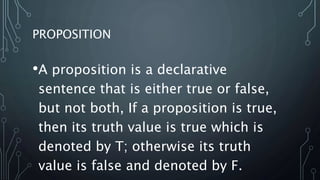

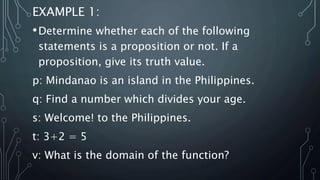


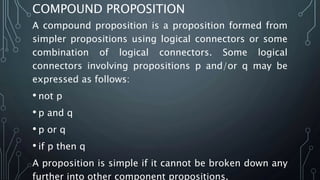


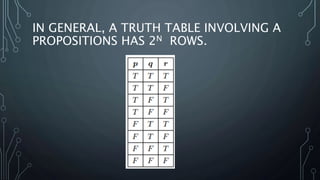


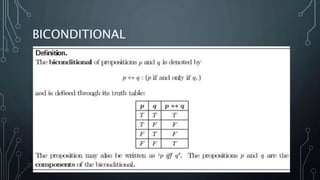



This document discusses basic concepts in logic and constructing truth tables. It defines a proposition as a declarative sentence that is either true or false. Propositions can be simple or compound, formed using logical connectors like "and", "or", and "if-then". Truth tables show all possible truth value combinations of propositions, with one row per combination. They are used to evaluate propositions with logical operators like negation, conjunction, disjunction, conditional, and biconditional. A truth table for n propositions will have 2n rows, one for each possible combination of true and false values.


