Discrete Mathematics 
Mathematical 
Logic
2 
Mathematical Logic 
 Definition: Methods of reasoning, provides rules 
and techniques to determine whether an 
argument is valid 
 Theorem: a statement that can be shown to be 
true (under certain conditions) 
 Example: If x is an even integer, then x + 1 is 
an odd integer 
 This statement is true under the condition that x is an 
integer is true
3 
Mathematical Logic 
 A statement, or a proposition, is a declarative sentence 
that is either true or false, but not both 
 Uppercase letters denote propositions 
 Examples: 
 P: 2 is an even number (true) 
 Q: 7 is an even number (false) 
 R: A is a vowel (true) 
 The following are not propositions: 
 P: My cat is beautiful 
 Q: My house is big
Propositions 
• A statement that has a truth value 
• Which of the following are propositions? 
– The Washington State flag is red 
– It snowed in Whistler, BC on January 4, 2008. 
– Hillary Clinton won the democratic caucus in Iowa 
– Space aliens landed in Roswell, New Mexico 
– Ron Paul would be a great president 
– Turn your homework in on Wednesday 
– Why are we taking this class? 
– If n is an integer greater than two, then the equation an + bn 
= cn has no solutions in non-zero integers a, b, and c. 
– Every even integer greater than two can be written as the 
sum of two primes 
– This statement is false 
– Propositional variables: p, q, r, s, . . . 
– Truth values: T for true, F for false
5 
Mathematical Logic 
 Truth value 
 One of the values “truth” (T) or “falsity” (F) 
assigned to a statement 
 Negation 
 The negation of P, written , is the statement 
obtained by negating statement P 
 Example: 
 P: A is a consonant 
 : it is the case that A is not a consonant 
 Truth Table 
P 
P 
T F 
F T 
P 
P
6 
Mathematical Logic 
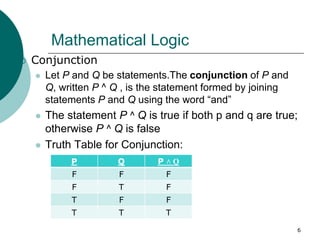
 Conjunction 
 Let P and Q be statements.The conjunction of P and 
Q, written P ^ Q , is the statement formed by joining 
statements P and Q using the word “and” 
 The statement P ^ Q is true if both p and q are true; 
otherwise P ^ Q is false 
 Truth Table for Conjunction: 
P Q P ˄ Q 
F F F 
F T F 
T F F 
T T T
7 
Mathematical Logic 
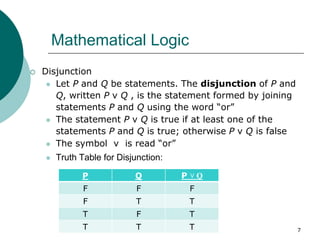
 Disjunction 
 Let P and Q be statements. The disjunction of P and 
Q, written P v Q , is the statement formed by joining 
statements P and Q using the word “or” 
 The statement P v Q is true if at least one of the 
statements P and Q is true; otherwise P v Q is false 
 The symbol v is read “or” 
 Truth Table for Disjunction: 
P Q P ˅ Q 
F F F 
F T T 
T F T 
T T T
8 
Mathematical Logic 
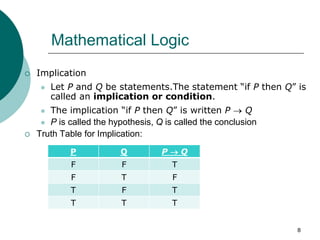
 Implication 
 Let P and Q be statements.The statement “if P then Q” is 
called an implication or condition. 
 The implication “if P then Q” is written P  Q 
 P is called the hypothesis, Q is called the conclusion 
 Truth Table for Implication: 
P Q P  Q 
F F T 
F T F 
T F T 
T T T
9 
Mathematical Logic 
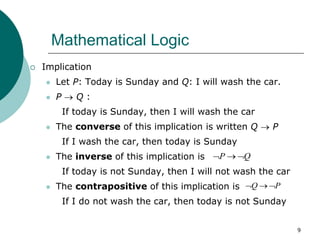
 Implication 
 Let P: Today is Sunday and Q: I will wash the car. 
 P  Q : 
If today is Sunday, then I will wash the car 
 The converse of this implication is written Q  P 
If I wash the car, then today is Sunday 
 The inverse of this implication is 
PQ 
If today is not Sunday, then I will not wash the car 
 The contrapositive of this implication is 
QP 
If I do not wash the car, then today is not Sunday
10 
Mathematical Logic 
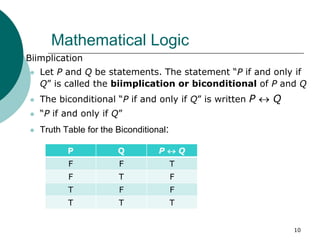
 Biimplication 
 Let P and Q be statements. The statement “P if and only if 
Q” is called the biimplication or biconditional of P and Q 
 The biconditional “P if and only if Q” is written P  Q 
 “P if and only if Q” 
 Truth Table for the Biconditional: 
P Q P  Q 
F F T 
F T F 
T F F 
T T T
11 
Mathematical Logic 
 Precedence of logical 
connectives is: 
 
 highest 
 ^ second highest 
 v third highest 
 → fourth highest 
 ↔ fifth highest
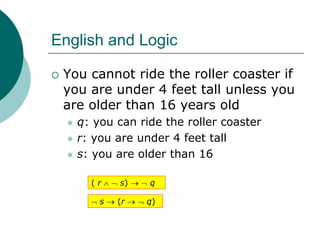
English and Logic 
 You cannot ride the roller coaster if 
you are under 4 feet tall unless you 
are older than 16 years old 
 q: you can ride the roller coaster 
 r: you are under 4 feet tall 
 s: you are older than 16 
( r   s)   q 
 s  (r   q)
13 
Mathematical Logic 
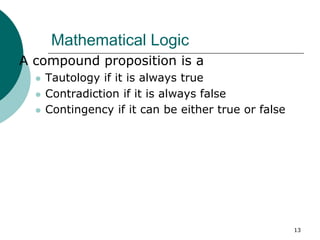
A compound proposition is a 
 Tautology if it is always true 
 Contradiction if it is always false 
 Contingency if it can be either true or false
14 
Mathematical Logic 
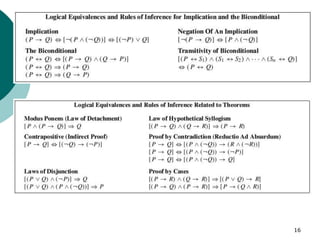
 Logically Implies 
 A statement formula A is said to logically imply a 
statement formula B if the statement formula A → B is a 
tautology. If A logically implies B, then symbolically we 
write A → B 
 Logically Equivalent 
 A statement formula A is said to be logically equivalent 
to a statement formula B if the statement formula 
A ↔ B is a tautology. If A is logically equivalent to B , 
then symbolically we write A  B
15
16
17 
Quantifiers and First Order Logic 
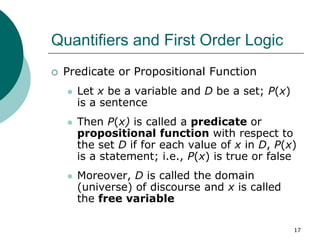
 Predicate or Propositional Function 
 Let x be a variable and D be a set; P(x) 
is a sentence 
 Then P(x) is called a predicate or 
propositional function with respect to 
the set D if for each value of x in D, P(x) 
is a statement; i.e., P(x) is true or false 
 Moreover, D is called the domain 
(universe) of discourse and x is called 
the free variable
18 
Quantifiers and First Order Logic 
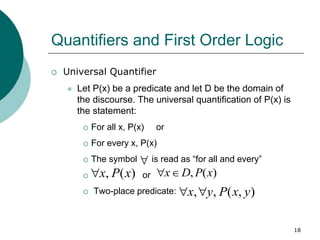
 Universal Quantifier 
 Let P(x) be a predicate and let D be the domain of 
the discourse. The universal quantification of P(x) is 
the statement: 
 For all x, P(x) or 
 For every x, P(x) 
 The symbol is read as “for all and every” 
 
x, P(x) 
 or 
xD,P(x) 
 Two-place predicate: 
x,y, P(x, y)
x,P(x) 
x, P(x) x, P(x) 
19 
Quantifiers and First Order Logic 
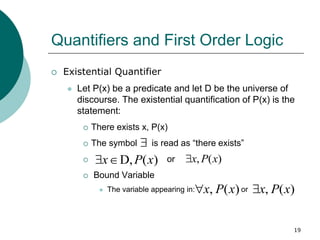
 Existential Quantifier 
 Let P(x) be a predicate and let D be the universe of 
discourse. The existential quantification of P(x) is the 
statement: 
 There exists x, P(x) 
 
 The symbol is read as “there exists” 
x D,P(x) 
 or 
 Bound Variable 
 The variable appearing in: or
20 
Quantifiers and First Order Logic 
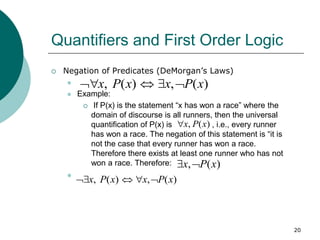
 Negation of Predicates (DeMorgan’s Laws) 
 
 Example: 
 If P(x) is the statement “x has won a race” where the 
domain of discourse is all runners, then the universal 
quantification of P(x) is , i.e., every runner 
has won a race. The negation of this statement is “it is 
not the case that every runner has won a race. 
Therefore there exists at least one runner who has not 
won a race. Therefore: 
 
x, P(x)  x,P(x) 
x, P(x) 
x,P(x) 
x, P(x)  x,P(x)

Mathematical Logic - Part 1

  • 1.
  • 2.
    2 Mathematical Logic  Definition: Methods of reasoning, provides rules and techniques to determine whether an argument is valid  Theorem: a statement that can be shown to be true (under certain conditions)  Example: If x is an even integer, then x + 1 is an odd integer  This statement is true under the condition that x is an integer is true
  • 3.
    3 Mathematical Logic  A statement, or a proposition, is a declarative sentence that is either true or false, but not both  Uppercase letters denote propositions  Examples:  P: 2 is an even number (true)  Q: 7 is an even number (false)  R: A is a vowel (true)  The following are not propositions:  P: My cat is beautiful  Q: My house is big
  • 4.
    Propositions • Astatement that has a truth value • Which of the following are propositions? – The Washington State flag is red – It snowed in Whistler, BC on January 4, 2008. – Hillary Clinton won the democratic caucus in Iowa – Space aliens landed in Roswell, New Mexico – Ron Paul would be a great president – Turn your homework in on Wednesday – Why are we taking this class? – If n is an integer greater than two, then the equation an + bn = cn has no solutions in non-zero integers a, b, and c. – Every even integer greater than two can be written as the sum of two primes – This statement is false – Propositional variables: p, q, r, s, . . . – Truth values: T for true, F for false
  • 5.
    5 Mathematical Logic  Truth value  One of the values “truth” (T) or “falsity” (F) assigned to a statement  Negation  The negation of P, written , is the statement obtained by negating statement P  Example:  P: A is a consonant  : it is the case that A is not a consonant  Truth Table P P T F F T P P
  • 6.
    6 Mathematical Logic  Conjunction  Let P and Q be statements.The conjunction of P and Q, written P ^ Q , is the statement formed by joining statements P and Q using the word “and”  The statement P ^ Q is true if both p and q are true; otherwise P ^ Q is false  Truth Table for Conjunction: P Q P ˄ Q F F F F T F T F F T T T
  • 7.
    7 Mathematical Logic  Disjunction  Let P and Q be statements. The disjunction of P and Q, written P v Q , is the statement formed by joining statements P and Q using the word “or”  The statement P v Q is true if at least one of the statements P and Q is true; otherwise P v Q is false  The symbol v is read “or”  Truth Table for Disjunction: P Q P ˅ Q F F F F T T T F T T T T
  • 8.
    8 Mathematical Logic  Implication  Let P and Q be statements.The statement “if P then Q” is called an implication or condition.  The implication “if P then Q” is written P  Q  P is called the hypothesis, Q is called the conclusion  Truth Table for Implication: P Q P  Q F F T F T F T F T T T T
  • 9.
    9 Mathematical Logic  Implication  Let P: Today is Sunday and Q: I will wash the car.  P  Q : If today is Sunday, then I will wash the car  The converse of this implication is written Q  P If I wash the car, then today is Sunday  The inverse of this implication is PQ If today is not Sunday, then I will not wash the car  The contrapositive of this implication is QP If I do not wash the car, then today is not Sunday
  • 10.
    10 Mathematical Logic  Biimplication  Let P and Q be statements. The statement “P if and only if Q” is called the biimplication or biconditional of P and Q  The biconditional “P if and only if Q” is written P  Q  “P if and only if Q”  Truth Table for the Biconditional: P Q P  Q F F T F T F T F F T T T
  • 11.
    11 Mathematical Logic  Precedence of logical connectives is:   highest  ^ second highest  v third highest  → fourth highest  ↔ fifth highest
  • 12.
    English and Logic  You cannot ride the roller coaster if you are under 4 feet tall unless you are older than 16 years old  q: you can ride the roller coaster  r: you are under 4 feet tall  s: you are older than 16 ( r   s)   q  s  (r   q)
  • 13.
    13 Mathematical Logic A compound proposition is a  Tautology if it is always true  Contradiction if it is always false  Contingency if it can be either true or false
  • 14.
    14 Mathematical Logic  Logically Implies  A statement formula A is said to logically imply a statement formula B if the statement formula A → B is a tautology. If A logically implies B, then symbolically we write A → B  Logically Equivalent  A statement formula A is said to be logically equivalent to a statement formula B if the statement formula A ↔ B is a tautology. If A is logically equivalent to B , then symbolically we write A  B
  • 15.
  • 16.
  • 17.
    17 Quantifiers andFirst Order Logic  Predicate or Propositional Function  Let x be a variable and D be a set; P(x) is a sentence  Then P(x) is called a predicate or propositional function with respect to the set D if for each value of x in D, P(x) is a statement; i.e., P(x) is true or false  Moreover, D is called the domain (universe) of discourse and x is called the free variable
  • 18.
    18 Quantifiers andFirst Order Logic  Universal Quantifier  Let P(x) be a predicate and let D be the domain of the discourse. The universal quantification of P(x) is the statement:  For all x, P(x) or  For every x, P(x)  The symbol is read as “for all and every”  x, P(x)  or xD,P(x)  Two-place predicate: x,y, P(x, y)
  • 19.
    x,P(x) x, P(x)x, P(x) 19 Quantifiers and First Order Logic  Existential Quantifier  Let P(x) be a predicate and let D be the universe of discourse. The existential quantification of P(x) is the statement:  There exists x, P(x)   The symbol is read as “there exists” x D,P(x)  or  Bound Variable  The variable appearing in: or
  • 20.
    20 Quantifiers andFirst Order Logic  Negation of Predicates (DeMorgan’s Laws)   Example:  If P(x) is the statement “x has won a race” where the domain of discourse is all runners, then the universal quantification of P(x) is , i.e., every runner has won a race. The negation of this statement is “it is not the case that every runner has won a race. Therefore there exists at least one runner who has not won a race. Therefore:  x, P(x)  x,P(x) x, P(x) x,P(x) x, P(x)  x,P(x)