Methods of Proof
Lecture 3: Sep 9
This Lecture
Now we have learnt the basics in logic.
We are going to apply the logical rules in proving mathematical theorems.
• Direct proof
• Contrapositive
• Proof by contradiction
• Proof by cases
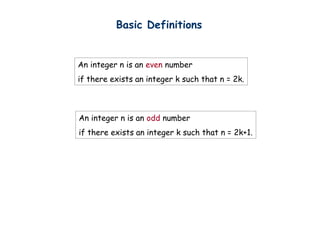
Basic Definitions
An integer n is an even number
if there exists an integer k such that n = 2k.
An integer n is an odd number
if there exists an integer k such that n = 2k+1.
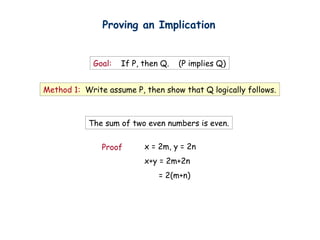
Proving an Implication
Goal: If P, then Q. (P implies Q)
Method 1: Write assume P, then show that Q logically follows.
The sum of two even numbers is even.
x = 2m, y = 2n
x+y = 2m+2n
= 2(m+n)
Proof
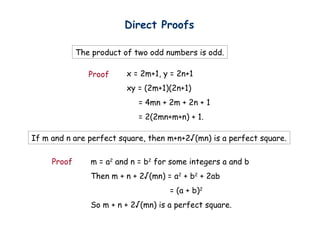
Direct Proofs
The product of two odd numbers is odd.
x = 2m+1, y = 2n+1
xy = (2m+1)(2n+1)
= 4mn + 2m + 2n + 1
= 2(2mn+m+n) + 1.
Proof
If m and n are perfect square, then m+n+2√(mn) is a perfect square.
Proof m = a2
and n = b2
for some integers a and b
Then m + n + 2√(mn) = a2
+ b2
+ 2ab
= (a + b)2
So m + n + 2√(mn) is a perfect square.
This Lecture
• Direct proof
• Contrapositive
• Proof by contradiction
• Proof by cases
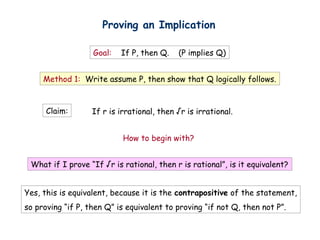
Proving an Implication
Claim: If r is irrational, then √r is irrational.
How to begin with?
What if I prove “If √r is rational, then r is rational”, is it equivalent?
Yes, this is equivalent, because it is the contrapositive of the statement,
so proving “if P, then Q” is equivalent to proving “if not Q, then not P”.
Goal: If P, then Q. (P implies Q)
Method 1: Write assume P, then show that Q logically follows.
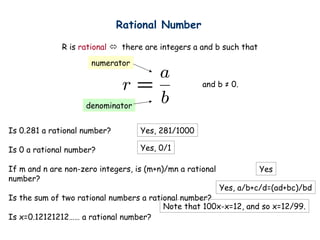
Rational Number
R is rational  there are integers a and b such that
and b ≠ 0.
numerator
denominator
Is 0.281 a rational number?
Is 0 a rational number?
If m and n are non-zero integers, is (m+n)/mn a rational
number?
Is the sum of two rational numbers a rational number?
Is x=0.12121212…… a rational number?
Yes, 281/1000
Yes, 0/1
Yes
Yes, a/b+c/d=(ad+bc)/bd
Note that 100x-x=12, and so x=12/99.
Proving the Contrapositive
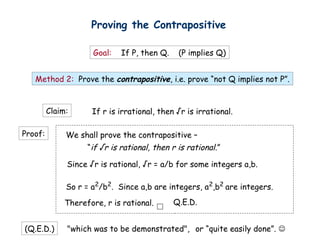
Claim: If r is irrational, then √r is irrational.
Method 2: Prove the contrapositive, i.e. prove “not Q implies not P”.
Proof: We shall prove the contrapositive –
“if √r is rational, then r is rational.”
Since √r is rational, √r = a/b for some integers a,b.
So r = a2
/b2
. Since a,b are integers, a2
,b2
are integers.
Therefore, r is rational.
(Q.E.D.) "which was to be demonstrated", or “quite easily done”. 
Goal: If P, then Q. (P implies Q)
Q.E.D.
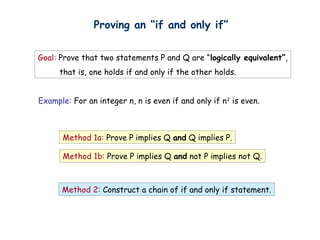
Proving an “if and only if”
Goal: Prove that two statements P and Q are “logically equivalent”,
that is, one holds if and only if the other holds.
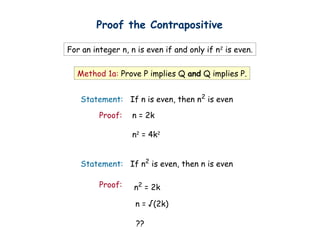
Example: For an integer n, n is even if and only if n2
is even.
Method 1a: Prove P implies Q and Q implies P.
Method 1b: Prove P implies Q and not P implies not Q.
Method 2: Construct a chain of if and only if statement.
Proof the Contrapositive
Statement: If n2
is even, then n is even
Statement: If n is even, then n2
is even
n = 2k
n2
= 4k2
Proof:
Proof: n2
= 2k
n = √(2k)
??
For an integer n, n is even if and only if n2
is even.
Method 1a: Prove P implies Q and Q implies P.
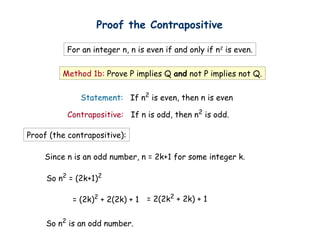
Since n is an odd number, n = 2k+1 for some integer k.
So n2
is an odd number.
Proof the Contrapositive
Statement: If n2
is even, then n is even
Contrapositive: If n is odd, then n2
is odd.
So n2
= (2k+1)2
= (2k)2
+ 2(2k) + 1
Proof (the contrapositive):
Method 1b: Prove P implies Q and not P implies not Q.
For an integer n, n is even if and only if n2
is even.
= 2(2k2
+ 2k) + 1
This Lecture
• Direct proof
• Contrapositive
• Proof by contradiction
• Proof by cases
FP
P
→
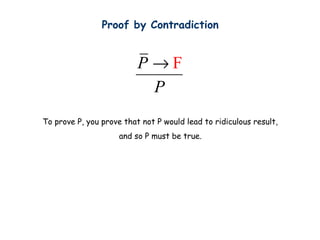
Proof by Contradiction
To prove P, you prove that not P would lead to ridiculous result,
and so P must be true.
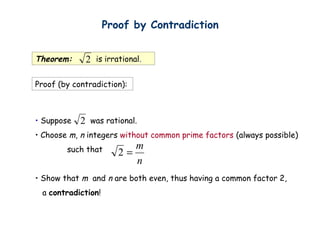
• Suppose was rational.
• Choose m, n integers without common prime factors (always possible)
such that
• Show that m and n are both even, thus having a common factor 2,
a contradiction!
n
m
=2
Theorem: is irrational.2
Proof (by contradiction):
Proof by Contradiction
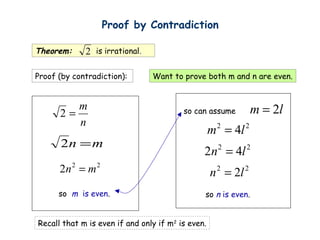
2
lm 2=so can assume
2 2
4m l=
22
2ln =
so n is even.
n
m
=2
mn =2
22
2 mn =
so m is even.
2 2
2 4n l=
Proof by Contradiction
Theorem: is irrational.2
Proof (by contradiction): Want to prove both m and n are even.
Recall that m is even if and only if m2
is even.
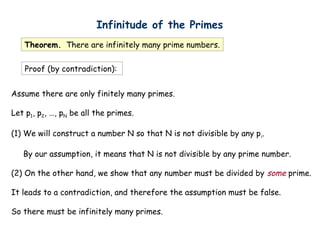
Infinitude of the Primes
Theorem. There are infinitely many prime numbers.
Assume there are only finitely many primes.
Let p1, p2, …, pN be all the primes.
(1) We will construct a number N so that N is not divisible by any pi.
By our assumption, it means that N is not divisible by any prime number.
(2) On the other hand, we show that any number must be divided by some prime.
It leads to a contradiction, and therefore the assumption must be false.
So there must be infinitely many primes.
Proof (by contradiction):
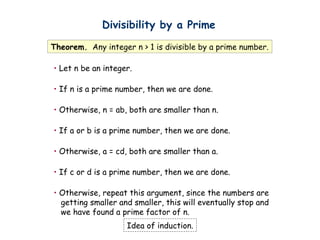
Divisibility by a Prime
Theorem. Any integer n > 1 is divisible by a prime number.
Idea of induction.
• Let n be an integer.
• If n is a prime number, then we are done.
• Otherwise, n = ab, both are smaller than n.
• If a or b is a prime number, then we are done.
• Otherwise, a = cd, both are smaller than a.
• If c or d is a prime number, then we are done.
• Otherwise, repeat this argument, since the numbers are
getting smaller and smaller, this will eventually stop and
we have found a prime factor of n.
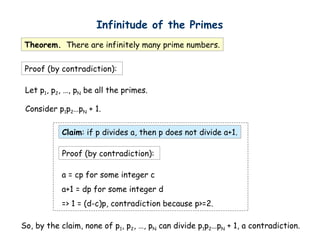
Infinitude of the Primes
Theorem. There are infinitely many prime numbers.
Claim: if p divides a, then p does not divide a+1.
Let p1, p2, …, pN be all the primes.
Consider p1p2…pN + 1.
Proof (by contradiction):
a = cp for some integer c
a+1 = dp for some integer d
=> 1 = (d-c)p, contradiction because p>=2.
So, by the claim, none of p1, p2, …, pN can divide p1p2…pN + 1, a contradiction.
This Lecture
• Direct proof
• Contrapositive
• Proof by contradiction
• Proof by cases
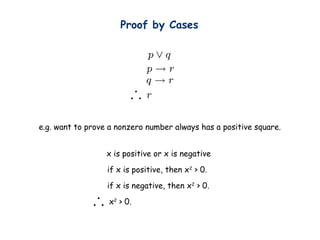
Proof by Cases
x is positive or x is negative
e.g. want to prove a nonzero number always has a positive square.
if x is positive, then x2
> 0.
if x is negative, then x2
> 0.
x2
> 0.
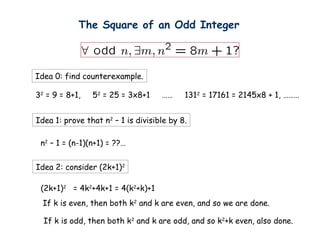
The Square of an Odd Integer
32
= 9 = 8+1, 52
= 25 = 3x8+1 …… 1312
= 17161 = 2145x8 + 1, ………
Idea 1: prove that n2
– 1 is divisible by 8.
Idea 2: consider (2k+1)2
Idea 0: find counterexample.
n2
– 1 = (n-1)(n+1) = ??…
(2k+1)2
= 4k2
+4k+1 = 4(k2
+k)+1
If k is even, then both k2
and k are even, and so we are done.
If k is odd, then both k2
and k are odd, and so k2
+k even, also done.
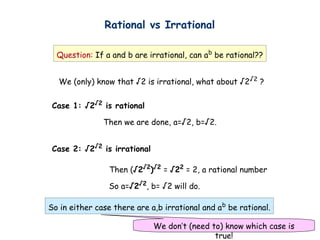
Rational vs Irrational
Question: If a and b are irrational, can ab
be rational??
We (only) know that √2 is irrational, what about √2√2
?
Case 1: √2√2
is rational
Then we are done, a=√2, b=√2.
Case 2: √2√2
is irrational
Then (√2√2
)√2
= √22
= 2, a rational number
So a=√2√2
, b= √2 will do.
So in either case there are a,b irrational and ab
be rational.
We don’t (need to) know which case is
true!
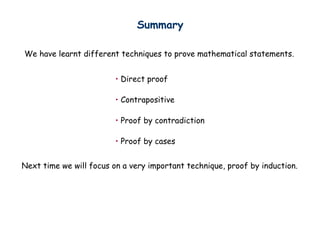
Summary
We have learnt different techniques to prove mathematical statements.
• Direct proof
• Contrapositive
• Proof by contradiction
• Proof by cases
Next time we will focus on a very important technique, proof by induction.

Discrete Math Lecture 03: Methods of Proof

  • 1.
  • 2.
    This Lecture Now wehave learnt the basics in logic. We are going to apply the logical rules in proving mathematical theorems. • Direct proof • Contrapositive • Proof by contradiction • Proof by cases
  • 3.
    Basic Definitions An integern is an even number if there exists an integer k such that n = 2k. An integer n is an odd number if there exists an integer k such that n = 2k+1.
  • 4.
    Proving an Implication Goal:If P, then Q. (P implies Q) Method 1: Write assume P, then show that Q logically follows. The sum of two even numbers is even. x = 2m, y = 2n x+y = 2m+2n = 2(m+n) Proof
  • 5.
    Direct Proofs The productof two odd numbers is odd. x = 2m+1, y = 2n+1 xy = (2m+1)(2n+1) = 4mn + 2m + 2n + 1 = 2(2mn+m+n) + 1. Proof If m and n are perfect square, then m+n+2√(mn) is a perfect square. Proof m = a2 and n = b2 for some integers a and b Then m + n + 2√(mn) = a2 + b2 + 2ab = (a + b)2 So m + n + 2√(mn) is a perfect square.
  • 6.
    This Lecture • Directproof • Contrapositive • Proof by contradiction • Proof by cases
  • 7.
    Proving an Implication Claim:If r is irrational, then √r is irrational. How to begin with? What if I prove “If √r is rational, then r is rational”, is it equivalent? Yes, this is equivalent, because it is the contrapositive of the statement, so proving “if P, then Q” is equivalent to proving “if not Q, then not P”. Goal: If P, then Q. (P implies Q) Method 1: Write assume P, then show that Q logically follows.
  • 8.
    Rational Number R isrational  there are integers a and b such that and b ≠ 0. numerator denominator Is 0.281 a rational number? Is 0 a rational number? If m and n are non-zero integers, is (m+n)/mn a rational number? Is the sum of two rational numbers a rational number? Is x=0.12121212…… a rational number? Yes, 281/1000 Yes, 0/1 Yes Yes, a/b+c/d=(ad+bc)/bd Note that 100x-x=12, and so x=12/99.
  • 9.
    Proving the Contrapositive Claim:If r is irrational, then √r is irrational. Method 2: Prove the contrapositive, i.e. prove “not Q implies not P”. Proof: We shall prove the contrapositive – “if √r is rational, then r is rational.” Since √r is rational, √r = a/b for some integers a,b. So r = a2 /b2 . Since a,b are integers, a2 ,b2 are integers. Therefore, r is rational. (Q.E.D.) "which was to be demonstrated", or “quite easily done”.  Goal: If P, then Q. (P implies Q) Q.E.D.
  • 10.
    Proving an “ifand only if” Goal: Prove that two statements P and Q are “logically equivalent”, that is, one holds if and only if the other holds. Example: For an integer n, n is even if and only if n2 is even. Method 1a: Prove P implies Q and Q implies P. Method 1b: Prove P implies Q and not P implies not Q. Method 2: Construct a chain of if and only if statement.
  • 11.
    Proof the Contrapositive Statement:If n2 is even, then n is even Statement: If n is even, then n2 is even n = 2k n2 = 4k2 Proof: Proof: n2 = 2k n = √(2k) ?? For an integer n, n is even if and only if n2 is even. Method 1a: Prove P implies Q and Q implies P.
  • 12.
    Since n isan odd number, n = 2k+1 for some integer k. So n2 is an odd number. Proof the Contrapositive Statement: If n2 is even, then n is even Contrapositive: If n is odd, then n2 is odd. So n2 = (2k+1)2 = (2k)2 + 2(2k) + 1 Proof (the contrapositive): Method 1b: Prove P implies Q and not P implies not Q. For an integer n, n is even if and only if n2 is even. = 2(2k2 + 2k) + 1
  • 13.
    This Lecture • Directproof • Contrapositive • Proof by contradiction • Proof by cases
  • 14.
    FP P → Proof by Contradiction Toprove P, you prove that not P would lead to ridiculous result, and so P must be true.
  • 15.
    • Suppose wasrational. • Choose m, n integers without common prime factors (always possible) such that • Show that m and n are both even, thus having a common factor 2, a contradiction! n m =2 Theorem: is irrational.2 Proof (by contradiction): Proof by Contradiction 2
  • 16.
    lm 2=so canassume 2 2 4m l= 22 2ln = so n is even. n m =2 mn =2 22 2 mn = so m is even. 2 2 2 4n l= Proof by Contradiction Theorem: is irrational.2 Proof (by contradiction): Want to prove both m and n are even. Recall that m is even if and only if m2 is even.
  • 17.
    Infinitude of thePrimes Theorem. There are infinitely many prime numbers. Assume there are only finitely many primes. Let p1, p2, …, pN be all the primes. (1) We will construct a number N so that N is not divisible by any pi. By our assumption, it means that N is not divisible by any prime number. (2) On the other hand, we show that any number must be divided by some prime. It leads to a contradiction, and therefore the assumption must be false. So there must be infinitely many primes. Proof (by contradiction):
  • 18.
    Divisibility by aPrime Theorem. Any integer n > 1 is divisible by a prime number. Idea of induction. • Let n be an integer. • If n is a prime number, then we are done. • Otherwise, n = ab, both are smaller than n. • If a or b is a prime number, then we are done. • Otherwise, a = cd, both are smaller than a. • If c or d is a prime number, then we are done. • Otherwise, repeat this argument, since the numbers are getting smaller and smaller, this will eventually stop and we have found a prime factor of n.
  • 19.
    Infinitude of thePrimes Theorem. There are infinitely many prime numbers. Claim: if p divides a, then p does not divide a+1. Let p1, p2, …, pN be all the primes. Consider p1p2…pN + 1. Proof (by contradiction): Proof (by contradiction): a = cp for some integer c a+1 = dp for some integer d => 1 = (d-c)p, contradiction because p>=2. So, by the claim, none of p1, p2, …, pN can divide p1p2…pN + 1, a contradiction.
  • 20.
    This Lecture • Directproof • Contrapositive • Proof by contradiction • Proof by cases
  • 21.
    Proof by Cases xis positive or x is negative e.g. want to prove a nonzero number always has a positive square. if x is positive, then x2 > 0. if x is negative, then x2 > 0. x2 > 0.
  • 22.
    The Square ofan Odd Integer 32 = 9 = 8+1, 52 = 25 = 3x8+1 …… 1312 = 17161 = 2145x8 + 1, ……… Idea 1: prove that n2 – 1 is divisible by 8. Idea 2: consider (2k+1)2 Idea 0: find counterexample. n2 – 1 = (n-1)(n+1) = ??… (2k+1)2 = 4k2 +4k+1 = 4(k2 +k)+1 If k is even, then both k2 and k are even, and so we are done. If k is odd, then both k2 and k are odd, and so k2 +k even, also done.
  • 23.
    Rational vs Irrational Question:If a and b are irrational, can ab be rational?? We (only) know that √2 is irrational, what about √2√2 ? Case 1: √2√2 is rational Then we are done, a=√2, b=√2. Case 2: √2√2 is irrational Then (√2√2 )√2 = √22 = 2, a rational number So a=√2√2 , b= √2 will do. So in either case there are a,b irrational and ab be rational. We don’t (need to) know which case is true!
  • 24.
    Summary We have learntdifferent techniques to prove mathematical statements. • Direct proof • Contrapositive • Proof by contradiction • Proof by cases Next time we will focus on a very important technique, proof by induction.