Proofs Methods and Strategy
Lecture 5, CMSC 56
Allyn Joy D. Calcaben
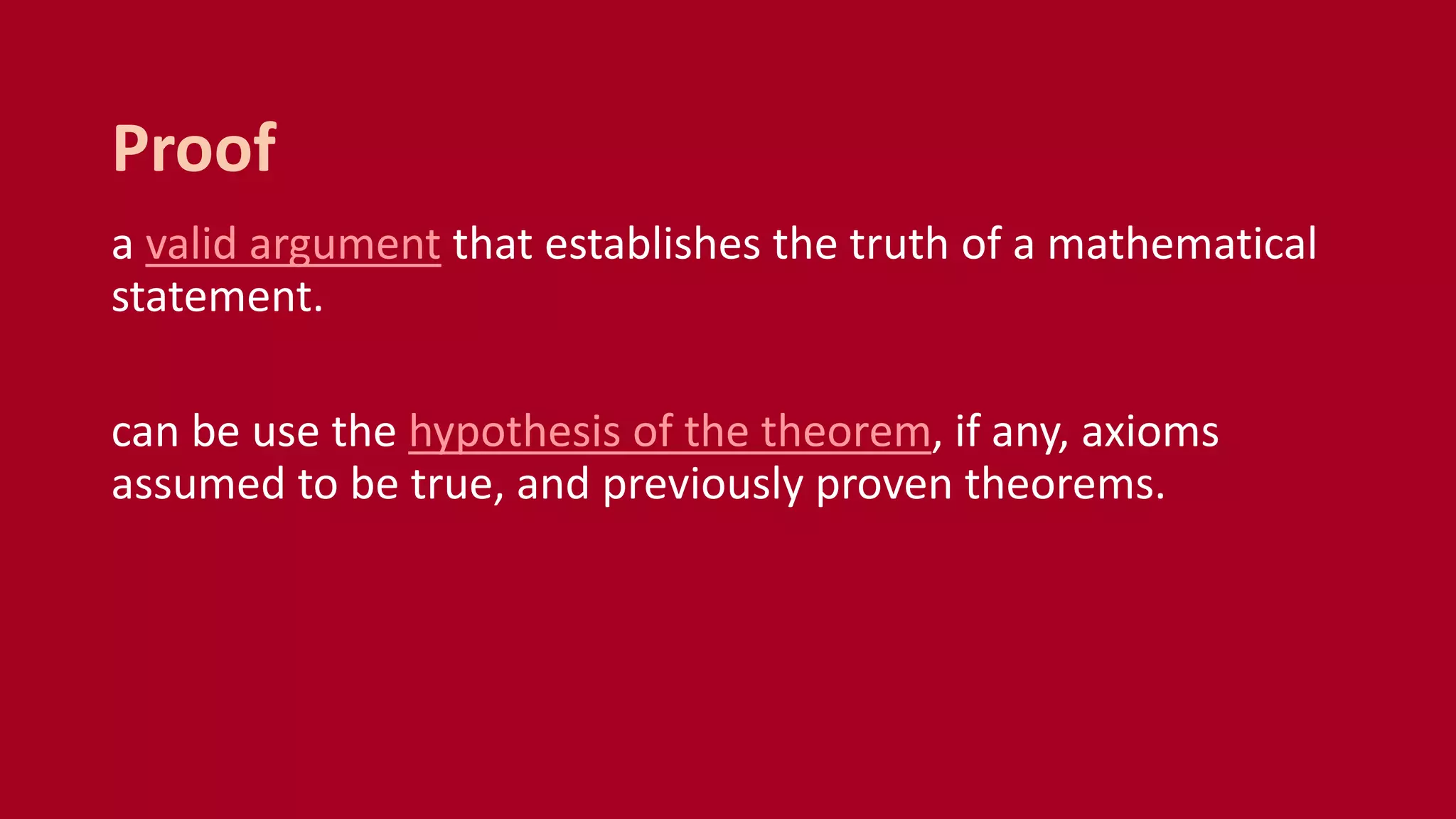
a valid argument that establishes the truth of a mathematical
statement.
can be use the hypothesis of the theorem, if any, axioms
assumed to be true, and previously proven theorems.
Proof
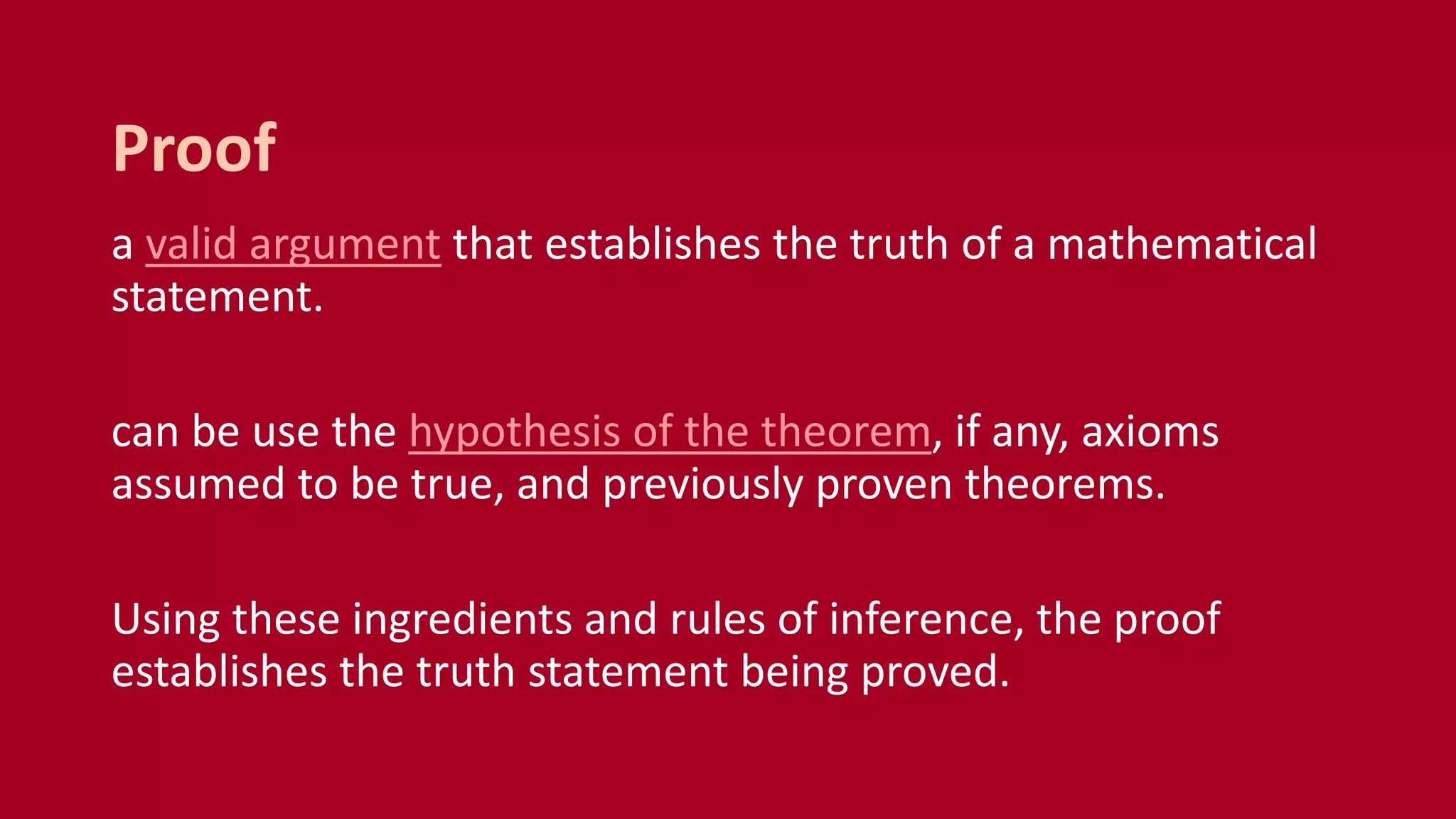
a valid argument that establishes the truth of a mathematical
statement.
can be use the hypothesis of the theorem, if any, axioms
assumed to be true, and previously proven theorems.
Using these ingredients and rules of inference, the proof
establishes the truth statement being proved.
Proof
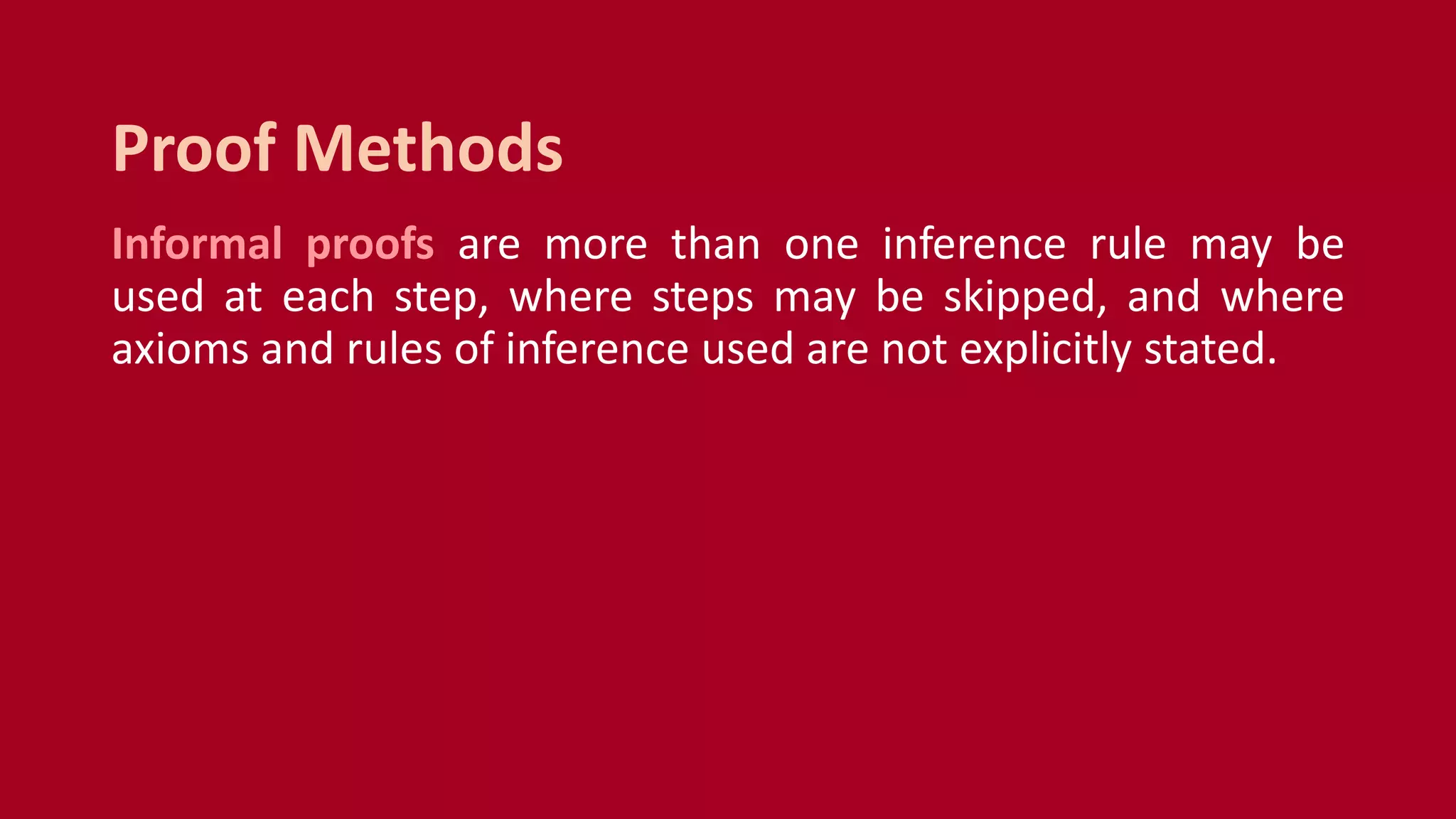
Informal proofs are more than one inference rule may be
used at each step, where steps may be skipped, and where
axioms and rules of inference used are not explicitly stated.
Proof Methods
Terminologies
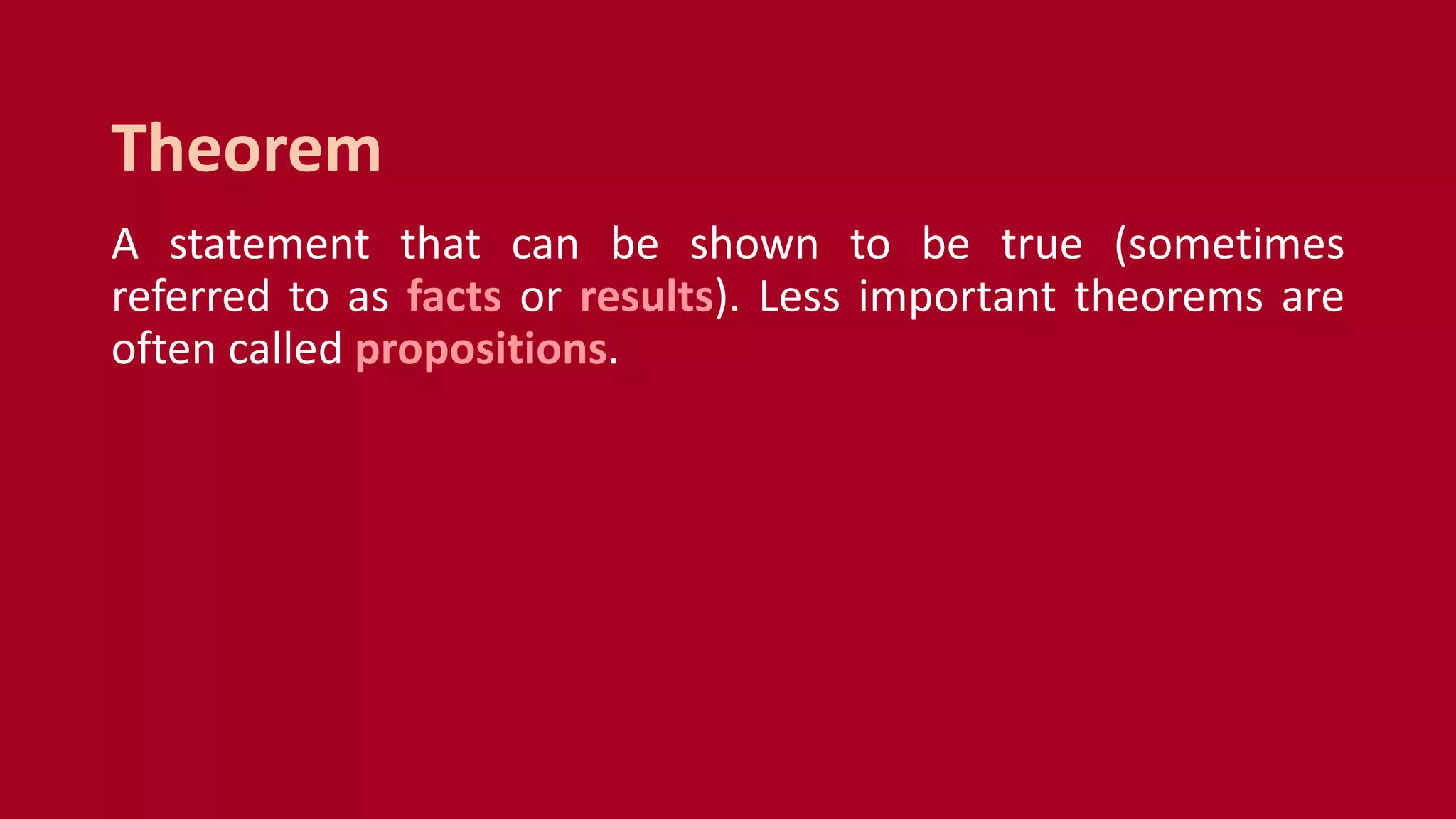
A statement that can be shown to be true (sometimes
referred to as facts or results). Less important theorems are
often called propositions.
Theorem
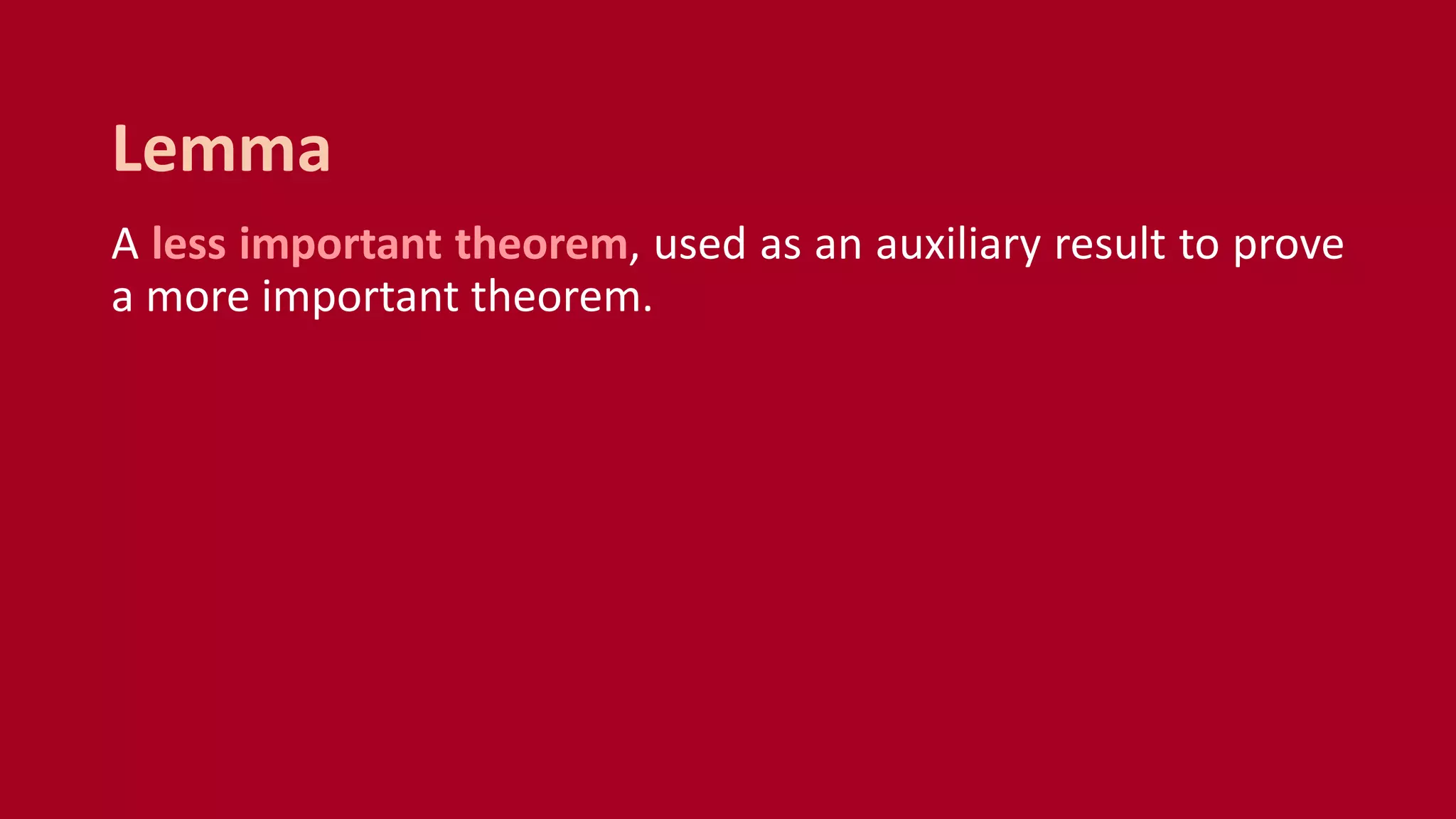
A less important theorem, used as an auxiliary result to prove
a more important theorem.
Lemma
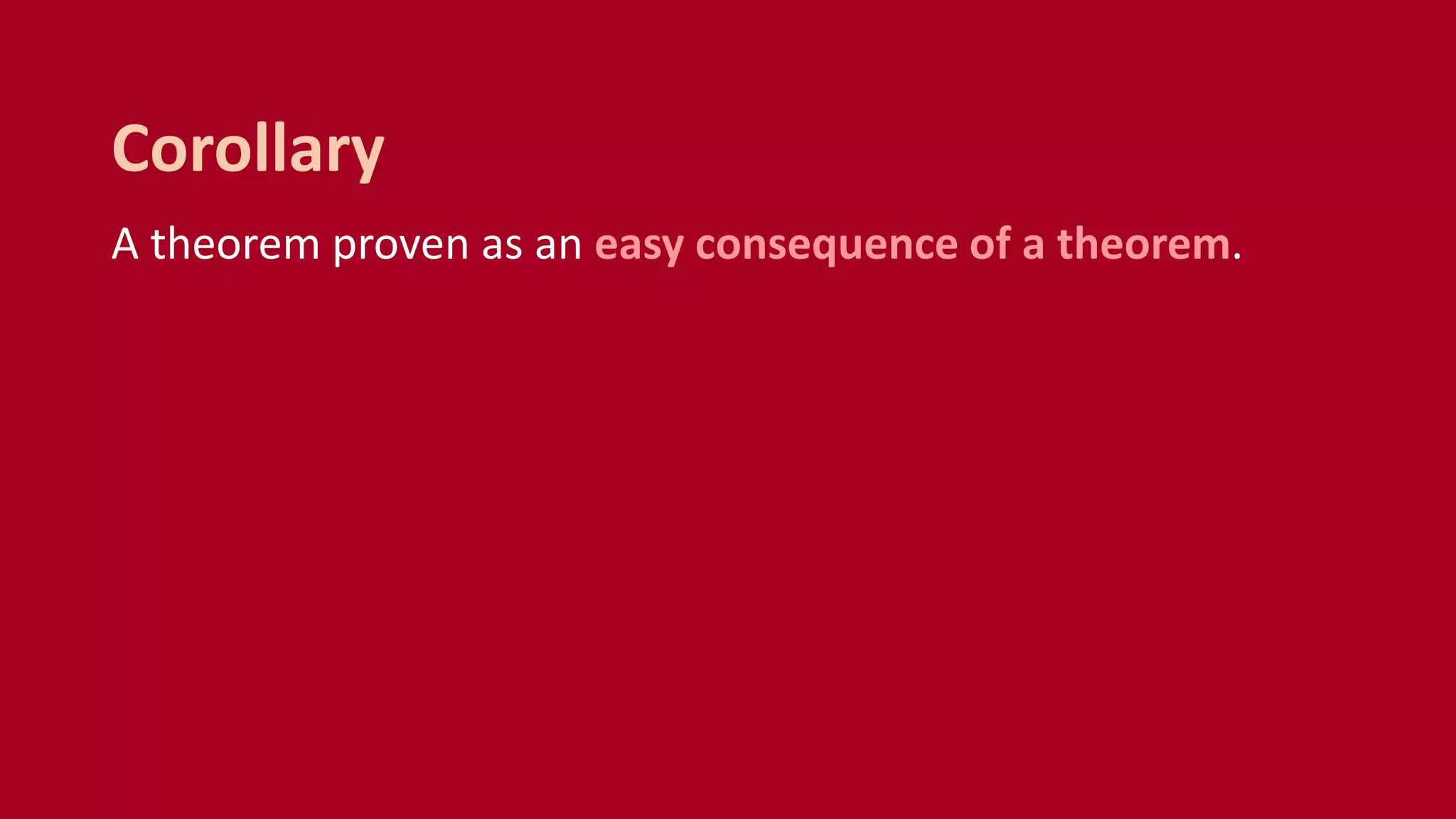
A theorem proven as an easy consequence of a theorem.
Corollary
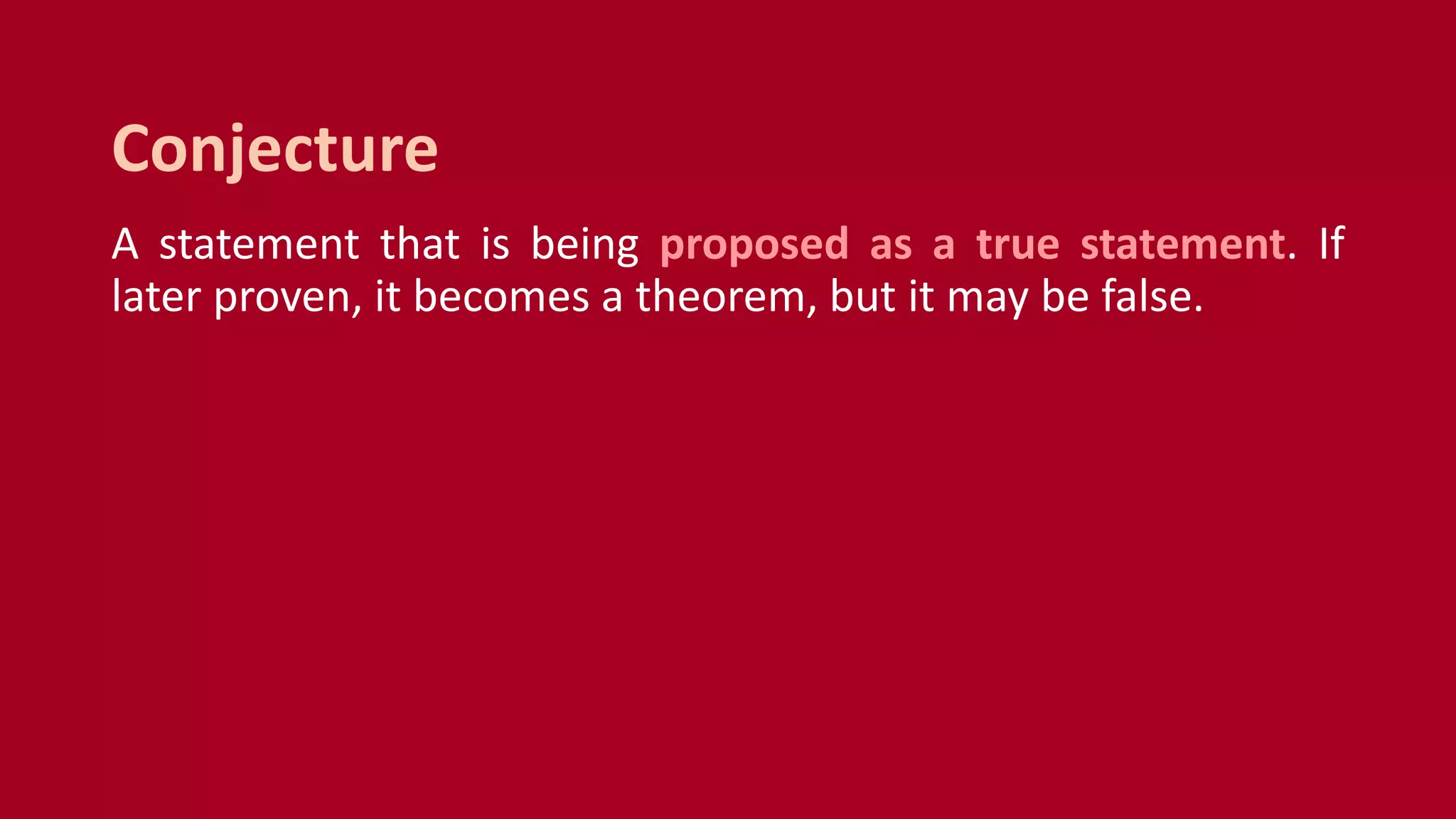
A statement that is being proposed as a true statement. If
later proven, it becomes a theorem, but it may be false.
Conjecture
known as postulates.
are statements that we assume to be true (algebraic axioms
specify rules for arithmetic like commutative laws).
Axiom
a valid argument that establishes the truth of a theorem. The
statements used in a proof include axioms, hypotheses (or
premises), and previously proven theorems. Rules of
inference, together with definition of terms, are used to draw
conclusions from other assertions, tying together the steps of
a proof.
Proof
Understanding
How Theorems Are Stated
Many theorems assert that a property holds for all elements
in a domain. However, the universal quantifier is often not
explicitly stated.
Understanding how theorems are stated
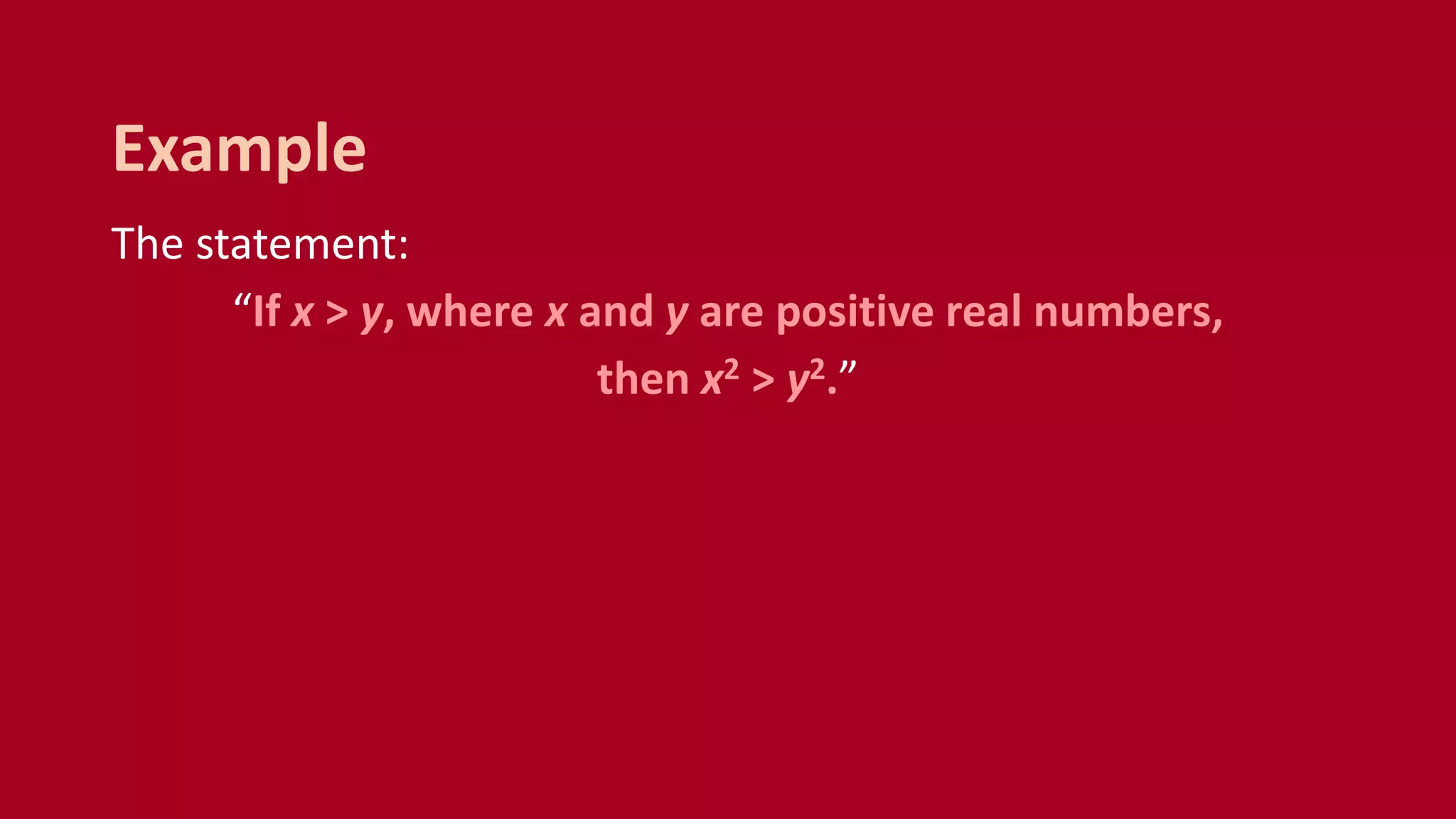
The statement:
“If x > y, where x and y are positive real numbers,
then x2 > y2.”
Example
The statement:
“If x > y, where x and y are positive real numbers,
then x2 > y2.”
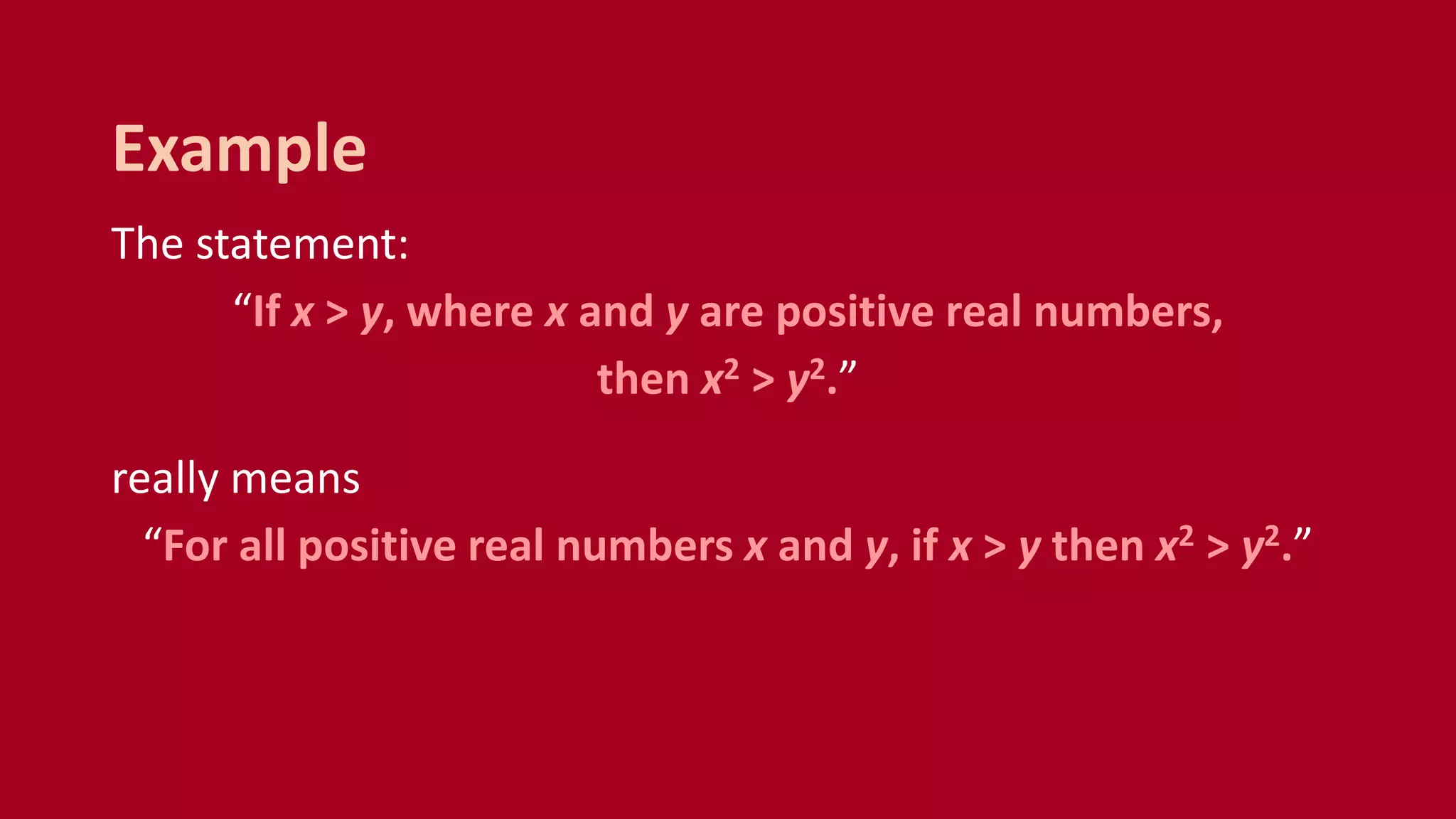
really means
“For all positive real numbers x and y, if x > y then x2 > y2.”
Example
The statement:
“If x > y, where x and y are positive real numbers,
then x2 > y2.”
really means
“For all positive real numbers x and y, if x > y then x2 > y2.”
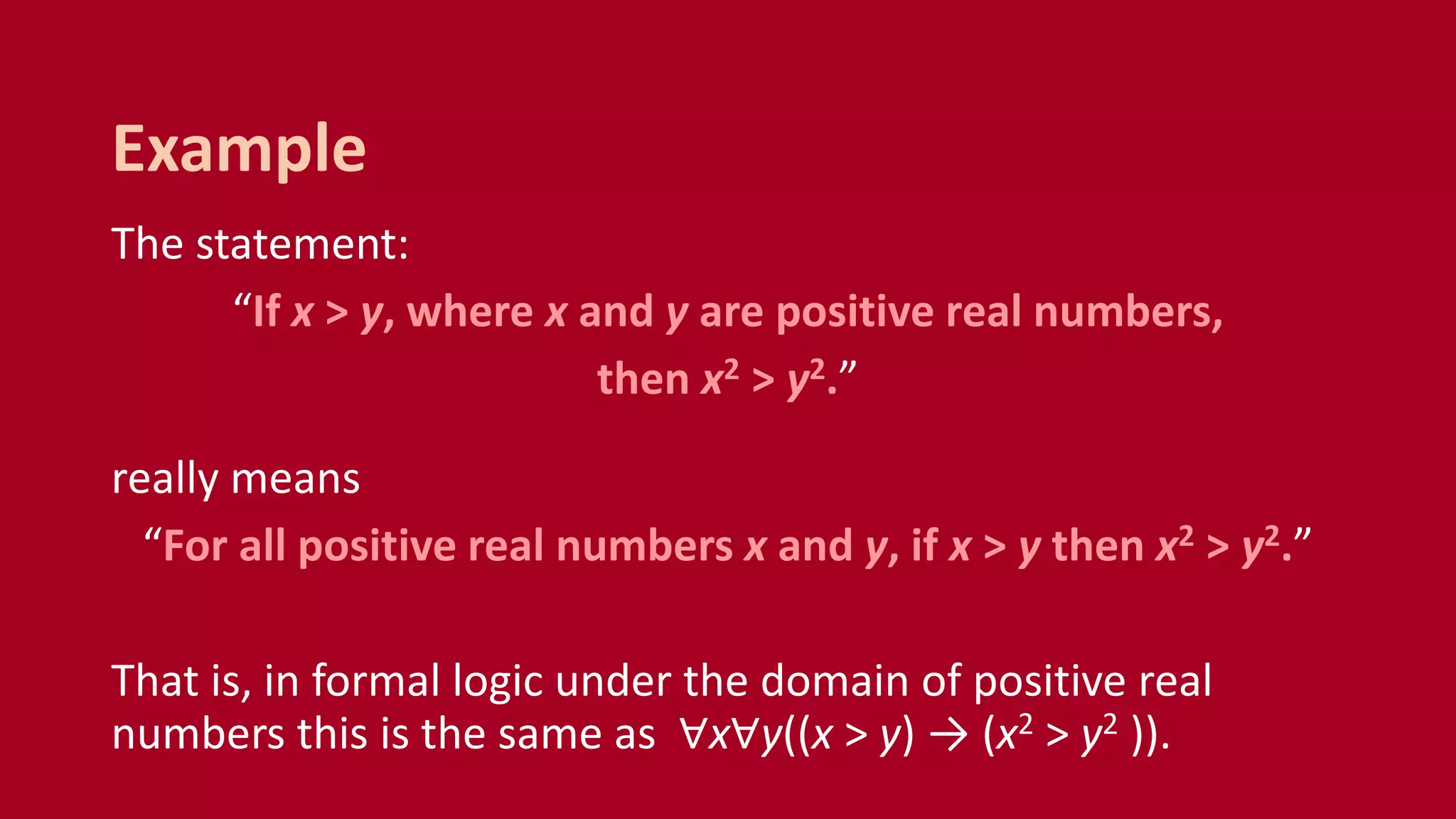
That is, in formal logic under the domain of positive real
numbers this is the same as ∀x∀y((x > y) → (x2 > y2 )).
Example
Methods of Proving Theorems
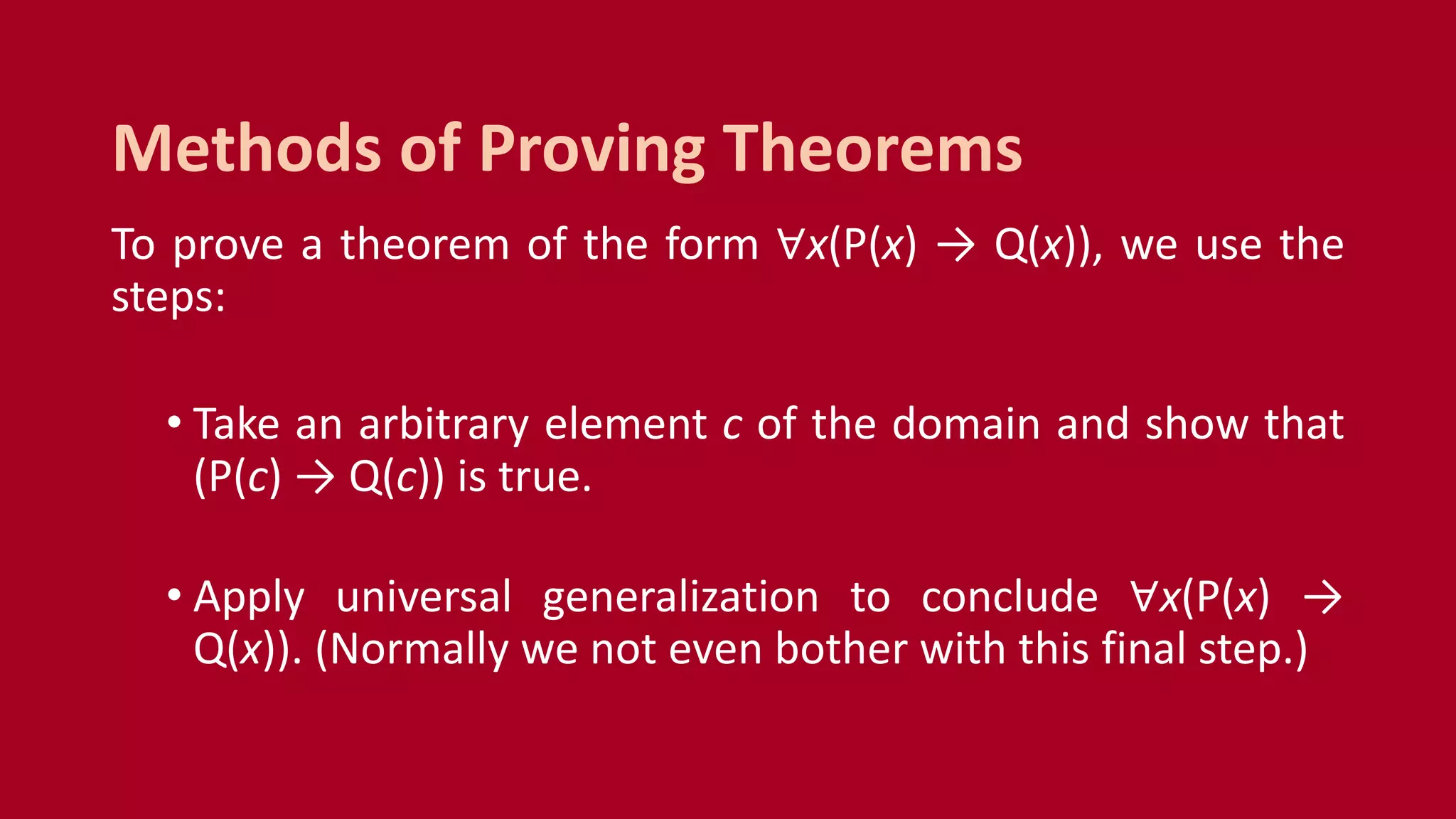
To prove a theorem of the form ∀x(P(x) → Q(x)), we use the
steps:
• Take an arbitrary element c of the domain and show that
(P(c) → Q(c)) is true.
• Apply universal generalization to conclude ∀x(P(x) →
Q(x)). (Normally we not even bother with this final step.)
Methods of Proving Theorems
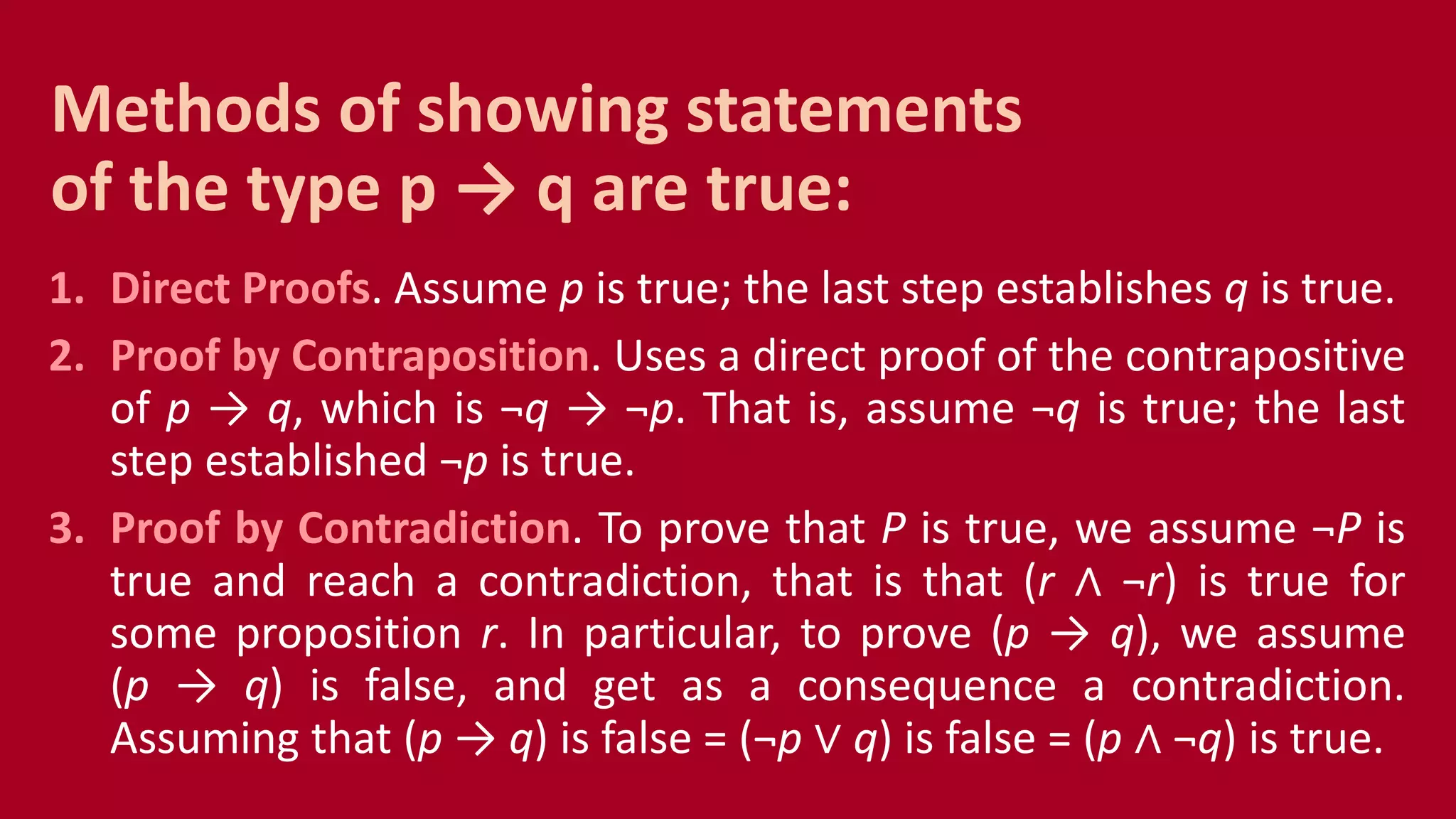
1. Direct Proofs. Assume p is true; the last step establishes q is true.
2. Proof by Contraposition. Uses a direct proof of the contrapositive
of p → q, which is ¬q → ¬p. That is, assume ¬q is true; the last
step established ¬p is true.
3. Proof by Contradiction. To prove that P is true, we assume ¬P is
true and reach a contradiction, that is that (r ∧ ¬r) is true for
some proposition r. In particular, to prove (p → q), we assume
(p → q) is false, and get as a consequence a contradiction.
Assuming that (p → q) is false = (¬p ∨ q) is false = (p ∧ ¬q) is true.
Methods of showing statements
of the type p → q are true:
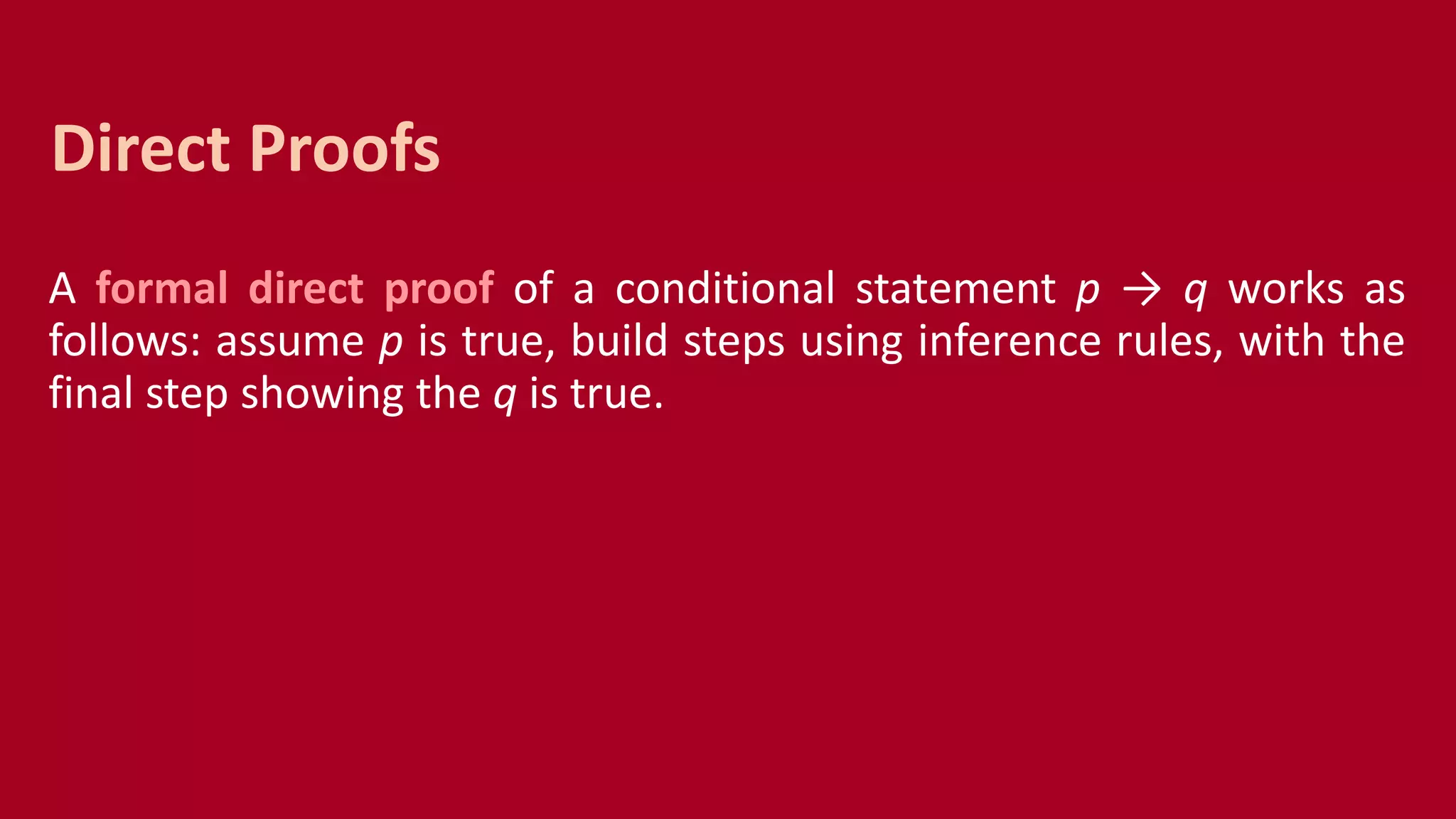
A formal direct proof of a conditional statement p → q works as
follows: assume p is true, build steps using inference rules, with the
final step showing the q is true.
Direct Proofs
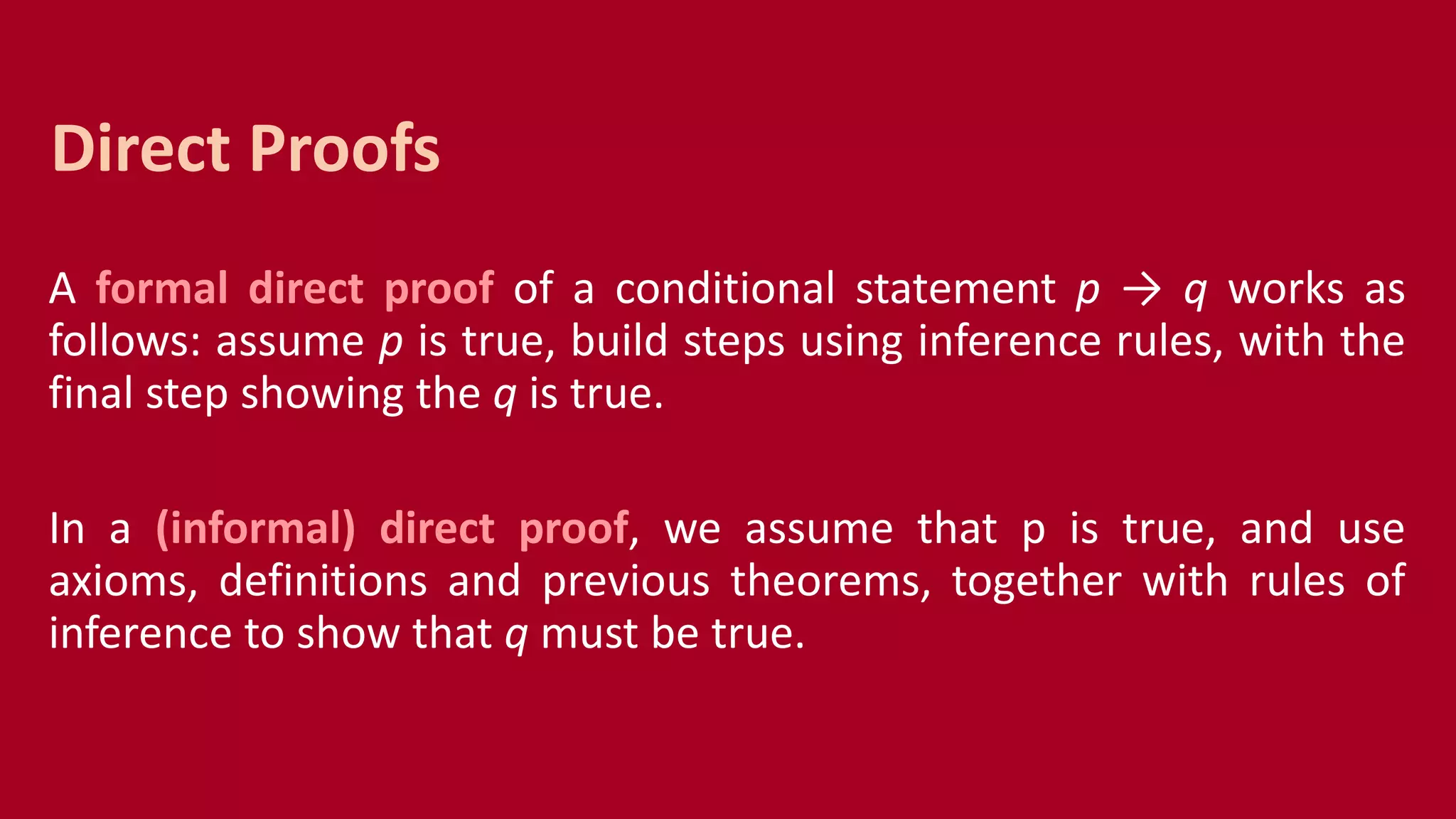
A formal direct proof of a conditional statement p → q works as
follows: assume p is true, build steps using inference rules, with the
final step showing the q is true.
In a (informal) direct proof, we assume that p is true, and use
axioms, definitions and previous theorems, together with rules of
inference to show that q must be true.
Direct Proofs
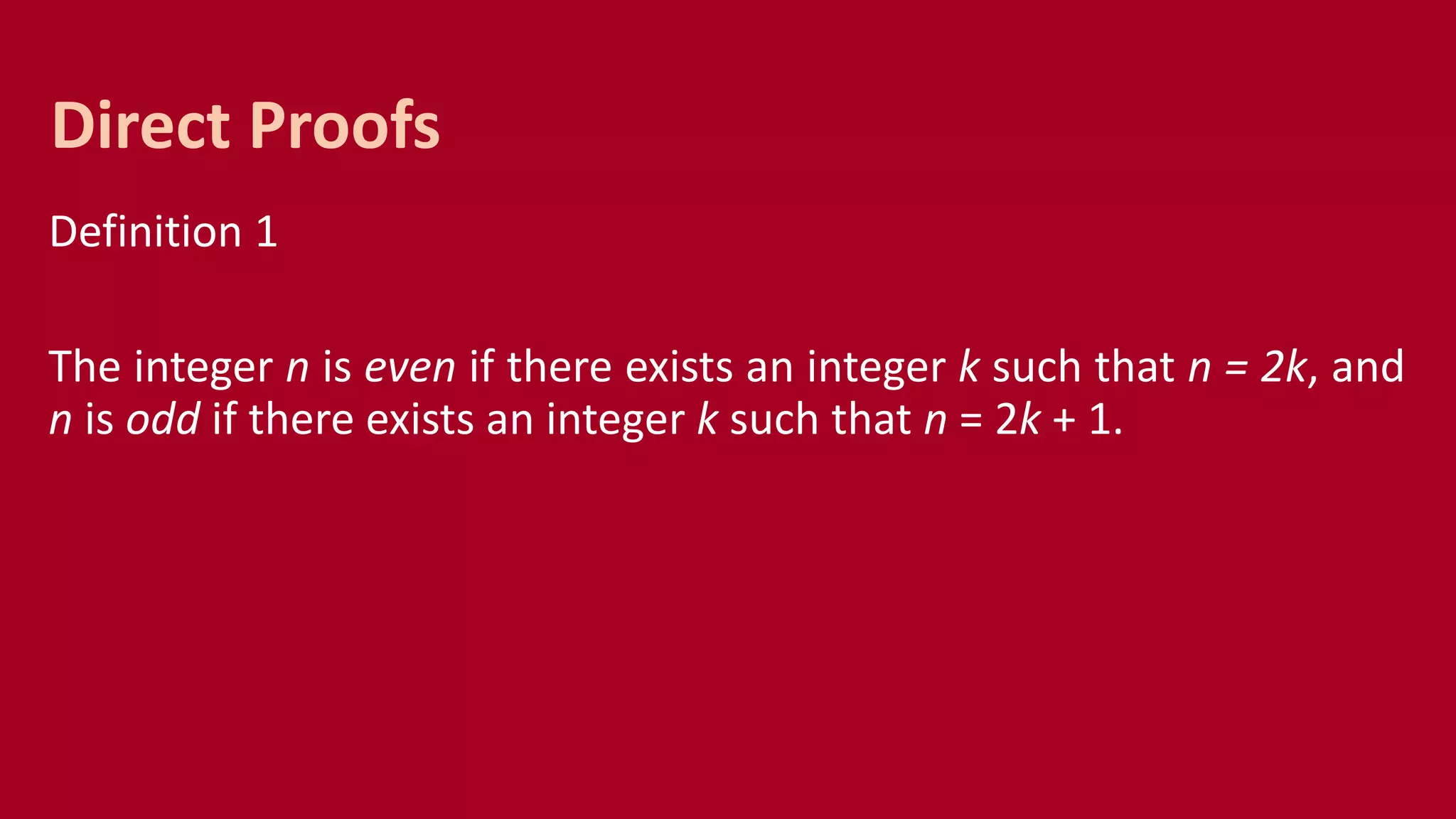
Definition 1
The integer n is even if there exists an integer k such that n = 2k, and
n is odd if there exists an integer k such that n = 2k + 1.
Direct Proofs
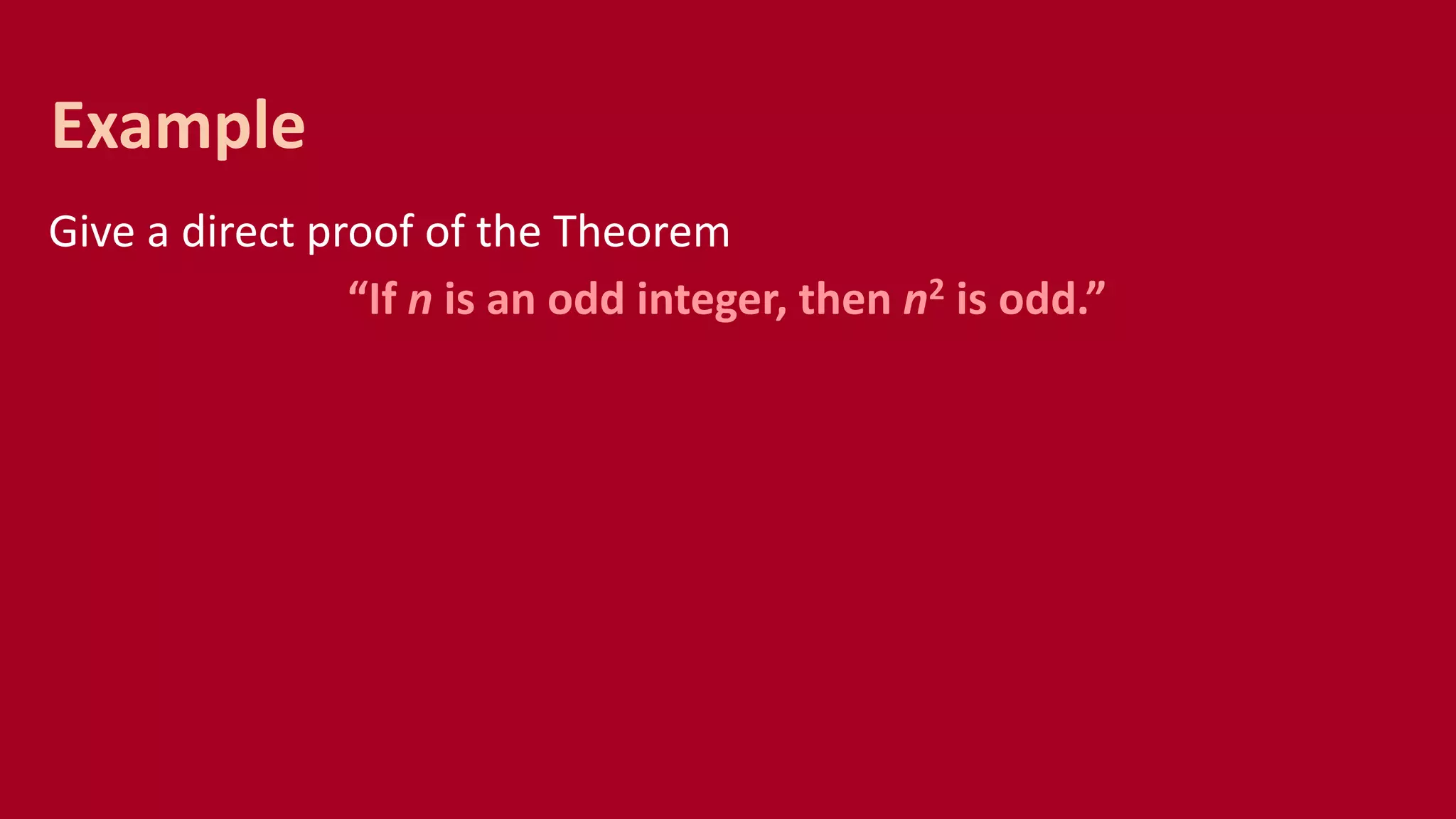
Give a direct proof of the Theorem
“If n is an odd integer, then n2 is odd.”
Example
Give a direct proof of the Theorem
“If n is an odd integer, then n2 is odd.”
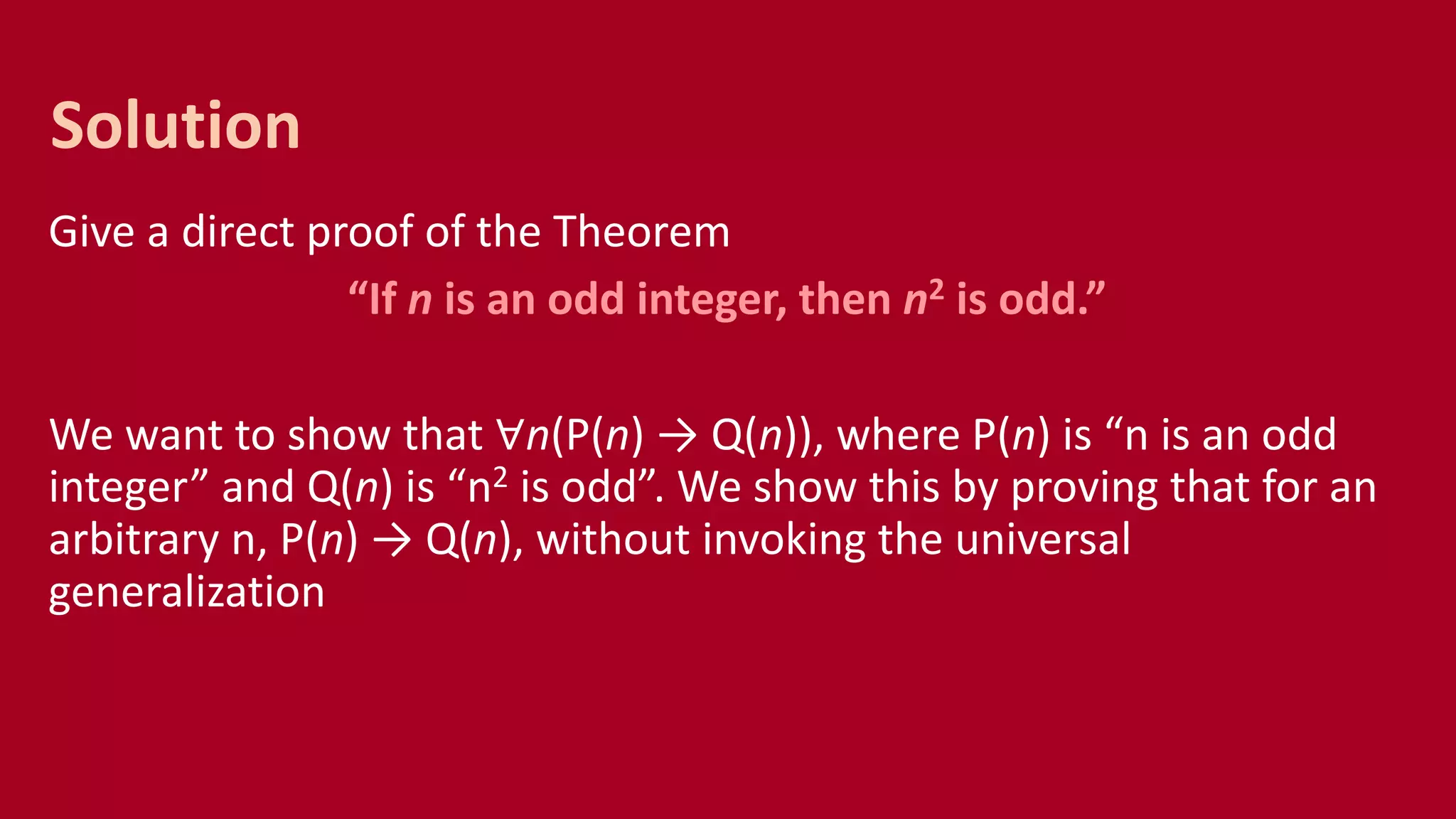
We want to show that ∀n(P(n) → Q(n)), where P(n) is “n is an odd
integer” and Q(n) is “n2 is odd”. We show this by proving that for an
arbitrary n, P(n) → Q(n), without invoking the universal
generalization
Solution
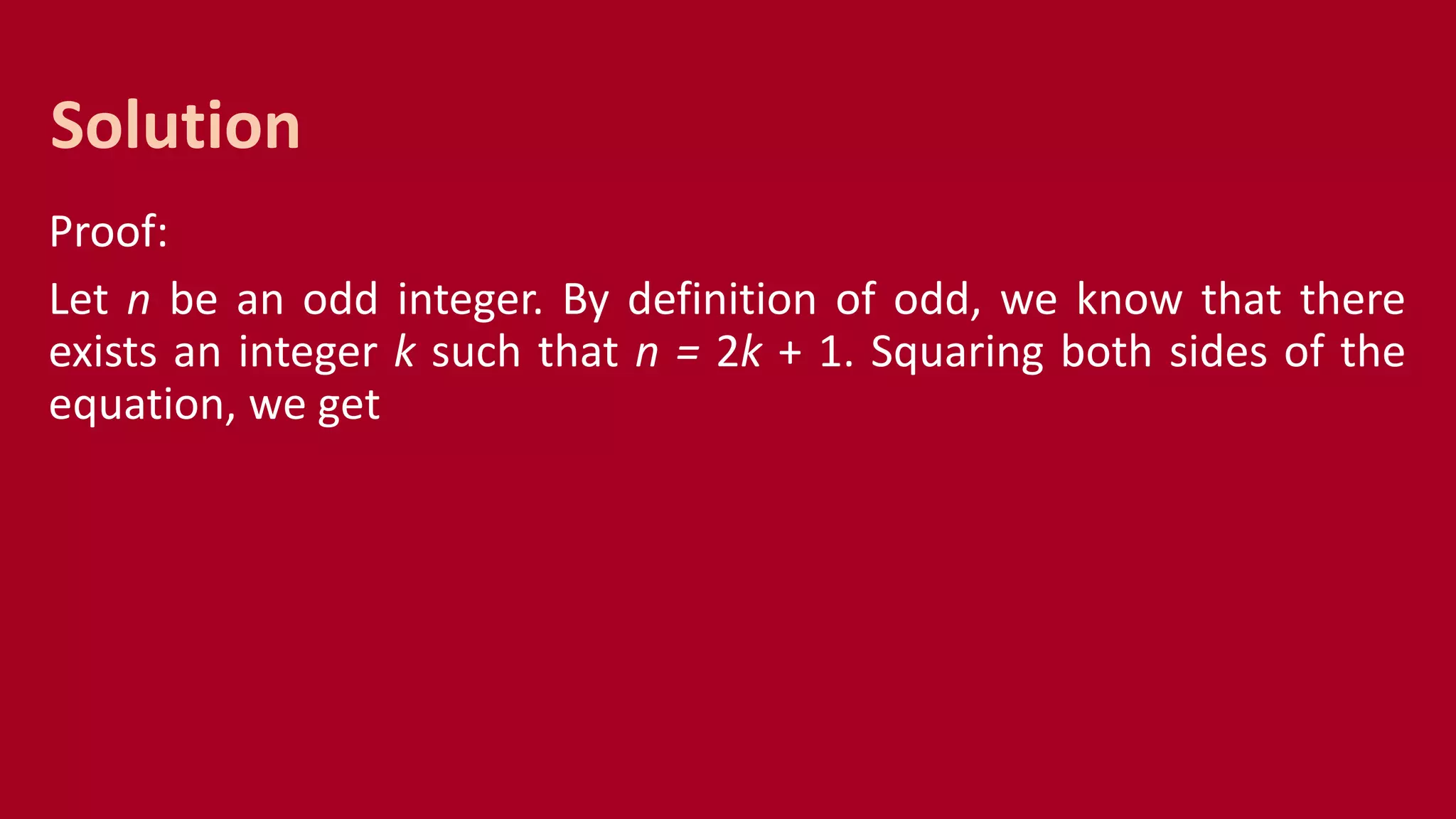
Proof:
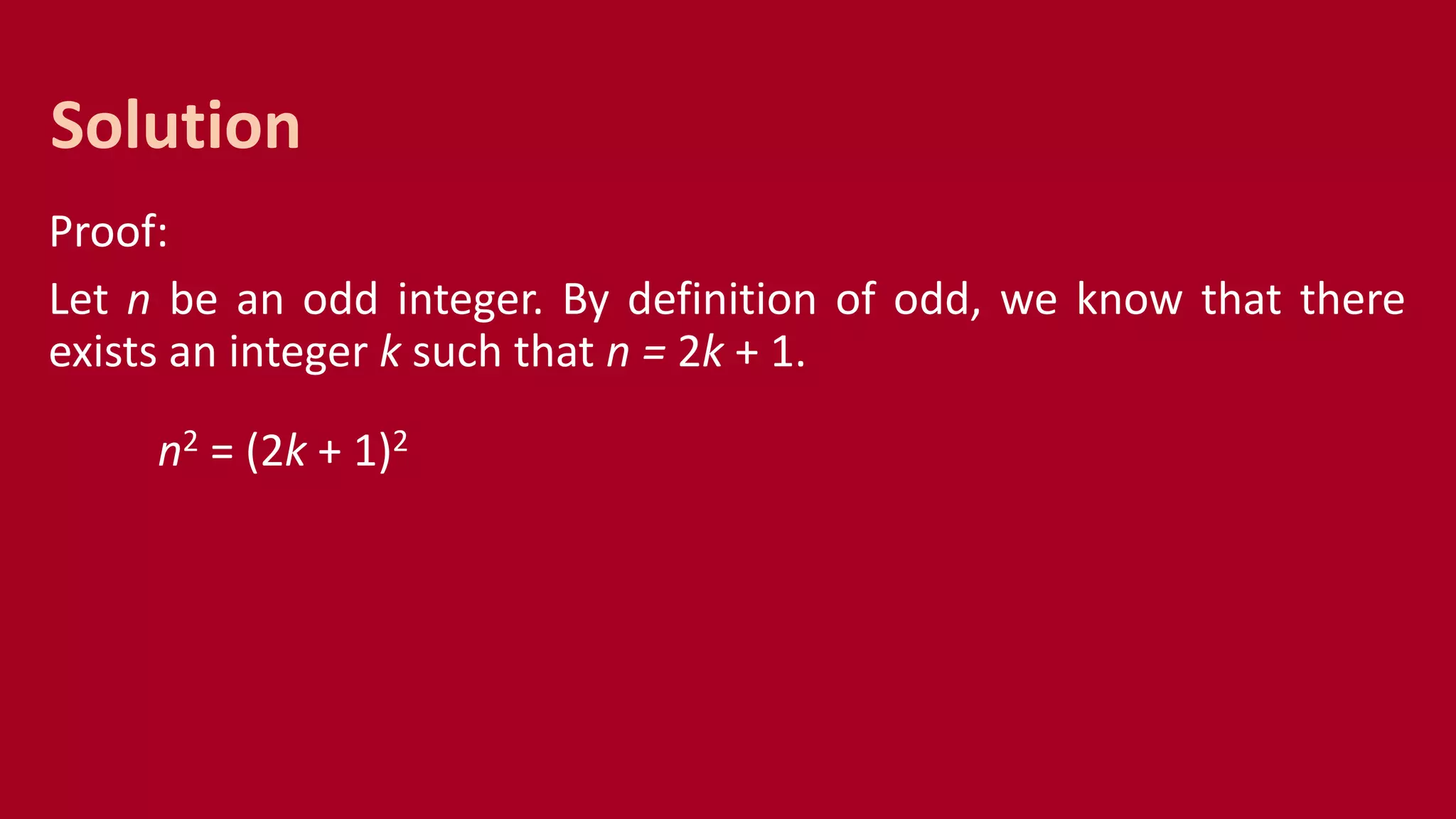
Let n be an odd integer. By definition of odd, we know that there
exists an integer k such that n = 2k + 1. Squaring both sides of the
equation, we get
Solution
Proof:
Let n be an odd integer. By definition of odd, we know that there
exists an integer k such that n = 2k + 1.
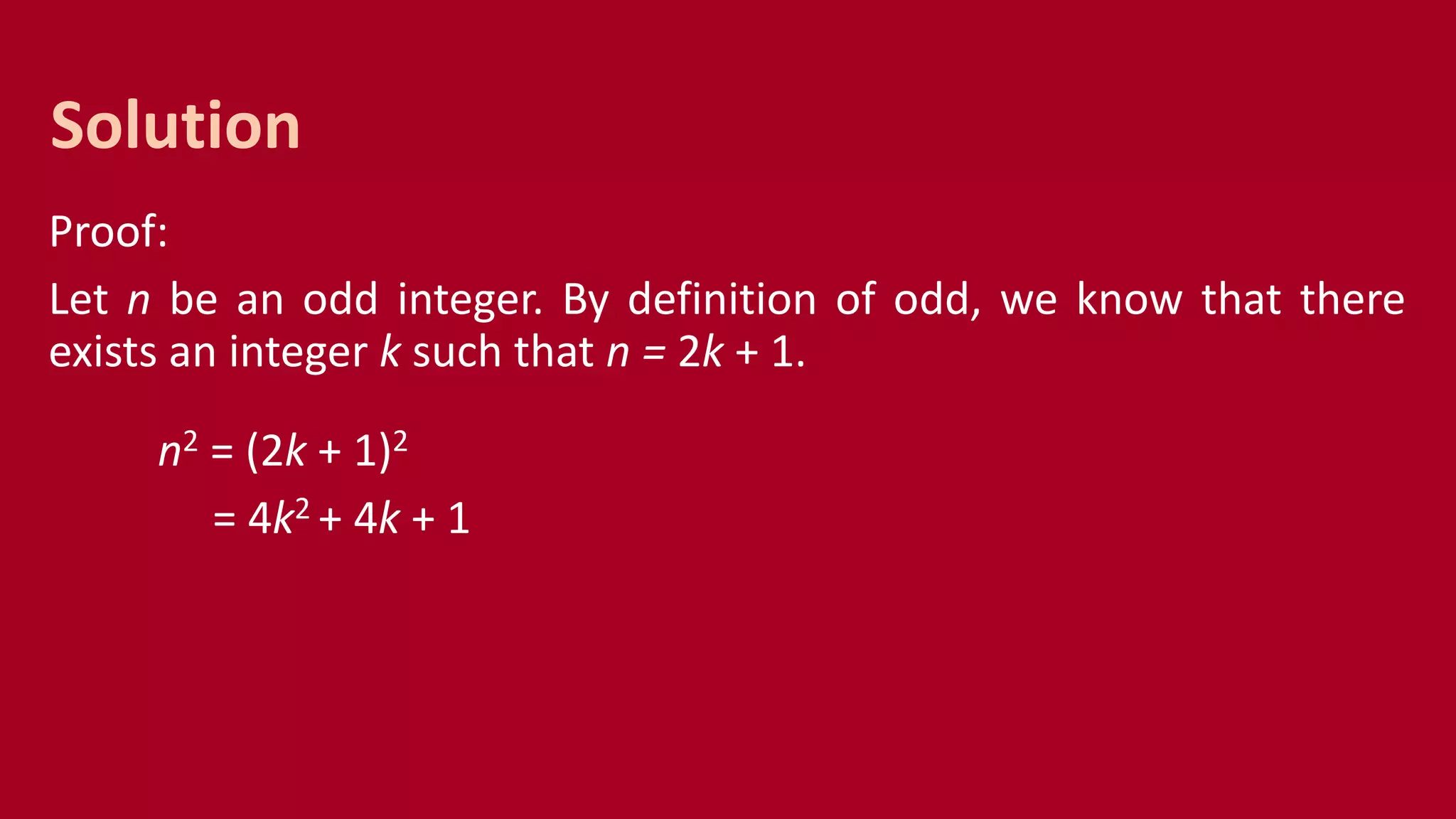
n2 = (2k + 1)2
Solution
Proof:
Let n be an odd integer. By definition of odd, we know that there
exists an integer k such that n = 2k + 1.
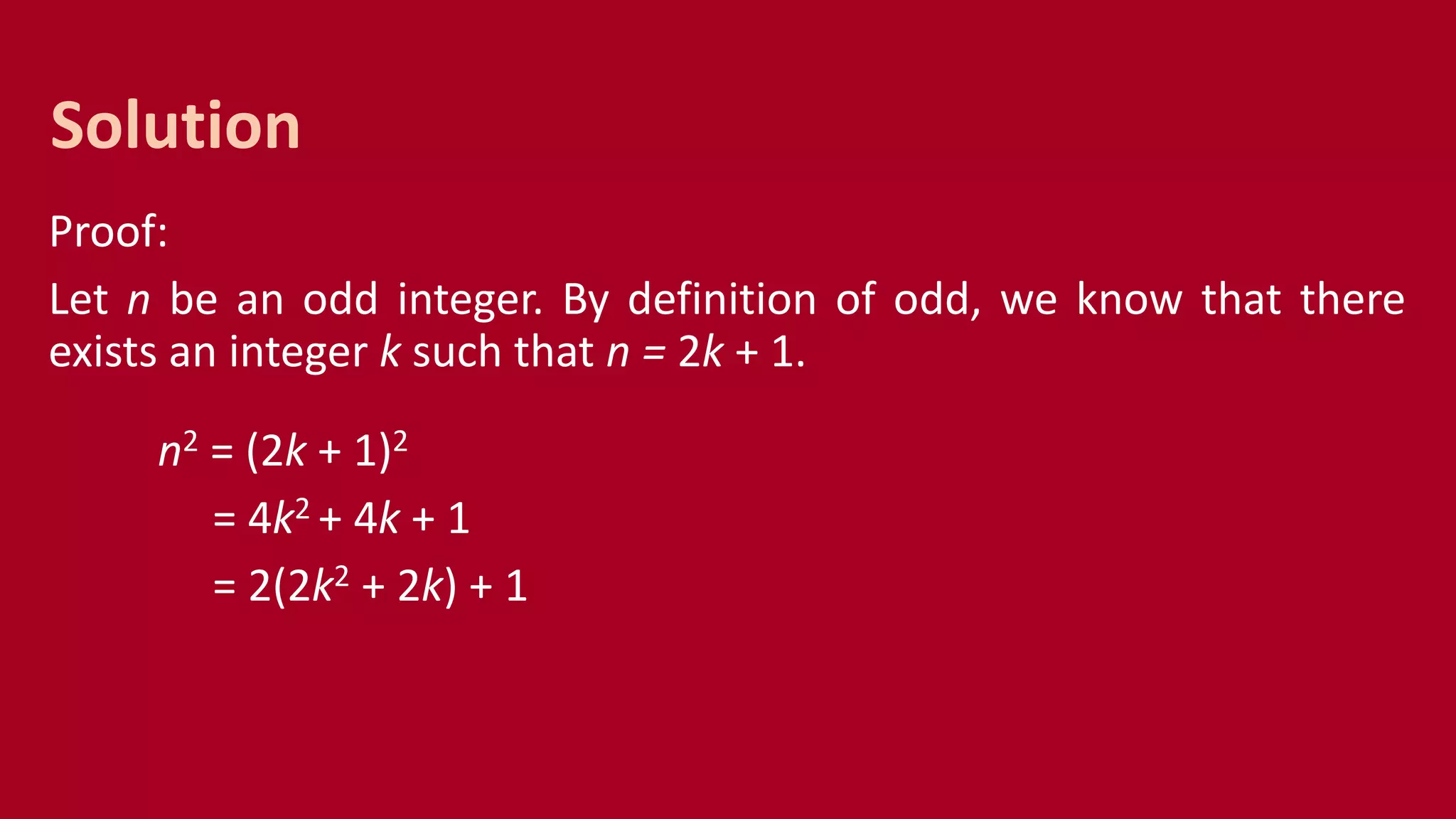
n2 = (2k + 1)2
= 4k2 + 4k + 1
Solution
Proof:
Let n be an odd integer. By definition of odd, we know that there
exists an integer k such that n = 2k + 1.
n2 = (2k + 1)2
= 4k2 + 4k + 1
= 2(2k2 + 2k) + 1
Solution
Proof:
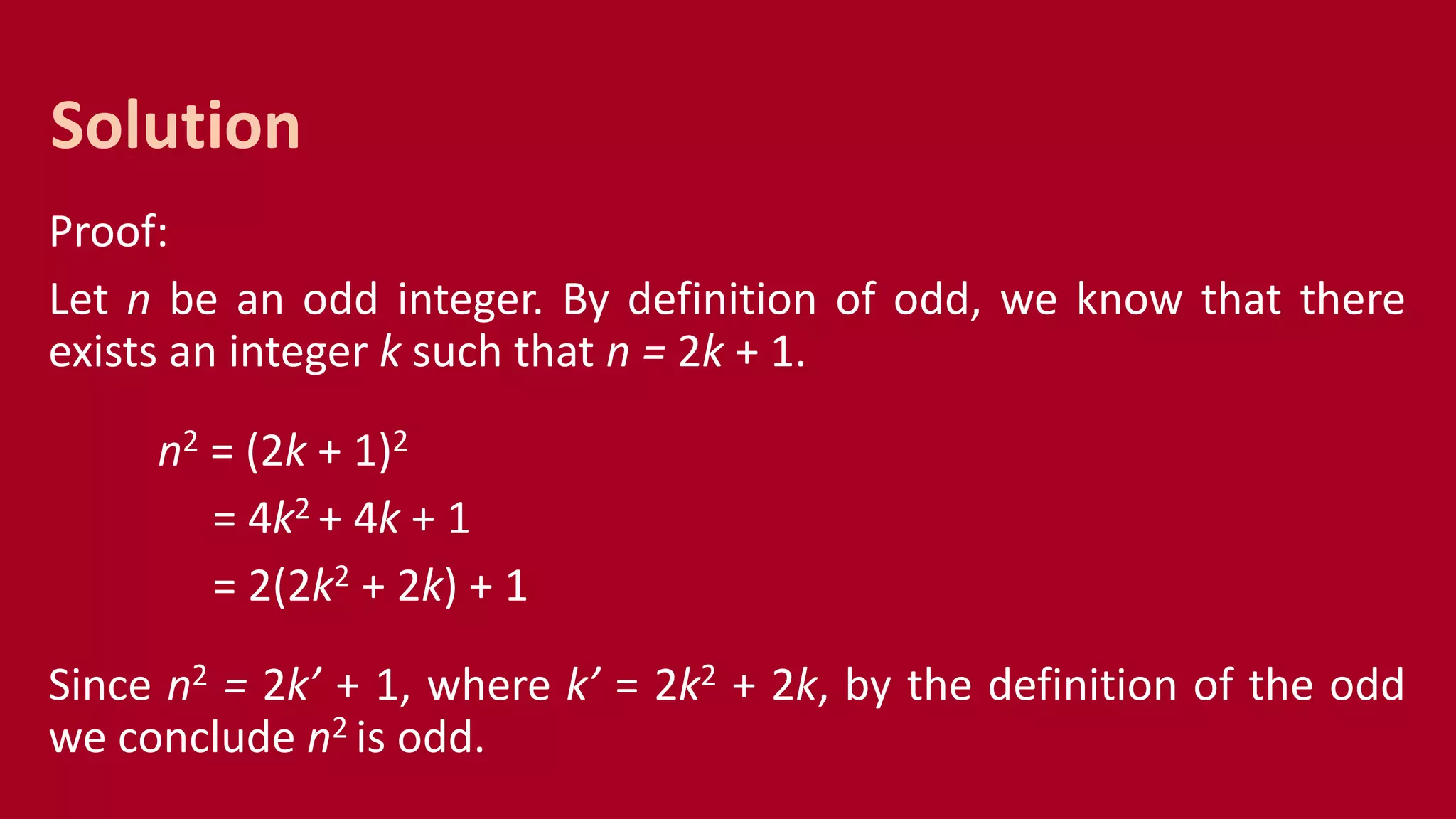
Let n be an odd integer. By definition of odd, we know that there
exists an integer k such that n = 2k + 1.
n2 = (2k + 1)2
= 4k2 + 4k + 1
= 2(2k2 + 2k) + 1
Since n2 = 2k’ + 1, where k’ = 2k2 + 2k, by the definition of the odd
we conclude n2 is odd.
Solution
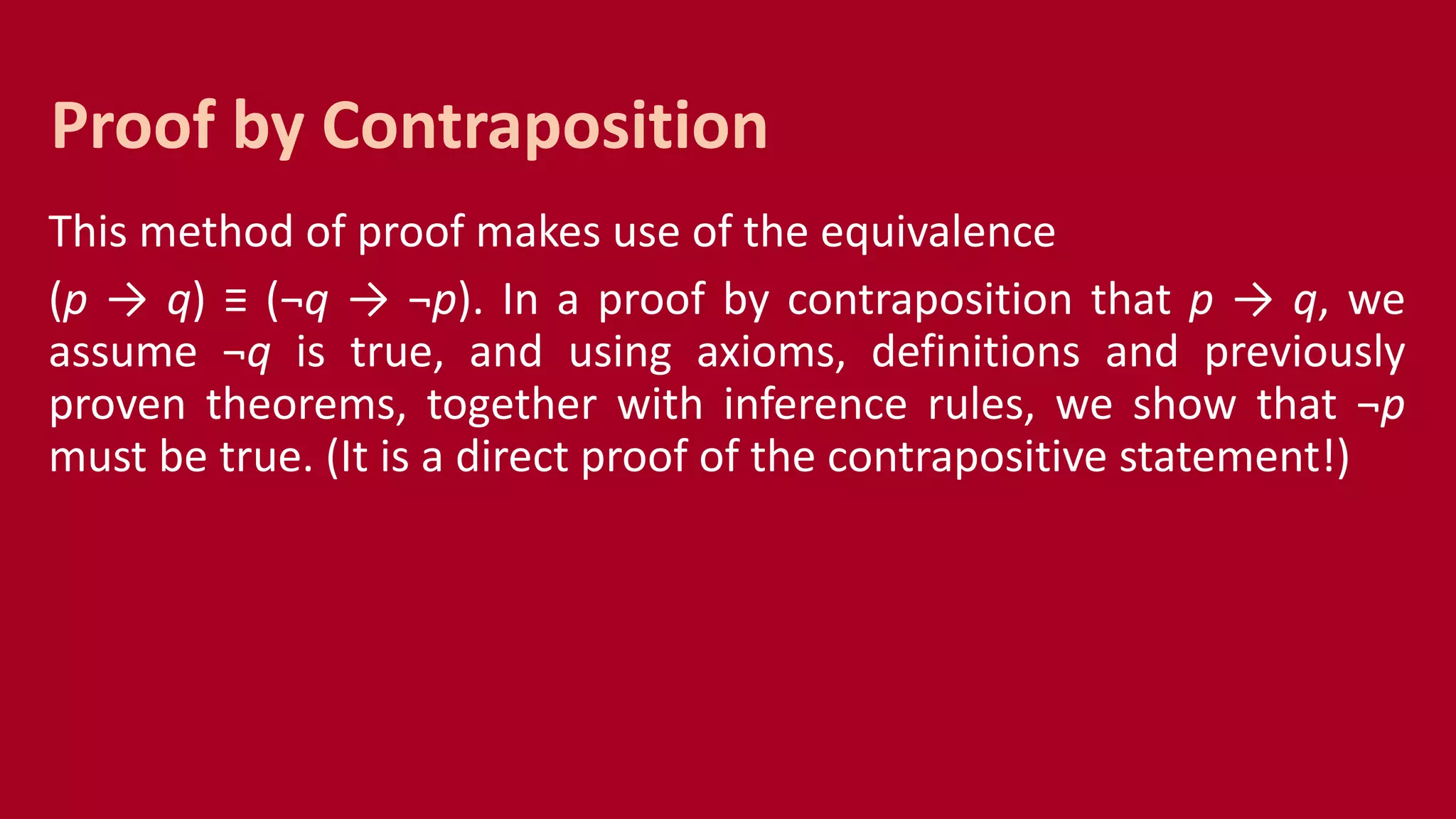
This method of proof makes use of the equivalence
(p → q) ≡ (¬q → ¬p). In a proof by contraposition that p → q, we
assume ¬q is true, and using axioms, definitions and previously
proven theorems, together with inference rules, we show that ¬p
must be true. (It is a direct proof of the contrapositive statement!)
Proof by Contraposition
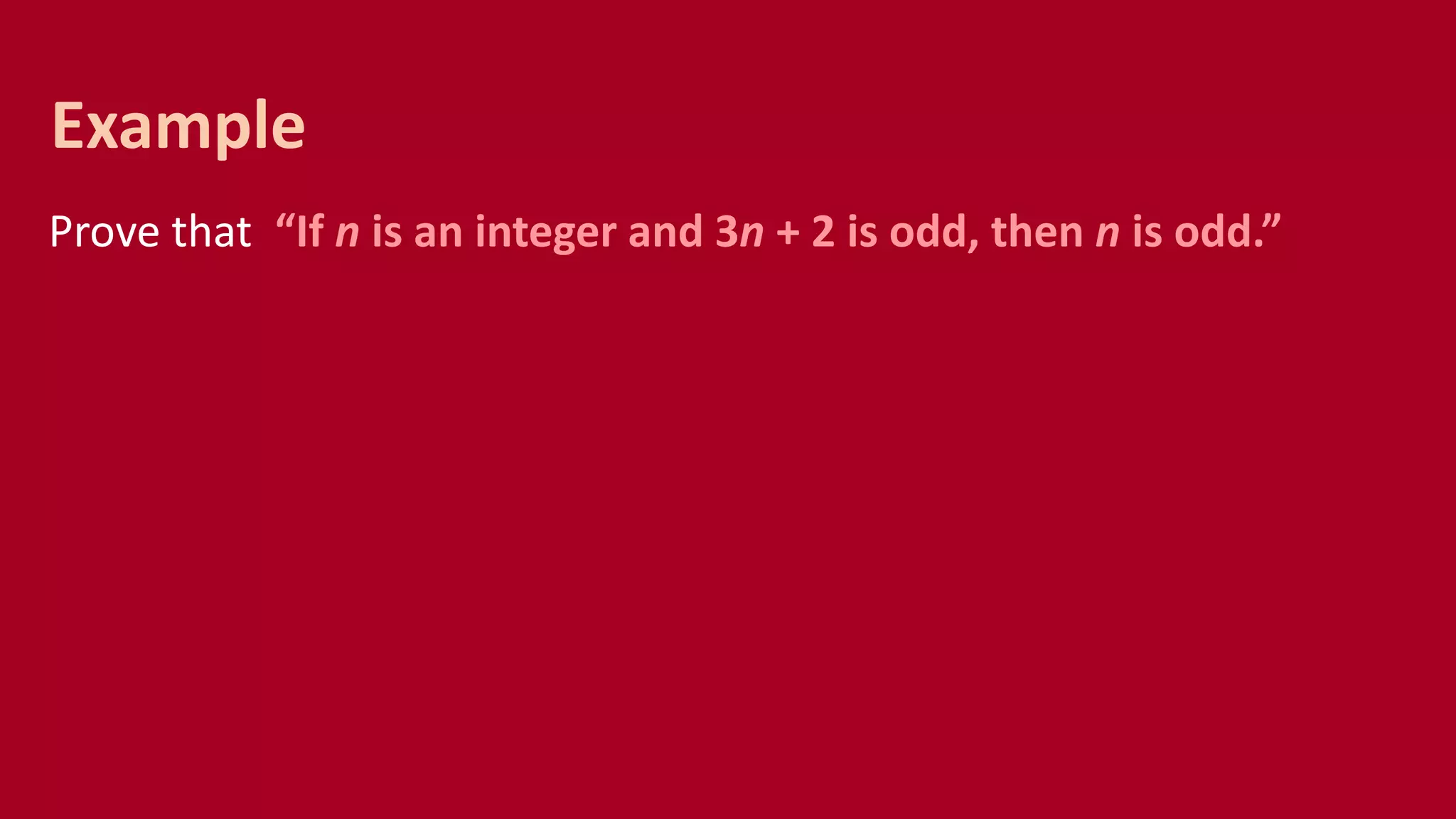
Prove that “If n is an integer and 3n + 2 is odd, then n is odd.”
Example
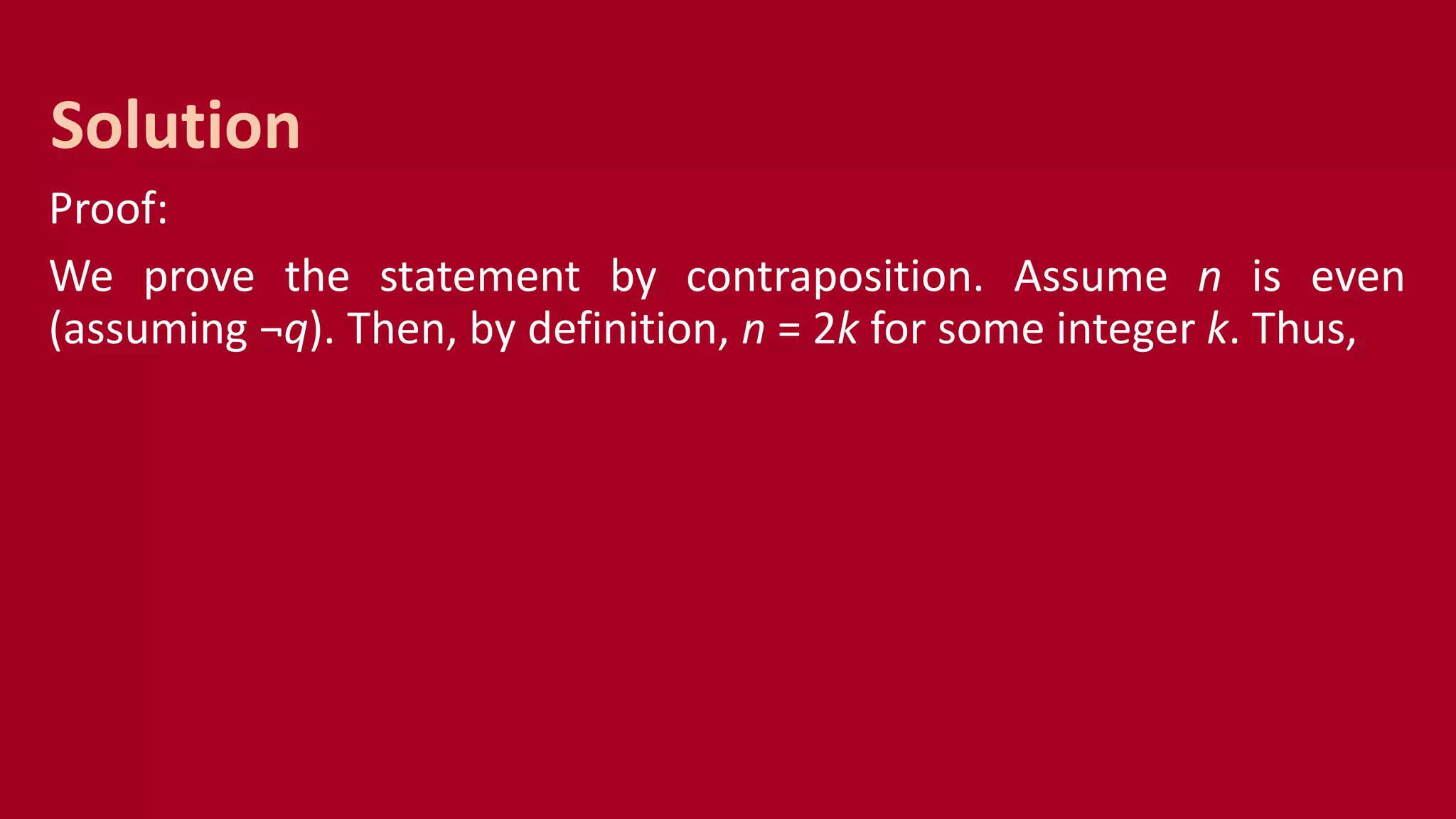
Proof:
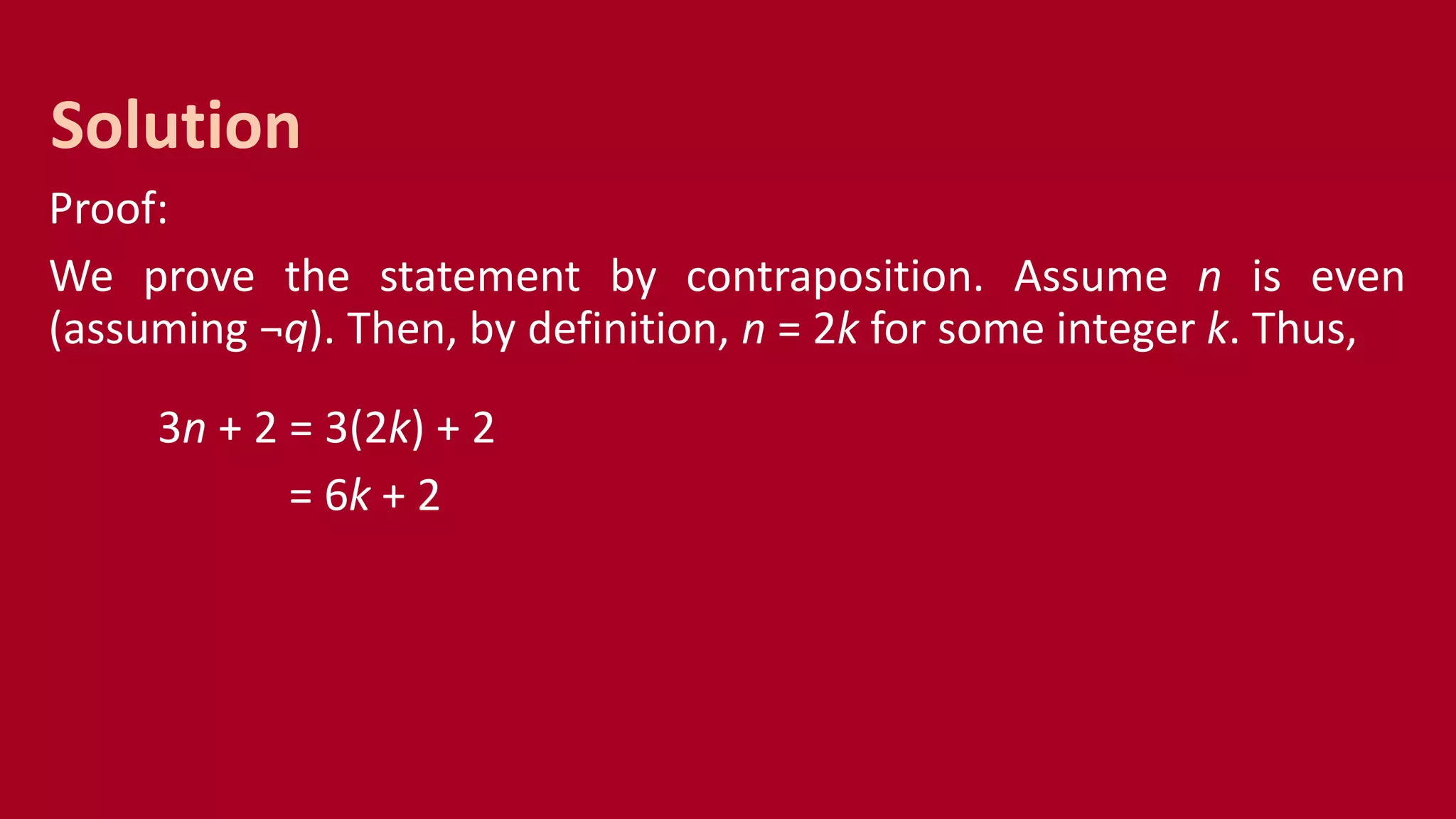
We prove the statement by contraposition. Assume n is even
(assuming ¬q). Then, by definition, n = 2k for some integer k. Thus,
Solution
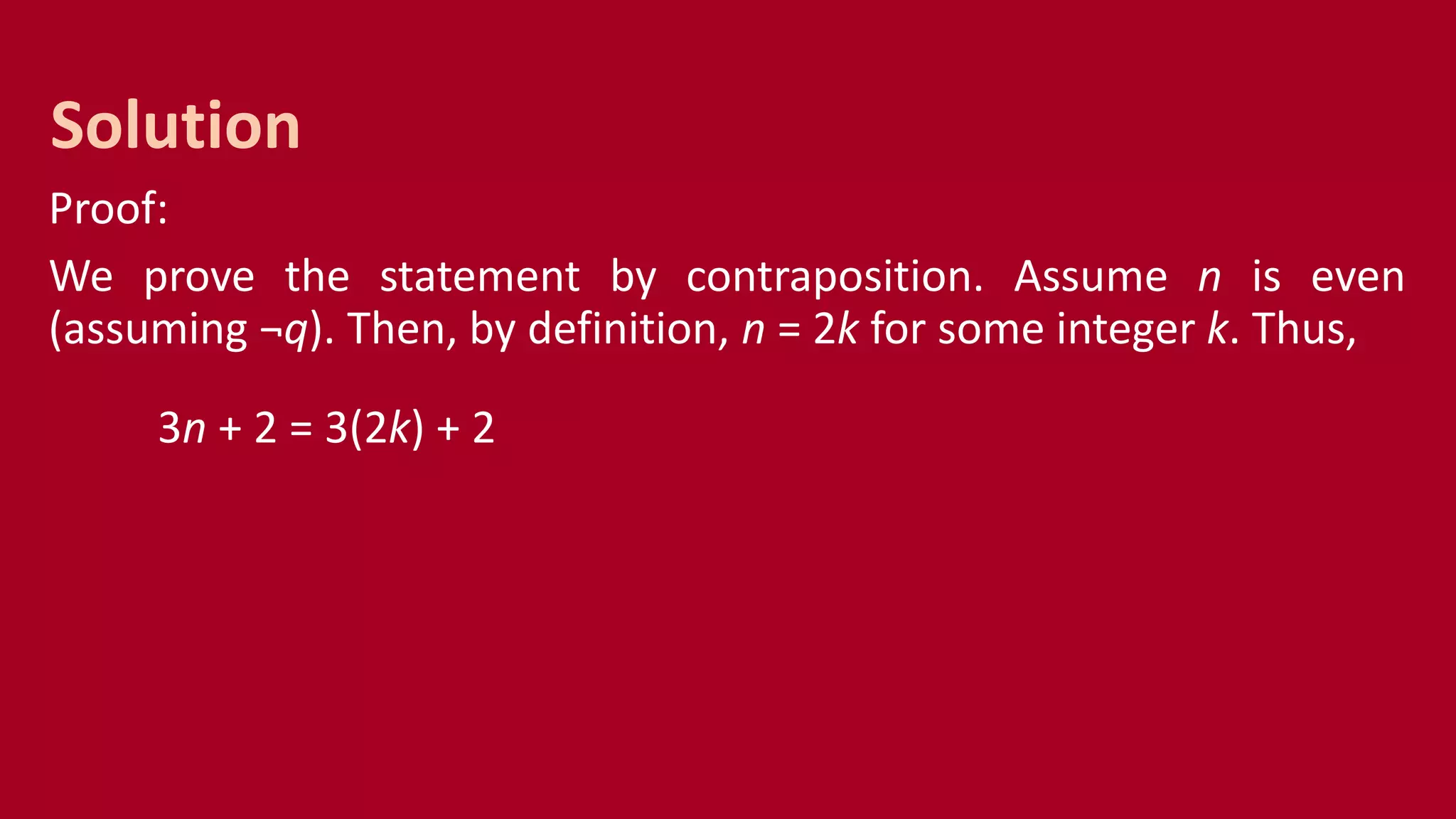
Proof:
We prove the statement by contraposition. Assume n is even
(assuming ¬q). Then, by definition, n = 2k for some integer k. Thus,
3n + 2 = 3(2k) + 2
Solution
Proof:
We prove the statement by contraposition. Assume n is even
(assuming ¬q). Then, by definition, n = 2k for some integer k. Thus,
3n + 2 = 3(2k) + 2
= 6k + 2
Solution
Proof:
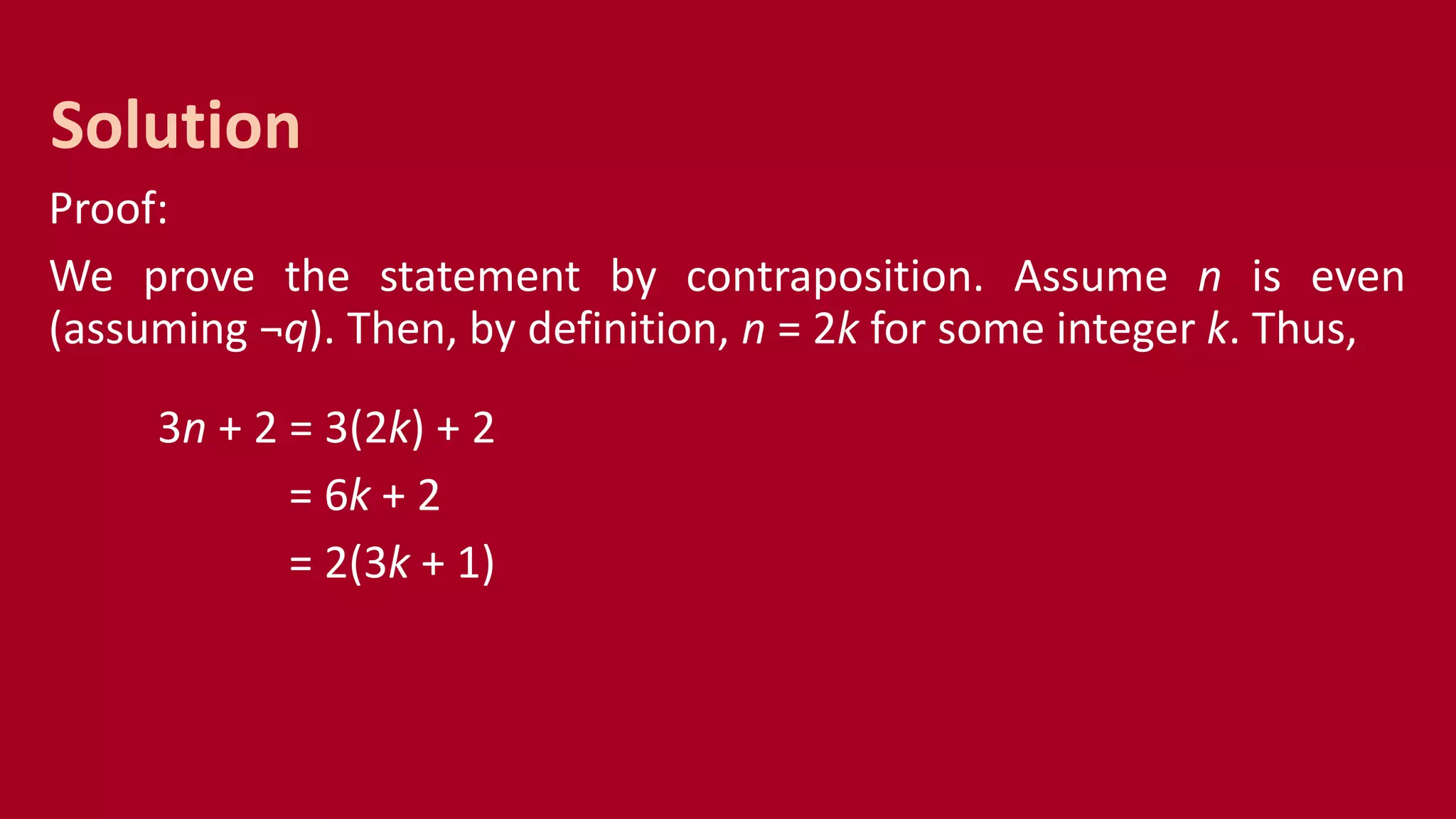
We prove the statement by contraposition. Assume n is even
(assuming ¬q). Then, by definition, n = 2k for some integer k. Thus,
3n + 2 = 3(2k) + 2
= 6k + 2
= 2(3k + 1)
Solution
Proof:
We prove the statement by contraposition. Assume n is even
(assuming ¬q). Then, by definition, n = 2k for some integer k. Thus,
3n + 2 = 3(2k) + 2
= 6k + 2
= 2(3k + 1)
We have that 3n + 2 = k’ where k’ = 3k + 1, which means 3n + 2 is an
even number. This is the negation of the hypothesis of the theorem
(¬p), which concludes our proof by contraposition.
Solution
Definition 2
A real number r is rational if there exists integers p and q with q ≠ 0
such that r = p/q. A real number that is not rational is called
irrational.
Proof by Contraposition
Prove that the sum of two rational numbers is rational.
Note: if we include the implicit quantifiers here, the theorem we
want to prove is
“For every real number r and every real number s,
if r and s are rational numbers, then r + s is rational.”
Example
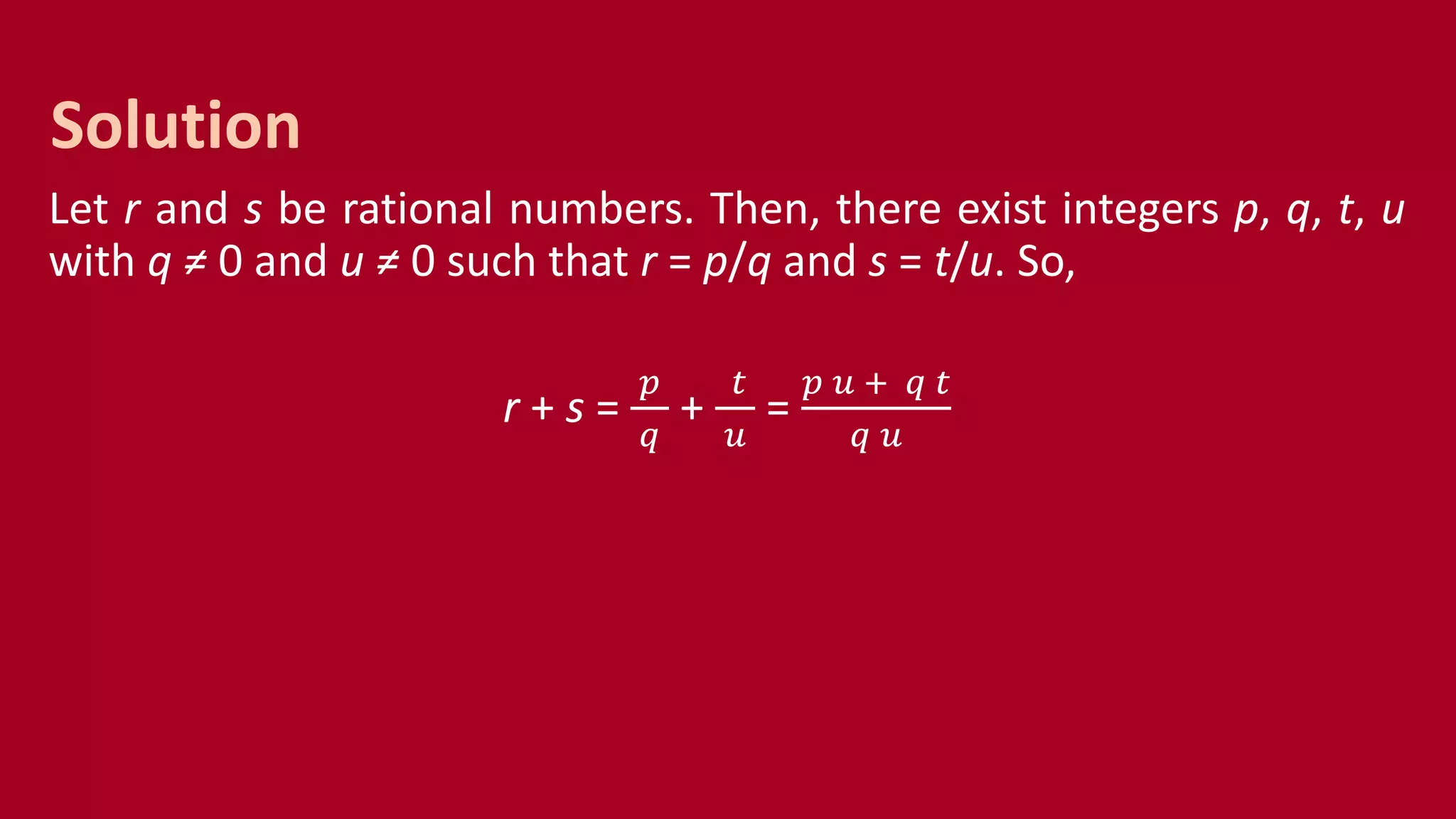
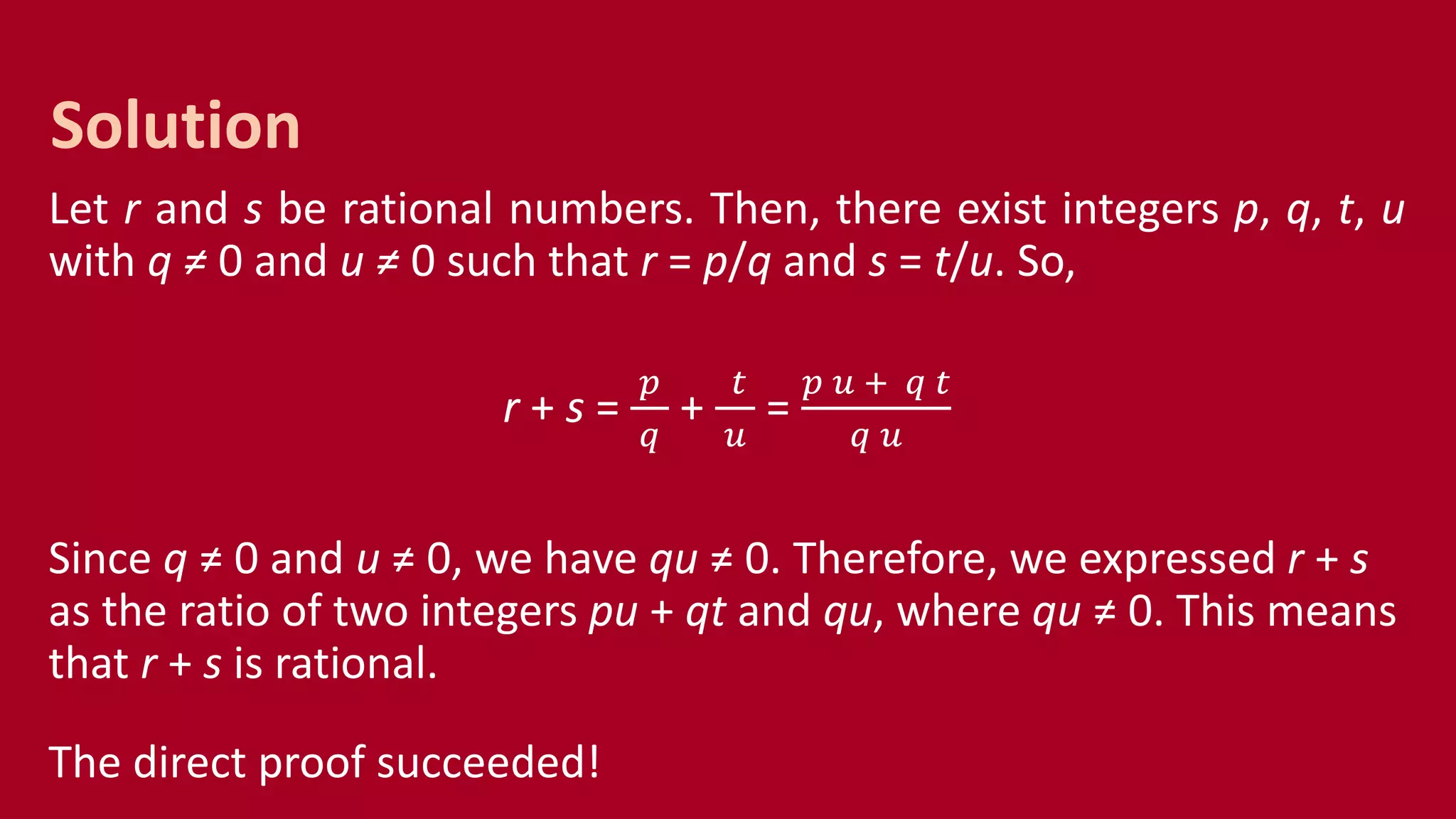
Let r and s be rational numbers. Then, there exist integers p, q, t, u
with q ≠ 0 and u ≠ 0 such that r = p/q and s = t/u. So,
Solution
Let r and s be rational numbers. Then, there exist integers p, q, t, u
with q ≠ 0 and u ≠ 0 such that r = p/q and s = t/u. So,
r + s =
𝑝
𝑞
+
𝑡
𝑢
=
𝑝 𝑢 + 𝑞 𝑡
𝑞 𝑢
Solution
Let r and s be rational numbers. Then, there exist integers p, q, t, u
with q ≠ 0 and u ≠ 0 such that r = p/q and s = t/u. So,
r + s =
𝑝
𝑞
+
𝑡
𝑢
=
𝑝 𝑢 + 𝑞 𝑡
𝑞 𝑢
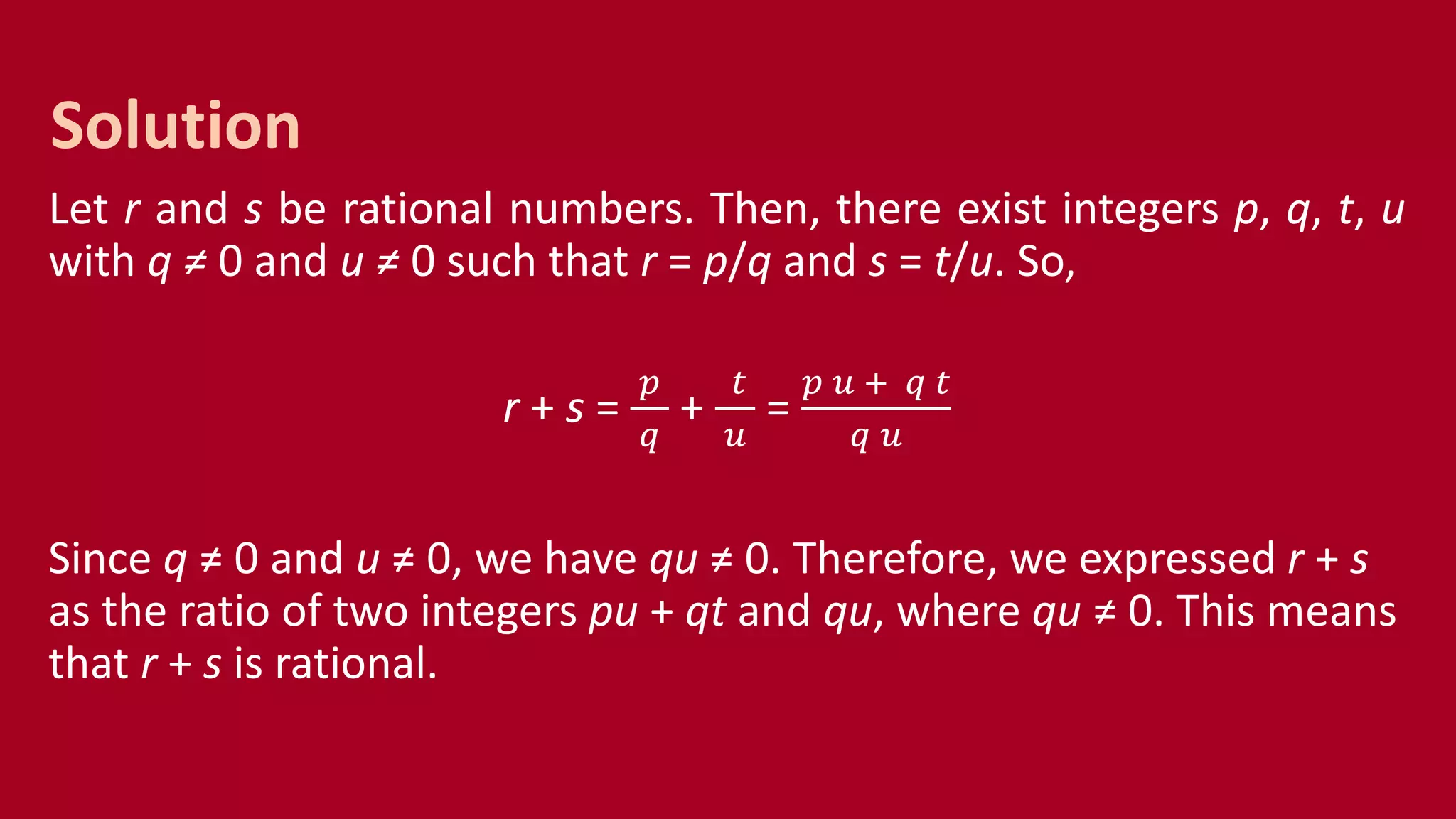
Since q ≠ 0 and u ≠ 0, we have qu ≠ 0. Therefore, we expressed r + s
as the ratio of two integers pu + qt and qu, where qu ≠ 0. This means
that r + s is rational.
Solution
Let r and s be rational numbers. Then, there exist integers p, q, t, u
with q ≠ 0 and u ≠ 0 such that r = p/q and s = t/u. So,
r + s =
𝑝
𝑞
+
𝑡
𝑢
=
𝑝 𝑢 + 𝑞 𝑡
𝑞 𝑢
Since q ≠ 0 and u ≠ 0, we have qu ≠ 0. Therefore, we expressed r + s
as the ratio of two integers pu + qt and qu, where qu ≠ 0. This means
that r + s is rational.
The direct proof succeeded!
Solution
Prove that for any integer number n, if n2 is odd, then n is odd.
Example
Prove that for any integer number n, if n2 is odd, then n is odd.
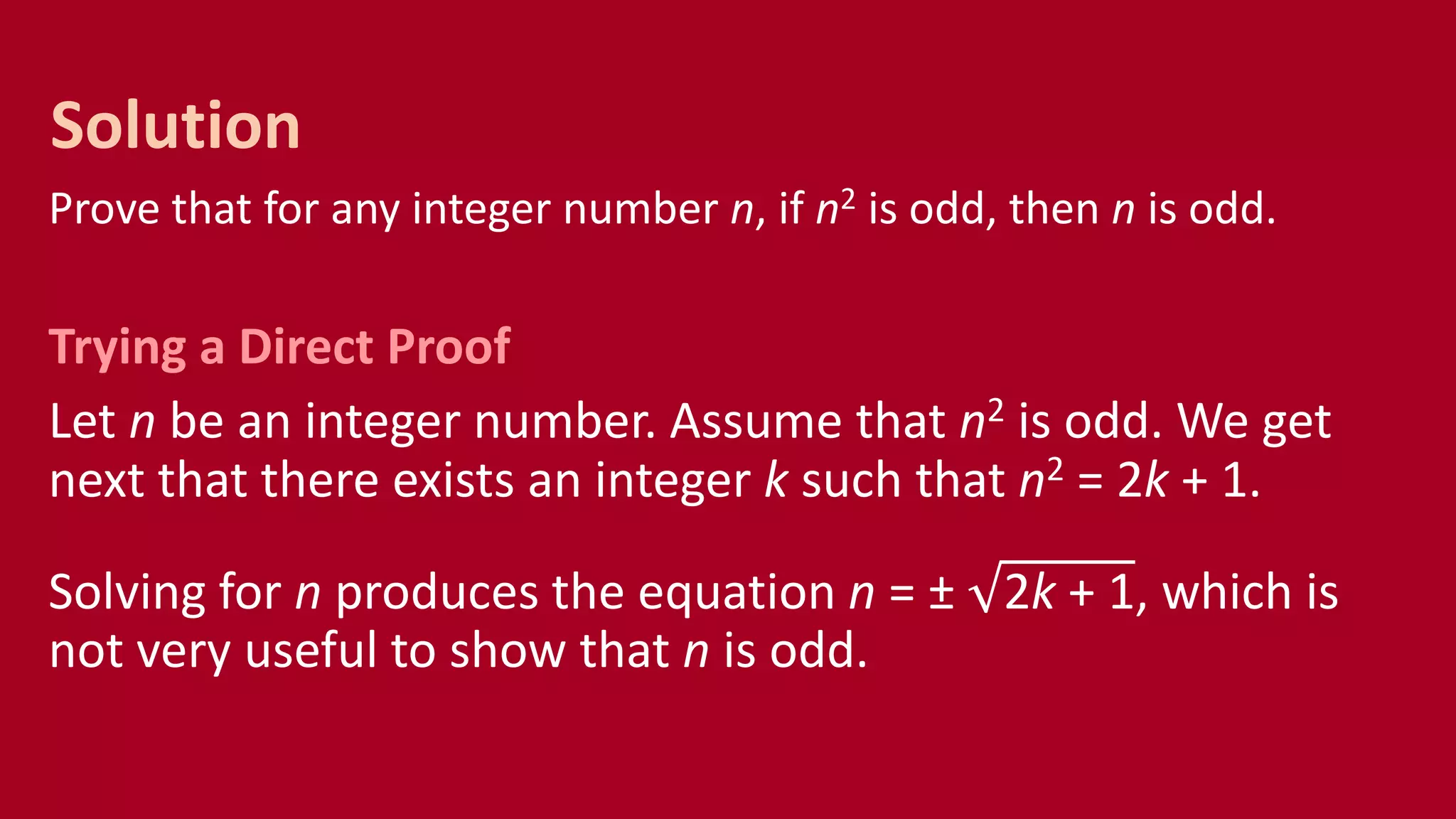
Trying a Direct Proof
Let n be an integer number. Assume that n2 is odd. We get
next that there exists an integer k such that n2 = 2k + 1.
Solving for n produces the equation n = ± 2k + 1, which is
not very useful to show that n is odd.
Solution
Prove that for any integer number n, if n2 is odd, then n is odd.
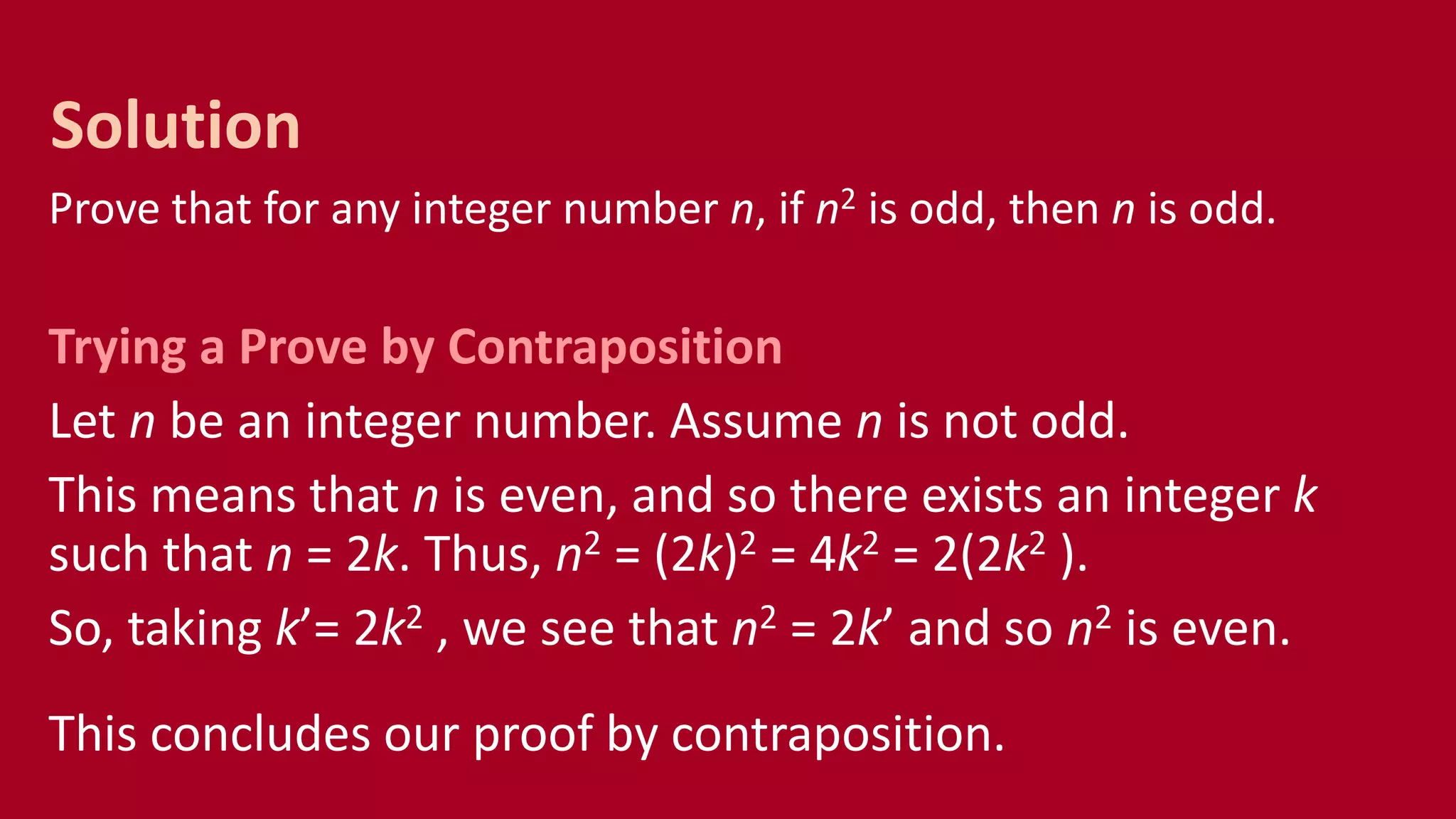
Trying a Prove by Contraposition
Let n be an integer number. Assume n is not odd.
This means that n is even, and so there exists an integer k
such that n = 2k. Thus, n2 = (2k)2 = 4k2 = 2(2k2 ).
So, taking k’= 2k2 , we see that n2 = 2k’ and so n2 is even.
This concludes our proof by contraposition.
Solution
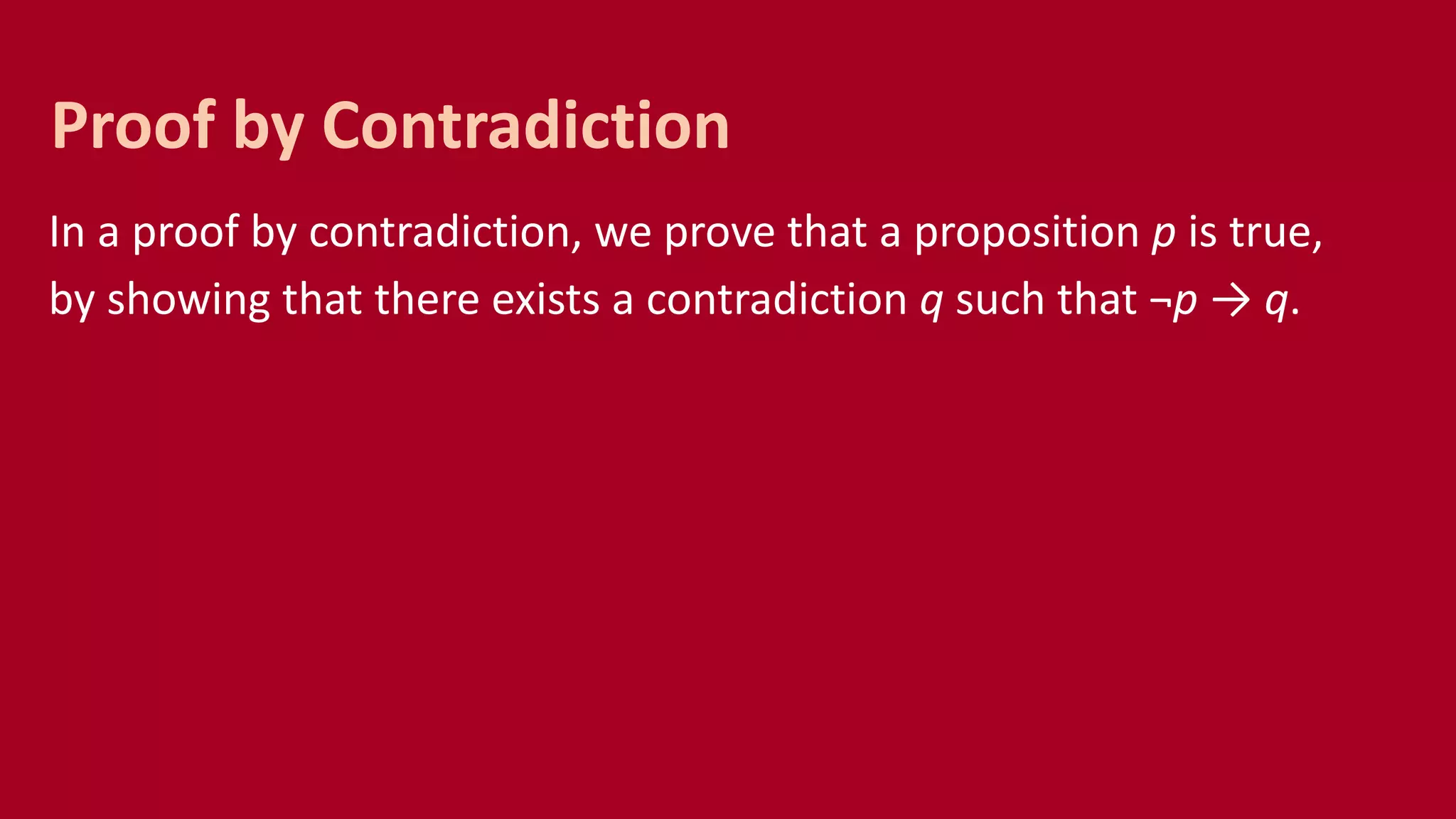
In a proof by contradiction, we prove that a proposition p is true,
by showing that there exists a contradiction q such that ¬p → q.
Proof by Contradiction
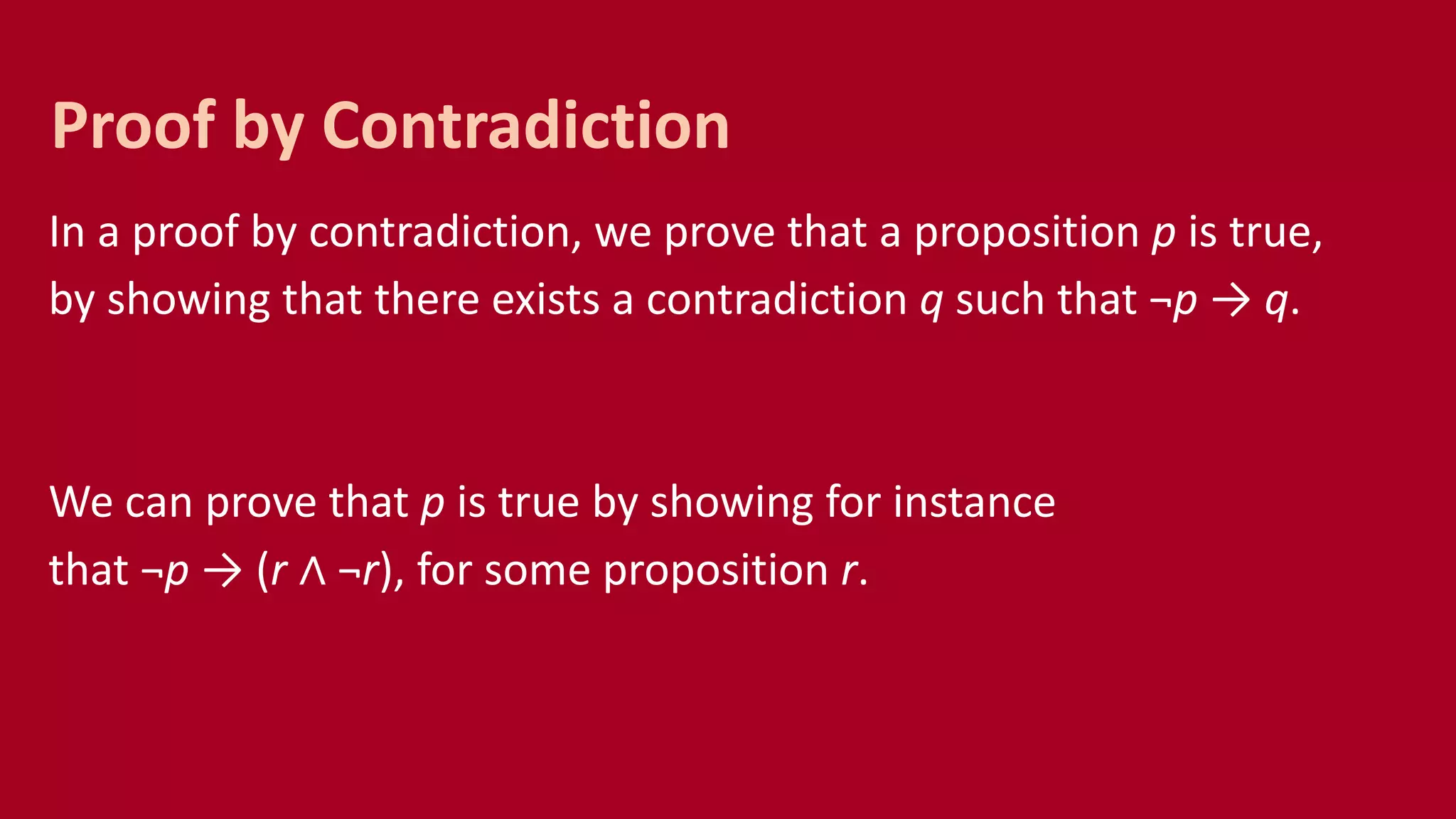
In a proof by contradiction, we prove that a proposition p is true,
by showing that there exists a contradiction q such that ¬p → q.
We can prove that p is true by showing for instance
that ¬p → (r ∧ ¬r), for some proposition r.
Proof by Contradiction
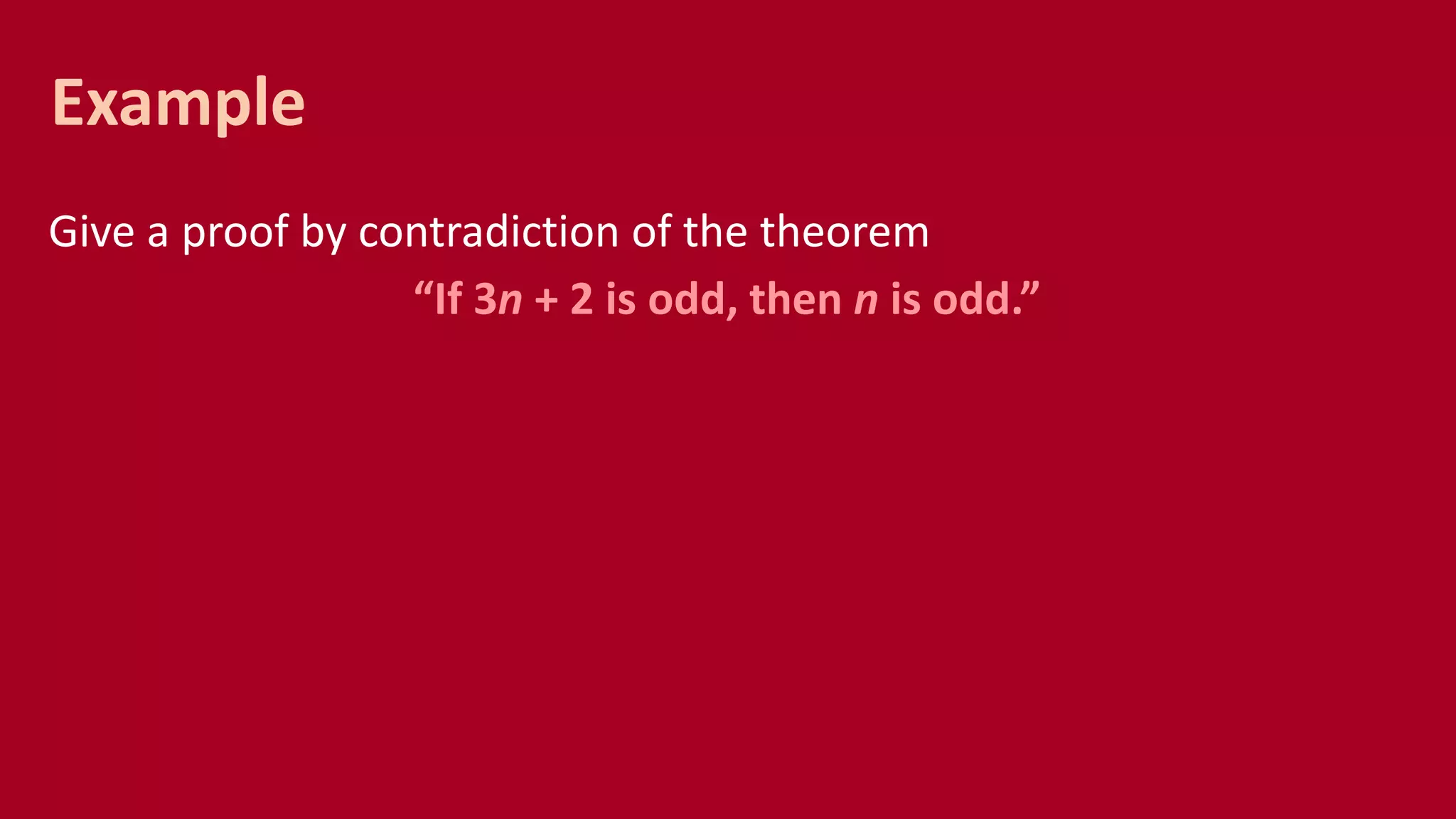
Give a proof by contradiction of the theorem
“If 3n + 2 is odd, then n is odd.”
Example
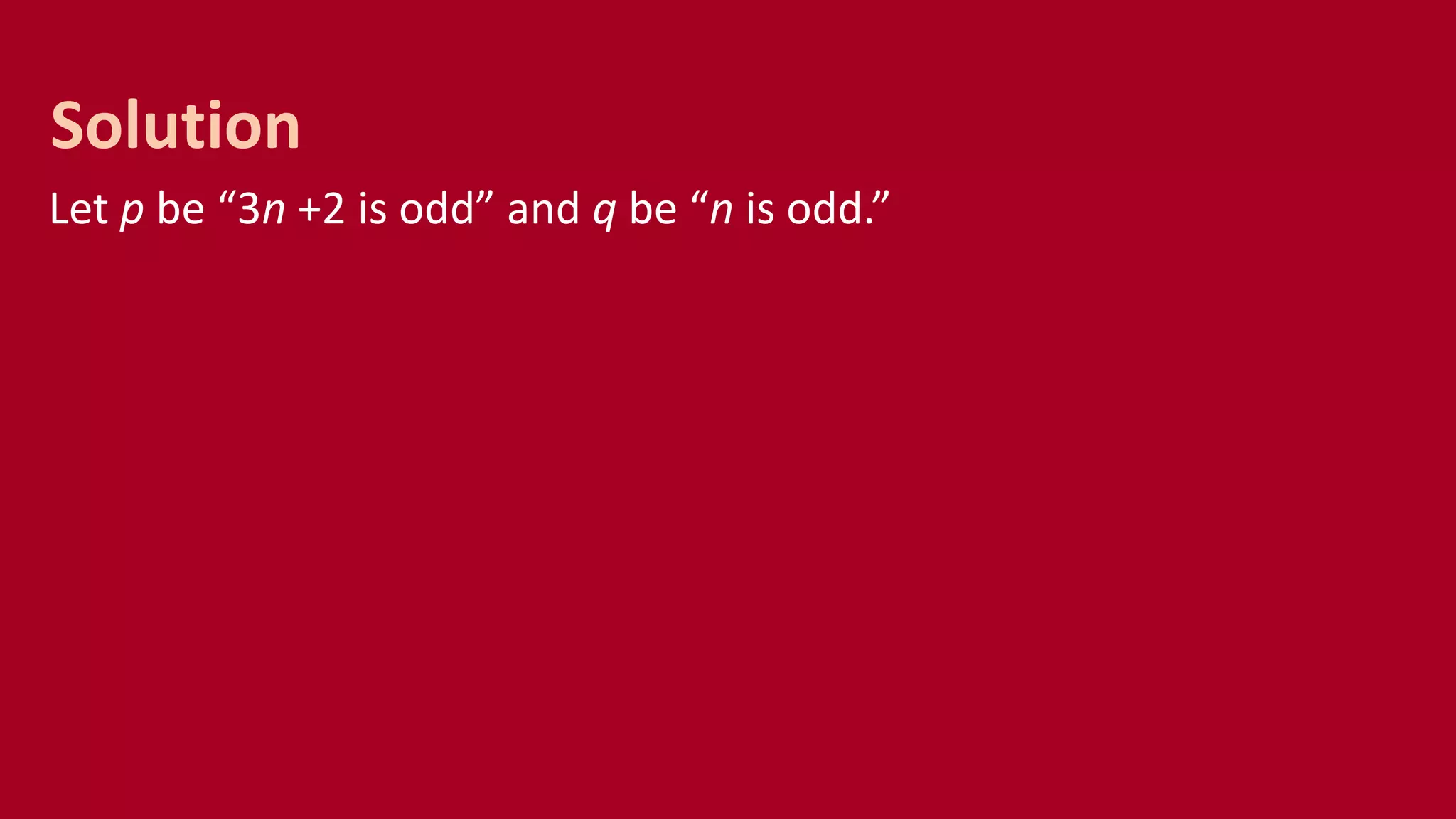
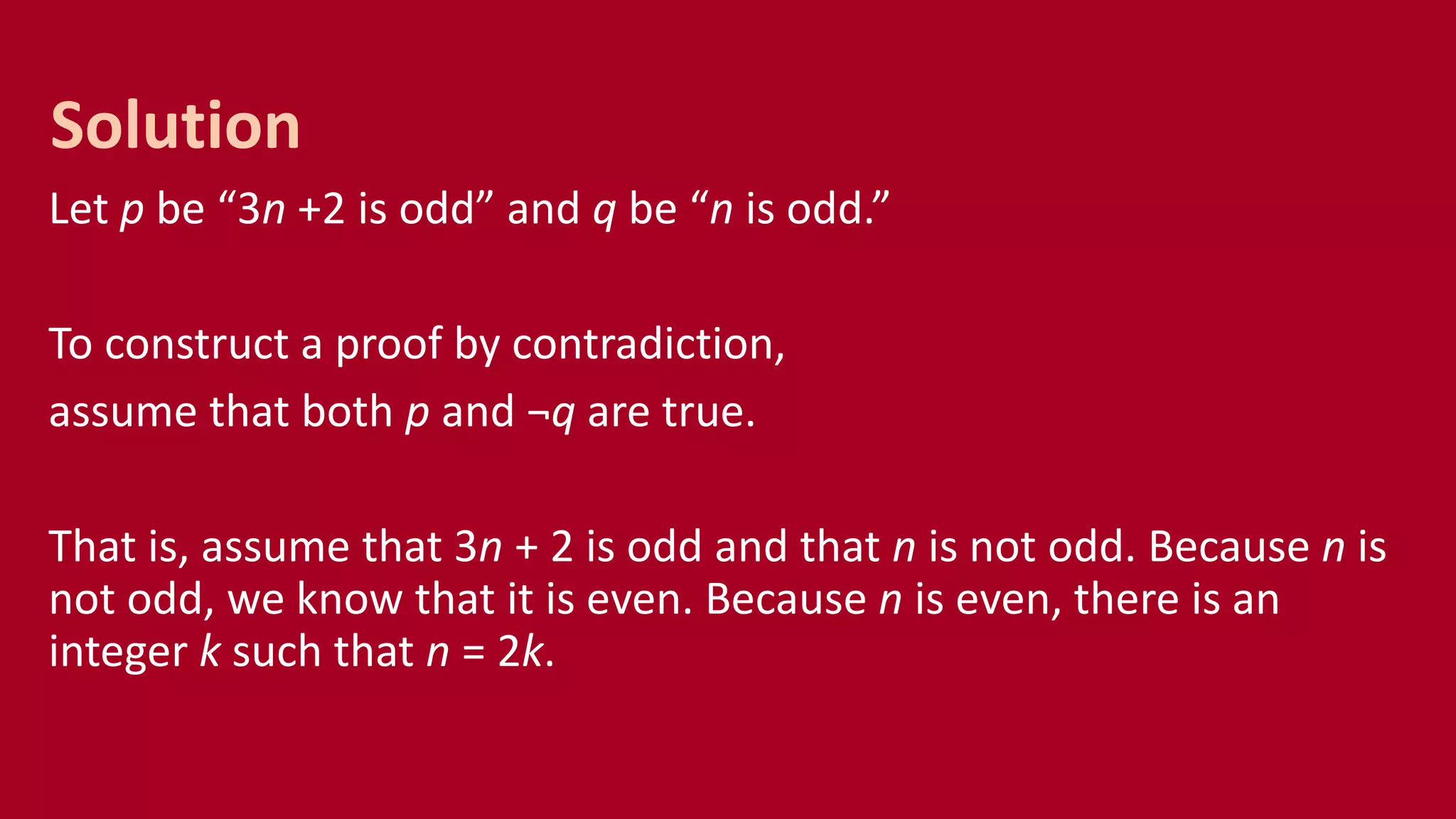
Let p be “3n +2 is odd” and q be “n is odd.”
Solution
Let p be “3n +2 is odd” and q be “n is odd.”
To construct a proof by contradiction,
assume that both p and ¬q are true.
Solution
Let p be “3n +2 is odd” and q be “n is odd.”
To construct a proof by contradiction,
assume that both p and ¬q are true.
That is, assume that 3n + 2 is odd and that n is not odd. Because n is
not odd, we know that it is even. Because n is even, there is an
integer k such that n = 2k.
Solution
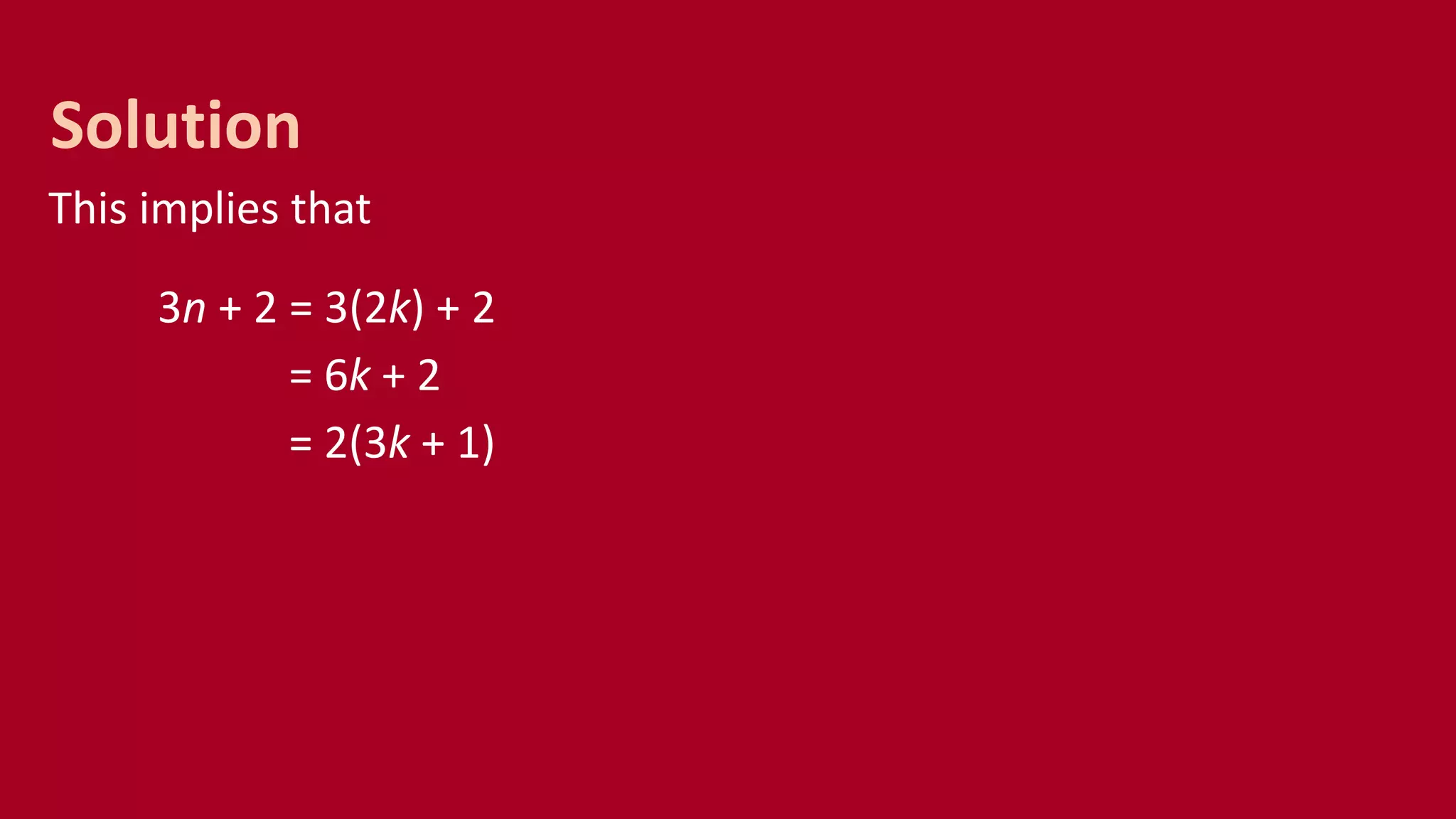
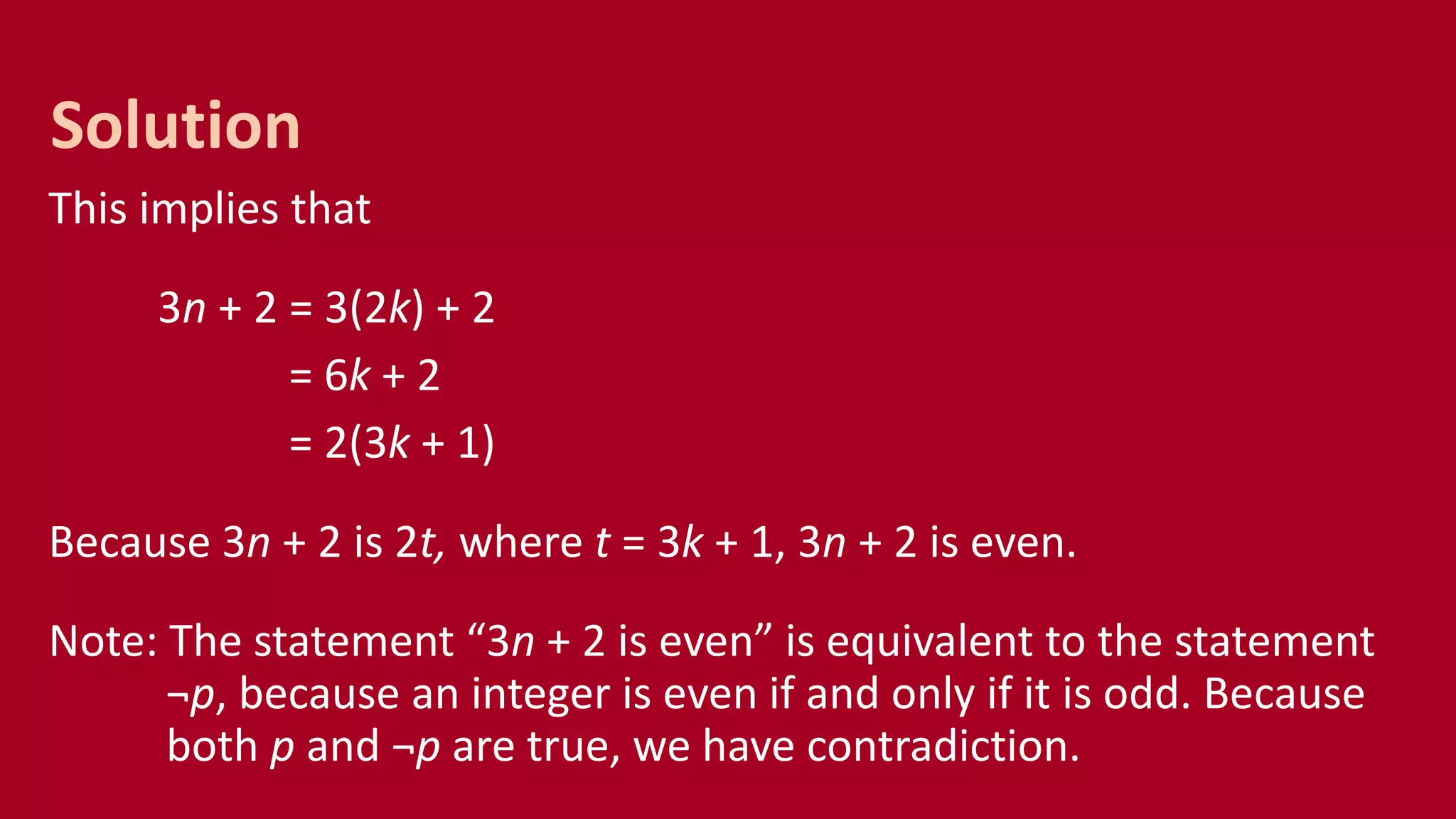
This implies that
3n + 2 = 3(2k) + 2
= 6k + 2
= 2(3k + 1)
Solution
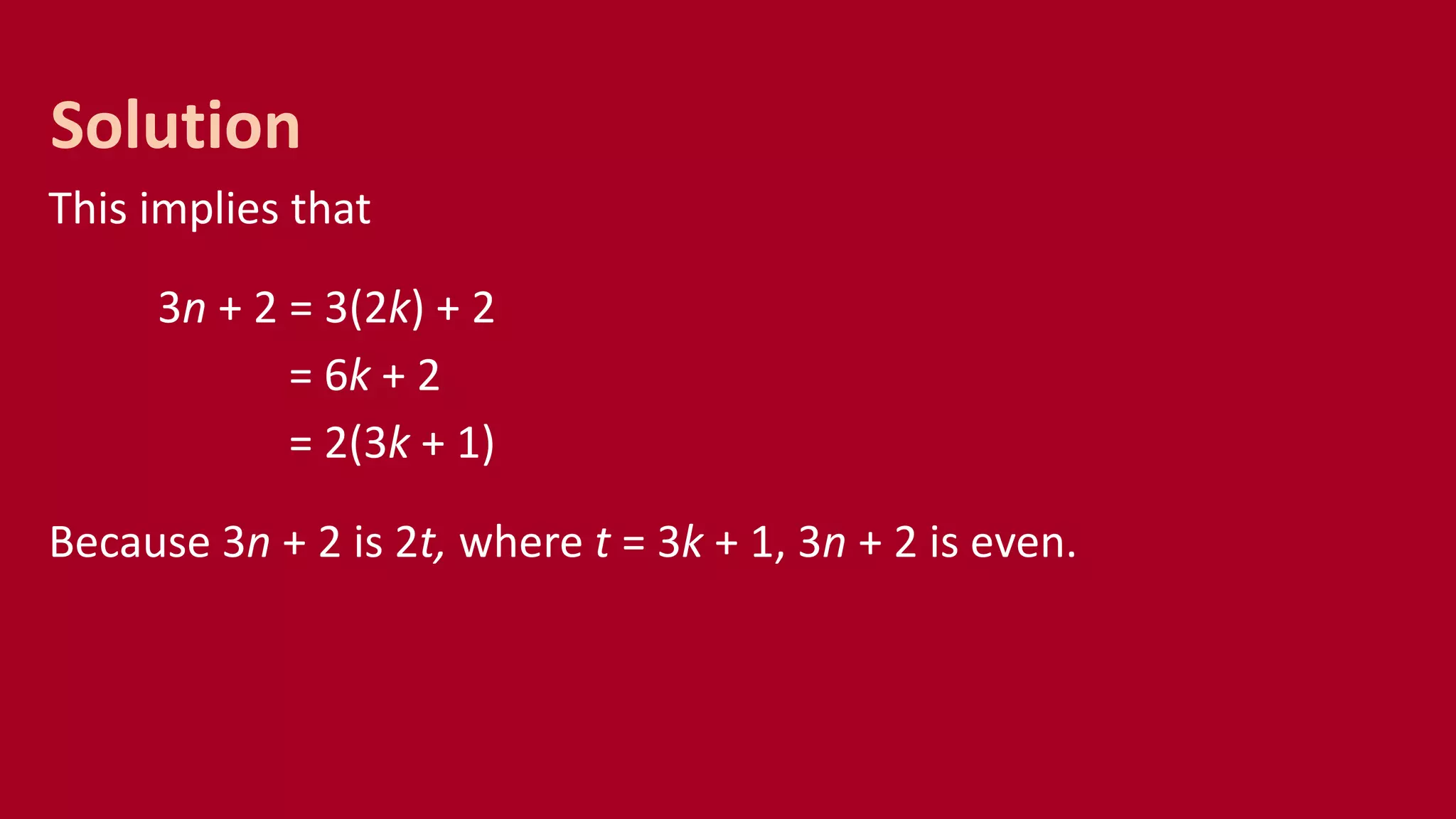
This implies that
3n + 2 = 3(2k) + 2
= 6k + 2
= 2(3k + 1)
Because 3n + 2 is 2t, where t = 3k + 1, 3n + 2 is even.
Solution
This implies that
3n + 2 = 3(2k) + 2
= 6k + 2
= 2(3k + 1)
Because 3n + 2 is 2t, where t = 3k + 1, 3n + 2 is even.
Note: The statement “3n + 2 is even” is equivalent to the statement
¬p, because an integer is even if and only if it is odd. Because
both p and ¬p are true, we have contradiction.
Solution
Mistakes in Proofs
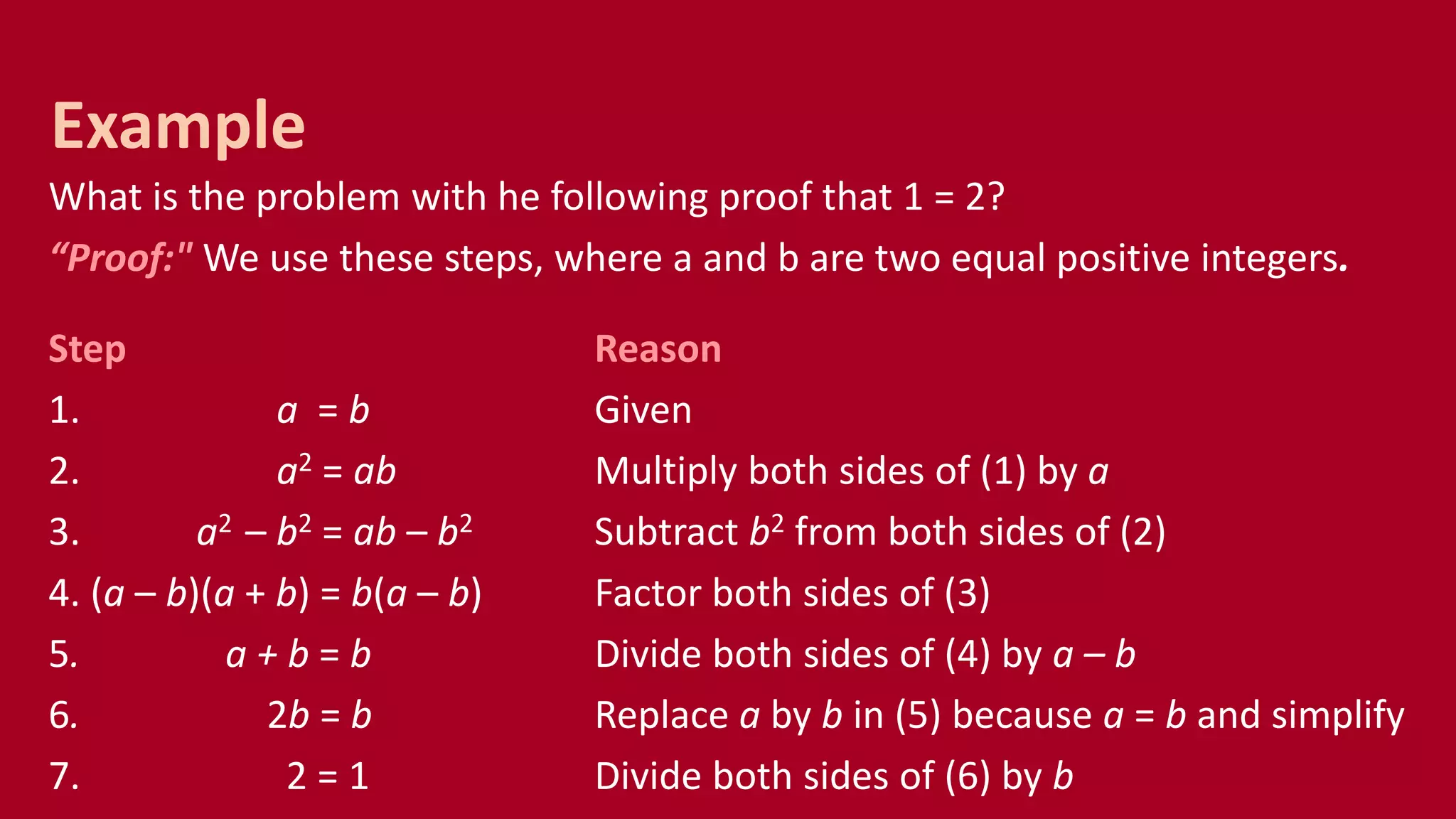
What is the problem with he following proof that 1 = 2?
“Proof:" We use these steps, where a and b are two equal positive integers.
Step Reason
1. a = b Given
2. a2 = ab Multiply both sides of (1) by a
3. a2 – b2 = ab – b2 Subtract b2 from both sides of (2)
4. (a – b)(a + b) = b(a – b) Factor both sides of (3)
5. a + b = b Divide both sides of (4) by a – b
6. 2b = b Replace a by b in (5) because a = b and simplify
7. 2 = 1 Divide both sides of (6) by b
Example
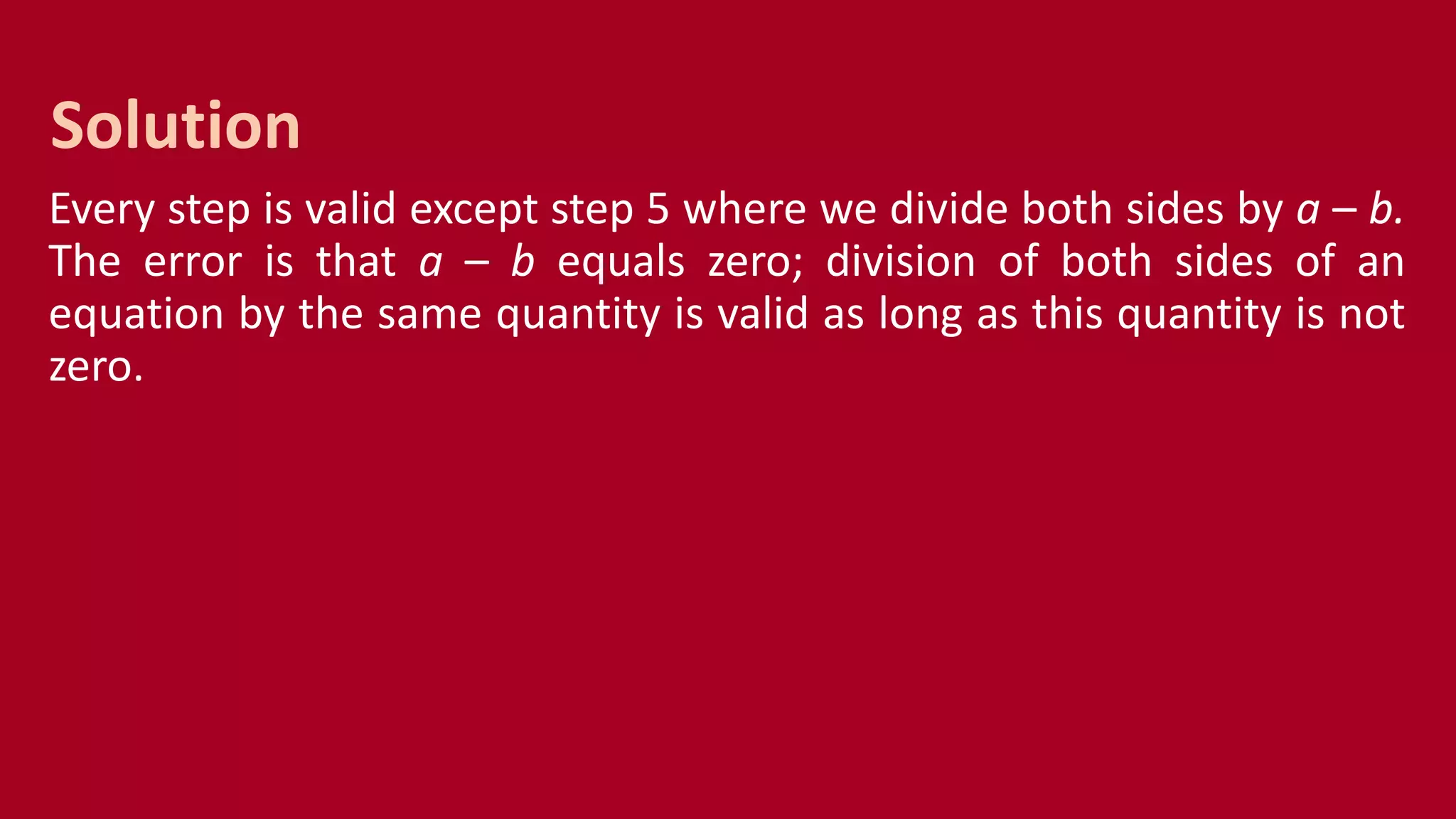
Every step is valid except step 5 where we divide both sides by a – b.
The error is that a – b equals zero; division of both sides of an
equation by the same quantity is valid as long as this quantity is not
zero.
Solution
Any Question?

CMSC 56 | Lecture 5: Proofs Methods and Strategy

  • 1.
    Proofs Methods andStrategy Lecture 5, CMSC 56 Allyn Joy D. Calcaben
  • 2.
    a valid argumentthat establishes the truth of a mathematical statement. can be use the hypothesis of the theorem, if any, axioms assumed to be true, and previously proven theorems. Proof
  • 3.
    a valid argumentthat establishes the truth of a mathematical statement. can be use the hypothesis of the theorem, if any, axioms assumed to be true, and previously proven theorems. Using these ingredients and rules of inference, the proof establishes the truth statement being proved. Proof
  • 4.
    Informal proofs aremore than one inference rule may be used at each step, where steps may be skipped, and where axioms and rules of inference used are not explicitly stated. Proof Methods
  • 5.
  • 6.
    A statement thatcan be shown to be true (sometimes referred to as facts or results). Less important theorems are often called propositions. Theorem
  • 7.
    A less importanttheorem, used as an auxiliary result to prove a more important theorem. Lemma
  • 8.
    A theorem provenas an easy consequence of a theorem. Corollary
  • 9.
    A statement thatis being proposed as a true statement. If later proven, it becomes a theorem, but it may be false. Conjecture
  • 10.
    known as postulates. arestatements that we assume to be true (algebraic axioms specify rules for arithmetic like commutative laws). Axiom
  • 11.
    a valid argumentthat establishes the truth of a theorem. The statements used in a proof include axioms, hypotheses (or premises), and previously proven theorems. Rules of inference, together with definition of terms, are used to draw conclusions from other assertions, tying together the steps of a proof. Proof
  • 12.
  • 13.
    Many theorems assertthat a property holds for all elements in a domain. However, the universal quantifier is often not explicitly stated. Understanding how theorems are stated
  • 14.
    The statement: “If x> y, where x and y are positive real numbers, then x2 > y2.” Example
  • 15.
    The statement: “If x> y, where x and y are positive real numbers, then x2 > y2.” really means “For all positive real numbers x and y, if x > y then x2 > y2.” Example
  • 16.
    The statement: “If x> y, where x and y are positive real numbers, then x2 > y2.” really means “For all positive real numbers x and y, if x > y then x2 > y2.” That is, in formal logic under the domain of positive real numbers this is the same as ∀x∀y((x > y) → (x2 > y2 )). Example
  • 17.
  • 18.
    To prove atheorem of the form ∀x(P(x) → Q(x)), we use the steps: • Take an arbitrary element c of the domain and show that (P(c) → Q(c)) is true. • Apply universal generalization to conclude ∀x(P(x) → Q(x)). (Normally we not even bother with this final step.) Methods of Proving Theorems
  • 19.
    1. Direct Proofs.Assume p is true; the last step establishes q is true. 2. Proof by Contraposition. Uses a direct proof of the contrapositive of p → q, which is ¬q → ¬p. That is, assume ¬q is true; the last step established ¬p is true. 3. Proof by Contradiction. To prove that P is true, we assume ¬P is true and reach a contradiction, that is that (r ∧ ¬r) is true for some proposition r. In particular, to prove (p → q), we assume (p → q) is false, and get as a consequence a contradiction. Assuming that (p → q) is false = (¬p ∨ q) is false = (p ∧ ¬q) is true. Methods of showing statements of the type p → q are true:
  • 20.
    A formal directproof of a conditional statement p → q works as follows: assume p is true, build steps using inference rules, with the final step showing the q is true. Direct Proofs
  • 21.
    A formal directproof of a conditional statement p → q works as follows: assume p is true, build steps using inference rules, with the final step showing the q is true. In a (informal) direct proof, we assume that p is true, and use axioms, definitions and previous theorems, together with rules of inference to show that q must be true. Direct Proofs
  • 22.
    Definition 1 The integern is even if there exists an integer k such that n = 2k, and n is odd if there exists an integer k such that n = 2k + 1. Direct Proofs
  • 23.
    Give a directproof of the Theorem “If n is an odd integer, then n2 is odd.” Example
  • 24.
    Give a directproof of the Theorem “If n is an odd integer, then n2 is odd.” We want to show that ∀n(P(n) → Q(n)), where P(n) is “n is an odd integer” and Q(n) is “n2 is odd”. We show this by proving that for an arbitrary n, P(n) → Q(n), without invoking the universal generalization Solution
  • 25.
    Proof: Let n bean odd integer. By definition of odd, we know that there exists an integer k such that n = 2k + 1. Squaring both sides of the equation, we get Solution
  • 26.
    Proof: Let n bean odd integer. By definition of odd, we know that there exists an integer k such that n = 2k + 1. n2 = (2k + 1)2 Solution
  • 27.
    Proof: Let n bean odd integer. By definition of odd, we know that there exists an integer k such that n = 2k + 1. n2 = (2k + 1)2 = 4k2 + 4k + 1 Solution
  • 28.
    Proof: Let n bean odd integer. By definition of odd, we know that there exists an integer k such that n = 2k + 1. n2 = (2k + 1)2 = 4k2 + 4k + 1 = 2(2k2 + 2k) + 1 Solution
  • 29.
    Proof: Let n bean odd integer. By definition of odd, we know that there exists an integer k such that n = 2k + 1. n2 = (2k + 1)2 = 4k2 + 4k + 1 = 2(2k2 + 2k) + 1 Since n2 = 2k’ + 1, where k’ = 2k2 + 2k, by the definition of the odd we conclude n2 is odd. Solution
  • 30.
    This method ofproof makes use of the equivalence (p → q) ≡ (¬q → ¬p). In a proof by contraposition that p → q, we assume ¬q is true, and using axioms, definitions and previously proven theorems, together with inference rules, we show that ¬p must be true. (It is a direct proof of the contrapositive statement!) Proof by Contraposition
  • 31.
    Prove that “Ifn is an integer and 3n + 2 is odd, then n is odd.” Example
  • 32.
    Proof: We prove thestatement by contraposition. Assume n is even (assuming ¬q). Then, by definition, n = 2k for some integer k. Thus, Solution
  • 33.
    Proof: We prove thestatement by contraposition. Assume n is even (assuming ¬q). Then, by definition, n = 2k for some integer k. Thus, 3n + 2 = 3(2k) + 2 Solution
  • 34.
    Proof: We prove thestatement by contraposition. Assume n is even (assuming ¬q). Then, by definition, n = 2k for some integer k. Thus, 3n + 2 = 3(2k) + 2 = 6k + 2 Solution
  • 35.
    Proof: We prove thestatement by contraposition. Assume n is even (assuming ¬q). Then, by definition, n = 2k for some integer k. Thus, 3n + 2 = 3(2k) + 2 = 6k + 2 = 2(3k + 1) Solution
  • 36.
    Proof: We prove thestatement by contraposition. Assume n is even (assuming ¬q). Then, by definition, n = 2k for some integer k. Thus, 3n + 2 = 3(2k) + 2 = 6k + 2 = 2(3k + 1) We have that 3n + 2 = k’ where k’ = 3k + 1, which means 3n + 2 is an even number. This is the negation of the hypothesis of the theorem (¬p), which concludes our proof by contraposition. Solution
  • 37.
    Definition 2 A realnumber r is rational if there exists integers p and q with q ≠ 0 such that r = p/q. A real number that is not rational is called irrational. Proof by Contraposition
  • 38.
    Prove that thesum of two rational numbers is rational. Note: if we include the implicit quantifiers here, the theorem we want to prove is “For every real number r and every real number s, if r and s are rational numbers, then r + s is rational.” Example
  • 39.
    Let r ands be rational numbers. Then, there exist integers p, q, t, u with q ≠ 0 and u ≠ 0 such that r = p/q and s = t/u. So, Solution
  • 40.
    Let r ands be rational numbers. Then, there exist integers p, q, t, u with q ≠ 0 and u ≠ 0 such that r = p/q and s = t/u. So, r + s = 𝑝 𝑞 + 𝑡 𝑢 = 𝑝 𝑢 + 𝑞 𝑡 𝑞 𝑢 Solution
  • 41.
    Let r ands be rational numbers. Then, there exist integers p, q, t, u with q ≠ 0 and u ≠ 0 such that r = p/q and s = t/u. So, r + s = 𝑝 𝑞 + 𝑡 𝑢 = 𝑝 𝑢 + 𝑞 𝑡 𝑞 𝑢 Since q ≠ 0 and u ≠ 0, we have qu ≠ 0. Therefore, we expressed r + s as the ratio of two integers pu + qt and qu, where qu ≠ 0. This means that r + s is rational. Solution
  • 42.
    Let r ands be rational numbers. Then, there exist integers p, q, t, u with q ≠ 0 and u ≠ 0 such that r = p/q and s = t/u. So, r + s = 𝑝 𝑞 + 𝑡 𝑢 = 𝑝 𝑢 + 𝑞 𝑡 𝑞 𝑢 Since q ≠ 0 and u ≠ 0, we have qu ≠ 0. Therefore, we expressed r + s as the ratio of two integers pu + qt and qu, where qu ≠ 0. This means that r + s is rational. The direct proof succeeded! Solution
  • 43.
    Prove that forany integer number n, if n2 is odd, then n is odd. Example
  • 44.
    Prove that forany integer number n, if n2 is odd, then n is odd. Trying a Direct Proof Let n be an integer number. Assume that n2 is odd. We get next that there exists an integer k such that n2 = 2k + 1. Solving for n produces the equation n = ± 2k + 1, which is not very useful to show that n is odd. Solution
  • 45.
    Prove that forany integer number n, if n2 is odd, then n is odd. Trying a Prove by Contraposition Let n be an integer number. Assume n is not odd. This means that n is even, and so there exists an integer k such that n = 2k. Thus, n2 = (2k)2 = 4k2 = 2(2k2 ). So, taking k’= 2k2 , we see that n2 = 2k’ and so n2 is even. This concludes our proof by contraposition. Solution
  • 46.
    In a proofby contradiction, we prove that a proposition p is true, by showing that there exists a contradiction q such that ¬p → q. Proof by Contradiction
  • 47.
    In a proofby contradiction, we prove that a proposition p is true, by showing that there exists a contradiction q such that ¬p → q. We can prove that p is true by showing for instance that ¬p → (r ∧ ¬r), for some proposition r. Proof by Contradiction
  • 48.
    Give a proofby contradiction of the theorem “If 3n + 2 is odd, then n is odd.” Example
  • 49.
    Let p be“3n +2 is odd” and q be “n is odd.” Solution
  • 50.
    Let p be“3n +2 is odd” and q be “n is odd.” To construct a proof by contradiction, assume that both p and ¬q are true. Solution
  • 51.
    Let p be“3n +2 is odd” and q be “n is odd.” To construct a proof by contradiction, assume that both p and ¬q are true. That is, assume that 3n + 2 is odd and that n is not odd. Because n is not odd, we know that it is even. Because n is even, there is an integer k such that n = 2k. Solution
  • 52.
    This implies that 3n+ 2 = 3(2k) + 2 = 6k + 2 = 2(3k + 1) Solution
  • 53.
    This implies that 3n+ 2 = 3(2k) + 2 = 6k + 2 = 2(3k + 1) Because 3n + 2 is 2t, where t = 3k + 1, 3n + 2 is even. Solution
  • 54.
    This implies that 3n+ 2 = 3(2k) + 2 = 6k + 2 = 2(3k + 1) Because 3n + 2 is 2t, where t = 3k + 1, 3n + 2 is even. Note: The statement “3n + 2 is even” is equivalent to the statement ¬p, because an integer is even if and only if it is odd. Because both p and ¬p are true, we have contradiction. Solution
  • 55.
  • 56.
    What is theproblem with he following proof that 1 = 2? “Proof:" We use these steps, where a and b are two equal positive integers. Step Reason 1. a = b Given 2. a2 = ab Multiply both sides of (1) by a 3. a2 – b2 = ab – b2 Subtract b2 from both sides of (2) 4. (a – b)(a + b) = b(a – b) Factor both sides of (3) 5. a + b = b Divide both sides of (4) by a – b 6. 2b = b Replace a by b in (5) because a = b and simplify 7. 2 = 1 Divide both sides of (6) by b Example
  • 57.
    Every step isvalid except step 5 where we divide both sides by a – b. The error is that a – b equals zero; division of both sides of an equation by the same quantity is valid as long as this quantity is not zero. Solution
  • 58.

Editor's Notes

  • #3 In English, what is predicate?
  • #4 In English, what is predicate?
  • #5 In English, what is predicate?
  • #7 In English, what is predicate?
  • #8 In English, what is predicate?
  • #9 In English, what is predicate?
  • #10 In English, what is predicate?
  • #11 In English, what is predicate?
  • #12 In English, what is predicate?
  • #14 In English, what is predicate?
  • #15 In English, what is predicate?
  • #17 In English, what is predicate?
  • #19 In English, what is predicate?
  • #20 In English, what is predicate?
  • #21 In English, what is predicate?
  • #22 In English, what is predicate?
  • #23 In English, what is predicate?
  • #24 In English, what is predicate?
  • #25 In English, what is predicate?
  • #26 In English, what is predicate?
  • #27 In English, what is predicate?
  • #28 In English, what is predicate?
  • #29 In English, what is predicate?
  • #30 In English, what is predicate?
  • #31 In English, what is predicate?
  • #32 In English, what is predicate?
  • #33 In English, what is predicate?
  • #34 In English, what is predicate?
  • #35 In English, what is predicate?
  • #36 In English, what is predicate?
  • #37 In English, what is predicate?
  • #38 In English, what is predicate?
  • #39 In English, what is predicate?
  • #40 In English, what is predicate?
  • #41 In English, what is predicate?
  • #42 In English, what is predicate?
  • #43 In English, what is predicate?
  • #44 In English, what is predicate?
  • #45 In English, what is predicate?
  • #46 In English, what is predicate?
  • #47 In English, what is predicate?
  • #48 http://www.site.uottawa.ca/~lucia/courses/2101-10/lecturenotes/04InferenceRulesProofMethods.pdf
  • #50 In English, what is predicate?
  • #51 In English, what is predicate?
  • #52 In English, what is predicate?
  • #53 In English, what is predicate?
  • #54 In English, what is predicate?
  • #55 http://www.site.uottawa.ca/~lucia/courses/2101-10/lecturenotes/04InferenceRulesProofMethods.pdf
  • #57 http://www.site.uottawa.ca/~lucia/courses/2101-10/lecturenotes/04InferenceRulesProofMethods.pdf