•Describe periodic trendsin ionization energy, and relate them to the
atomic structures of the elements.
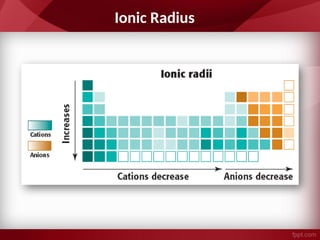
•Describe periodic trends in atomic and ionic radii, and relate them to the
atomic structures of the elements.
•Describe periodic trends in electronegativity, and relate them to the
atomic structures of the elements.
•Describe periodic trends in electron affinity, and relate them to the atomic
structures of the elements.
Periodic Trends
A trendis a predictable change in a particular direction
•Understanding a trend among the elements enables you to
make predictions about the chemical behavior of the elements.
•These trends in properties of the elements in a group or period
can be explained in terms of electron configurations.
Ionization Energy
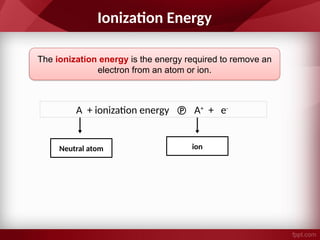
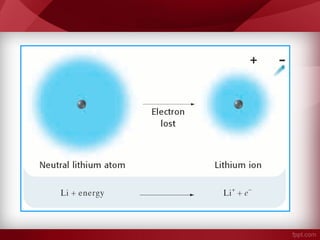
The ionizationenergy is the energy required to remove an
electron from an atom or ion.
A + ionization energy A+
+ e-
Neutral atom ion
9.
Ionization Energy, continued
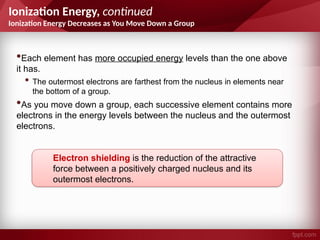
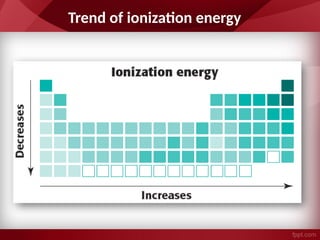
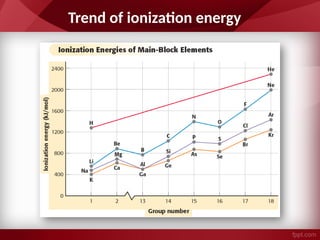
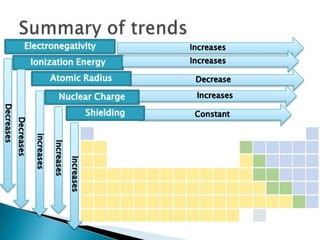
IonizationEnergy Decreases as You Move Down a Group
•Each element has more occupied energy levels than the one above
it has.
• The outermost electrons are farthest from the nucleus in elements near
the bottom of a group.
•As you move down a group, each successive element contains more
electrons in the energy levels between the nucleus and the outermost
electrons.
Electron shielding is the reduction of the attractive
force between a positively charged nucleus and its
outermost electrons.
10.
Ionization Energy, continued
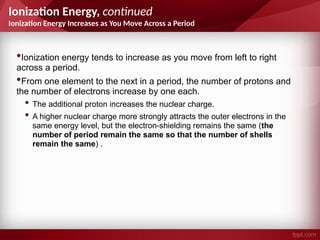
IonizationEnergy Increases as You Move Across a Period
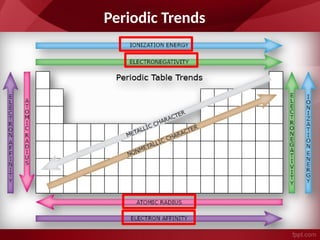
•Ionization energy tends to increase as you move from left to right
across a period.
•From one element to the next in a period, the number of protons and
the number of electrons increase by one each.
• The additional proton increases the nuclear charge.
• A higher nuclear charge more strongly attracts the outer electrons in the
same energy level, but the electron-shielding remains the same (the
number of period remain the same so that the number of shells
remain the same) .
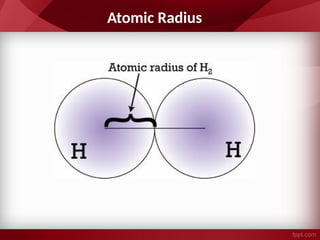
•As you proceedfrom one element down to the next in a group,
another principal energy level is filled.
•The addition of another level of electrons increases the size, or
atomic radius, of an atom.
Atomic Radius, continued
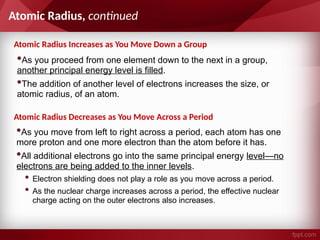
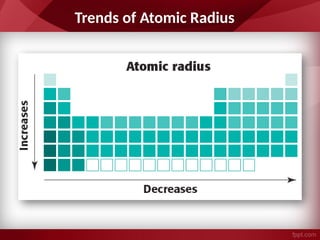
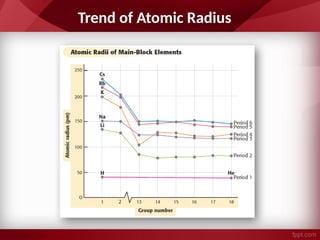
Atomic Radius Increases as You Move Down a Group
Atomic Radius Decreases as You Move Across a Period
•As you move from left to right across a period, each atom has one
more proton and one more electron than the atom before it has.
•All additional electrons go into the same principal energy level—no
electrons are being added to the inner levels.
• Electron shielding does not play a role as you move across a period.
• As the nuclear charge increases across a period, the effective nuclear
charge acting on the outer electrons also increases.
Electronegativity
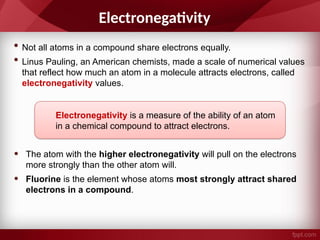
• Not allatoms in a compound share electrons equally.
• Linus Pauling, an American chemists, made a scale of numerical values
that reflect how much an atom in a molecule attracts electrons, called
electronegativity values.
• The atom with the higher electronegativity will pull on the electrons
more strongly than the other atom will.
• Fluorine is the element whose atoms most strongly attract shared
electrons in a compound.
Electronegativity is a measure of the ability of an atom
in a chemical compound to attract electrons.
19.
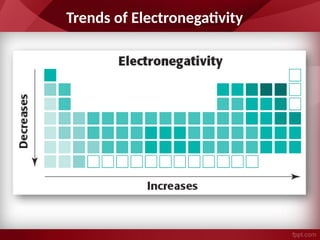
• Electronegativity valuesgenerally decrease as you move down a group.
• The more protons an atom has, the more strongly it should attract an electron.
• However, electron shielding plays a role again.
Electronegativity, continued
Electronegativity Decreases as You Move Down a Group
20.
Electronegativity Increases asYou Move Across a Period
Electronegativity, continued
• Electronegativity usually increases as you move left to right across a
period.
• As you proceed across a period, each atom has one more proton and
one more electron—in the same principal energy level—than the atom
before it has.
• Electron shielding does not change as you move across a period
because no electrons are being added to the inner levels.
• The effective nuclear charge increases across a period.
• As this increases, electrons are attracted much more strongly, resulting in an
increase in electronegativity.
Electron Affinity
Electron Affinityis the energy change that occurs when
a neutral atom gains an electron.
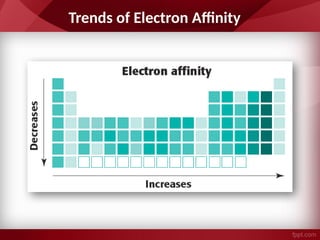
• The electron affinity tends to decrease as you move
down a group because of the increasing effect of electron
shielding.
• Electron affinity tends to increase as you move across
a period because of the increasing nuclear charge.