Periodic Trends
Mrs. Landgraf
Honors Chemistry
Development of the
Periodic Table
 Mendeleev developed periodic table
to group elements in terms of chemical
properties.
 Blank spots where elements should be
were observed.
 Periodic law = elements arranged by
atomic number gives physical and
chemical properties varying
periodically.
Part I – Atomic Size
Atomic Radius
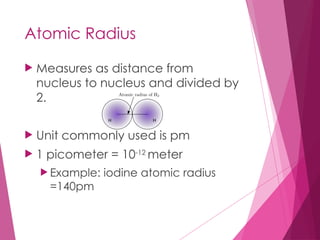
 Measures as distance from
nucleus to nucleus and divided by
2.
 Unit commonly used is pm
 1 picometer = 10-12
meter
 Example: iodine atomic radius
=140pm
How does atomic radius
change across a period?
 It is smaller to the right.
 Why?
 More protons in the nucleus
higher electrical force pulls
electrons closer to nucleus.
How does atomic radius
change down a group?
 It is larger down the group.
 Why?
 Valence electrons are at higher
energy levels and are not bound as
tightly to the nucleus because they are
screened or shielded ( pushed away)
by other electrons in inner levels.
Note
 There are some exceptions.
Example column 13.
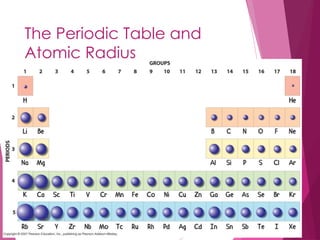
The Periodic Table and
Atomic Radius
Example:
Which is larger: a lithium atom or a
fluorine atom?
A lithium atom
Example:
 Which is larger: an arsenic atom
or a sulfur atom?
 An arsenic atom
Ion
 Positive ion - removal of
electron
 Negative ion - addition of
electron
Ionic size
 Metallic elements easily lose
electrons.
 Non-metals more readily gain
electrons.
How does losing or gaining an
electron effect the size of the
atom (ion) ?
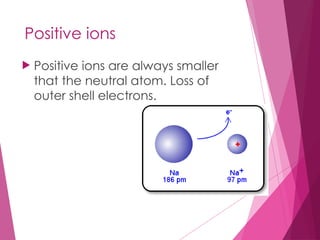
Positive ions
 Positive ions are always smaller
that the neutral atom. Loss of
outer shell electrons.
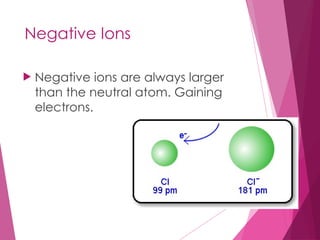
Negative Ions
 Negative ions are always larger
than the neutral atom. Gaining
electrons.
Ion size trends in periods.
 Going from left to right there is a
decrease in size of positive ions.
 Starting with group 5, there is
sharp increase followed by a
decrease in the size of the anion
as you move from left to right.
Ion size trends in columns.
 Ion size increases as you move
down a column for both positive
and negative ions
Part II – Ionization Energy
Ionization energy
 Ionization energy is the amount
of energy needed to remove an
electron from a gaseous atom.
First ionization energy – 1+
Second ionization energy – 2+
How does ionization energy
change down a group?
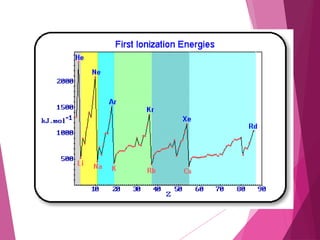
 The first ionization energy
decreases as you move down a
group.
 Why?
The size of the atom increases.
Electron is further from the
nucleus.
How does ionization energy
change across a period?
 The first ionization energy
increases as you move from left
to right across a period.
 Why?
Nuclear charge increases while
shielding is constant.
Attraction of the electron to
the nucleus increases.
Part III – Electronegativity
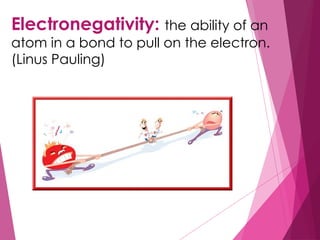
Electronegativity: the ability of an
atom in a bond to pull on the electron.
(Linus Pauling)
Electronegativity
 When electrons are shared by two atoms
a covalent bond is formed.
 When the atoms are the same they pull
on the electrons equally. Example, H-H.
 When the atoms are different, the atoms
pull on the electrons unevenly. Example,
HCl
Trends in Electronegativity
 Electronegativity generally decreases as
you move down a group.
 Electronegativity of the representative
elements (Group A elements) increases as
you move across a period.
Electronegativities of Some
Elements
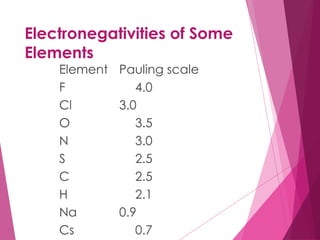
Element Pauling scale
F 4.0
Cl 3.0
O 3.5
N 3.0
S 2.5
C 2.5
H 2.1
Na 0.9
Cs 0.7
Note
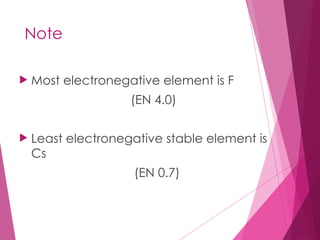
 Most electronegative element is F
(EN 4.0)
 Least electronegative stable element is
Cs
(EN 0.7)
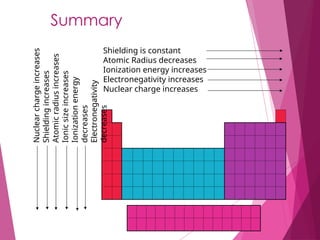
Summary
Shielding is constant
Atomic Radius decreases
Ionization energy increases
Electronegativity increases
Nuclear charge increases
Nuclear
charge
increases
Shielding
increases
Atomic
radius
increases
Ionic
size
increases
Ionization
energy
decreases
Electronegativity
decreases

Periodic Trends from the Periodic Table.

  • 1.
  • 2.
    Development of the PeriodicTable  Mendeleev developed periodic table to group elements in terms of chemical properties.  Blank spots where elements should be were observed.  Periodic law = elements arranged by atomic number gives physical and chemical properties varying periodically.
  • 3.
    Part I –Atomic Size
  • 4.
    Atomic Radius  Measuresas distance from nucleus to nucleus and divided by 2.  Unit commonly used is pm  1 picometer = 10-12 meter  Example: iodine atomic radius =140pm
  • 5.
    How does atomicradius change across a period?  It is smaller to the right.  Why?  More protons in the nucleus higher electrical force pulls electrons closer to nucleus.
  • 6.
    How does atomicradius change down a group?  It is larger down the group.  Why?  Valence electrons are at higher energy levels and are not bound as tightly to the nucleus because they are screened or shielded ( pushed away) by other electrons in inner levels.
  • 7.
    Note  There aresome exceptions. Example column 13.
  • 8.
    The Periodic Tableand Atomic Radius
  • 9.
    Example: Which is larger:a lithium atom or a fluorine atom? A lithium atom
  • 10.
    Example:  Which islarger: an arsenic atom or a sulfur atom?  An arsenic atom
  • 11.
    Ion  Positive ion- removal of electron  Negative ion - addition of electron
  • 12.
    Ionic size  Metallicelements easily lose electrons.  Non-metals more readily gain electrons. How does losing or gaining an electron effect the size of the atom (ion) ?
  • 13.
    Positive ions  Positiveions are always smaller that the neutral atom. Loss of outer shell electrons.
  • 14.
    Negative Ions  Negativeions are always larger than the neutral atom. Gaining electrons.
  • 15.
    Ion size trendsin periods.  Going from left to right there is a decrease in size of positive ions.  Starting with group 5, there is sharp increase followed by a decrease in the size of the anion as you move from left to right.
  • 16.
    Ion size trendsin columns.  Ion size increases as you move down a column for both positive and negative ions
  • 17.
    Part II –Ionization Energy
  • 18.
    Ionization energy  Ionizationenergy is the amount of energy needed to remove an electron from a gaseous atom. First ionization energy – 1+ Second ionization energy – 2+
  • 19.
    How does ionizationenergy change down a group?  The first ionization energy decreases as you move down a group.  Why? The size of the atom increases. Electron is further from the nucleus.
  • 20.
    How does ionizationenergy change across a period?  The first ionization energy increases as you move from left to right across a period.  Why? Nuclear charge increases while shielding is constant. Attraction of the electron to the nucleus increases.
  • 22.
    Part III –Electronegativity
  • 23.
    Electronegativity: the abilityof an atom in a bond to pull on the electron. (Linus Pauling)
  • 24.
    Electronegativity  When electronsare shared by two atoms a covalent bond is formed.  When the atoms are the same they pull on the electrons equally. Example, H-H.  When the atoms are different, the atoms pull on the electrons unevenly. Example, HCl
  • 25.
    Trends in Electronegativity Electronegativity generally decreases as you move down a group.  Electronegativity of the representative elements (Group A elements) increases as you move across a period.
  • 26.
    Electronegativities of Some Elements ElementPauling scale F 4.0 Cl 3.0 O 3.5 N 3.0 S 2.5 C 2.5 H 2.1 Na 0.9 Cs 0.7
  • 27.
    Note  Most electronegativeelement is F (EN 4.0)  Least electronegative stable element is Cs (EN 0.7)
  • 28.
    Summary Shielding is constant AtomicRadius decreases Ionization energy increases Electronegativity increases Nuclear charge increases Nuclear charge increases Shielding increases Atomic radius increases Ionic size increases Ionization energy decreases Electronegativity decreases