11/05/14 1
11/05/14 2
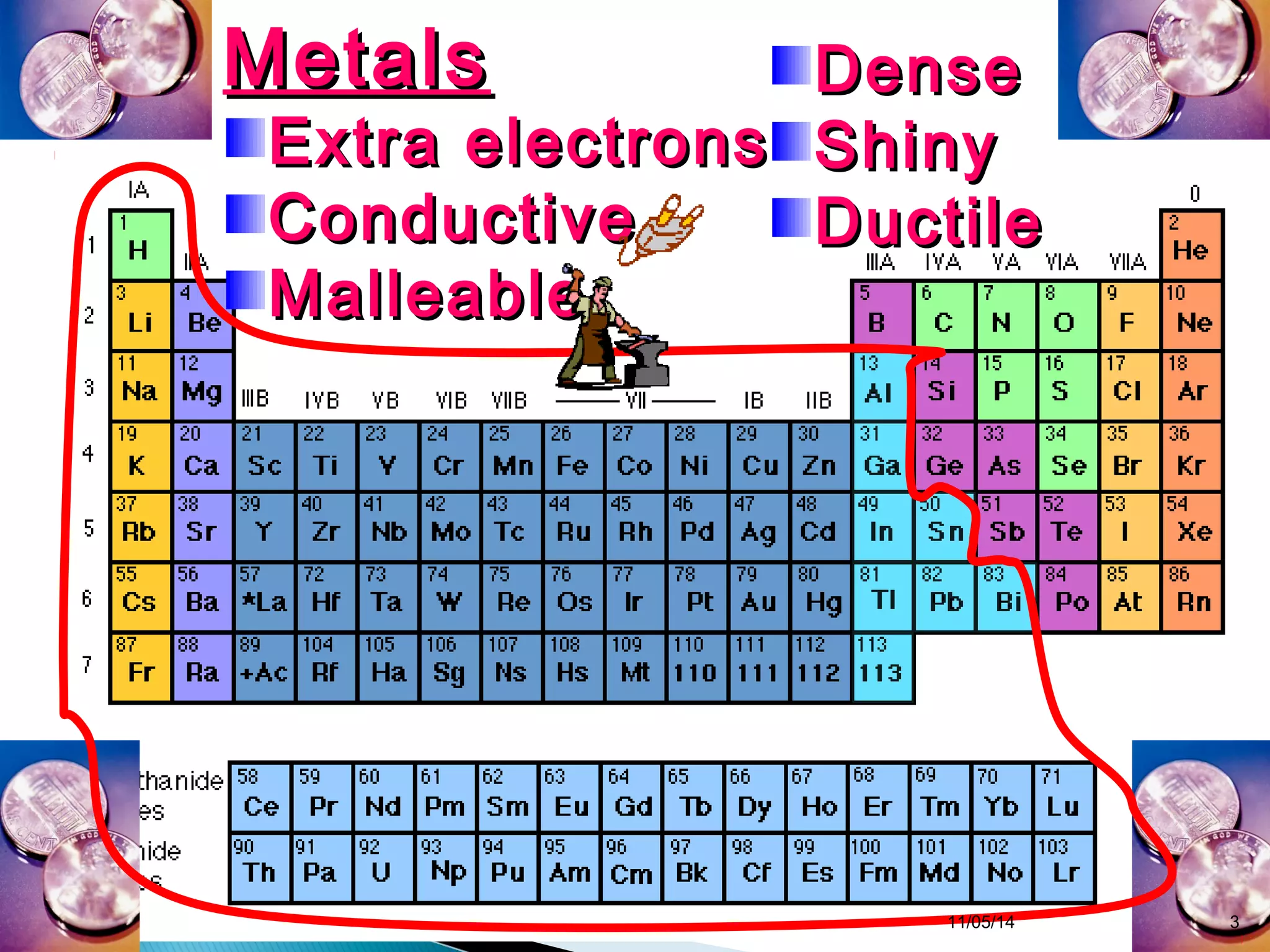
MMeettaallss 
EExxttrraa eelleeccttrroonnss 
CCoonndduuccttiivvee 
MMaalllleeaabbllee 
DDeennssee 
SShhiinnyy 
DDuuccttiillee 
11/05/14 3
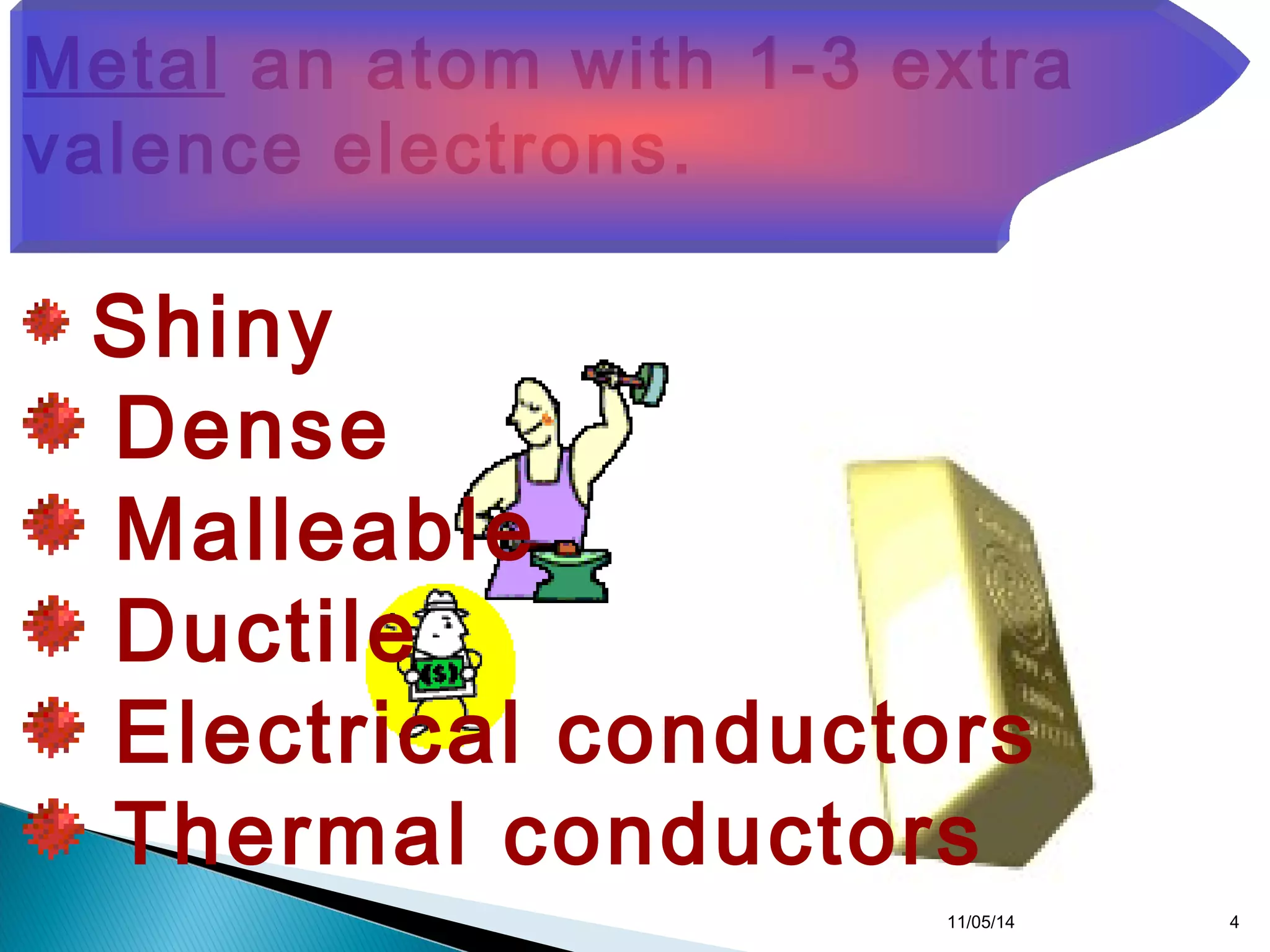
Metal an atom with 1-3 extra 
valence electrons. 
Shiny 
Dense 
Malleable 
Ductile 
Electrical conductors 
Thermal conductors 
11/05/14 4
 In 1817,German scientist named Deboreiner realized 
that there's is a connection between relative atomic 
mass and chemical properties 
 In 1829,he arranged many elements into group of 
three, called Deboreiner’s triads in which the relative 
mass of the middle element about the average of 
masses of the other two. However only few elements 
form the group of three. 
 In 1864, the British scientist called Newlands, 
Arranged elements in order of relative atomic mass 
and gave each one number, Hydrogen the lightest 
element was no. 1, lithium 2, helium was not known at 
that time and so on. 
 He was the first scientist to list elements in numerical 
order. BUT his law didn’t apply after 17 elements 
(Ca). 
11/05/14 5
 In 1869 Mendeleef, a Russian scientist, stated that the 
properties of element are a periodic in function of their 
atomic masses. 
 This periodic law means that if the elements are arranged 
in order of increasing their relative mass, element of similar 
properties appear in regular intervals . This kind of 
repetition is periodic 
 Mendeleef ‘s periodic table was in complete because many 
elements (e.g. noble gases were not known that time. 
 In 1913 an English research student called Moseley. He 
found that atomic number is more important than the 
relative atomic mass and that there is no exceptions in 
periodic table 
11/05/14 6
Periodic Table of an element 
 Is the arrangements of elements in order of their proton numbers, 
Horizontal raw are period and the vertical column are groups 
Characteristics of Periodic Table 
 There are 8 groups and 7 periods 
 Period 1 contain only Hydrogen and Helium. Hydrogen is placed both in 
group one and group 7 because its properties resembles of those of 
alkali metals and halogens 
 Period 2 and 3 (Short periods) contains 8 element each 
 Period 4 and 5 ( Long periods) each contains 18 elements. 8 elements 
of these correspond to the 8 element in the short period. The other 10 
are called transition elements . Which show similar properties before 
them and also some properties similar to those following them. 
 Period 6 and 7 contain 32 and 17 elements 
11/05/14 7
Periodicity of properties of the element. 
 Physical properties. 
 Physical properties of elements in the same group vary gradually and regularly. 
 All group one alkali metals have low densities, low melting point and high 
conductivities. 
 In group 7 halogens, The melting points, boiling points and the densities rise 
regularly. The first member of the group e.g lithium and fluorine is usually 
slightly different form the rest of the group) 
Chemical properties. 
 Vary gradually for the same group of elements. 
 Of the alkali metals potassium is more electropositive than sodium which is more 
electropositive than lithium. 
 Of halogens fluorine is most electronegative metals and iodide is least. 
 Metals are on the left hand side of the table and non metals are on the right. 
 In group 1 metals are reactive as their relative atomic mass increases. 
 In group 7 the halogen are less reactive when their masses increase. 
11/05/14 8
Families of elements. 
 The periodic table is accounted for the regular 
arrangement of electrons in atoms of elements. 
The periodicity of electron configuration leads to 
periodicity of chemical properties which depends 
on configuration of the outermost orbit. 
11/05/14 9
Noble gasses configuration. 
 The outer most shell of electron with two electrons 
in case of helium and eight for other elements 
 Are very stable and the electrons are not used in 
chemical reactions. 
 The noble gasses are very un reactive. Noble gas 
elements are Ne (2:8) Ar (2:8:8) 
11/05/14 10
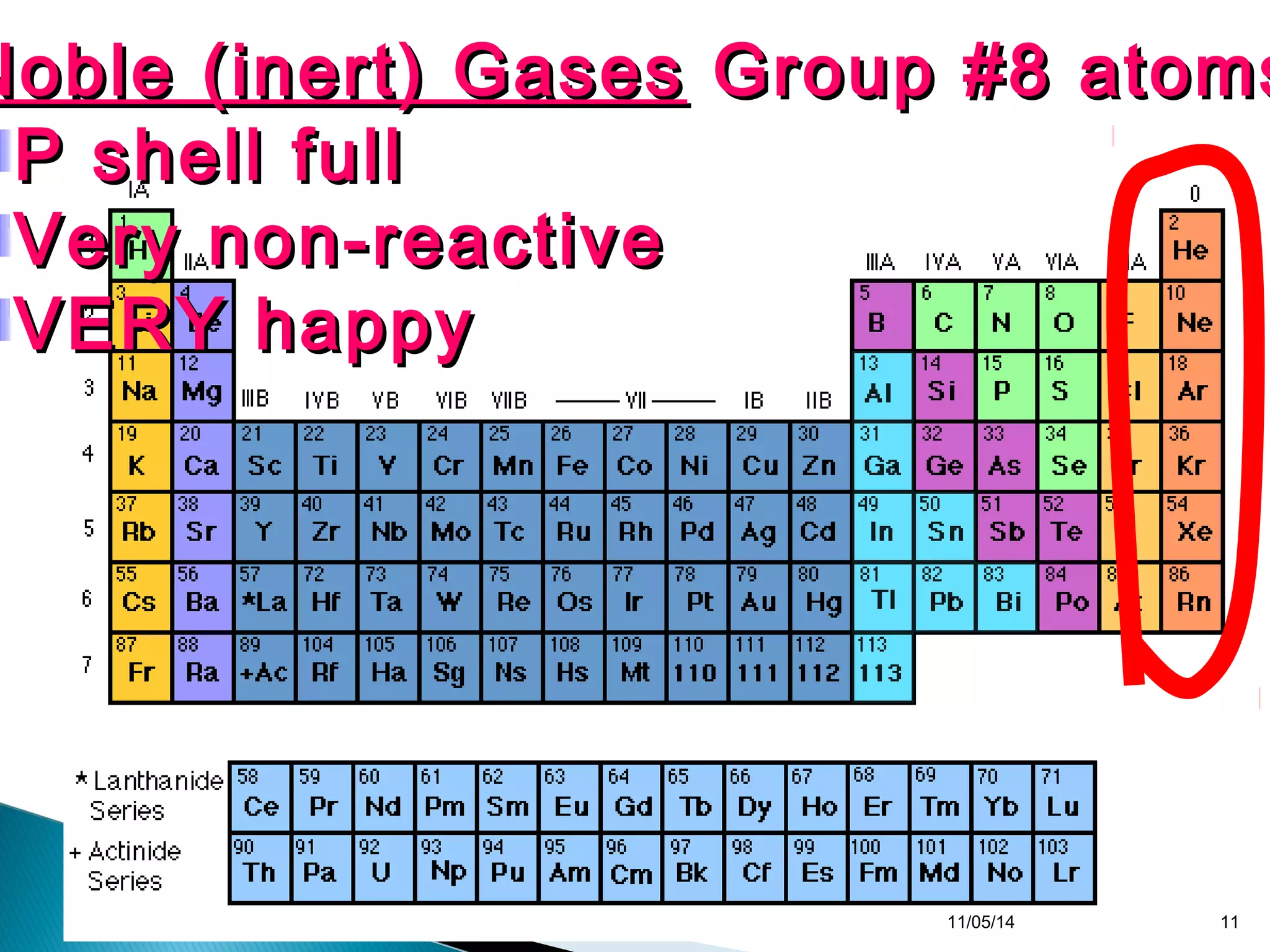
NNoobbllee ((iinneerrtt)) GGaasseess GGrroouupp ##88 aattoommss 
PP sshheellll ffuullll 
VVeerryy nnoonn--rreeaaccttiivvee 
VVEERRYY hhaappppyy 
11/05/14 11
GROUP 1 & 2 METALS. 
 An alkali metal atoms 
◦ Has one electron more than noble gas structure. The electron is readity detached and the element 
are therefore very electropositive . These include: Li (2:1) Na,(2:8:1) K, (2:8:8:1) 
 Alkali earth metals 
◦ Have two electrons more than noble gas these can readity be detached and the metals are 
electropositive. Examples of alkal earth metals are Be (2:2), Mg (2:8:2), Ca, (2:8:8:2) 
 They show relative weak metalic bonding because they have only one metalic bonding. 
 They are soft, can be cut with knife. 
 BP and MP are low. 
 Low standard heat enthalples 
 Low densities. 
 Group 2 with two valence electron they show stronger metalic bonding. 
11/05/14 12
periodic trends 
 are the tendencies of certain elemental 
characteristics to increase or decrease as one 
progresses along a row or column of the periodic 
table of elements. 
 Elemental characteristics in periodic table are 
 Atomic radius 
 Electronegativity 
 Ionization energy 
 Metallic characters 
11/05/14 13
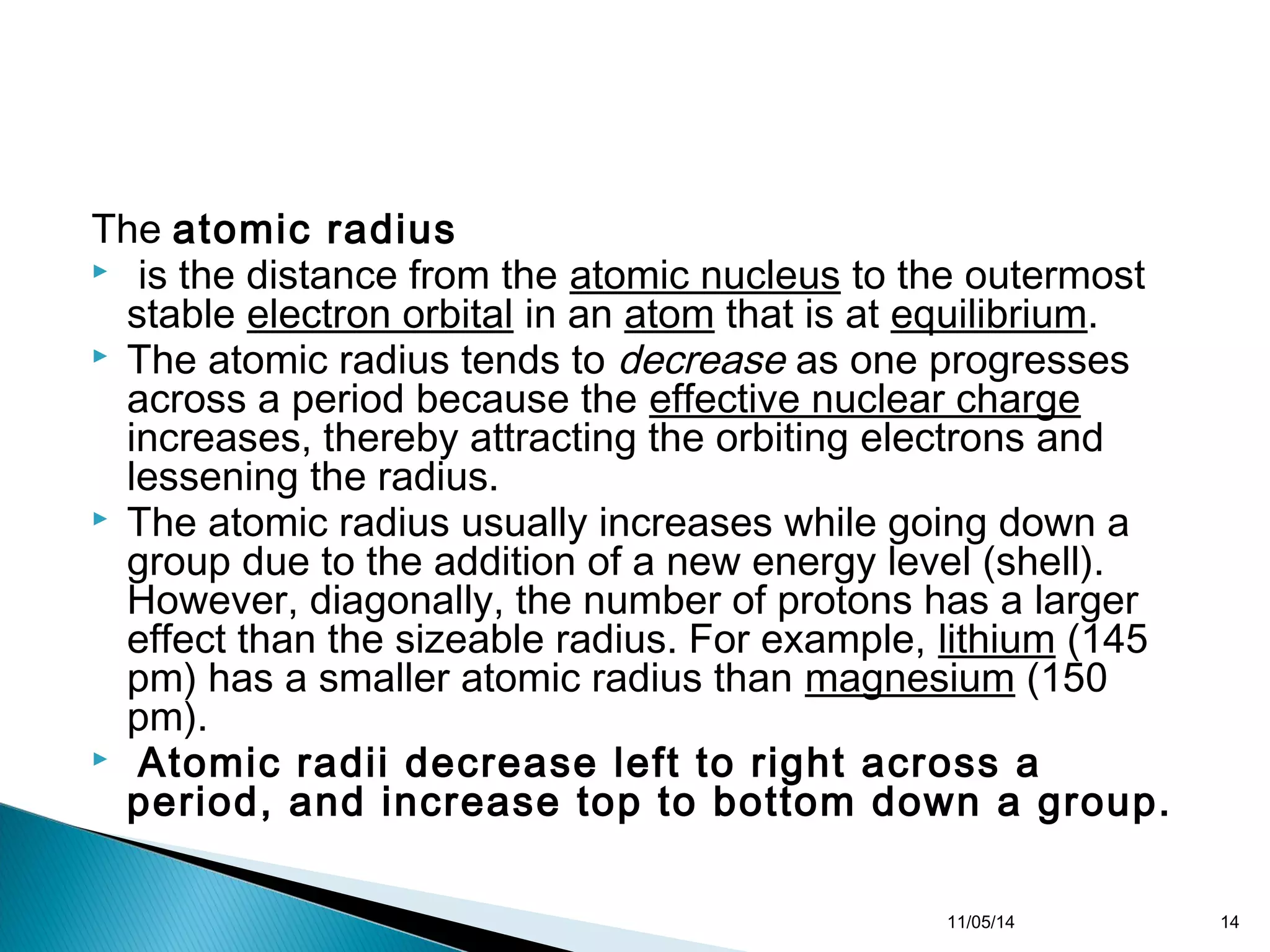
The atomic radius 
 is the distance from the atomic nucleus to the outermost 
stable electron orbital in an atom that is at equilibrium. 
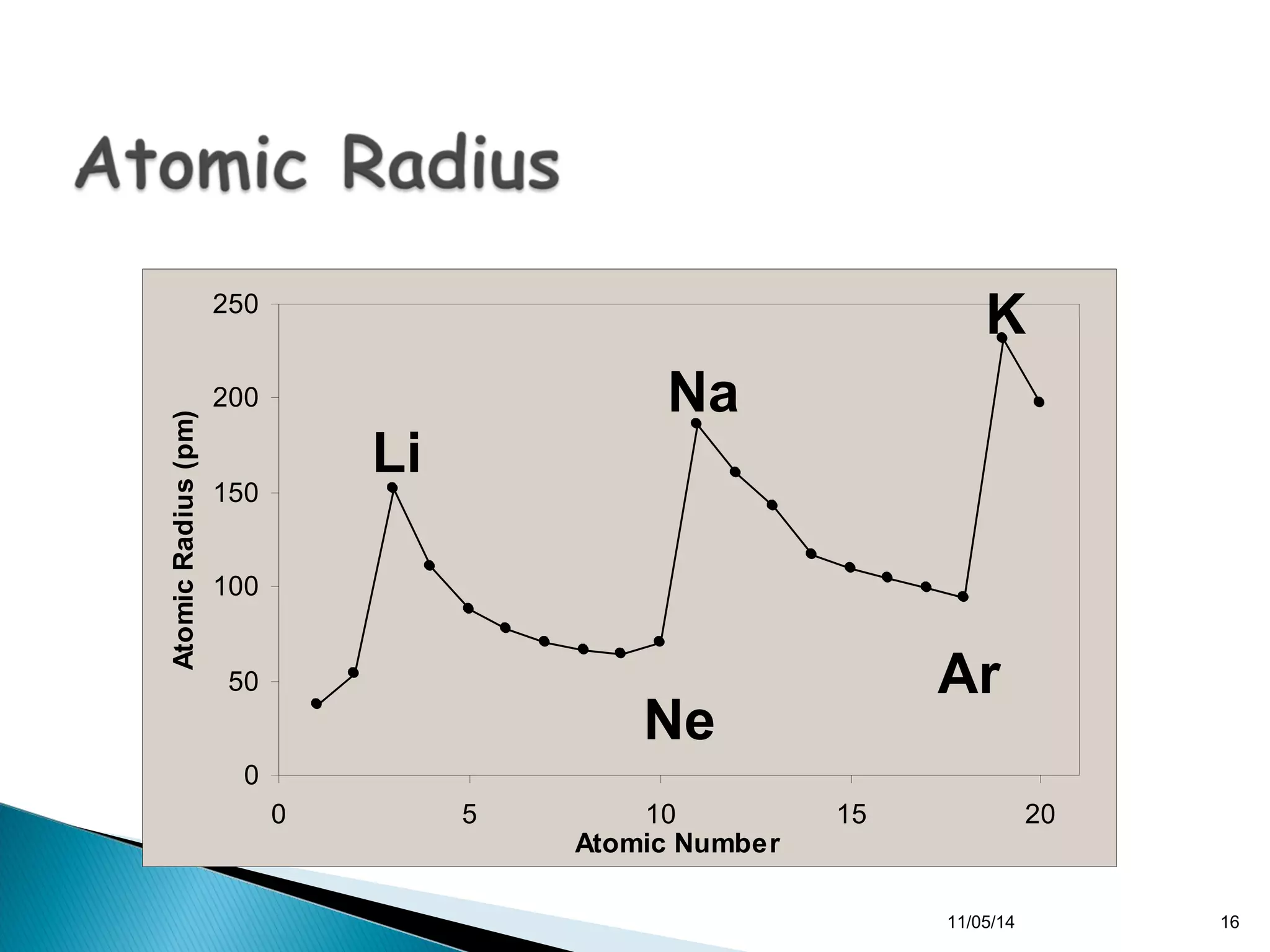
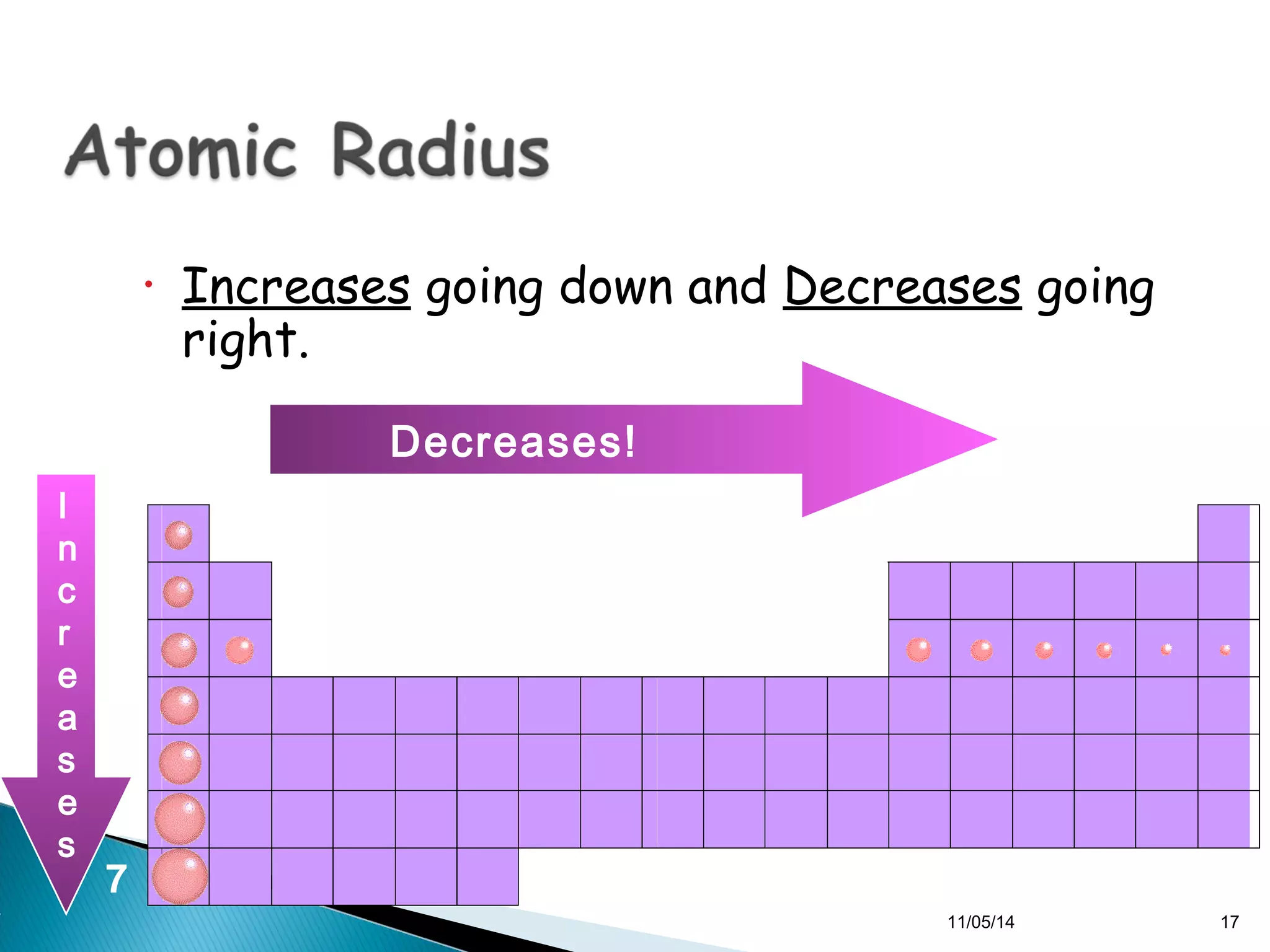
 The atomic radius tends to decrease as one progresses 
across a period because the effective nuclear charge 
increases, thereby attracting the orbiting electrons and 
lessening the radius. 
 The atomic radius usually increases while going down a 
group due to the addition of a new energy level (shell). 
However, diagonally, the number of protons has a larger 
effect than the sizeable radius. For example, lithium (145 
pm) has a smaller atomic radius than magnesium (150 
pm). 
 Atomic radii decrease left to right across a 
period, and increase top to bottom down a group. 
11/05/14 14
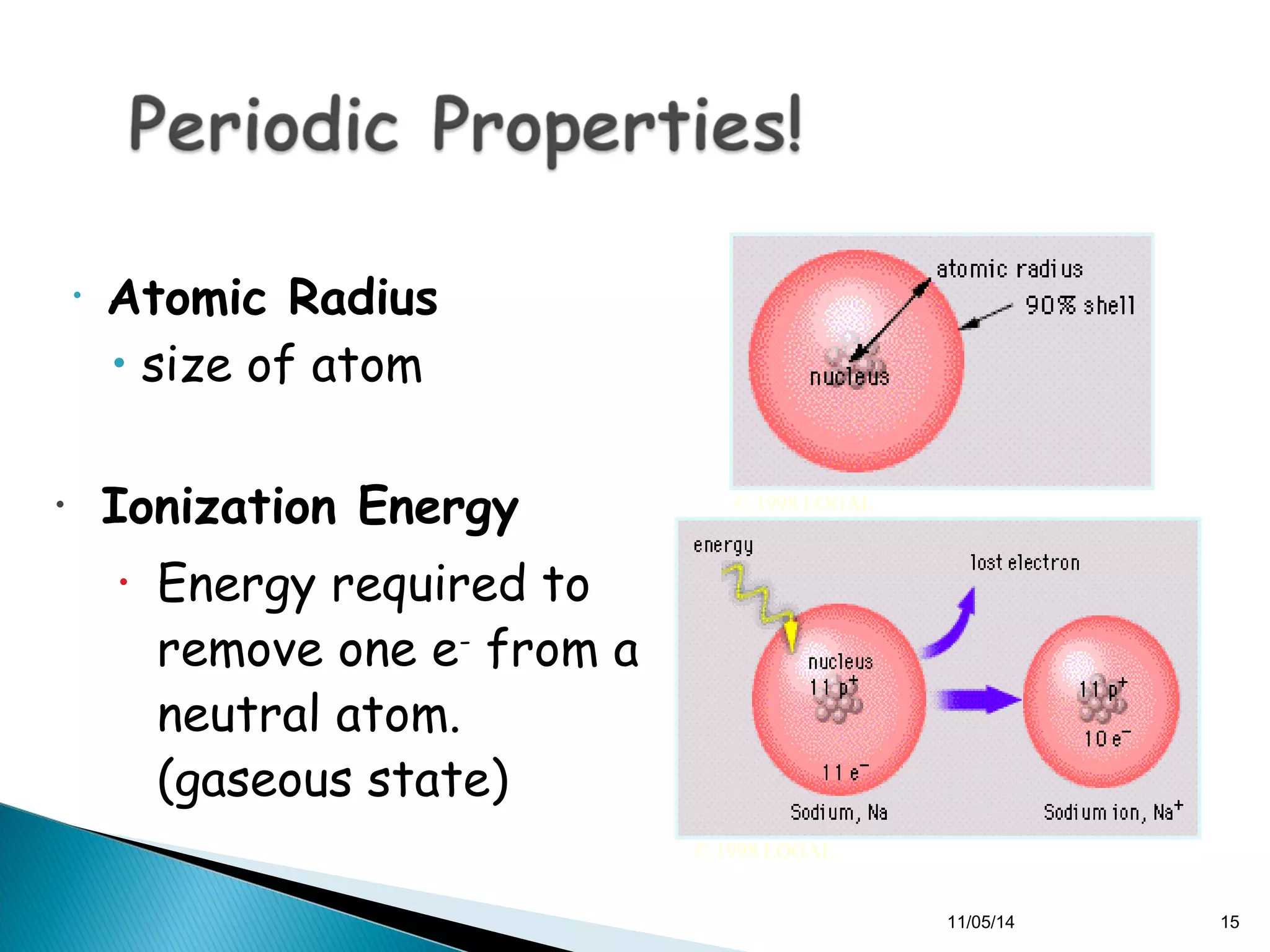
• Atomic Radius 
• size of atom 
• Ionization Energy © 1998 LOGAL 
• Energy required to 
remove one e- from a 
neutral atom. 
(gaseous state) 
© 1998 LOGAL 
11/05/14 15
250 
200 
150 
100 
50 
0 
0 5 10 15 20 
Atomic Number 
Atomic Radius (pm) 
Li 
Ar 
Ne 
K 
Na 
11/05/14 16
1 
2 
3 
4 
5 
6 
7 
• Increases going down and Decreases going 
right. 
Decreases! 
I 
ncr 
eas 
es 
11/05/14 17
• Why larger going down? 
• Higher energy levels have larger orbitals 
• Shielding - core e- block the attraction between the 
nucleus and the valence e- 
• Why smaller to the right? 
• Increased nuclear charge without additional 
shielding pulls e- in tighter 
11/05/14 18
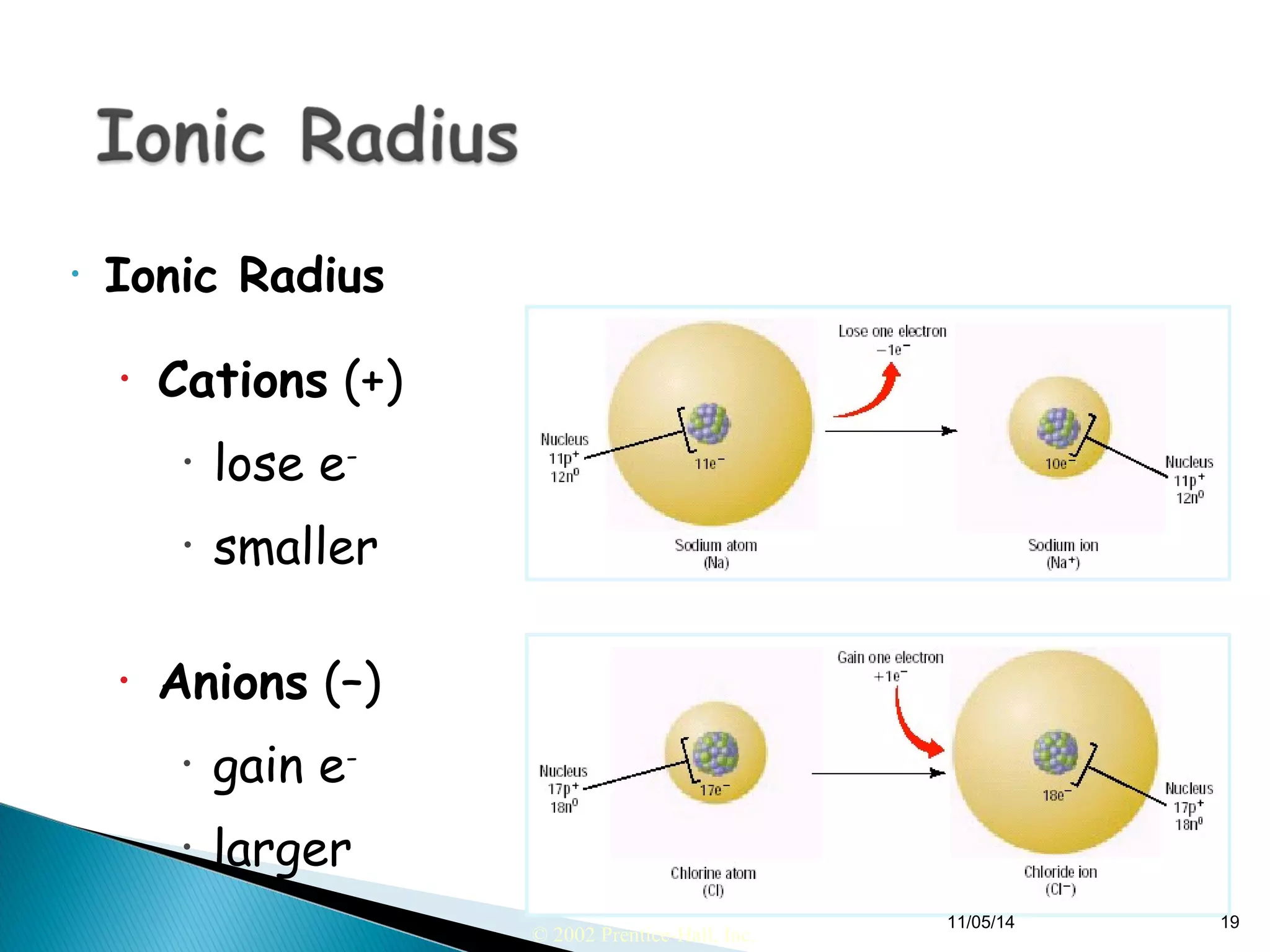
• Ionic Radius 
• Cations (+) 
• lose e- 
• smaller 
© 2002 Prentice-Hall, Inc. 
• Anions (–) 
• gain e- 
• larger 
11/05/14 19
Effective nuclear charge concept 
 The shielding effect that electrons close to the nucleus 
have an outer shell of an electrons in many electrons 
atoms. 
 The presence of shielding electrons reduces the 
electrostatics attraction between the positively charged 
protons in the nucleus and the outer electrons. 
 Moreover, the repulsive forces between the electrons in 
many electrons atom further offset the attractive force 
exerted by the nucleus the concept of effective nuclear 
charge 
 Effective nuclear charge increases from left to right across 
the period and from the bottom to top in a group of 
representative elements 
11/05/14 20
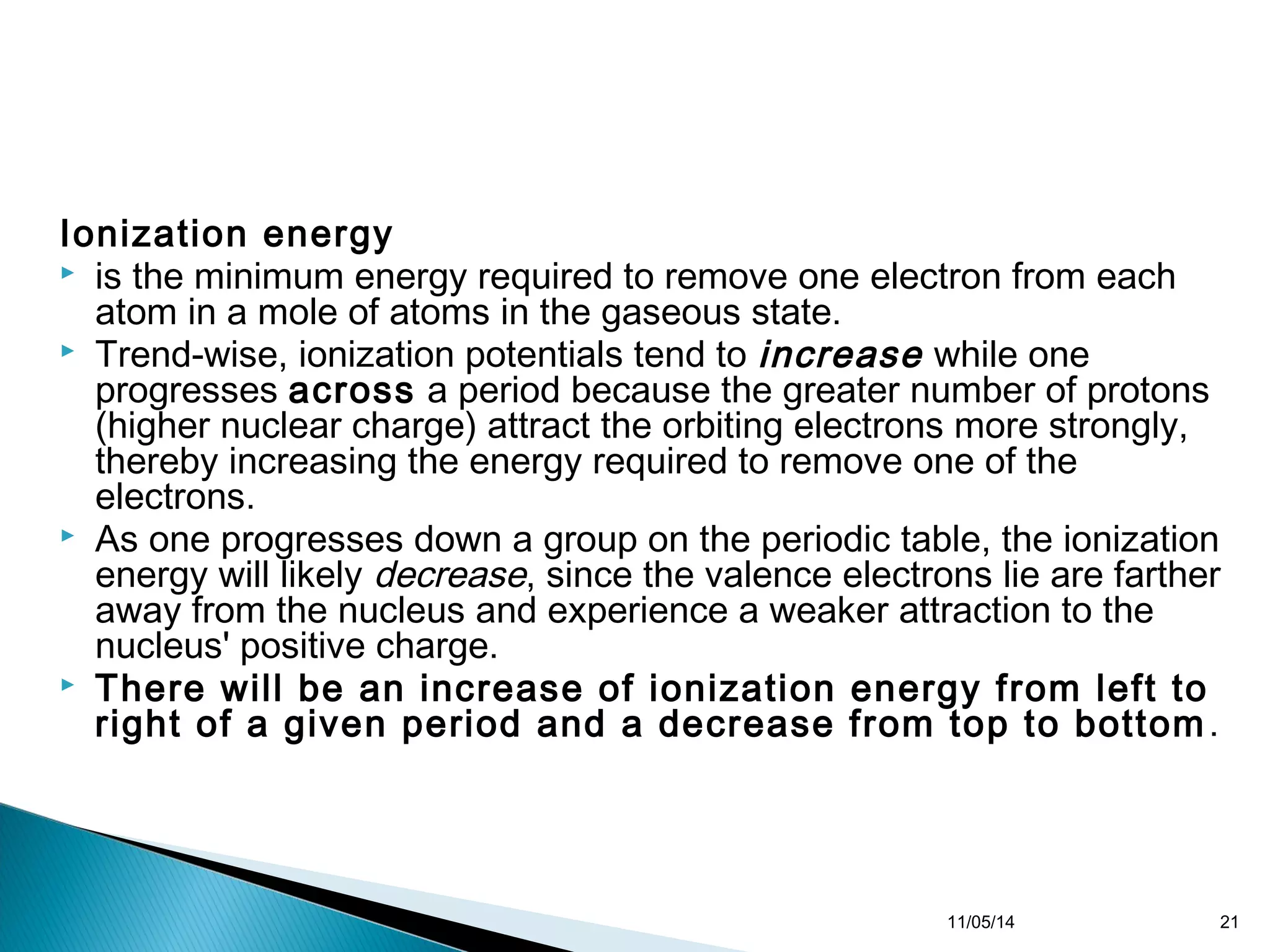
Ionization energy 
 is the minimum energy required to remove one electron from each 
atom in a mole of atoms in the gaseous state. 
 Trend-wise, ionization potentials tend to increase while one 
progresses across a period because the greater number of protons 
(higher nuclear charge) attract the orbiting electrons more strongly, 
thereby increasing the energy required to remove one of the 
electrons. 
 As one progresses down a group on the periodic table, the ionization 
energy will likely decrease, since the valence electrons lie are farther 
away from the nucleus and experience a weaker attraction to the 
nucleus' positive charge. 
 There will be an increase of ionization energy from left to 
right of a given period and a decrease from top to bottom. 
11/05/14 21
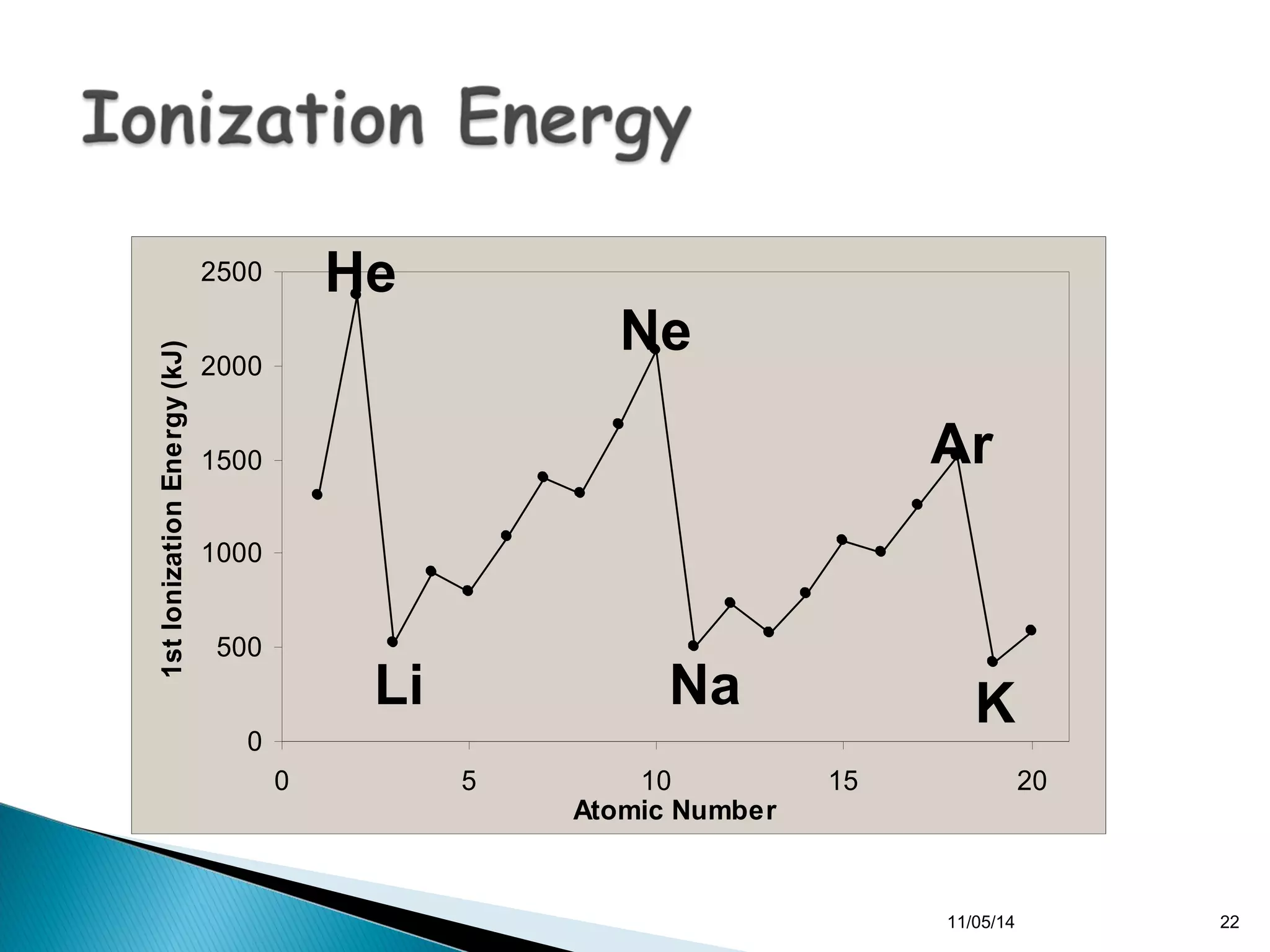
2500 
2000 
1500 
1000 
500 
0 
Ar 
Ne 
He 
0 5 10 15 20 
Atomic Number 
1st Ionization Energy (kJ) 
Li Na K 
11/05/14 22
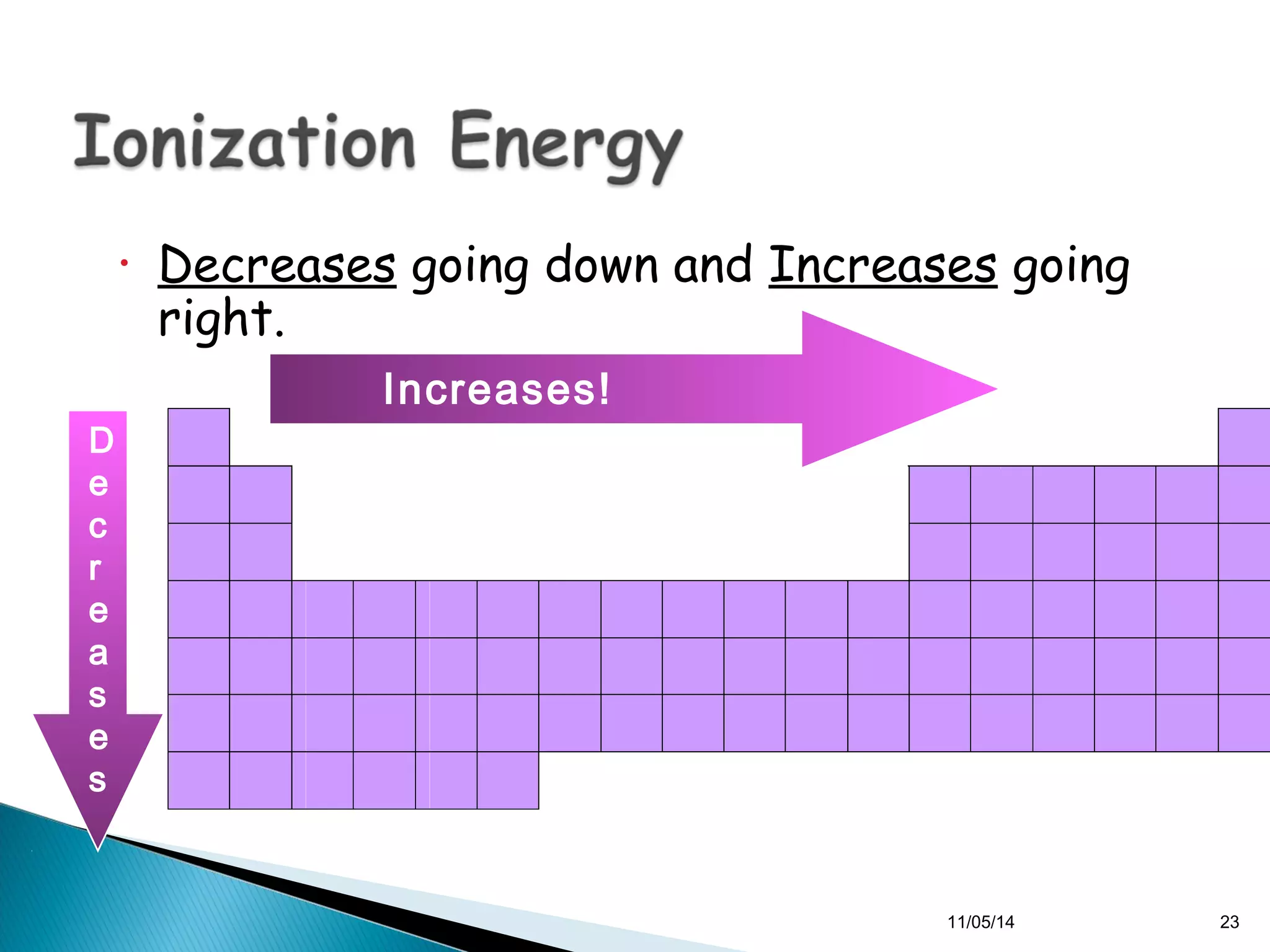
• Decreases going down and Increases going 
right. 
1 
2 
3 
4 
5 
6 
7 
Increases! 
Decr 
eas 
es 
11/05/14 23
• Why opposite of atomic radius? 
• In small atoms, e- are close to the nucleus where the attraction is stronger, therefore they are more difficult to remove 
• Which family has the highest IE and why? 
11/05/14 24
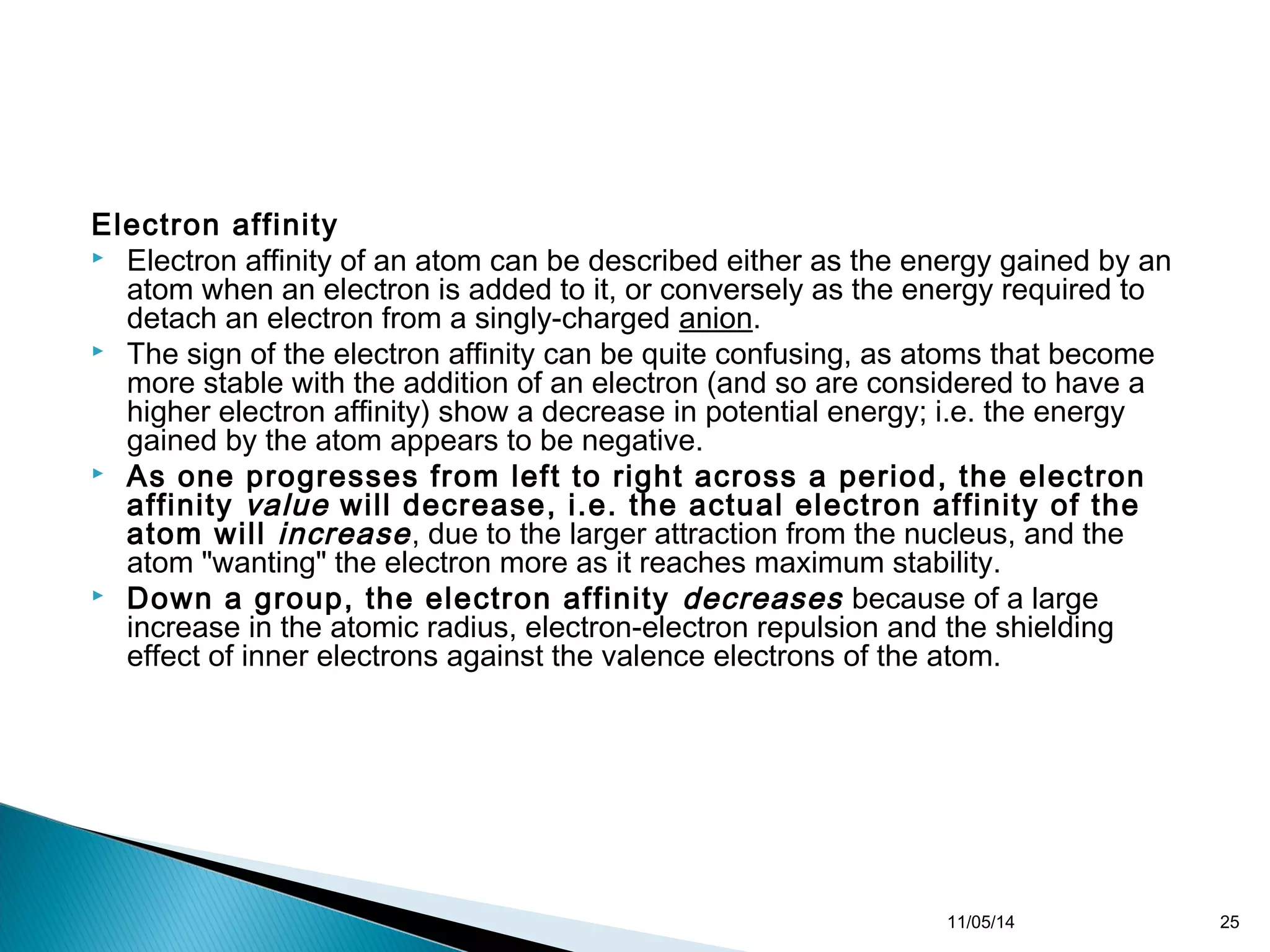
Electron affinity 
 Electron affinity of an atom can be described either as the energy gained by an 
atom when an electron is added to it, or conversely as the energy required to 
detach an electron from a singly-charged anion. 
 The sign of the electron affinity can be quite confusing, as atoms that become 
more stable with the addition of an electron (and so are considered to have a 
higher electron affinity) show a decrease in potential energy; i.e. the energy 
gained by the atom appears to be negative. 
 As one progresses from left to right across a period, the electron 
affinity value will decrease, i.e. the actual electron affinity of the 
atom will increase , due to the larger attraction from the nucleus, and the 
atom "wanting" the electron more as it reaches maximum stability. 
 Down a group, the electron affinity decreases because of a large 
increase in the atomic radius, electron-electron repulsion and the shielding 
effect of inner electrons against the valence electrons of the atom. 
11/05/14 25
Electronegativity 
 is a measure of the ability of an atom or molecule to attract 
electrons in the context of a chemical bond. 
 The type of bond formed is largely determined by the 
difference in electronegativity between the atoms involved. 
 Trend-wise, as one moves from left to right across 
a period in the periodic table, the 
electronegativity increases due to the stronger 
attraction that the atoms obtain as the nuclear charge 
increases. 
 Moving down a group, the electronegativity 
decreases due to the larger distance between the 
nucleus and the valence electron shell, thereby decreasing 
the attraction, making the atom have less of an attraction 
for electrons or protons. 
11/05/14 26
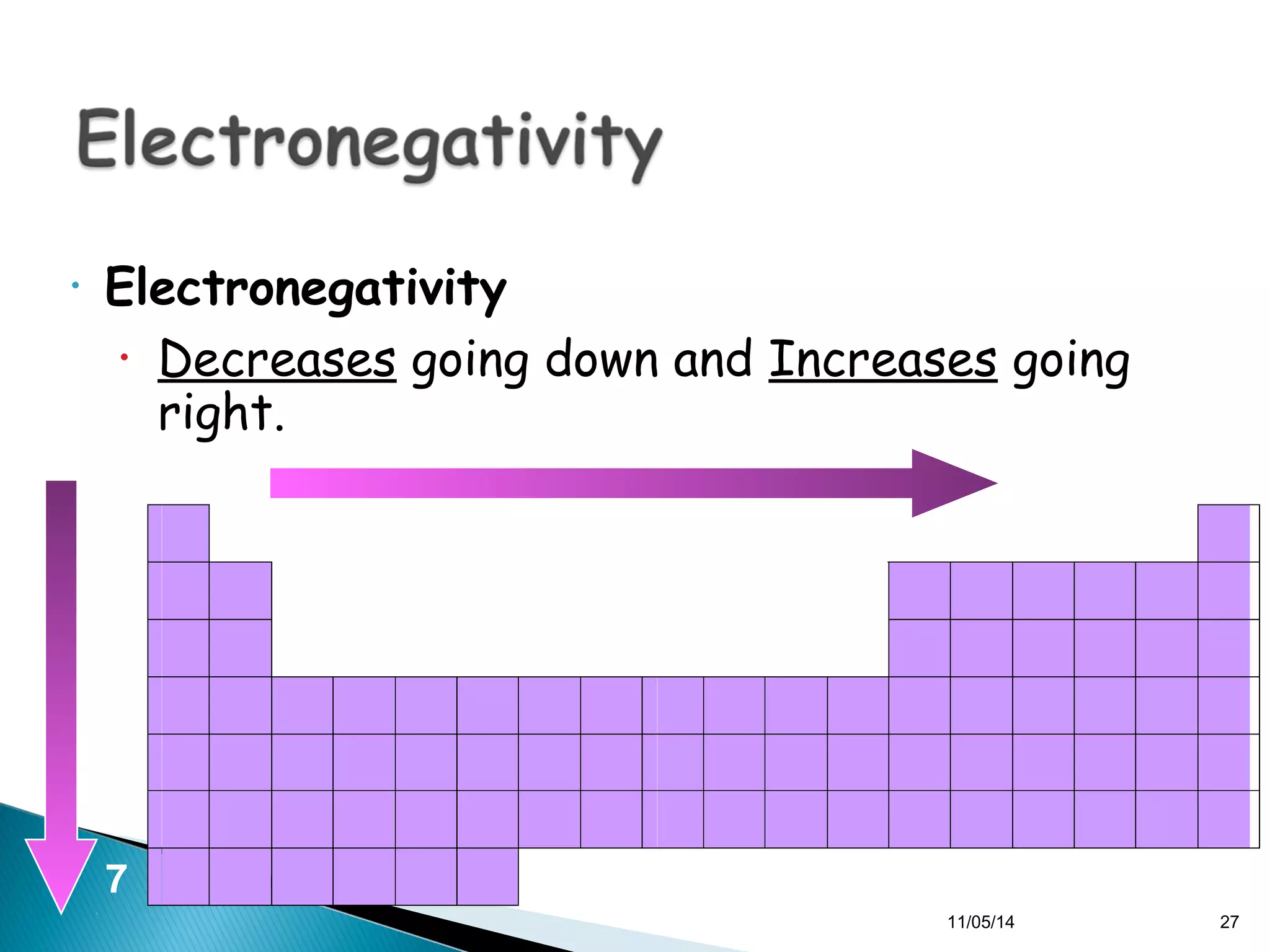
• Electronegativity 
• Decreases going down and Increases going 
1 
2 
3 
4 
5 
6 
7 
right. 
11/05/14 27
• Noble gases omitted because they do not 
form many compounds. 
• When F combines with another element, it 
attracts e- strongly. Tug-of-War!! 
11/05/14 28
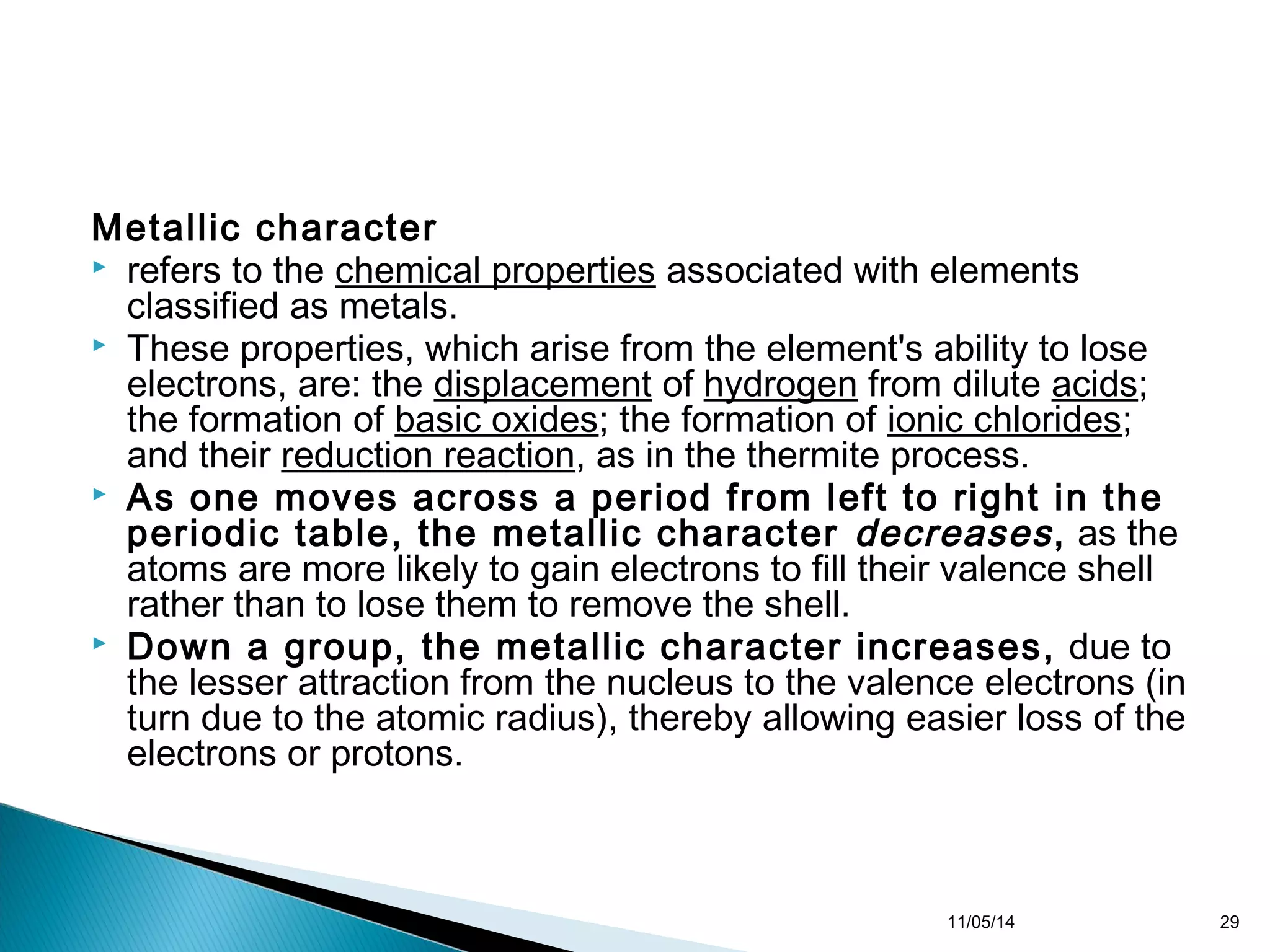
Metallic character 
 refers to the chemical properties associated with elements 
classified as metals. 
 These properties, which arise from the element's ability to lose 
electrons, are: the displacement of hydrogen from dilute acids; 
the formation of basic oxides; the formation of ionic chlorides; 
and their reduction reaction, as in the thermite process. 
 As one moves across a period from left to right in the 
periodic table, the metallic character decreases , as the 
atoms are more likely to gain electrons to fill their valence shell 
rather than to lose them to remove the shell. 
 Down a group, the metallic character increases, due to 
the lesser attraction from the nucleus to the valence electrons (in 
turn due to the atomic radius), thereby allowing easier loss of the 
electrons or protons. 
11/05/14 29
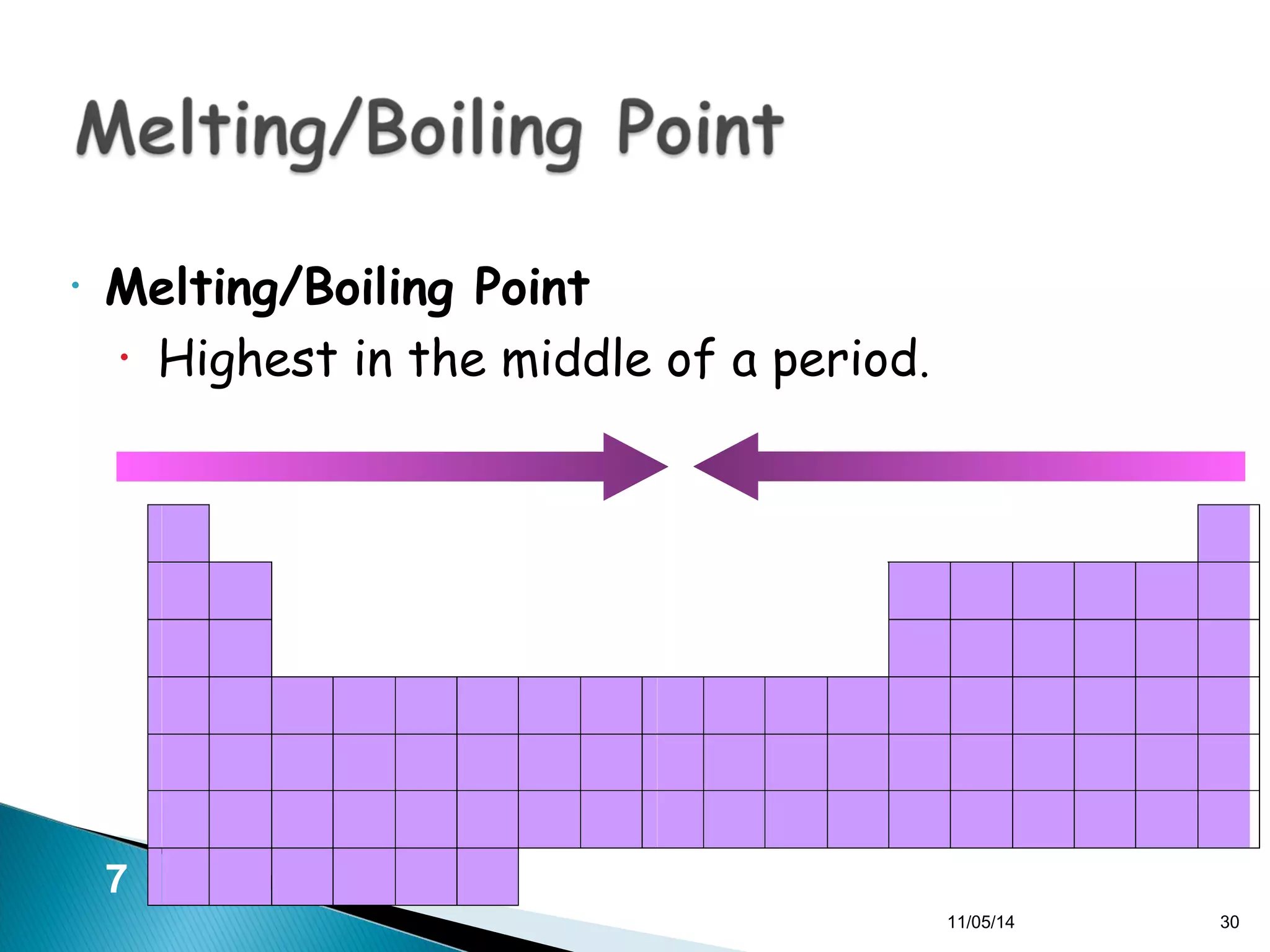
• Melting/Boiling Point 
• Highest in the middle of a period. 
1 
2 
3 
4 
5 
6 
7 
11/05/14 30
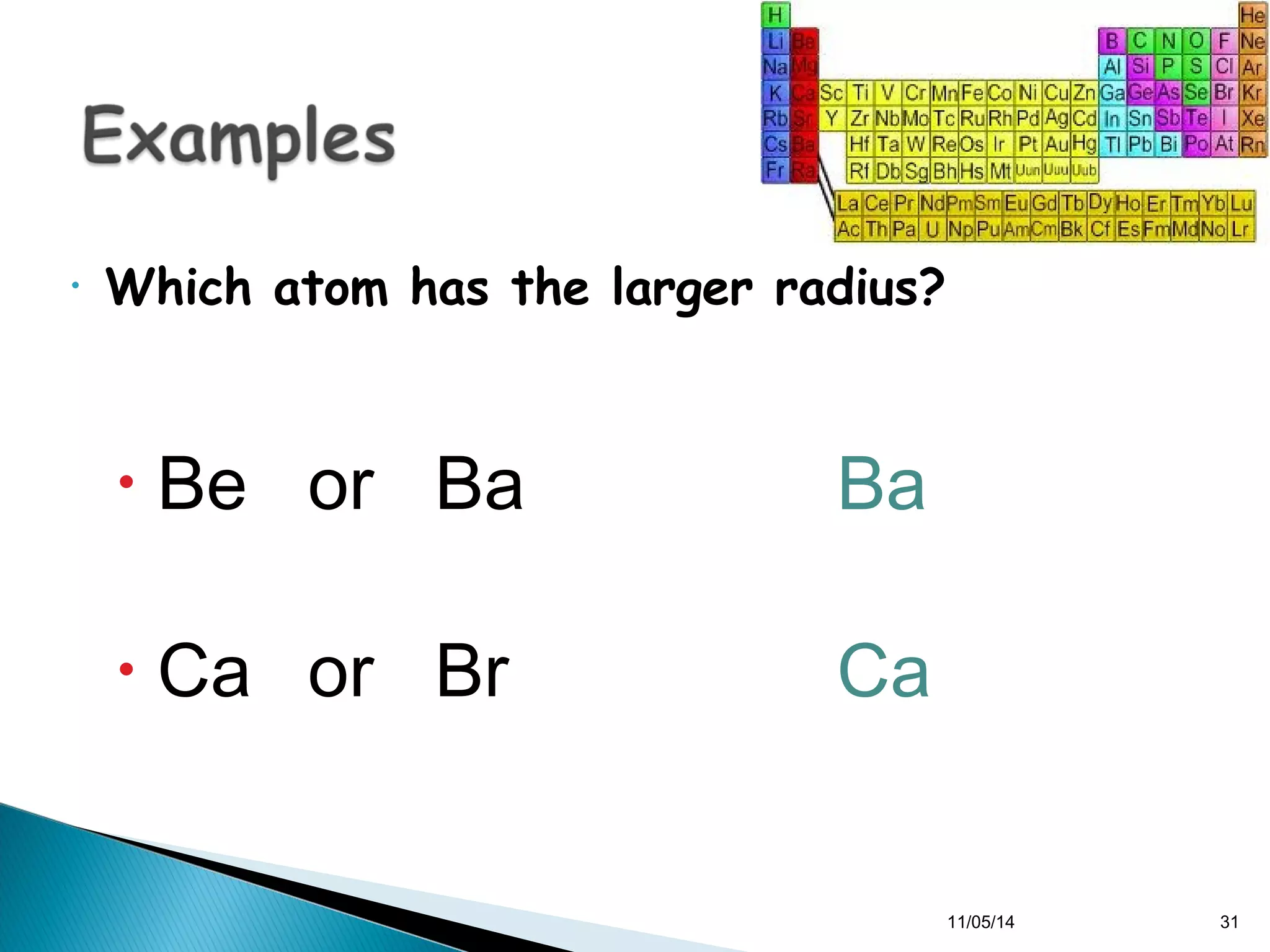
• Which atom has the larger radius? 
• Be or Ba 
• Ca or Br 
Ba 
Ca 
11/05/14 31
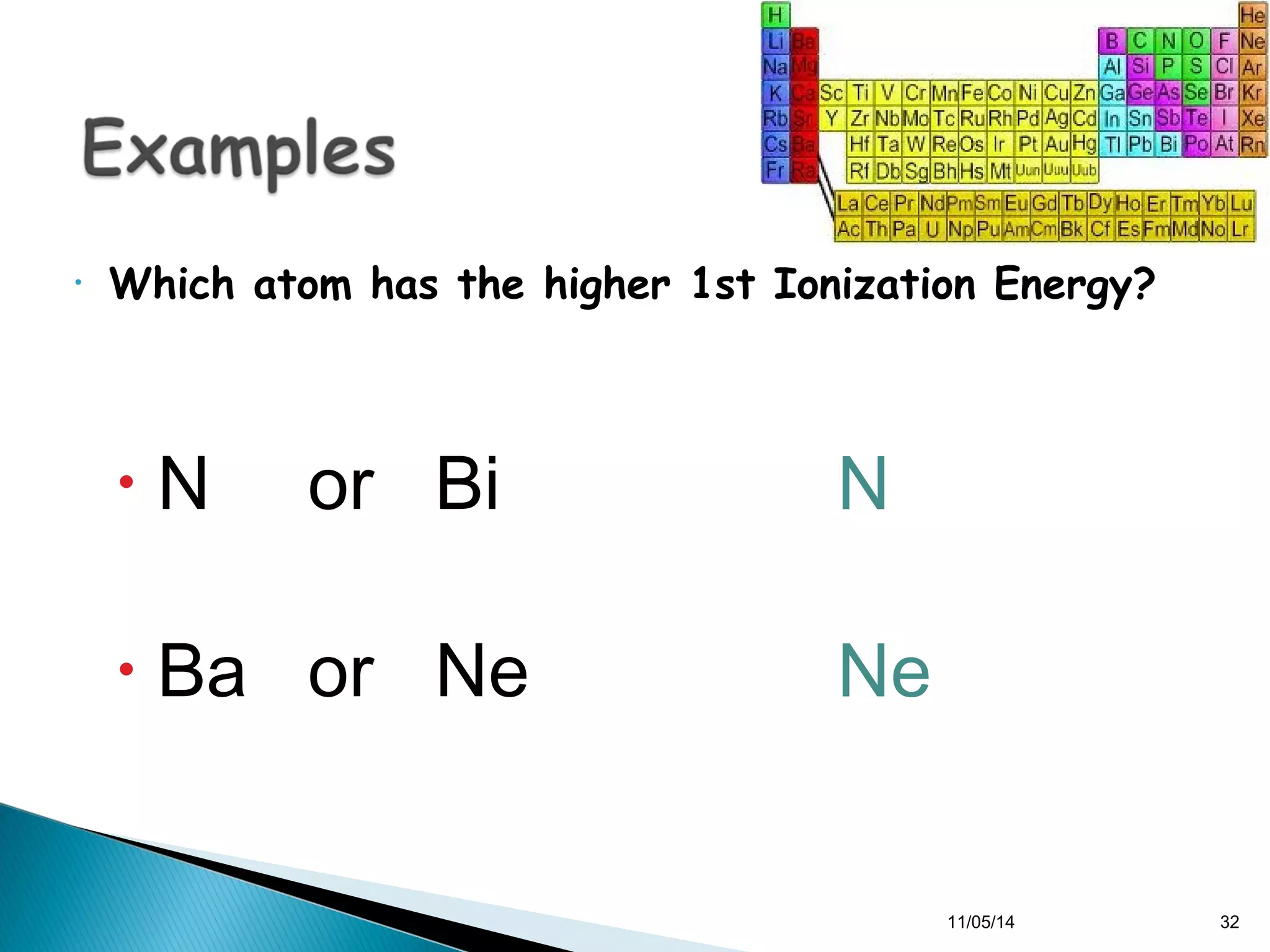
• Which atom has the higher 1st Ionization Energy? 
• N or Bi 
• Ba or Ne 
N 
Ne 
11/05/14 32
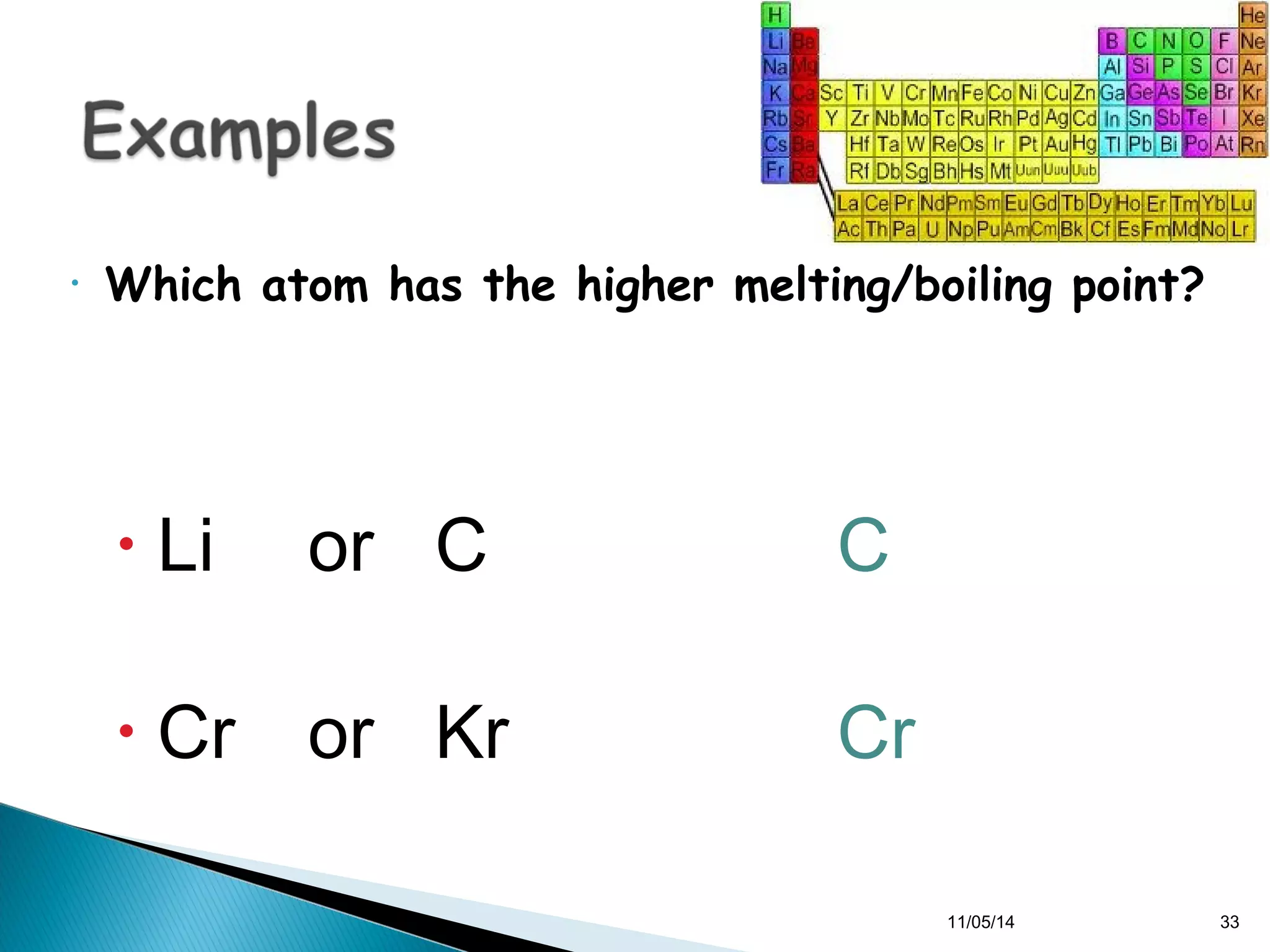
• Which atom has the higher melting/boiling point? 
• Li or C 
• Cr or Kr 
C 
Cr 
11/05/14 33
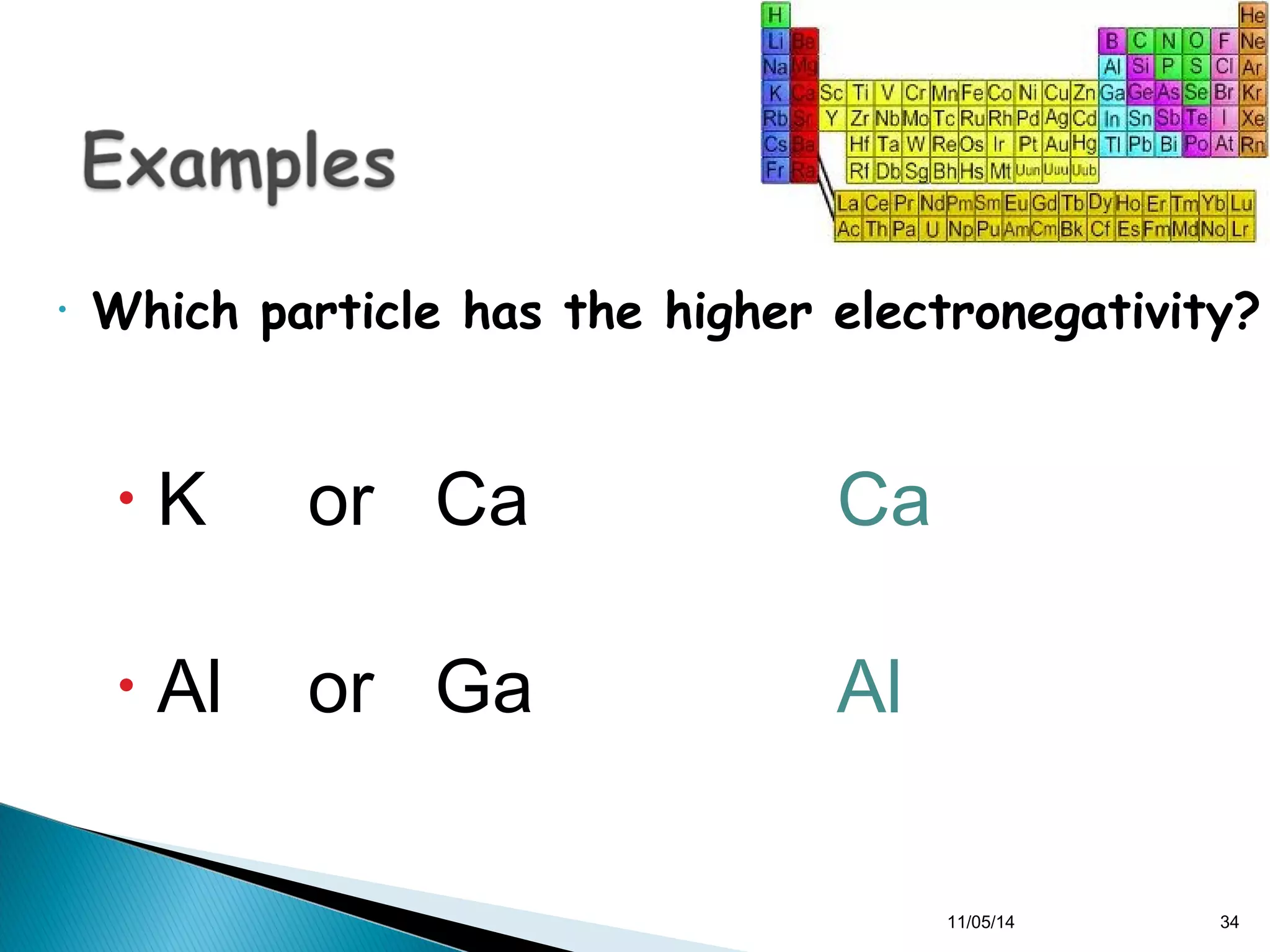
• Which particle has the higher electronegativity? 
• K or Ca 
• Al or Ga 
Ca 
Al 
11/05/14 34
THANK YOU FOR YOUR 
ATTENTION!!! 
11/05/14 35
11/05/14 36

4.periodic table 4

  • 1.
  • 2.
  • 3.
    MMeettaallss EExxttrraa eelleeccttrroonnss CCoonndduuccttiivvee MMaalllleeaabbllee DDeennssee SShhiinnyy DDuuccttiillee 11/05/14 3
  • 4.
    Metal an atomwith 1-3 extra valence electrons. Shiny Dense Malleable Ductile Electrical conductors Thermal conductors 11/05/14 4
  • 5.
     In 1817,Germanscientist named Deboreiner realized that there's is a connection between relative atomic mass and chemical properties  In 1829,he arranged many elements into group of three, called Deboreiner’s triads in which the relative mass of the middle element about the average of masses of the other two. However only few elements form the group of three.  In 1864, the British scientist called Newlands, Arranged elements in order of relative atomic mass and gave each one number, Hydrogen the lightest element was no. 1, lithium 2, helium was not known at that time and so on.  He was the first scientist to list elements in numerical order. BUT his law didn’t apply after 17 elements (Ca). 11/05/14 5
  • 6.
     In 1869Mendeleef, a Russian scientist, stated that the properties of element are a periodic in function of their atomic masses.  This periodic law means that if the elements are arranged in order of increasing their relative mass, element of similar properties appear in regular intervals . This kind of repetition is periodic  Mendeleef ‘s periodic table was in complete because many elements (e.g. noble gases were not known that time.  In 1913 an English research student called Moseley. He found that atomic number is more important than the relative atomic mass and that there is no exceptions in periodic table 11/05/14 6
  • 7.
    Periodic Table ofan element  Is the arrangements of elements in order of their proton numbers, Horizontal raw are period and the vertical column are groups Characteristics of Periodic Table  There are 8 groups and 7 periods  Period 1 contain only Hydrogen and Helium. Hydrogen is placed both in group one and group 7 because its properties resembles of those of alkali metals and halogens  Period 2 and 3 (Short periods) contains 8 element each  Period 4 and 5 ( Long periods) each contains 18 elements. 8 elements of these correspond to the 8 element in the short period. The other 10 are called transition elements . Which show similar properties before them and also some properties similar to those following them.  Period 6 and 7 contain 32 and 17 elements 11/05/14 7
  • 8.
    Periodicity of propertiesof the element.  Physical properties.  Physical properties of elements in the same group vary gradually and regularly.  All group one alkali metals have low densities, low melting point and high conductivities.  In group 7 halogens, The melting points, boiling points and the densities rise regularly. The first member of the group e.g lithium and fluorine is usually slightly different form the rest of the group) Chemical properties.  Vary gradually for the same group of elements.  Of the alkali metals potassium is more electropositive than sodium which is more electropositive than lithium.  Of halogens fluorine is most electronegative metals and iodide is least.  Metals are on the left hand side of the table and non metals are on the right.  In group 1 metals are reactive as their relative atomic mass increases.  In group 7 the halogen are less reactive when their masses increase. 11/05/14 8
  • 9.
    Families of elements.  The periodic table is accounted for the regular arrangement of electrons in atoms of elements. The periodicity of electron configuration leads to periodicity of chemical properties which depends on configuration of the outermost orbit. 11/05/14 9
  • 10.
    Noble gasses configuration.  The outer most shell of electron with two electrons in case of helium and eight for other elements  Are very stable and the electrons are not used in chemical reactions.  The noble gasses are very un reactive. Noble gas elements are Ne (2:8) Ar (2:8:8) 11/05/14 10
  • 11.
    NNoobbllee ((iinneerrtt)) GGaasseessGGrroouupp ##88 aattoommss PP sshheellll ffuullll VVeerryy nnoonn--rreeaaccttiivvee VVEERRYY hhaappppyy 11/05/14 11
  • 12.
    GROUP 1 &2 METALS.  An alkali metal atoms ◦ Has one electron more than noble gas structure. The electron is readity detached and the element are therefore very electropositive . These include: Li (2:1) Na,(2:8:1) K, (2:8:8:1)  Alkali earth metals ◦ Have two electrons more than noble gas these can readity be detached and the metals are electropositive. Examples of alkal earth metals are Be (2:2), Mg (2:8:2), Ca, (2:8:8:2)  They show relative weak metalic bonding because they have only one metalic bonding.  They are soft, can be cut with knife.  BP and MP are low.  Low standard heat enthalples  Low densities.  Group 2 with two valence electron they show stronger metalic bonding. 11/05/14 12
  • 13.
    periodic trends are the tendencies of certain elemental characteristics to increase or decrease as one progresses along a row or column of the periodic table of elements.  Elemental characteristics in periodic table are  Atomic radius  Electronegativity  Ionization energy  Metallic characters 11/05/14 13
  • 14.
    The atomic radius  is the distance from the atomic nucleus to the outermost stable electron orbital in an atom that is at equilibrium.  The atomic radius tends to decrease as one progresses across a period because the effective nuclear charge increases, thereby attracting the orbiting electrons and lessening the radius.  The atomic radius usually increases while going down a group due to the addition of a new energy level (shell). However, diagonally, the number of protons has a larger effect than the sizeable radius. For example, lithium (145 pm) has a smaller atomic radius than magnesium (150 pm).  Atomic radii decrease left to right across a period, and increase top to bottom down a group. 11/05/14 14
  • 15.
    • Atomic Radius • size of atom • Ionization Energy © 1998 LOGAL • Energy required to remove one e- from a neutral atom. (gaseous state) © 1998 LOGAL 11/05/14 15
  • 16.
    250 200 150 100 50 0 0 5 10 15 20 Atomic Number Atomic Radius (pm) Li Ar Ne K Na 11/05/14 16
  • 17.
    1 2 3 4 5 6 7 • Increases going down and Decreases going right. Decreases! I ncr eas es 11/05/14 17
  • 18.
    • Why largergoing down? • Higher energy levels have larger orbitals • Shielding - core e- block the attraction between the nucleus and the valence e- • Why smaller to the right? • Increased nuclear charge without additional shielding pulls e- in tighter 11/05/14 18
  • 19.
    • Ionic Radius • Cations (+) • lose e- • smaller © 2002 Prentice-Hall, Inc. • Anions (–) • gain e- • larger 11/05/14 19
  • 20.
    Effective nuclear chargeconcept  The shielding effect that electrons close to the nucleus have an outer shell of an electrons in many electrons atoms.  The presence of shielding electrons reduces the electrostatics attraction between the positively charged protons in the nucleus and the outer electrons.  Moreover, the repulsive forces between the electrons in many electrons atom further offset the attractive force exerted by the nucleus the concept of effective nuclear charge  Effective nuclear charge increases from left to right across the period and from the bottom to top in a group of representative elements 11/05/14 20
  • 21.
    Ionization energy is the minimum energy required to remove one electron from each atom in a mole of atoms in the gaseous state.  Trend-wise, ionization potentials tend to increase while one progresses across a period because the greater number of protons (higher nuclear charge) attract the orbiting electrons more strongly, thereby increasing the energy required to remove one of the electrons.  As one progresses down a group on the periodic table, the ionization energy will likely decrease, since the valence electrons lie are farther away from the nucleus and experience a weaker attraction to the nucleus' positive charge.  There will be an increase of ionization energy from left to right of a given period and a decrease from top to bottom. 11/05/14 21
  • 22.
    2500 2000 1500 1000 500 0 Ar Ne He 0 5 10 15 20 Atomic Number 1st Ionization Energy (kJ) Li Na K 11/05/14 22
  • 23.
    • Decreases goingdown and Increases going right. 1 2 3 4 5 6 7 Increases! Decr eas es 11/05/14 23
  • 24.
    • Why oppositeof atomic radius? • In small atoms, e- are close to the nucleus where the attraction is stronger, therefore they are more difficult to remove • Which family has the highest IE and why? 11/05/14 24
  • 25.
    Electron affinity Electron affinity of an atom can be described either as the energy gained by an atom when an electron is added to it, or conversely as the energy required to detach an electron from a singly-charged anion.  The sign of the electron affinity can be quite confusing, as atoms that become more stable with the addition of an electron (and so are considered to have a higher electron affinity) show a decrease in potential energy; i.e. the energy gained by the atom appears to be negative.  As one progresses from left to right across a period, the electron affinity value will decrease, i.e. the actual electron affinity of the atom will increase , due to the larger attraction from the nucleus, and the atom "wanting" the electron more as it reaches maximum stability.  Down a group, the electron affinity decreases because of a large increase in the atomic radius, electron-electron repulsion and the shielding effect of inner electrons against the valence electrons of the atom. 11/05/14 25
  • 26.
    Electronegativity  isa measure of the ability of an atom or molecule to attract electrons in the context of a chemical bond.  The type of bond formed is largely determined by the difference in electronegativity between the atoms involved.  Trend-wise, as one moves from left to right across a period in the periodic table, the electronegativity increases due to the stronger attraction that the atoms obtain as the nuclear charge increases.  Moving down a group, the electronegativity decreases due to the larger distance between the nucleus and the valence electron shell, thereby decreasing the attraction, making the atom have less of an attraction for electrons or protons. 11/05/14 26
  • 27.
    • Electronegativity •Decreases going down and Increases going 1 2 3 4 5 6 7 right. 11/05/14 27
  • 28.
    • Noble gasesomitted because they do not form many compounds. • When F combines with another element, it attracts e- strongly. Tug-of-War!! 11/05/14 28
  • 29.
    Metallic character refers to the chemical properties associated with elements classified as metals.  These properties, which arise from the element's ability to lose electrons, are: the displacement of hydrogen from dilute acids; the formation of basic oxides; the formation of ionic chlorides; and their reduction reaction, as in the thermite process.  As one moves across a period from left to right in the periodic table, the metallic character decreases , as the atoms are more likely to gain electrons to fill their valence shell rather than to lose them to remove the shell.  Down a group, the metallic character increases, due to the lesser attraction from the nucleus to the valence electrons (in turn due to the atomic radius), thereby allowing easier loss of the electrons or protons. 11/05/14 29
  • 30.
    • Melting/Boiling Point • Highest in the middle of a period. 1 2 3 4 5 6 7 11/05/14 30
  • 31.
    • Which atomhas the larger radius? • Be or Ba • Ca or Br Ba Ca 11/05/14 31
  • 32.
    • Which atomhas the higher 1st Ionization Energy? • N or Bi • Ba or Ne N Ne 11/05/14 32
  • 33.
    • Which atomhas the higher melting/boiling point? • Li or C • Cr or Kr C Cr 11/05/14 33
  • 34.
    • Which particlehas the higher electronegativity? • K or Ca • Al or Ga Ca Al 11/05/14 34
  • 35.
    THANK YOU FORYOUR ATTENTION!!! 11/05/14 35
  • 36.