MORE PERIODIC TRENDS
Key Concepts
• Effective Nuclear Charge: The attractive force exerted by
  the atoms positively charged nucleus (+) on an electron (-
  ).
   • Holds the electron in orbit.
   • Opposites attract.
   • As you add protons (+) the Effective Nuclear Charge grows
     larger.
• Electron Shielding: The reduction in the attractive force
  (Effective Nuclear Charge) between a positively charged
  nucleus and its outermost electrons due to the cancellation of
  some of the positive charge by the negative charges of the
  inner electrons.
   • Each primary energy level added moves the valence electrons farther
     from the nucleus.
   • Each successive energy level also puts more inner shell electrons “in
     the way” between the nucleus and valence (outer) shell.
   • Both of which decrease the amount of attractive force the nucleus can
     exert.
TREND I: ATOMIC RADIUS
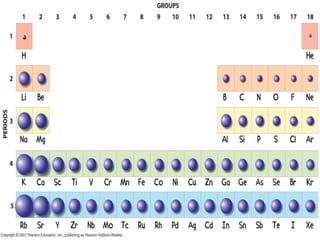
Atomic Radius
• The exact size of an atom is
  hard to determine.
• The volume the electrons
  occupy is thought of as an
  electron cloud, with no
  clear-cut edge.
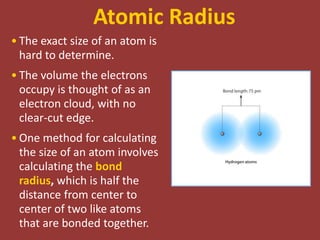
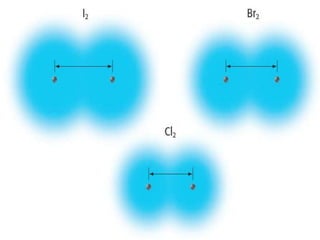
• One method for calculating
  the size of an atom involves
  calculating the bond
  radius, which is half the
  distance from center to
  center of two like atoms
  that are bonded together.
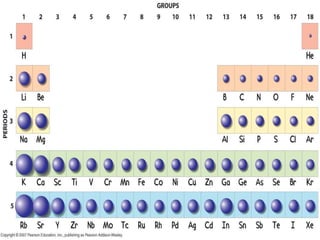
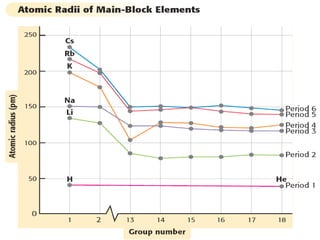
Atomic Radius Increases as You Move Down a Group

•As you proceed from one element down to
 the next in a group, a new principal energy
 level is added.
•The addition of another level of electrons
 increases the size, or atomic radius, of an
 atom.
•Effect is further magnified by electron
 shielding.
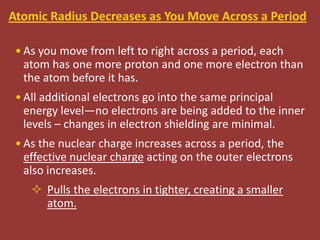
Atomic Radius Decreases as You Move Across a Period

 • As you move from left to right across a period, each
   atom has one more proton and one more electron than
   the atom before it has.
 • All additional electrons go into the same principal
   energy level—no electrons are being added to the inner
   levels – changes in electron shielding are minimal.
 • As the nuclear charge increases across a period, the
   effective nuclear charge acting on the outer electrons
   also increases.
     Pulls the electrons in tighter, creating a smaller
      atom.
Atomic Radii
TREND II: IONIZATION ENERGY
Ionization
• We’ve previously looked only at neutral atoms
  with equal numbers of protons and electrons.
• Ionization: The creation of an atom with a net
  charge, by the removal or addition of electrons.
  – Ions have more or less electrons than neutral atoms.
• Anion: An atom that has gained an electron and
  taken on a net negative charge.
• Cation: An atom that has lost an electron and
  taken on a net positive charge.
Ionization Energy
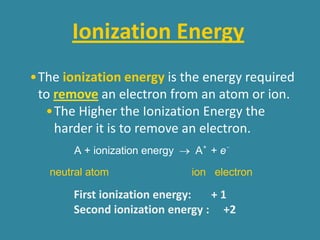
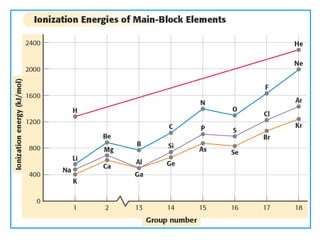
•The ionization energy is the energy required
 to remove an electron from an atom or ion.
  •The Higher the Ionization Energy the
    harder it is to remove an electron.
       A + ionization energy ® A + + e -

   neutral atom                ion electron

       First ionization energy:  +1
       Second ionization energy : +2
Multiple Ionization Energies
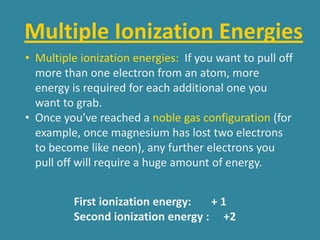
• Multiple ionization energies: If you want to pull off
  more than one electron from an atom, more
  energy is required for each additional one you
  want to grab.
• Once you’ve reached a noble gas configuration (for
  example, once magnesium has lost two electrons
  to become like neon), any further electrons you
  pull off will require a huge amount of energy.


          First ionization energy:  +1
          Second ionization energy : +2
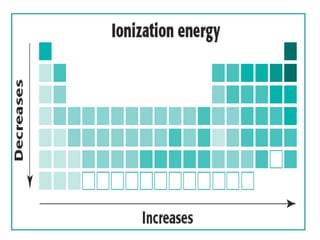
Ionization Energy Decreases as You
       Move Down a Group
• Each element has more occupied energy levels than the
  one above it has.
    • The outermost electrons are farthest from the
      nucleus in elements near the bottom of a group.
• As you move down a group, each successive element
  contains more electrons in the energy levels between
  the nucleus and the outermost electrons- more
  electron shielding.
• Therefore it gets easier to remove electrons as you go
  down.
Ionization Energy Increases as
        You Move Across a Period
• Ionization energy tends to increase as you move from
  left to right across a period.
• From one element to the next in a period, the number
  of protons and the number of electrons increase by
  one each- increases the effective nuclear charge.
    A higher nuclear charge more strongly attracts the
     outer electrons in the same energy level, but the
     electron-shielding effect from inner-level electrons
     remains the same.
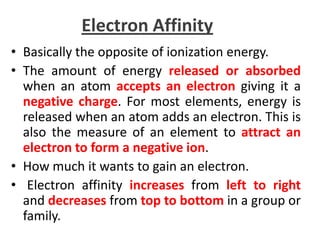
Electron Affinity
• Basically the opposite of ionization energy.
• The amount of energy released or absorbed
  when an atom accepts an electron giving it a
  negative charge. For most elements, energy is
  released when an atom adds an electron. This is
  also the measure of an element to attract an
  electron to form a negative ion.
• How much it wants to gain an electron.
• Electron affinity increases from left to right
  and decreases from top to bottom in a group or
  family.
TREND I: REVISITED
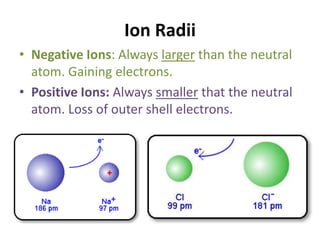
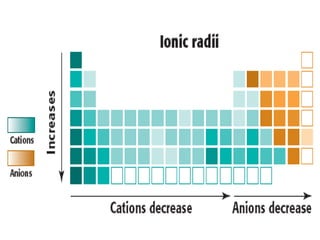
Ion Radii
• Negative Ions: Always larger than the neutral
  atom. Gaining electrons.
• Positive Ions: Always smaller that the neutral
  atom. Loss of outer shell electrons.
TREND III: ELECTRONEGATIVITY
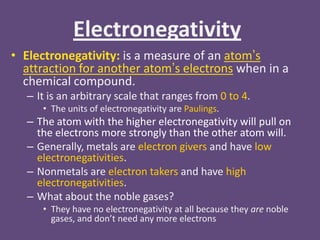
Electronegativity
• Electronegativity: is a measure of an atom’s
  attraction for another atom’s electrons when in a
  chemical compound.
  – It is an arbitrary scale that ranges from 0 to 4.
     • The units of electronegativity are Paulings.
  – The atom with the higher electronegativity will pull on
    the electrons more strongly than the other atom will.
  – Generally, metals are electron givers and have low
    electronegativities.
  – Nonmetals are electron takers and have high
    electronegativities.
  – What about the noble gases?
     • They have no electronegativity at all because they are noble
       gases, and don’t need any more electrons
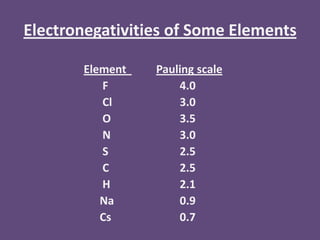
Electronegativities of Some Elements

       Element   Pauling scale
          F          4.0
          Cl         3.0
          O          3.5
          N          3.0
          S          2.5
          C          2.5
          H          2.1
          Na         0.9
          Cs         0.7
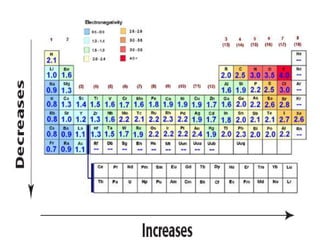
Electronegativity Decreases as You Move Down a Group

• Electronegativity values generally decrease as you
  move down a group.
    • As you move from higher to lower in a group, the
      electronegativity decreases due to the increase in
      separation and effects of electron shielding.
    • Generally, if an atom doesn’t hold the electrons it
      already has very strongly (low ionization energy), it
      won’t want to grab electrons from other atoms.
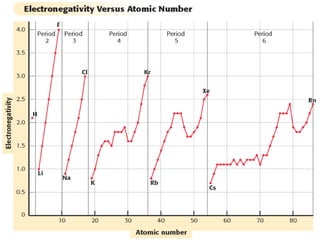
Electronegativity Increases as You Move Across a Period

• Electronegativity usually increases as you move left to
  right across a period.
• As you proceed across a period, each atom has one
  more proton and one more electron—in the same
  principal energy level—than the atom before it has.
     Therefore the effective nuclear charge increases
       across a period, resulting in an increase in
       electronegativity.
• The increase in electronegativity across a period is much
  more dramatic than the decrease in electronegativity
  down a group.
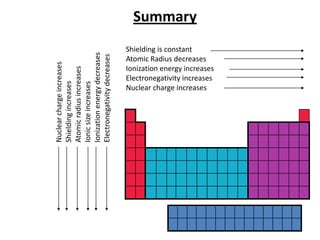
Nuclear charge increases
Shielding increases
Atomic radius increases
Ionic size increases
Ionization energy decreases
Electronegativity decreases
               Shielding is constant
                                             Summary

               Atomic Radius decreases


               Nuclear charge increases
               Electronegativity increases
               Ionization energy increases

PT IRE

  • 1.
  • 2.
    Key Concepts • EffectiveNuclear Charge: The attractive force exerted by the atoms positively charged nucleus (+) on an electron (- ). • Holds the electron in orbit. • Opposites attract. • As you add protons (+) the Effective Nuclear Charge grows larger. • Electron Shielding: The reduction in the attractive force (Effective Nuclear Charge) between a positively charged nucleus and its outermost electrons due to the cancellation of some of the positive charge by the negative charges of the inner electrons. • Each primary energy level added moves the valence electrons farther from the nucleus. • Each successive energy level also puts more inner shell electrons “in the way” between the nucleus and valence (outer) shell. • Both of which decrease the amount of attractive force the nucleus can exert.
  • 3.
  • 4.
    Atomic Radius • Theexact size of an atom is hard to determine. • The volume the electrons occupy is thought of as an electron cloud, with no clear-cut edge. • One method for calculating the size of an atom involves calculating the bond radius, which is half the distance from center to center of two like atoms that are bonded together.
  • 6.
    Atomic Radius Increasesas You Move Down a Group •As you proceed from one element down to the next in a group, a new principal energy level is added. •The addition of another level of electrons increases the size, or atomic radius, of an atom. •Effect is further magnified by electron shielding.
  • 7.
    Atomic Radius Decreasesas You Move Across a Period • As you move from left to right across a period, each atom has one more proton and one more electron than the atom before it has. • All additional electrons go into the same principal energy level—no electrons are being added to the inner levels – changes in electron shielding are minimal. • As the nuclear charge increases across a period, the effective nuclear charge acting on the outer electrons also increases.  Pulls the electrons in tighter, creating a smaller atom.
  • 9.
  • 10.
  • 11.
    Ionization • We’ve previouslylooked only at neutral atoms with equal numbers of protons and electrons. • Ionization: The creation of an atom with a net charge, by the removal or addition of electrons. – Ions have more or less electrons than neutral atoms. • Anion: An atom that has gained an electron and taken on a net negative charge. • Cation: An atom that has lost an electron and taken on a net positive charge.
  • 12.
    Ionization Energy •The ionizationenergy is the energy required to remove an electron from an atom or ion. •The Higher the Ionization Energy the harder it is to remove an electron. A + ionization energy ® A + + e - neutral atom ion electron First ionization energy: +1 Second ionization energy : +2
  • 13.
    Multiple Ionization Energies •Multiple ionization energies: If you want to pull off more than one electron from an atom, more energy is required for each additional one you want to grab. • Once you’ve reached a noble gas configuration (for example, once magnesium has lost two electrons to become like neon), any further electrons you pull off will require a huge amount of energy. First ionization energy: +1 Second ionization energy : +2
  • 14.
    Ionization Energy Decreasesas You Move Down a Group • Each element has more occupied energy levels than the one above it has. • The outermost electrons are farthest from the nucleus in elements near the bottom of a group. • As you move down a group, each successive element contains more electrons in the energy levels between the nucleus and the outermost electrons- more electron shielding. • Therefore it gets easier to remove electrons as you go down.
  • 15.
    Ionization Energy Increasesas You Move Across a Period • Ionization energy tends to increase as you move from left to right across a period. • From one element to the next in a period, the number of protons and the number of electrons increase by one each- increases the effective nuclear charge.  A higher nuclear charge more strongly attracts the outer electrons in the same energy level, but the electron-shielding effect from inner-level electrons remains the same.
  • 18.
    Electron Affinity • Basicallythe opposite of ionization energy. • The amount of energy released or absorbed when an atom accepts an electron giving it a negative charge. For most elements, energy is released when an atom adds an electron. This is also the measure of an element to attract an electron to form a negative ion. • How much it wants to gain an electron. • Electron affinity increases from left to right and decreases from top to bottom in a group or family.
  • 19.
  • 20.
    Ion Radii • NegativeIons: Always larger than the neutral atom. Gaining electrons. • Positive Ions: Always smaller that the neutral atom. Loss of outer shell electrons.
  • 23.
  • 24.
    Electronegativity • Electronegativity: isa measure of an atom’s attraction for another atom’s electrons when in a chemical compound. – It is an arbitrary scale that ranges from 0 to 4. • The units of electronegativity are Paulings. – The atom with the higher electronegativity will pull on the electrons more strongly than the other atom will. – Generally, metals are electron givers and have low electronegativities. – Nonmetals are electron takers and have high electronegativities. – What about the noble gases? • They have no electronegativity at all because they are noble gases, and don’t need any more electrons
  • 26.
    Electronegativities of SomeElements Element Pauling scale F 4.0 Cl 3.0 O 3.5 N 3.0 S 2.5 C 2.5 H 2.1 Na 0.9 Cs 0.7
  • 27.
    Electronegativity Decreases asYou Move Down a Group • Electronegativity values generally decrease as you move down a group. • As you move from higher to lower in a group, the electronegativity decreases due to the increase in separation and effects of electron shielding. • Generally, if an atom doesn’t hold the electrons it already has very strongly (low ionization energy), it won’t want to grab electrons from other atoms.
  • 28.
    Electronegativity Increases asYou Move Across a Period • Electronegativity usually increases as you move left to right across a period. • As you proceed across a period, each atom has one more proton and one more electron—in the same principal energy level—than the atom before it has.  Therefore the effective nuclear charge increases across a period, resulting in an increase in electronegativity. • The increase in electronegativity across a period is much more dramatic than the decrease in electronegativity down a group.
  • 31.
    Nuclear charge increases Shieldingincreases Atomic radius increases Ionic size increases Ionization energy decreases Electronegativity decreases Shielding is constant Summary Atomic Radius decreases Nuclear charge increases Electronegativity increases Ionization energy increases