SPECIALIZED TRANSDUCTION IN BACTERIA
DCC-BOT 8022T:-CYTOLOGY & GENETICS
SESSION:-2023-24
MSC BOTANY 2nd semester
Submitted to- Submitted by:-
Prof.H.R.Dagla. Mansi Kumari
DEPARTMENT OF BOTANY
JAI NARAIN VYAS UNIVERSITY, JODHPUR
CONTENT
•Introduction
•Transduction
•Specialized transduction
•Steps of this mechanism
•Significance
•Reference
INTRODUCTION
• Genetic recombination in Bacteria:-Genetic recombination
means that genetic material from two different places is mixed
together. Genetic recombination creates new genetic material to
give the ability to express new genes.
Types of genetic recombination in Bacteria
There are there methods of genetic recombination that are utilised
by bacteria.
1. Conjugation
2. Transformation
3. Transduction
TRANSDUCTION
• Transduction was first discovered in 1952 by Joshua Lederberg &
Norton Zinder.
• Studied in Salmonella typhimrium.
• In transduction, DNA is transferred from cell to cell through the agency
of viruses.
• Transduction occur by Bacteriophage means bacteria eater.
• A virus that infect certain types of bacteria and Replicate within them.
There are two types of transduction:-
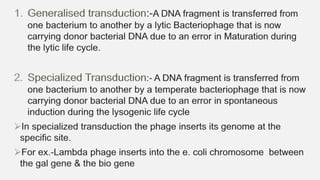
1. Generalised transduction
2. Specialised transduction
TERMS
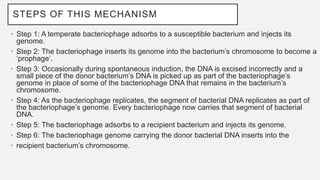
Repressor protein:- The nucleic acid of the phage
particle is coded for the synthesis of certain specific
protein in the bacterial cell these protein are known as
repressor proteins.
Prophage:- The phage DNA occurs in the bacterial cell
in the form of small fragments, Known as prophage.
STEPS OF THIS MECHANISM
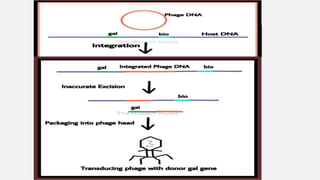
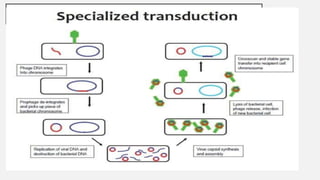
• Step 1: A temperate bacteriophage adsorbs to a susceptible bacterium and injects its
genome.
• Step 2: The bacteriophage inserts its genome into the bacterium’s chromosome to become a
‘prophage’.
• Step 3: Occasionally during spontaneous induction, the DNA is excised incorrectly and a
small piece of the donor bacterium’s DNA is picked up as part of the bacteriophage’s
genome in place of some of the bacteriophage DNA that remains in the bacterium’s
chromosome.
• Step 4: As the bacteriophage replicates, the segment of bacterial DNA replicates as part of
the bacteriophage’s genome. Every bacteriophage now carries that segment of bacterial
DNA.
• Step 5: The bacteriophage adsorbs to a recipient bacterium and injects its genome.
• Step 6: The bacteriophage genome carrying the donor bacterial DNA inserts into the
• recipient bacterium’s chromosome.
SIGNIFICANCE
• • It transfers genetic material from one bacterial cell to another
and alter the genetic characteristics.• For example: In
specialized transduction the gal gene, a cell lacking ability to
metabolize galactose could acquire the ability.
• • It shows the evolutionary relationship between the prophage
and host bacterial cell.
• • Prophage can exist in a cell for a long period suggests a
similar possible mechanism for the viral origin of cancer.
• • It provides a way to study the gene linkage.
REFERENCE
Principles of Genetics by Gardener et.al, John Willey. Eight edition
Albert’s B ,Johnson A ,Lewis j , et al ,Molecular biology of the cell 4th
edition new york Gare and science 2002
 https://www.ncbi.nlm.nih.gov/pmc/articles/PMC6687093/
https://en.m.wikipedia.org/wiki/Transduction_(genetics)
specialized_transduction_by_RK_0401.pptx

specialized_transduction_by_RK_0401.pptx

  • 1.
    SPECIALIZED TRANSDUCTION INBACTERIA DCC-BOT 8022T:-CYTOLOGY & GENETICS SESSION:-2023-24 MSC BOTANY 2nd semester Submitted to- Submitted by:- Prof.H.R.Dagla. Mansi Kumari DEPARTMENT OF BOTANY JAI NARAIN VYAS UNIVERSITY, JODHPUR
  • 2.
  • 3.
    INTRODUCTION • Genetic recombinationin Bacteria:-Genetic recombination means that genetic material from two different places is mixed together. Genetic recombination creates new genetic material to give the ability to express new genes. Types of genetic recombination in Bacteria There are there methods of genetic recombination that are utilised by bacteria. 1. Conjugation 2. Transformation 3. Transduction
  • 4.
    TRANSDUCTION • Transduction wasfirst discovered in 1952 by Joshua Lederberg & Norton Zinder. • Studied in Salmonella typhimrium. • In transduction, DNA is transferred from cell to cell through the agency of viruses. • Transduction occur by Bacteriophage means bacteria eater. • A virus that infect certain types of bacteria and Replicate within them. There are two types of transduction:- 1. Generalised transduction 2. Specialised transduction
  • 6.
    TERMS Repressor protein:- Thenucleic acid of the phage particle is coded for the synthesis of certain specific protein in the bacterial cell these protein are known as repressor proteins. Prophage:- The phage DNA occurs in the bacterial cell in the form of small fragments, Known as prophage.
  • 7.
    STEPS OF THISMECHANISM • Step 1: A temperate bacteriophage adsorbs to a susceptible bacterium and injects its genome. • Step 2: The bacteriophage inserts its genome into the bacterium’s chromosome to become a ‘prophage’. • Step 3: Occasionally during spontaneous induction, the DNA is excised incorrectly and a small piece of the donor bacterium’s DNA is picked up as part of the bacteriophage’s genome in place of some of the bacteriophage DNA that remains in the bacterium’s chromosome. • Step 4: As the bacteriophage replicates, the segment of bacterial DNA replicates as part of the bacteriophage’s genome. Every bacteriophage now carries that segment of bacterial DNA. • Step 5: The bacteriophage adsorbs to a recipient bacterium and injects its genome. • Step 6: The bacteriophage genome carrying the donor bacterial DNA inserts into the • recipient bacterium’s chromosome.
  • 10.
    SIGNIFICANCE • • Ittransfers genetic material from one bacterial cell to another and alter the genetic characteristics.• For example: In specialized transduction the gal gene, a cell lacking ability to metabolize galactose could acquire the ability. • • It shows the evolutionary relationship between the prophage and host bacterial cell. • • Prophage can exist in a cell for a long period suggests a similar possible mechanism for the viral origin of cancer. • • It provides a way to study the gene linkage.
  • 11.
    REFERENCE Principles of Geneticsby Gardener et.al, John Willey. Eight edition Albert’s B ,Johnson A ,Lewis j , et al ,Molecular biology of the cell 4th edition new york Gare and science 2002  https://www.ncbi.nlm.nih.gov/pmc/articles/PMC6687093/ https://en.m.wikipedia.org/wiki/Transduction_(genetics)