@ujjwal sirohi
PhD scholar
Transformation
 Gene transfer is the uptake of foreign DNA or
transgene by plant cells.
 It is the subsequent stable integration &
expression of a foreign DNA into the genome.
Methods of Transformation
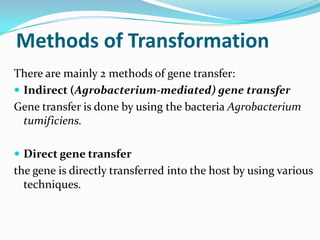
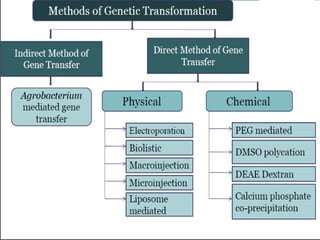
There are mainly 2 methods of gene transfer:
 Indirect (Agrobacterium-mediated) gene transfer
Gene transfer is done by using the bacteria Agrobacterium
tumificiens.
 Direct gene transfer
the gene is directly transferred into the host by using various
techniques.
Electroporation
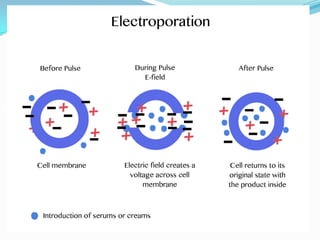
 Plant materials is incubated in a buffer solution
containing DNA and subjected to high-voltage electric
pulse.
 The DNA then migrates through high-voltage-induced
pores in the plasma membrane and integrates into the
genome.
 It can be used to transform all the major cereals
particularly rice, wheat, maize.
 It can be used to deliver DNA into plant cells and
protoplasts.
There are two systems of
electroporation
1. Low voltage – Long pulses
 300-400 V cm-1 for 10-50 ms
 Produce high rates of transient transformation
2. High voltage – Short pulses
 1000-1500 V cm-1 for 10μs
 Produce high rates of stable transformation
 Transformation frequency can be improve
 A prior heat shock treatment to protoplast
 Presence of low conc. PEG (8%)
Advantages:
 Both intact cells and tissue can be transformed.
 The efficiency of transformation depends upon the plant
materials
Disadvantages
 ~40 to 50% incubated cells receive DNA
 ~50% of the transformed cells can survive
Microinjection
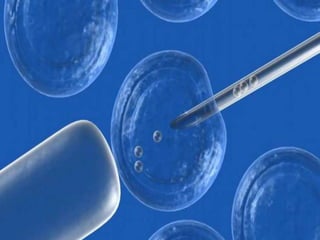
 Direct injection of DNA into plant protoplast or cell
using fine tipped (0.5-10um diameter) pipette.
 Protoplasts are immobilised on the agarose or held
with a micropipette under suction.
 DNA is injected into the cytoplasm or nucleus.
 Frequency of transformation:
Nucleus(14%)
Cytoplasm(6%)
 Successful transformation achieved in tobacco, alfalfa,
Brassica sp.
 Transformation frequency ranging from 14-60%
disadvantages
 Extreme slow process.
 Require expensive setup.
Macroinjection
 Macroinjection is the method tried for artificial DNA
transfer to cereals plants that show inability to
regenerate and develop into whole plants from
cultured cells.
 Needles used for injecting DNA are with the
diameter greater than cell diameter. (>10-100um).
 First study (1987), DNA was injected into developing
rye(cereal grain), & a low frequency of 0.07% was
recorded.
Advantages
 This technique does not require protoplast.
 Instrument is simple and cheap.
 Methods may prove useful for gene transfer into
cereals which do not regenerate from cultured cell
easily.
 Technically simple.
Limitations
1. Less specific.
2. Less efficient.
3. Frequency of transformation is very low.(0.07%)
Biolistic Method
 Firstly used by Klein et al (1987) & Sanford et al
(1987).
 Also called as, Ballistic method / Gene gun method /
Particle bombardment / Particle gun method /
Microprojectile.
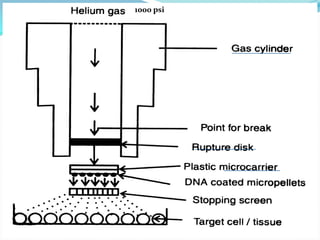
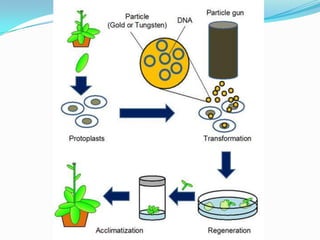
 Gene gun is developed to enable penetration of
the genetic material containing a gene of interest
in the cell.
 1-2μm tungsten or gold particles (micro-
projectiles)are used, coated with the DNA.
 Acceleration is given to enter the micro-projectiles into
the plant cells.
1000 psi
Advantages
 This method can be use to transform all plant species.
 Transformation protocol is relatively simple.
Disadvantages
 High cost of the equipment and microcarriers.
 Intracellular target is random (cytoplasm, nucleus,
vacuole, plastid, etc.).
 Transfer DNA is not protected.
Liposome mediated gene transfer
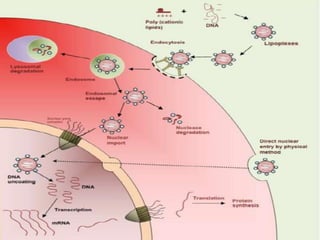
 Liposomes are spheres of lipids used to transport
molecules into the cells.
 These are artificial vesicles that can act as delivery
agents for exogenous materials including transgenes.
 They are considered as sphere of lipid bilayers
surrounding the molecule to be transported and
promote transport after fusing with the cell
membrane.
 Cationic lipids are those having a positive charge are
used for the transfer of nucleic acid.
 Liposomes are able to interact with the negatively
charged cell membrane more readily than uncharged
liposomes
 Due to fusion between cationic liposome and cell
surface results in the delivery of DNA directly
across the plasma membrane.
Advantages
 High degree of reproducibility.
 Long term stability.
 Protection of nucleic acid from degradation.
PEG mediated gene transfer
 Polyethylene glycol (PEG), in the presence of divalent
cations (using Ca2+), destabilizes the plasma
membrane of protoplasts and renders it permeable to
naked DNA.
 In this way, the DNA enters nucleus of the protoplasts
and gets integrated with the genome.
 Culture of protoplasts is taken into a tube and to this
tube 40% PEG 4000 (w/v) dissolved in mannitol and
calcium nitrate is added slowly.
 Then incubated for few min.
Process
 Protoplast suspended in medium (Mg and Ca ions)
 Heat shock treatment (5min, 45 ˚C)
 PEG added (20-28% conc.)
 Incubation (calcium conc. enhenced)
 cultured
Advantages
 A large number of protoplasts can be simultaneously
transformed.
 Can successfully use for a wide range of plant species.
Limitations
 The DNA is susceptible for degradation.
 Random integration of foreign DNA into genome may
result in undesirable traits.
 Regeneration of plants from transformed protoplasts is
a difficult task.
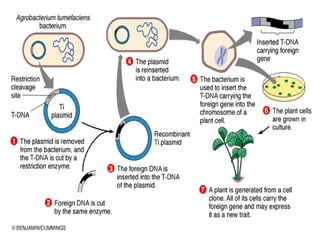
Agrobacterium mediated gene
transfer
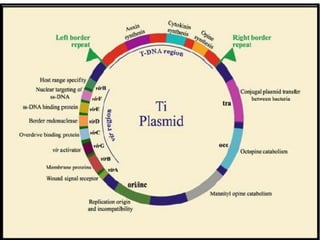
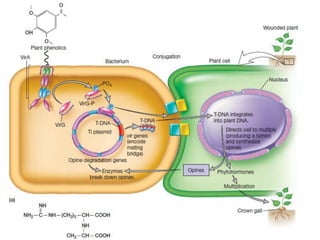
 Agrobacterium is soil borne, gram negative, rod shaped,
motile found in rhizosphere.
 Causative agents of “Crown gall” .
 Size od plasmid is about 200 kb.
 Contain a vir region ~ 35-40 kb at least 8-11 vir genes.
T-DNA
 Size 12 – 24 kb
 Left and right border sequence (24-bp) which will be
transferred into genome of host plant
 The T-DNA contains eight potential genes.
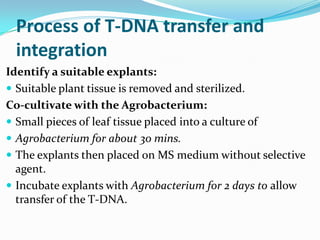
Process of T-DNA transfer and
integration
Identify a suitable explants:
 Suitable plant tissue is removed and sterilized.
Co-cultivate with the Agrobacterium:
 Small pieces of leaf tissue placed into a culture of
 Agrobacterium for about 30 mins.
 The explants then placed on MS medium without selective
agent.
 Incubate explants with Agrobacterium for 2 days to allow
transfer of the T-DNA.
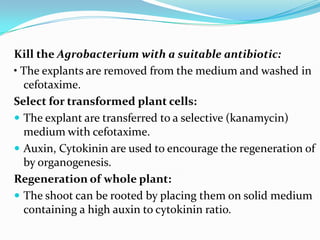
Kill the Agrobacterium with a suitable antibiotic:
• The explants are removed from the medium and washed in
cefotaxime.
Select for transformed plant cells:
 The explant are transferred to a selective (kanamycin)
medium with cefotaxime.
 Auxin, Cytokinin are used to encourage the regeneration of
by organogenesis.
Regeneration of whole plant:
 The shoot can be rooted by placing them on solid medium
containing a high auxin to cytokinin ratio.
Thank you

Gene transfer methods @ujjwasirohi

  • 1.
  • 2.
    Transformation  Gene transferis the uptake of foreign DNA or transgene by plant cells.  It is the subsequent stable integration & expression of a foreign DNA into the genome.
  • 3.
    Methods of Transformation Thereare mainly 2 methods of gene transfer:  Indirect (Agrobacterium-mediated) gene transfer Gene transfer is done by using the bacteria Agrobacterium tumificiens.  Direct gene transfer the gene is directly transferred into the host by using various techniques.
  • 5.
    Electroporation  Plant materialsis incubated in a buffer solution containing DNA and subjected to high-voltage electric pulse.  The DNA then migrates through high-voltage-induced pores in the plasma membrane and integrates into the genome.  It can be used to transform all the major cereals particularly rice, wheat, maize.  It can be used to deliver DNA into plant cells and protoplasts.
  • 7.
    There are twosystems of electroporation 1. Low voltage – Long pulses  300-400 V cm-1 for 10-50 ms  Produce high rates of transient transformation 2. High voltage – Short pulses  1000-1500 V cm-1 for 10μs  Produce high rates of stable transformation  Transformation frequency can be improve  A prior heat shock treatment to protoplast  Presence of low conc. PEG (8%)
  • 8.
    Advantages:  Both intactcells and tissue can be transformed.  The efficiency of transformation depends upon the plant materials Disadvantages  ~40 to 50% incubated cells receive DNA  ~50% of the transformed cells can survive
  • 9.
    Microinjection  Direct injectionof DNA into plant protoplast or cell using fine tipped (0.5-10um diameter) pipette.  Protoplasts are immobilised on the agarose or held with a micropipette under suction.  DNA is injected into the cytoplasm or nucleus.  Frequency of transformation: Nucleus(14%) Cytoplasm(6%)  Successful transformation achieved in tobacco, alfalfa, Brassica sp.  Transformation frequency ranging from 14-60%
  • 10.
    disadvantages  Extreme slowprocess.  Require expensive setup.
  • 12.
    Macroinjection  Macroinjection isthe method tried for artificial DNA transfer to cereals plants that show inability to regenerate and develop into whole plants from cultured cells.  Needles used for injecting DNA are with the diameter greater than cell diameter. (>10-100um).  First study (1987), DNA was injected into developing rye(cereal grain), & a low frequency of 0.07% was recorded.
  • 13.
    Advantages  This techniquedoes not require protoplast.  Instrument is simple and cheap.  Methods may prove useful for gene transfer into cereals which do not regenerate from cultured cell easily.  Technically simple. Limitations 1. Less specific. 2. Less efficient. 3. Frequency of transformation is very low.(0.07%)
  • 14.
    Biolistic Method  Firstlyused by Klein et al (1987) & Sanford et al (1987).  Also called as, Ballistic method / Gene gun method / Particle bombardment / Particle gun method / Microprojectile.  Gene gun is developed to enable penetration of the genetic material containing a gene of interest in the cell.  1-2μm tungsten or gold particles (micro- projectiles)are used, coated with the DNA.  Acceleration is given to enter the micro-projectiles into the plant cells.
  • 15.
  • 17.
    Advantages  This methodcan be use to transform all plant species.  Transformation protocol is relatively simple. Disadvantages  High cost of the equipment and microcarriers.  Intracellular target is random (cytoplasm, nucleus, vacuole, plastid, etc.).  Transfer DNA is not protected.
  • 18.
    Liposome mediated genetransfer  Liposomes are spheres of lipids used to transport molecules into the cells.  These are artificial vesicles that can act as delivery agents for exogenous materials including transgenes.  They are considered as sphere of lipid bilayers surrounding the molecule to be transported and promote transport after fusing with the cell membrane.
  • 20.
     Cationic lipidsare those having a positive charge are used for the transfer of nucleic acid.  Liposomes are able to interact with the negatively charged cell membrane more readily than uncharged liposomes  Due to fusion between cationic liposome and cell surface results in the delivery of DNA directly across the plasma membrane.
  • 21.
    Advantages  High degreeof reproducibility.  Long term stability.  Protection of nucleic acid from degradation.
  • 23.
    PEG mediated genetransfer  Polyethylene glycol (PEG), in the presence of divalent cations (using Ca2+), destabilizes the plasma membrane of protoplasts and renders it permeable to naked DNA.  In this way, the DNA enters nucleus of the protoplasts and gets integrated with the genome.  Culture of protoplasts is taken into a tube and to this tube 40% PEG 4000 (w/v) dissolved in mannitol and calcium nitrate is added slowly.  Then incubated for few min.
  • 24.
    Process  Protoplast suspendedin medium (Mg and Ca ions)  Heat shock treatment (5min, 45 ˚C)  PEG added (20-28% conc.)  Incubation (calcium conc. enhenced)  cultured
  • 25.
    Advantages  A largenumber of protoplasts can be simultaneously transformed.  Can successfully use for a wide range of plant species. Limitations  The DNA is susceptible for degradation.  Random integration of foreign DNA into genome may result in undesirable traits.  Regeneration of plants from transformed protoplasts is a difficult task.
  • 26.
    Agrobacterium mediated gene transfer Agrobacterium is soil borne, gram negative, rod shaped, motile found in rhizosphere.  Causative agents of “Crown gall” .  Size od plasmid is about 200 kb.  Contain a vir region ~ 35-40 kb at least 8-11 vir genes.
  • 28.
    T-DNA  Size 12– 24 kb  Left and right border sequence (24-bp) which will be transferred into genome of host plant  The T-DNA contains eight potential genes.
  • 31.
    Process of T-DNAtransfer and integration Identify a suitable explants:  Suitable plant tissue is removed and sterilized. Co-cultivate with the Agrobacterium:  Small pieces of leaf tissue placed into a culture of  Agrobacterium for about 30 mins.  The explants then placed on MS medium without selective agent.  Incubate explants with Agrobacterium for 2 days to allow transfer of the T-DNA.
  • 32.
    Kill the Agrobacteriumwith a suitable antibiotic: • The explants are removed from the medium and washed in cefotaxime. Select for transformed plant cells:  The explant are transferred to a selective (kanamycin) medium with cefotaxime.  Auxin, Cytokinin are used to encourage the regeneration of by organogenesis. Regeneration of whole plant:  The shoot can be rooted by placing them on solid medium containing a high auxin to cytokinin ratio.
  • 33.