HEENA KAUSAR
GOVT. E. RAGHVENDRA RAO PG SCIENCE
COLLEGE
⚫The transfer of genetic material from one cell to
another cell by a bacteriophage is called
Transduction.
⚫Transduction has been found to occur in variety of
prokaryotes , including certain species of Bacteria
e.g: Escherichia , Pseudomonas, Salmonella ,
Staphylococcus , etc.
⚫The bacteriophage containing the bacterial DNA is
called transduced DNA .
• Transduction was first discovered by Norton Zinder and
Joshua Lederberg in 1952.
Joshua Lederberg
Norton Zinder
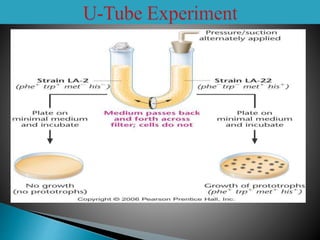
• Studied in Salmonella typhimurium
• Plated two auxotrophic strains (LA-2 and LA-22)
individually on minimal medium, no cells grew.
• Plated a mixture of the two auxotrophic strains on
minimal medium, cells grew into colonies.
• Thus, genetic exchange was taking place
between two cell types.
• VIRULENT: Capable of causing infection
eventually destruction and death of the bacterial cell.
These follow LYTIC CYCLE .
 Example : T4 host E.coli .
• TEMPERATE: Does not cause destruptic infection
instead phage DNA incorporated into bacterial DNA
and replicate (LYSOGENIC) and after some cycle
become virulent cause lysis.
 Example : lamda phage.
• There are TWO types of transduction
1. Generalized transduction: A DNA fragment is
transferred from one bacterium to another by a
lytic bacteriophage(virulent) which carrying
donor bacterial DNA due to an error .
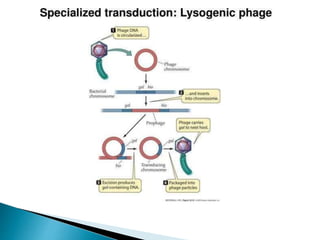
2. Specialized transduction: A DNA fragment is
transferred from one bacterium to another by a
temperate bacteriophage which carrying donor
DNA along with phage genome due to an error.
In this a phage insert a genome at specific site.
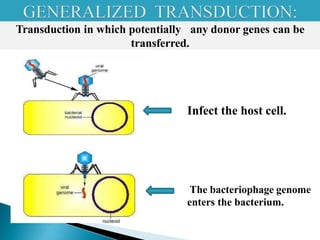
Infect the host cell.
The bacteriophage genome
enters the bacterium.
Transduction in which potentially any donor genes can be
transferred.
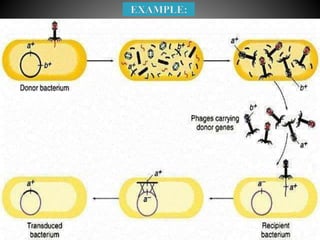
Bacteriophage (carries a host
DNA) attach to the recipient
cell.
The donor bacterium”s DNA
exchange the some of the
recipient bacterium”s DNA
The bacteriophage inserts the
donor bacterium's DNA it is
carrying into the recipient
bacterium .
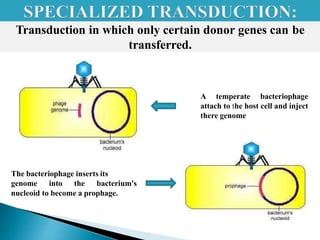
A temperate bacteriophage
attach to the host cell and inject
there genome
The bacteriophage inserts its
genome into the bacterium's
nucleoid to become a prophage.
Transduction in which only certain donor genes can be
transferred.
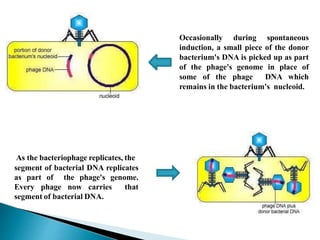
Occasionally during spontaneous
induction, a small piece of the donor
bacterium's DNA is picked up as part
of the phage's genome in place of
some of the phage DNA which
remains in the bacterium's nucleoid.
As the bacteriophage replicates, the
segment of bacterial DNA replicates
as part of the phage's genome.
Every phage now carries that
segment of bacterial DNA.
The bacteriophage genome
carrying the donor bacterial DNA
inserts into the recipient
bacterium's nucleoid.
The bacteriophage adsorbs to
a recipient bacterium and
injects its genome.
• It transfers genetic material from one bacterial cell
to another and alter the genetic characteristics.
• For example: In specialized transduction the
gal gene, a cell lacking ability to metabolize
galactose could aquire the ability .
• It shows the evolutionary relationship between the
prophage and host bacterial cell.
• Prophage can exist in a cell for a long period
suggests a similar possible mechanism for the
viral origin of cancer.
• It provides a way to study the gene linkage.
Transduction

Transduction

  • 1.
    HEENA KAUSAR GOVT. E.RAGHVENDRA RAO PG SCIENCE COLLEGE
  • 2.
    ⚫The transfer ofgenetic material from one cell to another cell by a bacteriophage is called Transduction. ⚫Transduction has been found to occur in variety of prokaryotes , including certain species of Bacteria e.g: Escherichia , Pseudomonas, Salmonella , Staphylococcus , etc. ⚫The bacteriophage containing the bacterial DNA is called transduced DNA .
  • 3.
    • Transduction wasfirst discovered by Norton Zinder and Joshua Lederberg in 1952. Joshua Lederberg Norton Zinder
  • 4.
    • Studied inSalmonella typhimurium • Plated two auxotrophic strains (LA-2 and LA-22) individually on minimal medium, no cells grew. • Plated a mixture of the two auxotrophic strains on minimal medium, cells grew into colonies. • Thus, genetic exchange was taking place between two cell types.
  • 6.
    • VIRULENT: Capableof causing infection eventually destruction and death of the bacterial cell. These follow LYTIC CYCLE .  Example : T4 host E.coli . • TEMPERATE: Does not cause destruptic infection instead phage DNA incorporated into bacterial DNA and replicate (LYSOGENIC) and after some cycle become virulent cause lysis.  Example : lamda phage.
  • 7.
    • There areTWO types of transduction 1. Generalized transduction: A DNA fragment is transferred from one bacterium to another by a lytic bacteriophage(virulent) which carrying donor bacterial DNA due to an error . 2. Specialized transduction: A DNA fragment is transferred from one bacterium to another by a temperate bacteriophage which carrying donor DNA along with phage genome due to an error. In this a phage insert a genome at specific site.
  • 8.
    Infect the hostcell. The bacteriophage genome enters the bacterium. Transduction in which potentially any donor genes can be transferred.
  • 9.
    Bacteriophage (carries ahost DNA) attach to the recipient cell.
  • 10.
    The donor bacterium”sDNA exchange the some of the recipient bacterium”s DNA The bacteriophage inserts the donor bacterium's DNA it is carrying into the recipient bacterium .
  • 12.
    A temperate bacteriophage attachto the host cell and inject there genome The bacteriophage inserts its genome into the bacterium's nucleoid to become a prophage. Transduction in which only certain donor genes can be transferred.
  • 13.
    Occasionally during spontaneous induction,a small piece of the donor bacterium's DNA is picked up as part of the phage's genome in place of some of the phage DNA which remains in the bacterium's nucleoid. As the bacteriophage replicates, the segment of bacterial DNA replicates as part of the phage's genome. Every phage now carries that segment of bacterial DNA.
  • 14.
    The bacteriophage genome carryingthe donor bacterial DNA inserts into the recipient bacterium's nucleoid. The bacteriophage adsorbs to a recipient bacterium and injects its genome.
  • 16.
    • It transfersgenetic material from one bacterial cell to another and alter the genetic characteristics. • For example: In specialized transduction the gal gene, a cell lacking ability to metabolize galactose could aquire the ability . • It shows the evolutionary relationship between the prophage and host bacterial cell. • Prophage can exist in a cell for a long period suggests a similar possible mechanism for the viral origin of cancer. • It provides a way to study the gene linkage.