By,
Padmaratinam.C.U
3rd year B.Tech Biotech
Cauliflower Mosaic Virus
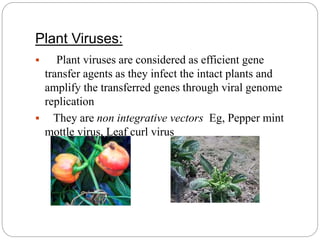
Plant Viruses:
 Plant viruses are considered as efficient gene
transfer agents as they infect the intact plants and
amplify the transferred genes through viral genome
replication
 They are non integrative vectors Eg, Pepper mint
mottle virus, Leaf curl virus
Criteria needed:
 The virus must be capable of spreading from cell to
cell through plasmodesmata
 The viral genome should be able to replicate in the
absence of viral coat protein and spreads from cell to
cell
 Elicit little or no disease symptoms
 Should have broad range of host
CaulimoViruses
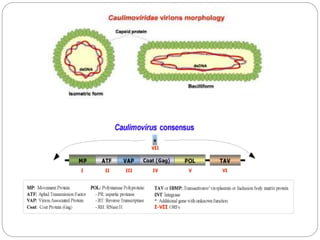
 Caulimoviruses contain circular ds DNA and are
spherical in shape
 This group includes 15 viruses of which CaMV is the
most important for gene transfer
 The other caulimoviruses includes carnation etched
virus, dahlia mosaic virus mirabilis mosaic virus
and strawberry vein banding virus
Cauliflower Mosaic Virus
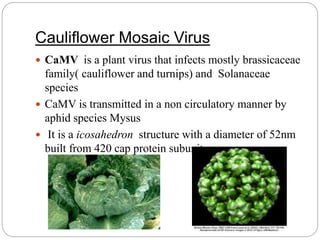
 CaMV is a plant virus that infects mostly brassicaceae
family( cauliflower and turnips) and Solanaceae
species
 CaMV is transmitted in a non circulatory manner by
aphid species Mysus
 It is a icosahedron structure with a diameter of 52nm
built from 420 cap protein subunits
Genome of CaMV
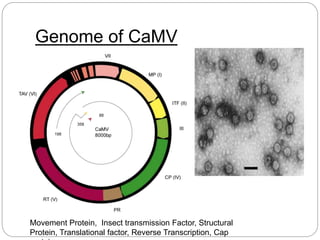
Movement Protein, Insect transmission Factor, Structural
Protein, Translational factor, Reverse Transcription, Cap
 Thepromoter of the 35S RNA is a very strong constitutive
promoter responsible for the transcription of the whole
CaMV genome.
 It is well known for its use in plant transformation.
 It causes high levels of gene expression in dicot plants
 The 35S RNA is particularly complex, containing a highly
structured 600 nucleotide long leader sequence with six to
eight short open reading frames
 This leader is followed by seven tightly arranged, longer
ORFs that encode all the viral proteins. The mechanism of
expression of these proteins is unique, in that the ORF VI
protein (encoded by the 19S RNA) controls translation
reinitiation of major open reading frames on the
polycistronic 35S RNA, a process that normally only
happens on bacterial mRNAs
Use of CaMV in gene transfer
 For effective transmission of CaMV the foreign DNA must
be encapsulated in viral protein and the inserted gene
should not interfere with native assembly of virus
 CaMV does not contain any non coding region wherein
foreign DNA can be inserted
 But there a are two genes namely gene II and gene VII have
no essential functions for the virus
 So the gene of interest can be replaced in the place of these
two genes
 Attractive feature is infection is systemic and the genome
has 3 discontinuities
 Use of CaMV as a vector pertains to the bacterial dhfr
(dihydroxy folatereductase) gene inserted in the place
of gene II and successfully expressed in plants
 This dhfr gene is needed for providing resistance to
methotrexate( inhibitor of dhfr and extremely toxic to
plants)
Limitation of CaMV:
 Limited capacity for insertion
 Infective capacity is lost if few hundreds of nucleotides
are introduced
 Because of its exceeding natural genome size they are
not effectively suitable for gene transfer
Cauliflower mosaic virus

Cauliflower mosaic virus

  • 1.
    By, Padmaratinam.C.U 3rd year B.TechBiotech Cauliflower Mosaic Virus
  • 2.
    Plant Viruses:  Plantviruses are considered as efficient gene transfer agents as they infect the intact plants and amplify the transferred genes through viral genome replication  They are non integrative vectors Eg, Pepper mint mottle virus, Leaf curl virus
  • 3.
    Criteria needed:  Thevirus must be capable of spreading from cell to cell through plasmodesmata  The viral genome should be able to replicate in the absence of viral coat protein and spreads from cell to cell  Elicit little or no disease symptoms  Should have broad range of host
  • 4.
    CaulimoViruses  Caulimoviruses containcircular ds DNA and are spherical in shape  This group includes 15 viruses of which CaMV is the most important for gene transfer  The other caulimoviruses includes carnation etched virus, dahlia mosaic virus mirabilis mosaic virus and strawberry vein banding virus
  • 6.
    Cauliflower Mosaic Virus CaMV is a plant virus that infects mostly brassicaceae family( cauliflower and turnips) and Solanaceae species  CaMV is transmitted in a non circulatory manner by aphid species Mysus  It is a icosahedron structure with a diameter of 52nm built from 420 cap protein subunits
  • 7.
    Genome of CaMV MovementProtein, Insect transmission Factor, Structural Protein, Translational factor, Reverse Transcription, Cap
  • 8.
     Thepromoter ofthe 35S RNA is a very strong constitutive promoter responsible for the transcription of the whole CaMV genome.  It is well known for its use in plant transformation.  It causes high levels of gene expression in dicot plants  The 35S RNA is particularly complex, containing a highly structured 600 nucleotide long leader sequence with six to eight short open reading frames  This leader is followed by seven tightly arranged, longer ORFs that encode all the viral proteins. The mechanism of expression of these proteins is unique, in that the ORF VI protein (encoded by the 19S RNA) controls translation reinitiation of major open reading frames on the polycistronic 35S RNA, a process that normally only happens on bacterial mRNAs
  • 9.
    Use of CaMVin gene transfer  For effective transmission of CaMV the foreign DNA must be encapsulated in viral protein and the inserted gene should not interfere with native assembly of virus  CaMV does not contain any non coding region wherein foreign DNA can be inserted  But there a are two genes namely gene II and gene VII have no essential functions for the virus  So the gene of interest can be replaced in the place of these two genes  Attractive feature is infection is systemic and the genome has 3 discontinuities
  • 10.
     Use ofCaMV as a vector pertains to the bacterial dhfr (dihydroxy folatereductase) gene inserted in the place of gene II and successfully expressed in plants  This dhfr gene is needed for providing resistance to methotrexate( inhibitor of dhfr and extremely toxic to plants) Limitation of CaMV:  Limited capacity for insertion  Infective capacity is lost if few hundreds of nucleotides are introduced  Because of its exceeding natural genome size they are not effectively suitable for gene transfer