BACTERIAL
TRANSDUCTIO
N
R.S.SUKANYA M.Sc.,
ASSISTANT PROFESSOR,
DEPARTMENT OF MICROBOLOGY
INTRODUCTION:
 Transduction is the process by which DNA is
transferred from one bacterium to another by a virus. It
also refers to the process whereby foreign DNA is
introduced into another cell via a viral vector.
 Transduction is especially important because it explains
one mechanism by which antibiotic drugs become
ineffective due to the transfer of antibiotic-resistance
genes between bacteria.
CONT…
 When bacteriophages (viruses that infect bacteria)
infect a bacterial cell, their normal mode of
reproduction is to harness the replicational,
transcriptional, and translation machinery of the host
bacterial cell to make numerous virions, or complete
viral particles, including the viral DNA or RNA and the
protein coat.
BACTERIAL TRANSDUCTION PRINCIPLE
 The principle of transduction is based on the mechanism of infection
of the bacteriophage.
 In transduction, the bacterial donor DNA is incorporated into the
bacteriophage either through the lytic or lysogenic cycle.
 After the bacterial DNA is incorporated into the phage, new phages
are released from the bacterial cell.
 These phages then infect the host bacterial cell. Phages attach to a
specific bacterial cell surface receptor and inject their DNA
containing the donor DNA into the cytoplasm of the host bacterial
cell.
 Depending on the phage, the DNA integrates into the bacterial
genome, replicates in the cytoplasm as a plasmid, or replicates
immediately producing phage progeny.
TYPES OF TRANSDUCTION
 There are commonly known two types of transduction
that involve the transfer of a foreign genome into
another bacterial cell. They are listed below.
(I) Generalised Transduction - The phage carries any
random part of bacterial DNA.
(II) Specialised Transduction - The phage carries a specific
part of the bacterial DNA.These two kinds of
transduction are explained as follows.
GENERALIZED TRANSDUCTION
 In generalized transduction, phage mistakenly
packages bacterial DNA instead of their own phage
DNA during phage assembly.
 This results in an infectious virus particle containing
bacterial DNA, but one that can no longer replicate in
the bacterium due to the loss of all of the phage DNA
CONT….
STEPS:
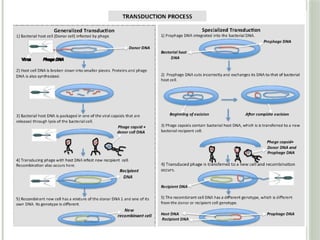
 The phage host cell (donor cell) is first infected with the phage,
during which, the phage DNA enters the cytoplasm of the
bacteria.
 During the lytic cycle of the viral replication, the phage DNA,
along with the bacterial chromosome is broken down into smaller
pieces.
 Some part of the bacterial chromosome is then packaged into one
of the viral capsids when that is released by lysis of the
bacterium.
CONT…
 The transducing phase with the bacterial chromosome
now infects a second bacterium (recipient bacterium),
and the donor DNA enters the cytoplasm of the second
bacterium.
 In the presence of a host recombinase recA, the donor
DNA recombines with the homologous DNA of the
bacterial recipient to generate stable transductants.
STEPS OF SPECIALIZED TRANSDUCTION
 In specialized transduction, the phage undergoes lysogeny usually at
specific locations in the bacterial genome called attachment sites.
 During this process, the phage genome usually integrates into the
bacterial chromosome as virus replication is repressed during
lysogeny.
STEPS:
 After the infection of the donor bacterium with the bacteriophage,
the phage DNA is integrated into the bacterial chromosome during
the lysogenic cycle.
 Due to the imprecise cutting of the phage DNA, some part of the
bacterial chromosome is also excised.
CONT….
 The phage containing some part of the bacterial
chromosome then infects a new host, and the donor
DNA is incorporated into the recipient bacterium
during the lysogenic cycle of the replication.
 The recipient then expresses the newly acquired
genetic trait.
THANK
YOU

Bacterial Transduction and its types.pptx

  • 1.
  • 2.
    INTRODUCTION:  Transduction isthe process by which DNA is transferred from one bacterium to another by a virus. It also refers to the process whereby foreign DNA is introduced into another cell via a viral vector.  Transduction is especially important because it explains one mechanism by which antibiotic drugs become ineffective due to the transfer of antibiotic-resistance genes between bacteria.
  • 3.
    CONT…  When bacteriophages(viruses that infect bacteria) infect a bacterial cell, their normal mode of reproduction is to harness the replicational, transcriptional, and translation machinery of the host bacterial cell to make numerous virions, or complete viral particles, including the viral DNA or RNA and the protein coat.
  • 4.
    BACTERIAL TRANSDUCTION PRINCIPLE The principle of transduction is based on the mechanism of infection of the bacteriophage.  In transduction, the bacterial donor DNA is incorporated into the bacteriophage either through the lytic or lysogenic cycle.  After the bacterial DNA is incorporated into the phage, new phages are released from the bacterial cell.  These phages then infect the host bacterial cell. Phages attach to a specific bacterial cell surface receptor and inject their DNA containing the donor DNA into the cytoplasm of the host bacterial cell.  Depending on the phage, the DNA integrates into the bacterial genome, replicates in the cytoplasm as a plasmid, or replicates immediately producing phage progeny.
  • 5.
    TYPES OF TRANSDUCTION There are commonly known two types of transduction that involve the transfer of a foreign genome into another bacterial cell. They are listed below. (I) Generalised Transduction - The phage carries any random part of bacterial DNA. (II) Specialised Transduction - The phage carries a specific part of the bacterial DNA.These two kinds of transduction are explained as follows.
  • 7.
    GENERALIZED TRANSDUCTION  Ingeneralized transduction, phage mistakenly packages bacterial DNA instead of their own phage DNA during phage assembly.  This results in an infectious virus particle containing bacterial DNA, but one that can no longer replicate in the bacterium due to the loss of all of the phage DNA
  • 8.
    CONT…. STEPS:  The phagehost cell (donor cell) is first infected with the phage, during which, the phage DNA enters the cytoplasm of the bacteria.  During the lytic cycle of the viral replication, the phage DNA, along with the bacterial chromosome is broken down into smaller pieces.  Some part of the bacterial chromosome is then packaged into one of the viral capsids when that is released by lysis of the bacterium.
  • 9.
    CONT…  The transducingphase with the bacterial chromosome now infects a second bacterium (recipient bacterium), and the donor DNA enters the cytoplasm of the second bacterium.  In the presence of a host recombinase recA, the donor DNA recombines with the homologous DNA of the bacterial recipient to generate stable transductants.
  • 10.
    STEPS OF SPECIALIZEDTRANSDUCTION  In specialized transduction, the phage undergoes lysogeny usually at specific locations in the bacterial genome called attachment sites.  During this process, the phage genome usually integrates into the bacterial chromosome as virus replication is repressed during lysogeny. STEPS:  After the infection of the donor bacterium with the bacteriophage, the phage DNA is integrated into the bacterial chromosome during the lysogenic cycle.  Due to the imprecise cutting of the phage DNA, some part of the bacterial chromosome is also excised.
  • 11.
    CONT….  The phagecontaining some part of the bacterial chromosome then infects a new host, and the donor DNA is incorporated into the recipient bacterium during the lysogenic cycle of the replication.  The recipient then expresses the newly acquired genetic trait.
  • 12.