Thurston’s
Group Factor
Theory
Jammu University
2 Year B.Ed.
Paper 202
Sem: II
Dr. Atul Thakur
This work is licensed under a Creative Commons Attribution-ShareAlike 4.0 International
License.
Thurston’s Group Factor Theory
Louis Thurston came out with the group factor
theory (1937) saying that Intelligence is a cluster
of abilities
These mental operations then constitute a group
 A second group of mental operations has its own
unifying Primary factor; a third group has a third
Primary factor and so on.
Each of them has its own primary factor
Each of these primary factors is said to be
relatively independent of others
He pointed out that there were Seven Primary
Mental Abilities and later on added two more.
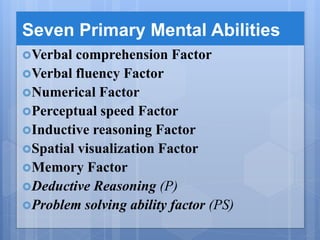
Seven Primary Mental Abilities
Verbal comprehension Factor
Verbal fluency Factor
Numerical Factor
Perceptual speed Factor
Inductive reasoning Factor
Spatial visualization Factor
Memory Factor
Deductive Reasoning (P)
Problem solving ability factor (PS)
Seven Primary Mental Abilities
Verbal comprehension Factor
This factor involves a person’s ability to
understand verbal material
It is measured by tests such as vocabulary and
reading comprehension.
Verbal fluency Factor
This ability is involved in rapidly producing
words, sentences, and other verbal material
It is measured by tests such as one that requires
the examinee to produce as many words as
possible beginning with a particular letter in a
short amount of time.
Numerical Factor
This ability is involved in rapid arithmetic
computation and in solving simple arithmetic
word problems.
Perceptual speed Factor
This ability is involved in proofreading and in
rapid recognition of letters and numbers
It is measured by tests such as those requiring the
crossing out of As in a long string of letters or in
tests requiring recognition of which of several
pictures at the right is identical to the picture at the
left.
Inductive reasoning Factor
This ability requires generalization—reasoning
from the specific to the general
It is measured by tests, such as letter series,
number series, and word classifications, in
which the examinee must indicate which of
several words does not belong with the others.
Spatial visualization Factor
This ability is involved in visualizing shapes,
rotations of objects, and how pieces of a puzzle fit
together
An example of a test would be the presentation of
a geometric form followed by several other
geometric forms
Each of the forms that follows the first is either
the same rotated by some rigid transformation or
the mirror image of the first form in rotation
The examinee has to indicate which of the forms
at the right is a rotated version of the form at the
left, rather than a mirror image.
Memory Factor
It means the ability to recall and associate
previously learned items effectively or
memorize quickly.
Deductive Reasoning (P) – Ability to use the
generalized results correctly
Problem solving ability factor (PS) -Ability
to solve problem independently.
Educational Significance and
Implications
contributed greatly to the measurement of
attitudes. ‘Thurston scale’ developed in 1928
was the first formal techniques for measuring
of attitudes
Thurston’s theory of intelligence was a major
influence on later theories of multiple
intelligences, such as those of Guilford,
Gardner, and Sternberg.
developed a comparative judgment scaling
technique-rank scale, can be used to rank all
possible feelings related to an issue and to
categorize people expressing an opinion
based on the rank of that opinion
if the individual wants to perform any
particular activity, one or more of these
factors or abilities are involved. Some of
them are more important than others.

Thurston's Group Factor Theory

  • 1.
    Thurston’s Group Factor Theory Jammu University 2Year B.Ed. Paper 202 Sem: II Dr. Atul Thakur This work is licensed under a Creative Commons Attribution-ShareAlike 4.0 International License.
  • 2.
    Thurston’s Group FactorTheory Louis Thurston came out with the group factor theory (1937) saying that Intelligence is a cluster of abilities These mental operations then constitute a group  A second group of mental operations has its own unifying Primary factor; a third group has a third Primary factor and so on. Each of them has its own primary factor Each of these primary factors is said to be relatively independent of others He pointed out that there were Seven Primary Mental Abilities and later on added two more.
  • 3.
    Seven Primary MentalAbilities Verbal comprehension Factor Verbal fluency Factor Numerical Factor Perceptual speed Factor Inductive reasoning Factor Spatial visualization Factor Memory Factor Deductive Reasoning (P) Problem solving ability factor (PS)
  • 4.
    Seven Primary MentalAbilities Verbal comprehension Factor This factor involves a person’s ability to understand verbal material It is measured by tests such as vocabulary and reading comprehension. Verbal fluency Factor This ability is involved in rapidly producing words, sentences, and other verbal material It is measured by tests such as one that requires the examinee to produce as many words as possible beginning with a particular letter in a short amount of time.
  • 5.
    Numerical Factor This abilityis involved in rapid arithmetic computation and in solving simple arithmetic word problems. Perceptual speed Factor This ability is involved in proofreading and in rapid recognition of letters and numbers It is measured by tests such as those requiring the crossing out of As in a long string of letters or in tests requiring recognition of which of several pictures at the right is identical to the picture at the left.
  • 6.
    Inductive reasoning Factor Thisability requires generalization—reasoning from the specific to the general It is measured by tests, such as letter series, number series, and word classifications, in which the examinee must indicate which of several words does not belong with the others.
  • 7.
    Spatial visualization Factor Thisability is involved in visualizing shapes, rotations of objects, and how pieces of a puzzle fit together An example of a test would be the presentation of a geometric form followed by several other geometric forms Each of the forms that follows the first is either the same rotated by some rigid transformation or the mirror image of the first form in rotation The examinee has to indicate which of the forms at the right is a rotated version of the form at the left, rather than a mirror image.
  • 8.
    Memory Factor It meansthe ability to recall and associate previously learned items effectively or memorize quickly. Deductive Reasoning (P) – Ability to use the generalized results correctly Problem solving ability factor (PS) -Ability to solve problem independently.
  • 9.
    Educational Significance and Implications contributedgreatly to the measurement of attitudes. ‘Thurston scale’ developed in 1928 was the first formal techniques for measuring of attitudes Thurston’s theory of intelligence was a major influence on later theories of multiple intelligences, such as those of Guilford, Gardner, and Sternberg.
  • 10.
    developed a comparativejudgment scaling technique-rank scale, can be used to rank all possible feelings related to an issue and to categorize people expressing an opinion based on the rank of that opinion if the individual wants to perform any particular activity, one or more of these factors or abilities are involved. Some of them are more important than others.